Home Blog Page 672

64% of Filipinos can’t afford P10,000 medical bill without borrowing, says global consulting firm

The average annual income of Filipino families rose by 15% to P353,230 in 2023 from P307,190 in 2021, data from the statistics agency showed. — PHILIPPINE STAR /WALTER BOLLOZOS

A majority of Filipinos, or 64%, cannot shoulder a P10,000 medical bill out-of-pocket without borrowing money or relying on a health maintenance organization (HMO), according to a new study by global management consulting firm Boston Consulting Group (BCG).

BCG’s Filipino Family Study, released Tuesday, surveyed 1,515 families nationwide.

The report found that financial strain emerges even at lower thresholds: 20% of respondents said they would likely borrow for a bill under P1,000, 28 percent for P5,000, and 16 percent for P10,000.

Grounded in this reality, BCG said seven out of ten families identified health security as their top concern, surpassing savings, education, and home ownership.

“We at BCG think that it’s partly driven by the pandemic,” Lance Katigbak, principal at BCG, said during the study’s launch.

“Not because health is a new priority for us, but because so many Filipinos within that one event experienced that situation where everyone had to pool together money to pay for that hospital bill.”

BCG noted that just one emergency surgery or extended hospital stay could already push most Filipino families into years of debt.

The study also highlighted a mismatch between HMO coverage and what families truly prioritize during health emergencies. Mr. Katigbak said many Filipino adults are likely to delay their own care, even with the same symptoms, to prioritize children and elderly relatives.

Coverage gaps remain stark: only 15% of children are covered by HMOs, compared with 27% of seniors and 47% of adults.

The Filipino Family Study continues BCG’s earlier report, The Filipino Dream, and the Heart of Hustle, which featured Filipino Micro, Small, and Medium enterprises (MSMEs). — Edg Adrian A. Eva

ADB to extend $15 billion in assistance to PHL for 2026-2028

BW FILE PHOTO

THE Asian Development Bank (ADB) expects to extend around $15 billion in assistance to the Philippines over the next three years.

“Our annual assistance including cofinancing is expected to exceed $5 billion in 2025, and to reach $15 billion over 2026–2028. This reflects both the ambition of the government’s development agenda and the strength of our collaboration,” ADB President Masato Kanda said in a statement.

“The Philippines is home to ADB’s headquarters and one of our most important and long-standing partners.”

This comes as Mr. Kanda on Nov. 25 met with newly appointed Finance Secretary Frederick D. Go to reaffirm the multilateral lender’s partnership with the Philippine government. The ADB chief said they are committed to supporting the administration’s governance and anticorruption agenda as transparency and public trust are key to spurring development.

The ADB is also preparing comprehensive technical and financing support for the Philippines’ chairmanship of the Association of Southeast Asian Nations in 2026, it said.

The bank was the second-biggest development partner of the Philippines in 2024 with $11.05 billion worth of loans and grants, behind the Japanese government’s $13.32 billion.

Mr. Kanda said the ADB is also scaling up its support for the private sector, including an upcoming $400-million program “to promote a modern, technology-enabled business environment.”

The ADB also provided $100 million as lead investor in the initial public offering of the Maynilad Water Services Inc. to help modernize water systems and deepen the Philippines’ equity capital markets.

The Philippines is also benefiting from ADB’s transaction advisory services for public–private partnerships, it added. — Aubrey Rose A. Inosante

Ongpin Tower: An irresistible smart investment

In buying a property or choosing a home, buyers always look for its long-term value and lasting legacy. That’s exactly what Ongpin Tower offers to individuals and families who look for a sound investment, securing for a brighter future.

“Ongpin Tower is not just a home but a legacy investment,” shared the Chief Operating Officer of Keen and Worth Property Developers, Inc., Kimberly Wong. “It redefines Chinatown living with its blend of luxury, heritage, and opportunity.”

OWN A LEGACY, BUILD YOUR FUTURE

There is no doubt that Ongpin Tower is a good investment for its unparalleled visibility, accessibility, and prestige. The 52-storey residential tower takes pride with its power address, rising on a rare tri-corner lot at the intersection of Ongpin, Gonzalo Puyat, and F. Torres streets at the heart of the world’s oldest Chinatown — Binondo.

It’s right in the smack of one of Manila’s historic and bustling districts where commercial and residential demand remains consistently high. Ongpin Tower is within easy reach and access to schools, medical centers, churches & places of worship, shopping malls, and more.

Its strategic location enhances property value and ensures stronger capital appreciation over time. This makes Ongpin Tower a perfect choice for investors seeking stable rental income from professionals, business owners, and expatriates looking for premium city living.

“Buying a unit at Ongpin Tower is not just owning a home — it’s securing an investment in the most sought-after address in Chinatown,” Ms. Wong added.

LIVING IN STYLE

Ongpin Tower stands tall with its modern and timeless architectural design, adding it to the list of iconic landmarks in Manila. Its rare tri-corner lot advantage adds premium to its value making it a smart investment. On top of its solid investment potential, the residential tower is a perfect enclave for Filipino-Chinese individuals and families who value legacy, location, and long-term investment.

Residents enjoy exclusive access to family-centric amenities such as sky park, helipad, pool, gym, and function rooms — features that elevate both living experience and market value.

The 226-residential unit tower features elegant finishes giving residents ease, comfort and privacy they deserve. Each unit is built with high-quality handover provisions from trusted global brands such as Daikin, Electrolux, American Standard, and Panasonic — ensuring durability and long-term comfort.

“The Filipino-Chinese family values serve as our guide in the whole architectural design of Ongpin Tower,” stressed Ms. Wong. “That’s why we want to make sure that space for togetherness, privacy when needed, and flexibility for every life stage are in place and fully enjoyed by our residents.”

TOPPING OFF THIS DECEMBER

Ongpin Tower is in full swing with Second Quarter of 2027 as target date of completion and turnover. This first and flagship project of Keen and Worth Property Developers, Inc. will have its topping off on Dec. 6, 2025.

To discover more about Ongpin Tower, click https://ongpintower.com or you may call at +63917-858-5555 for further queries.


Spotlight is BusinessWorld’s sponsored section that allows advertisers to amplify their brand and connect with BusinessWorld’s audience by publishing their stories on the BusinessWorld Web site. For more information, send an email to online@bworldonline.com.

Join us on Viber at https://bit.ly/3hv6bLA to get more updates and subscribe to BusinessWorld’s titles and get exclusive content through www.bworld-x.com.

Bulacan contactors tied to ghost projects face tax evasion raps – BIR

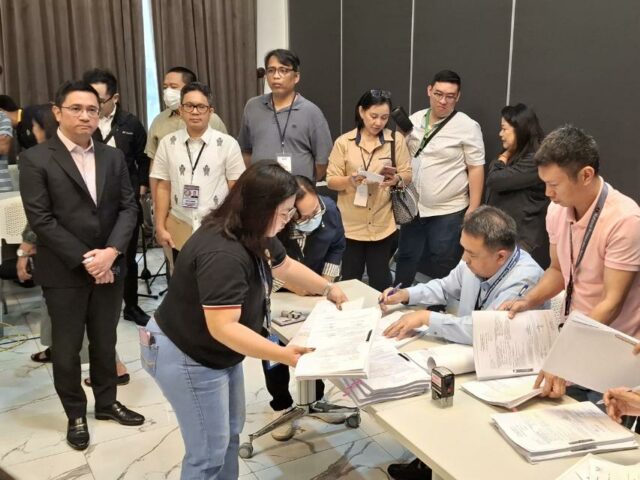
Bureau of Internal Revenue (BIR) Commissioner Charlito Martin R. Mendoza (left) lodged criminal complaints against IM Construction Corp. and SYMS Construction Trading for tax evasion before the Department of Justice. Courtesy of BIR

The Bureau of Internal Revenue (BIR) has filed tax evasion complaints against two Bulacan-based contractors allegedly involved in ghost flood-control projects.

In a statement on Thursday, the agency said newly appointed BIR Commissioner Charlito Martin R. Mendoza lodged criminal complaints against IM Construction Corp. and SYMS Construction Trading before the Department of Justice (DoJ) over fictitious expenses, underreported income, and false value-added tax declarations.

The BIR said combined assessments for IM Construction and SYMS Construction amounted to P13.8 million in total tax deficiencies.

“The BIR will not allow contractors to enrich themselves through fake projects and falsified tax filings. We will pursue every offender, recover every peso, and continue filing criminal charges until this practice ends,” Mr. Mendoza said, who assumed office on Nov. 13.

The two firms were charged with violation of Section 254 or Tax Evasion, and Section 255 or Willful Failure to Supply Correct and Accurate Information.

The BIR said IM Construction Corp. received payments for the construction of a pumping station and flood gate in Barangay Sto. Rosario, Hagonoy.

However, physical verification confirmed that no structure of any kind was built, it said. The company’s claimed project costs, deductions, and input taxes were entirely fictitious, resulting in significant tax deficiencies, it added.

Meanwhile, SYMS Construction Trading collected the full contract amount for a reinforced river wall in Barangay Piel, Baliuag but inspectors found no river wall at the site.

The BIR has now filed a total of 12 criminal complaints linked to anomalous flood-control projects, with estimated total potential tax liabilities of P8.87 billion under investigation.

Separately, the Department of Public Works and Highways Secretary Vivencio “Vince” B. Dizon said the two contractors also face bid-rigging and bid manipulation complaints. — Aubrey Rose A. Inosante

Pope Leo heading to Turkey for closely watched first overseas trip

Pope Leo XIV leads the Angelus prayer on his 70th birthday, from the window of the Apostolic Palace at the Vatican, Sept. 14, 2025. REUTERS/Vincenzo Livieri

VATICAN CITY — Pope Leo XIV begins his first trip outside Italy as Catholic leader on Thursday with a visit to Turkey, where he is expected to make appeals for peace in the Middle East and urge unity among long-divided Christian churches.

The first US pope chose mainly Muslim Turkey as his first overseas destination to mark the 1,700th anniversary of a landmark early Church council there that produced the Nicene Creed, still used by most of the world’s Christians today.

Leo, who has a crowded three-day itinerary in Turkey before heading on to Lebanon, will be closely watched as he makes his first speeches overseas and visits sensitive cultural sites.

“It’s a very important trip because we do not know much yet about Leo’s geopolitical views, and this is the first big chance for him to make them clear,” Massimo Faggioli, an Italian academic who follows the Vatican, told Reuters.

PAPAL TRIPS ABROAD DRAW GLOBAL ATTENTION
Foreign travel has become a major part of the modern papacy, with popes attracting international attention as they lead events with crowds sometimes in the millions, give foreign policy speeches and conduct international diplomacy.

Leo was elected in May by the world’s cardinals to succeed the late Pope Francis. A relative unknown on the world stage before his election, Leo spent decades as a missionary in Peru and only became a Vatican official in 2023.

Pope Francis had been planning to visit Turkey and Lebanon but was unable to go because of his worsening health.

Leo, 70, will depart with his entourage from Rome’s Fiumicino airport at around 7.40 a.m. (0640 GMT) and will first visit the Turkish capital Ankara, where he will meet President Tayyip Erdogan and address political leaders.

He will fly on Thursday evening to Istanbul, home to Patriarch Bartholomew, spiritual leader of the world’s 260 million Orthodox Christians.

Orthodox and Catholic Christians split in the East-West Schism of 1054 but have generally sought in recent decades to build closer ties.

Leo and Bartholomew travel on Friday to Iznik, 140 km (90 miles) southeast of Istanbul and once called Nicaea, where early churchmen formulated the Nicene Creed, which lays out what remain the core beliefs of most Christians today.

In a departure from normal practice – popes usually speak Italian on foreign trips – Leo is expected to speak English in his speeches in Turkey.

PEACE WILL BE KEY THEME OF LEBANESE LEG
Peace is expected to be a key theme of the pope’s visit to Lebanon, which starts on Sunday. Lebanon has the largest percentage of Christians in the Middle East.

Last Sunday, Israel killed the top military official in the Iran-backed militant group Hezbollah in an airstrike on a southern suburb of the Lebanese capital Beirut despite a year-long, US-brokered truce.

Vatican spokesman Matteo Bruni said on Monday that necessary security precautions were being taken to ensure the pope’s safety in Lebanon, but he would not comment on specifics.

Leaders in Lebanon, which hosts 1 million Syrian and Palestinian refugees and is also struggling to recover after years of economic crisis, hope the papal visit might bring global attention to the country. — Reuters

Mexico investigates Miss Universe president for drugs, arms trafficking

MEXICO CITY — Mexico is investigating the president of the Miss Universe organization in relation to alleged drugs and arms trafficking as well as fuel theft, the Attorney General’s Office said on Wednesday, adding to controversy surrounding the beauty pageant.

The office in a statement said it has issued 13 arrest warrants as part of the probe, without identifying individuals.

Local media reported that a warrant has been issued for Miss Universe President Raul Rocha. The Mexican national owns half of the Miss Universe organization.

The Attorney General’s Office, in disclosing details of the investigation which it said dates back to 2024, referred to Mr. Rocha as “Raul R,” as is customary in Mexico. It said it would announce information about his status in due course.

Mr. Rocha did not immediately respond to a Reuters request for comment sent to his Instagram account.

The Miss Universe organization did not immediately respond to a request for comment submitted through its website.

Mexican Fatima Bosch won this year’s Miss Universe contest in Thailand on Friday.

Earlier in the competition, Ms. Bosch led a contestant walk-out, saying pageant director Nawat Itsaragrisil called her a “dumbhead.” Mr. Itsaragrisil denied he used the term and said he had been misunderstood.

Ms. Bosch won the support of Mexico’s President Claudia Sheinbaum who called her “an example of how we women should speak out.”

Mr. Rocha purchased 50% of the Miss Universe organization through his company Legacy Holding Group USA in 2024 from JKN Global Group. — Reuters

Hong Kong police arrest three as apartment fire death toll rises to 44,  hundreds missing

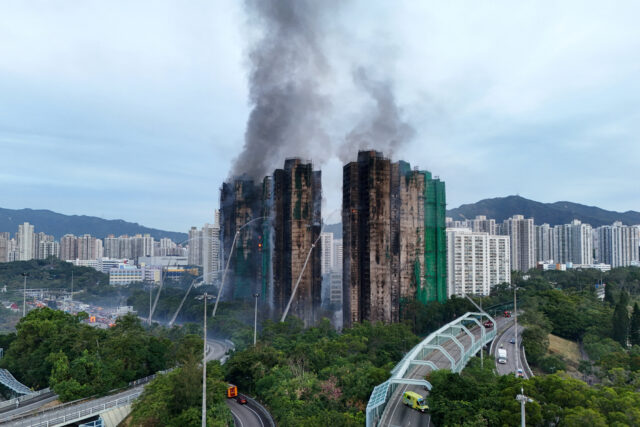
A drone view shows flames and thick smoke rising from the Wang Fuk Court housing estate during a major fire, in Tai Po, Hong Kong, China, Nov. 27, 2025. REUTERS/TYRONE SIU

HONG KONG — A huge fire still burning in a Hong Kong apartment complex that has killed at least 44 people and left almost 300 missing may have been spread by unsafe scaffolding and foam materials used during maintenance work, police said on Thursday.

Working through the night, firefighters were struggling to reach residents potentially trapped on the upper floors of the Wang Fuk Court housing complex due to the intense heat and thick smoke from the fire that erupted on Wednesday afternoon. The complex in the northern Tai Po district has 2,000 apartments in eight blocks.

By early Thursday morning, authorities said they had brought the fire four in blocks under control, with operations continuing in three blocks after more than 15 hours.

Video from the scene showed flames still leaping from at least two of the 32-storey towers and heavy smoke billowing from several buildings.

Police said in addition to the buildings being covered with protective mesh sheets and plastic that may not meet fire standards, they discovered some windows on one unaffected building were sealed with a foam material, installed by a construction company carrying out maintenance work.

“We have reason to believe that the company’s responsible parties were grossly negligent, which led to this accident and caused the fire to spread uncontrollably, resulting in major casualties,” Eileen Chung, a Hong Kong police superintendent, said.

Three men from the construction company, two directors and one engineering consultant, had been arrested on suspicion of manslaughter over the fire, she added.

The green construction mesh and bamboo scaffolding used on the buildings are a mainstay of traditional Chinese architecture but have been subject to a phase-out in Hong Kong since March for safety reasons.

A firefighter was among the 44 killed, with 45 people in hospital in critical condition, Hong Kong police told a press conference before dawn on Thursday.

The death toll is now the highest in a Hong Kong fire since World War Two, surpassing the 41 killed in a blaze in a commercial building in the Kowloon district in November 1996.

The latest fire has prompted comparisons to the Grenfell Tower inferno that killed 72 people in London in 2017. That fire was blamed on firms fitting the exterior with flammable cladding, as well as failings by the government and the construction industry.

“The priority is to extinguish the fire and rescue the residents who are trapped,” Hong Kong leader John Lee told reporters earlier. “The second is to support the injured. The third is to support and recover. Then, we’ll launch a thorough investigation.”

Some 279 people were uncontactable and 900 were in eight shelters, he added.

One 71-year-old resident surnamed Wong broke down in tears, saying his wife was trapped inside.

Harry Cheung, 66, who has lived at Block Two in one of the complexes for more than 40 years, said he heard a loud noise about 2:45 p.m. (0645 GMT) and saw fire erupt in a nearby block.

“I immediately went back to pack up my things,” he said.

“I don’t even know how I feel right now. I’m just thinking about where I’m going to sleep tonight.”

The Philippine foreign ministry said in a statement that its consulate in Hong Kong had received unverified information that some Filipino domestic workers may be trapped inside the buildings. It said it was coordinating with the police to assist any Filipino national affected.

CHINA’S XI URGES ‘ALL-OUT’ EFFORT AGAINST FIRE
On Wednesday, frames of scaffolding were seen tumbling to the ground as firefighters battled the blaze, while scores of fire engines and ambulances lined the road below the development.

From the mainland, China’s President Xi Jinping urged an “all-out effort” to extinguish the fire and to minimize casualties and losses, China’s state broadcaster CCTV said.

Hong Kong’s sky-high property prices have long been a trigger for social discontent in the city and the fire tragedy could further stoke resentment towards authorities ahead of a city-wide legislative election in early December.

Hong Kong’s Transport Department said that a number of roads would remain closed in the area on Thursday morning and 39 bus routes have been diverted.

At least six schools will be closed on Thursday due to the fire and traffic congestion, the city’s Education Bureau said.

A public inquiry yielded sweeping updates to building standards and fire safety regulations in high-rise offices, shops and homes.

BAMBOO SCAFFOLDING BEING PHASED OUT
Hong Kong is one of the last places in the world where bamboo is still widely used for scaffolding in construction.

On mainland China, where use of bamboo in construction originated from ancient times, scaffolding is now mainly metal.

Hong Kong’s government moved to start phasing out bamboo scaffolding in March, citing worker safety after 22 deaths involving bamboo scaffolders between 2019 and 2024. It announced that 50% of public construction works would be required to use metal frames instead.

Though fire hazard was not cited as a reason for the phase-out, there have been at least three fires involving bamboo scaffolding this year, according to the Association for the Rights of Industrial Accident Victims in Hong Kong.

Wang Fuk Court is one of many high-rise housing complexes in Hong Kong, one of the most densely populated areas in the world. Tai Po, located near the border with mainland China, is an established suburban district with some 300,000 residents.

Occupied since 1983, the complex is under the government’s subsidized home ownership scheme, according to property agency websites. According to online posts, it has been undergoing renovations for a year at a cost of HK$330 million ($42.43 million), with each unit paying between HK$160,000 and HK$180,000.

Owning a home is a distant dream for many in Hong Kong, one of the world’s most expensive housing markets and where residential rents are hovering around record highs.($1 = 7.7779 HK$). — Reuters

NG posts P11.2-B surplus in October

An employee of the Bureau of Internal Revenue (BIR) checks an income tax return filed by a taxpayer in this file photo. — PHILIPPINE STAR/EDD GUMBAN

By Aubrey Rose A. Inosante, Reporter

THE NATIONAL GOVERNMENT’S (NG) fiscal position swung to a surplus in October as revenues and expenditures declined amid a corruption scandal, the Bureau of the Treasury (BTr) said on Wednesday.

Data from the Treasury showed a P11.2-billion surplus in October, a turnaround from the P248.08-billion deficit in September and wider than the P6.3-billion surplus seen in October 2024.

This was the first budget surplus since the P67.3-billion surplus in April.

In October, government expenditures fell by 7.76% to P430.6 billion from P466.8 billion in the same month last year.

October marked the third straight month that expenditures declined on an annual basis, as disbursements for public works projects were tightened amid a widening corruption probe.

Primary spending — which refers to total expenditures minus interest payments — fell by 9.29% to P373.2 billion in October from P411.4 billion a year earlier.

Interest payments rose by 3.57% to P57.4 billion in October this year from P55.4 billion in the same month in 2024.

At the same time, revenue declined by 6.64% to P441.7 billion in October from P473.1 billion in the same month last year.

Tax revenues inched down by 0.09% to P414.5 billion in October from P414.9 billion in the same month in 2024.

The bulk or 69.62% of tax revenues came from the Bureau of Internal Revenue (BIR), whose collections rose by 1.02% to P328.8 billion in October from P325.5 billion a year ago.

This included a P211-million tax refund, which pushed the gross BIR collections to P329.1 billion.

“This robust performance was driven by collections from corporate income tax, personal income tax, value-added tax, percentage tax on banks/financial institutions, and excise tax on tobacco products,” the BTr said.

The Bureau of Customs (BoC) saw revenues fall by 4.52% to P83 billion in October from P86.9 billion a year ago, as a ban on rice imports started in September.

Nontax revenues plunged by 53.29% to P27.2 billion in October from P58.3 billion in the same month in 2024.

BTr revenues dropped by 13.82% to P12.5 billion in October, while other offices slid by 66.39% to P14.7 billion.

Reinielle Matt M. Erece, an economist at Oikonomia Advisory and Research, Inc., said in a Viber message that the wider surplus in October is mainly caused by the sharp decline in government spending.

“Since public spending issues became a hot topic, the government became very cautious to avoid backlash, thus spending went down significantly,” he said.

However, he noted that revenues also declined due to slower economic activity and less tax filings.

Rizal Commercial Banking Corp. Chief Economist Michael L. Ricafort attributed the budget surplus to the government’s lower disbursement in implementation of anti-corruption measures.

The wider surplus could also signal more disciplined spending, Mr. Ricafort said in a Viber message.

Mr. Erece also noted that a surplus is not necessarily a positive sign and may signal poor budget efficiency.

“Surpluses mean that there are still cash or resources that can be used to further drive growth,” he said.

10-MONTH DEFICIT
For the first 10 months, the NG budget deficit sharply widened to P1.11 trillion from the P963.9-billion gap in the same period last year.

“The 10-month fiscal gap was underpinned by a 1.13% growth in revenues, amidst the non-recurrence of last year’s extraordinary nontax receipts, matched with a modest 3.9% expansion in expenditures,” the BTr said.

The Treasury said the end-October fiscal gap showed the “government’s continued implementation of priority programs and projects to accelerate inclusive economic growth and drive meaningful social transformation.”

“The year-to-date deficit remains in line with the government’s fiscal consolidation goal at 70.83% of the FY 2025 revised full-year target of P1.56 trillion,” BTr said.

State spending rose by 3.9% to P4.91 trillion in the January-to-October period. This was already 80.8% of the P6.08-trillion revised full-year expenditure program.

Primary expenditures rose by 2.45% to P4.19 trillion as of end-October, while interest payments went up by 13.24% to P723.2 billion.

“The minimal growth in primary expenditures was affected by the contraction in infrastructure spending amid the ongoing probe on the DPWH’s flood control issues and review of project implementation,” it said.

Meanwhile, total revenue collection during the January-to-October period slipped by 1.13% to P3.81 trillion. The BTr said the cumulative collection was 84.25% of the P4.52-trillion revised full-year program.

Tax revenues rose by 7.45% to P3.47 trillion, which was already 82.28% of the P4.21-trillion target.

In the first 10 months, BIR collections rose by 9.55% to P2.65 trillion, accounting for 82.35% of the P3.22-trillion full-year target.

Customs collection inched up by 0.91% to P784.6 billion as of end-October. This was 81.84% of the revised P958.7-billion program for the year.

Nontax revenues plunged by 36.71% to P341.3 billion for the first ten months of the year, even as it has already exceeded the P301.5-billion full-year nontax revenue program by 11.37%.

Treasury income slipped by 6.75% to P209.6 billion as of end-October, while other offices’ income slumped by 58.12% to P131.7 billion.

In the coming months, Mr. Ricafort said there is still a “good chance” that the NG could hit the P1.56-trillion budget deficit ceiling by yearend.

“(This) could be made possible by further fiscal reform measures, tax reform measures, especially anti-corruption measures/reforms to increase the structural source of National Government revenues and to prevent corruption, wastage, leakages on the government expenditure side, as part of the overall priority on governance reforms,” he said.


Frozen assets linked to flood control scandal reach nearly P12 billion 

The Anti-Money Laundering Council (AMLC) has secured two freeze orders against the assets of two government officials, including P3.9 billion worth of air assets. Earlier, Public Works Secretary Vivencio “Vince” B. Dizon earlier said they have sought freeze orders on helicopters and airplanes owned by former Ako Bicol Party-list Rep. Elizaldy S. Co. — PHILIPPINE STAR/RYAN BALDEMOR

PRESIDENT Ferdinand R. Marcos, Jr. on Wednesday said more assets linked to the flood control scandal have been frozen, bringing the total so far to around P12 billion.

“This is only the start. More assets will be frozen to return the people’s money to them,” Mr. Marcos said in mixed Filipino and English in a video posted on his Facebook page.

“This is our promise: the money of the people will be given back to the people.”

The Anti-Money Laundering Council (AMLC) said in a separate statement that it has secured two more freeze orders, which brought the total value of all frozen assets linked to the flood control mess to P11.7 billion. This included 3,566 bank accounts, 198 insurance policies, 247 motor vehicles, 178 real properties and 16 e-wallet accounts.

AMLC said the two new freeze orders cover the assets of an incumbent high-ranking official from an independent constitutional body and a former elected government official. It did not name the officials.

“The freeze orders encompass 230 bank accounts, 15 insurance policies, two helicopters and one airplane. The air assets alone are valued at approximately P3.9 billion,” the AMLC said.

While the AMLC did not identify the owner of the air assets, Mr. Marcos said these belong to former Ako Bicol Party-list Rep. Elizaldy S. Co.

The AMLC said assets were also linked to breaches of the Republic Act No. 3019 or the Anti-Graft and Corrupt Practices Act as well as the Malversation of Public Funds and Property under Article 217 of the Revised Penal Code, as amended.

“The issuance of the freeze orders will enable AMLC to pursue a more extensive financial investigation to uncover any possible money laundering scheme linked to the flood control projects,” AMLC Executive Director Matthew M. David said in a statement on Wednesday.

“The public can be assured that the AMLC will continue to pursue all possible legal remedies to ensure that those involved in the misuse of public funds are held accountable,” he added.

At the same time, Mr. Marcos said the government would endorse to the Office of the Ombudsman plunder, graft, bribery and conflict-of-interest charges against eight lawmakers who allegedly own construction firms with government contracts — escalating his administration’s crackdown on the multibillion-peso flood control scandal.

The Independent Commission for Infrastructure and the Department of Public Works and Highways would submit evidence to the Office of the Ombudsman to bolster the charges, he said.

Mr. Marcos had exposed the wide-scale corruption within the bureaucracy in his fourth State of the Nation address in July, where he alleged lawmakers gained kickbacks in public works projects.

BLACKMAIL
Meanwhile, Mr. Marcos separately accused Mr. Co’s camp of trying to blackmail the government into stopping the cancellation of his passport.

He said the lawyer of the former lawmaker had approached officials with an offer to withhold a planned video unless authorities reversed the move to cancel Mr. Co’s travel document.

“I do not negotiate with criminals,” the President said in mixed English and Filipino. “Even if you release your video of lies to destabilize the government, your passport will still be canceled. You cannot escape justice.”

Mr. Co has posted a series of videos accusing Mr. Marcos and senior officials of graft after the administration launched a sweeping probe into alleged anomalies in flood control contracts.

However, Mr. Co’s legal counsel Ruy Albert S. Rondain denied the President’s accusation, saying it is “completely untrue.”

“I have not spoken with anyone from the government to negotiate the stoppage of the videos for the passport. As I have always maintained, I have no control over the release of the videos,” Mr. Rondain said in a statement. — Chloe Mari A. Hufana and Katherine K. Chan

DA probes slow imports of red onions as prices soar past P300 per kilo

RED ONIONS are sold at a market in Manila in this file photo. — PHILIPPINE STAR/WALTER BOLLOZOS

By Vonn Andrei E. Villamiel

THE Department of Agriculture (DA) said it has ordered importers to explain the slow arrival of red onion shipments, warning that unused import permits will be canceled and reallocated as retail prices climbed above P300 per kilo ahead of the holiday season.

The Bureau of Plant Industry (BPI) is reviewing the utilization of Sanitary and Phytosanitary Import Clearances (SPSICs) after data showed that permits for red onions are being used at a much slower pace than those for yellow onions, despite significantly higher demand for the red variety, the DA said.

“We want to know the status of those import permits — if they plan to use them. If not, we will cancel the permits and award them to other importers to ensure sufficient domestic supply, especially at this time of year,” Agriculture Secretary Francisco P. Tiu Laurel, Jr. was quoted as saying in a statement.

The DA earlier issued SPSICs for up to 69,040 metric tons (MT) of red onions and 42,261 MT of yellow onions.

As of Nov. 20, importers have only used 192 of the 1,202 SPSICs issued for red onions, bringing in 12,824 MT since September.

According to the DA, the slow utilization of permits for red onions comes amid higher demand, with monthly consumption estimated at around 17,000 MT.

The DA said vegetable vendors have reported tight supply in markets, with red onion prices surging past P300 per kilo.

Mr. Laurel said import permits that are not being used will be canceled and reassigned to other importers, including the state-run Food Terminal, Inc., to speed up onion importation and help ease supply pressures.

Sought for comment, Danilo V. Fausto, president of the Philippine Chamber of Agriculture and Food, Inc., said that while onion prices normally increase as the holiday season approaches due to tight supply, importers may also be deliberately delaying shipments.

“I think traders are trying to leverage for good prices, but I think they can do this only up to December. Shortage of supply could be deliberate to bring up prices,” he told BusinessWorld via Viber.

He added that some cold storage facilities still hold imported and local onions and will only release them starting next week.

According to the DA, all SPSICs must be used by Jan. 15, 2026, a deadline set to prevent importers from hoarding clearances to influence supply and prices.

The schedule is also designed to ensure that arrivals of imported onions do not overlap with the domestic harvest, which could depress farmgate prices and hurt local farmers.

PHL manufacturers need to move up the value chain

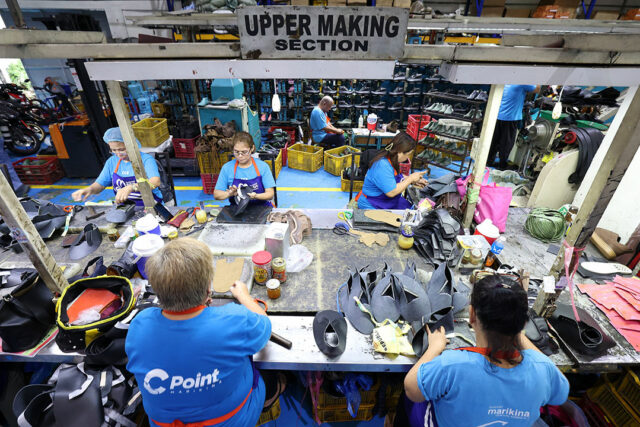
Workers assemble footwear at a manufacturing facility in Marikina City, July 9. — PHILIPPINE STAR/MIGUEL DE GUZMAN

PHILIPPINE MANUFACTURERS should go up the value chain to produce more globally competitive export products and cater to the country’s growing domestic base amid global disruptions, according to industry stakeholders.

Federation of Philippine Industries President John Reinier H. Dizon said that recent global shocks revealed the country’s import dependency for some products.

“I think a couple of years ago, everyone can still remember when the pandemic hit us all. And for me, the key learning there is it actually exposed our risk that we are dependent on the global supply chain,” he said at the BusinessWorld Forecast 2026 on Tuesday.

Mr. Dizon recalled that during the pandemic the Philippines had to manufacture basic items such as face masks. “Then over time we were able to actually develop local industries to support those things,” he added.

In the last 25 years, he said that the Philippines opened its borders to Association of Southeast Asian Nations (ASEAN) members and forged bilateral agreements with several countries.

“Now, there are pros and cons to such free trade, and there is nothing wrong with free trade. It obviously helps companies and individuals procure cheaper products… but many other countries have placed more safeguards vis-a-vis the Philippines,” Mr. Dizon said.

“The Philippines was maybe a little bit more aggressive, and in hindsight, as a consequence, several industries actually faltered,” he added.

Within ASEAN, he said that the Philippines recorded the biggest trade deficit at P54 billion in 2024.

“Now, if we compare that with the likes of Vietnam, they actually had a trade surplus of P28 billion; Thailand’s trade surplus of P6 billion; Malaysia, a trade surplus of P20 billion; and Indonesia, a trade deficit, but at a much more manageable level, at P15 billion,” he said.

To address this, Mr. Dizon said that there should be more support for Filipino products.

“It’s not a silver bullet, but let’s patronize our local products, food, consumer goods, etc. Because it’s always easy to import, it’s cheaper. But make no mistake, it has dire consequences and multiplier effects,” he said.

“We need to revive manufacturing and production in our country,” he added.

Semiconductor and Electronics Industries in the Philippines Foundation, Inc. (SEIPI) President Danilo C. Lachica said that the goal is to maintain the country’s competitive advantage.

“Definitely, we want to maintain whatever limited competitive advantage that we have. But if you look at the challenges, and I’m not just talking about the export industry but even local industries, there’s a whole slew of challenges, both external and internal,” he said.

Domestically, Mr. Lachica said that the Philippines is facing several issues including prop osed legislated wage hikes, field audits by the Bureau of Internal Revenue, and corruption.

“For the electronics industry to be able to catch up, we need to look at moving up the value chain in terms of technology, improving our talent and infrastructure,” he said.

For the semiconductor and electronics industry, Mr. Lachica said that the country needs to build its own wafer fabrication plant to move up the value chain.

“This is what we need to grow — our own integrated circuit design industry. This is what we need to get the Philippines on the map for front-end semiconductor manufacturing,” he said.

Mr. Lachica said it is very important that the Philippines should plan for the long term amid the changing geopolitical landscape and trade policies.

“We cannot be paralyzed by what we hear. We just have to make the most intelligent decisions based on the information, whether it’s investment or the market. We certainly have to minimize dependence on certain markets,” he said. 

“But I think what we all should be doing really is from the private sector, we need to work closely with the government and academe to put forward initiatives and programs to the best interest of the Philippines,” he added.

Meanwhile, Victor Andres C. Manhit, president of think tank Stratbase ADR Institute, said the Philippines does not have to be an export-oriented country, as it has a strong consumer base.

Household consumption, which accounts for around 70% of Philippine gross domestic product, has been a driver of growth.

Instead, Mr. Manhit said the country should focus on capacitating its people, which is key to sustaining growth momentum.

“We focus on building the capacity of our young people. They can consume. They can be hired in more strategic manufacturing industries, part of the global supply chain, continue to grow the business process outsourcing industry, and develop the creative industry,” he added.

Mr. Manhit said giving incentives to export-oriented enterprises and not to domestic enterprises was a “mistake policy-wise.” 

Aside from thinking long term or beyond political timelines, he said that there is a need to invest in the country’s strong sectors.

“Let’s start to think long term and invest in those strengths that we have, build on the capacity of our local industries, look at the consumers as a potential source of growth, and always think about how important we are in geopolitics,” he added. — Justine Irish D. Tabile

Ayala Land raises P4 billion from block sale of AREIT ahead of asset infusion

AYALALAND.COM.PH

By Beatriz Marie D. Cruz, Reporter

AYALA LAND, INC. raised P4.19 billion from a block sale of 100 million shares in its real estate investment trust AREIT, Inc., as it prepares to inject mall properties into the trust.

The shares were sold at P41.90 each through a placement managed by UBS AG Singapore Branch, BPI Capital Corp. and Maybank Securities Pte. Ltd., the listed Philippine developer said in a stock exchange filing on Wednesday.

The offering was made to buyers both outside and within the US. The transaction was exempt from registration requirements under the Securities Regulation Code and was not registered with the Securities and Exchange Commission. Proceeds are set to be settled on Nov. 28.

“The block sale helps raise the public float of AREIT in anticipation of the upcoming infusion of Ayala Center Cebu and Ayala Malls Feliz,” Juan Paolo E. Colet, managing director at China Bank Capital Corp., said in a Viber message. “It also enables Ayala Land to recycle capital into new projects to sustain growth.”

AREIT plans to expand its assets under management by P19.5 billion through a property-for-share swap with Ayala Land and its wholly owned unit Summerhill Commercial Ventures Corp.

Under the deal, the sponsor will contribute Ayala Center Cebu in Cebu Business Park and Ayala Malls Feliz in Pasig, boosting AREIT’s managed assets to P158 billion.

The combined gross leasable area of the two properties is 375,000 square meters (sq.m.), lifting AREIT’s total area to 4.7 million sq.m. The swap will let Ayala Land and Summerhill subscribe to 441.13 million primary common shares of AREIT.

Shares of Ayala Land fell 0.94% to P21 each at the close of trading at the Philippine Stock Exchange, while AREIT ended at P42.15, down 3.44%, reflecting broader market volatility amid the block sale.

The transaction positions AREIT to broaden its investor base ahead of its asset infusion while giving Ayala Land additional capital flexibility to fund its pipeline of commercial projects.