Home Blog Page 6537

Mapua keeps its hold of third spot in beating CSB, 84-65

By Joey Villar

MAPUA coach Randy Alcantara pleaded to his Cardinals to continue to trust their shooters despite being horrid from beyond the three-point arc to start their season. Their faith paid off.

Firing on all cylinders from rainbow country for the second straight game, Mapua outgunned College of St. Benilde (CSB), 84-65, on Tuesday to keep its grip of the third spot in the 97th NCAA basketball tournament at the La Salle Greenhills Gym.

Brian Lacap and Paolo Hernandez presided over CSB’s three-point shooting spree as each fired four of their team’s 12 treys and helped lift the Blazers to their fifth win in seven outings while closing in on a spot to the play-in phase.

Letran and San Beda led the way with perfect 5-0 records.

It was another shooting feast for the Cardinals after draining a season-high 16 triples in a 95-83 win over the Perpetual Help Altas on Wednesday.

Mapua’s two-game total of 28 threes surpassed the 27 (out of 115 attempts) it made in its first five outings.

And all of it was because the Cardinals responded to Mr. Alcantara’s call.

“Coach kept telling us in practice to keep our trust on each other and believe in our open teammates from the outside and pass it to them. We also did extra shooting after practice,” said Mr. Lacap, who finished with a career-high 22 points.

“We’re thankful that our faith and efforts paid off,” he added.

While Mapua hummed from the perimeter, CSB just utterly stunk and hit just one — courtesy of Fil-Kiwi Taine Davis in garbage time — of 18 shots from there.

Mr. Lacap, who honed his crafts playing street ball in Valenzuela, ended up with a well-rounded effort as he complimented his spectacular scoring game with four rebounds, four steals and two assists.

Mr. Hernandez, for his part, wound up with 17 points.

MVP candidate Will Gozum saw action after coming into the game as doubtful to play due to a sore foot and led his squad with 13 points, 14 boards and two blocks.

It wasn’t enough though to negate the Mapua barrage as the Blazers fell to fourth with a 4-3 mark.

The scores:

First Game

Mapua 84 – Lacap 22, Hernandez 17, Nocum 14, Agustin 9, Gamboa 8, Pido 6, Mercado 4, Bonifacio 4, Asuncion 0, Salenga 0, Milan 0, Garcia 0, Soriano 0.

CSB 65 – Gozum 13, Corteza 11, Benson 10, Carlos 8, Nayve 6, Davis 5, Marcos 4, Cullar 4, Lepalam 3, Flores 1, Mosqueda 0, Sangco 0, Publico 0, Lim 0.

Quarterscores: 19-19; 39-30; 62-47; 84-65.

BI keeps stance unchanged to support economy

REUTERS
BANK INDONESIA kept its benchmark interest rate unchanged to support the economy’s recovery. — REUTERS

INDONESIA’S central bank kept its benchmark interest rate unchanged to support the economy’s recovery, while downgrading its growth outlook and saying it will keep a watch on price pressures fueled by the Russia-Ukraine conflict.

Bank Indonesia (BI) held the seven-day reverse repurchase rate at a record low 3.5% on Tuesday as expected by all 29 economists in a Bloomberg survey. The key rate was last adjusted in February 2021.

“The decision is consistent with the need to maintain exchange rate stability and control inflation, coupled with efforts to revive economic growth despite a build-up of external pressure,” Governor Perry Warjiyo said, citing Russia’s war in Ukraine and faster global monetary policy normalization as risks.

The rupiah, which has been among the least volatile currencies in Asia, was trading around 0.15% stronger against the dollar after the decision. The currency has weakened just 0.6% so far this year.

Like most of its neighbors, Bank Indonesia is waiting for a recovery in Southeast Asia’s biggest economy to take hold before unwinding pandemic-era monetary support. Policy makers have pledged to keep borrowing costs low to boost bank lending as the economy reopens, even as peers in advanced economies have turned to tightening policy settings to combat inflation.

The central bank lowered the economy’s growth forecast this year to a range of 4.5%-5.3% from 4.7%-5.5% earlier, underlining the need for continued support. Bank Indonesia also sees global expansion slowing to 3.5% from 4.4% amid supply chain disruptions caused by the war.

Indonesia has policy space to stand pat, for now, with inflation hovering below the midpoint of its 2%-4% target band despite rising food and fuel prices. Warjiyo said on Tuesday that inflation remains manageable, with the forecast for price growth kept steady at 2%-4% for the current year while watching for any risks from global spillovers.

“Slower growth and higher inflation mark an uneasy combination for many policymakers now,” said Wellian Wiranto, an economist at Oversea-Chinese Banking Corp. in Singapore. “Despite such budding growth concerns, we expect BI to start to prioritize inflation fight” going forward.

Policy makers have reason for caution as government price-controls that kept inflation benign earlier this year are rolled back to ease pressure on the state budget. Value-added taxes were also raised this month, with power tariffs possibly next.

A more aggressive tightening by the Federal Reserve could add another layer of risk to Indonesia’s policy outlook. The Fed is seen weighing a hike of as much as 50 basis points at its May meeting — a move that could spur a sell-off in emerging-market assets and weaken the local currency. — Bloomberg

Church of the Holy Sepulchre’s ancient altar rediscovered, researchers say

PHOTO FROM CHURCHOFTHEHOLYSEPULCHRE.NET

JERUSALEM — Pressed against a wall in a back corridor of Jerusalem’s Church of the Holy Sepulchre, a stone slab bore testimony only to the graffiti etched on it by multitudes of pilgrims through the ages.

But the 2.5 x 1.5 meter stone turned out to be far more precious when its other side was exposed during recent renovations at the church, the traditional site of Jesus’ crucifixion and burial.

Researchers believe the elaborate looping ornaments they found on the long-hidden part of the slab indicate it was once the decorated front of a medieval high altar that took pride of place centuries ago in one of Christianity’s holiest sites.

“You cannot see it now, but originally it was inlaid with pieces of precious marble, pieces of glass, pieces of small, finely made marble,” said Amit Re’em, Jerusalem regional archaeologist for the Israel Antiquities Authority.

“It was shining and this was a really amazing artefact,” said Mr. Re’em, who conducted the research with Ilya Berkovich of the Austrian Academy of Sciences.

They identified the unique decoration method as “Cosmatesque,” which combines Classical, Byzantine and early Islamic art in which finely cut tiles of colorful marble are used to fill in circular engravings on the stone.

“It stood at the apex, at the sanctuary of the Church (of the Holy Sepulchre),” Mr. Re’em said.

“All the eyes of the believers, of the pilgrims, (went) to this object. And right above it and around it, all the high priests, the priests and the monks of the church did all the liturgy, the main liturgy of the church, on the table, right here on the table of this altar,” he said.

Similarly decorated altars have been found inside churches in Rome dating to the 12th and 13th centuries, the researchers said.

They believe the relic in Jerusalem corresponds with past archaeological findings and with pilgrims’ accounts of the consecration of the church by the Crusaders and the forming of its main altar in 1149.

The altar was used by the Catholic clergy to celebrate mass until the Crusaders left Jerusalem, Mr. Re’em said. Afterwards it was used by the Greek Orthodox church until it was damaged in a fire in 1808, cast aside and forgotten until the recent renovations, he said.

Archbishop Aristarchos of Constantina, the chief secretary of the Greek Orthodox Patriarchate of Jerusalem, welcomed such research at the church.

“Works from people of art, people of archaeology, contribute to us, contribute to the belief of the church, to the conviction of the church, that this is the place… on which Jesus Christ was crucified… buried and from which he came to resurrection,” he told Reuters.

The researchers’ findings are due to be published by the end of the year by Israel’s Exploration Society. — Reuters

SPC Power’s 2021 earnings slide due to weak Q4

SPCPOWERGROUP.COM

SPC POWER Corp.’s attributable net income went down by 25.74% year on year to P1.19 billion in 2021 due to its weaker fourth-quarter performance.

In a disclosure, SPC Power said its net income translated to earnings per share of 81 centavos from P1.07 in 2020 and return on equity of 11.99% versus 15.8% the prior year.

The company said its full-year income was dragged down by its financial performance in the last quarter of 2021. However, no fourth-quarter figures were provided.

SPC Power’s end-September 2021 net income was at P1.38 billion, higher than the P1.31 billion in the comparable year-ago period.

The company said its performance in the fourth quarter was hit by the delayed recovery of purchased power costs following Typhoon Odette, since the Wholesale Electricity Spot Market’s (WESM) operations in the Visayas grid only resumed on Jan. 17.

It also recorded lower revenues due to cheaper sales of power generated and sold to distribution utilities and electric cooperatives, as well as the expiry of power supply contracts, which were not offset by increased capacity sold to WESM.   

Due to higher pass-through costs of fuel and power, SPC Power logged operation costs that were higher than its revenues, slashing its gross margin by 6.3% to P516.9 million in 2021.

“The power distribution business segment bore the brunt of the typhoon damage,” the company said, citing a 68.9% decline in the segment’s contribution to its net income.   

Meanwhile, its power generation business segment’s earnings also dropped by 17.8% to P317.8 million.

SPC Power’s shares went down by 20 centavos or 1.38% to close at P14.30 each on Tuesday. — R.C.S. Agustin

Taking care of those who take care of us

PHILSTAR

OUR recent experience with the coronavirus disease 2019 (COVID-19) pandemic highlights the need to build the health workforce back better. Health workers served as frontliners, with many of them getting sick or even dying from COVID-19 and its complications.  

It is high time to do more to support the health workforce with necessary investments, and with policies that will better train, deploy, equip, protect, retain and support health workers. 

Organized by the Frontline Health Workers Coalition, the WHO and other partners, Health Worker Week celebrates and raises awareness of the important role of health workers everywhere. Celebrated April 4–8, this year’s World Health Worker Week theme is “Build the Health Workforce Back Better.” 

At the height of the COVID-19 pandemic, the PHAPCares Foundation spearheaded a campaign that seeks to strengthen health care system capacity, and protect health care workers.  

PHAPCares members provided personal protective equipment sets, test kits, ventilators, medicines, vitamins, vaccines, personal hygiene items, disinfectants, and food packs for frontline health workers, patients and affected communities. 

The commitment to support health workers and the communities impacted by the pandemic, disasters, and armed conflicts will continue this year as the PHAPCares Foundation names its new officers and trustees. 

This year, the PHAPCares Foundation will be led by its officers: President Lotis Ramin (President, AstraZeneca Pharmaceuticals Phils.); vice president Jugo Tsumura (President and Managing Director, Novartis Healthcare Pharmaceutical, Inc.); and treasurer Melissa Belvis (General Manager, Abbott Philippines).  

Also serving as trustees are Yee Kok Cheong (General Manager, Boehringer Ingelheim Philippines); Janette Jakosalem (Market Managing Director, Zuellig Pharma Philippines); Angel-Michael Evangelista (Managing Director and Country Division Head, Pharmaceuticals, Bayer Philippines); Maria Rosarita Quijano-Siasoco (Executive Director, PHAPCares Foundation); Dr. Corazon Maglaya (Honorary Trustee); and myself. 

By partnering with the Metropolitan Manila Development Authority (MMDA), the PHAPCares Foundation added Earthquake, Landslide, Search and Rescue Orientation Course (ELSAROC) training for health workers to improve disaster response.  

Guided by the whole-of-society and whole-of-government approach of the Universal Health Care (UHC) Act, the 2020–2040 Human Resources for Health (HRH) Masterplan of the Department of Health (DoH) serves as the long-term strategic plan for the management and development of HRH in the country.  

Its guiding principle is to provide qualified HRH with rural background with scholarships in learning institutions near their places of origin; learning and development opportunities; and improved working conditions with their protection and wellbeing in mind. 

The HRH Masterplan is implemented through a multi-stakeholder HRH Network composed of both public and private organizations and agencies. The HRH Masterplan is composed of short-, medium- and long-term plans. Each plan defines the scenarios that need to be addressed, strategic focus of interventions, resource requirements, and monitoring and evaluation considerations. 

To strengthen primary care services in the country, the World Health Organization (WHO) Workload Indicators of Staffing Needs (WISN) study in 2019 estimated a requirement of 240,780 physicians, nurses, midwives, and medical technologists in all rural health units (RHUs) and 12,950 nurses and midwives in barangay health stations (BHS). 

Seeking to achieve a more equitable HRH distribution, the DoH has deployed health workers in Geographically-Isolated and Disadvantaged Areas (GIDAs), low-income class municipalities, municipalities with Indigenous Peoples, and national priority areas for poverty-reduction and peacebuilding efforts.  

In 2020, the DoH deployed a total of 29,509 health professionals and public health associates and complemented the health workforce in 1,634 municipalities and cities. Of the total health workforce that were deployed, 15,441 physicians, nurses and midwives were assigned in 978 municipalities with GIDAs, while 8,681 were assigned in 749 fourth- to sixth-class municipalities. 

Good health and thriving economies are inextricably linked, and hinge on access to quality and effective health services necessary for all citizens to lead healthy, safe, and productive lives.  

Building robust health economies requires the commitment of resources not only in infrastructure and systems, but also in investing in and supporting health workers who are able and fully equipped to serve the people in their communities. 


Teodoro B. Padilla is the executive director of Pharmaceutical and Healthcare Association of the Philippines (PHAP), which represents the biopharmaceutical medicines and vaccines industry in the country. Its members are at the forefront of research and development efforts for COVID-19 and other diseases that affect Filipinos.


Limitless faces TnT in Second Conference Grand Finals today

AFTER six well-fought legs, the top 10 teams of the PBA 3×3 led by No. 1 Limitless and No. 2 TnT battle it out for the ultimate prize in the Second Conference Grand Finals on Wednesday at the Smart Araneta Coliseum.

The Appmasters seek to live up to their billing as the most accomplished squad in the standalone league, having previously won the First Conference crown and topping a total of four legs prior to the one-day finale.

Out to provide a serious challenge to the Southeast Asian Games-bound Limitless are the Almond Vosotros-led Tropang Giga, who are determined to go all the way after taking bronze in the maiden conference finals.

Similarly tipped to contend is No. 3 Meralco, which is embarking on a redemption tour after a disappointing exit in the quarterfinal round of the previous grand final.

No. 4 San Miguel Beer, meanwhile, looks to carry over the momentum from its amazing triumph in last week’s Leg 6 to vie for top honors.

Sitting in the lower ranks but definitely capable of springing surprises are Pioneer Pro Tibay (277), Barangay Ginebra (267), Platinum Karaoke (266), Purefoods (238), Sista (180) and Terrafirma (136).

The Appmasters, the Tropang Giga, the Bolts and the Beermen are seeded straight into the quarterfinal round while the six others have to dispute the four remaining berths in the preliminary phase beginning at 9 a.m.

Pioneer, Purefoods and Sista vie in Pool A while Ginebra, Platinum and Terrafirma slug it out in Pool B with the top 2 squads in each group advancing to the quarters.

A cool P750,000 awaits the conference champion while P250,000 goes to the runner-up and P100,000 to the third placer. — Olmin Leyba

Fed’s Bullard says 75-basis-point hike could be option if needed

REUTERS

FEDERAL RESERVE Bank of St. Louis President James Bullard said the central bank needs to move quickly to raise interest rates to around 3.5% this year with multiple half-point hikes and that it shouldn’t rule out rate increases of 75 basis points.

“More than 50 basis points is not my base case at this point,” Mr. Bullard said in a virtual presentation to the Council on Foreign Relations on Monday, adding the Fed under Alan Greenspan did such a hike in 1994 leading to a decade-long expansion. “I wouldn’t rule it out, but it is not my base case here.”

Fed Chair Jerome Powell has said that a 50 basis-point increase is possible at the Fed’s May 3-4 meeting. Comments by colleagues since then have hardened expectations they’ll make that move, as officials extend a hawkish pivot to curb the hottest inflation since 1981.

Mr. Bullard repeated he favors an interest rate of about 3.5%, citing a version of the Taylor rule, a guideline developed by Stanford University’s John Taylor that uses inflation, the unemployment rate and an estimate of the neutral interest rate —  a rate neither contractionary nor expansionary — to come up with his estimate.

“You can’t do it all at once, but I think it behooves us to get to that level by the end of the year,” Mr. Bullard said.

The Federal Open Market Committee’s first goal should be getting to a neutral rate soon, Mr. Bullard said. The committee estimates that rate at about 2.4%.

“We want to get to neutral expeditiously, I guess is the word of the day,” he said, repeating a word used by a number of colleagues. “I’ve even said we want to get above neutral as early as the third quarter and try to put further downward pressure on inflation at that point.”

The St. Louis Fed official said talk about recession was premature, with the Fed having only raised rates once at this point. He predicted that the US economy would grow at a healthy rate in excess of its long-term trend both in 2022 and 2023, adding he expects unemployment to fall below 3%.

Minutes of their March meeting showed many Fed officials favored raising rates by a half point and only opted for the more cautious 25 basis-point move because of the uncertainty around Russia’s invasion of Ukraine.

The account showed officials expect to start shrinking their balance sheet by $95 billion a month, or more than $1 trillion a year, and could announce a decision in May. Governor Lael Brainard said April 12 that could mean roll-off as soon as June.

A known hawk, Mr. Bullard has been favoring faster and more aggressive rate hikes by the Fed. He was the lone dissenter in the 8-1 policy vote in March having favored a 50 basis points move and has also pushed for balance sheet reduction.

That hawkishness is being mirrored by other central banks too. The Bank of Canada and Reserve Bank of New Zealand both this month raised their benchmark rates by 50 basis points — their biggest moves in 22 years — indicating a new sense of urgency among policy makers to rein in inflation.

Mr. Bullard’s hawkishness could yet prove to be a defining pivot for Fed policy makers, said Stephen Innes, managing partner at SPI Asset Management.

“The fact that Bullard is talking about a seventy-five basis point hike suggests other hawks are on the same page,” he said. — Bloomberg

Life and work of New York artist Basquiat showcased by sisters

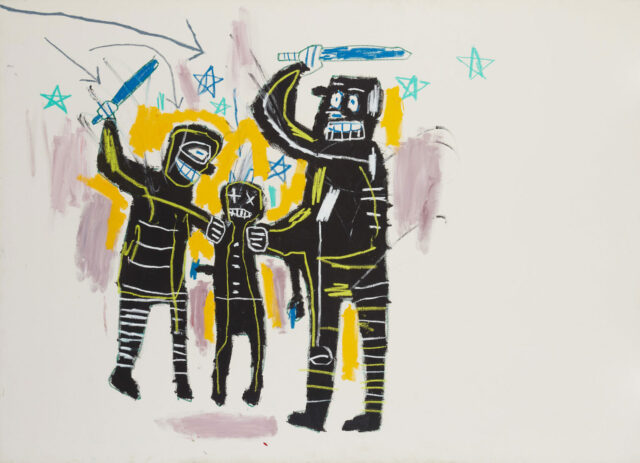
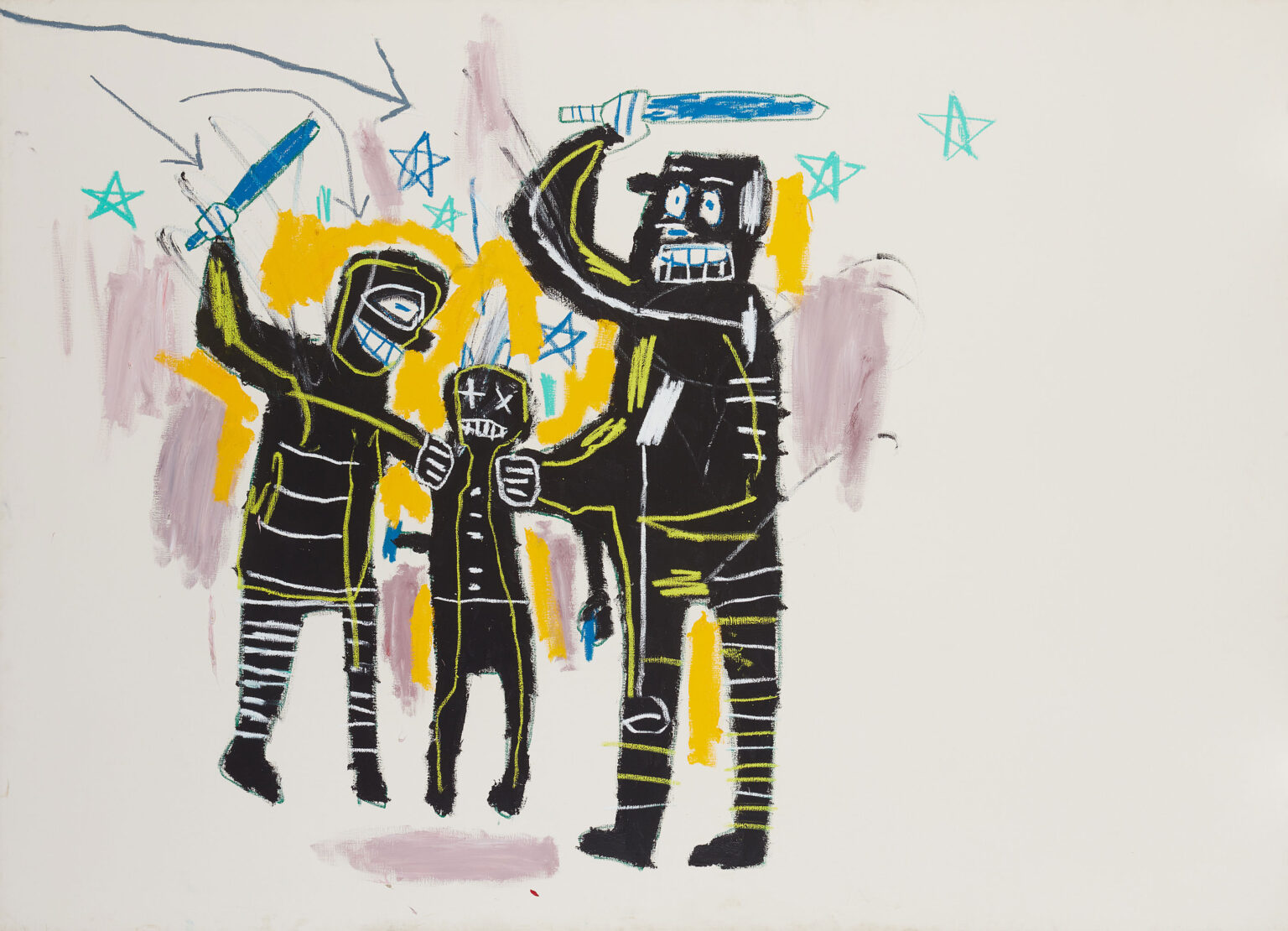
Jean-Michel Basquiat, Jailbirds, 1983 — THE ESTATE OF JEAN-MICHEL BASQUIAT/ KINGPLEASURE.BASQUIAT.COM

NEW YORK —  The personal and professional life of American artist Jean-Michel Basquiat is being shared in a new experience titled, Jean-Michel Basquiat: King Pleasure in New York City.

Over 200 never-before or rarely seen paintings, drawings, ephemera and artifacts by Basquiat, who died of a drug overdose at age 27 in 1988, fill the space at the landmark Starrett-Lehigh building.

Basquiat’s sisters, Jeanine Heriveaux and Lisane Basquiat, created the exhibit to showcase Jean-Michel, his work, and the context of where he came from and how he lived.

“We wanted to make sure that we had — the passion that we’re feeling for the project and for him and the love that we have for him,” said Jeanine Heriveaux. “One of the things that we wanted to do was to ensure that people who appreciate Jean-Michel’s art had a fully immersive experience,” added Lisane Basquiat.

It took the sisters 18 to 19 months to fully realize the space that was created with ISG Productions. The pair spent hours pouring through his work.

The experience starts with “1960 – Introduction,” the year he was born where his self-portrait is found, and then transitions to “Kings County,” the location where the family grew up in Brooklyn. Other environments include “World Famous” and “Ideal” which showcases his studio and track the different periods of his life.

A replica of NYC nightclub Palladium’s VIP — Michael Todd Room, was also constructed to showcase the two paintings, Nu-Nile and Untitled, Jean-Michel created for the club in 1985.

“It was hard because Jean-Michel, like every one of his works, is absolutely amazing. And then also putting a focus on Jean-Michel’s very strong expression of what he felt and what he thought about what was happening in the world from a political and social, economic and cultural perspective,” said Lisane Basquiat.

There is also a focus on his very strong expression of the world with three galleries in the “SoHo” section that use titles of his work Royalty, Those Who Dress Better, and The Irony of a Negro Policeman.

In 2017 Jean-Michel’s vibrant, untitled 1982 portrait sold at auction by Sotheby’s for $110.5 million. At that time, it was the second-highest price ever for a work of contemporary art.

All of the items displayed are owned by the estate, which the family says they will never sell. —  Reuters

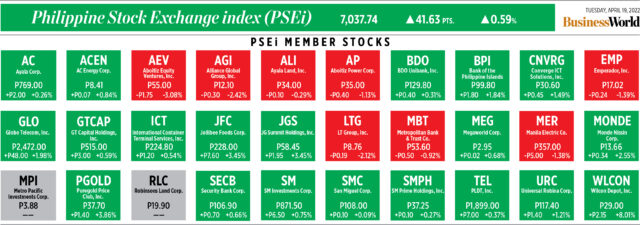
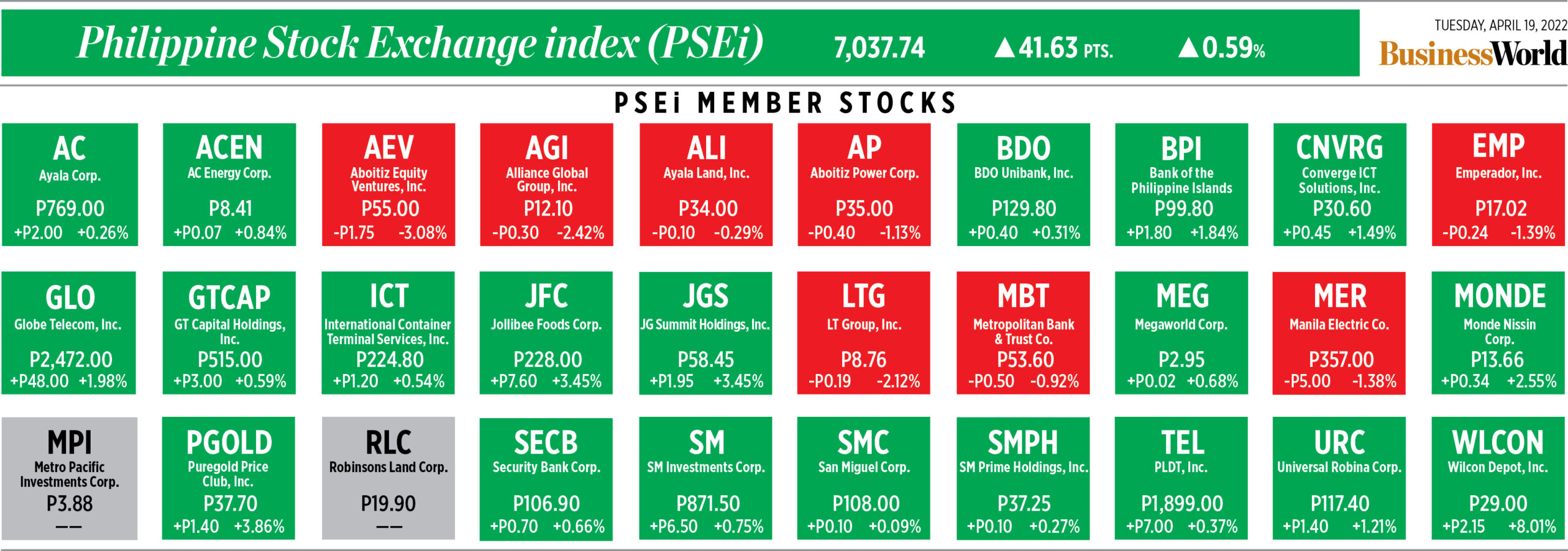
How PSEi member stocks performed — April 19, 2022

Here’s a quick glance at how PSEi stocks fared on Tuesday, April 19, 2022.


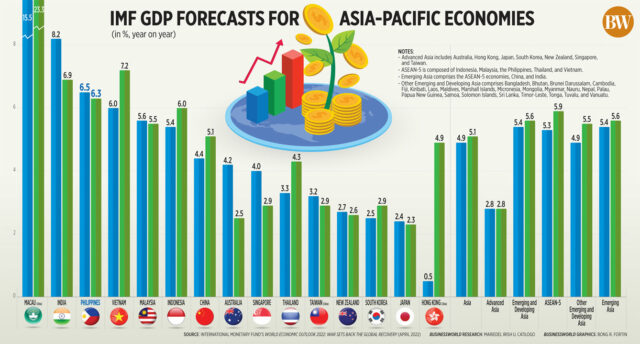
IMF GDP forecasts for Asia-Pacific economies

THE International Monetary Fund (IMF) expects a faster expansion for the Philippine economy this year, but still below the government’s growth target as the ongoing war in Ukraine clouds the global economic outlook. Read the full story.

IMF GDP forecasts for Asia-Pacific economies

Peso weakens on hawkish Fed

BW FILE PHOTO
THE PESO declined against the dollar on Tuesday due to hawkish comments from a US central bank official and higher oil prices. — BW FILE PHOTO

THE PESO retreated versus the greenback on Tuesday as oil prices shot up and with a US Federal Reserve official floating the idea of bigger rate increases to tame inflation.

The local unit closed at P52.46 per dollar on Tuesday, depreciating by 19 centavos from its P52.27 finish on Monday, based on data from the Bankers Association of the Philippines.

The peso opened Tuesday’s session at P52.35 versus the dollar. Its weakest showing was at P52.48, while its intraday best was at P52.31 against the greenback.

Dollars exchanged dropped to $1.087 billion on Tuesday from $1.142 billion on Monday.

The peso weakened as oil prices continued to increase, Rizal Commercial Banking Corp. Chief Economist Michael L. Ricafort said in a Viber message.

Reuters reported that fuel prices picked up by more than 1% on Monday as outages in Libya ignited fears that coincided with the war in Ukraine on tighter supply.

Brent crude increased by 1.3% to close at $113.16 per barrel, while the US West Texas Intermediate (WTI) ended 1.2% higher at $108.21. During the session, Brent and WTI hit $114.84 and $109.81 per barrel, their highest since March 28.

Meanwhile, a trader said the peso weakened as the market reacted to hawkish comments from a Fed official.

St. Louis Federal Reserve Bank President James Bullard said the central bank should not rule out 75-basis-point increases in its benchmark rates as inflation hit 40-year highs in February and March.

Mr. Bullard noted such a move was made in 1994 under the Fed leadership of Alan Greenspan. “I wouldn’t rule it out, but it is not my base case here,” he said.

US inflation surged to 8.5% year on year in March amid record high fuel costs.

A Reuters poll last week showed analysts expect the Fed to raise rates by 50 bps each for its May and June review to respond to runaway inflation. These analysts also expect a 40% probability of recession by 2023.

For Wednesday, both Mr. Ricafort and the trader gave a forecast range of P52.30 to P52.50 versus the dollar. — L.W.T. Noble with Reuters

PSE index rises as China cuts banks’ reserve ratios

BW FILE PHOTO

SHARES improved on Tuesday after China’s central bank said it would cut banks’ reserve requirements to help prop up a slowing economy due to a fresh surge in coronavirus disease 2019 (COVID-19) cases.

The benchmark Philippine Stock Exchange index (PSEi) climbed by 41.63 points or 0.59% to close at 7,037.74 on Tuesday, while the broader all shares rose by 18.96 points or 0.50% to 3,742.92.

“The market rose on hopes [that] regional economic recovery of Asian emerging markets will get a lift from China’s looser central bank monetary policy intended to boost the economy from COVID-led lockdowns… The looser credit policy also helps to mitigate the adverse effects of hawkish US Federal Reserve tightening,” First Metro Investment Corp. Head of Research Cristina S. Ulang said in a Viber message.

“Philippine shares were bought up as investors continued to keep an eye on surging rates and commodities. Macroeconomic data outside the country remained weak, while locally others are making bets ahead of the earnings season,” Regina Capital Development Corp. Head of Sales Luis A. Limlingan added in a Viber message.

“China’s March activity data broadly weakened on the worsened domestic COVID situation and escalation in restrictions,” Mr. Limlingan added.

China said on Friday it would cut the amount of cash that banks must hold as reserves for the first time this year, releasing about 530 billion yuan ($83.25 billion) in long-term liquidity to cushion a sharp slowdown in economic growth, Reuters reported.

The People’s Bank of China said on its website it would cut the reserve requirement ratio for all banks by 25 basis points, effective from April 25, but analysts said it might not yet be enough to reverse the slowdown.

China’s gross domestic product on Monday beat analysts’ expectations with a 4.8% increase in the first quarter from a year earlier, while data on March activity showed weakness in consumption, property and exports affected by COVID-19 curbs.

All sectoral indices ended in the green on Tuesday. Mining and oil gained by 256.36 points or 2.08% to 12,547; services went up by 26.72 points or 1.37% to 1,973.28; industrials improved by 79.70 points or 0.82% to 9,688.23; financials added 9.16 points or 0.55% to 1,658.79; holding firms rose by 26.31 points or 0.40% to 6,578.37; and property advanced by 1.78 points or 0.05% to 3,240.16.

Meanwhile, the MidCap index went up by 1.42 points or 16.60% to 1,184.74 and the Dividend Yield index added 8.22 points or 0.49% to close at 1,685.

Value turnover increased to P5.20 billion with 989.95 million shares changing hands on Tuesday from the P3.66 billion with 751.06 million issues seen on Monday.

Advancers outnumbered decliners, 102 versus 83, while 46 names ended unchanged.

Net foreign selling grew to P350.41 million from P198.13 million seen the previous trading day. — L.M.J.C. Jocson with Reuters

ADVERTISEMENT
ADVERTISEMENT