Home Blog Page 6535

To stem tide of trash, PEMSEA calls for ‘truly biodegradable’ packaging

Wire trash basket. — Gregg Yan/PEMSEA

An environmental organization reiterated the call for better local management of plastic waste and a shift to biodegradable packaging to manage plastic waste entering Manila Bay, a pollution hotspot, from Cavite’s Imus River, which it called “a conveyor belt” of trash.  

“One solution is for manufacturers to shift to truly biodegradable packaging, such as processed seaweed and cassava,” said Gregg H. Yan, a consultant for Partnerships in Environmental Management for the Seas of East Asia (PEMSEA), in an e-mail. Incentivizing consumers by giving them discounts for bringing their own resealable plastic containers can also work, he added.  

On April 19, PEMSEA released five studies on the Imus River watershed, which measures 186.15 kilometers and has a population of 1,351,057 as of 2015.  

“We wanted to understand not just what types of waste enter the Imus River, but how the people who live near the river itself perceived plastic pollution as well as local efforts to combat it,” said Edwin F. Lineses, a social scientist at De La Salle University-Dasmarinas (DLSU-D), which led the studies along with Cavite State University. 

Locals were aware of the negative effects of plastic pollution in the Imus River, the studies found. They also had positive attitudes about conservation efforts, although most respondents still preferred sachets and single-use plastics because of their convenience, affordability, and perceived value-for-money.  

Single-use sachets and packets are among the most pervasive types of litter in and along the river.  

“Oxo-degradable plastics are not good for the environment because they’re only designed to break down into smaller and smaller pieces,” said Mr. Yan. “These tiny microplastics remain in the environment for a long time before being fully broken down by natural processes.”  

PEMSEA also recommended educating Cavite residents of solutions beyond regular trash collection and cleanup drives, such as proper segregation and recycling. 

Small businesses should likewise be given incentives to provide product refills, use alternative packaging, and comply with waste management policies, the environmental organization said. 

“This Earth Day [April 22], buhayin natin ang ating mga ilog (let’s revive our rivers),” said PEMSEA executive director Aimee T. Gonzales. 

The studies were launched under PEMSEA’s Project ASEANO, an initiative to stem the flow of plastic pollution in two pilot locations: the Philippines’ Imus River and Indonesia’s Citarum River. 

They can be downloaded at https://pemsea.org/publications/reports. — Patricia B. Mirasol

G20 members condemn Russia’s war in Ukraine, after Yellen and others stage walkout

US Treasury Secretary Janet Yellen. — US FEDERAL RESERVE

WASHINGTON/LONDON — Top officials from Britain, the United States, and Canada walked out on Russia’s representatives at a Group of 20 (G20) meeting on Wednesday and many members spoke to condemn Moscow’s war in Ukraine, exposing deep divisions in the bloc of major economies. 

Indonesian Finance Minister Sri Mulyani Indrawati, who chaired the meeting of G20 finance officials in Washington, acknowledged the body faced unprecedented challenges but called for cooperation to overcome headwinds slowing global growth. 

“This is an extraordinary situation,” Ms. Indrawati told reporters after the daylong meeting. “It’s not business as usual, a very dynamic and challenging one.” 

The G20 includes Western countries that have accused Moscow of war crimes in Ukraine, as well as China, India, Indonesia and South Africa which have not joined Western-led sanctions against Russia over the conflict. 

Ms. Indrawati said many countries spoke out against the war at the meeting, although she did not identify them. 

“In order for us to be able to recover together … we need more and even stronger cooperation,” Ms. Indrawati told a briefing. “The G20 is still … the premier forum for all of us to be able to discuss and talk about all the issues.” 

US Treasury Secretary Janet Yellen told attendees she strongly disapproved of a senior Russian official’s presence at the meeting before she walked out, two sources told Reuters. 

She was joined by Federal Reserve Chair Jerome Powell, Bank of England Governor Andrew Bailey, Canadian Finance Minister Chrystia Freeland, and European Central Bank President Christine Lagarde. 

Ukrainian officials, in Washington seeking billions of dollars of additional funding, also walked out of the meeting, a source familiar with the meeting said. 

Russian Deputy Finance Minister Timur Maksimov represented Moscow in person, while Russian Finance Minister Anton Siluanov and Russia’s central bank governor joined virtually, a second source said. 

Over five million Ukrainians have fled abroad since Russia invaded on Feb. 24, the biggest attack on a European state since 1945. 

The United States accuses Russia of committing war crimes in what Moscow calls a “special military operation.” Russia denies the allegations. 

NO ‘BUSINESS AS USUAL’
One source added that Ms. Yellen told participants there could be “no business-as-usual” for Russia in the global economy, a view echoed by Indrawati, whose government is heading the G20 group this year. 

British Finance Minister Rishi Sunak said in a tweet: “We are united in our condemnation of Russia’s war against Ukraine and will push for stronger international coordination to punish Russia.” 

Russia’s finance ministry did not mention the walkout in a statement issued after the meeting. It cited Mr. Siluanov as calling on the G20 not to politicize dialogue between members and stressing the grouping had always focused on the economy. 

He also complained about the damaging effect of Western sanctions, the statement said. 

“Another aspect of the current crisis is the undermining of confidence in the existing international monetary and financial system,” it said. “The safety of international reserves and the possibility of free trade and financial transactions are no longer guaranteed.” 

Ms. Lagarde urged Mr. Maksimov to convey to Moscow a clear message — to end the war in Ukraine, one of the sources said. 

G20 finance ministers and central bank governors met on the sidelines of a semi-annual conference held by the International Monetary Fund (IMF) and World Bank in Washington, with the Ukraine war, food security and ongoing recovery from the coronavirus pandemic the key topics. 

Given the divisions, the group did not issue a communique. Instead, Indrawati read a statement summarizing the meeting and underscoring the importance of the body. 

Ms. Freeland, who is of Ukrainian descent and has made impassioned pleas on behalf of the country, said she walked out of a G20 plenary meeting to protest against Russia’s participation. 

“This week’s meetings in Washington are about supporting the world economy — and Russia’s illegal invasion of Ukraine is a grave threat to the global economy,” she said on Twitter, adding that Russia should not be participating.  

FRAGMENTATION FEARS
IMF Managing Director Kristalina Georgieva on Wednesday acknowledged it was a “difficult moment” for the G20, a forum that has played a key role in coordinating the fight against coronavirus disease 2019 (COVID-19) and responding to the 2008–2009 financial crisis. 

But she said cooperation through the forum would continue. 

“There are clearly very, very unsettling facts we have to deal with,” said Ms. Georgieva, a Bulgarian native. “But we also recognize how interdependent we are … And it is so obvious that cooperation must and will continue.” 

Ms. Georgieva and Ms. Yellen have warned against a fragmentation of the global economy into geopolitical blocs, with the United States and market-driven democracies on one side and China, Russia and other state-driven economies on another. — Reuters

Philippine ‘Avengers’ battle disinformation before election

KATEMANGOSTAR-FREEPIK

BANGKOK/MANILA — At St. Francis of Assisi church in Manila, as parishioners kneel and bow their heads in prayer at Sunday mass, the lector appeals for a safe, peaceful and honest presidential election. 

The prayer — recited in Tagalog or English to a nation of some 85 million Catholics — also seeks deliverance from “dishonesty, lies and all distortion of truth.” 

The May 9 election to pick the nation’s president, vice president, senators, and fill 300 lower house seats and 18,000 local posts, is seen as highly consequential, with the son of an ousted dictator, Ferdinand Marcos Jr., pitted against an incumbent vice president, Maria Leonor “Leni” G. Robredo. 

For Angelique Mendoza, a 61-year-old retiree, it is only fitting that church leaders have joined the fight against disinformation, as citizens face a barrage of falsehoods on social media platforms, as they did before 2016’s election. 

“Some people are getting tired of priests telling us about the dangers of fake news. I am not, because it is their moral obligation to warn us of what is not good for our spirituality,” she said after mass at St. Francis church on a recent Sunday. 

“I don’t mind hearing the priests warning us about fake news. As long as they do not mention any names, I still find them apolitical,” she told the Thomson Reuters Foundation. 

The word of the church carries enormous clout in the Philippines, where eight in 10 people are Catholics. 

Its influence is not lost on Ms. Robredo, sole female candidate for president, who is trailing frontrunner Mr. Marcos and has enlisted the help of priests in her campaign. 

“The Catholic Church has the machinery on the ground to fight disinformation,” Ms. Robredo told reporters in Cebu city. 

“But my call is for everyone, not only the Catholic Church. This is not only my problem as a candidate, but a problem for everyone: the elections will be based on lies if we don’t do everything to stop disinformation,” she said. 

“The worst thing that can happen is not me losing, but the other candidate winning through disinformation.” 

ONLINE MISINFORMATION
Ms. Robredo’s plea appears to have been heeded. 

Media firms, universities, civil society groups, lawyers and church leaders have formed several fact-checking coalitions in an unprecedented effort to counter election disinformation. 

Nearly half of misinformation online targets Ms. Robredo and helps Mr. Marcos, according to fact-checking coalition Tsek.ph. 

A spokesman for Mr. Marcos did not respond to a request for comment. 

“We’ve seen the damage lies can do. We know that it’s impossible to have integrity of elections when we don’t have integrity of facts,” said Maria Ressa, chief executive of Rappler, a digital media outlet, which is part of FactsFirstPH, a fact-checking collaborative of about 150 organizations. 

“In this ‘Avengers Assemble’ moment, there is strength in standing together. We know what happens when we don’t stand up for facts,” said Ms. Ressa, referring to a gathering of superheroes who take on the villains in the Marvel film. 

Ms. Ressa, a Nobel Prize laureate, had repeatedly warned of the spread of disinformation on social media platforms in favor of then presidential candidate Rodrigo R. Duterte in 2016, when Mr. Marcos lost the race for vice president to Ms. Robredo. 

His daughter, Sara Duterte-Carpio, is now running with Mr. Marcos for vice president. 

Mr. Marcos’s campaign is well funded, undermines Ms. Robredo and has a long reach, said Jonathan Corpus Ong, an associate professor and disinformation researcher at Harvard University. 

He said TikTok, the short-video platform, is particularly influential as its playful format appeals to young Filipinos who make up more than half the voter base. Facebook and YouTube are also major channels for misinformation, he added. 

“In 2016, the Philippines was caught flat-footed when it came to fake news and troll armies — we didn’t even know these terms then. Now, there have been some legislative efforts, and there’s greater awareness across the board,” he said. 

“But the misinformation campaigns are a thriving, normalized industry, and fact checkers can only catch the misinformation once it’s already been circulated. Going after low-level trolls is a game of whack-a-mole — the powerful people behind the campaigns are not being held accountable,” he added. 

TikTok did not respond to a request for comment. 

CONTENT MODERATION
Meta Platforms, the parent of Facebook, said earlier this month that it had removed a network of more than 400 accounts, pages and groups in relation to the Philippine election. 

It said that it had built new products and developed “stronger” policies “to remove harmful content and networks when we see them,” and has a dedicated team, including local experts. 

Google and YouTube have introduced candidate information panels, and support the FactsFirstPH collaborative. YouTube has removed more than 400,000 videos uploaded from the Philippines from Feb. 2021 to Jan. 2022, a spokesperson said. 

Content moderation policies of social media platforms have come under greater scrutiny worldwide, as Facebook changed its rules for the Ukraine invasion, and Rohingya Muslims filed a lawsuit last year against Facebook for failing to police hate content they say led to their genocide in 2017. 

The Philippine presidential candidates — among Manila City Mayor Francisco “Isko” M. Domagoso and former boxing champion  Emmanuel “Manny” D. Pacquiao — said in a debate last month that social media firms must be held liable for the spread of disinformation on their platforms. 

Mr. Marcos did not participate in that debate. 

While platforms appear to have adopted some remedial measures, “the speed, breadth and depth of their responses are an issue, given the overwhelming disinformation we’re awash in,” said Yvonne Chua, project leader of Tsek.ph. 

“Countering disinformation requires a whole-of-society approach. Fact-checkers are an important cog in the wheel in the fight against disinformation, but there are other cogs,” she added. 

So at the nation’s many churches, priests will warn congregations about the evils of disinformation and pray for an honest election, said Bishop Pablo David, head of the Philippines Association of Catholic Bishops. 

“One of the most crucial issues about the coming election is the moral imperative of upholding the truth,” he said. 

“The moral obligation of every Christian is to uphold the truth.” — Rina Chandran and Manuel Mogato/Thomson Reuters Foundation

Russia tests nuclear-capable missile that Putin calls world’s best

RUSSIAN President Vladimir Putin. — REUTERS

LONDON — In a show of strength two months into its assault on Ukraine, Russia test-launched a new nuclear-capable intercontinental ballistic missile which President Vladimir Putin said on Wednesday would make Moscow’s enemies stop and think. 

Mr. Putin was shown on TV being told by the military that the long-awaited Sarmat missile had been test-launched for the first time from Plesetsk in northwest Russia and hit targets in the Kamchatka peninsula, nearly 6,000 km (3,700 miles) away. 

The test of the Sarmat, under development for years, did not surprise the West, but came at a moment of extreme geopolitical tension. Russia has yet to capture any major cities since it sent tens of thousands of troops into Ukraine on Feb. 24. 

Ukraine’s defense ministry was not immediately available for comment. 

“The new complex has the highest tactical and technical characteristics and is capable of overcoming all modern means of anti-missile defense. It has no analogues in the world and won’t have for a long time to come,” Mr. Putin said. 

“This truly unique weapon will strengthen the combat potential of our armed forces, reliably ensure Russia’s security from external threats and provide food for thought for those who, in the heat of frenzied aggressive rhetoric, try to threaten our country.” 

Announcing the invasion eight weeks ago, Putin made a pointed reference to Russia’s nuclear forces and warned the West that any attempt to get in its way “will lead you to such consequences that you have never encountered in your history.” 

Days later, he ordered Russia’s nuclear forces to be put on high alert. “The prospect of nuclear conflict, once unthinkable, is now back within the realm of possibility,” United Nations Secretary-General Antonio Guterres said last month. 

Russia’s defense ministry said on Wednesday the Sarmat was fired from a silo launcher at 1512 Moscow time (1212 GMT). 

Russia’s nuclear forces will start taking delivery of the new missile “in the autumn of this year” once testing is complete, Tass quoted Dmitry Rogozin, head of the Roscosmos space agency, as saying on Wednesday. 

SYMBOLIC TIMING
Jack Watling of the RUSI think-tank in London said there was an element of posturing and symbolism involved, less than three weeks before the annual Victory Day parade where Russia shows off its latest weapons. 

“The timing of the test reflects the Russians wanting to have something to show as a technological achievement in the lead-up to Victory Day, at a time when a lot of their technology has not delivered the results they would have liked,” Watling said. 

Douglas Barrie, senior fellow for military aerospace at the International Institute for Strategic Studies, said the launch was an important milestone after years of delays caused by funding issues and design challenges. 

He said more tests would be needed before Russia could actually deploy it in place of ageing SS-18 and SS-19 missiles that were “well past their sell-by date”. 

Mr. Barrie said the Sarmat’s ability to carry 10 or more warheads and decoys, and Russia’s option of firing it over either of the Earth’s poles, posed a challenge to ground and satellite-based radar and tracking systems. 

Igor Korotchenko, editor in chief of Russia’s National Defence magazine, told RIA news agency it was a signal to the West that Moscow was capable of meting out “crushing retribution that will put an end to the history of any country that has encroached on the security of Russia and its people.” 

Ukraine has mounted stiff resistance and the West has imposed sweeping sanctions to try to force Russia to withdraw forces Moscow says are on a special operation to degrade its southern neighbor’s military capabilities and root out people it calls dangerous nationalists. — Mark Trevelyan/Reuters

Radisson Hotel Group plans Asia-Pacific expansion as travel restrictions ease

https://www.radissonhotels.com/en-us/

MANILA – Radisson Hotel Group plans to add 150 hotels in Asia-Pacific this year as it banks on travel, tourism, and economic recovery in the region, its CEO said on Thursday.

Radisson, one of the world’s largest hotel groups, is in the midst of a five-year plan to double its properties to 3,200 hotels in 120 countries by 2025.

“Overall, Asia plays a significant role in our business plans because of the significant presence that we can build in the future,” Radisson CEO Federico Gonzalez told reporters.

Radisson last year signed deals to put up 200 hotels worldwide, of which 137 are in Asia-Pacific. It takes three to five years for hotel deals to reach operation stage.

Radisson sees its China and India portfolios increasing to 1,000 and 200 hotels, respectively, by 2025, Gonzalez said, adding that around 150 deals will be signed this year. But China’s stringent lockdown measures could impact the completion of new hotels, he said.

Travel in Asia-Pacific is trailing the rest of the world and should expect a bumpy recovery, because of slower border reopenings, a Booking.com executive said in March.

At the end of the company’s expansion programme, Asia-Pacific will account for most of Radisson’s hotel rooms though much of revenues will still come from Europe.

Revenues and profits are expected to return to pre-pandemic levels by next year, Gonzalez said, as COVID-19 restrictions are lifted around the world. — Reuters

UN panel coordinator urges stepped up focus on North Korea cyber crime

REUTERS

WASHINGTON — The coordinator for the UN body monitoring enforcement of sanctions on North Korea said on Wednesday a stepped up focus was needed on cybercrime, which had become fundamental to Pyongyang’s ability to finance its banned weapons programs. 

Eric Penton-Voak, of the UN Security Council’s Panel of Experts on North Korea, noted that despite the widest sanctions regime ever imposed by the United Nations on a nation state, North Korea had markedly accelerated its missile testing, particularly over the past six months. 

“It may be no coincidence that the words cyber and cryptocurrency do not actually appear in the UN sanctions resolutions,” he told a discussion hosted by Washington’s Center for a New American Security think tank. 

Mr. Penton-Voak said he believed cyber activity had become “absolutely fundamental” to North Korea’s ability to evade UN sanctions to raise money for its nuclear and missile programs, but biannual reports of the experts’ panel had not reflected this as member states had been reluctant to report breaches. 

“We rely on UN member states to inform us about breaches in order to investigate. But many, many member states are quite cautious about their own cyber capabilities,” he said. 

“Victims for their part are often very reluctant to discuss how hacks happened and how extensive they were … I do hope and expect that our reports in the future will rather better reflect the central importance of cyber-enabled financial crime to (North Korea).” 

Mr. Penton-Voak said North Korean hackers were at the cutting edge of cyber technology, as shown by the recent hack of the Axie Infinity video game. 

The United States last week linked North Korean hackers to the theft of hundreds of millions of dollars’ worth of cryptocurrency tied to Axie Infinity

Ronin, a blockchain network that lets users transfer crypto in and out of the game, said digital cash worth almost $615 million was stolen on March 23. 

A post on the official Ronin blog said the FBI had attributed the hack to the Lazarus Group, a hacking entity the Washington says is controlled by the Reconnaissance General Bureau, North Korea’s primary intelligence bureau. 

It has been accused of involvement in the “WannaCry” ransomware attacks, hacking of international banks and customer accounts, and 2014 cyber-attacks on Sony Pictures Entertainment. 

Washington has been pushing the UN Security Council to blacklist Lazarus and freeze its assets, according to a draft resolution reviewed by Reuters last week. — Reuters

Filinvest Land and Cebu province commemorate partnership

Left to right: Filinvest Land Executive Vice-President and Chief Strategy Officer Tristan Las Marias, Cebu Board Member Glenn Anthony Soco, Cebu Gov. Gwen Garcia, Filinvest Land President and CEO and Filinvest REIT Chairwoman Josephine Gotianun Yap, Filinvest REIT President Maricel Brion Lirio, Cebu Board Member Christopher Baricuatro, and Cebu Board Member Victoria Toribio

Filinvest Land unveiled a new marker to commemorate its fruitful partnership with the Province of Cebu for the prime office development Filinvest Cyberzone Cebu in Lahug. Province of Cebu Governor Gwen Garcia joined Filinvest Land President and CEO Josephine Gotianun Yap, Chief Strategy Officer Tristan Las Marias, and Filinvest REIT President Maricel Brion Lirio for the unveiling ceremony.

“We were put together at the right time for the right reasons. And this is the right reason, a mutually beneficial partnership with Filinvest that can only mean more revenues for the Province of Cebu, added assets for the province of Cebu and, together with Filinvest, give more opportunities for progress and development of our beloved Province of Cebu,” said Gov. Garcia.

The unveiling ceremony was held at Tower Two of Filinvest Cyberzone Cebu attended by other provincial government officials and key executives of Filinvest Land. Filinvest Cyberzone Cebu is a 1.2-hectare PEZA-accredited, 4-tower modern office development designed to cater to blue chip companies. It was recently given a Grade A rating by Jones Lang LaSalle. Notably, Filinvest Cyberzone Cebu remained operational 24/7 during Typhoon Odette’s onslaught.

“Filinvest Cyberzone Cebu is one of our biggest investments in the province. Through this development, we aim to provide world-class office spaces to empower global and local businesses to thrive in Cebu. We are ever grateful for the support of our joint-venture partner the Province of Cebu, led by Gov. Gwen Garcia,” said Ms. Gotianun Yap.

“Filinvest has always strived to be the province’s partner in progress. This marker is testament to the strength of the partnership between Filinvest Land and the Province of Cebu,” added Mr. Las Marias.

Filinvest Cyberzone Cebu is a joint-venture commercial development between Filinvest and the Cebu Provincial Government. The completed towers 1 and 2 have a combined gross leasable area of 48,233 square meters of office space and 1,307 square meters of retail space. The remaining towers 3 and 4 set for completion in 2023 have a combined gross leasable area of 38,718 square meters of office space and 5,471 square meters of retail space.

“We are proud to say that through Filinvest Cyberzone Cebu Towers 1 and 2, approximately 29,000 new jobs were created while for the upcoming Towers 3 and 4, we expect to generate approximately 21,000 new jobs from the office spaces alone. Our retail spaces are expected to add another 1,000 jobs,” said Ms. Brion Lirio.

The first tower of Filinvest Cyberzone Cebu is part of the portfolio of Filinvest REIT Corp. (FILRT), the real estate investment trust of the Filinvest group. Listed in the Philippine Stock Exchange, FILRT’s portfolio consists of 17 Grade A office buildings totaling over 300,000 square meters of gross leasable area.

“We expect that the easing restrictions for COVID-19, return-to-work policies, and the untiring support of the provincial government of Cebu will boost the resurgence of the province’s BPO office industry. We are proud to have seen an increase in occupancy for Filinvest Cyberzone Cebu after Typhoon Odette and we expect this trend to continue for the rest of 2022,” said Ms. Brion Lirio.

Filinvest REIT Corp. is backed by one of the country’s largest developers, Filinvest Land. Filinvest Land has been a part of Cebu for decades with 14 projects across the province. Filinvest Cyberzone Cebu is part of the developer’s extensive portfolio nationwide with over 250 projects in over 50 key areas nationwide. A steadfast partner of the province, Filinvest Land donated vaccine doses, medical supplies, and equipment to various cities of Cebu province. Filinvest Land also conducted relief operations which included distribution of relief goods and clean potable water for Typhoon Odette victims through its Pusong Filinvest program.


Spotlight is BusinessWorld’s sponsored section that allows advertisers to amplify their brand and connect with BusinessWorld’s audience by enabling them to publish their stories directly on the BusinessWorld Web site. For more information, send an email to online@bworldonline.com.

Join us on Viber to get more updates from BusinessWorld: https://bit.ly/3hv6bLA.

Inflation in Russia hits highest since early 2002

WIKIMEDIA COMMONS

Annual inflation in Russia accelerated to 17.62% as of April 15, its highest since early 2002 and up from 17.49% a week earlier, the economy ministry said on Wednesday, as the volatile ruble sent prices soaring amid Western sanctions.

Prices on nearly everything from vegetables and sugar to clothes and smartphones have risen sharply in recent weeks after Russia on Feb. 24 began what it calls “a special military operation” in Ukraine.

But weekly inflation in Russia slowed after a big rise in the past few weeks, data from statistics service Rosstat showed on Wednesday, giving the central bank reason to consider cutting rates at its board meeting on April 29.

The central bank has said it may cut its key interest rate from 17% at the upcoming board meetings and will try not to lower inflation, which it targets at 4% in annual terms, by any means.

Weekly inflation in Russia slowed to 0.20% in the week to April 15 from 0.66% a week earlier, taking the year-to-date increase in consumer prices to 11.05%, Rosstat said.

In the same period a year ago, consumer prices rose 2.72%.

Inflation could reach between 17% and 20% this year, Alexei Kudrin, the head of Russia’s audit chamber, said last week. Analysts polled by Reuters in late March had on average forecast 2022 inflation to accelerate to 23.7%, its highest since 1999. — Reuters

Yen’s past points to more pain ahead

SINGAPORE — The yen has tumbled 10% to a two-decade low to the dollar in a matter of weeks. But history suggests that still isn’t cheap, and investors are betting that it’s going to fall even further. 

The drop, precipitous for a major currency in the $6.6-trillion-a-day global foreign exchange market, has been triggered by the fragility of the world’s third-largest economy and the Bank of Japan’s (BOJ) reluctance to follow the United States and the rest of the world in tightening monetary policy. 

That has created an unfavorable gap in government bond yields which has widened at the same time as the soaring cost of energy imports has slammed Japan’s trade balance into deficit. 

Yet even as yen selling extended for a record 13-day streak, analysts say the downtrend has room to run. The trade outlook and lessons from previous bouts of yen weakness point to a further decline, especially while tourism flows are absent. 

“This is a regime change and when the regime changes there is no support,” Junichi Inoue, who manages a portfolio of Japanese stocks at Janus Henderson, said by phone from Tokyo. 

“I think there is no valuation on the currency,” he said, leaving it adrift after breaching resistance around 125-per-dollar. 

“Once the direction is set towards weakening there are no hedging activities — until something happens. So I think 130 yen isn’t going to stop (the currency’s decline),” referring to a level where some traders think Japanese authorities may intervene. 

Selling carried the yen close to that on Wednesday, when it touched 129.43 per dollar, its weakest since April 2002. 

Back then, investors thought Japan was beginning to emerge from its “lost decade” of the ’90s and the yen was beginning a long rise. Today, traders are drawing parallels with the yen’s weakness at the advent of deflation-fighting “Abenomics” in 2013 to make a case that there is no such turning point ahead. 

In 2013, when a weaker yen was part of then-Prime Minister Shinzo Abe’s drive to raise inflation, the gap between the benchmark U.S. and Japanese 10-year yields widened about 120 basis points and the yen fell by nearly 27%. 

This year, the rates move is comparable, but the yen has lost less in percentage terms, dropping about 20%. Thus far traders have also discounted officials’ verbal efforts to steady the yen, while the BOJ has been spending billions to anchor bond yields. 

At the same time, capital has flowed out of Japan to seek better returns elsewhere, and for eight months in a row the trade balance has been negative. 

“The most convincing turns on the currency are apt to occur when trade and financial accounts combine,” said Alan Ruskin, macro strategist at Deutsche Bank. 

He said average growth rates for Japan’s exports are lagging near the bottom of 45 countries the bank’s analysts cover. 

“We still seem some way from a yen positive scenario,” he added. 

PAST PERFORMANCE 

In theory, a weaker yen improves exporters’ competitiveness, driving growth and prompting a policy response that lifts the yen back up. The yen’s value, weighted for trade and inflation among its biggest trading partners, is at a multi-decade low. 

Shifting production patterns — for example, cars made abroad now account for some two-thirds of Japanese automakers’ sales — make that less likely to support growth and can be more than offset by the dampening effects of rising import costs. 

For some analysts, this raises the risk of government intervention to steady the currency, especially as higher energy costs are starting to hurt households. 

There is also an outside chance that the BOJ raises or abandons its bond yield target, which would cause the yen to jump. 

But previous experience has most betting that even an intervention wouldn’t be enough to turn around the momentum. 

“History shows that intervention rarely delivers its policy objective of changing the trend in the currency,” said Joe Capurso at the Commonwealth Bank of Australia in Sydney, who has analyzed the past four BOJ interventions dating back to 2010. 

“We found success in only the March 2011 episode,” he said, when the BOJ was helped by other big central banks to weaken the yen in the wake of a devastating earthquake and tsunami. In the other three instances, the yen reverted to its pre-intervention levels within two weeks, Mr. Capurso said. 

The four interventions were all aimed at stemming yen strength. The last time Japan intervened to buy yen was in 1998. 

Positioning data also shows long dollar/yen positions have built to a three-and-a-half year high but are short of peaks hit in 2017, 2013 and 2007, suggesting there is room for investors to keep on selling for a while yet. 

Dollar-yen risk-reversals, which show the biases in the options market, showed dollar longs in favor, but not as much as in 2015, which Citi analysts said was consistent with the idea that the yen has further to fall. 

Neither Japanese retail long positions in yen nor foreign speculative short positions had kept pace with the speed of the yen’s selloff, J.P. Morgan FX strategist Benjamin Shatil noted. 

“We see neither as posing a significant headwind to further yen depreciation,” he said, adding that a move to 130 or beyond would be consistent with a 10-year Treasury yield in the low 3% range. It was last at 2.91%. — Tom Westbrook/Reuters

Britons embrace savings apps as inflation hits household finances

UNSPLASH

LONDON — When Welsh civil servant Amy Cunningham’s water bill went down earlier this year, she used the spare money to top up the gas and electricity “savings pot” in her digital banking account as she braced for higher energy prices. 

Ms. Cunningham, who set up her first “savings pot” on the Monzo app to put money aside for her wedding, is among a growing number of Britons using personal finance apps to budget as rising energy and food costs push inflation to a 30-year high. 

She now splits all her income into such pots, helping her prepare for an expected hike in energy bills this month due to a 54% increase in the price cap by regulators. 

“We know exactly now which pot’s going up … and we know that we’ve got a little surplus money in another pot if we ever need it,” said Ms. Cunningham, 38, by phone from her home in the town of Merthyr Tydfil in South Wales. 

Rising outgoings appear to be driving thousands of people to try money management apps for the first time. 

Another such tool, Emma, was downloaded more than 2,000 times every day in January, according to the company, while budget planner app Snoop registered a 56% jump in downloads in the first quarter of 2022 from the previous three months, said co-founder Scott Mowbray. 

“This is no doubt down to the pressure people are facing on the cost of living,” Mr. Mowbray said. 

With such users in mind, Snoop recently introduced a cost-of-living calculator that predicts how a user’s household bills could increase on the basis of inflation, price cap rises and their spending history. 

FINTECH BOOM 

The digitization of banking services and the easing of regulations have helped spark a boom in fintech (financial technology) worldwide, with users from Brazil to Indonesia embracing digital lending apps and budgeting apps. 

But privacy advocates have warned that users’ data may not be protected on these apps, while financial experts say basic budgeting skills are still needed, and that older people and those who are not comfortable with technology may be excluded. 

“Apps are great tools, and if you’re digitally native then they’re a fantastic tool. But there’s a whole cohort of people who are a little bit more averse to technology,” said Russell Winnard, chief operating officer of financial education at the Young Enterprise charity. 

The average age of a Monzo user is 32, though nearly 100 of the app’s users are in their 90s, the company said. Snoop, meanwhile, appears to have a slightly older following, with 40% of customers aged over 45. 

Kim Tracey, 58, a journalist from Yorkshire began to manually calculate her expenses from shopping receipts a week before the energy price cap was due to change. 

“It’s difficult to make the transition (to tech). It’s definitely an age-related thing,” she told the Thomson Reuters Foundation, adding that she has struggled to find an app that she is comfortable using, and that she trusts. 

“Data leaks are clearly a worry. There’s potentially a massive downside,” she added. 

TOO OLD FOR TECH? 

In 2018, Britain introduced the Open Banking directive, which facilitates the sharing of bank data, and allowed fintech services to offer users all their banking data in one place. 

While the global fintech boom has led to data breaches, especially on digital lending platforms, the British directive has helped boost financial inclusion, according to the Bank of International Settlements (BIS). 

Among some 200 firms enrolled in Open Banking in Britain, are fintech companies providing services aimed at helping lower-income or financially vulnerable groups to manage their money, the BIS said. 

But budgeting apps alone are no panacea for the rising cost of living, said Anthony Villis, managing director of financial planning company First Wealth. 

“(Tech) can only help in terms of being aware of what your situation is,” he said. “With the best financial advisors, the best technology, there is only so much you can do, and to say otherwise would be misleading.” 

Mr. Villis runs an Instagram page, Let’s Talk About Money, that provides basic personal finance tips to young people, and has seen its following more than double in the last year, he said. 

There has also been an explosion in so-called “finfluencers,” or social media influencers offering financial advice. 

Ms. Cunningham, who follows several such pages on Instagram, said she did not learn how to budget when she was young, so is now trying to teach her eldest daughter to do so. 

“It’s been a massive eye opener, and I know I can pass on this learning to the kids,” she said. “I wish I’d known this years and years ago, to be in a better position.” 

“But it’s never too old to start.” — Beatrice Tridimas/Thomson Reuters Foundation
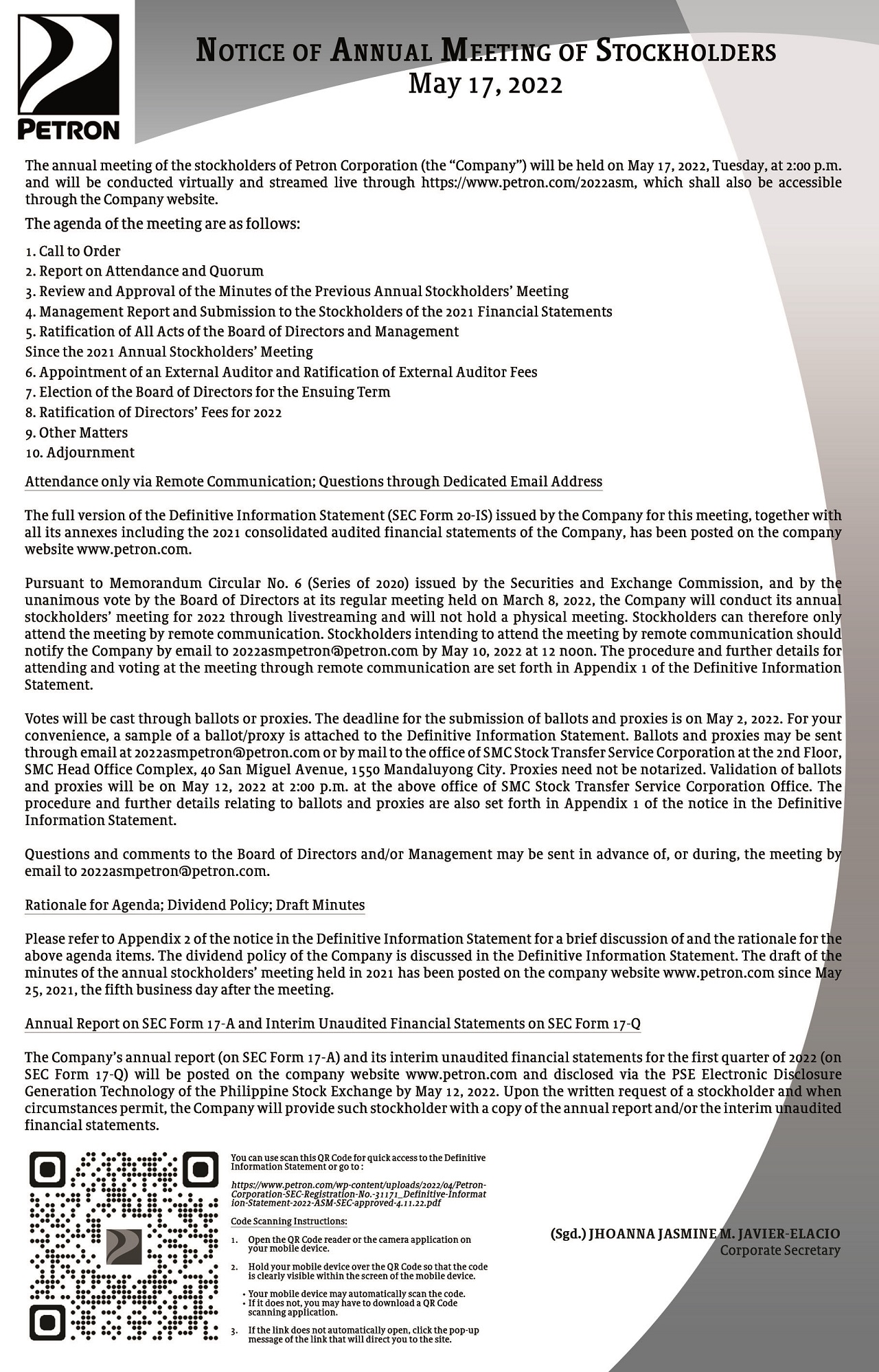
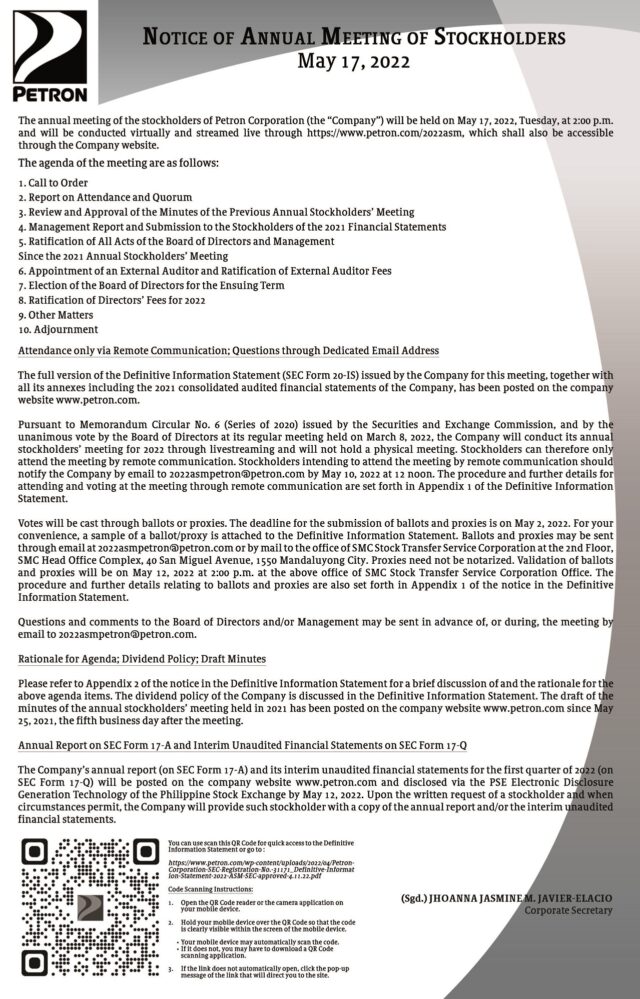
Petron Corporation announces schedule of annual meeting of stockholders

Click to enlarge.
Click to enlarge.


Spotlight is BusinessWorld’s sponsored section that allows advertisers to amplify their brand and connect with BusinessWorld’s audience by enabling them to publish their stories directly on the BusinessWorld Web site. For more information, send an email to online@bworldonline.com.

Join us on Viber to get more updates from BusinessWorld: https://bit.ly/3hv6bLA.

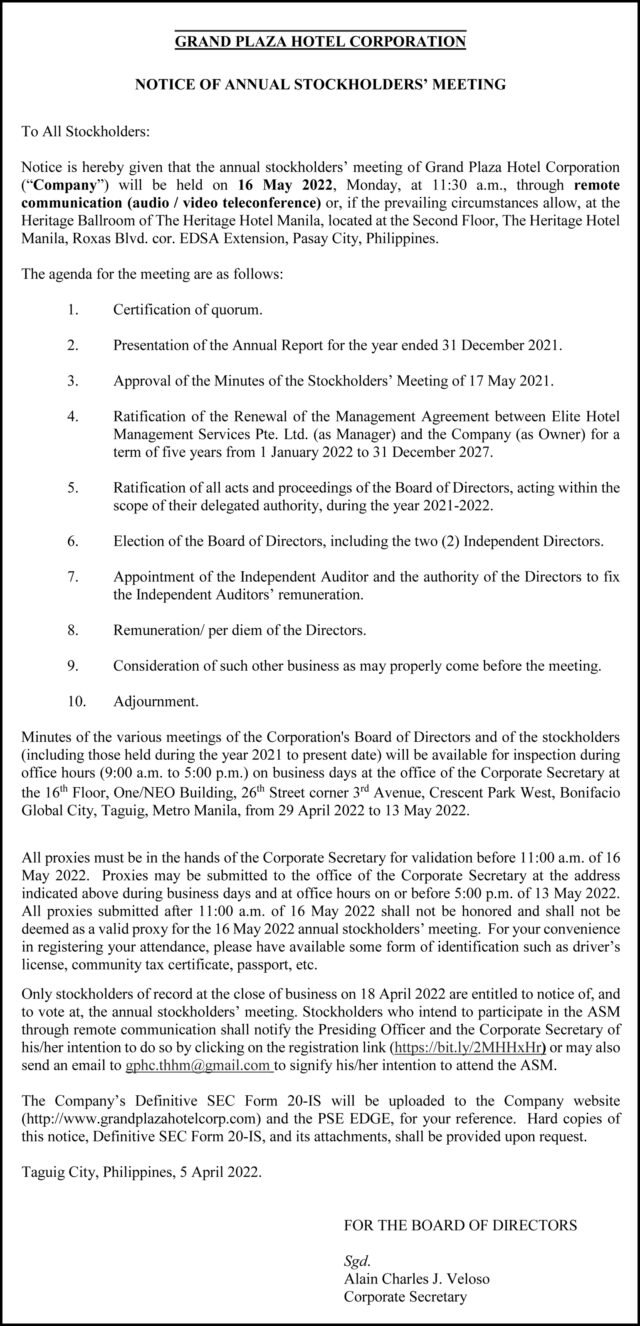
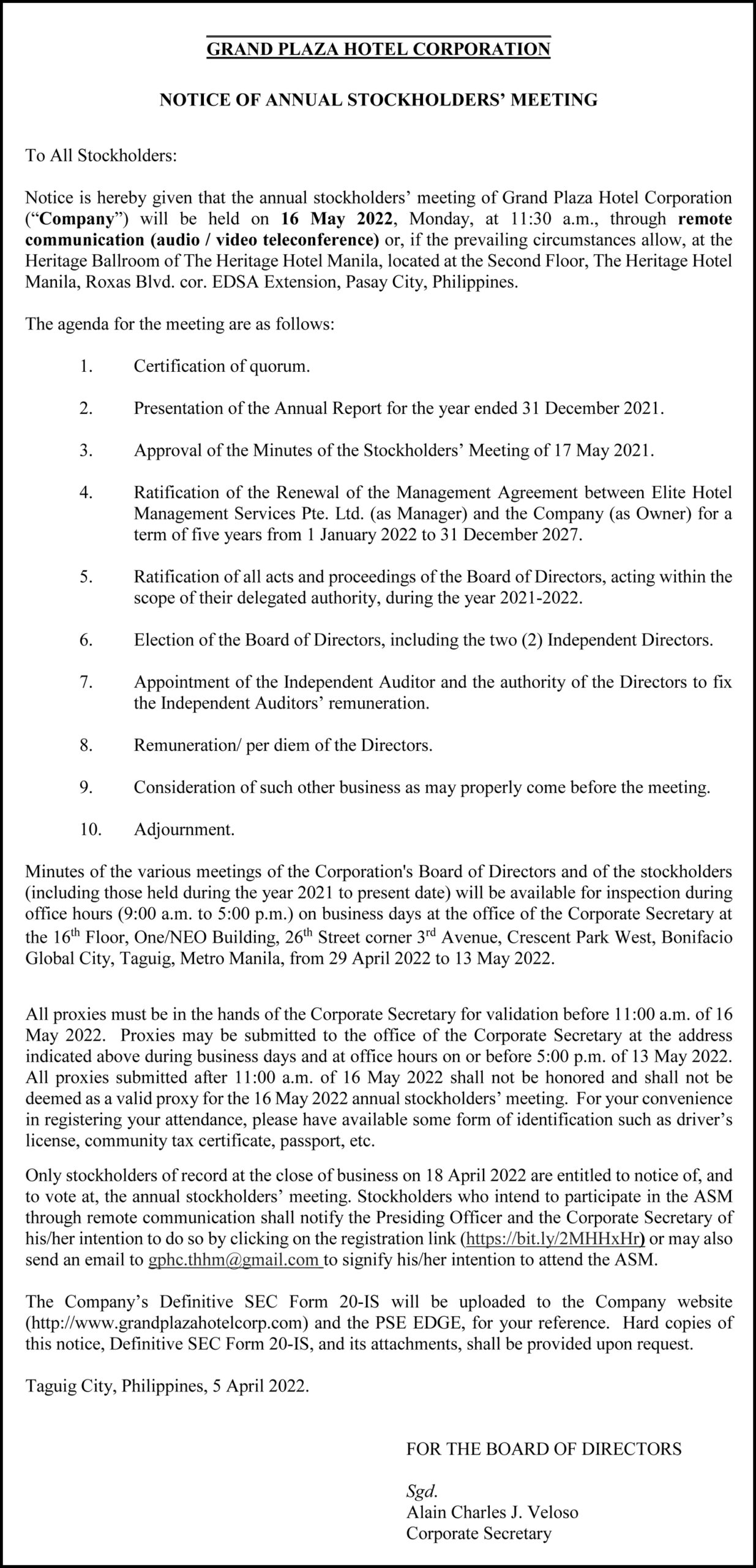
Grand Plaza Hotel Corp. to conduct annual stockholders’ meeting through remote communication on May 16

Click to enlarge.
Click to enlarge.

Spotlight is BusinessWorld’s sponsored section that allows advertisers to amplify their brand and connect with BusinessWorld’s audience by enabling them to publish their stories directly on the BusinessWorld Web site. For more information, send an email to online@bworldonline.com.

Join us on Viber to get more updates from BusinessWorld: https://bit.ly/3hv6bLA.