Home Blog Page 6466

IPOPHL in anti-piracy tieup with Japanese content organization

REUTERS

THE Intellectual Property Office of the Philippines (IPOPHL) said it has entered into an anti-piracy partnership with Japan’s Content Overseas Distribution Association (CODA).  

IPOPHL said the memorandum of understanding with CODA, signed on Jan. 25, will seek to protect the copyrighted Philippine and Japanese content in their respective jurisdictions via information exchange, research, online monitoring, and site blocking to improve enforcement efforts in the Philippines and Japan.

IPOPHL Director General Rowel S. Barba said cross-border collaboration is important amid increased digitalization and globalization.  

“Cross-border collaboration can help keep the wheels of creativity moving forward and help open greater international opportunities to the Philippine creative industry, which suffered massive job losses in this pandemic,” Mr. Barba said.

IPOPHL said that its Intellectual Property Rights Enforcement Office recorded 31 piracy complaints and reports in 2020.   

“This MoU will be a game-changer in our fight against piracy, a matter we must urgently address amid heightened intellectual property violations during the pandemic,” Mr. Barba said.

CODA promotes the international distribution of Japanese music, film, animation, TV programs and video games. — Revin Mikhael D. Ochave

USAID, Nestlé PHL in climate change, waste management partnership

PHILIPPINE STAR/ MICHAEL VARCAS

THE United States Agency for International Development (USAID) and Nestlé Philippines, Inc. have entered into a partnership to improve solid waste management practices and implement a climate change education program.

“Combatting ocean plastics pollution is a challenge that requires strong partnerships. USAID is pleased to partner with Nestlé Philippines in supporting local governments to reduce waste-linked contributions to ocean plastics and the climate crisis,” USAID Philippines Mission Director Ryan Washburn said in a statement.

The partnership will be undertaken via the Clean Cities, Blue Ocean (CCBO) program, with a focus on local solid waste management. The program will be conducted in conjunction with Nestlé Philippines’ Climate Change and Solid Waste Management Education Program.

Launched in 2019, CCBO is a P2.5-billion program that will run until 2024.

“As a food and beverage manufacturer with a major presence in the country, we are called upon to be at the forefront in helping tackle the urgent issues of climate change and plastic waste. As Nestlé Philippines sustains plastic neutrality, and other pioneering initiatives for the environment, it is important for us to help capacitate people at the grassroots level,” said Nestlé Philippines Chairman and Chief Executive Officer Kais Marzouki.

USAID said that the program is also intended to help local government units that struggle to implement and enforce regulations.

“By strengthening waste management systems and building circular economies city by city, the program builds sustainable solutions that reduce ocean plastics while empowering vulnerable populations and mitigating pollution that affects human health and the climate,” USAID said. — Luisa Maria Jacinta C. Jocson

Hiring managers have generally positive views of  ‘job hoppers’ — survey

PHILSTAR

JOB HOPPING is generally viewed positively in the Philippines, according to the results of a survey conducted by consumer data and analytics firm Milieu Insight.   

In a statement on Tuesday, Milieu Insight said the survey, conducted in December with 6,000 respondents drawn from Singapore, Thailand, Malaysia, Indonesia, Vietnam, and Philippines.

According to the survey, 64% of Philippine respondents involved in hiring had a positive view of job switchers, while 28% held neutral opinions, and 7% considered the practice to be negative.

The study defined a job-hopper as someone who has less than one year’s tenure in his or her current job but is searching for new employment.

Milieu Insight said 57% of respondents in the Philippines believe that job hoppers are capable of learning faster in a new environment, while 55% see them to have more diversified skill sets.

The study found that 46% of respondents consider job hoppers to be resilient to changes in the working environment while 41% of respondents believe them to hold clear ideas of what they want and do not want.

The main concerns about the practice of frequent job switching were the fear that such workers will be seeking opportunities elsewhere (66% of respondents) and that such workers are uncertain of their ultimate career goals (48%).

Milieu Insight added that 43% of respondents are concerned about a lack of worker loyalty.

The survey also found that 72% of respondents in the Philippines are somewhat or very likely to take an offer and leave their current company if they are presented with a better opportunity, while 21% were neutral on the matter, and 6% were somewhat or very unlikely to leave their jobs.

The Philippine Statistics Authority estimated the employment rate at 93.5% in November, against the 92.6% posted in October. The November rate is the equivalent of 45.48 million employed persons.

Unemployment in November was 6.5%, equivalent to 3.16 million persons. The October rate was 7.4% or 3.50 million unemployed persons. — Revin Mikhael D. Ochave

Red tide warning issued for Bataan, Masbate, Bohol

THE Bureau of Fisheries and Aquatic Resources (BFAR) has issued a red tide warning for parts of Bataan, Masbate, Bohol, Zamboanga del Sur, and the two Surigao provinces.

The BFAR said it detected paralytic shellfish poison (PSP) in shellfish harvested from those areas.

The specific areas where the warning applies are Mariveles, Limay, Orion, Pilar, Balanga, Hermosa, Orani, Abucay and Samal, Bataan; Milagros, Masbate; Dauis and Tagbilaran City, Bohol; Dumanquillas Bay, Zamboanga del Sur; Litalit Bay, Surigao del Norte; and Lianga Bay, Surigao del Sur.

Shellfish and alamang (Acetes sp. or krill) from these areas tested for PSP beyond the regulatory limit and are deemed unsafe for human consumption.

Fish, squid, shrimp and crab caught from these waters are safe to eat after removing the internal organs and thorough cleaning.

Meanwhile, Biliran Islands, Leyte, and Samar were declared red tide-free.

Consuming infected shellfish can cause poisoning, affect the nervous system, and paralyze muscles. — Luisa Maria Jacinta C. Jocson

Philippine presidential bets kick off 2022 campaign

PHILIPPINE presidential candidates started their three-month campaign on Tuesday with grand rallies and parades aimed at wooing millions of voters more concerned about personalities than policies. 

Six candidates vying to succeed President Rodrigo R. Duterte have until May 7 to present their platforms and convince Filipinos to vote for them two days later. Nine are running for vice-president. 

The late dictator’s son Ferdinand “Bongbong” R. Marcos, Jr. is leading opinion polls on a race dominated by powerful clans and influenced by religious blocs. 

Mr. Marcos launched his campaign at the world’s largest indoor arena in Bulacan province owned by the religious group Iglesia Ni Cristo (INC). The group is known to vote as a bloc and had historically backed the Marcoses. 

Political analysts have said more than a million INC voters might be enough to swing the votes. 

“It is just a venue,” Marcos lawyer Victor D. Rodriguez told reporters when asked if the religious group had endorsed his client and running mate and presidential daughter Sara Duterte-Carpio. 

The candidate’s rally was hosted by actress Celestine “Toni” Gonzaga, whom civic groups had criticized for allegedly downplaying the atrocities committed during the martial law regime of his father, the late dictator Ferdinand E. Marcos. 

At the program, Mr. Marcos reiterated his call for unity, which has been heavily criticized by victims of his father’s martial rule. 

Also running for president are incumbent Vice-President Maria Lenor “Leni” G. Robredo, former matinee idol and Manila Mayor Francisco “Isko” M. Domagoso, boxing champion and Senator Emmanuel “Manny” D. Pacquiao, Senator Panfilo M. Lacson who is a former police chief and labor leader Leodegario “Ka Leody” de Guzman 

Ms. Robredo, a former lawyer for the poor, started her pink-colored campaign in Lupi town in Camarines Sur province. A distant second in opinion polls, she has vowed to “defeat the old and rotten brand of politics.” 

She was thrust into the political limelight after the death of her husband and local government champion Jesse M. Robredo. She ran for a House of Representatives seat in 2013 and won. 

Mr. Duterte, who is barred by law from running for reelection, on Monday night said almost all of the candidates had sought his endorsement, but he was not supporting any of them at the moment. “At this time, I am saying that I’m not supporting anybody,” he told a televised Cabinet meeting. 

He had chosen loyal aide Senator Christopher Lawrence T. Go to replace him, but he pulled out of the race. 

Mr. Duterte, who is stepping down in less than five months, said he had been longing for retirement. “I have started packing. I have had some of my belongings shipped.” 

SIGNATURE TUNE
Meanwhile Mr. Domagoso started the first day of the national campaign with a mass in Tondo, Manila where he grew up. 

He was seen dancing to the tune of “Dying Inside to Hold You” as speakers blasted his signature tune, while his motorcade passed through a street in the district of Tondo, where he collected garbage as a boy. 

Mr. Domagoso said he had a good chance of winning just like Mr. Duterte, who was mayor of Davao City before he became president in 2016. 

He said people’s lives have not improved under the late dictator and his successor, democracy icon Corazon C. Aquino. “If you’re tired of these two, I’m just here.” 

Mr. Pacquiao started his uphill climb to the presidency with a caravan in his hometown of General Santos City. Starting at the village of Bawing to the Oval Plaza Stand where he was to have his proclamation rally. 

At his rally, the boxing champ said government corruption is the root cause of poverty. “The fight of Manny Pacquiao is not a fight for myself no my family. Rather, it is a fight for every Filipino.” 

Mr. Lacson started his campaign in his hometown of Imus in Cavite province. He vowed a “disciplined” campaign, leading by example and avoiding mudslinging. 

“The people may not be our masters, but definitely we are your servants,” he said at his proclamation rally. “If I become the president, I will not embarrass you. I will not fail you.” 

Meanwhile, Mr. de Guzman held his proclamation rally at the Bantayog ng mga Bayani (Heroes’ Monument) in Quezon City later in the day. 

At his proclamation rally, he said it is time for workers and the poort to lead the country. “The problems of the rich are different from the ordinary Filipino which is why those in power do not take our country’s problems seriously,” he said in Filipino. 

He also reiterated his plan to impose a wealth tax on the richest Filipinos. “This should be the government of the people, not the government of billionaires.” 

Senatorial candidates also kicked off their campaign, including six lawmakers who are seeking reelection. 

Senator Leila M. de Lima, one of Mr. Duterte’s staunchest critics, said her “unjust detention” would not prevent her campaigning. She would use surrogates, video messages and dispatches to woo voters. 

Senator Richard J. Gordon, on his final term, vowed to fight corruption and incompetence in government. “Our crusade against corrupt and abusive members of the government will not end here because we will continue to hold those who steal and sin against the people accountable.” 

Senator Ana Theresia “Risa” N. Hontiveros-Baraquel held a caravan in Camarines Sur, focusing on jobs, health and economic revival. 

The three are part of Ms. Robredo’s senatorial slate. 

Senator Joel J. Villanueva, who is running as an independent for a second term, pledged to continue his agenda of job creation. 

Also running for reelection are Juan Miguel F. Zubiri and Sherwin T. Gatchalian. 

Antique Rep. Lorna Regina “Loren” B. Legarda, who had been a senator for three terms, vowed to prioritize the poor “as we tread on the path towards sustainable and green pandemic recovery.” 

Former Duterte spokesman Herminio L. Roque, Jr., who is part of Mr. Marcos’s senatorial lineup, vowed to improve healthcare and reform the justice system. — Kyle Aristophere T. Atienza, Alyssa Nicole O. Tan, Jaspearl Emerald G. Tan and John Victor D. Ordoñez


DoH reports 3,574 more COVID cases, 83 more deaths

PHILIPPINE STAR/ MICHAEL VARCAS

THE DEPARTMENT of Health (DoH) posted 3,574 coronavirus infections on Tuesday, bringing the total to 3.62 million.

The death toll hit 54,621 after 83 more patients died, while recoveries rose by 14,644 to 3.46 million, it said in a bulletin.

It said 16.3% of 23,754 samples on Feb. 5 tested positive for coronavirus disease 2019 (COVID-19), still above the 5% threshold set by the World Health Organization (WHO).

Of 105,550 active cases, 4,059 did not show symptoms, 96,722 were mild, 3,007 were moderate, 1,446 were severe and 316 were critical.

The DoH said 87% of the latest cases occurred from Jan. 26 to Feb. 8. The top regions with new cases in the past two weeks were Metro Manila with 528, Western Visayas with 357 and Central Visayas with 308 infections. It added that 64% of new deaths occurred in February.

The agency said 328 duplicates had been removed from the tally, 276 of which were recoveries, while 35 recoveries were relisted as deaths. Six laboratories failed to submit data on Feb. 5.

DoH said 41% of intensive care unit beds in the country had been used, while the rate for Metro Manila was 35%.

The country’s average daily cases fell by 52% last week from a week earlier, Health Undersecretary Maria Rosario S. Vergeire told an online news briefing.

Zamboanga Peninsula, the Davao region, Soccsksargen and Northern Mindanao were at high risk from the virus, she added.

The government is scrambling to vaccinate more people as it reopens the national economy.

The Philippines had fully vaccinated 60.15 million people as of Feb. 7, while 60.74 million have received their first dose, data from the Health department showed. About 8.24 million booster shots have been injected.

The government is also aiming to inject booster shots to 72.16 million adults and 12.47 million minors aged 12 to 17.

On Feb. 7, The government started vaccinating children aged five to 11. The government aims to inoculate 15.56 million kids under the age bracket.

Ms. Vergeire said more than 9.2 million children aged 12-17 have been vaccinated with no deaths reported. Among the more than 9,000 kids vaccinated on Monday, only one child reported a mild reaction, she added.

Meanwhile, the government would keep the virus alert system, presidential spokesman Karlo Alexei B. Nograles told a televised news briefing.

The five-tier alert level system will be institutionalized in the fifth phase of the National Economic Development Authority’s national action plan “to serve as our warning system for possible increase in cases or outbreaks,” he said.

“Alert Level 1 is our new normal, which focuses on enhancing risk management, although it appears to be less restrictive,” he added.

Agencies are working on a national roadmap so the country could move toward living with COVID-19, Mr. Nograles said.

“We feel that it is now time to start discussing and planning out a roadmap so we can already start living with COVID-19, and we will start doing that this month,” Vivencio B. Dizon, deputy enforcer of the country’s pandemic plan, told a televised Cabinet meeting on Monday night.

Meanwhile, DoH has lowered the price cap on COVID-19 antigen test kits to P350 from P500, based on a Jan. 28 circular released on Tuesday. — Kyle Aristophere T. Atienza

Vote buying incidents may now be reported through Comelec’s social media accounts

VOTE BUYING, the act of giving money or other forms of valuable goods in exchange for guaranteed support on election day, may now be reported through social media platforms, the Commission on Elections (Comelec) said on Tuesday as the official campaign period started for national candidates. 

Comelec Spokesman James B. Jimenez, however, stressed that the public’s responsibility does not stop at merely reporting the vote buying incident — and/or selling, which means acceptance of the bribe.

“If you see vote-buying, you should document the vote-buying activity, file a  formal complaint, and pursue the case to the end,” Mr. Jimenez said in a tweet on Tuesday.

He also said that simply posting pictures of campaign materials with stapled money does not count as a formal complaint.

Formal reports of election violations may be coursed through Comelec’s social media accounts using the #SumbongKo tag, Mr. Jimenez said in a press briefing on Tuesday.

Giving out food assistance or anything of value is also prohibited, Comelec Director Elaiza S. Sabile-David said in a radio interview over DZBB on Tuesday.

E-WALLET
Mr. Jimenez also said that Comelec is planning to address the possible use of electronic-wallet services for vote-buying. 

“We haven’t made any concrete agreements with these e-wallet services, but we’re trying to get something down,” he said.

He added that it is difficult to prove someone’s use of an e-wallet service for criminal purposes like vote buying.

Vote buying or selling is illegal under the Omnibus Election Code. Those found guilty face penalties of imprisonment for one to six years, disqualification from public office, and forfeiture of one’s right to vote. 

A political party found guilty faces a fine of at least P10,000. 

Mr. Jimenez also reminded candidates and supporters that  

campaign materials have to comply with Comelec rules such as using designated public areas for posters and a maximum size of two-by-three feet. 

Meanwhile, the poll body has printed 17.5 million ballots as of Monday for the May 9 polls, data from Comelec showed.

This total includes about 60,000 local absentee ballots, 79,080 overseas manual ballots, 2.6 million ballots for the Bangsamoro Autonomous Region in Muslim Mindanao, and 1.6 million overseas automated elections system ballots. 

Comelec is set to print 67.4 million ballots, including 65.7 million for voters nationwide and 1.7 million for overseas voters, according to Comelec Deputy Executive Director Helen C. Aguila Flores. — John Victor D. Ordoñez 

Business adviser urges gov’t to shift to ‘recovery mode’ with Alert Level 1 by March

PHILIPPINE STAR/ MICHAEL VARCAS

PRESIDENTIAL Adviser for Entrepreneurship Jose Ma. A. Concepcion III called on the government to place the country under pandemic Alert Level 1, the least restrictive under a five-level system, by March to sustain economic recovery.

Mr. Concepcion said in a statement on Tuesday that Alert Level 1 should be implemented starting next month as the country is seen to record lower coronavirus cases, citing an estimate by the OCTA Research Group that daily infections will drop to 1,000 to 2,000 by end-February. 

“We need to de-escalate our countrymen from crisis mode to recovery mode,” Mr. Concepcion said. 

“This is important if Filipinos (have) to come out and help rebuild our country by engaging in economic activity like going to shops, dining out, traveling or going back to work.”

Mr. Concepcion said a shift to Alert Level 1 will have a big effect on the country’s economic recovery, adding that areas with high vaccination rate can implement a no alert level status while maintaining minimum health protocols such as wearing of face mask. 

“I think that as long as there are no variants of concern, and we have already achieved a high vaccination rate and hospital utilization rate is low, we can already start to consider lifting alert levels,” he said. 

Mr. Concepcion also suggested that the government should firm up the timing for administering booster shots, noting that immunity will eventually wane and thousands of vaccines are approaching expiry date.

During an interview in ABS-CBN News Channel on Tuesday, Mr. Concepcion also recommended that the alert level system should eventually be set aside and just reimplemented if there is another virus outbreak.

“Six months or eight months or a year from now, we don’t know if there’ll be another virus, maybe more contagious. But the alert level system is still there. So, we can bring it back once we see the threat,” he said. “My only suggestion is maybe we can trim it down instead of Alert Level 1 to 5, maybe we can trim it down to Alert Level 1 to 3.” — Revin Mikhael D. Ochave

Duterte orders gov’t agencies to prepare for use of national ID in delivery of services

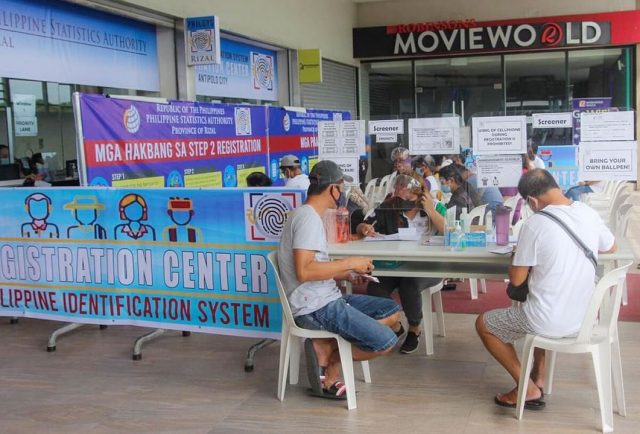
PRESIDENT Rodrigo R. Duterte has issued a memorandum circular directing agencies to prepare for the use of the Philippine Identification System (PhilSys) and its integration into government processes. 

Memorandum Circular No. 95, signed on Feb. 7., mandates all government agencies — including government-controlled corporations, local government units, and government financial institutions — to incorporate and integrate in their respective databases and services the Philsys Number (PSN) and Philippine Identification (PhilID) of registered individuals as well as the other components of PhilSys. 

“The covered agencies shall prioritize PhilSys integration to enable the use of PhilSys-enabled services, involving, among others, online authentication processes and proper controls for the PhilID, including features such as real-time authentication and validation, as established by the Philippine Statistics Authority (PSA), within two years from the launching of the said services in their respective agencies,” the memo states. 

The circular orders covered agencies to identify processes that can utilize the Philsys as well as determine the appropriate types and quantity of biometric authentication devices that need to be procured. 

Agencies are also mandated to develop their respective two-year work plans indicating the activities to be covered by the integration initiative; and coordinate with and enter into formal agreements with the PSA to ensure effective implementation of the PhilSys integration. 

Mr. Duterte signed the law that created PhylSis in 2018. 

A total of 50,014,382 Filipinos completed the second step of PhilSys registration as of Dec. 11, 2021, according to PSA. 

Step 1 involves submission of data; step 2 covers data validation; and the last step is the issuance of the PhilSys Number and ID. — Kyle Aristophere T. Atienza 

Solon says farmers can have direct link to retailers through digital platforms like dating apps

BLOOMBERG

A LAWMAKER said farmers can cut out middlemen and sell directly to retailers through digital platforms like dating apps, citing a model project in Butuan City called AgriBOOST. 

“These apps would sort of be like dating apps but being matched are the farmers, livestock raisers and fisherfolk on one side, while on the other side are vendors for public markets, supermarkets and cooperatives,” said Rep. Lawrence H. Fortun who represents the 1st district of Agusan del Norte which covers Butuan.

The city, located in southern Philippines, was one of the 15 winners of Bloomberg Philanthropies’ 2021 Global Mayors Challenge for the AbriBOOST project. 

Mr. Fortun called on telecommunication companies and financial institutions to step in to hasten the development of similar initiatives across the country. 

He said telecom service providers can tap their e-commerce platforms to make “mobile apps for farmers, livestock growers, and fishermen to achieve sustainable and profitable economies”.

In the financial sector, he said the Banko Sentral ng Pilipinas, Securities and Exchange Commission and the Department of Agriculture can jointly draft guidelines for the establishment of regional and national commodities trading boards. 

“The regional bourses must be auditable by the country’s many reputable audit firms and should address current and immediate local supply and demand, as well as future needs of the market within 12 months, especially the lean months or up to three cycles of harvests,” he said. — Jaspearl Emerald G. Tan

Cebu woos return of direct flights with top 3 tourist markets Japan, Korea, China

THE CEBU provincial government met with the consuls of Japan, Korea and China on Monday to push for the resumption of direct flights soon as the Philippines reopens its borders to fully-vaccinated foreign tourists starting Feb. 10. 

Gov. Gwendolyn F. Garcia also said that the local government intends to disregard the national government’s policy of recognizing only the vaccination certificates of countries with a reciprocal arrangement with the Philippines. 

“The governor will issue a memorandum that will lay down Cebu’s own protocols for vaccinated foreign tourists, particularly taking away this reciprocal arrangement requirement, as stated by IATF in its new ruling,” the Cebu provincial government said in a statement. 

Ms. Garcia stressed that the primary goal of all efforts to safely reopen Cebu’s borders is to help the tourism industry get back on its feet.

Hotel, Resort, and Restaurant Association of Cebu President Alfred Reyes said the industry is counting on the return of foreign tourists to drive occupancy rate as the government has already withdrawn the facility-based quarantine requirement for returning Filipinos. 

The Mactan-Cebu International Airport, located in central Philippines, is the second busiest gateway in the country. — MSJ

QC partners with fintech firm for SME financial literacy program

THE QUEZON City government has partnered with credit firm First Circle for a financial literacy program directed at the city’s over 75,000 small and medium enterprises (SMEs). 

“This is something very different and has not been done in our city… Through this partnership, we can provide two-pronged support to our entrepreneurs — financial assistance as well as financial literacy,” Mayor Maria Josefina “Joy” G. Belmonte said during the partnership agreement signing on Feb. 7. 

“We know that our SMEs need more help to survive in the competitive world of business in the midst of the pandemic,” she said.

The program will provide free quarterly webinars on money management and loans, and other topics intended to help business owners recover and grow their enterprises. 

“We’ve got a long road ahead of us but we’re very excited for everything to come,” First Circle Chief Executive officer Patrick Lynch said.

The Quezon City government previously rolled out other assistance projects for SMEs, such as a subsidy scheme to help cover wages and capital funding for unique startups.