Home Blog Page 64

An old-fashioned cure for fading trust in government

STOCK PHOTO | Image by Vwalakte from Freepik

By Clive Crook

ACROSS much of the industrial world, trust in government is low and declining. Why is this happening and why, exactly, does it matter? An unusually thorough new study looks at these questions and finds answers that are somewhat unexpected and, in one way, more disturbing than you might have guessed.

The fact of diminished trust is hardly a revelation, least of all in countries such as the US, where anti-establishment populists have turned politics upside down and elite expertise has become not just distrusted but disdained.

Last year a survey found that fewer than one in six Americans expect Washington to do the right thing “nearly always” (1%) or “most of the time” (15%). At the turn of the century, such measures for the US were more than twice as high. Across the Organization for Economic Cooperation and Development, many other countries (including the UK, the Netherlands, Spain, New Zealand, and Chile) have also seen trust decline. But in others (such as Finland, Ireland, Portugal, and Mexico) trust has increased. Levels of trust, as opposed to rates of change, also vary a lot. These widely differing patterns make it possible to examine causes.

On the face of it, the collapse of trust seems like a phenomenon of social psychology — a perspective that tends to highlight a confluence of cultural and technological factors. Social media, disinformation and misinformation, echo chambers, epistemic bubbles and whatnot are often taken to be responsible.

This view is mistaken, according to a study by Michael Boskin, Alexander Kleiner and Ian Whiton, all from Stanford University. Their paper adds to a body of research that says straightforward economic factors are what count. Looking at 34 countries between 2007 and 2023, they find that per capita gross domestic product, debt, social spending, unemployment, and inflation all have pronounced effects on trust in government. In their analysis, the interactions and trade-offs among these measures largely explain the outcome, leaving non-economic factors to play “only a supporting role.”   

Overall, an increase in per capita GDP (in real, after-tax terms) of $1,000 corresponded to a rise in trust of 0.2 percentage points. The effect of higher social spending was even more pronounced: An increase of $1,000 per capita is associated with a 1.4 percentage-point increase in trust. Higher inflation and higher unemployment both reduce trust, as you’d expect; each increase of a percentage point reduces trust in government by 1.6 and 1.0 percentage points, respectively. Half a century ago, the economist Arthur Okun coined the “misery index,” the sum of the rates of inflation and unemployment. Evidently, misery means distrust, and inflation is especially likely to induce it.

More important are the trade-offs connecting these various measures. Other things being equal, trust rises when social spending goes up. If higher spending coincides with a period of high unemployment and spare economic capacity, it’s likely to cut joblessness without pushing inflation up. The net effect, thanks to lower unemployment, would then be an even bigger improvement in trust. But if the spending coincides with full employment and no spare capacity, it will likely drive up inflation — most likely by enough to yield a net reduction in trust. The authors surmise that this is what happened in many countries, especially the US, once the recovery from the pandemic was well under way.

One way to summarize the finding is to say that sound macroeconomic management — not the same as “big government” or “small government” — promotes trust, and that the main test of sound macroeconomic policy is low unemployment and (especially) low inflation. But there’s another more unsettling implication: Declining trust will be self-reinforcing if, as seems likely, it makes sound macroeconomic policy more difficult.

A vicious circle of macro mismanagement and declining trust is plausible. Inflation expectations are anchored by the credibility of policymakers’ commitment to keep prices under control. If that credibility erodes, achieving low inflation gets harder. And this risk isn’t confined to the decisions made by central banks. Fiscal policy is equally implicated. Rising debt arouses distrust in its own right; at a certain point, it also calls into question the government’s preference for low inflation (because higher inflation would reduce the debt in real terms). Higher inflation means less trust; less trust makes higher inflation more likely. Trust in government requires good government; good government requires trust in government.

The good news in this study is that restoring trust might be more straightforward than cultural revolution and/or technological stasis. Plain old sound economic management — with particular stress on keeping inflation tamed — might suffice. The bad news for countries like the US, which have seen trust in government fall so precipitously, is that sound economic management is now a lot more difficult than before.

BLOOMBERG OPINION

Globe sees strong growth potential in digital landscape

GLOBE.COM.PH

GLOBE TELECOM, INC. is banking on the Philippines’ upbeat digital outlook, citing a tech-savvy population and supportive policies as it accelerates network expansion.

“I’m hopeful and optimistic about the Philippine telecom industry because we still have many opportunities ahead… We have a young population, strong digital habits, and real demand. We need to further unlock that potential,” Globe President and Chief Executive Officer Carl Raymond R. Cruz said in a media release on Sunday.

Globe said the Philippines is becoming more connected and that the country is well positioned to capture expanding digital growth.

“The country’s outlook remains positive. The Philippines has a young, tech-forward population and a policy environment that recognizes the importance of digital access,” the company said.

The company said these factors position Globe to continue strengthening its network while allowing it to offer solutions that support emerging digital capabilities.

Globe also said the growing adoption of artificial intelligence (AI) will place additional strain on both wireless and fixed networks. It added that building a national fiber backbone is a crucial step in meeting future digital demand, as mobile networks may not be sufficient on their own to support projected traffic growth.

The country’s digital economy is set to reach $36 billion in gross merchandise value (GMV) this year, supported by rapid adoption of e-commerce, transport and delivery services, digital finance, and AI, according to a report by Google, Temasek Holdings and Bain & Company.

The report projected that the country’s overall digital economy could reach $70 billion to $140 billion in GMV by 2030, slightly lower than last year’s forecast of $80 billion to $150 billion.

The Department of Information and Communications Technology (DICT) aims to raise the digital economy’s share of total output to 12.5% by 2028, fast-tracking digital infrastructure projects and attracting hyperscalers to operate in the country. — Ashley Erika O. Jose

PHL’s 1st industrial corn complex seen curbing post-harvest losses

REUTERS

A NEWLY opened industrial corn facility in Ilagan City, Isabela is expected to strengthen the province’s role in the corn value chain and help farmers minimize post-harvest losses, especially during the wet season, according to the city agriculture office.

The Industrial Corn (I-Corn) Complex, which became operational last month, provides drying and post-harvest services to about 17,000 maize growers in Ilagan City.

According to the City Agriculture Office, the complex is the first public facility of its kind in the country. It was built in collaboration with the Department of Agriculture (DA) and the city government, which provided the five-hectare site and land development services.

The I-Corn Complex forms part of a P250-million DA project, with its first phase, worth P107 million, now operating eight dryers with a total capacity of 120 metric tons (MT) a day.

City agriculturist Moises C. Alamo told reporters that the project is designed to support farmers in maintaining grain quality and addressing the lack of drying facilities, a common challenge during the wet season.

“Some farmers harvest late, sometimes not until November, due to a shortage of manpower or machinery, especially in hilly areas where combine harvesters cannot operate. By those months, rainfall is usually heavy, and the moisture damages the quality of the corn,” he said.

Mr. Alamo said timely drying is crucial to prevent the buildup of aflatoxin, which develops when wet corn is stored for too long.

“If aflatoxin levels are high, the corn can no longer be used as animal feed because it becomes toxic. That’s why we make sure to protect the quality of our corn. The lower the quality, the lower the price in the market,” he said.

The City Agriculture Office said the second phase of the project will include a warehouse and feed mill to supply livestock growers. A 500-MT silo for feed storage has been built in preparation for these operations.

“I hope the release of funds will be expedited so that by 2026 the feed mill can be constructed to meet the livestock feed requirements,” Mr. Alamo said.

He added his office also hopes that similar drying and post-harvest facilities be built for other corn-producing areas in the region.

Ilagan City is the largest corn producer in Isabela. The city accounts for roughly 2%, or over 150,000 MT, of the country’s annual total corn production. — Vonn Andrei E. Villamiel

BSP securities fetch lower average rate

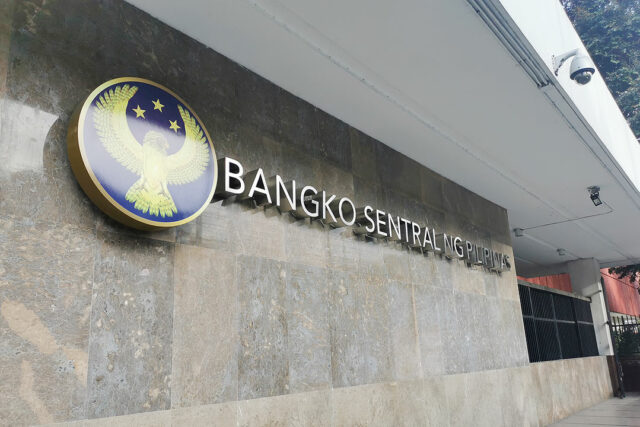
Bangko Sentral ng Pilipinas main office in Manila. — BW FILE PHOTO

THE BANGKO SENTRAL ng Pilipinas’ (BSP) one-month securities fetched a lower average yield on Friday as the offer attracted strong demand.

The 28-day BSP bills fetched bids amounting to P137.421 billion on Friday, exceeding the P90 billion on offer and the P101.405 billion in tenders the prior week. The central bank made a full award of its offering.

Accepted yields for the tenor ranged from 4.9% to 4.99%, wider and lower than the 4.95% to 5.05% band logged a week ago. This caused the weighted average accepted rate of the 28-day papers to decline by 6.45 basis points to 4.9461% from 5.0106%.

“The 28-day BSP bill rate declined,” the central bank said in a statement. “The BSP maintained the total offer volume at P90 billion, while total tenders reached P137.4 billion, resulting in a bid-to-cover ratio of 1.53x.”

This was higher than the bid-to-cover ratio of 1.13 times seen in the previous offering.

The BSP has not auctioned off the 56-day bills for over a month or since Oct. 24.

The central bank uses the BSP securities and its term deposit facility to mop up excess liquidity in the financial system and to better guide short-term market rates towards its policy rate.

The BSP bills also contribute to improved price discovery for debt instruments while supporting monetary policy transmission, the regulator has said.

In August, BSP Governor Eli M. Remolona, Jr. said they are gradually shifting away from the issuance of short-term papers to manage liquidity as they want to boost activity in the money market.

The central bank started auctioning off short-term securities weekly in 2020, initially offering only a 28-day tenor and adding the 56-day bill in 2023.

Data from the central bank showed that around 50% of its market operations are done through its short-term securities. — K.K. Chan

Two designers, one outfit

A designer and a former muse team up for a pop-up

DESIGNER IVARLUSKI ASERON and model-then-photographer-then-designer Jo Ann Bitagcol have teamed up to open a pop-up at Rockwell’s Powerplant Mall. Their store opened with a Dec. 1 launch and will run until February next year.

PLACKET TAILORING
As a designer, Ms. Bitagcol is known for printing her own photographs of Philippine artifacts on fabric. Meanwhile, Mr. Aseron, with more than 20 years of fashion under his belt, has been known for many innovations, including gowns made with page-leaf effects. The duo goes a bit lean for this ready-to-wear (RTW) collaboration: Ms. Bitagcol’s boxy tops are reimagined into kamisa chino (a traditional Filipino collarless shirt with buttons down a short placket) and feature her signature barong print. The sporty kimono, a relatively new addition to her line, is given a new look with the use of fine handwoven piña and hand-beaded accents. There are also skirts, pants, detachable terno sleeves, and even lace dresses. Meanwhile, Mr. Aseron’s collection features layers of checkered tulle over pleats and a muted palette of grays, whites, and trims of black. A new innovation which he introduced at the 2023 Red Charity Gala, is a puzzle piece that recalls a hobby and an advocacy for autism, seen in the clothes at the pop-up.

While Ms. Bitagcol’s ready-to-wear line can be seen in other designer friends’ stores, Mr. Aseron hasn’t done an RTW line in three years. He told BusinessWorld in an interview, “It’s not very often. I treat it in a special way.” He added, “Every time I do ready-to-wear, I give my all.”

The designers’ roots go deep: Ms. Bitagcol recalled walking for Mr. Aseron’s shows, not to mention that she approached him (and other designers) for input when she was designing her first line, according to a story the pair shared. “She’s very good at it,” said Mr. Aseron. “She doesn’t need to consult,” he teased.

Jokingly, Ms. Bitagcol said, “Ganoon (is that so)?”

For her part, she said, “I’m happy he allowed me to collaborate. I know him very well. He’s very particular. Allowing this to happen is a big deal for me.” To that, Mr. Aseron answered: “Stop it!”

While one would expect a line that combined both their sensibilities, there was only one such outfit in the whole store: one of Ms. Bitagcol’s prints was sewn underneath a sheer pocket on one of Mr. Aseron’s pieces. Asked why they only had one shared outfit, they both laughed, and Mr. Aseron said, “We didn’t have time! That’s it.”

Both had been offered separate spaces at the Powerplant Mall for this season, and they worked on their personal collections to be shown at these spaces. Unfortunately, neither could finish their collections in time, but combined, they had just enough for one store. “Shared space na lang, instead of giving it up,” said Ms. Bitagcol.

Asked about what they liked working with each other, Ms. Bitagcol said, “I have so much respect for Ivar’s aesthetic, creativity, and craftsmanship.” Mr. Aseron replied, “I have the same respect. Why would I have several pieces from her [in my wardrobe otherwise]?”

Aseron and Bitagcol’s Pop-Up Collaboration will run from December to February. Their space can be found at R2 Powerplant Mall, Rockwell Center, Makati. — Joseph L. Garcia

We cannot trust the tobacco industry in the fight against illicit trade

STOCK PHOTO | Image from Freepik

On Nov. 25, the Philippine Star published an opinion piece by Marichu Villanueva entitled “Defying the odds.”

The piece attacked illicit tobacco trade, a phenomenon that health advocates have likewise flagged as a threat to public health and government revenue. However, in the process of condemning those who participate in illicit trade (specifically unregistered cigarette brands), the article also whitewashes what the author calls “legitimate tobacco manufacturers” or registered tobacco brands.

“There is a world of difference between those who comply with the law and contribute to national development, as against those who operate in the shadows, undermining both revenue collection and public health and welfare,” the piece read.

Let’s get one thing straight: illicit tobacco is dangerous. When tobacco is cheap, it entices the price-sensitive youth. It defeats the purpose of raising tobacco prices through taxation to deter consumption. But all kinds of tobacco, whether licit or illicit, kill. Paying the legally mandated excise taxes does not give registered tobacco companies a pass or excuse them from “feeding nicotine addiction and endangering the public health system,” which is what the author only accuses unregistered brands of.

We cannot fall for the false narrative that the tobacco industry peddles: that they are reliable allies in the fight against illicit trade. Even registered tobacco brands have been proven to be complicit in illicit trade, the most prominent example being the case of tax evasion by the tobacco giant Mighty in 2017, when the company was exposed for using counterfeit tax stamps and was made to pay a total of P30 billion, the largest sum raised by the Philippine government from a tax settlement to date. The tobacco industry thus cannot feign innocence.

Legality aside, we must emphasize that from a public health perspective, even registered or “legitimate” cigarettes are harmful to health.

The legal tobacco industry opposes illicit trade because the latter eats up the market share of the former. But tobacco control advocates fight illicit tobacco trade because it is harmful to health and public revenues.

Globally, the tobacco industry has exaggerated the magnitude of illicit trade as a justification to lower tobacco taxes. The tobacco industry falsely claims that illicit trade and high tobacco tax rates are linked.

Earlier this year, there was a brazen attempt by Northern Luzon legislators, mostly from tobacco-growing regions, led by Deputy Speaker Rep. Kristine Singson-Meehan, to lower tobacco taxes through filing House Bill (HB) 11360. Although HB 11360 did not have a Senate counterpart and was not signed into law, a few months into the 20th Congress, Reps. Singson-Meehan and her colleagues from Northern Luzon, Rep. Ferdinand Hernandez, and Rep. Rufus Rodriguez, filed House Bills 5207, 5212, and 5364, proposing to lower taxes on vape products.

The sponsors of what civil society watchdogs call the “Sin Tax Sabotage Bill” argue that tax rates are too high, thereby causing illicit trade.

But recent evidence from an Action for Economic Reforms (AER) and Economics for Health (EfH) study done in 2024 shows that in the major cities covered by the survey done throughout the country, illicit trade prevalence is most disturbing only in Mindanao while it is muted in other parts of the country. This implies that national tax policy is not the main driver of illicit trade. The study found that the prevalence of unregistered brands sold in sari-sari (sundry) stores was as high as 58.6% in Mindanao (General Santos City), while it was as low as 0% in Metro Manila (Pasay) and Northern Luzon (Dagupan).

Furthermore, the AER and EfH study showed that registered tobacco brands should be investigated, given that even packs bearing the labels of registered brands were found by the Bureau of Internal Revenue (BIR) to have fake tax stamps.

It showed that 8.4% of audited JTI-branded cigarette packs in Quezon City, for example, were found to have fake tax stamps. Meanwhile, in Quezon City, 8% of audited Philip Morris-branded cigarette packs were found to bear fake tax stamps.

The study recommends that the solutions to illicit trade, including a comprehensive track-and-trace system with physical and digital markers, are independent of the tobacco industry, and that any proposal to lower excise taxes on tobacco products be vehemently rejected.

We must combat the tobacco industry’s misinformation and resist the narrative painting registered brands as merely innocent victims in illicit trade, or even as beacons of public health and good governance simply for paying the taxes required of them. We must not forget the economic and social toll of all kinds of tobacco, whether licit or illicit.


Pia Rodrigo is AER’s strategic communication officer.

Meralco to energize Cagbalete Island

(L-R) MERALCO Senior Vice-President and Chief Revenue Officer Ferdinand O. Geluz, Meralco Executive Vice-President and Chief Operating Officer Ronnie L. Aperocho, Department of Energy (DoE) Secretary Sharon S. Garin, DoE Undersecretary Rowena Cristina L. Guevarra, Napocor President and Chief Executive Officer Jericho B. Nograles, and Napocor Vice-President for Corporate Affairs Rogel T. Teves.

MANILA ELECTRIC CO. (Meralco), the country’s largest private electric distribution utility, has started pursuing microgrid electrification as it prepares to energize homes and businesses on Cagbalete Island in Mauban, Quezon.

Meralco will install a 2.8-megawatt-peak solar photovoltaic system, a 6.69-megawatt-hour battery energy storage system, and four sets of 0.25-megawatt diesel backup in the next three years, the company said in a statement on Sunday.

The project follows the microgrid service contract signed with the Department of Energy and the National Power Corp. (Napocor), which allows the provision of subsidies through the Universal Charge for Missionary Electrification (UCME).

UCME is a monthly charge collected from on-grid electricity end users to subsidize the cost of power in off-grid areas.

The Energy Regulatory Commission will set the final electricity rates in the next phase to ensure affordability for residents and businesses on the island.

Napocor President and Chief Executive Officer Jericho B. Nograles acknowledged Meralco’s willingness to serve as a microgrid system provider.

“The responsibilities outlined in the agreement — design, construction, operation, billing, maintenance, guaranteed dependable capacity, and the 24/7 delivery of electricity to all existing and future households — these are not light commitments,” Mr. Nograles said. “They reflect a strong confidence in the mission and a readiness to support communities that rely on us for progress.”

Slated for operation this month, the hybrid solution is expected to deliver electricity to more than 1,000 residential and commercial customers, enabling 100% household-level electrification on the island and providing renewable energy that can potentially offset up to 42,000 metric tons of carbon dioxide emissions.

“With the launch of the Cagbalete Microgrid, we reaffirm Meralco’s commitment to power progress with sustainable energy solutions, ensuring that no one is left in the dark,” Meralco Executive Vice-President and Chief Operating Officer Ronnie L. Aperocho said.

Meralco is the main power distributor for Metro Manila and nearby areas, covering 39 cities and 72 municipalities, and delivering power to more than eight million customers.

Meralco’s controlling stakeholder, Beacon Electric Asset Holdings, Inc., is partly owned by PLDT Inc. Hastings Holdings, Inc., a unit of PLDT Beneficial Trust Fund subsidiary MediaQuest Holdings, Inc., holds an interest in BusinessWorld through the Philippine Star Group, which it controls. — Sheldeen Joy Talavera

Pre-need sector books higher premium income

PHILSTAR FILE PHOTO

THE PRE-NEED INDUSTRY booked a higher premium income in the first nine months of 2025 on the back of continued asset growth and higher plans sold.

The sector’s premium income grew by 3.92% year on year to P17.52 billion as of end-September, the Insurance Commission (IC) said in a statement on Friday.

“This growth demonstrates the industry’s continued development and consistent performance despite persistent economic challenges. It confirms the industry’s commitment to improving and expanding market reach,” Insurance Commissioner Reynaldo A. Regalado said.

The IC said the sector’s higher premium income led to continued profitability in the period, with its net earnings at P4.96 billion as of the third quarter.

This was supported by the 5.33% expansion in assets to P173.41 billion at end-September from P164.64 billion a year ago, “highlighting the industry’s resilience and positive market performance.”

“A key contributor to this growth was the rise in investments in trust funds, composed of planholders’ payments set up to cover the cost of benefits and services, which account for 85.78% of the industry’s total assets,” it said. These investments increased by 5.84% year on year.

“The industry continues to affirm a strong and healthy financial position, with investments in trust funds remaining more than sufficient to cover future benefit claims. This robust balance reflects the industry’s good fund management, ensuring that obligations to planholders are and shall be fully met.”

Meanwhile, pre-need reserves, which represent the actuarial reserve liabilities established by companies to cover their net obligations to planholders, rose by 5.99% to P134.22 billion at end-September from P126.64 billion a year prior.

As a result, the sector’s total net worth inched up by 1.7% to P31.56 billion.

Total plans sold by pre-need companies increased to 690,064 in the nine-month period from 509,323 a year ago.

“As of the third quarter of 2025, life and memorial plans continued to dominate the industry, accounting for 99.86% of all pre-need plans sold.” Mr. Regalado said.

“These indicators underscore the industry’s sustained growth and market stability,” the IC added. — A.M.C. Sy

Pork supply seen sufficient for holidays after Spanish import ban; inventory ample

REUTERS

THE Department of Agriculture (DA) said the supply of pork will remain sufficient during the holidays, even following the temporary ban on hog and pork imports from Spain after it confirmed an outbreak of African Swine Fever (ASF) .

Agriculture Secretary Francisco Tiu Laurel, Jr. said the import freeze, which covers live pigs, pork meat, pork skin and semen used for artificial insemination, will not drive up prices or tighten supply.

Mr. Laurel said “cold storage units are full” and that inventory levels can handle the increased year-end demand.

The Philippines banned Spanish pork imports following the confirmation of ASF cases among wild pigs in Sabadell, Vallès Occidental in Catalonia.

The DA said all sanitary and phytosanitary permits for hog imports from Spain have been automatically revoked.

According to the DA, only frozen pork products produced on or before Nov. 11, and which were loaded, in transit, or accepted at port on or before Dec. 4, will be allowed entry into the Philippines.

Spain is one of the largest pork producers in the European Union and the second-largest supplier of pork to the Philippines, shipping 117,000 metric tons in the nine months. — Vonn Andrei E. Villamiel

30 years and a holiday collection

LUSH CHRISTMAS 2025 Collection

CELEBRATING its 1995 founding, Lush had a few tricks up its sleeve to dress up some of its classics during a Nov. 17 party in Makati’s Poblacion.

Guests rolled up their sleeves to make their own cleansers and bath bombs. However, its signature holiday line, Snow Fairy, was there at the launch, in three new forms. Brand new additions to the 2025 Snow Fairy range include a pink edition of the Scrubbee exfoliator, a hair primer, and a miniature candle. The signature shower gels, soaps, lotions, and even bath clay were also on display. The bath bombs (a statement says UK staff handmade 11.5 million of them last year) include a raspberry one shaped like a unicorn, a citrusy penguin, and a date-scented reindeer.

As for its scents, it’s pushing the Turmeric Latte perfume (vanilla, milk, and tonka bean: gourmand scents seem to be on trend), and the Yog Nog body spray with clove bud oil and ylang-ylang. A signature, Karma, is now in a limited-edition bottle.

In 2026, Lush will release a new skincare line in its UK base, which will arrive in the Philippines a couple of months after, according to Liberty Nicholls, international partner support for Lush in an interview with BusinessWorld. While not sharing any details about the line’s composition, she said, “It’s about protecting your microbiome. The products use fresh active ingredients rather than synthetic active ingredients, which will look after the skin’s barrier.”

30 YEARS IN KIND BEAUTY
“I think what led to us being here, in this position, is the innovation, the sustainability, and the focus on the human part of the business. Really connecting with our staff, but also with our consumer base,” said Ms. Nicholls. A statement says they had sold 21.2 million items last year, through 850 shops in 50 countries.

Founded in 1995 by Mark Constantine, his wife Mo, and a handful of other partners, Lush was at the forefront of the natural beauty movement. In fact, prior to founding their own brand, Lush had once supplied to The Body Shop, another British natural beauty brand. With Lush’s product line being about 95% vegan, Ms. Nicholls noted that their zero animal testing policy then influenced that of The Body Shop. “We love the planet and we want it to be looking after us for as long as possible,” said Ms. Nicholls.

Asked if their natural and handmade approach — a form of corporate morality — influences quality, she said, “100% yes.”

She talked about their ethical sourcing for ingredients: from using synthetic mica (as glitter) to help reduce mining operations, to site visits to source vanilla and tonka beans. “We can see from the person supplying that ingredient the quality of life they’re having, and ensure that they’re getting a fair wage. Because we did that, from that moment, all the way through the supply chain, you feel that when you try it.

“I think when something’s handmade, with somebody’s hands, there’s love going into the products,” she said.

In the Philippines, Lush is exclusively distributed by Stores Specialists, Inc., and has shops at Alabang Town Center, Ayala Malls Manila Bay, Bonifacio High Street, Glorietta 4, Greenbelt 3, Robinsons Magnolia, Shangri-La Plaza, SM Mall of Asia, SM Megamall, and TriNoma. Lush is also available in Shopee, Lazada, Zalora, and Trunc.com. For more information visit www.lush.com.ph and www.ssilife.com.ph or follow @ssilifeph on Instagram. — Joseph L. Garcia

A flurry of resignations

STOCK PHOTO | Image from Freepik

“Stressed Singson quits ICI,” the Philippine Star headlined on Dec. 4.

Rogelio Singson has resigned from the Independent Commission for Infrastructure (ICI), the independent body created by President Ferdinand R. Marcos, Jr., tasked with investigating anomalous infrastructure projects over the past 10 years. “As a former Public Works secretary, he has a good idea of where the bodies are buried,” Mr. Marcos said of Singson in September. “That will give us an immediate advantage when the commission is doing this.”

In mid-September, Mr. Marcos created the ICI and appointed Mr. Singson, who had served as the secretary of the Department of Public Works and Highways (DPWH) from 2010 to 2016 under the late former President Benigno Simeon Aquino III, and SGV Country Managing Partner Rossana Fajardo as members, and retired Supreme Court Associate Justice Andres Reyes, Jr. as chair. Baguio Mayor Benjamin Magalong was the special adviser and investigator to the Commission. The ICI took over the Senate Blue Ribbon Committee’s initially assumed lead role in investigating the infrastructure projects — which were suspected of being anomalous — that exacerbated the damage of the unabating typhoons of the season.

At his fourth State of the Nation Address on July 28, President Marcos Jr. criticized corruption in flood control projects, revealing that a preliminary probe had found a small number of contractors had monopolized over P100 billion in contracts. Public outrage rose over the worst-ever systemic corruption that engulfed the country. Reported anomalies in flood control projects, including incomplete or substandard work and alleged ghost projects, unleashed widespread angry criticism of the government. Public discontent escalated calls for transparency and accountability, demanding the incarceration of the corrupt and the restitution of stolen wealth to the people.

Amidst the mounting public panic, political overlays on the investigative spadework built up conspiracy theories cemented by misleading inputs from suspects and even among the investigators themselves. The livestreamed Senate Blue Ribbon Committee hearings that first interrogated the contractors and DPWH personnel suspected of participating in, or orchestrating the infrastructure project scams unabashedly bared the opposing political factions in the Blue Ribbon that pushed discussions to a blame game.

On Oct. 6, Senate President Pro Tempore Panfilo “Ping” Lacson resigned as Blue Ribbon committee chairman, citing the dissatisfaction of fellow senators on the “direction” of the legislative inquiry on the alleged anomalous flood control projects for his resignation. GMA News aired Mr. Lacson’s gripe that some senators “publicly and secretly pursue the narrative that [he is] zeroing in on several of my colleagues while purportedly protecting those members of the Lower House perceived to be the principal actors in the budget anomalies related to the substandard and ghost flood control projects.”

Okay lang, because just when the Senate Blue Ribbon had lost its glam (because of the political infighting), the “independent” ICI that President Marcos Jr. envisioned was establishing itself as the true, the one and only, investigator for the flood control projects, with recommendatory powers to the Ombudsman, who would have the final say on those who should face the justice system.

The politics of the ICI seemed to have been balanced: Mr. Singson was President Aquino III’s DPWH Secretary; Andres Reyes, Jr. was appointed Presiding Justice of the Court of Appeals (2010-2017) by then-President Gloria Macapagal-Arroyo, then Associate Justice of the Supreme Court (2017-2020) by then-President Rodrigo Duterte; Rosanna Fajardo had just been appointed country managing partner on July 1 this year by Sycip, Gorres, Velayo & Co. (SGV), “the largest multidisciplinary professional services firm in the country since 1946.” Mayor Benjamin Magalong’s immediate previous appointment was by then-President Duterte to the Inter-Agency Task Force for the Management of Emerging Infectious Diseases (IATF-EID), after his retirement from the Philippine National Police (PNP) as Deputy Chief of Operations in 2016.

But why did Mr. Magalong resign from the ICI on Sept. 26, after just 11 days on the job? He was doing very well, going around the provinces, inspecting and pointing out on live news, unfinished but fully paid-for infrastructure projects, substandard and ghost projects which were also fully paid to that select group of some 15 favored contractors already identified in previous Blue Ribbon hearings and initial ICI panels. Was he over-zealous and too “OC” (obsessive-compulsive) in the performance of his job? Was he a publicity freak?

Mr. Magalong said he resigned as a special adviser to the ICI following the remarks of Palace press officer Clare Castro at a press conference on Sept. 26: “Magalong was designated as a special adviser and not lead investigator or in any other form of investigator, while reminding him that he holds no authority over the Philippine National Police or the Criminal Investigation and Detection Group.” It was also insinuated that since Mr. Magalong was holding two concurrent official positions — mayor of Baguio City and chief security adviser to the ICI — did he have enough time and energy so that one job would not suffer less attention and care than the other? “I can blend both jobs,” Mr. Magalong said.

A news item said Mr. Magalong was “insulted” that Malacañang ordered a review of his appointment following questions over a possible conflict of interest — St. Gerrard Construction, owned by contractors Curlee and Sarah Discaya, who were under investigation, built the controversial P110-million tennis court and parking facility at the Baguio Athletics Bowl, a project that faced issues like water leaks, flooding, delays, and questions about its bidding and completion. But Mr. Magalong had questioned the independence of the commission after irregular transactions in his city’s public works surfaced amid the ICI probe, the Inquirer pointed out on Dec. 4.

Mr. Magalong’s exit was controversial, as he was believed to have “struck some nerves” during his two-week tenure at the commission, philstar.com noted. On the other hand, Mr. Singson’s resignation was hard to fathom.

When Mr. Singson announced his resignation from the ICI, the Makabayan bloc questioned the president’s seriousness in investigating and punishing those involved in the flood control mess. “What prompted Singson’s resignation? Did he encounter political interference in the investigation? Was he prevented from going after the big fish? What really transpired inside the ICI?” ACT Teachers party-list Rep. Antonio Tinio, Gabriela Women’s Party Rep. Sarah Elago, and Kabataan party-list Rep. Renee Louise Co said in a joint statement.

ICI chair Andres Reyes, Jr. hastily proffered “health reasons” to explain the ICI “star player’s” sudden exit. Mr. Singson said at a press conference on Dec. 4 that his “resignation was not because he no longer hoped to serve the commission, but because the work’s stress had led to multiple hospital visits and medical conditions he never had before.”

According to DPWH Secretary Vince Dizon, Mr. Singson resigned because he would like to be involved directly in the implementation of DPWH projects, specifically in the “80 major river system master plan” that he started during his term as DPWH secretary under President Aquino. The DPWH is now working closely and cooperatively with the local government units (the mayors) on projects for the LGUs (The Financial Express, Dec. 3).

Mr. Singson took the opportunity to air his “last wishes” before officially leaving the ICI on Dec. 15. Beyond his current health issues, he said the body still has a long way to go in effectively investigating flood control anomalies and corruption among high-ranking officials. Without more powers like the ability to subpoena, the ICI has no legal ammunition to compel important resource persons to testify.

“The burden of this project cannot rely solely on ICI. We need the strong support of the Office of the President. We need the strong support from both houses of Congress, otherwise, on its own, without the necessary powers, [the investigation] won’t move as fast as we want to,” Mr. Singson said, urging lawmakers to pass the measure strengthening the ICI before the year ends (philstar.com, Dec. 4).

“What a waste, he’s very credible. Sad and unfortunate,” Mr. Magalong lamented. Mr. Singson’s resignation comes as the public remains ambivalent toward the commission. A WR Numero survey released yesterday found that 37% trust the commission, while 32% do not (Ibid.).

Rep. Leila de Lima (ML Party-list) called Mr. Singson’s resignation “a major blow” to the effort to strengthen the independent body and ensure a transparent and comprehensive investigation into the corruption scandal hounding infrastructure projects. His resignation should give the president even more reason to certify the Independent Commission Against Infrastructure Corruption (ICAIC) bill as urgent, which House Speaker Bojie Dy already promised to prioritize before the year ends (Ibid.)

House Bill Nos. 4453 and 5699, currently pending in the House of Representatives of the Philippines, both aim to establish an ICAIC. The goal of these bills is to grant more authority to the existing ICI to investigate and prosecute corruption in flood control and other infrastructure projects.

What’s keeping our leaders and lawmakers from doing the right things to truly stop systemic corruption that thrives with impunity in our ravaged country? Enough with competitive politics and the insatiable greed of those in power.

It looks bad that the few good men in government are resigning, giving up on our country…


Amelia H. C. Ylagan is a Doctor of Business Administration from the University of the Philippines.

ahcylagan@yahoo.com

SEC introduces online ticket system for instant status updates

BW FILE PHOTO

THE SECURITIES and Exchange Commission (SEC) has rolled out an upgraded online ticketing system, iMessage, that centralizes services and allows users to track inquiries and complaints in real time.

“iMessage helps the SEC process requests, inquiries, reports and complaints in a more organized and efficient manner, allowing us to deliver our services to our stakeholders without delays while promoting transparency and accountability in every step,” SEC Chairman Francis Ed. Lim said in a statement over the weekend.

“At the same time, iMessage allows the transacting public to track the status of their inquiries, requests or complaints in real time, and ensure that their transactions are processed within the prescribed periods and in accordance with the established procedures,” he added.

Accessible through https://imessage.sec.gov.ph/, the updated platform provides a single system for submitting and managing public inquiries, complaints, incidents, and service requests, helping users monitor progress and resolution of each ticket.

Users must sign in to iMessage using their Electronic SEC Universal Registration Environment (eSECURE) account. After logging in, they can select the service they need and complete the required form.

To view the status of their submissions, users can go to the tickets tab, which lists all requests filed. They can also access the full history of a request by clicking on its reference number.

The platform also allows users to send messages directly to the department handling their inquiry and attach supporting files when necessary.

The system covers services from all SEC offices, including the main office in Makati City and extension offices in Baguio, Ilagan, Laoag, Tarlac, Lipa, Legazpi, Iloilo, Cebu, Bacolod, Tacloban, Zamboanga, Koronadal, Davao, Cagayan de Oro, and Butuan.

“Streamlining our requirements and processes has been one of our top priorities as part of our commitment to further improving the ease of doing business in the country and elevating the quality of the public services we deliver,” Mr. Lim said. — Alexandria Grace C. Magno