Home Blog Page 6267

Jared Leto and Anne Hathaway tell the story of WeWork’s descent

NEW YORK — The rise and fall of office-sharing company WeWork has been turned into a television series with Oscar winners Anne Hathaway and Jared Leto at the helm.

WeCrashed, an eight-part limited series about founders Rebekah and Adam Neumann, will begin streaming on Apple TV + on Friday. The show details the couple’s love story, successes and mistakes.

In 2019, when WeWork first tried to launch an initial public offering with Adam Neumann as chief executive, the proposed share sale imploded spectacularly after investors balked at the company’s hefty losses, Mr. Neumann’s management style and WeWork’s corporate governance lapses.

Mr. Leto stepped into the role of Adam Neumann, an Israeli businessman, after filming House of Gucci, about the famous fashion family, and said the transition was challenging.

“Big characters, very, very different characters,” Mr. Leto said. “Just starting with the accents alone. There was a lot to learn.”

Part of that learning process was a secret meeting with Adam Neumann that was set up without the knowledge of the filmmakers, where Mr. Leto offered the businessman advice.

“I said to him, ‘don’t ever watch it.’ And which I stand by, you know, I mean, there’s no really no — he… first of all, he lived it, why, why, why live through it again? But it’s so subjective and a piece like this.”

Ms. Hathaway portrays Rebekah Neumann and said she was careful not to “drag” or “judge” her.

“These are human beings that we’re talking about, and to put ourselves in a position of superiority to me is missing the point,” she said. “This is an opportunity to understand people.”

Both Leto and Hathaway said they wanted the story to be fair.

“It was important for me not to just be part of a takedown piece, but to really examine the humanity, the complexity of these people,” Mr. Leto said. — Reuters

SPNEC to use offering proceeds to start 4-GW solar projects

INSTEAD of waiting for the effectivity of its authorized capital stock increase, Solar Philippines Nueva Ecija Corp. (SPNEC) eyes using proceeds from its planned stock rights offering (SRO) for the 4 gigawatts (GW) of its 10-GW projects, the company said on Thursday.

In a media release posted by the exchange, the Leviste-led company said it was granted by its parent, Solar Philippines Power Project Holdings, Inc., the option to accelerate the development of the project sites and make it construction-ready by end of 2023 so it can increase its capacity.

“We note the feedback of our public shareholders who want us to accelerate our business plan, ahead of the consummation of the increase in authorized capital stock and share swap. As such, we are preparing SPNEC to accelerate the development of our largest projects, from the proceeds of an earlier filed SRO, given the importance of speed in developing projects to meet the growing demand for solar in the Philippines,” said Solar Philippines founder Leandro Leviste.

Earlier, SPNEC said it targets to complete its asset-for-share deal with its parent company by the middle of this year.

Once executed, SPNEC will have 32,497,400,005 shares, from which, it will issue at least 5,124,832,502 shares to the public through a stock rights offering, private placement, or follow-on offering.

The solar firm earlier said it was planning to raise P10 billion from its SRO in the second quarter of this year.

The company said the move is among the steps it was looking at to reach its goal of creating P15 million per megawatt of value from its 10 GW of solar projects by 2025.

SPNEC shares at the local bourse surged 21 centavos or 13.55% to close P1.76 apiece on Thursday. — Marielle C. Lucenio

Chris Cuomo seeks $125 Million from CNN over firing

FORMER CNN anchor Chris Cuomo claims the network owes him more than $125 million for wrongfully firing him last year.

In a demand for arbitration filed on Wednesday, Mr. Cuomo says he never lied to the network about advising his brother, ex-New York Governor Andrew Cuomo, about his sexual harassment scandal and kept executives informed of his actions.

CNN’s decision to terminate him was “nothing more than an apparent rush to judgment and caving to uninformed public and internal pressure that was based on speculation and assumption rather than facts and evidence,” Mr. Cuomo said.

CNN declined to comment on the arbitration request.

Mr. Cuomo also pointed the finger at former CNN President Jeff Zucker and former executive Allison Gollust, saying they encouraged him to interact with his brother because their segments together became “wildly popular” during the pandemic.

Mr. Zucker and Ms. Gollust “made a concerted effort to cement and strengthen the network’s ties to Gov. Cuomo and his administration and control his media presence for CNN’s exclusive benefit,” Mr. Cuomo said.

Andrew Cuomo was widely praised for his early leadership during the pandemic, but his reputation took a steep dive after several women accused him of sexual harassment. He resigned last year after New York Attorney General Letitia James issued a report detailing a pattern of harassment towards female state workers. Chris Cuomo was fired from CNN after Ms. James’s office released documents showing he had advised his brother on how to handle the allegations.

Mr. Zucker and Ms. Gollust both resigned earlier this year after acknowledging they had failed to disclose that they had been involved in a romantic relationship. An internal report by CNN found Mr. Zucker, Ms. Gollust, and Mr. Cuomo all violated company policies. —  Bloomberg

Hotshots and Bolts out to protect PBA Governors’ Cup quarter order

Magnolia Hotshots

By Olmin Leyba

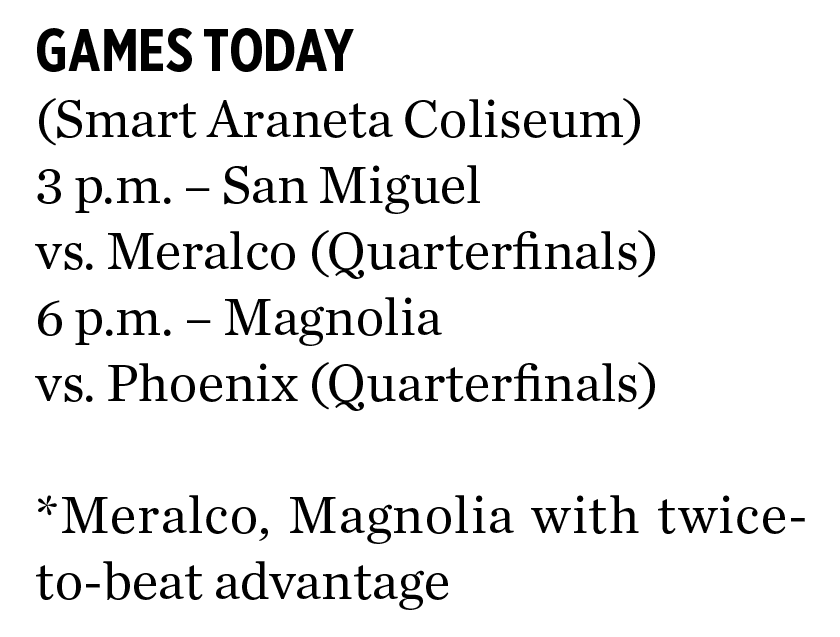
PROTECTING the quarterfinal order is the theme for No. 1 Magnolia and No. 4 Meralco as they set out to get their passes to the Philippine Basketball Associaiton (PBA) Governors’ Cup semifinals on first take on Friday at the Smart Araneta Coliseum.

Coming on the heels of the other two higher seeds getting dragged to a sudden death, the twice-to-beat Hotshots and Bolts go for a quick disposal of No. 8 Phoenix and No. 5 San Miguel Beer (SMB), respectively, in their own end of the Last-8.

Game time for Magnolia-Phoenix tussle is at 6 p.m. following the Meralco-San Miguel Beer grudge match at 3 p.m.

It has been a generally stellar run for the Hotshots, who posted a leading 9-2 card on the way to the playoffs. But one of their red marks was a 101-100 setback at the end of the elims to Blackwater, a team that previously lost a record 29 consecutive games since October 2020.

This shocking defeat, coach Chito Victolero stressed, should fire up the Hotshots even more in the bigger battles ahead.

“I know my players, they will be ready for the playoffs,” he said. “That game was a learning experience for us. We should stay hungry, stay focused and have that attitude coming to war.”

That can also embolden the Fuel Masters into further believing that an upset of their powerhouse rival is very doable. Moreover, coach Topex Robinson’s charges carry some momentum from the 101-98 victory over NorthPort in the playoff for the eighth spot last Sunday.

Meralco, meanwhile, intends to take full advantage of its win-once edge to score an emotional payback and semis-clincher against SMB.

“We owe them. They beat us, we (will) beat them,” said Bolts import Tony Bishop.

The last time they met, Shabazz Muhammad torched Meralco with 57 points as the Beermen rallied from 26 points down to post a 115-110 caper. Interestingly, Mr. Muhammad was the Bolts’ first-choice import who backed out but eventually landed at SMB.

I look at it (SMB matchup) as we have to beat them once,” said Meralco mentor Norman Black. “I can’t bring back what happened in that game but obviously, we’d like to watch that game and try to learn from it. But going into this game, you start off 0-0 so that (today’s quarterfinal) will be my focus.”

If successful, Magnolia and Meralco are on their way to a rematch of their Final Four faceoff in the last Philippine Cup, which the Hotshots won in six en route to their runner-up finish to TnT.

Otherwise, they go through a winner-take-all for the semis — just like fellow twice-to-beat squads NLEX and TnT.

The No. 2 Road Warriors fell to a seventh-ranked Alaska Aces team determined to extend its last hurrah, 93-79, while the Tropang Giga took a 104-92 loss to No. 6 defending champion Barangay Ginebra San Miguel last Wednesday.

Palace decision on four-day workweek due Monday

By Kyle Aristophere T. Atienza, Reporter

PRESIDENT Rodrigo R. Duterte will announce his decision on the proposed four-day workweek on March 21, the Palace spokesman said on Thursday.

“We will know the decision on Monday,” the President’s acting spokesman Jose Ruperto Martín M. Andanar told DZBB radio, according to a transcript issued by the Office of the President.

Mr. Andanar said the President will likely follow the recommendations of his economic managers.

“The important thing is that President Duterte told (Finance Secretary Carlos G. Dominguez III) … after the Secretary gave his recommendation, that whatever decision the economic cluster will make is our policy because that is their forte,” Mr. Andanar said.

Socioeconomic Planning Secretary Karl Kendrick T. Chua recently proposed a four-day workweek to help businesses cut costs and insulate workers from rising fuel prices.

A similar four-day week was implemented in 2008 when fuel prices were also high, Mr. Chua told Mr. Duterte late Tuesday.

The proposal requires workers to render 40 hours of work per week over four 10-hour days, Mr. Chua said at the Tuesday meeting.

Employers may implement such shortened weeks even without a new law or department order, the Labor department said on Wednesday.

Meanwhile, Labor Undersecretary Benjo Santos M. Benavidez said the government “can only encourage, not obligate the private sector to adopt four-day workweeks.”

“We can appeal to the private sector to implement (it) because again, it’s management prerogative, they have to decide on this and it’s within their sole jurisdiction,” he told ABS-CBN News Channel.

 He said the labor code “does not (prescribe) the minimum number of working days in a week.”

In a statement, the Trade Union Council of the Philippines (TUCP) reminded the government and private sector that the proposed compressed workweek would require the consent of workers “because it means setting aside the eight-hour workday.”

“Workers are supposed to have eight hours of work, eight hours of sleep, and eight hours with their families.  Only workers can waive the right to an eight-hour workday,” it said. “Workers must therefore be consulted regarding the compressed workweek. Workers will also have to voluntarily agree to the proposal. The agreement must be (put in) writing, and the agreement must be submitted to (the Department of Labor and Employment) to ensure monitoring and no management abuse.”

The TUCP said any flexible work arrangements must not result in the diminution of wages and benefits. “Workers’ salary during the four-day compressed work week is equivalent to the salary for five or six days of work. Also, work beyond eight hours a day must be compensated with overtime pay.”

The TUCP also warned that there might be an increase in healthcare concerns once the proposal is enforced.

“We remind the proponent both the National Economic and Development Authority (NEDA) and the Department of Energy (DoE), that while this is a proposal to economize by lessening consumption, it will not result in the lowering of the price of petroleum products nor will it bring down the costs of goods and services,” it said.

Fuel retailers on Tuesday raised gasoline and diesel prices by P7.10 and P13.15 per liter, respectively.  Mr. Duterte has rejected calls to suspend the excise tax on fuel products.

PHL 5G users see greatest speed uplift among peers — Opensignal

FIFTH-GENERATION (5G) network users in the Philippines experienced the greatest uplift in terms of average download speeds versus 4G across 10 Asia-Pacific (APAC) markets, including Thailand, Taiwan, South Korea, and New Zealand, the UK mobile analytics company Opensignal Ltd. said in its latest analysis.

“Impressively, the average 5G download speeds seen by our users were 8.9 times faster than average 4G speeds in the Philippines,” Opensignal analyst Ian Fogg said in the report “Benchmarking the 5G Experience – Asia Pacific – March 2022.”

Thailand came in second in terms of uplift in download speeds with a 7.5 rating, followed by Taiwan (7.2), South Korea (6.3), New Zealand (6), and Hong Kong (5.1).

“On mobile video streaming, Filipino users enjoyed a 33% higher video experience score using 5G versus 4G,” Mr. Fogg said.

For this category, the Philippines was followed by Indonesia with a video experience score of 29%, Thailand (23%), Hong Kong (18%), and Taiwan (14%).

“5G continues to mature as a technology as operators expand the extent of their 5G services. Either by boosting the geographic reach, or by deploying 5G on new spectrum bands that improve speed and capacity — if mid or higher frequency — or by boosting in-building signal propagation and rural reach through the use of lower frequency bands for 5G,” Mr. Fogg said.

He also noted that Filipino 5G users would usually spend 11.1% of their time connected to 5G.

“Users enjoy average 5G download speeds of 136.6 Mbps (megabits per second) and peak 5G download speeds of 408.7 Mbps.”

“Across the region, our users experienced widely varying access to 5G services. In South Korea, users spent 30.7% of time with an active 5G connection which is an excellent 5G availability score when we compare that globally,” Mr. Fogg added.

“South Korean users also saw 5G service in approximately two-thirds of the locations they visited which led to a 5G reach score of 6.6 on a 10-point scale.”

As for the Philippines, Mr. Fogg said the numerous islands and challenging interior of the country mean that the scores of 11.1% (5G availability) and 3.7 (5G reach) “are similarly impressive.” — Arjay L. Balinbin

Netflix tests charging some customers more for password sharing

DIMA SOLOMIN-UNSPLASH

NETFLIX, Inc. will start charging some customers more to share their accounts with people who aren’t in the same household in an effort to crack down on unauthorized password exchanges.

The streaming giant is testing the feature in three markets: Chile, Costa Rica, and Peru. Subscribers with premium and standard plans will be able to add up to two additional users in other locations, the company said Wednesday in a blog post. The additional fees will vary by country. Costa Ricans will pay $3 more per month.

Netflix is making it easy for subscribers to transition a new member to the plan, keeping in place their account profile, viewing history, and personalized recommendations. It also means the company will more aggressively go after subscribers who share their logins with friends and family members outside their home.

Chengyi Long, Netflix’s director of product innovation, said the company has tried to make it easier for people who live together to share accounts, with features such as separate profiles and the ability to view multiple shows at once.

“While these have been hugely popular, they have also created some confusion about when and how Netflix can be shared,” Long said. “As a result, accounts are being shared between households — impacting our ability to invest in great new TV and films for our members.” —  Bloomberg

‘Battle of Katipunan’ at 84th season opening of UAAP

THREE-TIME defending champion Ateneo and the beefed-up University of the Philippines headline the explosive quadruple-header offering of the 84th UAAP Season when it plunges back to action on March 26 after a two-year hiatus.

The Blue Eagles and the Fighting Maroons clash at 4 p.m., setting the stage for a unique chapter in their fabled “Battle of Katipunan” rivalry amid the pandemic.

Both teams along with the rest of the eight-strong UAAP cast will have no roaring fans and cheerdance squads behind for now under a full-bubble setting at the Mall of Asia Arena in Pasay City.

Another storied rivalry is slated in the curtain-raiser at 10 a.m. featuring Far Eastern University and Santo Tomas followed by a collision between rebuilding Adamson U and National U (NU) at 1 p.m.

Capping off the four-game opening marathon is host De La Salle University, which will parade returning mentor Derrick Pumaren against his former squad University of the East at 7 p.m.

But the spotlight will be on the Tab Baldwin-mentored Ateneo with a goal of extending its University Athletic Association of the Philippines (UAAP) dynasty against the revamped UP squad under former NU high school coach Goldwin Monteverde.

Gilas Pilipinas naturalized player Ange Kouame and ace SJ Belangel banner the Blue Eagles’ bid following the departure of their championship core led by Thirdy Ravena, Isaac Go, Matt Nieto, Mike Nieto and Will Navarro.

UP also lost its core in Kobe Paras, Bright Akhuetie, Juan and Javi Gomez de Liaño but will have young stars Gerry Abadiano, Carl Tamayo and Terrence Fortea, who led NU’s high school reign under Mr. Monteverde.

Joining the troika, which also anchored Gilas youth with Kai Sotto, are other UP acquisitions in CJ Cansino, Joel Cagulangan and Malick Diouf with Ricci Rivero as the key holdover. — John Bryan Ulanday

China finds way for ‘COVID Zero’ while keeping factories open

REUTERS

JUST DAYS into a COVID-19 lockdown that bars residents of Shenzhen from leaving their homes, China is allowing some companies to restart factories in the tech hub in a move that may provide a blueprint for shielding the economy and supply chains from the country’s virus fight.

iPhone maker Foxconn Technology Group is the most prominent, allowed to partially resume its operations in Shenzhen on Wednesday by deploying a so-called closed loop system. Workers are ferried from their company-run dormitory to the factory and back, subject to regular COVID testing and checks. Zhen Ding Technology Holding Ltd., a Taiwanese maker of printed circuit boards, is also operating a closed loop at its plant, along with a medical device company manufacturing essential goods that didn’t want to be named.

The system — which effectively puts factory workers in a bubble, insulated from outside infection — is also being used in nearby Dongguan, a manufacturing center that pumps out shoes, toys and textiles for export around the globe, but has restrictions in place to quell a virus outbreak, as well. On Thursday, a Shenzhen government official said factories will gradually be able to resume production in an “orderly manner.”

With economists increasingly warning about the hit to the world’s second-largest economy from lockdowns and other aspects of China’s COVID Zero strategy, such systems could help keep the engines of growth running while other curbs remain in place.

Plunged into a snap lockdown on Sunday as infections climbed, Shenzhen’s restaurants and subway are closed, its 17.5 million residents unable to leave the city limits for non-essential reasons. Whole neighborhoods are being sent to isolation sites under China’s policy of quarantining every COVID case. By deploying factory bubbles, the economic impact will be “significantly less,” said Paul Donovan, UBS’s global chief economist.

“The problem is that people hear ‘lockdown’ and instinctively think of what happened in 2020,” he said. “That is not what is happening now.”

LIKE WUHAN
In the early days of the pandemic, China sealed off the original epicenter of Wuhan, with industry and manufacturing in the city shut down for months.

Still, as the outbreak was contained and Wuhan started to cautiously emerge from restrictions, it started to deploy similar moves to those now being rolled out in the south, with computer maker Lenovo Group Ltd. taking factory workers’ temperatures multiple times a day and isolating staff for testing. Such measures enabled China to emerge swiftly from the initial pandemic economic hit, despite fears restarting factories would contribute to the virus’s spread. The theory may be the same now.

As part of a vow to stabilize financial markets and stimulate the economy on Wednesday, China also said virus controls should be coordinated with economic development. The comments, made at a meeting of China’s top financial policy committee, reiterated what has been a regular drumbeat from officials the past month that COVID policy needed to be tweaked to minimize disruption for business.

The closed-loop arrangement for Shenzhen’s factories appears similar to a bubble system China adopted during the Beijing Winter Olympics in February, where athletes and Games-related personnel were kept separate from the general public, only allowed to travel between sporting venues and their hotels via designated transportation. The system was successful in preventing any COVID spread from the Games within China.

There have been discussions about replicating the Olympic bubble for some events, Bloomberg News has reported, particularly as a way to allow foreigners to come into the country without the need for hotel quarantine, which is currently mandatory for all incoming travelers.

OLYMPIC MODEL
Michael Hart, president of the American Chamber of Commerce in China, said member companies had proposed similar setups to the Olympics model, where technical and training staff from abroad could fly into China and work alongside locals after a period of negative tests.

“I don’t know of any companies that have been able to execute this yet, but we’re hopeful that something like this could be approved on a case-by-case basis as a workaround to the current quarantine restrictions,” Hart said.

China has kept the virus at bay for most of the past two years using a combination of effectively closed borders, mandatory isolation of all virus cases and mass testing to limit outbreaks.

But more contagious variants like Omicron are challenging the regime, which is becoming more disruptive as infections flare more regularly and the rest of the world opens up. China has has imposed more lockdowns over the past week than at any point in the pandemic, with Shenzhen, Langfang City near Beijing, the city of Changchun in the northeast and then its surrounding province, Jilin, all put under movement restrictions.

Banks including Nomura Holdings, Inc., and Morgan Stanley say China’s resource-intensive approach to containing COVID — a strategy that has delivered one of the lowest death tolls globally — damp the country’s growth outlook.

The closed-loop system may help individual manufacturers keep operating under COVID curbs, but it is unlikely to be a model of where China’s overall approach to the virus may be heading, said Louis Kuijs, Asia Pacific chief economist at S&P Global Ratings. “Most people in China do not work in factories, but in offices, shops, restaurants and the like. In those type of workplaces, it is much harder to set up a closed-loop bubble.”

It may also not prove a panacea for factories, if the lockdown has halted logistics and deliveries.

Chinese logistics firm 4PX said on its website on Monday that it had stopped picking up parcels from Shenzhen due to the COVID restrictions, while most online retail exporters have been disrupted by the measures, according to Wang Xin, head of the Shenzhen Cross-Border E-Commerce Association. — Bloomberg

Contributors of PERA increase almost threefold as of February

CONTRIBUTORS of the Personal Equity Retirement Account (PERA) have continued to rise as more were able to enjoy the convenience of its digitization.

“Since the launch of digital PERA in September 2020 until end-February 2022, the number of PERA contributors has grown from 1,684 to 4,379, or almost three times,” Bangko Sentral ng Pilipinas (BSP) Governor Benjamin E. Diokno said at an online briefing on Thursday.

“Digital PERA has significantly reduced processing time and transaction cost,” he added.

However, this is still far from the five million PERA contributors the BSP targets to have by 2025, which represents 10% of working Filipinos locally and abroad.

“In any case, we recognize the current challenges that may prolong the achievement of our goal. We will reassess the targets after consultations with industry, partner agencies and other stakeholders,” the BSP chief said.

Mr. Diokno said 71% of contributors are employees, while the rest are overseas Filipino workers (OFWs).

He said total PERA contributions as of February reached P265.5 million, nearly double the P140.8-million level in September 2020.

Broken down, 68% of the contributions were from employees, 19% were from OFWs, and 13% were invested by self-employed individuals.

“We expect the growth to continue as the economy recovers from the pandemic,” Mr. Diokno said.

The BSP chief said there are 12 PERA unit investment trust funds (UITFs) that are suitable to contributors with different risk profiles. These include three money market funds, six bond funds, and three equity funds.

Five more UITFs have been accredited by the BSP and the Bureau of Internal Revenue which are expected to be launched soon for PERA contributors, Mr. Diokno added.

PERA is a voluntary retirement fund scheme opened to Filipinos through Republic Act 9505. It was meant to supplement the retirement benefits from the Social Security System, Government Service Insurance System, and private employers.   

Contributors can inject maximum annual investments worth P100,000, while overseas Filipinos are allowed to pour in up to P200,000 a year in their PERA accounts.

PERA contributors benefit from perks like exemptions from final withholding, capital gains and regular income taxes. They are also entitled to a 5% tax credit on contributions for the year, which can be used to pay or lower annual income tax due. — L.W.T. Noble

Taft Hydro Energy switches on 16-MW hydropower project

TAFT Hydro Energy Corp. announced on Thursday that its 16-megawatt (MW) hydropower project has started commercial operations after an almost three-month delay, boosting power supply in Samar and Leyte.

“Hydro projects are challenging to build but despite the pandemic [the company] did it in record time of less than two years,” Taft Hydro Energy President Benjie Q. Picardo said in a statement.

He cited the support of the Department of Energy, Development Bank of the Philippines, electric cooperatives, the local government of Eastern and Western Samar, local communities “and our workers on the ground who went the extra mile so we can complete this project on time and on budget.”

The project uses of the running water in Taft-Tubig river to secure affordable power in the Samar-Leyte area. It consists of three units with 5.9 MW each.

The company earlier said the facility would provide power during the holiday season, as it was initially expected to be turned on by December last year.

The hydropower project is seen to boost the potential of the tuna industry in the area, which is part of the so-called “tuna highway,” as logistics and cold storages were hampered by the lack of power.

“At the same time, the completion of the project will create a major economic multiplier by the opening of investment opportunities in cold storage, processing plants, and even in tourism,” Mr. Picardo said.

Taft Hydro Energy is a project company under the Filipino-led Magis Energy Holdings Corp. to spur growth specifically in rural communities by developing renewable energy facilities. The 8.6-MW Matuno River Development Corp. in Nueva Vizcaya is also under Magis Energy. — Marielle C. Lucenio

What to see this week (03/18/22)

PAW Patrol: The Movie — IMDB.COM

Paw Patrol

WHEN the Paw Patrol’s biggest rival, Humdinger, becomes Mayor of nearby Adventure City and starts wreaking havoc, Ryder and the puppies fight to save the citizens of the city. Directed by Cal Brunker, this animated film features the voices of Iain Armitage, Marsai Martin, Ron Pardo, Yara Shahidi, Kim Kardashian, and Randall Park. Variety’s Courtney Howard writes, “The filmmakers take great craft and care building out this universe — one where dogs speak to humans and a 10-year-old drives an RV — in order to tell an expansive tale with empathy, complexity and engaging character dynamics, all while retaining the spirit of the series and keeping lessons digestible for young audiences.” Review aggregate site Rotten Tomatoes’ Tomatometer gives the film a 80% and the audience score is 97%.

MTRCB Rating: G

Ambulance 

DECORATED veteran Will Sharp seeks the help of his adoptive brother to pay his wife’s hospital bills. When his brother gets him involved in a bank heist, they find themselves in a hijacked ambulance with a wounded passenger, while the authorities are close in. Directed by Michael Bay, the film stars Jake Gyllenhaal, Yahya Abdul-Mateen II, Eiza González, Garret Dillahunt, Keir O’Donnell, and Moses Ingram

MTRCB Rating: R-13