Home Blog Page 6154

The tension in Japan’s dialed-up defense ambitions
STEVEN DIAZ-UNSPLASH

JAPAN is on the cusp of two big decisions: extent to which it can expand its defense capabilities and where to find the money to pay for it. The belligerent region Japan inhabits requires more resources devoted to national security, regardless of the ambivalence voters have historically felt toward a more assertive military.

Prime Minister Fumio Kishida must reconcile competing strategic, electoral, and budget priorities. In his favor are important shifts in Japan’s internal politics. Issues related to defense and diplomacy that were no-go zones a generation ago are now freely aired by politicians. The late Shinzo Abe was as much a reflection of the transformation as its driver.

Is the economy ready for a steep defense bill and how does the nation buttress its armed services with a contracting population? I spoke with  Sheila A. Smith, senior fellow for Asia-Pacific Studies at the Council on Foreign Relations and the author of several books on Japanese diplomacy and politics. The conversation has been edited for clarity and length.

Daniel Moss: How has Japan’s strategic posture changed in past two decades? Did Abe instigate that or merely channel it?

Sheila A. Smith: He was always hawkish and wanted Japan to be more self-reliant. There are several pieces that came together during his time in office. One was the rise of China, which is a very significant shift in the balance of power. Japan’s complex relationship with its own past is baked into that, along with differences in the political systems of the two countries. So, Japan had to rethink its approach. It also has to contend with a more assertive Russia and North Korea.

Abe is often portrayed as a right-winger. I’m not sure that’s the right way to understand him. He was on the conservative side of interpreting Japan’s post-war experience, deeply uncomfortable with the US-written constitution and didn’t think Japan should always have to apologize. From 2012 until he stepped down in 2020, you saw a man who was coming to terms with his aspiration to lead and, critically, a Japan that is confronting a world that is changing. There was an intersection.

DM: To what extent has the ruling Liberal Democratic Party (LDP) changed? Center-right parties globally have become more right-wing and nationalist.

SS: The conservative right in many democracies has also become populist, less establishment. That is the difference with the LDP. The party has become more conservative in recent years without embracing the populist bit. You see now, after Abe, a fairly large swathe of people in the LDP who want a stronger military, want to lift defense spending to 2% of gross domestic product. They don’t support nuclear weapons, but want to be able to reach out and touch an adversary with conventional weapons as a means of deterrence.

These used to be very right-wing views. Not anymore. You have generational change, a leadership in the LDP that is much more assertive about bringing up what used to be taboo. That reflects a region where everyone is demonstrating military capabilities and inviting questions about whether self-restraint is the best way for Japan to protect itself. 

DM: I still meet people who think Japan has no military to speak of and that everything has been outsourced to the US. In substance, how big a player in the defense industry is Japan?

SS: Traditionally, Japan’s leaders hadn’t seen the global defense industry as a place where Japanese companies ought to play. There were restrictions adopted in the 1950s that said Japan shouldn’t sell weapons. Abe opened that up. During the Abe era they were encouraged and urged to participate in the arms market. Could they be significant? We’ll see. For Japanese industrial companies, defense is only a small part of their operations. But now they are expected to be out and about and showing what they can do. I don’t think executives are fully on board. They feel there’s a lot of reputational risk with their brand being too associated with the military.

More broadly, it’s not true that Japan has delegated everything to the US. Credible estimates of defense spending and investment tend to show Japan, depending on what the yen is doing, consistently in the top 10. Not that different from, say, France or the UK. Japan is around the same as the NATO allies.

DM: The government has begun a comprehensive review of Japan’s defense strategy. Why is that important and what are the likely outcomes?

SS: A new national security strategy document is going to be issued. The first leader to issue [one] was Shinzo Abe, in 2013. So, this will be only the second statement by Japan, ever. It’s significant this is all together in one place, not just bombs and bullets. It’s about what Japan needs to do to achieve its interests in the world and how to proceed. In 2013, the language on China was pretty benign compared with what I think we will see in the next one. Russia will be near the top of concerns after the Ukraine invasion. North Korea continues to be a problem, given its missiles and the ability to launch them undetected.

There will also be a cabinet decision in December on the next 10-year defense plan. This is where we will see how serious Kishida is about defense. Within the 10-year plan will be a five-year plan on how much Japan spends and on what. The other issue that needs to be handled deftly is that of counterstrike capability.

DM: Japan is one of the most indebted economies. How does all this get financed?

SS: I don’t know how they pay for it. Debt servicing is somewhere near 23% of Japan’s budget. Social security is about a third. The budget doesn’t have a lot of latitude. I’m not convinced about 2% of GDP, but let’s use that as a reference point. Last year, Japan spent about 1.3% of GDP on defense. You get to 2%, you are basically doubling it. That’s big.

Kishida may back off a specific number and instead talk about substantial spending over a period of time. We will have to watch his maneuvering. He will have to show that spending goes up in a way that is demonstrable. He promised Joe Biden. So where does that come from? It is zero sum. It’s not like Japan’s economy is about to really take off.

DM: Article 9 of Japan’s constitution renounces war as a sovereign right and a means to settle disputes. It also says that to accomplish that aim, forces won’t be maintained. Is the constitution misunderstood?

SS: People have this idea that Article 9 means Japan can’t do anything, which isn’t correct. There needs to be some kind of self-defense. How much is necessary? That is the political elasticity and where Abe tried to push the envelope. If we read the parliamentary deliberations in the early 1950s when Japan was creating the self-defense force, they never used the word nuclear, but they do talk about modern weapons, which was code for nuclear. They aren’t banned, if needed for self-defense. That is where interpretations come in.

That aside, there is an acutely sensitive antennae among the Japanese public that pays great attention when weapons systems are discussed. Even in the conventional strike debate, the public reaction is going to be very interesting. You may have some people who say China has missiles, North Korea has missiles and so does Russia, so we need them, too. But there will be a lot of people who say this takes us way beyond where we are ready to go and increases the chances of war. We shouldn’t dismiss the balancing act required here.

DM:  Japan has huge demographic challenges. How do you reconcile a shrinking population and limited appetite for immigration with boosting the military?

SS: There is the fiscal burden of an aging population, which gets us back to the tug and pull on the budget. Pension reform in the name of higher military spending is a tough sell. So, you will see more automation, you will see more emphasis on women serving. You are just now starting to see women take on command positions. There will be more robotics. That is where the opening to the international arms market will happen, the use of Japan’s technological ability to get economies of scale. There will be much more emphasis on battle drones, undersea drones, surveillance and reconnaissance. There are recruitment problems. Big challenges, demographically. That has implications for how quickly Japan can deploy.

BLOOMBERG OPINION
State of the world, state of the nation

This paper will expand my hypothesis that I mentioned last week — that Europe and North America will deindustrialize in the short- to medium-term and many companies there will migrate to Asia. The Philippines should prepare for this.

DEGROWTH AND BLACKOUT ECONOMICS
I encountered for the first time the concept of Degrowth economics from these articles:

1. “Climate Change Modeling of ‘Degrowth’ Scenarios — Reduction in GDP, Energy and Material Use” by University of Sydney, scitechdaily.com, May 11, 2021;

2. “1.5°C degrowth scenarios suggest the need for new mitigation pathways” by Lorenz T. Keyßer and Manfred Lenzen, nature.com, May 11, 2021;

3. “Degrowth: Universities Push Permanent Poverty as the Solution to Climate Change” by Eric Worrall, wattsupwiththat.com, May 13, 2021.

To argue for reduced production of material goods and services to “save the planet” is irresponsible and insane, and the idea comes from the academe.

Then when there were frequent yellow-red alerts in the Philippines in May-June 2021, and electricity prices in Europe started rising due to less windy and more cloudy condition and thin reserves in July 2021 onwards, I started writing about “Blackout economics” in this column in BusinessWorld: “Ten indicators of blackout economics” (June 14, 2021), “Blackout economics, COP26 and Negros’ power prices” (Nov. 15, 2021), “Europe’s blackout economics and the Philippines’ path to brownouts” (Dec. 27, 2021).

EUROPE DECLINING POWER GENERATION
Energy is development. Insufficient and unstable energy supply means slow and unsustained growth, higher power and consumer prices. Meanwhile, a high and stable electricity supply means there is a high capacity for power-intensive manufacturing, malls, residential and office condos and villages, hospitals, etc. to keep humming and producing various goods and services 24/7.

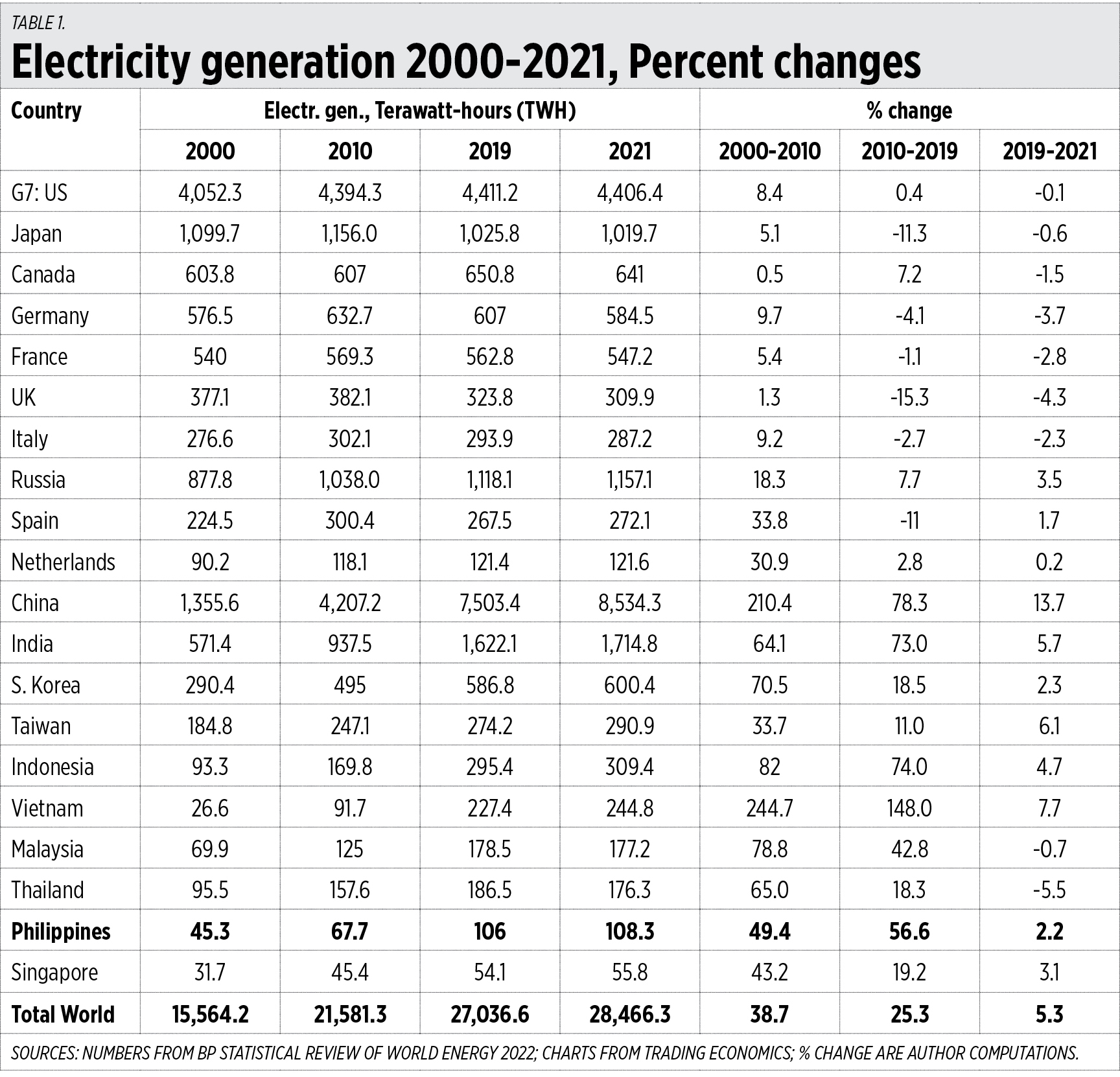
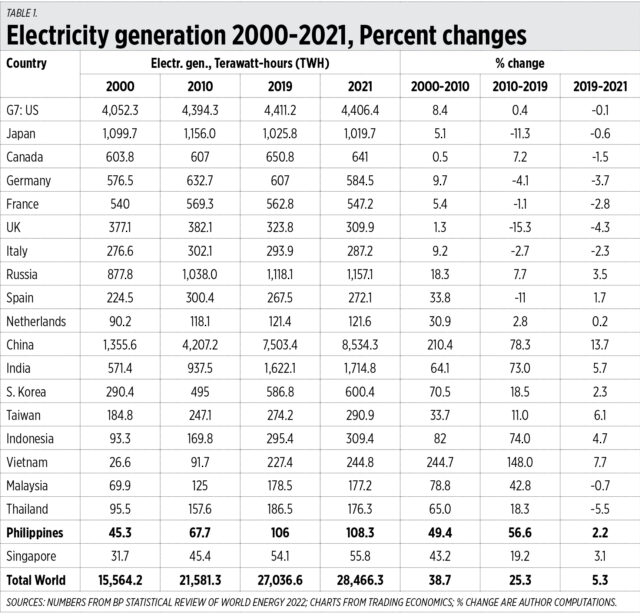
The Group of Seven (G7) industrialized countries of the world are in the forefront of “decarbonization” and “net zero” campaigns to fight “man-made” climate change. They do not believe that there is natural and cyclical climate change. The last two decades showed a drastic reduction in power generation of G7, also in two other big European countries with a GDP size of at least $1 trillion, Spain and Netherlands.

East and South Asia, excluding Japan, just paid lip-service to “decarbonization” and went on to make huge increases in power generation, based mainly on fossil fuels, especially China, India, Vietnam, and Indonesia. Russia took the East Asian path, though at a slower pace. Overall global power generation saw continued growth in energy production (Table 1).

The G7 and other European countries have a sustained belief in climate and energy alarmism. This will lead them to a path of deindustrialization.

STATE OF THE WORLD IN INFLATION AND GROWTH
Industrialized countries by default have low inflation because their technological advancement means they can mass produce many things, and have efficient storage and transportation logistics for a huge volume of goods 24/7. Thus, the average inflation rate from 1990-2010 were: Italy 3.1%, the UK 2.7%, the US 2.6%, Canada 2.1%, Germany 2%, France 1.8%, and Japan 0.4%.

Insufficient power generation and expensive electricity relative to their high industrial and commercial demand contributed to 37- to 49-years of high inflation in G7 countries except Japan. They have had anemic GDP growth over the past two decades, with 2.3% average growth already considered “very high.”

In contrast, East and South Asians that pursued high power generation would consider average growth of 3.3% as “very low” because their growth would range from 4-10% (Table 2).

STATE OF THE NATION IN TAX COMPETITIVENESS
My view is that North America and Europe will further deteriorate economically, and are likely to experience “stagflation” or stagnant/low growth with high inflation. So, many companies there will start migrating to Asia where growth is fast, where consumers are in the billions, and where energy policies are not held fully hostage by climate alarmism.

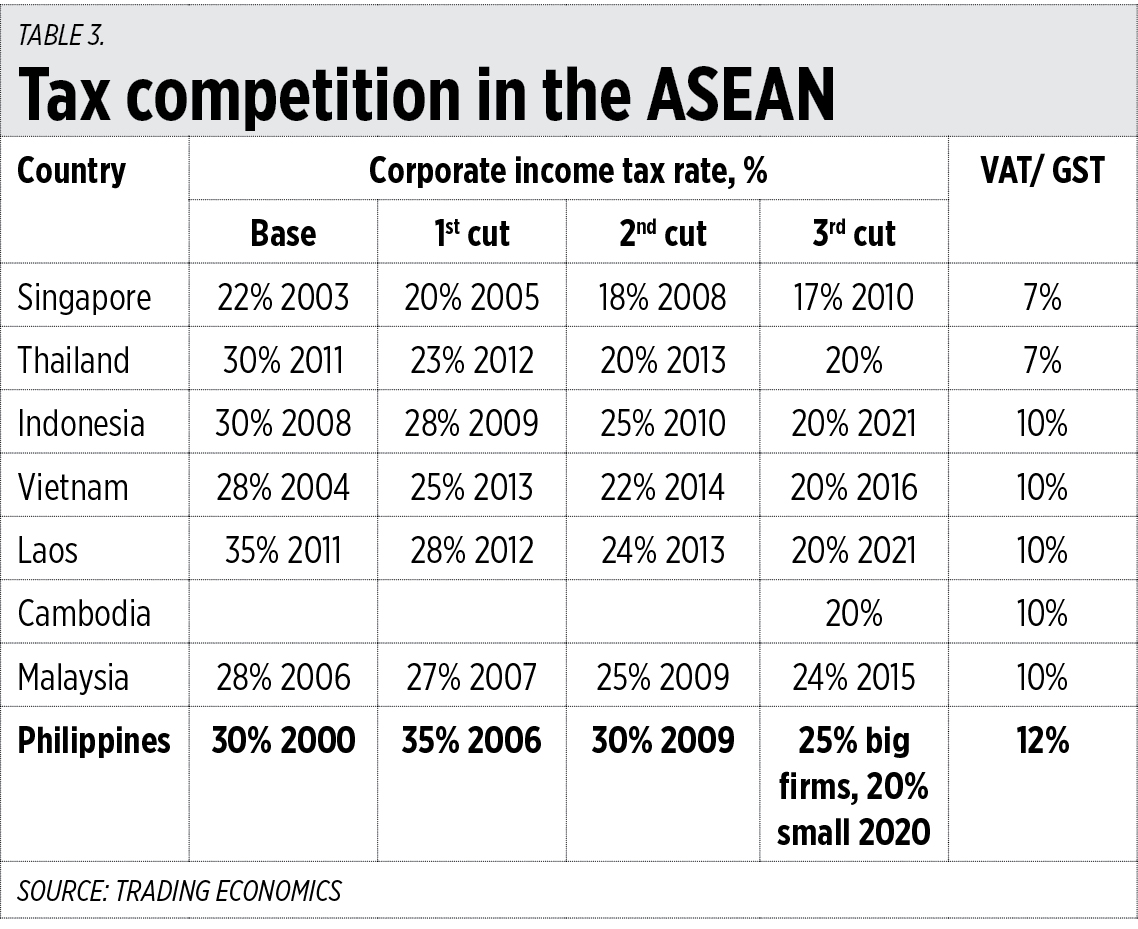
The Philippines should continue down the path of lower tax rates and a broader tax base that can lead to stable and high revenues. The Corporate Recovery and Tax Incentives for Enterprises (CREATE) Act of 2021 (RA 11534) has reduced the corporate income tax rate from 30% to 25% for big corporations and 20% for small and medium enterprises (SMEs) with net taxable income of P5 million or lower, and total assets of P100 million or lower excluding land. This was a good move by the Duterte administration.

The next challenge would be to reduce the value-added tax (VAT) from 12% to around 10% and reduce the number of exempted sectors to have a broader tax base. We have the highest VAT or gross sales tax (GST) rate in the ASEAN and this is not good for us (Table 3).

The current strategy of Finance Secretary Benjamin Diokno of further broadening the tax base is good — I support it. Then there is the improvement in tax administration via digitalization and the taxation of many online transactions to be at par with taxation in malls, shops, and groceries. But no amount of raising revenues will be sufficient to reduce our huge public debt, outstanding and guaranteed debt — only P8.2 trillion in 2019, P12.2 trillion in 2021, and P12.9 trillion in May 2022 — unless there is corresponding fiscal discipline and cuts in expenditures or subsidies. This column will discuss more fiscal policies in future articles.

To summarize, the state of the world is there is generally more economic sanity but it is the rich, industrialized, and influential countries like G7 that lead in economic and energy irrationality. The Philippines should prepare for companies migrating from the west. The government’s economic team, local business, labor, and even civil society sectors should prepare for this.


Bienvenido S. Oplas, Jr. is the president of Minimal Government Thinkers.

minimalgovernment@gmail.com

Myanmar executes 4 democracy activists

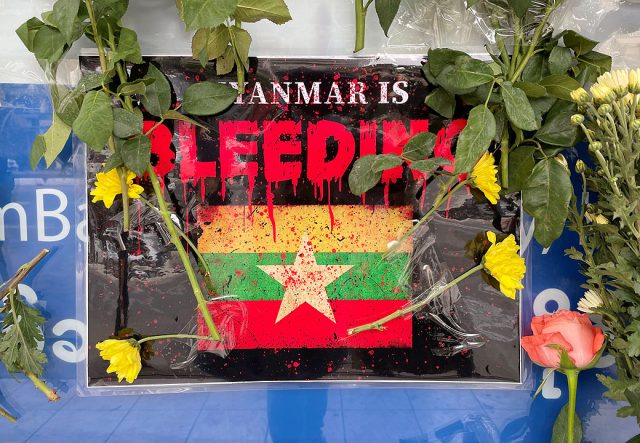
FLOWERS hang during a nationwide flower campaign against the military coup in Yangon, Myanmar, April 2, 2021. — REUTERS

MYANMAR’s military junta on Monday said it had executed four democracy activists accused of helping to carry out “terror acts” in the Southeast Asian nation’s first executions in decades, sparking widespread condemnation.

Sentenced to death in closed-door trials in January and April, the four men had been accused of helping militias to fight the army that seized power in a coup last year and unleashed a bloody crackdown on its opponents.

Myanmar’s National Unity Government (NUG), a shadow administration outlawed by the ruling military junta, condemned the executions and called for international action against Myanmar’s junta.

“Extremely saddened…condemn the junta’s cruelty…,” the NUG president’s office spokesman Kyaw Zaw told Reuters via message. “The global community must punish their cruelty.”

Among those executed were democracy figure Kyaw Min Yu, better known as Jimmy, and former lawmaker and hip-hop artist Phyo Zeya Thaw, the Global New Light of Myanmar newspaper said.

Kyaw Min Yu, 53, and Phyo Zeya Thaw, a 41-year-old ally of ousted Myanmar leader Aung San Suu Kyi, lost their appeals against the sentences in June. The two others executed were Hla Myo Aung and Aung Thura Zaw.

“These executions amount to arbitrary deprivation of lives and are another example of Myanmar’s atrocious human rights record,” said Erwin Van Der Borght, regional director of rights group Amnesty International.

“The four men were convicted by a military court in highly secretive and deeply unfair trials. The international community must act immediately as more than 100 people are believed to be on death row after being convicted in similar proceedings.”

Thazin Nyunt Aung, the wife of Phyo Zeya Thaw, said she had not been told of her husband’s execution. Other relatives could not immediately be reached for comment.

“My heart goes out to their families, friends and loved ones and indeed all the people in Myanmar who are victims of the junta’s escalating atrocities,” the U.N. special rapporteur on human rights in Myanmar, Tom Andrews, said in a statement.

The men had been held in the colonial-era Insein prison and a person with knowledge of the events said their families visited the prison last Friday. Only one relative was allowed to speak to the detainees via the Zoom online platform, said the person.

Myanmar’s state media on Monday reported the executions had taken place and junta spokesman Zaw Min Tun later confirmed the executions to Voice of Myanmar. Neither gave any details about when the executions occurred.

Previous executions in Myanmar have been by hanging.

An activist group, the Assistance Association of Political Prisoners (AAPP), said Myanmar’s last judicial executions were in the late 1980s.

Last month junta spokesman Zaw Min Tun defended the death penalty, saying it was justified and used in many countries.

“At least 50 innocent civilians, excluding security forces, died because of them,” he told a televised news conference.

“How can you say this is not justice?” he asked. “Required actions are needed to be done in the required moments.”

Cambodian Prime Minister Hun Sen, chair of the Association of Southeast Asian Nations (ASEAN), appealed in a letter in June to junta leader Min Aung Hlaing not to carry out the executions, relaying deep concern among Myanmar’s neighbors.

Myanmar’s ruling junta has condemned foreign statements about the execution orders as “reckless and interfering”.

Myanmar has been in chaos since last year’s coup, with conflict spreading nationwide after the army crushed mostly peaceful protests in cities.

“These horrendous executions were murders. They’re a part of the junta’s ongoing crimes against humanity and attack on the civilian population,” Matthew Smith, head of Southeast Asia’s Fortify Rights, told Reuters.

“The junta would be completely wrong to think this would instill fear in the hearts of the revolution.”

The AAPP says more than 2,100 people have been killed by the security forces since the coup. The junta says that figure is exaggerated.

The true picture of violence has been hard to assess as clashes have spread to more remote areas where ethnic minority insurgent groups are also fighting the military.

Last Friday, the World Court rejected Myanmar’s objections to a genocide case over its treatment of the Muslim Rohingya minority, paving the way for the case to be heard in full.

The latest executions close off any chance of ending the unrest in the country, said Myanmar analyst Richard Horsey, of the International CRISIS group.

“Any possibility of dialogue to end the crisis created by the coup has now been removed,” Mr. Horsey told Reuters.

“This is the regime demonstrating that it will do what it wants and listen to no one. It sees this as a demonstration of strength, but it may be a serious miscalculation.”

Acting Asia director of Human Rights Watch, Elaine Pearson, said the executions aimed to chill the anti-coup protest movement.

“European Union member states, the United States, and other governments should show the junta that there will be a reckoning for its crimes,” said Ms. Pearson.

“They should demand immediate measures, including the release of all political prisoners, and let the junta know the atrocities it commits have consequences.” Reuters

Bavarian Nordic monkeypox vaccine wins EU approval

OSLO — Danish biotechnology company Bavarian Nordic said on Monday the European Commission had given permission for its Imvanex vaccine to be marketed as protection against monkeypox, as recommended last week by the European Medicines Agency (EMA).

The approval comes just one day after the World Health Organization issued a high-level alert declaring the rapidly spreading monkeypox outbreak as a global health emergency.

“The availability of an approved vaccine can significantly improve nations’ readiness to fight emerging diseases, but only through investments and structured planning of the biological preparedness,” Bavarian Chief Executive Paul Chaplin said.

Bavarian’s vaccine, the only one to have won approval for the prevention of monkeypox disease in the United States and Canada, has in the European Union (EU) so far only been approved to treat smallpox.

But the company has supplied the vaccine to several EU countries during the current monkeypox outbreak for what is known as “off-label” use.

The approval is valid in all European Union Member States as well as in Iceland, Liechtenstein, and Norway, Bavarian Nordic said in a statement.

The development of Imvanex was made possible through significant investments from the US government during the past two decades, the company added.

Bavarian’s share price has risen by 122% in the last three months, driven by strong demand for the monkeypox vaccine. — Reuters

Musk denies ‘romantic’ affair with Google co-founder Brin’s wife

DANIEL OBERHAUS-FLICKER

TESLA, INC. boss Elon Musk said late on Sunday on Twitter that he and Google co-founder Sergey Brin remain friends and denied a report that he had been involved in an affair with Brin’s wife Nicole Shanahan.

Mr. Musk’s tweets came after a Wall Street Journal report that cited unidentified sources saying he had engaged in a brief affair with Ms. Shanahan. The paper said the affair prompted Mr. Brin to file for divorce from Ms. Shanahan earlier this year and ended the tech billionaires’ long friendship.

Dismissing the report, Mr. Musk tweeted, “Sergey and I are friends and were at a party together last night! I’ve only seen Nicole twice in three years, both times with many other people around. Nothing romantic.”

Tesla and Google, whose parent company is Alphabet, Inc., did not immediately respond to Reuters’ requests for comments outside regular business hours.

Reuters wasn’t immediately able to reach Mr. Brin or Ms. Shanahan for comment. A lawyer for Mr. Brin declined to comment to the WSJ, and Shanahan didn’t respond to requests from the paper for comment.

Mr. Brin filed for divorce citing “irreconcilable differences,” the Journal said, quoting records it said were filed in Santa Clara County Superior Court. Reuters wasn’t able to determine independently whether divorce papers have been filed.

In its report, the WSJ also said Mr. Brin instructed his advisers to sell personal investments in Mr. Musk’s companies after he came to know about the affair. The paper said it wasn’t able to determine how large those investments were, nor whether any sales were made.

The Wall Street Journal did not immediately respond to Reuters’ request for comment on Mr. Musk’s denial of the report outside of regular US business hours. — Reuters

Record number of COVID-hit Australians in hospital as Omicron surges

BW FILE PHOTO

SYDNEY — The number of Australians admitted to hospitals with COVID-19 hit a record of about 5,450 on Monday, official data showed, as the spread of highly contagious new Omicron sub-variants strains the healthcare system nationwide.

The figure has grown since late June, as the BA.4 and BA.5 strains became dominant since they can evade immune protection, whether from vaccination or prior infection, while some experts say the latter can be as infectious as measles.

The number of those in hospitals is the highest since the emergence of the coronavirus, exceeding January’s high of 5,390 during the first wave of Omicron infections. Daily death tolls have also risen, topping 100 on Saturday for the first time.

More than 1,000 retirement homes have suffered outbreaks, the government said, as the elderly are largely affected.

With several aged care centers battling a shortage of staff, the support of defense personnel in such facilities is to be extended until the end of September, Defense Minister Richard Marles said.

“It is an extreme measure and it’s right to describe it as that,” he told ABC television. “Given the number of outbreaks that we’ve got right now, this is the right thing to do.”

Many frontline workers in hospitals are also sick or in isolation, worsening the healthcare crisis.

During a harsh winter with both coronavirus disease 2019 (COVID-19) and the flu virus circulating, authorities have recommended the use of masks indoors and urgent booster doses of vaccine, while telling businesses to allow work from home.

Australia, one of the countries that have been heavily vaccinated against COVID-19, has given two doses to about 95% of those older than 16, although just about 71% have had booster shots.

Still, its tally of about 9.13 million infections and 11,181 deaths was lower than many developed economies. — Reuters

Verstappen wins in France after Leclerc crashes out

RED Bull’s Max Verstappen won the French Grand Prix on Sunday and took a huge stride towards a second Formula One title after Ferrari’s Charles Leclerc made a costly mistake and crashed out while leading.

Seven-times world champion Lewis Hamilton finished second for Mercedes in his 300th grand prix, with team mate George Russell third to secure their first podium double of the campaign.

The victory on a hot afternoon at Le Castellet was Verstappen’s seventh in 12 races this season and 27th of his career.

It also left him a hefty 63 points — more than two race wins — clear of closest rival Leclerc at the top with 10 rounds remaining.

“I think we had really good pace from the start, I was putting pressure on Charles,” said the Dutch 24-year-old, who also won at the southern Circuit Paul Ricard last year.

“Following around here, with this heat, the tyres are overheating a lot so I could never really go for a move – only once.”

Leclerc had led away from pole position, with Verstappen needing six laps before he could get close enough to attempt a move.

While he pulled closer on the straights, Leclerc had an advantage through the corners and managed to remain just out of reach with the race shaping up as another private battle between the two.

The Ferrari then appeared to be pulling away and out of range, but with some concern about tyre wear, as Verstappen made his first pitstop on lap 16 and Leclerc stayed out. And then it all changed on lap 18.

The Ferrari driver screamed in rage and frustration over the radio after his car spun mid-corner and plunged into the tyre barrier at Le Beausset.

The Monegasque, unhurt, blamed himself for the unforced error.

Leclerc had led Verstappen by 46 points early in the season but this time his own hand helped push the pendulum further against him.

“I’ve been saying I think I’m performing at my highest level in my career but if I keep doing those mistakes then it’s pointless to perform at a very high level,” he told Sky Sports television. “I’m losing too many points.” (Full Story)

CAUGHT OUT
The safety car was deployed briefly but from then on Verstappen was able to do his race and look after the tyres without much trouble.

Red Bull’s Sergio Perez lost out to both Mercedes drivers, Hamilton roaring past at the start and Russell catching him out three laps from the end as a virtual safety car period ended.

The Mexican complained over the radio that Russell had exceeded track limits, while the Mercedes driver felt Perez owed him the place.

Mercedes team boss Toto Wolff made a radio intervention, urging Russell to stay calm and assuring the driver he could “hunt him down”.

Carlos Sainz was fifth for Ferrari after starting at the back due to engine penalties and storming through the field to secure a bonus point for fastest lap. He was also voted Driver of the Day.

Sainz would have finished higher, having got himself up to third, but the Spaniard pitted a second time with 10 laps remaining in a strategy decision questioned by some.

He also served a five-second penalty for an unsafe release from an earlier stop.

Fernando Alonso was sixth for Renault-owned Alpine, who moved ahead of McLaren and into fourth place in the constructors’ standings.

McLaren’s Lando Norris was seventh and Alpine’s Esteban Ocon eighth after overtaking McLaren’s Daniel Ricciardo, who finished ninth.

Canadian Lance Stroll took the final point in 10th for Aston Martin after fighting team mate Sebastian Vettel to the last corner. — Reuters

Aaron Judge crushes 37th homer as Yankees blank Orioles

AARON Judge smacked his major league-leading 37th home run, Jose Trevino had the first four-hit game of his career and Nestor Cortes pitched six scoreless innings in the New York Yankees’ 6-0 victory over the host Baltimore Orioles on Sunday.

Judge went 2-for-4 with two RBIs, two runs and a walk for the Yankees, who took two of the three games from the upstart Orioles. Baltimore has dropped four of its past six games.

After DJ LeMahieu gave the Yankees a 1-0 lead with an RBI double that scored Trevino with two outs in the third, Judge blasted Dean Kremer’s curveball 456 feet over the left field fence to extend the advantage to 3-0.

That’s all Cortes (8-3) needed, as the left-hander allowed just one Oriole to reach third base. He yielded just six hits and no walks with seven strikeouts before Clarke Schmidt relieved him to open the bottom half of the seventh.

The Yankees extended their lead in the sixth. After Kremer opened the frame by hitting Anthony Rizzo with a pitch and getting Gleyber Torres to fly out to right, he was relieved by Keegan Akin.

Akin gave up a single to Matt Carpenter and struck out Aaron Hicks before faltering, allowing a run-scoring single to Isiah Kiner-Falefa that scored Rizzo. Trevino followed with a double to right to plate Carpenter for a 5-0 lead.

Kremer (3-2) allowed four runs on five hits with a walk and six strikeouts in 5 1/3 innings.

Hicks capped the scoring in the ninth, when his single to center scored Judge.

Schmidt allowed just two hits to go along with three strikeouts and two walks over the final three innings to pick up his first save of the season.

Trevino, who played in his first All-Star Game last week, went 4-for-4 with an RBI and a run for the Yankees, who also got a pair of hits from Hicks and Torres.

Adley Rutschman and Tyler Nevin each had two hits for the Orioles.

Judge, the major league leader in home runs and RBIs, had a monster series against the Orioles, going 8-for-13 with eight RBIs, three home runs, two doubles and four runs.

Judge has hit four home runs in the Yankees’ five games since the All-Star break. — Reuters

Tony Finau comes from behind to win 3M Open

TONY Finau rolled in four birdies on the back nine, including three in a row, to break away from the pack Sunday and win the 3M Open at TPC Twin Cities in Blaine, Minn.

Finau’s 4-under-par 67 lifted him to a 72-hole score of 17-under 267. South Korea’s Sungjae Im (68) and Argentina’s Emiliano Grillo (71) tied for second three back at 14-under 270.

Scott Piercy, who held at least a share of the lead after each of the first three rounds and a four-stroke lead entering Sunday, stumbled to a 5-over 76. He finished in a three-way tie for fourth.

That left the door wide open for Finau to collect his third PGA Tour victory.

“I was playing great and every time I looked up, it seemed like I was four, five shots back really all day,” Finau said on the CBS broadcast. “I really got things going in the middle of our back nine.”

Finau was 1 under through 10 holes before making birdie at Nos. 11, 14, 15 and 16. He found himself in the lead after he birdied the 14th and Piercy, playing one group behind, made triple bogey at the same hole.

When Finau sank a downhill, right-to-left birdie putt from 31 feet away at No. 15, he’d gone from behind by three shots to ahead by two in a matter of two holes.

“Once I took control of the golf tournament, it was a whole different mindset trying to seal the deal,” Finau said.

Finau nearly found water off the tee at the par-3 17th, but narrowly missed a chip-in birdie and saved par. His tee shot at No. 18 did find the water and he settled for bogey, but by then he was out of reach.

Im played a clean round of three birdies and no bogeys to grab a share of second. Conversely, Grillo had five birdies offset by two bogeys and a triple bogey at the par-4 seventh, where he had to take a penalty stroke for a drop in the rough behind the green and still couldn’t get out with his fourth shot.

“Tony pressed really hard on the gas and he just made it very hard for everybody,” Grillo said. “You know, I gave myself a chance and he just got away and I didn’t — I left every putt short.”

James Hahn tied for fourth at 13 under with Tom Hoge (70) and Piercy.

Hahn’s 6-under 65 featured a hole-out eagle from the fairway at the par-5 12th hole. He later had three straight birdies at Nos. 14-16.

“Magical, that’s what it felt like,” Hahn said. “Yeah, I was just playing really smart, hit a lot of good shots on the front nine. Only came away with two birdies, but I felt like I was hitting it really good. Then the chip-in eagle on 12, that started everything.”

Piercy, 43, was hunting for his fifth career win on tour and his first since 2018. He birdied two of his first six holes but went bogey-bogey to finish the front nine. A disastrous back nine included four bogeys and a triple bogey at the par-4 14th, where he drove into a bunker, couldn’t get out on his second shot and sent his third shot from sand to water. — Reuters

Marcos vows farm and tax overhauls in address to nation

PHILIPPINE STAR/KRIZ JOHN ROSALES

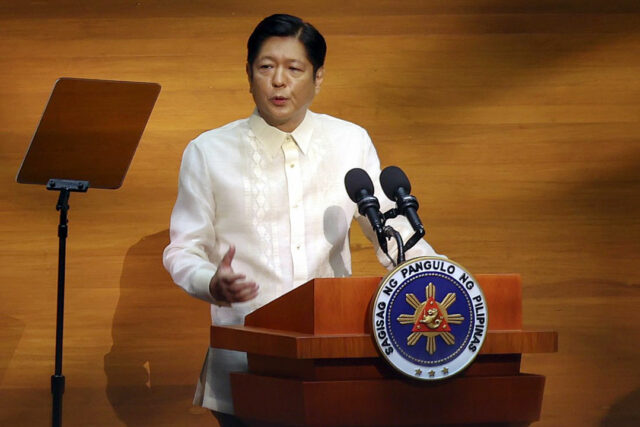
MANILA – Philippine President Ferdinand Marcos Jr pledged on Monday to overhaul his country’s tax system and make it a destination for investment and tourism, promising also a big agriculture overhaul to boost output and reduce its heavy import reliance.

Speaking before Congress in his first state of the nation address, Marcos, who won a May election in a landslide, said it was vital to implement reforms to bring in tourism and investment and maintain what was currently firm growth momentum.

His administration would implement solid fiscal policy management and was targeting 6.5% to 7.5% gross domestic product growth this year, he said, while warning of challenges ahead in keeping prices stable.

Marcos, the son of the late strongman ousted from power in a 1986 uprising, said it was critical that the Philippines, a major importer of rice and other commodities, can boost its farm output and become more resilient to climate change.

Among the measures he would introduce was a moratorium on farmers’ debts to allow them to channel resources into improving output.

“It will unburden farmers of their dues and be able to focus on improving farm productivity,” he said, while stressing the need for an “infusion of fresh and new blood”, and use of scientific farming by a new breed of farmers.

Marcos also promised to improve education, healthcare and working conditions for doctors and nurses and boost infrastructure in the nation of more than 7,000 islands, including modernising airports. — Reuters

Dell reports record year of remote work support for PHL partners 

XPS-UNSPLASH

Digital transformation efforts led to a record year for remote work support, according to information technology (IT) service provider Dell Technologies. 

“We don’t have specific numbers, but the fiscal year of 2022 for the Philippines is a record year for us,” said country general manager Ronnie Latinazo, at a media roundtable on June 22 in Dell’s newly renovated local office in Bonifacio Global City.  

“It’s a strong year and we posted high growth. In fact, the Philippines posted even better growth rates than international, in practically all key drivers,” he added. 

In Asia Pacific and Japan, the Partner Program saw order revenues grow by up to 12% year-on-year as of the first quarter of 2022. Dell also reported that distribution revenue and rebate payouts increased by 12% and 38% respectively. 

Tiang-Hin Ang, Dell’s channel general manager for South Asia, shared that this growth was due to customers realizing that hybrid work is the future, entailing the need for collaboration, security, and performance whether working onsite or online.

“Partners’ strategies are now focused on how to differentiate themselves as experts,” he said. “They’re adapting their business models to address evolving customer needs.”  

This data-driven mindset is the reason for the 24% rise in storage revenue, he added.  

Dell’s clientele includes solution providers, cloud service providers, and original equipment manufacturer (OEM) partners. — Brontë H. Lacsamana

China Belt & Road spending dips in H1, with no investment in Russia — research

JCOMP-FREEPIK

SHANGHAI — China’s finance and investment spending in Belt and Road countries fell slightly in the first half compared to a year earlier, with no new coal projects and investments in Russia, Egypt, and Sri Lanka falling to zero, new research showed. 

Saudi Arabia was the biggest recipient of Chinese investments over the period, with about $5.5 billion, according to the Shanghai-based Green Finance and Development Center (GFDC) in research published on Sunday. 

Total financing and investment stood at $28.4 billion over the period, down from $29.6 billion a year earlier, bringing total cumulative Belt and Road spending to $932 billion since 2013, GFDC said. 

President Xi Jinping launched the Belt and Road Initiative in 2013 aiming to harness China’s strengths in financing and infrastructure construction to “build a broad community of shared interests” throughout Asia, Africa, and Latin America. 

But it has come under scrutiny for the debt burden it places on countries and other issues such as environmental degradation. Some countries have also renegotiated their investment projects with China, highlighting the debt risks. 

No new coal projects received Chinese support over the period after a pledge made at the United Nations General Assembly by Xi last September to put an end to overseas coal financing. 

However, a Chinese developer won a bid to build a thermal power plant in Indonesia in February, and there are still 11.2 gigawatts of capacity that have already secured financing though are yet to begin construction, according to GFDC, part of Shanghai’s Fudan University. 

China has continued to provide support to other fossil fuel projects in Belt and Road countries, with oil and gas amounting to around 80% of China’s overseas energy investments and 66% of its construction contracts, GFDC said. 

Engagements in gas projects stood at $6.7 billion in the first half, compared with $9.5 billion over the whole of last year, it said. 

Green energy and hydropower transactions fell 22% from a year earlier. Investment rose to $1.4 billion from $400 million, but green energy-related construction spending fell to $1.6 billion, less than half the level a year earlier. — Reuters

ADVERTISEMENT
ADVERTISEMENT