Home Blog Page 6105

The irony of the D&E electoral choice
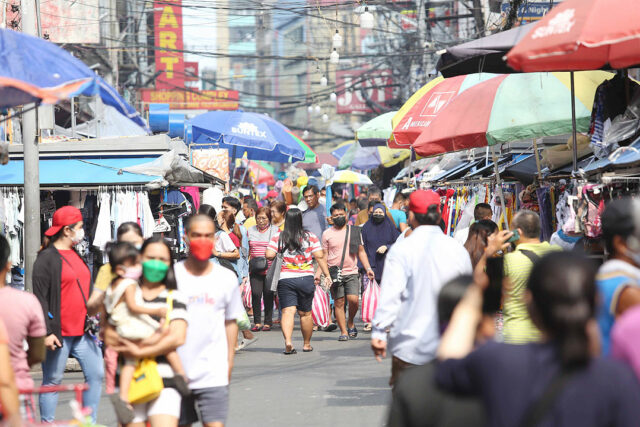
PHILIPPINE STAR/ RUSSEL PALMA

Isn’t it ironic that the D&E socioeconomic classes, the very sector that needs social and economic reforms the most, are the stronghold of the Marcos and Duterte UniTeam.

We all know that the Marcoses and Dutertes are political dynasties. They are supported by the Arroyos, the Estradas, and the Romualdezes, all of whom are dynasties too. And since Marcos and Duterte have the lead in the polls, numerous dynasties across the archipelago have pledged their support for their political survival.

Given the composition and background of the UniTeam, it is highly unlikely that reforms to democratize wealth will be realized. Political dynasties will do what they have always done — consolidate influence for the family even at the expense of vital reforms. I reckon the future, under the UniTeam, will be a status quo situation where the narrow elite control the power and wealth of the land while the majority are given just enough not to revolt.

Why then is Marcos-Duterte tandem the seemingly preferred candidate for the D&E classes? The answer lies in the shortcomings of post-EDSA reforms.

However, sweeping the Aquino and Ramos reforms were to re-establish democracy and re-boot the economy, it fell short when it came to uplifting the lives of the poor. The majority of those who were poor in 1986 remain poor today.

Consider these statistics. Despite the economy expanding by 13.5 times its size in 1986, the wealth of the nation remains concentrated with just 143,000 households or a mere 0.6% of the population. According to the Philippine Institute for Development Studies, this razor-thin elite enjoy incomes of between P2.5 million to several billion pesos annually. Meanwhile, 5.6 million households live below the poverty line, earning less than P10,481 per month. Nine million households live from hand to mouth, earning between P10,481 to P20,962 per month. The middle class, or those who earn between P20,962 and P208,000 a month, comprise the balance of households.

Acute income inequality has led to widespread discontent among the masses. And this, dear reader, is the reason why the Marcos-Duterte tandem is immensely popular. For those that live below or slightly above the poverty line, a vote for Marcos Junior is a rebellion against the status quo. It is a clamor for radical change since the reforms enacted by the revolutionary government failed, as far as they are concerned. Again, its ironic.

In fact, the sentiments of discontent triggered by income inequality were already apparent as far back as 2016. Despite record economic growth fostered by the former President Noynoy Aquino, the masses gravitated to Rodrigo Duterte and his invective-laced battle cries. Mr. Duterte’s foul mouth reflected the anger of the disenfranchised masses.

There are a multitude of reasons why income has not trickled down to the masses despite the seeming success of the Aquino- Ramos reforms. For expediency and lack of space, let me distill them to three.

The first is a failure of the Local Government Code of 1991. The author of the law, Senator Nene Pimentel, had good intentions. The idea was to devolve the powers of the national government to the local governments. This way, they could be the masters of their own fate as far as economic development, environmental protection, healthcare and social services are concerned.

Unfortunately, 31 years after the enactment of the law, most LGUs remain poor and dependent on the national government for their sustenance. Poverty remains rampant and the delivery of social services remains wanting. Worse, the absence of an Anti-political dynasty law led to local government officials cornering political and economic powers within their respective bailiwicks.

Political dynasties are at the heart of income inequality. In the Senate, 16 out of the 24 members belong to dynasties as are 70% of the members of Congress. Among local governments, 73 out of 80 provinces are controlled by dynasties.

Statistics show that the average incidence of poverty in provinces controlled by dynasties is a staggering 29.15% while those not under dynastic control stand at only 18.91%. Abject poverty is at 2.31% in dynastic bailiwicks and only 1.96% in non-dynastic localities.

Most dynasties are ineffective. Why? Because when members of the same family occupy multiple positions within a city or municipality, most are likely to consolidate power in a pseudo monarchial manner. In such a setup, the preservation of power becomes the priority, even more important than social and economic development itself. Painful but necessary reforms are avoided as they erode political equity. Adoption of populist policies becomes the norm at the cost of stunted development.

The second is the failure of the Comprehensive Agrarian Reform Program (CARP). While CARP succeeded on a political level, it failed to arrest the continued drop in agricultural output.

CARP resulted in an average farm size of one hectare with a maximum holding of five. Worsened by an inefficient cooperative system and expensive farm inputs (seeds, fertilizers, machinery), farmers were relegated to subsistence farming characterized by low output, low income, and zero bandwidth for expansion.

The third failure is the protective economic provisions of the 1987 constitution. Stiff restrictions on foreign investments have deprived our people of a vibrant manufacturing sector that could have provided high-income jobs, complete with benefits and security of tenure.

All this is not to say that the Cory and Ramos governments were not successful. It was Cory who dissolved the Marcos-controlled Batasan Pambansa and replaced it with a bi-cameral legislature, duly mandated by a brand-new constitution. Human rights were upheld anew and enshrined in the constitution. Mass media and freedoms of speech, expression, and assembly were re-established. Thanks to her, we now have the right to due process if arrested, the rights to privacy, to information and to protection under the law, among others.

For his part, Ramos succeeded in breaking down monopolies and opening up industries to competition. He embarked on a massive privatization program that allowed us to enjoy relatively reliable electric power, water, air transport, and telecommunications today. He restored economic competitiveness through a series of reforms under the Philippines 2000 agenda.

But all these do not matter to the sector that still lives from hand to mouth.

The Marcos-Duterte campaign spent billions to associate their greatest rivals, the Robredo-Pangilinan tandem, with the post-revolution governments of Cory Aquino, Fidel Ramos, and Noynoy Aquino. By association, the poor blame the “pinks” for their misery.

But unbeknownst to the D&E, it is Robredo-Pangilinan who has articulated their intent to disrupt the status quo. They vowed to enact the Anti Political Dynasty Bill, the Freedom of Information Bill, the Full Disclosure Policy Bill, the People Empowerment Bill, and the Participatory Budget Process Bill. These bills are game-changers that will redistribute wealth, allow more participative governance, and espouse transparency.

As we cast our votes today, let us hope that the D&E classes get what they truly deserve — a government that will raise them up from poverty and narrow the chasm that exists between the elite and the poor.


Andrew J. Masigan is an economist

andrew_rs6@yahoo.com

Facebook@AndrewJ. Masigan

Twitter @aj_masigan

The Collective Conscience speaks

FREEPIK

Today, May 9, 2022 is General Election Day. The day when eligible voters will elect 18,180 new officials for the executive and legislative branches of the government — 77 national posts and 18,103 provincial and local positions, except for the barangay officials.

According to the Commission on Elections (Comelec), of the country’s total population of 110 million, there are 65.7 million registered local voters (61%) who are expected to go out and vote today, aside from the 1.8 million overseas voters who have had the opportunity to vote earlier.

Tempering expectations to a voter turnout of about 82%, like at the 2016 General Elections, that would mean about 55.35 million Filipinos would vote today to choose their leaders for the next six years (for President, Vice-President, and Legislators) and three years (for local governments). A difficult decision.

Today, the Collective Conscience will speak. Whether the good and deserving or the bad and undeserving win or lose, the Collective Consciousness will have chosen. And whichever candidates have won or lost in this perhaps most virulent, ugliest, and brusquely contentious fight for jealous suffrage in decades, they might not have won on pure merit but on the perception of the voters of their capacities to deliver the expectations from such office. It is not even morality or spirituality that will raise the winners, for how can it be explained that even deeply religious and upright people have tenaciously supported the candidates of obvious moral lack and utter dearth of character?

The popularity surveys that proliferated in this most vulnerably impressionable time before elections have insinuated into the collective consciousness, whether they were believed or not, causing mixed emotions of fear or reinforcement. Those who opposed and doubted surveys have brought up concerns about “mind conditioning,” where the repetitive reinforcement of supposedly scientifically derived conclusions convinces the target audience that they should likewise approve of the candidate like those randomly selected interviewees in the surveys. But despite the cynicism about the accuracy of surveys (perhaps more by those whose preferred outcomes are not validated), surveys do call to the bandwagon effect, either positively (join!) or negatively (go for the underdog). Information is always absorbed and processed, consciously or instinctively, by the collective mind — that is what collective consciousness is.

“A lie repeated often enough becomes the truth,” as the infamous Nazi spokesperson Goebbels espoused. Fake news and disinformation have clouded the collective consciousness in this critical time, amidst political and social insecurities exacerbated by the lingering anxieties of the COVID pandemic that would not go away yet. Perhaps the intermittent isolation/restrictions and gradual relaxation — made more confusing with the insistent new variants of the virus — have dissipated suspicion of fake news for want of excitement and novelty in day-to-day living. The internet and its seemingly unlimited information might have surreptitiously taken the lead in molding the collective consciousness, especially of the young, who are more “techie” and more adaptive to new technologies.

The “Young” (those between the ages 18 and 41 as defined by Comelec) are 37 million (about 56%) of the 65.7 million voters in the country — a “prime mover” of the May 2022 election results, Comelec said (CNN Philippines, Feb. 8, 2022). The turnout of the youth in the 2016 election was about 30%, but the turnout this year is projected to be much higher, according to Comelec spokesperson James Jimenez. This might be because the young are more aware of their rights, and of issues about these rights and freedoms — thanks to the accessibility and exchange of information and communication on social media.

Perhaps the biggest challenge facing young volunteers (campaigners) has been the wave of disinformation that has lionized the Marcos era and vilified Ms. (Leni) Robredo as a communist… Tsek.ph, an independent fact-checking project in the Philippines, found that Mr. Marcos (Jr.) has benefited the most from disinformation this year, while Ms. Robredo has been its biggest victim so far. The group said that of more than 200 election-related posts it analyzed, 94% targeted Ms. Robredo; only 10% went after Mr. Marcos Jr.” (nytimes.com, May 1, 2022).

The sinister, selective bashing in social and mass media of the more instinctively liked candidates who have no history of wrong-doing is revising history itself. How can the collective consciousness erase in its mind and soul what history taught it by experience to be the ideals and values for living in peace and harmony in life? Historical revisionism is the betrayal of the collective conscience. “Never again!” is the battle cry of the collective conscience to always remember what the Filipino soul fought for at the EDSA People Power Revolution in February, 1986 — when the dictator Ferdinand Edralin Marcos (Sr.) was ousted after 14 years of bloody martial law that trampled and stole the people’s life, rights, and wealth. “Tama na, sobra na!” Enough is enough!

It turns the knife in the wounded soul of the collective consciousness to now reduce the EDSA Revolution to a fight between “the Yellows” (anti-Marcos) and the pro-Marcos (those who think Marcos did nothing wrong, and even did good for the country back then). The reversal and re-assignment of moral roles — with the Yellows as the bad ones and Marcos as the good one — was a most blatant and despicable mental bullying of the collective soul by present-day pro-Marcos campaigners.

After the counting of votes by the Comelec Board of Canvassers, it will be known who the winners are for the positions to be filled. It will be known if the surveys were right; it will be known if social media was true or false; it will be known if the euphoria of those pre-election rallies of hundreds of thousands for “the good one” (the morally and ethically upright candidate) was premature and naïve. What if the consistent top-notcher (“the other one”) in the popularity surveys wins as President despite moral and ethical doubts on his character?

The moral considerations in choosing whom to vote for in this election have roused the religious (the Catholic clergy) to unprecedented direct involvement in the campaign. Five days before the elections, the Clergy for the Moral Choice (CMC) with over 1,200 (now 1,500) priests, bishops, and deacons, officially endorsed the candidacy of Leni Robredo and her running mate Senator Francis “Kiko” Pangilinan. The CMC reminded Catholic Filipinos (who make up 86% of population) of “their sacred duty… to vote and to vote only for the right leaders of this our beloved country, the Philippines, to choose and to elect true servant-leaders whose hearts are really after the heart of the Good Shepherd” (Rappler, May 4, 2022).

On Teleradyo on May 5, hosts Tony Velasquez and Danny Buenafe asked Fr. Francis Lucas, President of the Catholic Media Network and Director of the Catholic Bishops Conference of the Philippines (CBCP) if the active voice of the Catholic clergy in the elections was a transgression of the constitutional separation of Church and State and against the prohibition in Canon Law for the clergy to be political. Fr. Francis clarified that the endorsement by a group of Catholic clergy was not an institutional endorsement by the Catholic Church, and thus did not violate the Constitution nor Canon Law.

The indigenous religious sect Iglesia ni Cristo (INC) publicly (institutionally) endorsed candidates Bongbong Marcos and Sara Duterte and 12 Senatorial bets for election. “INC requires its members (who make up 2.3% of population) to vote as one, in accordance with the church’s beliefs and the importance it places on unity” (ABS-CBN, May 5, 2022.) The endorsement of certain candidates by the “Moral choice” Catholic clergy was far from being a directive to vote for those endorsed — there is no buying or bribing; no quid pro quo, no forcing, no threats.

Fr. Francis reinforced the concern of the CMC that the collective conscience must make a moral choice on who should lead our country. He prayed: “Panginoong Diyos, mahilom nawa ang mga mali naming pananaw sa buhay; ang pagsalanta namin sa Iyong mga batas at sa Iyong adhikain sa aming ikabubuti.” (Lord God, may our wrong views on life, our disruption of Your laws and Your cause for our good be silenced.)

Heal our collective conscience that has lowered our moral standards by our own disrespect of Your laws, Oh God, and our selfish disregard of Your guidance on what is good for us all.


Amelia H. C. Ylagan is a doctor of Business Administration from the University of the Philippines.

ahcylagan@yahoo.com

HK’s next leader endorsed by pro-Beijing elites

REUTERS

HONG KONG — Hong Kong’s  (HK) leader-in-waiting, John Lee, was endorsed for the city’s top job on Sunday by a committee stacked with pro-Beijing loyalists, as the financial hub attempts to relaunch itself after several years of political upheaval.

Mr. Lee, the sole candidate, received the votes of 1,416 members of a pro-Beijing election committee on Sunday morning, granting him the majority required to anoint him as Hong Kong’s next leader. Eight voted to “not support” him.

Few of the city’s 7.4 million people have any say in choosing their leader, despite China’s promises to one day grant full democracy to the former British colony, which returned to Chinese rule in 1997.

Security was tight around the venue, with police preventing a small group of protesters from approaching.

“We believe we represent many Hong Kong people in expressing opposition to this China-style, single-candidate election,” said Chan Po-ying, a protester with the League of Social Democrats, holding up a banner demanding full democracy.

Mr. Lee, a former Hong Kong secretary for security, has forcefully implemented China’s harsher regime under a national security law that has been used to arrest scores of democrats, disband civil society groups and shutter liberal media outlets, such as Apple Daily and Stand News.

He has pledged to relaunch Hong Kong as an international city and bolster its competitiveness, amid concerns among some Western governments, including the United States, that freedoms and the rule of law have been undermined by the security legislation that was imposed by Beijing in 2020.

Chinese authorities say the law is necessary to restore stability after protracted pro-democracy protests in 2019.

Some critics say Mr. Lee’s attempts to relaunch Hong Kong internationally could be affected by sanctions imposed on him by the United States in 2020 over what Washington said was his role in “being involved in coercing, arresting, detaining, or imprisoning individuals” under the security law.

YouTube owner Alphabet, Inc. has said it took down the Lee campaign’s YouTube account to comply with US sanction laws.

Mr. Lee, who says enacting more national security laws for Hong Kong will be a priority, has often said Hong Kong is a law-abiding society and that everyone must act in accordance with the law.

Among his other priorities, Mr. Lee has said he will restructure the government to bolster policy-making and try to boost housing supply in one of the world’s most expensive housing markets. — Reuters

Sinn Fein calls for united Ireland debate after historic election win

THE TITANIC BUILDING and Harland and Wolff cranes are seen in Belfast, Northern Ireland, April 29, 2022. — REUTERS

BELFAST —  Sinn Fein, the former political wing of the Irish Republican Army (IRA), hailed its first victory in a Northern Ireland Assembly election as a “defining moment” for the British-controlled region and called for a debate on a united Ireland.

Sinn Fein was ahead of the pro-British Democratic Unionist Party (DUP) by 27 to 24 seats with two left to declare, making it the first Irish nationalist party to become the largest in the devolved assembly.

“Today represents a very significant moment of change. It’s a defining moment in our politics and for our people,” said the head of Sinn Fein in Northern Ireland, Michelle O’Neill, whose party secured 29% of first-preference votes to the DUP’s 21.3%.

She said there should now be an “honest debate” around the party’s goal of unifying the territory with the Republic of Ireland.

The victory will not change the region’s status, as the referendum required to leave the United Kingdom is at the discretion of the British government and likely years away.

But the symbolic importance is huge, ending a century of domination by pro-British parties, supported predominantly by the region’s Protestant population.

The DUP, a leading proponent of Britain’s exit from the European Union, saw support undermined in part due to its role in post-Brexit talks between London and Brussels that resulted in trade barriers between Northern Ireland and the rest of the United Kingdom.

‘HISTORIC RESULT’
Scottish First Minister Nicola Sturgeon, who is also leading a campaign to secede from the United Kingdom, was among the first to congratulate Sinn Fein in a Twitter post that hailed a “truly historic result.”

While the largest party has the right to put forward a candidate for First Minister of Northern Ireland’s compulsory power-sharing government, disagreements with the DUP mean such an appointment could be months away.

Asked by a journalist if she expected to become the region’s first Irish nationalist First Minister, Ms. O’Neill said: “The people have spoken.”

DUP leader Jeffrey Donaldson said his party would not join the government unless the protocol governing Northern Ireland’s trade with the rest of the UK following its exit from the European Union was totally overhauled.

The DUP’s campaign focused on a promise to scrap what it calls a border in the Irish Sea.

Mr. Donaldson said he would see what British Prime Minister Boris Johnson says on the topic in a speech next week before deciding his next move.

The British government’s minister for Northern Ireland Brandon Lewis in a statement called on the parties to form an executive as soon as possible.

Sinn Fein was long shunned by the political establishment on both sides of the Irish border for its links to Irish Republican Army violence during three decades of fighting over Northern Ireland’s place within the United Kingdom that ended with a 1998 peace deal.

Since then it has reinvented itself to become the most popular party in the Republic of Ireland, where it has carved out a successful base by campaigning on everyday issues such as the cost of living and healthcare.

It followed a similar path in the Northern Irish elections, where it focused on economic concerns rather than Irish unity to appeal to middle-ground voters.

The election follows demographic trends that have long indicated that pro-British Protestant parties would eventually be eclipsed by predominantly Catholic Irish nationalist parties who favor uniting the north with the Republic of Ireland. — Reuters

Taliban orders Afghan women to cover faces again

US Office of the Chairman of the Joint Chiefs of Staff/Flickr

KABUL — Afghanistan’s Taliban government ordered women on Saturday to cover their faces in public, a return to a signature policy of their past hardline rule and an escalation of restrictions that are causing anger at home and abroad.

A decree from the group’s supreme leader, Haibatullah Akhundzada, said that if a woman did not cover her face outside home, her father or closest male relative would be visited and face potential prison or firing from state jobs.

“We call on the world to co-operate with the Islamic Emirate and people of Afghanistan … Don’t bother us. Don’t bring more pressure, because history is witness, Afghans won’t be affected by pressure,” Mohammad Khalid Hanafi, the minister for the Propagation of Virtue and Prevention of Vice, told a news conference.

The ideal face covering was the all-encompassing blue burqa, the group said, referring to the garment that was obligatory for women in public during the Taliban’s previous 1996-2001 rule.

Most women in Afghanistan wear a headscarf for religious reasons but many in urban areas such as Kabul do not cover their faces.

The Taliban has faced intense criticism from Western governments, but also by some religious scholars and Islamic nations, for limiting women’s rights including keeping girls’ high schools closed.

The United Nations’ mission to Afghanistan (UNAMA) said in a statement on Saturday that it would immediately seek meetings with the Taliban over the issue, adding it would consult with others in the international community on the implications of the ruling.

“UNAMA is deeply concerned with today’s announcement by the Taliban de facto authorities … this decision contradicts numerous assurances regarding respect for and protection of all Afghans’ human rights,” the statement said.

The United States and others have already cut development aid and sanctioned the banking system since the group took over in August, pushing Afghanistan towards economic ruin.

The Taliban says it has changed since its last rule, but in recent months has added regulations limiting women’s movement without a male chaperone and banning men and women from visiting parks together.

“It is interfering with women’s private lives,” Kabul-based women’s rights advocate Mahbouba Seraj said of Saturday’s decree. “Today we have lots of other problems, like suicide attacks, poverty … People are dying every day, our girls can’t go to school, women can’t work … But they just think and speak and make laws about hijab (women’s Islamic dress).” — Reuters

Unemployment rate dips in March, job quality worsens

PHILIPPINE STAR FILE PHOTO

By Mariedel Irish U. CatilogoResearcher

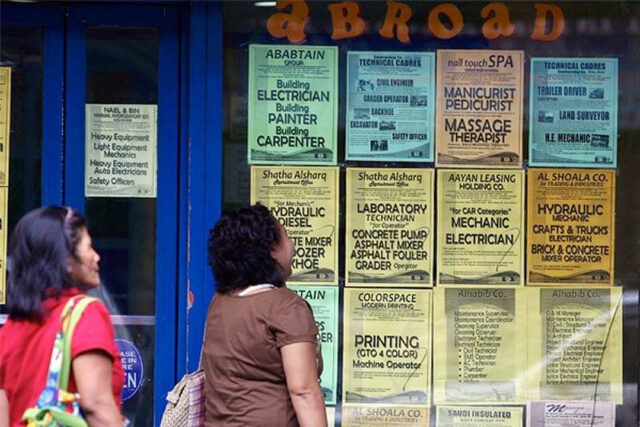
The country’s unemployment rate in March eased on a monthly basis to its lowest since the start of the coronavirus pandemic due to further loosening of mobility restrictions, but job quality worsened to a four-month high.

Preliminary results of the Philippine Statistics Authority’s (PSA) March round of the Labor Force Survey (LFS) on Friday showed the unemployment rate slowed to 5.8% from 6.4% in February. This was also slower than the jobless rate of 7.1% a year ago.

The number of the unemployed Filipinos was reduced by 251,000 to 2.875 million in March from 3.126 million in February. This was also lower by more than half a million from 3.441 million in March last year.

Philippine labor force situation

March’s jobless rate was the lowest since the 5.3% in January 2020, before the government imposed strict mobility curbs in March to contain the spread of the coronavirus disease 2019 (COVID-19).

Meanwhile, the size of the labor force in March continued to climb month on month by 1.244 million to 49.850 million. It was larger by 1.078 million from 48.772 million a year ago.

This translated to a labor force participation rate (LFPR) — the proportion of the total labor in the working-age population of 15 years old and over — of 65.4% in March, higher than the previous month’s 63.8% and last year’s 65%.

It was the highest LFPR since the 66.3% in October 2011.

However, the quality of jobs deteriorated in March as more employed Filipinos look for an additional job or longer working hours. The underemployment rate rose to 15.8% that month, an increase from 14% the previous month, but still lower than the 16.2% in the same period last year.

This translated to 7.422 million underemployed Filipinos, an increase of 1.040 million from February’s 6.382 million and higher by 86,000 from 7.335 million a year ago.

Underemployment rate in March was the highest in four months or since the 16.7% recorded in November last year.

The employment rate — the of the employed population to the total workforce — was 94.2% in March, picking up from 93.6% in the previous month and 92.9% in March 2021.

This was equivalent to approximately 46.975 million employed Filipinos, higher by 1.495 million from 45.480 million in February. About 1.643 million Filipinos became employed from last year’s 45.332 million.

“The March labor force survey results reflect the gains from moving around 70% of the economy to Alert Level 1,” Socioeconomic Planning Secretary Karl Kendrick T. Chua said in a press release.

“As we continue to manage the risks, we reiterate our recommendation to shift the entire country to alert level 1 to generate more employment and strengthen the domestic economy against external shocks,” he added.

The National Economic and Development Authority estimated that around 81% of the economy is now under the most lenient Alert Level 1 that prompted businesses to operate at full capacity.

Metro Manila and other areas has been under the Alert Level 1 starting March as COVID-19 cases continued to decline.

Security Bank Corp. Chief Economist Robert Dan J. Roces attributed the improvement in the country’s labor market to the relaxation of quarantine restrictions.

“Latest results jive with higher import numbers, an indication of better capital and consumer demand, and the PMI (purchasing managers’ index) number which was in expansion and indicative of mobility improvements and growth,” Mr. Roces said in an e-mail.

The country’s manufacturing Purchasing Managers’ Index (PMI) an index that indicates the country’s conditions in the manufacturing sector, improved to over three-year high of 53.2 in March. The 50 mark separates expansion from contraction.

In a separate e-mail, Trade Union Congress of the Philippines (TUCP) Spokesperson Alan A. Tanjusay said that “freer alert levels, continuing opening and more mobility of products and services” resulted in the improvement of the unemployment rate.

Meanwhile, the higher underemployment print in March “may be reflective of a labor market still in recovery mode, as businesses gradually reopen,” Mr. Roces said.

The Filipino worker worked on an average of 40.6 hours in a week in March, slightly lower than the 40.8 in February but higher than 39.7 hours last year.

By sector, the services sector remained the largest contributor to the workforce at 57.4%, lower than the 58.2% share in February. This was followed by agriculture at 25.2% from 23.9% and industry at 17.4% from 17.9%.

Mr. Roces was optimistic about the labor market’s recovery this year.

“The labor numbers at this point is a function of the quarantine measures, and if looser curbs hold, then a return to pre-pandemic labor figures is certain,” he added.

For his part, Mr. Tanjusay, spokesperson of the country’s largest labor federation, expressed uncertainty on the recovery of the labor market.

“It depends on the conduct and outcome of the national and local elections. If the democratic process is followed and results are respected then it is possible for existing and new investors come in and create jobs,” he said.

The national elections will be held on May 9.

The PSA started reporting monthly jobs data in 2021. Prior to that, the agency published employment figures on a quarterly (January, April, July, and October) basis.

The March round of LFS was conducted from March 8 to 28.

Trade deficit widens in March

ICTSI

By Bernadette Therese M. Gadon, Researcher

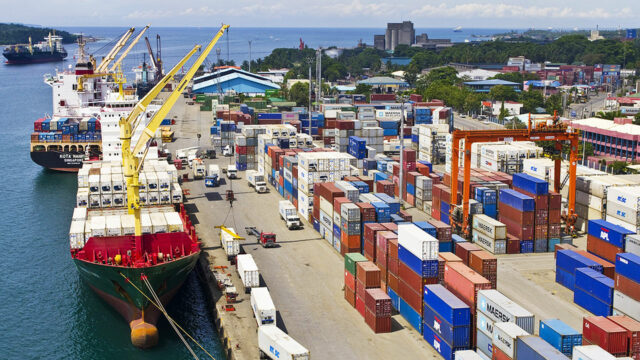
THE country’s trade-in-goods deficit widened to a three-month high in March as imports outpaced exports which could dampen the economic output in the first quarter.

Preliminary data from the Philippine Statistics Authority (PSA) showed the value of merchandise exports grew by 5.9% to $7.171 billion in March, easing from 15.8% growth in February and 33.4% in March last year.

This was the lowest pickup in five months or since the 2% growth in October 2021.

Philippine trade year-on-year performance

Meanwhile, the country’s merchandise imports rose by 27.7% to $12.175 billion in March. This was slower than the 28.6% posted the previous month but faster than 22.1% a year ago.

This matched January’s pace and was the lowest in five months or since the 25.2% growth in October last year.

This brought the trade-in-goods deficit to $5.004 billion in March, almost double the $2.759 billion gap a year ago. It was the widest trade gap since December last year’s $5.273 billion shortfall.

In the first quarter, the trade gap further yawned to a $13.892 billion deficit, wider than the $8.345 billion gap registered in the same period last year.

For the three-month period ending March, exports rose by 9.8% year on year to $19.418 billion, already above the 6% growth projected by the Development Budget and Coordination Committee this year.

Meanwhile, imports surpassed the 10% growth projection for 2022 with a 28% increase during the first three months of the year to $33.309 billion.

“The bloating trade deficit should weigh on the overall GDP (gross domestic product) print,” ING Bank N.V. Manila Branch Senior Economist Nicholas Antonio T. Mapa said in an e-mail interview. He expects the economy to grow by 6.1% in the first quarter of this year.

“Export growth continues but has finally normalized after base effects wane. Sector continues to take its cue from the performance of the mainstay electronics sector,” he said.

“Imports also posted an expected double-digit gain in large part because of the bloated fuel import bill. However, key subsectors such as consumer imports and capital machinery suggests that the economic recovery will continue to be shallow as consumption and investment momentum is not as robust as hoped for,” Mr. Mapa added.

Historically, exports of goods and services account for around a fourth of the Philippine economy, while imports have more than 30%.

The PSA will report the first-quarter GDP data on May 12.

Electronic products remained the country’s top export product, accounting for 55.3% of total sales in March. Total receipts for this commodity group amounted to $3.963 billion that month, rising by 8.1% from $3.666 billion in March last year.

Semiconductors, which accounted for about three-fourths of electronic products and 41.8% of total exports in March, increased by 9.2% annually to $2.996 billion from $2.744 billion a year ago.

Other mineral products went up by a fifth to $410.857 million, with 5.7% share to total sales that month.

Other manufactured goods, meanwhile, dropped by 4.5% to $375.679 million. It accounted for 5.2% of exports in March.

Raw materials and intermediate goods took a 37.3% share of March’s import bill. Its bill amounted to $4.544 billion in March, higher by 18% annually from $3.851 billion a year ago.

Capital goods went up by 9.5% to $3.270 billion from $2.986 billion. Mineral fuels, lubricant, and related materials more than doubled to $2.584 billion from $1.042 billion.

Importation of consumer goods likewise rose by 8.6% to $1.711 billion.

Danilo C. Lachica, president of the Semiconductor and Electronics Industries in the Philippines, Inc. (SEIPI) attributed March’s trade performance to the lockdowns imposed in China and Hong Kong, as cases of the Omicron variant rose and supplies were put on freeze.

“What’s more bothersome would be the lockdowns in China. Because we get 30% of imported materials from China and Hong Kong, and basically with the lockdowns, it’s impacting the materials and the logistics lead time. So that’s the impact of the pandemic,” he said in a Zoom video call interview.

“In addition to that, if you have supply chain disruption, your costs skyrockets, as it is right now, Philippines has a higher logistics cost than our ASEAN neighbors at something like 20-30%, so it’s exacerbated by these supply chain [issues] because we have to pay premium for deliveries,” he added.

The Russia-Ukraine conflict that started in February also played a part in terms of fuel costs in the latter half of the quarter, Mr. Lachica said. However, the lowering of prices seen at present indicates better trading in the coming months.

China announced country-wide lockdowns across in late March, especially in their main cities after a surge in coronavirus (COVID-19) cases, forcing companies to stop trading and supplies going in and out to be delayed.

Despite this, China remained to be the country’s top source of imports with 17.5% share in March, lower than the 24.1% in the same month last year. This was followed by Japan (10.2%), and South Korea (9.8%).

China was also the top destination of Philippine-made goods, with a 16.5% share of total export sales in March. It was followed by the United States (15.2%) and Japan (14.5%).

For the rest of the year, Mr. Lachica said commodities related to work-from-home setups will drive the trade, and ease of lockdowns in China will pick up the slower growth recorded in March, adding that the Philippines should also continue to control the COVID-19 cases to avoid further disruption of the supply chain and operations locally.

Restrictions in Metro Manila and various parts of the country have been relaxed to Alert Level 1 since March.

“For April’s trade, I guess we’ll probably continue to see an increase in medical electronics, semiconductor components, telecommunications products because of the work-from-home [setups],” Mr. Lachica said.

“The widening trade deficit means pressure on the peso will persist into the medium term and exert more price pressures for the rest of the year and next,” Mr. Mapa said.

MSMEs are key to creating unicorn startups

Micro, small, and medium enterprises (MSMEs) may be the key to birthing the next Philippine unicorns, according to a technology accelerator for early-stage startups.

A unicorn is a startup with a valuation of over $ 1 billion.

“Ninety-eight percent of the Philippine economy is MSMEs. If you can find a way to digitize them and help them export their products on a global scale, you’re going to be a winner,” said Rene “Butch” S. Meily, president of IdeaSpace Foundation, at a BusinessWorld Insights event held on May 6.

Stakeholders from the private and public sectors are laying the foundation for both unicorns and camels to thrive. (A camel is a startup that can survive a crisis without a sky-high valuation.)

“Whether we’re talking about camels or unicorns, we really need to focus in terms of building the foundation, ensuring that we have a robust startup and innovation ecosystem,” said Rafaelita “Fita” M. Aldaba, undersecretary for Competitiveness and Innovation of the Department of Trade and Industry.

“There’s a strong momentum among the different stakeholders.”

Policy reforms that have been enacted to create an enabling environment for startups include Republic Act (RA) No. 11337 or the Innovative Startup Act, which encourages the operation of innovative new enterprises; and RA No. 11232 or the Revised Corporation Code of the Philippines, which allows a single person to form a corporation without the need for shareholders.

Eight regional inclusive innovation centers — including SHINE in Cagayan Valley and iStrike Davao — have been set up to connect and integrate the innovation and entrepreneurial ecosystem throughout the country.

Southeast Asia is home to 35 startups, 15 of which are in Singapore. According to a report on ASEAN startups by Credit Suisse, 19 startups in the region saw an increase in valuation to above $1 billion in 2021 alone.

Mynt, Globe’s fintech arm that manages the e-wallet GCash, is the Philippines’ sole unicorn.

The 2019 Global Competitiveness Report ranked the Philippines 64th out of 140 countries.

“Our country is part of a global village and has to measure itself against international rankings,” said Anna Irmina “Minette” B. Navarrete, the co-founder and president of Kickstart Ventures, Inc. (KVI), a Globe subsidiary and corporate venture capital firm.

KVI has funds focused on digital adoption, telecommunications, and technologies that support the future of data, work, home, and life.

“We need to cultivate ambition on a massive scale,” Ms. Navarrete said. “We need to have a mindset and a perspective that looks to grow, and that looks for consistent delivery of excellence of service and products to a high standard, [and] over a long period of time.” — Patricia B. Mirasol

BW Insights: Transforming Philippine Startups into Unicorns

As many of our neighbors are now showing great strides in producing unicorns, the Philippines continues its search for more startups that will further boost the economy as they solve local problems, as well as make waves globally.

In order to do so, what should be enhanced or improved within the sector? How do we cultivate an environment that will eventually make way for these unicorns?

Learn that and more this May 6 (Friday) at 11 a.m. in the second and final leg of BusinessWorld Insights’ two-part series themed “Philippine Startups: Moving Forward and Up”.

Catch experts as they discuss the topic “Transforming Philippine Startups into Unicorns” LIVE and FREE on BusinessWorld’s and The Philippine STAR’s Facebook pages.

This session of #BUSINESSWORLDINSIGHTS is supported by the Management Association of the Philippines, British Chamber of Commerce Philippines, Philippine Chamber of Commerce and Industry, and The Philippine STAR.

Bumble offers online trauma support for sexual assault survivors 

Ivan Radic/Flickr/CC BY 2.0

Dating and networking app Bumble and survivor-led non-profit organization Bloom announced on Tuesday that they are providing online trauma support to Bumble users who report sexual assault or relationship abuse.  

Bumble members who report sexual assault or emotional abuse to the app’s feedback team will be given any or all of Bloom’s self-guided courses, available in English and Spanish, on:

  • Healing from Sexual Trauma;
  • Society, Patriarchy, and Sexual Trauma; and
  • Dating, Boundaries, and Relationships.

In some cases, Bumble users can also access one-on-one chat support and up to six therapy sessions.  

“The safety of our members has been central to our mission from day one. It is vital that we create a space for survivors within our community to be seen, heard, and believed,” said Kenya Fairley, Bumble’s head of member safety support, in a statement. 

In the Philippines, usage of the app remained high amid the pandemic because of Filipinos’ strong online presence, with personality being the top priority for Filipino users when looking for a partner, according to Bumble in November. 

There is no data for negative Philippine-based experiences of online dating, but the 2017 National Demographic Health Survey conducted by the Philippine Statistics Authority showed that one in four Filipino women aged 15 to 49 has experienced physical, emotional, or sexual violence by a partner. 

A global survey that Bloom conducted among Bumble members highlighted that emotional abuse was the most commonly experienced form of abuse, happening almost equally online and in-person. 

In-person abuse is reported less often, however, with 35% saying they didn’t report because they didn’t think it would achieve anything, and 15% saying they thought they wouldn’t be believed.  

“Where there is trauma, there is room for healing. Feedback from our course participants shows that Bloom supports survivors to feel less alone and make progress along their healing journey in whatever way works for them,” said Hera Hussain, founder of Chayn, the organization against gender-based violence that runs Bloom. 

Bumble has no access to any information disclosed in the therapy sessions. Bloom uses technology with end-to-end encryption that enables secure and anonymous group therapy conversations. — Brontë H. Lacsamana

Shanghai says China’s worst COVID outbreak under ‘effective control’

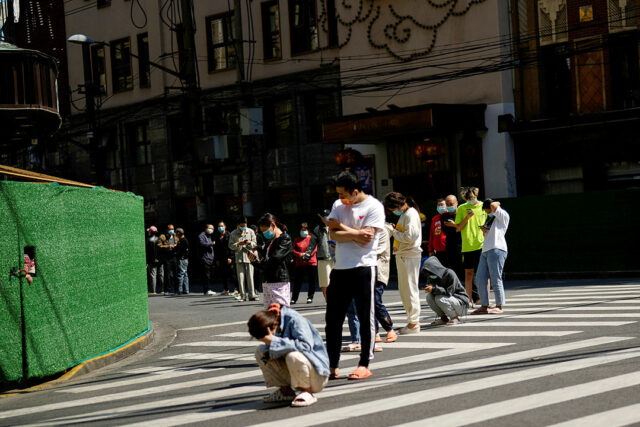
RESIDENTS line up for nucleic acid tests during a lockdown in Shanghai, China, April 17. — REUTERS

SHANGHAI — Shanghai said on Friday it has brought China’s worst outbreak of coronavirus disease 2019 (COVID-19) under effective control following a month-long lockdown of nearly 25 million people, with authorities vowing to stand by their zero-COVID strategy despite mounting economic costs. 

The number of new COVID infections in China’s financial hub had been on a “continuous downward trend” since April 22, the city’s vice mayor Wu Qing said. 

“Currently, our city’s epidemic prevention and control situation is steadily improving, and the epidemic has come under effective control,” he told a news conference. 

Many of Shanghai’s 25 million residents are still under lockdown and chafing against the measures, now in their second month, implemented as part of China’s “zero-COVID” approach to tackling COVID. 

Mr. Wu sounded a note of caution, saying while community transmission has been “effectively curbed” there was a risk of a rebound, and the city would not sway from the “dynamic clearance” strategy. 

“We cannot relax, we cannot slack off: persistence is victory,” he said, echoing comments at a meeting of the standing committee of the ruling Communist Party’s politburo late on Thursday. 

The virus was first identified in the Chinese city of Wuhan in late 2019. The strategy taken by China to fight it, of mass testing, strict quarantine and sweeping lockdowns, threatens its official growth target of about 5.5% this year and has sent reverberations across the global economy. 

Though some 2.3 million Shanghai residents are still in sealed-off high-risk areas, another 16.67 million are in lower-risk “prevention zones”, meaning they can, in theory, leave their homes and roam around their communities. 

However, many residents have been complaining that different community officials are applying the rules in different ways, with some people in “prevention zones” still unable to get out even though their area has reported no positive cases for weeks. 

One large compound in central Shanghai’s Changning district, announced on Friday that it was relaxing restrictions within the compound and scaling back the number of volunteers helping to deliver food. But its residents could still not get out through its locked gates. 

Shanghai reported 4,024 new local asymptomatic coronavirus cases on May 5, down from 4,390 a day earlier. Confirmed symptomatic cases stood at 245, also down from 261 a day earlier. Deaths fell to 12, from 13 a day earlier. — Reuters

Singapore convicts two linked to $6B penny-stock crash

PIXABAY

SINGAPORE — Singapore’s high court has convicted two people over what authorities consider to be the largest market manipulation case in the city-state, a joint statement by the Singapore police and Monetary Authority of Singapore said on Thursday. 

For almost a decade, Singapore authorities have been investigating suspected trading irregularities tied to a so-called penny-stock crash in late 2013 that wiped out around S$8 billion ($5.78 billion) from the value of three companies within the space of a few days. 

Quah Su-Ling and Malaysian John Soh Chee Wen were the masterminds behind an elaborate scheme to artificially inflate the value of shares of Blumont Group Ltd. (Blumont), Asiasons Capital Ltd. (Asiasons) and LionGold Corp. Ltd. (LionGold), the statement said. 

The pair were found guilty on more than a hundred offenses each, including market manipulation and cheating, it said. 

The scandal, which saw those stocks surge multiple times in the months before they slumped, battered investor confidence and led to a series of reforms to the city-state’s stock trading rules. 

During investigations, Singapore authorities raided more than 50 locations and interviewed over 70 individuals, examining evidence consisting of more than two million emails, 500,000 trade orders, and thousands of telephone records and financial statements, the joint statement said. 

Soh and Quah, who could not be reached for comment, will be sentenced at a later date. 

A lawyer representing Soh did not immediately respond to a request for comment. Quah was not represented in court, according to media reports. — Reuters