(L-R) Patrick Avila, director of A-FLOW, Vic Barrios, CEO and president of Digital Edge Philippines, Maricar Nepomuceno, country director of Digital Halo, Victor Genuino, president and CEO, VITRO, Inc., Carlo Malana, president and CEO of ST Telemedia Global Data Centres (Philippines), Nik de Ynchausti, president/co-founder of YCO Cloud.—Data Center Operators of the Philippines
PHILIPPINE DATA CENTER operators have formed the Data Center Operators of the Philippines (DCPH) to coordinate efforts in strengthening the country’s position as a digital hub in Southeast Asia.
“The Philippines can enhance its infrastructure resilience, attract greater cloud and AI investments, and establish itself as a leading digital hub in the region, enabling the free and seamless flow of data across borders to support the digital economy,” DCPH said in a media release on Tuesday.
The alliance, composed of VITRO Inc., ST Telemedia Global Data Centres (Philippines), YCO Cloud, Digital Edge Philippines, Digital Halo, and A-FLOW (a joint venture between FLOW Digital Infrastructure and AyalaLand Logistics Holdings Corp.), signed a memorandum of understanding to bolster the country’s regional standing in the global digital economy through robust data center infrastructure development and industry cooperation.
“Together, these companies share a common vision — to strengthen the Philippines’ regional competitiveness in the global digital economy through robust data center infrastructure development and industry collaboration,” the group said.
VITRO, the data center unit of the PLDT Group under ePLDT, Inc., is building its 12th data center in General Trias, Cavite, which will be its largest to date.
The facility will have a capacity of 100 megawatts (MW) — double that of its 50-MW VITRO Sta. Rosa campus in Laguna, currently the largest in the country.
STT GDC Philippines, a joint venture between Globe Telecom, Inc., Ayala Corp., and ST Telemedia Global Data Centres, operates seven data centers in the country with a combined IT load of 150 MW.
Members of DCPH have a combined 473 MW of IT power capacity, the group said, adding that it will serve as a unified voice for the country’s data center industry.
“Driving stronger collaboration across stakeholders and allied sectors. Its key goals include advancing infrastructure and innovation; working with the power sector to ensure competitive rates and renewable energy access; collaborating with telcos to enhance connectivity; and engaging with government agencies,” it said.
The group also seeks to work closely with the Department of Information and Communications Technology (DICT) on supportive policies such as data localization, while also developing talent and manpower amid growing demand for hyperscalers and emerging technologies, particularly artificial intelligence.
“The alliance underscored that data localization is crucial for data processed and stored by the public sector. Keeping government data within the country safeguards national security and protects citizen data,” it added.
The DICT has projected that the Philippines’ data center capacity could reach 1.5 gigawatts (GW) by 2028 as more local and foreign operators establish facilities in the country.
“As digital transformation and AI adoption accelerate worldwide, this alliance marks a pivotal step toward building a future-ready and globally competitive digital economy for the Philippines — one powered by data centers, the backbone of digitalization,” DCPH said. — Ashley Erika O. Jose
POMPEII, Italy — Pompeii’s ancient Roman frescoes, shattered and buried for centuries, could get a second life thanks to a pioneering robotic system designed to support archaeologists in one of their most painstaking tasks: reassembling fragmented artifacts.
The technology, developed under an European Union-funded project called RePAIR, combines advanced image recognition, AI-driven puzzle-solving, and ultra-precise robotic hands to accelerate traditionally slow and often frustrating restoration work.
Launched in 2021 and coordinated by Venice’s Ca’ Foscari University, the robotic project showcased in Pompeii last Thursday brought together international research teams that have used the archaeological site as their testing ground.
The experimental project “actually started from a very concrete necessity to recompose fragments of frescoes that had been destroyed during the Second World War,” said the site’s director Gabriel Zuchtriegel.
Researchers believe the technology could transform restoration practices worldwide.
The robot uses twin arms equipped with flexible hands in two sizes and vision sensors to identify, grip, and assemble fragments without damaging their delicate surfaces.
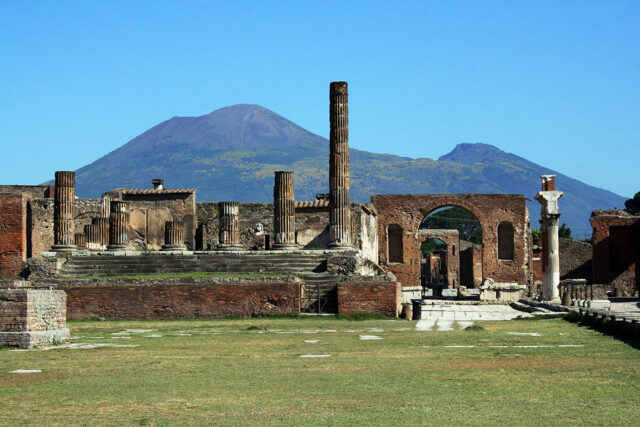
The once-thriving city of Pompeii, near Naples, and its surrounding countryside were submerged by volcanic ash when Mount Vesuvius exploded in AD 79.
Researchers focused on frescoes preserved in a fragmentary state in Pompeii’s storerooms — two large ceiling paintings which were damaged during the initial eruption and later shattered by bombing in World War Two, and frescoes from the so-called House of the Gladiators which collapsed in 2010.
Replicas were created during this initial testing phase to avoid risking the original pieces.
While the robotics teams worked on designing and building the system, experts in artificial intelligence and machine learning developed algorithms to reconstruct the frescoes, matching colors and patterns that may not be visible to the human eye.
Experts say the task is similar to solving a giant jigsaw puzzle, with extra difficulties such as missing pieces and no reference image of the final result.
“It’s like you buy four or five boxes of jigsaw puzzles. You mix everything together, then you throw away the boxes and try to solve four or five puzzles at the same time,” said Marcello Pelillo, the Venice university professor who coordinated the project. — Reuters
THE PESO slipped against the dollar on Tuesday on economic growth concerns and ahead of key US data to be released on Friday.
The local unit went down by 3.1 centavos to close at P58.521 against the greenback from its P58.49 finish on Monday, Bankers Association of the Philippines data showed.
The peso opened Tuesday’s session flat at P58.49 to the dollar. Its weakest showing was at P58.54, while its intraday best was at P58.33 versus the greenback.
Dollars traded went up to $1.49 billion from $1.22 billion on Monday.
The local unit edged down after Economy Secretary Arsenio M. Balisacan said that Philippine gross domestic product (GDP) growth may not even reach the lower end of the government’s 5.5-6.5% full-year target due to the impact of the corruption scandal and adverse weather, Rizal Commercial Banking Corp. Chief Economist Michael L. Ricafort said in a Viber message. If realized, 2025 would be the third straight year that the Philippines will miss its GDP growth goal.
The economy expanded by 4% in the third quarter, the slowest in over four years, bringing the nine-month average to 5%.
“The peso weakened amid expectations of a stronger US PCE (personal consumption expenditures) inflation data due to be released on Friday,” the first trader said in a Viber message.
Investors are now looking out for Wednesday’s November ADP employment report and Friday’s delayed September PCE Index, for clues on a Fed interest rate cut at the central bank’s meeting next week, Reuters reported.
Traders are pricing in an 87% chance of a December Fed rate cut, per CME’s FedWatch tool.
“The dollar-peso closed slightly higher due to geopolitical fears that attract dollar strength during Asian time amid rising oil prices. (There are) growing geopolitical fears after the drone strike damaged infrastructure of the Black Sea Terminal,” the second trader said in a phone interview.
For Wednesday, the first trader sees the peso moving between P58.40 and P58.65 per dollar, while the second trader expects it to range from P58.30 to P58.60. Mr. Ricafort said the peso could trade from P58.40 to P58.65. — A.R.A. Inosante
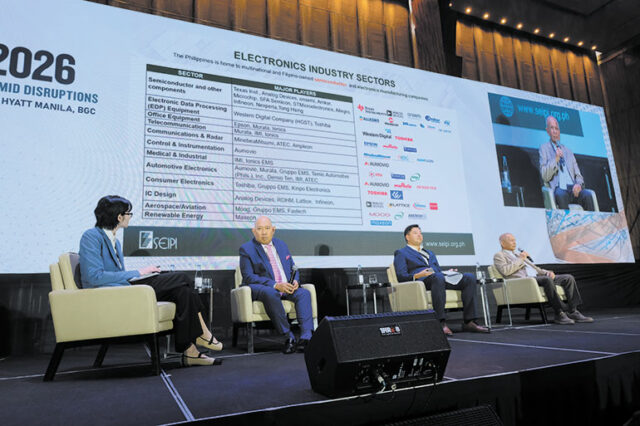
Panel Discussion 4 (L-R): Former BusinessWorld reporter Luisa Jocson (moderator), Victor Andres “Dindo” Manhit of Stratbase Institute, John Reinier Dizon of the Federation of Philippine Industries, and Dan Lachica of the Semiconductor and Electronics Industries in the Philippines Foundation, Inc. — Photos by The Philippine Star/Jesse Bustos
By Bjorn Biel M. Beltran, Special Features and Content Assistant Editor
“For an impenetrable shield, stand inside yourself.”
Henry David Thoreau, the most commonly attributed source of that quote, posited that with inner strength and unshakeable fortitude, one can overcome almost anything. The most powerful defense is internal.
This universal truth was reached by the final panel of BusinessWorld Forecast 2026, where representatives from trade organizations and think tanks came together to discuss “Navigating New Normal in Trade: How Philippines Is Faring in the New Global Trade Order.”
Since recovering from the global pandemic, international trade has been defined less by recovery and more by turbulence. Geopolitics is now a disruptive force of its own, reshaping value chains and redrawing the map of opportunity. Major economies like the United States under President Donald Trump are forcing supply chains to recalibrate, even as technology becomes ever necessary through the proliferation of digital systems and economies. This shifting order has sharpened competition across Asia and exposed long-standing vulnerabilities in trade-dependent economies like the Philippines.
“Today the world, I would say, is in a global disorder,” Stratbase Institute President Victor Andres “Dindo” C. Manhit said.
Since the Second World War, Mr. Manhit explained, there had been a prevailing narrative about the world: that the West had been up to now the custodians of the global order, and that the Philippines as a country has benefitted greatly from this order. But as Western influence wanes, those who have questioned that arrangement — countries like China, Russia, and Iran — are stepping into the limelight.
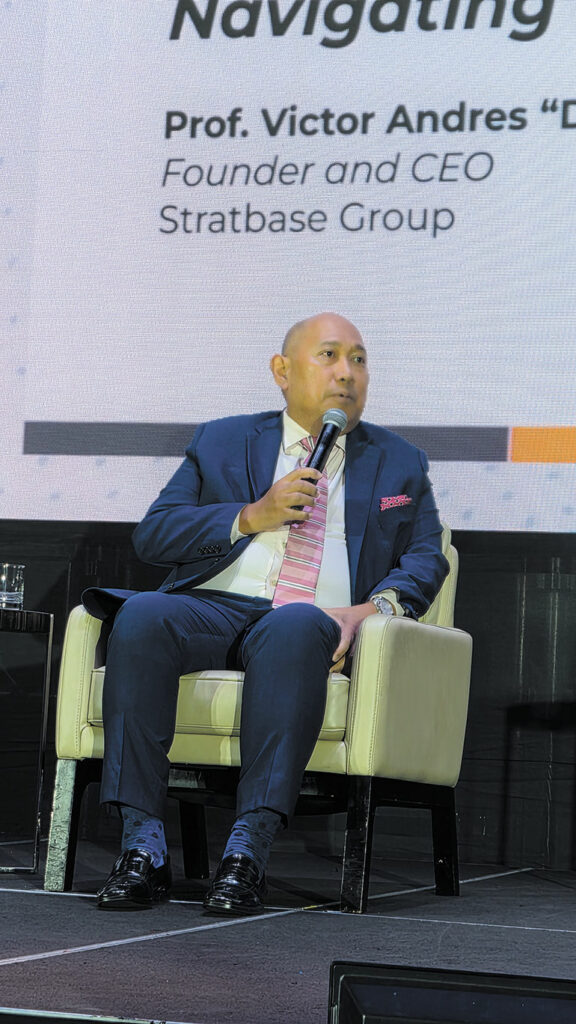
Stratbase Institute President Victor Andres “Dindo” C. Manhit
“The past few years we have seen a confluence of national security and economic security,” he said. “I see a world whereby the Philippines is in the middle.”
The Philippines, as he sees it, is in the perfect strategic position to take advantage of shifting geopolitics. However, the country cannot rely on external momentum alone. It needs its own foundation, and that is the greatest challenge.
No industry illustrates the tension better than electronics. The sector has long been the backbone of Philippine exports. Semiconductor and Electronics Industries in the Philippines Foundation, Inc. President Danilo “Dan” C. Lachica laid out the magnitude with precision.
“The sector accounts for 70% of the country’s $42.6-billion exports,” he said, noting that despite earlier projections of flat growth due to inventory corrections and reciprocal tariffs, the industry is still seeing growth riding the wave of advanced technologies. “Because of artificial intelligence, data centers, TVs, and all that, we’re now looking at 5% to 7% growth.”
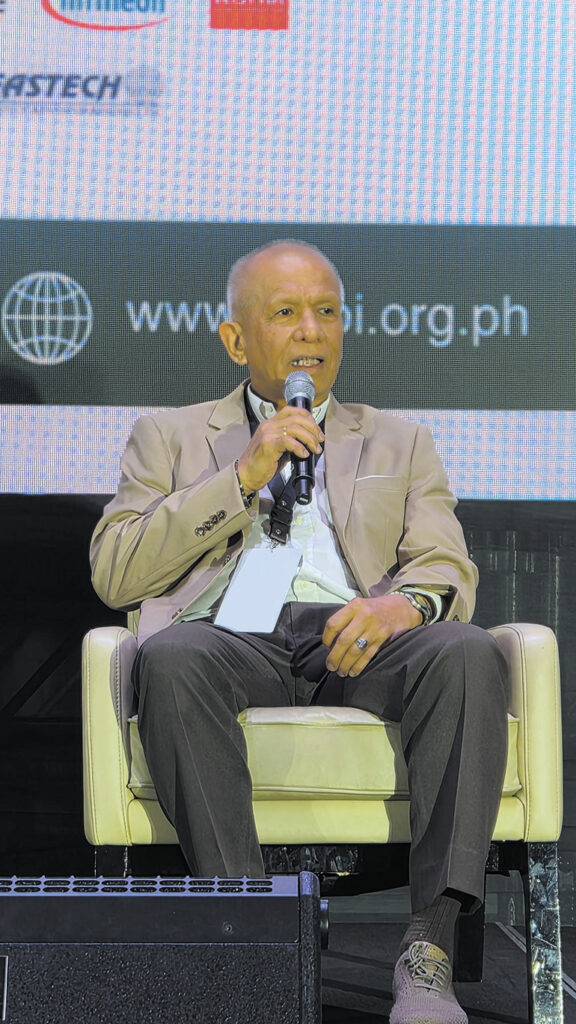
Semiconductor and Electronics Industries in the Philippines Foundation, Inc. President Dan Lachica
Yet, the very success of electronics exposes how narrow the country’s export base has become. Mr. Lachica was quick to point out the structural fragility: global electronics supply chains flow overwhelmingly through Hong Kong, and China still is the biggest export origin.
During the pandemic, this near-total dependence locked the industry into paralysis. “We were practically at a standstill,” he recalled.
Even now, the sector’s integration into global technological trends is not matched by equally strong domestic supply-chain development or industrial strategy. Mr. Lachica noted with concern that semiconductor electronics was absent from the initial priority track for ASEAN discussions in 2026 — despite being the country’s largest dollar generator. It’s a telling omission, and one that underscores how the Philippines still enjoys export success without fully anchoring it in national policy.
The rest of manufacturing illustrates this internal weakness. Federation of Philippine Industries President John Reinier H. Dizon reminded the audience how liberalization reshaped the country’s economic terrain.
“There are pros and cons of such free trade. There is nothing wrong with it,” he said. “But many other countries have placed more safeguards… The Philippines was maybe a little bit more aggressive. And as a consequence, over time, it actually affected our trade deficit.”
The consequences are visible across decades. “Several industries actually faltered,” Mr. Dizon said, citing the collapse of the Marikina shoe sector, the decline of textiles, and the fall of National Steel Corp. The country embraced free trade before building the productive base that would allow it to benefit from openness. Consumption rose, but the industrial core thinned.
The result today is a staggering trade imbalance. “We have the biggest trade deficit in ASEAN… about $54 billion,” he pointed out. “If we compare that with the likes of Vietnam, they actually had a trade surplus of $28 billion. Thailand, trade surplus of $6 billion. Malaysia, trade surplus of $20 billion. Indonesia, their trade deficits at a much more manageable level, at $15 billion.”
Thus, in the global market, the Philippines has become a consumer with relatively little to offer. So, how can a country leverage regional agreements or global markets if it has nothing to sell?
Federation of Philippine Industries President John Reinier Dizon
Mr. Dizon urged the government to put more effort into reviving manufacturing and production to support local industries. Initiatives like the Tatak Pinoy Act, or Republic Act No. 11981, aimed at enhancing collaboration between the government and private sector, is a start.
The shield we have yet to build
This foundational core begins with perception.
The Philippines, Mr. Manhit argued, needs to stop seeing itself as an accessory to bigger, more powerful countries. This shift in self-perception matters not just for diplomacy but for investment strategy. After six years of Chinese-focused foreign policy under the Duterte administration, he pointed out that the Philippines scarcely got any investment from Beijing. Real capital inflows continue to come from Japan, the United States, and the European Union, partners that coincidentally also align with the country’s security interests.
“Maybe it’s time for us to look at who our friends are and really build a secure economy that also protects our interests,” he said. “At the end of the day, we are in a good strategic position. Let’s maximize it.”
This convergence of geopolitics and economics may define the coming decade. Supply chain diversification, reshoring, and allied manufacturing give the Philippines the chance to reposition itself, but only if it stabilizes its policy environment and strengthens governance. Transparency, stable policies, and partnerships between the public and private sectors are now essential conditions for competitiveness.
Former BusinessWorld reporter Luisa Jocson moderated the panel discussion.
For an impenetrable shield, one must create it inward. Competitiveness — one that can thrive in any storm — does not come from aligning with the right partners alone, nor from riding the growth of a single sector. It comes from building resilience within, through strong industries, governance, and institutions.
“Let’s stop looking at ourselves like such poor Filipinos,” Mr. Manhit encouraged. “Strategic thinkers used to say, ‘Why do you call yourself a small country? Because you’re not.’”
“We have the economy growing. We have a population that is big. We also need to think big,” he added.
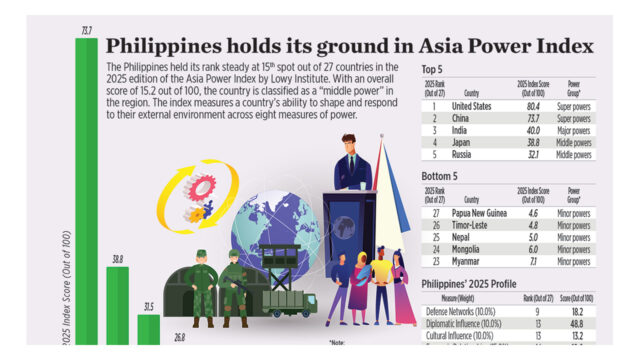
The Philippines held its rank steady at 15th spot out of 27 countries in the 2025 edition of the Asia Power Index by Lowy Institute. With an overall score of 15.2 out of 100, the country is classified as a “middle power” in the region. The index measures a country’s ability to shape and respond to their external environment across eight measures of power.
FLOODING along E. Rodriguez Avenue in Quezon City brought by torrential rains from Typhoon Carina and the southwest monsoon on July 24, 2024. — PHILIPPINE STAR/MIGUEL DE GUZMAN
THE Philippine government is considering offering a bounty for former House of Representatives appropriations committee Chairman Elizaldy S. Co, who authorities believe fled to Portugal to evade arrest following a Sandiganbayan-issued warrant tied to an anomalous flood control project in Oriental Mindoro.
Palace Press Officer Clarissa A. Castro told a news briefing that while a bounty “could possibly be considered,” no official discussions have taken place.
Mr. Co’s company, Sunwest, Inc., is alleged to have misappropriated public funds for a P289-million road dike along the Mag-Asawang Tubig River in Naujan, Oriental Mindoro. He faces graft charges.
The case is part of a broader investigation into a corruption scandal involving high-ranking officials and private contractors receiving kickbacks on government projects.
Separately, Ms. Castro addressed calls for a lifestyle audit of presidential son and Ilocos Norte Rep. Ferdinand Alexander “Sandro” A. Marcos III, whose district reportedly received among the highest Department of Public Works and Highways (DPWH) funds from 2023 to 2025.
She said there is no restriction on subjecting any public official to a lifestyle check and reiterated that the First Family has consistently welcomed such reviews.
A recent Philippine Center for Investigative Journalism (PCIJ) report highlighted how DPWH funds have become a de facto pork barrel, allowing lawmakers to channel large infrastructure allocations to favored districts.
Sandro Marcos reportedly received P15.8 billion, while former Speaker and presidential cousin Ferdinand Martin G. Romualdez got P14.4 billion — far above most other districts, some of which received minimal funding.
“The President has read the PCIJ report,” Ms. Castro said. “[Sandro] has said that he volunteered, and whatever issues concern him, he will personally go to the [Independent Commission for Infrastructure] to be investigated,” she added in Filipino.
The PCIJ report raised concerns over transparency, political favoritism and fairness, noting that funds are released before specific projects are identified.
Nonallocable DPWH projects have also been used for alleged political insertion and kickbacks, suggesting that significant discretionary influence persists, echoing the previous pork barrel scheme.
President Ferdinand R. Marcos, Jr. has tried to reassure the public by promising jail time for those involved in anomalous flood control projects before Christmas.
He earlier announced arrest warrants for Mr. Co and several others linked to an anomalous public works deal in Bulacan, north of the capital.
The President earlier flagged about P545 billion in flood control spending since 2022, saying about P100 billion in contracts went to only 15 contractors, including companies tied to political clans.
On Nov. 26, Mr. Marcos said more assets linked to the flood control scandal had been frozen, bringing the total so far to about P12 billion.
The Anti-Money Laundering Council has said the frozen assets included 3,566 bank accounts, 198 insurance policies, 247 motor vehicles, 178 real properties and 16 e-wallet accounts.
Mr. Co earlier posted a series of videos accusing Mr. Marcos and senior officials of graft after the administration launched a sweeping probe
Thousands of protesters gathered in the Philippine capital on Nov. 30 — a national holiday marking the birth of revolutionary hero Andres Bonifacio — demanding Mr. Marcos’ resignation over the flood scam.
The rally started at the Luneta National Park in Manila, with protesters marching on to the presidential palace. — Chloe Mari A. Hufana
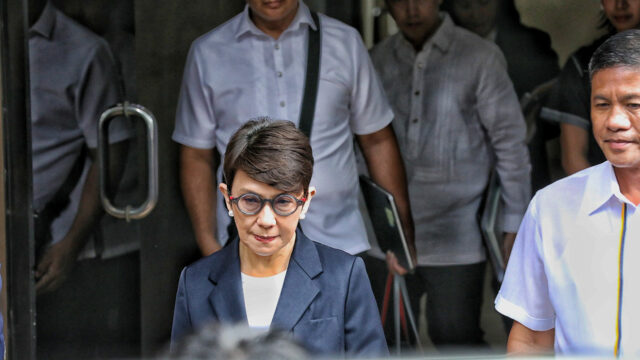
LANDBANK PRESIDENT and Chief Executive Officer Lynette V. Ortiz comes out of the ICI building in Taguig City after attending a hearing on the flood control scandal. — PHILIPPINE STAR/WALTER BOLLOZOS
By Erika Mae P. Sinaking
THE Independent Commission for Infrastructure (ICI) started livestreaming its proceedings on Tuesday as it investigates irregularities in government flood control projects, with more lawmakers expected to appear in the coming days.
Laguna Rep. Benjamin C. Agarao, Jr. appeared before the body and denied claims by contractors Cezarah Rowena C. Discaya and Pacifico F. Discaya II, who accused him of soliciting commissions in exchange for government flood control projects.
“I do not personally know them,” he told commissioners. “I do not know what motive the Discaya couple may have. I have nothing to say because I was not present during the period they are referring to.”
“I cannot fathom why he mentioned my name and accused me of what I believe are false allegations. My family has been deeply affected,” Mr. Agarao said, adding that he might pursue legal action against the Discayas.
In a separate session, officials from state-owned Land Bank of the Philippines (LANDBANK) submitted a “disbursement framework” detailing institutional workflows, internal controls and validation procedures for its financial operations.
Landbank President and Chief Executive Officer Lynette V. Ortiz said all transactions linked to government projects, including a P457-million cash release to contractor Syms Construction, were properly conducted.
ICI Commissioner Rogelio “Babes” L. Singson questioned Landbank officials about multiple accounts linked to contractors and potential red flags. Ms. Ortiz acknowledged the interlinked ownership but said it did not automatically constitute a red flag, citing bank secrecy rules for specifics.
Several lawmakers are scheduled to appear this week as resource persons, including House of Representatives Majority Leader and Ilocos Rep. Ferdinand Alexander “Sandro” A. Marcos III, Davao City Rep. Paolo “Pulong” Z. Duterte, Benguet Rep. Eric Go Yap and Bulacan Rep. Danilo A. Domingo.
Meanwhile, Party-list Rep. Antonio L. Tinio submitted a letter and technical report urging the ICI to investigate alleged irregularities in P4.4 billion worth of flood control contracts in Davao City.
He cited discrepancies in project locations, incomplete works and possible overpricing in at least 80 contracts executed from 2019 to 2022.
“Some project locations differ from what was approved in the budget,” Mr. Tinio said. “In some cases, the actual project length is shorter than what was funded, which suggests possible overpricing.”
He noted that more than half of the projects were congressional insertions and called for a probe into the role of then-Congressman Mr. Duterte.
THOUSANDS marched near the People Power Monument along the EDSA highway in Quezon City on Nov. 30 to protest against state corruption. — PHILIPPINE STAR/MIGUEL DE GUZMAN
By Kenneth Christiane L. Basilio, Reporter
MOST Filipinos backed a recent anti‑corruption protest over alleged irregularities in flood control projects, pollster WR Numero said on Tuesday, as reports of wrongdoing linked to anomalous infrastructure deals continue to fuel discontent against the government.
In a statement, WR Numero said 58% of Filipinos supported the Nov. 30 protest against widespread corruption, with 12% saying they were “strongly supportive” and 46% “supportive.”
About 18% of respondents said they did not support the movement, according to a poll of 1,412 Filipinos conducted from Nov. 21 to 28, with an error margin of ±2.8 points. About two in 10 were unsure.
“Support for the protests signals accumulated frustrations,” Ederson DT. Tapia, a public administration professor at the University of Makati, said in a Facebook Messenger chat.
“While the government has taken visible steps to address issues such as corruption and improve service delivery, many citizens still feel a gap between policy intent and lived experience,” he added.
Thousands of Filipinos marched through the streets of Manila and Quezon City to denounce corruption in the government on Nov. 30, with some protesters calling for the resignations of officials linked to the multibillion-peso scandal.
The flood control controversy has struck a chord with Filipinos due to the scale of the fraud and the shock over collusion among politicians and contractors to pocket billions of pesos meant for infrastructure projects widely seen as a need in the flood-prone country.
Mr. Tapia noted that while support for the anti‑corruption movement remains strong, organizers should sustain momentum by broadening their calls and linking the campaign to other issues.
“We must avoid the temptation to view public sentiment through a single-issue lens,” he said. “Corruption is important, but citizens also care deeply about economic stability, job creation and the country’s long-term development trajectory.”
“Rally support can be strong, but sustaining momentum requires recognizing the full spectrum of public concerns,” he added.
THE Office of the Solicitor General (OSG) reinstated itself as counsel for the government respondents in Senator Ronald “Bato” M. Dela Rosa’s petition challenging the arrest of former President Rodrigo R. Duterte before the Supreme Court (SC).
In a recent manifestation filed with SC on Dec. 1, the OSG, under Solicitor General Darlene Marie B. Berberabe, formally re-entered the case as counsel for all government respondents, reversing the stance of former Solicitor General Menardo I. Guevarra, who had recused the OSG from the proceedings.
“After due consideration, the OSG hereby enters its appearance anew as counsel for all the Respondents in the above-captioned case and requests that it be furnished with copies of all court issuances and submissions at its official address,” the OSG said.
Mr. Guevarra earlier recused from representing the government in a consolidated lawsuit filed by Mr. Duterte’s children — Sebastian, Paolo, and Veronica — regarding their father’s arrest on March 11 through a warrant issued by the International Criminal Court (ICC).
In a statement on Tuesday, Duterte camp’s legal counsel Israelito P. Torreon said the re-entry of the OSG in the case, “constitutes an abrupt and unexplained shift from its earlier and formally approved recusal.”
“The OSG’s latest filing stands in direct conflict with its own prior position and raises substantial concerns regarding internal consistency, neutrality, and adherence to a Supreme Court Resolution that had already granted its withdrawal from participation,” he added. — Erika Mae P. Sinaking
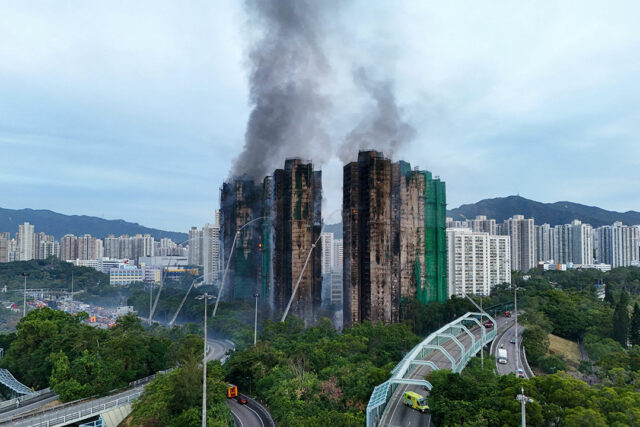
A DRONE view shows flames and thick smoke rising from the Wang Fuk Court housing estate during a major fire in Tai Po, Hong Kong, China, Nov. 27. — REUTERS/TYRONE SIU
ALL Filipinos affected by the blaze that engulfed multiple residential buildings in Hong Kong (HK) last week have all been confirmed to be safe, the Philippine Consulate General in Hong Kong said.
In a statement on Tuesday, the Philippine Consulate confirmed that all 92 Filipino nationals residing in the Wang Fuk Court residential complex in Tai Po, Hong Kong were all safe and accounted for.
“All Filipinos who likely worked at the Wang Fuk Court residential complex are all accounted for,” it added.
The consulate said that the last two overseas Filipino workers listed for verification have been found to be already in the Philippines when the fire broke out.
Earlier the consulate confirmed the death of a Filipina domestic worker who was said to be taking care of her employer’s five-year-old daughter when the fire broke out.
The consulate added that the other Filipina who was injured during the incident remains in the hospital.
The fire, which hit on Wednesday afternoon (Nov. 26), rapidly engulfed seven of the eight 32-storey blocks at the complex during renovations.
Hong Kong authorities have arrested at least 13 people in connection to the fire that led to the deaths of about 152 people. — Adrian H. Halili
Education and professional regulatory agencies vow to address the nationwide diploma mill crisis. - ALMIRA S. MARTINEZ
THE Senate on Tuesday approved a measure extending the Second Congressional Commission on Education’s (EDCOM II) life for another two years on third and final reading.
All sixteen senators present on Tuesday’s session approved Senate Bill No. 1483 that proposes to extend the commission to December 2027 from its initial December 2025 deadline, allowing the commission more time to ensure education reforms are fully implemented beyond its deadline this year.
The measure would also allow for further research, oversight of initial reforms, and coordination with stakeholders to turn proposals into lasting policies.
The proposed extension has also received support from the Department of Education, Commission on Higher Education, and the Technical Education and Skills Development Authority, during a committee hearing earlier.
The commission is tasked to work with Congress and other government agencies to ensure alignment of education and training systems with national development and labor market requirements.
A similar measure seeking to extend the commission’s life span hurdled a House of Representatives committee last month.
Formed in 2022, the education commission was tasked with crafting reforms to address weaknesses in the school system exposed during the COVID-19 pandemic, when classrooms were shut for more than two years, forcing a nationwide shift to online learning that led to stunted learning.
A World Bank report noted that nine out of 10 Filipinos are unable to read and understand a simple age-appropriate text at age 10.
Filipino students were among the world’s weakest in math, reading and science, according to the 2022 Program for International Student Assessment. The Philippines ranked 77th out of 81 countries and performed worse than the global average in all categories. — Adrian H. Halili