Home Blog Page 6014

Department of miseducation
BW FILE PHOTO

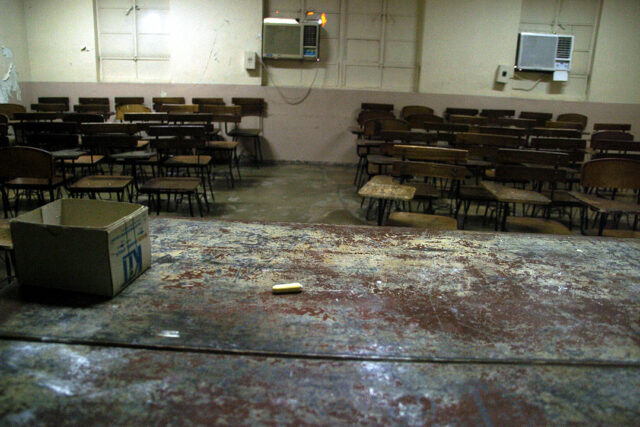
The bias in some Department of Education (DepEd) teaching materials against Vice-President Leni Robredo was obvious and bad enough. But even worse are their errors — the word “government” was for example misspelled in the offending texts — and their misleading and releasing these among the populace of ill-trained and uninformed future citizens incapable of wisely exercising their rights and discharging their duties, such as electing the right leaders of this rumored democracy.

Whether old (print, broadcasting, film) or new (online news sites, blogs, etc.), as purveyors of information the media can shackle the mind or free it, and deter change or accelerate it. So can the educational system provide the knowledge and understanding that can liberate men and women from ignorance — or keep them in its depths by miseducating them.

For the most part, however, both primarily function as among the means through which the State persuades and convinces the citizenry that things should remain the way they have always been. Some teachers and media practitioners are advocates of change, whether cultural, political, economic, or social. But they are the exceptions rather than the rule — deviations from the “normal” almost immediately provoke State intervention.

The Philippine experience is illustrative of how the power elite has repeatedly tried, and mostly succeeded, in controlling the narratives of the media and the educational system on what happened in the past and what is happening in the present of these troubled isles.

The political economy of the dominant media — their being commercial enterprises in the hands of economic interests whose protection and advancement depends on government goodwill — has led to institutional and practitioner self-censorship, among other consequences. Although privately owned, some media organizations are besieged by such other problems as government threats and harassment, which prevent them from fully discharging the ethical and professional responsibilities of truth-telling.

Control over the educational system is, on the other hand, at least partly assured by its being an instrumentality of the Executive Branch of government through DepEd and the Commission on Higher Education (CHED). But that control has not been absolute.

For example, although a State institution, the University of the Philippines (UP) has a number of times been in the crosshairs of State intervention for some of its constituents’ criticism of government, its officials, and its policies.

It was accused of promoting “godlessness” and “subversion” in the late 1950s. A number of its professors were brought before the House of Representatives Committee on Anti-Filipino Activities (CAFA) and interrogated for publishing a document in one of its research journals on how the tenancy system was driving the peasantry to rebellion. Martial law shut it down for weeks. Its staff, students, and faculty were already under surveillance prior to its declaration, and some were arrested and detained indefinitely once martial rule was implemented. It has more recently been tagged a “recruitment center” of the Communist Party of the Philippines (CPP) and the New People’s Army (NPA), apparently for some of its professors’ encouraging, and some of its students’ internalizing, the imperative of learning as a lifelong commitment of the truly educated man and woman.

But that is only UP — and only some of its professors and students. As for the so-called State “universities” created by congressmen out of this or that fifth-rate school in their districts, few of their so-called professors, if any, are even aware of the responsibilities of teaching and learning, and are easily bullied by such pretenders to academic authority as police and military censors into purging their libraries and silencing themselves and their students.

Their reach, however, is fairly limited compared to that of basic education, which shapes the minds of the young at their most vulnerable and impressionable age. Indeed, it is in the primary and secondary schools under DepEd’s charge where much of the misinformation and disinformation that clutter the brains of millions of Filipinos is generated, shared, and distributed.

The quality of the products of any system is what best describes it, its capacities as well as its flaws. There are basic education graduates who have not even heard of Adolf Hitler, for example, despite that monster’s slaughter of more than six million Jews and other “undesirables” (no wonder his admirer Rodrigo Duterte thought the number to be three million); his having committed the worst crime in all of human history; and his starting a war that killed an additional 50 million people in Europe alone.

Here in the lair of the Philippines’ ruling dynasties, the domestic equivalent of European fascism is hardly studied. If the Marcos kleptocracy is at all mentioned in school, it is in glowing terms by clueless teachers who use the error-filled textbooks written by well-connected “authors” that they make their students read. That the Marcos dictatorship is being described as a “golden age” — the exact opposite of what it really was — could only have originated in this country’s primary and secondary level classrooms.

It explains why the 30- to 40-year-olds who constitute the bulk of the supporters of Ferdinand Marcos, Jr. and his family either have no inkling of what transpired during that dark and brutal period, or else romanticize it as a time of peace, justice, and prosperity — and who spread their sub-literate views through Instagram and Tiktok.

Among the consequences of mass ignorance of those dark periods in history is the failure to appreciate the value of human rights and to understand how barbaric dictatorships can be. To many Filipinos, despotism is either an abstraction that has nothing to do with human lives — or, worse, a benevolent and even necessary option in times of crisis.

As bad or even worse is the failure of the same system to even provide the literacy and numeracy skills individuals need. Every independent study on the capacities of Filipino primary and secondary students has in fact found abysmally low levels of reading and mathematical competence among them.

Those findings seriously question their capacity to meet the complex challenges posed by the problems of their own country or even to survive them. Many thus end up either as domestics at home or abroad, or as part of the vast legions of the unemployed and unemployable, while being among the most confident people in the world about their social media-based, fact-challenged opinions on public issues.

The historian Renato Constantino wrote lengthily in his pioneering work, The Miseducation of the Filipino, on how little Filipinos know about what happened in Philippine history, and how misleading a guide in navigating the turbulent waters of the Philippine crisis their limited knowledge of it has been. And yet, as he pointed out, education is crucial to the cultural renewal necessary for the realization of their aspirations for a just and reasonably prosperous society.

That was in the 1960s, but here we are, six decades later and already in the 21st century, with those hopes still unrealized. Certainly, one of the reasons for it is the failure of the so-called educational system to provide the knowledge that is among the most crucial factors in any society’s advancement and even survival.

That failure is a convincing argument in favor of giving the agency in charge of education in this part of the planet a name that more accurately describes what it has been doing. But that of course will never happen — not in this country where the words of government are too often part of the State apparatus of mass deception rather than of enlightenment.


Luis V. Teodoro is on Facebook and Twitter (@luisteodoro).
www.luisteodoro.com

Mainstreaming inflation and the Fund

TARTILLA-FREEPIK

Mainstreaming some economic ideas becomes easier when enough focus is dedicated to it during the Annual Meetings of the International Monetary Fund (IMF) and the World Bank Group. After years of absence, for instance, inflation took center stage again during this April’s hybrid Spring Meetings. Fund economists behind the World Economic Outlook (WEO) have started talking about it and raising the red flags to global growth because of price pressures building up both in the US and big markets, and in small developing and emerging markets.

For instance, the IMF’s Chief Economist Pierre-Olivier Gourinchas in his press briefing on the latest WEO last Tuesday argued that the world’s economic prospects have been severely undermined as inflation may prove to be more long lasting due to Russia’s invasion of Ukraine. This is enough for the Fund to downgrade its projection of global growth from January’s 4.4% to this month’s 3.6%.

All that the Fund is saying is that Ukraine is the wild card. The continued hostilities fuel the series of supply shocks that propagate spillovers to the global economy through commodity markets, trade and financial linkages. With reduced supplies from Russia and Ukraine, oil, gas, metals, wheat, and corn prices are bound to escalate and magnify price pressures on other commodities and services.

The timing of the war in Eastern Europe could not have been worse. The pandemic has hardly disappeared from the scene while supply-demand imbalances continue to rage, prompting monetary policy normalization. With supply bottlenecks already pushing inflation higher, the latest China lockdowns could add yet another supply shock.

The Fund therefore identified monetary tightening and financial market volatility as one of the principal forces shaping near-term global outlook namely, the Russia-Ukraine war, fiscal withdrawal, slowing growth in China, and the pandemic and vaccine access.

For these reasons, the Fund has declared that “inflation has become a clear and present danger for many countries.”

Gourinchas noted that inflation has reached its highest level in over 40 years in the United States and some European countries given their tightening labor markets. This is just the inflation level, but what should also worry us is its expected long duration.

The Fund correctly identified the risk of a possible de-anchoring of inflation expectations away from central bank inflation targets. Some central banks have actually begun tightening their monetary stance; others decided to wait for more signs of second-round effects. The problem with being patient nowadays is that price movements have been unprecedentedly sharp, especially for food and fuel. This could easily build up into social unrest and destabilization.

If this rising inflation is not arrested promptly, we might be seeing spillovers into the global financial markets, tightening of financial conditions, and ultimately, from the perspective of smaller economies, capital flight. We don’t have to complete the analytical loop but we can almost foresee what comes next in terms of currency depreciation, trade disruption, and still higher inflation, and then weaker growth.

Looking back, the concern about this rising inflation originated from former US Treasury Secretary Larry Summers in a Washington Post column in Feb. 2021. He questioned the enormous size of US President Joseph R. Biden’s $1.9-trillion pandemic response which passed through the US Congress. He predicted then: “There is a chance that macroeconomic stimulus on a scale closer to World War II levels than normal recession levels will set off inflationary pressures of a kind we have not seen in a generation.” US inflation then stood below 2%. In March this year, inflation averaged 8.54 %.

Today, people are disputing whether Summers’s analysis is consistent with what is unravelling. As John Cassidy in The New Yorker of April 8 clarified, while Summers stressed the expansionary role of Biden’s American Rescue Plan and the US Fed that seems to be behind the curve in raising its policy rate early enough, others put weight on the pandemic impact on global supply chains and the labor market. Following this argument, some wonder why some European economies that eschewed big pandemic packages are also going through inflation of historic proportions.

If this analysis is to be followed, we must be seeing a global phenomenon that is gaining momentum from factors other than pandemic-driven fiscal support. US economists’ assessment that does not derive from Summers’, points to the prolonged Delta and Omicron variants and their impact on supply chains and the labor market. Most importantly, US administration economists are questioning Summers’ statistics. They argued that the estimated output gap was much larger than what was assumed by the Congressional Budget Office and the actual amount of public spending stood so much less than what was assumed by the former US treasury secretary. Therefore, with a bigger output gap and lower actual public spending, the budget allocation should not be too inflationary.

But Summers was quick to point out that the US nominal GDP is double digit and with some capacity constraints, inflation could only be excessive. He also cited a study by the Federal Reserve Bank of San Francisco showing that with a large stimulus budget including for cash transfer, that could have contributed at least three percentage points to inflation by the fourth quarter of 2021. On the smaller size of actual public spending, Summers countered: “If the argument is that the money has not yet been spent, that makes the stimulus even more problematic because it’s going to be coming at a time when there is overheating.”

His central point is that demand has been high relative to potential supply. If the two cannot be balanced and inflation starts heating up, macroeconomic management must have failed.

For Summers, it is important that the US Fed bite the bullet and sharply increase its policy rate. He is for prompt monetary action against the threat of inflation. While some Democrats have observed Summers could be providing too much ammunition to the Republicans, he has this to say: “The benefits from the American Rescue Plan depend on a strong economy, which is threatened as overheating leads to declining real wages and, quite possibly, recession.”

Two other important points are prominent in the analysis of Summers. The enormous pandemic plan has crowded out desirable long-term investments in what the US calls “Build Back Better” Plan. In the Philippines, this could be a good return to a more efficient and effective execution of Public-Private Partnerships.

His other point is that inflation at all costs should be considered a grave threat to be managed well. Otherwise, even progressive politics could be at risk. Closer at home, international financial institutions like the IMF, World Bank, ADB, and the ASEAN +3 Monitoring and Research Office are all one in saying the Philippine economy could grow by about 6% in 2022 and pre-pandemic levels could be regained in a couple of years. Yet, monetary policy appears timid even as official forecasts already indicate elevated inflation for the rest of the year in excess of the target. Next year’s inflation is expected to start tapering. A preemptive, nominal adjustment could have a big meaningful guidance to the market that inflation is a concern and monetary policy remains cautiously pro-active to re-anchor inflation expectations close to the targets.

Back to the Fund.

In the April WEO, the Fund was unequivocal that inflation drivers could be diverse, and in many cases, beyond monetary control. But it has been observed that price pressures are increasingly becoming more broad-based. The impact of the Ukraine war could also vary across countries depending on their trade and financial linkages.

Like a referee, the Fund prescribes that whether inflation is driven by strong fiscal policy support, as Summers would put it, or motivated by fuel- and war-related commodity price pressures, the Fund believes that “tighter monetary policy will be appropriate to check the cycle of higher prices driving up wages and inflation expectations, and wages and inflation expectations driving up prices.”

By all means, we must avoid this cycle in the Philippines.


Diwa C. Guinigundo is the former deputy governor for the Monetary and Economics Sector, the Bangko Sentral ng Pilipinas (BSP). He served the BSP for 41 years. In 2001-2003, he was alternate executive director at the International Monetary Fund in Washington, DC. He is the senior pastor of the Fullness of Christ International Ministries in Mandaluyong.

Second wave of Russian oil shock is starting

DEPOSITPHOTOS/ NOFRET

The lights are dimming over the Russian oil industry — literally.

The Kremlin is doing its best to conceal the full impact of formal and informal energy sanctions after its invasion of Ukraine. But Moscow can’t hide from the satellites above Siberia that measure the amount of light its oilfields emit as unwanted gas is burned, or flared: The higher the production, the more flaring and the more light — and vice versa.

The flaring data, combined with anecdotal information from traders and leaks of official Russian statistics, suggest that eight weeks into the war, Moscow is finally succumbing to the impact of government-imposed penalties and companies’ self-sanctions. On average, Russian oil output is down 10% from its pre-war level.

More production losses are likely as Western refiners and traders walk away from Russia upon the expiry of supply contracts in coming weeks. The European Union (EU) is also considering baby steps to reduce its purchases of Russian oil, trying to find ways to sidestep German opposition to the measures. “We are currently developing smart mechanisms so that oil can also be included in the next sanctions package,” EU Commission President Ursula von der Leyen told the Bild am Sonntag.

For consumers — and central banks in inflation-fighting mode — declining Russian production signals the beginning of a second, and likely longer lasting, wave of oil price increases. For Vladimir Putin, the stakes are even higher: revenue from oil and gas sales has so far helped cushion the blow of international sanctions, stabilizing the ruble and financing his military machine. A lasting decline in production that outweighs any price increase would be a longer-term headwind for Russia’s economy on top of the direct costs of the war.

The first phase of the oil-price shock from Putin’s invasion was as intense as it was brief. Russian output proved more resilient than expected; China’s COVID lockdowns reduced demand, and the US and its allies released millions of barrels from their strategic petroleum reserves. Brent, the global oil benchmark, initially surged to $139.13 a barrel on March 7 in the first days of the Russian military campaign but retreated nearly 30% to a low of $97.57 a barrel by April 11.

The second phase is likely play out in slow motion over a longer period, risking more economic havoc. Brent crude has already climbed back to near $110 a barrel, and prices will probably rise gradually as the market absorbs the supply losses. Seasonal peak demand is still two-and-a-half months away, with the summer holiday period of the northern hemisphere, and retail gasoline prices are sure to climb.

Brent has averaged $99.20 a barrel so far this year. In 2008, when prices hit an all-time high, the average price year-to-date at this time of year was $98.40 a barrel. The only potential relief is bad economic news: a recession in the US and Europe is the clearest obstacle to $100-plus oil.

Russian oil production is likely to drop further in coming months, judging by statistics from OilX, a consultancy that uses imaging data from NASA satellites to measure flaring. It estimates that output fell earlier this month to a low of 9.76 million barrels a day. On average, Russia pumped about 10.2 million barrels a day in the first two weeks of April. While the losses appear to have stabilized in recent days, April represents a big drop from the 11.1 million of February, before the impact of the invasion of Ukraine, and the 11 million of March.

The behavior of the Russian oil companies themselves highlights the declining international demand for their product. State-controlled Rosneft PJSC is trying to sell millions of barrels of crude in Europe and Asia via tenders that close on Thursday. Typically, Rosneft sells via long-term deals with commodity traders like Vitol Group, Trafigura Group, and Glencore Plc. But Western traders face a deadline of May 15 from the EU that restricts their dealings with Rosneft and several other Russian companies to “essential” activity needed to supply the EU. What “essential” means is open to interpretation, and for now, many traders are simply reducing their dealings. The production losses so far in April continue and deepen in May, as many in the industry expect, the laws of supply and demand will take over. Oil markets are like the proverbial tanker: they take time to turn. But turning they are. And that means prices are heading higher, again.

BLOOMBERG OPINION

Pay attention or die

RAWPIXELS.COM-FREEPIK

As you’re reading this, you’re likely listening to your Spotify playlist while occasionally scrolling through Twitter or Facebook. While eating your sandwich or sipping coffee. While wondering what you will have for dinner tonight and who is going to win in the coming May elections.

Welcome to the world of attention deficit.

You may think you’re simply multitasking but, as Angela Haupt said in her review of Johann Hari’s book Why You Can’t Pay Attention — and How to Think Deeply Again (“Our attention spans are suffering. Maybe there’s a way to get them back” by Angela Haupt; Washington Post, Jan. 22, 2022), “this constant switching between tasks is at the root of the attention crisis. There’s been such an enormous increase in the volume of new information available every second that we’ve become transfixed by things that are ‘very fast and very temporary, like a Twitter feed.’ The more information we inhale, he says, the less we’re able to focus on any one piece of it. Our brains aren’t designed to absorb so much at a time: In one study, 136 students took a test; some had their phones turned off, while others received occasional text messages. Those who received messages scored about 20% lower than those who didn’t.”

And this distracted attention span, the inability to focus, comes at a cost. Andrew Haldane, Bank of England chief economist, claims that a “rising incidence of attention deficit disorders, and the rising prominence of Twitter, may be further evidence of shortening attention spans,” which, according to the article that quotes him (“Is Twitter bad for economic growth?”; The Guardian; Feb. 18, 2015), is the danger of “shorter-term decision making.” The point is that “fast thought could make for slow growth,” says Mr. Haldane. “If short-termism is on the rise, this puts at risk skills-building, innovation and future growth.”

Medical data seems to back Mr. Haldane’s assertions: “A preliminary, incomplete, and conservative estimate of the annual COI [cost of illness] of ADHD is $14,576 per child in 2005 dollars, with a very wide range across a small number of studies. Using an ADHD prevalence of 5%, this translates into a minimum annual aggregate COI of $42.5 billion, with a more likely estimate being twice that amount. These costs are staggering and comparable in magnitude to other serious medical and MH problems in both children and adults” (“The Economic Impact of Attention-Deficit/Hyperactivity Disorder in Children and Adolescents”; William E. Pelham, et al.; Journal of Pediatric Psychology, July 2007). The costs covered areas such as healthcare, education, parental work loss, and juvenile crime.

Commonsensically indeed, an individual with a fractured attention span can’t be optimally productive, his lack of focus detracting from his ability to set goals as well as the discipline and concentration necessary to achieve those goals. And since society is inherently composed of the totality of individual actions and decision making, then consequently this seeming difficulty to maintain focus could only result in a country’s loss in terms of productivity, overall welfare, and even security.

Present day culture’s glorification of “busy” is a contributing factor, with the resultant lack of sleep directly leading to a weakened ability to focus. But while it is indeed true that a lessening of one’s general well-being can lead to lessened focus, a lessened focus can also lead to a mitigation of one’s general well-being.

Thus, people with a short attention span could open themselves up to several physical or psychological issues, particularly:

• poor performance at work or school

• inability to complete daily tasks

• missing important details or information

• communication difficulties in relationships

• poor health related to neglect and inability to practice healthy habits (“What Are the Causes of a Short Attention Span, and How Can I Improve It?”; Healthline)

Technology is also seemingly to be blamed for our enslaved attention. As the review of Johann Hari’s book puts it: “Technology is deliberately designed to distract. Big-name websites and apps strive to distract because that’s the key to profitability. When we’re looking at our screens, these companies make money; when we’re not, they don’t. So they manipulate us to keep us there, scrolling and clicking.”

The foregoing is compounded by work demands, specially in today’s compelled “work from home” situation due to misguided COVID measures. Thus, whereas in previous years only cabinet secretaries and medical doctors were needed to be on constant call, nowadays nearly everybody is tethered electronically to their employment.

Which led to what is now known as the “right to disconnect,» which is legislation allowing “people to disconnect from work and primarily not to engage in work-related electronic communications such as e-mails or messages during non-work hours” (see Wikipedia). Thus, employees do not have to take calls or read e-mails related to work when the work day is done or when they are on leave. Several European countries, primarily France, have introduced right to disconnect laws. Large multinational companies have also voluntarily included it in their labor policies.

The Philippines does not currently have equivalent legislation, although it was attempted with the 2017 House Bill 4721 (“An act granting employees the right to disconnect from work-related electronic communications after work hours”). Labor lawyers nevertheless have posited that the right to disconnect is implied in our current labor laws.

The foregoing seems to give new life to the old caution against dilettantes, of the “jack of all trades but master of none.”


Jemy Gatdula is a senior fellow of the Philippine Council for Foreign Relations and a Philippine Judicial Academy law lecturer for constitutional philosophy and jurisprudence

https://www.facebook.com/jigatdula/

Twitter@jemygatdula

Hunger, blackouts may be a sign of brewing global economic crisis

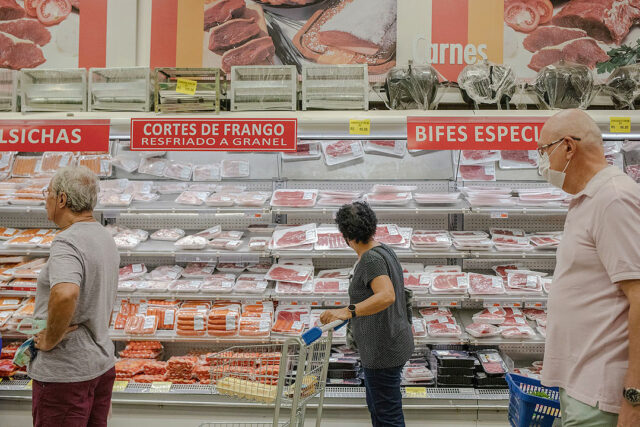
Residents shop in a popular grocery store in downtown Rio de Janeiro, Brazil on April 5. — BLOOMBERG

A BARRAGE of shocks is building that’s unlike anything emerging markets have had to confront since the 1990s, when a series of rolling crises sank economies and toppled governments.

Turmoil triggered by rising food and energy prices is already gripping countries like Sri Lanka, Egypt, Tunisia and Peru. It risks turning into a broader debt debacle and yet another threat to the world economy’s fragile recovery from the pandemic.

Compounding the danger is the most aggressive monetary tightening campaign the Federal Reserve has embarked on in two decades. Rising US interest rates mean a jump in debt-servicing costs for developing nations — right after they borrowed billions to fight COVID-19 — and tend to spur capital outflows. And on top of it all: the stark reality that war in Europe, which is driving the latest food and energy shock, shows few signs of ending.

The cocktail of risks has already pushed Sri Lanka to the brink of default on its bonds. A handful of other emerging economies, from Pakistan and Tunisia to Ethiopia and Ghana, are in immediate danger of following suit, according to Bloomberg Economics. Of course, the developing world’s commodity exporters stand to benefit from higher prices. Still, there are other troubles brewing, with a new COVID-19 outbreak locking down key cities in China, and growing angst that Europe and the US will fall into recession.

The world’s top economic policy makers are sounding the alarm. The dominant themes at the spring meetings of the International Monetary Fund (IMF) and World Bank in Washington this week are a slowing global economy and the rising risks —  seen and unseen — facing developing nations.

The IMF, in its latest World Economic Outlook, likened the war’s impact to “seismic waves” rolling over the global economy. It also warned of the possible return in emerging markets of the sort of “doom loop” that led Russia to default in 1998, helped bring Vladimir Putin to power and took hedge fund Long Term Capital Management to the verge of collapse. The World Bank slashed its global growth forecast and announced the creation of a $170-billion rescue package — bigger than its COVID-19 response — for crisis-hit nations.

“We can see this train wreck coming towards us,” said John Lipsky, who spent half a decade as No. 2 at the IMF. The combination of real-economy shocks and financial-market tightening, he said, is “going to push a large number of low-income countries into the need for debt restructuring.”

The biggest default looming in emerging economies is in Russia, where Mr. Putin’s decision to invade Ukraine has brought sanctions, economic isolation, and a pledge to pay debts only in rubles — which would likely be ruled a breach of commitments, triggering losses for investors.

Still, Russia’s role as the sanctions-hit aggressor make it a unique case. Which means Sri Lanka, for now, is at the vanguard of the potentially broader crisis.

The country’s currency is down nearly 40% this year. Last week, it suspended foreign debt payments, deciding to use what’s left of its reserves to cover food and energy imports rather than pay investors.

For people like Jagath Gunasena, the crisis has already arrived. It’s meant sending his wife and son to stand for hours to refill the cooking-gas cylinder they need to run their Colombo food stall — only to see them turned away when supplies run out. “At least we have leftovers from our food stall to eat,” Mr. Gunasena said. “I don’t know how the others will find ways to cook or get by.”

That kind of uncertainty has driven protesters to call for President Gotabaya Rajapaksa to resign even as his government tries to negotiate help with the IMF and Asian powers like China and India.

Sri Lanka may be the first. But it’s not alone. Some 13 emerging countries have bonds trading at least 1,000 basis points above US Treasuries, up from six a year ago. Credit-default swaps on developing-country debt spiked in the first weeks of the Ukraine war, showing a growing fear of default — and while they’ve since retreated, they’re still some 90 basis points above last year’s average.

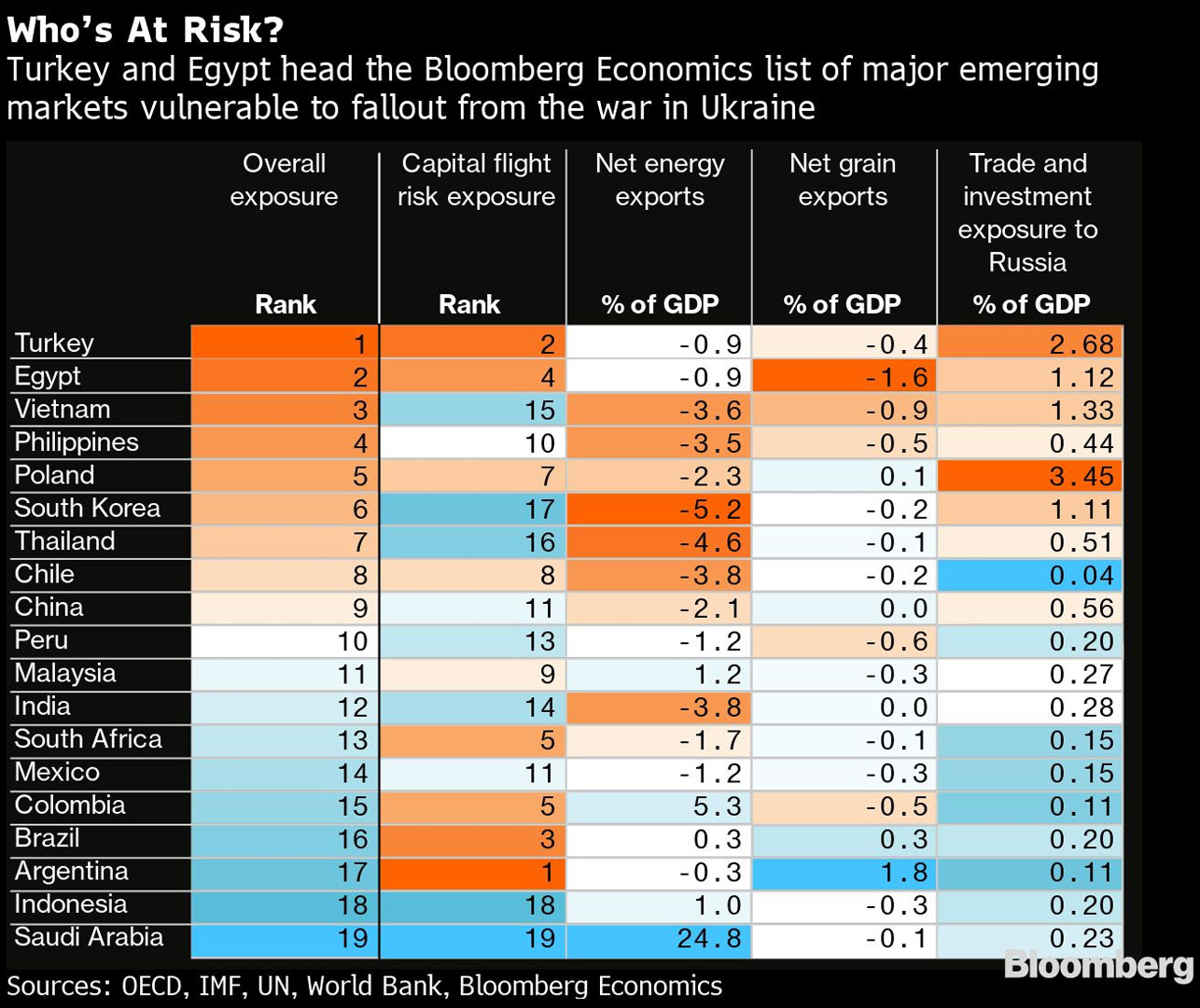
Bloomberg Economics, which keeps scorecards of the building risks for EM countries, puts Turkey and Egypt top of the list of major emerging markets exposed to “economic and financial spillovers” from the Ukraine war. And it ranks Tunisia, Ethiopia, Pakistan, Ghana and El Salvador — with large debt stocks and borrowing costs that have risen by more than 700 basis points since 2019 — among countries in immediate danger of being unable to repay debts.

‘START TO SURFACE’
The direct impact of a default in five countries such as these on the global economy would be small, but crises in the developing world have a history of spreading well beyond their starting points. “In a cascade of emerging-market credit events, the negative impact of the whole could be larger than the sum of the parts,” wrote Ziad Daoud, Bloomberg Economics’ chief EM economist.

The World Bank calculates 60% of low-income countries are in debt distress already, or at high risk of it. So far, the trouble is brewing in the sort of “off the radar screen” places investors don’t pay much attention to, said the Bank’s chief economist, Carmen Reinhart.

Governments all over the emerging world stepped up their borrowing to cushion the pandemic’s impact. The cost of servicing those debts is rising “on a steep incline,” according to the IMF.

A record amount of that debt is now held on balance sheets of local banks in emerging economies, according to the IMF — raising the risk of a feedback loop in which banks are forced to pull back on lending as economies slow and the value of the government bonds they own falls. Which in turn may lead to the sort of economic “doom loop” that drove Russia to default in 1998 and Argentina to a similar fate a few years later.

The increase in borrowing costs is likely to get steeper still as the Fed’s efforts to combat inflation at home lead to higher interest rates on US Treasuries, the benchmark for many developing economies. Central banks across much of the emerging world are raising their own policy rates too, as prices surge.

Jim O’Neill, the former Goldman Sachs economist who coined the term BRICs in the early 2000s to describe the then fast-growing emerging markets of Brazil, Russia, India and China, said the current environment is the most uncertain he’s seen since he began his career in finance in the early 1980s. “If we get the inflation risk persisting and central banks have to tighten policy, for certain emerging markets it will be a disaster,” he said.

One sign of trouble ahead is the lengthening line of countries in rescue talks with the IMF.

Along with Sri Lanka, it includes countries with similar balance-of-payments problems like Egypt and Tunisia, where food prices helped drive regime change just a decade ago.

To be sure, many developing nations sell more commodities than they buy, and benefit from rising prices. They’re typically a boon in regions like Latin America, for example — where Brazil’s real is the world’s best-performing major currency this year, and Chile’s exports in March were up more than 20% from a year earlier.

Robin Brooks, chief economist at the Institute for International Finance, predicts the fallout from the Ukraine war will largely be limited to food and energy importers.

Busts often follow booms — and there haven’t been many of the latter in an emerging world that’s had a rough ride from COVID-19, Brooks points out. By contrast, the crises of the 1990s erupted in economies where capital had been pouring in, and its abrupt departure revealed flaws in corporate balance sheets. Even with risks rising because of an increasingly aggressive Fed, “I’m not as worried as others about skeletons in the closet,” he said.

But if that pandemic backdrop leaves emerging countries less vulnerable to capital outflows, the opposite is true when it comes to social tensions.

That’s one reason why it’s hard not to see something broader in the political and economic turmoil starting to hit the poorest corners of the global economy. Oxfam is warning that more than a quarter of a billion people could be pushed into extreme poverty this year. — Bloomberg

West warns of Russian cyber-attacks on critical infrastructure

LONDON — Western governments jointly warned on Wednesday about a potential threat of increased malicious cyber activity by Russia against critical infrastructure as a response to sanctions imposed as punishment for its invasion of Ukraine.

The cybersecurity agencies of the United States, Britain, Australia, Canada and New Zealand — which together form the Five Eyes intelligence-sharing alliance — said the war could expose organizations everywhere to cybercrime.

“This activity may occur as a response to the unprecedented economic costs imposed on Russia as well as materiel support provided by the United States and US allies and partners,” the US Cybersecurity & Infrastructure Security Agency (CISA) said in a statement on its website.

In March, CISA said there was “evolving intelligence” that Russia was exploring options for potential cyberattacks.

Last week, it said advanced hackers have shown they can take control of an array of devices that help run power stations and manufacturing plants, although that alert did not name Russia, which routinely denies it carries out cyberattacks.

Wednesday’s statement also warned of the potential for cybercrime groups which have pledged to support the Russian government to carry out digital extortion attacks against Western targets.

“These Russian-aligned cybercrime groups have threatened to conduct cyber operations in retaliation for perceived cyber offensives against the Russian government or the Russian people,” the statement said. — Reuters

Peru seeks to punish pedophile rapists with chemical castration

PERU’s government will present a bill to allow for chemical castration as a penalty for raping a minor, Cabinet members told reporters on Wednesday, following national outrage over the rape of a 3-year-old girl.

“We consider that this measure will be an additional penalty for those who commit rape,” said Justice Minister Felix Chero.

He said the government hopes those who rape minors will serve prison time and be chemically castrated at the end of their sentences.

The move comes after a 48-year-old man was arrested earlier this month on suspicion of raping the 3-year-old girl, who had to undergo surgery after the ordeal.

President Pedro Castillo, a socially conservative former schoolteacher, has been supportive of the bill, saying people who rape minors need to be punished in an exemplary fashion.

“We hope that congress will back (the bill),” Mr. Castillo said earlier this week.

To become law, the bill will have to pass through Peru’s opposition-controlled Congress. Conservatives make up the majority of lawmakers, including some who have made an alternative proposal to include the death penalty as punishment for rape of a minor.

The chemical castration proposal has been criticized by Peru’s own health minister Jorge Lopez, as well as by the parents of the victim and by women’s rights organizations.

“We regret that the Executive does not understand sexual violence,” women’s rights group Flora Tristan said on Twitter. “What we need are measures to speed up judicial processes, to improve care, to combat impunity and strengthen prevention.”

This is not the first time politicians have discussed the measure. In 2018, Congress pushed to include chemical castration as a penalty for those who violate children under 14 years of age. The proposal, however, was not implemented. — Reuters

To stem tide of trash, PEMSEA calls for ‘truly biodegradable’ packaging

Wire trash basket. — Gregg Yan/PEMSEA

An environmental organization reiterated the call for better local management of plastic waste and a shift to biodegradable packaging to manage plastic waste entering Manila Bay, a pollution hotspot, from Cavite’s Imus River, which it called “a conveyor belt” of trash.  

“One solution is for manufacturers to shift to truly biodegradable packaging, such as processed seaweed and cassava,” said Gregg H. Yan, a consultant for Partnerships in Environmental Management for the Seas of East Asia (PEMSEA), in an e-mail. Incentivizing consumers by giving them discounts for bringing their own resealable plastic containers can also work, he added.  

On April 19, PEMSEA released five studies on the Imus River watershed, which measures 186.15 kilometers and has a population of 1,351,057 as of 2015.  

“We wanted to understand not just what types of waste enter the Imus River, but how the people who live near the river itself perceived plastic pollution as well as local efforts to combat it,” said Edwin F. Lineses, a social scientist at De La Salle University-Dasmarinas (DLSU-D), which led the studies along with Cavite State University. 

Locals were aware of the negative effects of plastic pollution in the Imus River, the studies found. They also had positive attitudes about conservation efforts, although most respondents still preferred sachets and single-use plastics because of their convenience, affordability, and perceived value-for-money.  

Single-use sachets and packets are among the most pervasive types of litter in and along the river.  

“Oxo-degradable plastics are not good for the environment because they’re only designed to break down into smaller and smaller pieces,” said Mr. Yan. “These tiny microplastics remain in the environment for a long time before being fully broken down by natural processes.”  

PEMSEA also recommended educating Cavite residents of solutions beyond regular trash collection and cleanup drives, such as proper segregation and recycling. 

Small businesses should likewise be given incentives to provide product refills, use alternative packaging, and comply with waste management policies, the environmental organization said. 

“This Earth Day [April 22], buhayin natin ang ating mga ilog (let’s revive our rivers),” said PEMSEA executive director Aimee T. Gonzales. 

The studies were launched under PEMSEA’s Project ASEANO, an initiative to stem the flow of plastic pollution in two pilot locations: the Philippines’ Imus River and Indonesia’s Citarum River. 

They can be downloaded at https://pemsea.org/publications/reports. — Patricia B. Mirasol

G20 members condemn Russia’s war in Ukraine, after Yellen and others stage walkout

US Treasury Secretary Janet Yellen. — US FEDERAL RESERVE

WASHINGTON/LONDON — Top officials from Britain, the United States, and Canada walked out on Russia’s representatives at a Group of 20 (G20) meeting on Wednesday and many members spoke to condemn Moscow’s war in Ukraine, exposing deep divisions in the bloc of major economies. 

Indonesian Finance Minister Sri Mulyani Indrawati, who chaired the meeting of G20 finance officials in Washington, acknowledged the body faced unprecedented challenges but called for cooperation to overcome headwinds slowing global growth. 

“This is an extraordinary situation,” Ms. Indrawati told reporters after the daylong meeting. “It’s not business as usual, a very dynamic and challenging one.” 

The G20 includes Western countries that have accused Moscow of war crimes in Ukraine, as well as China, India, Indonesia and South Africa which have not joined Western-led sanctions against Russia over the conflict. 

Ms. Indrawati said many countries spoke out against the war at the meeting, although she did not identify them. 

“In order for us to be able to recover together … we need more and even stronger cooperation,” Ms. Indrawati told a briefing. “The G20 is still … the premier forum for all of us to be able to discuss and talk about all the issues.” 

US Treasury Secretary Janet Yellen told attendees she strongly disapproved of a senior Russian official’s presence at the meeting before she walked out, two sources told Reuters. 

She was joined by Federal Reserve Chair Jerome Powell, Bank of England Governor Andrew Bailey, Canadian Finance Minister Chrystia Freeland, and European Central Bank President Christine Lagarde. 

Ukrainian officials, in Washington seeking billions of dollars of additional funding, also walked out of the meeting, a source familiar with the meeting said. 

Russian Deputy Finance Minister Timur Maksimov represented Moscow in person, while Russian Finance Minister Anton Siluanov and Russia’s central bank governor joined virtually, a second source said. 

Over five million Ukrainians have fled abroad since Russia invaded on Feb. 24, the biggest attack on a European state since 1945. 

The United States accuses Russia of committing war crimes in what Moscow calls a “special military operation.” Russia denies the allegations. 

NO ‘BUSINESS AS USUAL’
One source added that Ms. Yellen told participants there could be “no business-as-usual” for Russia in the global economy, a view echoed by Indrawati, whose government is heading the G20 group this year. 

British Finance Minister Rishi Sunak said in a tweet: “We are united in our condemnation of Russia’s war against Ukraine and will push for stronger international coordination to punish Russia.” 

Russia’s finance ministry did not mention the walkout in a statement issued after the meeting. It cited Mr. Siluanov as calling on the G20 not to politicize dialogue between members and stressing the grouping had always focused on the economy. 

He also complained about the damaging effect of Western sanctions, the statement said. 

“Another aspect of the current crisis is the undermining of confidence in the existing international monetary and financial system,” it said. “The safety of international reserves and the possibility of free trade and financial transactions are no longer guaranteed.” 

Ms. Lagarde urged Mr. Maksimov to convey to Moscow a clear message — to end the war in Ukraine, one of the sources said. 

G20 finance ministers and central bank governors met on the sidelines of a semi-annual conference held by the International Monetary Fund (IMF) and World Bank in Washington, with the Ukraine war, food security and ongoing recovery from the coronavirus pandemic the key topics. 

Given the divisions, the group did not issue a communique. Instead, Indrawati read a statement summarizing the meeting and underscoring the importance of the body. 

Ms. Freeland, who is of Ukrainian descent and has made impassioned pleas on behalf of the country, said she walked out of a G20 plenary meeting to protest against Russia’s participation. 

“This week’s meetings in Washington are about supporting the world economy — and Russia’s illegal invasion of Ukraine is a grave threat to the global economy,” she said on Twitter, adding that Russia should not be participating.  

FRAGMENTATION FEARS
IMF Managing Director Kristalina Georgieva on Wednesday acknowledged it was a “difficult moment” for the G20, a forum that has played a key role in coordinating the fight against coronavirus disease 2019 (COVID-19) and responding to the 2008–2009 financial crisis. 

But she said cooperation through the forum would continue. 

“There are clearly very, very unsettling facts we have to deal with,” said Ms. Georgieva, a Bulgarian native. “But we also recognize how interdependent we are … And it is so obvious that cooperation must and will continue.” 

Ms. Georgieva and Ms. Yellen have warned against a fragmentation of the global economy into geopolitical blocs, with the United States and market-driven democracies on one side and China, Russia and other state-driven economies on another. — Reuters

Philippine ‘Avengers’ battle disinformation before election

KATEMANGOSTAR-FREEPIK

BANGKOK/MANILA — At St. Francis of Assisi church in Manila, as parishioners kneel and bow their heads in prayer at Sunday mass, the lector appeals for a safe, peaceful and honest presidential election. 

The prayer — recited in Tagalog or English to a nation of some 85 million Catholics — also seeks deliverance from “dishonesty, lies and all distortion of truth.” 

The May 9 election to pick the nation’s president, vice president, senators, and fill 300 lower house seats and 18,000 local posts, is seen as highly consequential, with the son of an ousted dictator, Ferdinand Marcos Jr., pitted against an incumbent vice president, Maria Leonor “Leni” G. Robredo. 

For Angelique Mendoza, a 61-year-old retiree, it is only fitting that church leaders have joined the fight against disinformation, as citizens face a barrage of falsehoods on social media platforms, as they did before 2016’s election. 

“Some people are getting tired of priests telling us about the dangers of fake news. I am not, because it is their moral obligation to warn us of what is not good for our spirituality,” she said after mass at St. Francis church on a recent Sunday. 

“I don’t mind hearing the priests warning us about fake news. As long as they do not mention any names, I still find them apolitical,” she told the Thomson Reuters Foundation. 

The word of the church carries enormous clout in the Philippines, where eight in 10 people are Catholics. 

Its influence is not lost on Ms. Robredo, sole female candidate for president, who is trailing frontrunner Mr. Marcos and has enlisted the help of priests in her campaign. 

“The Catholic Church has the machinery on the ground to fight disinformation,” Ms. Robredo told reporters in Cebu city. 

“But my call is for everyone, not only the Catholic Church. This is not only my problem as a candidate, but a problem for everyone: the elections will be based on lies if we don’t do everything to stop disinformation,” she said. 

“The worst thing that can happen is not me losing, but the other candidate winning through disinformation.” 

ONLINE MISINFORMATION
Ms. Robredo’s plea appears to have been heeded. 

Media firms, universities, civil society groups, lawyers and church leaders have formed several fact-checking coalitions in an unprecedented effort to counter election disinformation. 

Nearly half of misinformation online targets Ms. Robredo and helps Mr. Marcos, according to fact-checking coalition Tsek.ph. 

A spokesman for Mr. Marcos did not respond to a request for comment. 

“We’ve seen the damage lies can do. We know that it’s impossible to have integrity of elections when we don’t have integrity of facts,” said Maria Ressa, chief executive of Rappler, a digital media outlet, which is part of FactsFirstPH, a fact-checking collaborative of about 150 organizations. 

“In this ‘Avengers Assemble’ moment, there is strength in standing together. We know what happens when we don’t stand up for facts,” said Ms. Ressa, referring to a gathering of superheroes who take on the villains in the Marvel film. 

Ms. Ressa, a Nobel Prize laureate, had repeatedly warned of the spread of disinformation on social media platforms in favor of then presidential candidate Rodrigo R. Duterte in 2016, when Mr. Marcos lost the race for vice president to Ms. Robredo. 

His daughter, Sara Duterte-Carpio, is now running with Mr. Marcos for vice president. 

Mr. Marcos’s campaign is well funded, undermines Ms. Robredo and has a long reach, said Jonathan Corpus Ong, an associate professor and disinformation researcher at Harvard University. 

He said TikTok, the short-video platform, is particularly influential as its playful format appeals to young Filipinos who make up more than half the voter base. Facebook and YouTube are also major channels for misinformation, he added. 

“In 2016, the Philippines was caught flat-footed when it came to fake news and troll armies — we didn’t even know these terms then. Now, there have been some legislative efforts, and there’s greater awareness across the board,” he said. 

“But the misinformation campaigns are a thriving, normalized industry, and fact checkers can only catch the misinformation once it’s already been circulated. Going after low-level trolls is a game of whack-a-mole — the powerful people behind the campaigns are not being held accountable,” he added. 

TikTok did not respond to a request for comment. 

CONTENT MODERATION
Meta Platforms, the parent of Facebook, said earlier this month that it had removed a network of more than 400 accounts, pages and groups in relation to the Philippine election. 

It said that it had built new products and developed “stronger” policies “to remove harmful content and networks when we see them,” and has a dedicated team, including local experts. 

Google and YouTube have introduced candidate information panels, and support the FactsFirstPH collaborative. YouTube has removed more than 400,000 videos uploaded from the Philippines from Feb. 2021 to Jan. 2022, a spokesperson said. 

Content moderation policies of social media platforms have come under greater scrutiny worldwide, as Facebook changed its rules for the Ukraine invasion, and Rohingya Muslims filed a lawsuit last year against Facebook for failing to police hate content they say led to their genocide in 2017. 

The Philippine presidential candidates — among Manila City Mayor Francisco “Isko” M. Domagoso and former boxing champion  Emmanuel “Manny” D. Pacquiao — said in a debate last month that social media firms must be held liable for the spread of disinformation on their platforms. 

Mr. Marcos did not participate in that debate. 

While platforms appear to have adopted some remedial measures, “the speed, breadth and depth of their responses are an issue, given the overwhelming disinformation we’re awash in,” said Yvonne Chua, project leader of Tsek.ph. 

“Countering disinformation requires a whole-of-society approach. Fact-checkers are an important cog in the wheel in the fight against disinformation, but there are other cogs,” she added. 

So at the nation’s many churches, priests will warn congregations about the evils of disinformation and pray for an honest election, said Bishop Pablo David, head of the Philippines Association of Catholic Bishops. 

“One of the most crucial issues about the coming election is the moral imperative of upholding the truth,” he said. 

“The moral obligation of every Christian is to uphold the truth.” — Rina Chandran and Manuel Mogato/Thomson Reuters Foundation

Russia tests nuclear-capable missile that Putin calls world’s best

RUSSIAN President Vladimir Putin. — REUTERS

LONDON — In a show of strength two months into its assault on Ukraine, Russia test-launched a new nuclear-capable intercontinental ballistic missile which President Vladimir Putin said on Wednesday would make Moscow’s enemies stop and think. 

Mr. Putin was shown on TV being told by the military that the long-awaited Sarmat missile had been test-launched for the first time from Plesetsk in northwest Russia and hit targets in the Kamchatka peninsula, nearly 6,000 km (3,700 miles) away. 

The test of the Sarmat, under development for years, did not surprise the West, but came at a moment of extreme geopolitical tension. Russia has yet to capture any major cities since it sent tens of thousands of troops into Ukraine on Feb. 24. 

Ukraine’s defense ministry was not immediately available for comment. 

“The new complex has the highest tactical and technical characteristics and is capable of overcoming all modern means of anti-missile defense. It has no analogues in the world and won’t have for a long time to come,” Mr. Putin said. 

“This truly unique weapon will strengthen the combat potential of our armed forces, reliably ensure Russia’s security from external threats and provide food for thought for those who, in the heat of frenzied aggressive rhetoric, try to threaten our country.” 

Announcing the invasion eight weeks ago, Putin made a pointed reference to Russia’s nuclear forces and warned the West that any attempt to get in its way “will lead you to such consequences that you have never encountered in your history.” 

Days later, he ordered Russia’s nuclear forces to be put on high alert. “The prospect of nuclear conflict, once unthinkable, is now back within the realm of possibility,” United Nations Secretary-General Antonio Guterres said last month. 

Russia’s defense ministry said on Wednesday the Sarmat was fired from a silo launcher at 1512 Moscow time (1212 GMT). 

Russia’s nuclear forces will start taking delivery of the new missile “in the autumn of this year” once testing is complete, Tass quoted Dmitry Rogozin, head of the Roscosmos space agency, as saying on Wednesday. 

SYMBOLIC TIMING
Jack Watling of the RUSI think-tank in London said there was an element of posturing and symbolism involved, less than three weeks before the annual Victory Day parade where Russia shows off its latest weapons. 

“The timing of the test reflects the Russians wanting to have something to show as a technological achievement in the lead-up to Victory Day, at a time when a lot of their technology has not delivered the results they would have liked,” Watling said. 

Douglas Barrie, senior fellow for military aerospace at the International Institute for Strategic Studies, said the launch was an important milestone after years of delays caused by funding issues and design challenges. 

He said more tests would be needed before Russia could actually deploy it in place of ageing SS-18 and SS-19 missiles that were “well past their sell-by date”. 

Mr. Barrie said the Sarmat’s ability to carry 10 or more warheads and decoys, and Russia’s option of firing it over either of the Earth’s poles, posed a challenge to ground and satellite-based radar and tracking systems. 

Igor Korotchenko, editor in chief of Russia’s National Defence magazine, told RIA news agency it was a signal to the West that Moscow was capable of meting out “crushing retribution that will put an end to the history of any country that has encroached on the security of Russia and its people.” 

Ukraine has mounted stiff resistance and the West has imposed sweeping sanctions to try to force Russia to withdraw forces Moscow says are on a special operation to degrade its southern neighbor’s military capabilities and root out people it calls dangerous nationalists. — Mark Trevelyan/Reuters

Radisson Hotel Group plans Asia-Pacific expansion as travel restrictions ease

https://www.radissonhotels.com/en-us/

MANILA – Radisson Hotel Group plans to add 150 hotels in Asia-Pacific this year as it banks on travel, tourism, and economic recovery in the region, its CEO said on Thursday.

Radisson, one of the world’s largest hotel groups, is in the midst of a five-year plan to double its properties to 3,200 hotels in 120 countries by 2025.

“Overall, Asia plays a significant role in our business plans because of the significant presence that we can build in the future,” Radisson CEO Federico Gonzalez told reporters.

Radisson last year signed deals to put up 200 hotels worldwide, of which 137 are in Asia-Pacific. It takes three to five years for hotel deals to reach operation stage.

Radisson sees its China and India portfolios increasing to 1,000 and 200 hotels, respectively, by 2025, Gonzalez said, adding that around 150 deals will be signed this year. But China’s stringent lockdown measures could impact the completion of new hotels, he said.

Travel in Asia-Pacific is trailing the rest of the world and should expect a bumpy recovery, because of slower border reopenings, a Booking.com executive said in March.

At the end of the company’s expansion programme, Asia-Pacific will account for most of Radisson’s hotel rooms though much of revenues will still come from Europe.

Revenues and profits are expected to return to pre-pandemic levels by next year, Gonzalez said, as COVID-19 restrictions are lifted around the world. — Reuters