Home Blog Page 6013

Two firms to acquire 5,907 PLDT towers for P77B

PLDT Chairman Manuel V. Pangilinan leads signing ceremonies with PLDT, Smart, edotco, EdgePoint, Axiata and DigitalBridge representatives. Seated, from left: Suresh Sidhu (CEO, EdgePoint), Justin Chang (Managing Director, Head of Asia, DigitalBridge), Mr. Pangilinan, Mohamad Adlan Ahmad Tajudin (CEO, edotco Group) and Annis Sheikh Mohamed (CFO, edotco Group). Standing, left to right: Joachim Horn (Next-Generation Solutions Advisor, Smart), Marilyn V. Aquino (Chief Legal Counsel, PLDT), Anabelle L. Chua (CFO, PLDT). On screen: Alfredo S. Panlilio (President and CEO, PLDT and Smart), Dato’ Izzaddin Idris (President and Group CEO, Axiata).

By Arjay L. Balinbin, Senior Reporter

PLDT, Inc. announced on Tuesday that it entered into agreements with two foreign tower companies for the sale and leaseback of its 5,907 telecom towers for P77 billion, which will be used to repay debt, fund major cash requirements, and pay special dividends of up to P9 billion.

The group’s subsidiaries, Smart Communications, Inc. and Digitel Mobile Philippines, Inc., signed the sale and purchase deals with the subsidiaries of international telecommunications infrastructure services companies edotco Group and EdgePoint, PLDT said in a disclosure to the stock exchange.

The 5,907 towers — almost half of PLDT’s total tower portfolio — are spread across the Philippines, with 2,973 being acquired by ISOC edotco Towers, Inc., a subsidiary of edotco Group, and 2,934 towers by Comworks Infratech Corp., a subsidiary of EdgePoint.

With the proceeds from the transaction, the PLDT group aims to prepay P27.5 billion in debt maturing this year, PLDT Chief Finance Officer Anabelle L. Chua said during a press briefing.

“We do not need to borrow P24.5 billion that will be used for capital expenditures and other investment requirements. Originally, based on our plans, we would have had to borrow; but this time, we can avoid doing that with the proceeds that we’ll generate from this transaction,” she noted.

“So with the P52 billion that’s largely being used to deleverage the company, we should enjoy savings on our financing costs. The estimate here of P2.6 billion is calculated at the assumption of a 5% interest rate per annum,” she added.

The company also expects to see a payment of special dividends of up to P9 billion to its shareholders.

The transaction was signed on Tuesday. PLDT expects staggered closing because of the number of towers being transferred.

“First closing is expected in May 2022 with final closing by the fourth quarter,” Ms. Chua said.

PLDT Chairman Manuel V. Pangilinan in March said the bids the company had received for its towers were “north of the P50-billion mark.”

Asked how PLDT was able to fetch a higher valuation for the towers, he said during Tuesday’s briefing: “I think that’s partly on the back of the good condition of our towers; partly because of the good credit standing of PLDT, I would like to believe, and partly because we had good financial advisors.”

“I think, on the whole, the timing was perfect, and also this is the first ever towers sale to be achieved here in this country, so in many respects, it had the benefit of a first mover advantage,” he added.

edotco Group, which has more than 54,000 towers across nine countries in Asia, and EdgePoint, which owns around 10,000 towers across Indonesia and Malaysia, will “bring to bear global best practices and technologies in operating the towers which should translate into better network quality, higher resilience and faster recovery from typhoons and other natural calamities,” PLDT said.

PLDT said its wireless arm Smart has agreed to lease back the towers sold in the transaction for a period of 10 years.

“Smart has secured competitive terms as the anchor tenant on the towers and expects to benefit from operational and capital expenditure savings,” the company said.

“The sale and leaseback will be complemented by a new tower build commitment of 1,500 towers in total over the next few years,” it added.

Regina Capital Development Corp. Equity Analyst Anna Corenne M. Agravio said in a phone message that the transaction is “one of the largest asset acquisitions by foreign players that the market has observed so far.”

“Given that this means PLDT will book considerable gains, the deal would help the company lower its leverage — which has stayed elevated since 2019 — even with its aggressive spending,” Ms. Agravio added.

According to PLDT, the arrangement is also expected to be “earnings accretive from the first full year post closing.”

“This implies that the deal would not just be a one-off gain,” Ms. Agravio said.

“PLDT’s share price has outperformed the index the past few days, so it looks like investors have turned more bullish on the telco,” she added.

In a separate phone message, Rizal Commercial Banking Corp. Chief Economist Michael L. Ricafort said: “This is a positive signal to the international investment community, attesting to increased confidence by foreign investors to bring in more capital into the country.”

“This in view of the country’s improved economic and credit fundamentals in recent years/decades as attested by relatively favorable credit ratings of about 1-3 notches above the minimum investment grade, maintained despite the pandemic since 2020, as well as the country’s attractive demographics, with a population of 110 million, or the 12th largest in the world, with relatively young population and majority of the population already at working age since 2015 (demographic sweet spot) that helps sustain relatively faster economic growth in recent decades,” he added.

PLDT shares closed 0.37% higher at P1,899 apiece on Tuesday.

Hastings Holdings, Inc., a unit of PLDT Beneficial Trust Fund subsidiary MediaQuest Holdings, Inc., has a majority stake in BusinessWorld through the Philippine Star Group, which it controls.


PAL Q1 results ‘better than expected’

REUTERS
PHILIPPINE AIRLINES President and Chief Operating Officer Capt. Stanley K. Ng. said the company’s first quarter results were “very encouraging” and “better than expected.” — REUTERS

FLAG CARRIER Philippine Airlines (PAL) said on Tuesday that it saw “very encouraging” results in the first quarter as travel demand began to recover amid relaxed restrictions.

“It’s very encouraging, the results of the first quarter, which we will release soon. It was better than expected. We actually beat our budget,” PAL President and Chief Operating Officer Capt. Stanley K. Ng told reporters during a briefing.

“For domestic travel, we’re already at more than 80% of our pre-pandemic level, while for international, we’re around at 60% of our pre-pandemic level. So the results are really encouraging,” he added.

The airline anticipates returning to pre-pandemic levels of domestic flight capacity this year.

PARTNERSHIP WITH SINGAPORE
At the same time, PAL and the Singapore Tourism Board (STB) announced a partnership on Tuesday to entice more Filipinos to visit Singapore, which officially opened its borders on March 4.

“With this partnership, we are really looking forward that this route can recover soon. We’re looking at adding a third; and by the fourth quarter, we’re looking at going back to the pre-pandemic level of our flights,” Mr. Ng said.

STB Chief Executive Keith Tan said Singapore considers the Philippines as an “important tourism market.”

“Strong flight connectivity between our countries is really important for us, both for tourists and business travelers,” he added.

Under the partnership, “passengers of PAL will… be entitled to exclusive boarding pass privileges that provide special deals and promotions across a wide range of tourism establishments in Singapore, including Museum of Ice Cream, Mandai Wildlife Reserve, establishments on Sentosa, and more,” STB said in a statement.

It noted that since April 1, vaccinated ​travelers to Singapore have been enjoying “a streamlined travel process, requiring only proof of vaccination, a pre-departure coronavirus test, and a simple SG arrival card.”

PAL Holdings, Inc., the listed operator of PAL, saw its net income improve to P60.6 billion last year from a loss of P73.1 billion in 2020, primarily due to an increase in “other income” attributable to gain from debt settlement and condonation.

Its revenues for 2021 reached P58.7 billion, 6.2% higher than the P55.3 billion in 2020. — Arjay L. Balinbin

Embattled Bolts setting up winner-take-all blockbuster

PBA IMAGES

By Olmin Leyba

WILL it be 2016 all over again with Barangay Ginebra cashing in on its 3-2 lead and securing the clincher in Game 6? Or will there be a repeat of 2017 with Meralco forcing another standoff at three wins apiece and setting up a blockbuster winner-take-all?

With history split on the outcome of similar situations, the title-seeking Gin Kings and the embattled Bolts throw everything at each other in tonight’s sixth match to further their respective causes in their battle for the 46th PBA Governors’ Cup diadem.

The stakes in the 6 p.m. tiff to be played at an expectedly full-packed Smart Araneta Coliseum are higher on the part of Meralco, which teeters on the brink of blowing its fourth opportunity to score a franchise breakthrough. Aside from their 4-2 setback in 2016, the Bolts fell short against Ginebra in 2017, 4-3, and in 2019, 4-1.

“They only have three wins. (If) We win this game, we tie the series so that’s what we’re focused on right now,” said a defiant Bolts coach Norman Black.

His charges are staying upbeat that they can still salvage this and go all the way with back-to-back victories.

“Our mindset is: Let’s win this game then let’s do it again on Friday (Game 7). More than ever, we’re motivated to win the first championship for Meralco,” said gunner Allein Maliksi.

“We’ll give it our best shot,” added big man Raymond Almazan.

On the threshold of its fourth title in the last five Governors’ Cup meets, the Gin Kings treat Game 6 as a “life-or-death.”

“We’ll definitely go for it on Wednesday. We can’t afford to be forced to a Game 7 kasi we know how difficult it is dealing with Meralco’s defense. It showed in the latter part of Game 5, sobrang hirap,” said Ginebra skipper LA Tenorio. “So that’s our do-or-die game on Wednesday, not on Friday.”

The Gin Kings got on the hill after overhauling the Bolts’ 2-1 upperhand with big wins on Holy Wednesday, 95-84, and on Easter Sunday, 115-110.

“We know that trying to beat a good team like this three times in a row is nearly impossible. When I look at it, it seems close but it’s really very far away,” said Ginebra mentor Tim Cone.

Justin Brownlee, fresh from becoming the first import to make 400 three-pointers in Philippine Basketball Association (PBA) history, as well as Scottie Thompson, Mr. Tenorio, Christian Standhardinger and hopefully a healthier Japeth Aguilar spearhead Ginebra’s closeout bid against the life-saving efforts of Meralco’s Tony Bishop, Chris Newsome, Mr. Maliksi, Aaron Black, Mr. Almazan and Cliff Hodge.

Gov’t makes full award of bonds at higher rate on inflation fears

BW FILE PHOTO
THE government fully awarded the reissued seven-year papers it offered on Tuesday at a higher average rate. — BW FILE PHOTO

THE GOVERNMENT made a full award of the reissued Treasury bonds (T-bonds) it offered on Tuesday at a higher average rate due to inflation fears and hawkish comments from US Federal Reserve policymakers.

The Bureau of the Treasury (BTr) raised P35 billion as programmed from the reissued seven-year bonds it auctioned off on Tuesday, with bids reaching P47.336 billion.

The debt papers, which have a remaining life of six years and three months, were awarded at an average rate of 5.779%, up by 17.8 basis points (bps) from the 5.601% fetched when they were last sold on March 22. The bonds have a coupon rate of 3.75%.

The average rate was also higher than the 5.6836% quoted for the seven-year tenor at the secondary market prior to the auction, based on the PHP Bloomberg Valuation Service Reference Rates published on the Philippine Dealing System’s website.

National Treasurer Rosalia V. de Leon said in a Viber message to reporters that the government made a full award of its T-bond offer at a higher rate due to hawkish comments from Fed officials suggesting a hike of 50 bps to tame rising prices.

Central banks around the world have been tightening their monetary policies to temper inflation despite lingering risks to economic growth.

A Reuters poll last week showed analysts expect the Fed to raise rates by 50 bps each for its May and June review to respond to runaway inflation. These analysts also expect a 40% probability of recession by 2023.

St. Louis Federal Reserve Bank President James Bullard on Monday said he wants to increase benchmark interest rates to 3.5% by the end of the year to slow inflation that reached 40-year highs in February and March. This would mean 50-bp interest hikes at all six of the Fed’s remaining meetings this year.

US inflation surged to 8.5% year on year in March amid record high fuel costs.

Oil prices rose on Tuesday due to the closure of oil fields in Libya. Brent crude rose by $1.46 or 1.3% to settle at $113.16 a barrel, while US crude rose by $1.26 or 1.2% to $108.21 a barrel.

Meanwhile, a trader in a Viber message said the T-bond auction result came as a surprise as the market was expecting the rate of the tenor to only be between 5.5% and 5.75%.

“Bids were higher due to CPI (consumer price index) pressures and hawkish tone of other central banks,” the trader said.

The trader added that Tuesday’s auction result may cause the market to be defensive ahead of next week’s 10-year T-bond offer.

The BTr wants to raise P200 billion from the domestic market in April, or P60 billion through Treasury bills and P140 billion via T-bonds.

The government borrows from local and external sources to help fund a budget deficit capped at 7.7% of gross domestic product this year. — T.J. Tomas with Reuters

Andy Warhol’s Marilyn Monroe portraits expose the darker side of the ’60s

ANDY WARHOL (1928-1987) Shot Sage Blue Marilyn acrylic and silkscreen ink on linen 40 x 40 in. / 101.6 x 101.6 cm. Painted in 1964.
ANDY WARHOL (1928-1987)
Shot Sage Blue Marilyn
acrylic and silkscreen ink on linen
40 x 40 in. / 101.6 x 101.6 cm.
Painted in 1964.

“IF you remember the ’60s, you weren’t really there.” This famous quip says much about our rose-tinted nostalgia for the decade. The fun-loving hedonism of Woodstock and Beatlemania may be etched into cultural memory, but Andy Warhol’s Marilyn Monroe portraits reveal a darker side to the swinging ’60s that turns our nostalgia on its head.

Warhol’s iconic Marilyn Monroe portrait Shot Sage Blue Marilyn, due to go on sale at Christie’s in May, is expected to fetch record-breaking bids of $200 million (£153 billion), making it the most expensive 20th century artwork ever auctioned. Nearly 60 years after they were first created, Warhol’s portraits of the ill-fated Hollywood star continue to fascinate us.

According to Alex Rotter, Christie’s chairman for 20th and 21st century art, Warhol’s Marilyn is “the absolute pinnacle of American Pop and the promise of the American dream, encapsulating optimism, fragility, celebrity and iconography all at once.”

Hollywood stars were great sources of inspiration for the Pop art movement. Monroe was a recurring motif, not only in the work of Warhol but in the work of his contemporaries, including James Rosenquist’s Marilyn Monroe, I and Pauline Boty’s Colour Her Gone and The Only Blonde in the World.

Born Norma Jeane Mortenson but renamed Marilyn Monroe by 20th Century Fox, the actress went on to become one of the most illustrious stars of Hollywood history, famed for her roles in classic films like Gentlemen Prefer Blondes and Some Like It Hot. She epitomized the glitzy world of consumerism and celebrity that Pop artists thought was emblematic of 1950s and 1960s American culture.

While Rotter’s statement may be true to some extent, there is also a sinister edge to the Marilyns because many were produced in the months following her unexpected death in 1962.

On the surface, the works may look like a tribute to a much-loved icon, but themes of death, decay, and even violence lurk within these canvases. Clues can often be found in the production techniques. One of the collection’s most famous pieces, Marilyn Diptych, uses flaws from the silkscreen process to create the effect of a decaying portrait. Warhol’s The Shot Marilyns consists of four canvases shot through the forehead with a single bullet. In this, the creation of Warhol’s art is as important as the artwork itself.

At a glance, the surface-level glamor of Warhol’s Marilyn immortalizes the actress as a blonde bombshell of Hollywood’s bygone era. It is easy to forget the tragedy behind the image, yet part of our enduring fascination with Marilyn Monroe is her tragedy.

Her mental health struggles, her tempestuous personal life, and the mystery surrounding her death have been well documented in countless biographies, films, and television shows, including Netflix’s documentary The Mystery of Marilyn Monroe: The Unheard Tapes and upcoming biopic Blonde. She epitomizes the familiar narrative of the tragic icon that is doomed to keep repeating itself — something that Warhol understood all too well after surviving a shooting by Valerie Solanas in 1968.

The death at the heart of Warhol’s Marilyns is not just rooted in grief but is also a reflection of the wider cultural landscape. The 1960s were a remarkably dark period in 20th century American history. A brief look at the context in which Warhol was producing these images reveals a decade plagued by a series of traumatic events.

Life Magazine published violent photographs of the Vietnam War. Television broadcasts exposed shocking police brutality during civil rights marches. America was shaken by the assassinations of John F Kennedy, Robert Kennedy, and Martin Luther King, Jr. Footage of JFK’s death captured by bystander Abraham Zapruder was repeatedly broadcast on television. Celebrated Hollywood stars were dying young and in tragic circumstances, from Marilyn Monroe and Judy Garland to Jayne Mansfield and Sharon Tate.

This image of the 1960s is echoed by the postmodern theorist Fredric Jameson, who describes the decade as a “virtual nightmare” and a “historical and countercultural bad trip.” Stars like Monroe were not as flawless as they may appear in Warhol’s portraits, but were “notorious cases of burnout and self-destruction.”

Warhol understood this more than anyone. His Death and Disaster series explores the spectacle of death in America and affirms the 1960s as a time of anxiety, terror, and crisis. The series consists of a vast collection of silkscreened photographs of real-life disasters including car crashes, suicides, and executions taken from newspapers and police archives. Famous deaths are also a central theme of the series, including portraits of Marilyn Monroe, Elizabeth Taylor, and Jackie Kennedy — all of whom are associated with significant deaths or near-death experiences.

Death and Disaster came about in 1962 when Warhol’s collaborator Henry Geldzahler suggested that the artist should stop producing “affirmation of life” and instead explore the dark side of American culture:

Maybe everything isn’t always so fabulous in America. It’s time for some death. This is what’s really happening.

He handed Warhol a copy of the New York Daily News, which led to the first disaster painting 129 Die in Jet!.

The recent hype around the auctioning of the Marilyn portrait reveals as much about our time as it does about our nostalgia for the 1960s. We choose to remember the decade in all its glorious technicolor, but uncovering its darker moments provides room for reconsideration. Perhaps Warhol’s Marilyn is not just a symbol of the swinging ’60s, but an artefact from a time that was as turbulent and uncertain as our own.


Harriet Fletcher is an Associate Lecturer in English and History at the Lancaster University.

CTA affirms canceled P1.3-B tax assessment on Fonterra Brands

THE COURT of Tax Appeals (CTA) affirmed the cancellation of the tax assessment on Fonterra Brands Philippines, Inc. for 2019 to 2010 worth P1.3 billion, inclusive of interest.

In a ruling on Apr. 11 and made public on Apr. 18, the CTA en banc said it agreed with the decision of the court in division, which said the Bureau of Internal Revenue’s (BIR) formal letter of demand did not say when the payment of deficiency taxes was due.

“Indeed, the Formal Letter of Demand’s failure to state when the payment of the deficiency taxes shall become due violates respondent’s right to be informed of the determinable amount for which it is liable to pay,” the tax court said in the ruling written by CTA Associate Justice Juanito C. Castañeda, Jr.

“Petitioner (Commissioner of Internal Revenue) failed to raise meritorious arguments to justify the reveal of the assailed Decision and Resolution, as such the denial of the instant Petition for Review is in order.”

The petitioner is the Commissioner of Internal Revenue (CIR), who has the authority to decide disputed assessments and to cancel tax liabilities based on the country’s revenue code.

Fonterra Brands Philippines, the respondent, is engaged in the business of manufacturing, importing, and distributing on a wholesale basis of dairy and other food products under the Anchor brand.

“A final assessment notice must not only indicate the legal and factual bases of the assessment but must also state a clear and categorical demand for payment of the computed tax liabilities within a specific period,” CTA Associate Justice Roman G. del Rosario noted in his separate concurring opinion.

HARTE-HANKS PHILIPPINES
Meanwhile, the Supreme Court (SC) has reversed a CTA decision dismissing the appeal of Harte-Hanks Philippines, Inc.’s P2.54-million excess input value-added tax (VAT) on zero-rated sales for the second quarter of 2008.

In its ruling on Mar. 7 and made public on Apr. 18, the high court said the CTA Second Division and en banc made an error in denying the company’s claim, as it had jurisdiction over the claim for refund.

Harte-Hanks Philippines, the petitioner, is a domestic corporation engaged in outsourcing customer relationship management solutions by inbound or outbound call services to its clients. The CIR is the respondent for the case.

The CTA en banc previously affirmed the Second Division’s ruling favoring the CIR’s motion to dismiss the claim due to premature filing.

“By way of exception, judicial claims filed during the window period from 10 Dec. 2003 to 6 Oct. 2010, need not to wait for the exhaustion of the required 120-day period,” the SC said, citing previous jurisprudence.

It added that the petitioner filed the judicial claim with the CTA Second Division on June 29, 2010, which was within the period of the cited exception.

“As a final note, the court emphasized that, although the petitioner did not actually invoke BIR Ruling No. DA-489-03 in any of its pleadings to justify the timeliness of its judicial claim with the CTA, the BIR ruling applies to all taxpayers who filed their judicial claims within the window period of Dec. 10, 2003, to Oct. 6, 2010,” the high court said in its ruling written by SC Associate Justice Ramon Paul L. Hernando. — John Victor D. Ordonez

A history of bad hearts: cardiovascular disease and your genes

PIXABAY

A 20-year-old with a family history of high cholesterol could be at risk of developing heart disease even if they live healthily. 

“If you have familial hypercholesterolemia (FH), your children have a 50% chance of inheriting it,” said Dr. Jose Donato A. Magno, executive director and cardiovascular chief of the Cardiovascular Institute at the Angeles University Medical Center, at a recent webinar by the Department of Science and Technology.  

FH, an inherited disorder that affects how the body recycles “bad” cholesterol, should be the primary goal of cholesterol screening, according to medical experts.  

LDL (low-density lipoprotein) — the so-called “bad” cholesterol — contributes to plaque formation in the arteries, causing decreased blood flow to the heart.  

People with FH have a higher risk of heart disease, said Dr. Rody G. Sy, a professor emeritus of the University of the Philippines-Manila’s College of medicine. Though the condition is present from birth, its symptoms may not appear until adulthood.   

Children with untreated FH have a “dramatic” increase in the risk of premature coronary heart disease (CHD) after the age of 20, Dr. Sy added. “Mortality rates from CHD in FH are 100 times greater in those between 20–39 years old,” he said. “It is four times greater in those between 40–59 years old.”  

To lessen the burden of the disease in adulthood, probe into the family history, Dr. Magno said.  

“We need to focus efforts on populations at risk to enhance our pickup of FH,” he added.  

Cascade screening, which identifies relatives who have the same genetic condition as a patient, reduces the average age of an FH diagnosis. Meanwhile, targeted screening — or the screening of specific populations — is recommended for children two years or younger if one or both biological parents are known to have hypercholesterolemia or are receiving medicines that lower lipids, or if there is a family history of premature atherosclerotic cardiovascular disease. 

Screening can be done through a blood test or through genetic testing.  

Dr. Magno added that the telltale signs of the disease are a buildup of fat around one’s knees, knuckles, and elbows; and a silvery color in the shape of a half-moon on the outside of one’s cornea. 

When it comes to LDL cholesterol, remember the number 190 mg/dL, said Dr. Lourdes G. Santos, preventive cardiology head of the Cardinal Santos Medical Center.   

“If you see this number, let it [kick start] your journey into discovering if you have FH,” she said. “That is a red flag for screening.”   

The optimal level of LDL is less than 100 mg/dl among adults. — Patricia B. Mirasol

Philippine weightlifting team targets two to five golds in Hanoi Games

SPEARHEADED by Tokyo Olympics gold medalist Hidilyn F. Diaz, the Philippine weightlifting team is eyeing a minimum of two gold medals and a maximum of five in the Hanoi Southeast Asian (SEA) Games scheduled on May 12 to 23.

“We’re confident of winning at least two golds, we will fight for four or five golds,” said Samahang Weightlifting ng Pilipinas president Monico Puentevella during Tuesday’s online Philippine Sportswriters Association Forum.

Ms. Diaz was one of the 13-strong team — seven women and six men — from the country seeing action in all but one of the 14 weight divisions calendared in the Hanoi meet.

And she should be the overwhelming favorite to claim her second mint in the biennial event.

Also tipped to strike gold are Asian champion Vanessa Sarno, 2019 SEA Games golden girl Kristel Macrohon, and Olympian Elreen Ando.

Fernando Agad, Jr., Rowel Garcia, Nestor Colonia, Lemon Denmark Tarro, John Kevin Padullo, John Dexter Tabique, Mary Flor Diaz, Rosegie Ramos, and Margaret Colonia are the other members of the national squad.

Mr. Puentevella, however, warned it wouldn’t be a walk in the park as he expects strong challenges to come from host Vietnam and Thailand, which was back after serving a suspension from the International Weightlifting Federation due to alleged doping.

“Vietnam is doing well and I was told Thailand will return to the SEA Games,” said Mr. Puentevella. “But I’m optimistic we will pull off a surprise or two outside those athletes who are expected to contend.”

Mr. Puentevella is also hoping to use the Hanoi experience as a gauge on who to send in the Hangzhou Asian Games set on Sept. 10 to 25 and the World Championships at a still unspecified date and venue this year.

BPI AIA sees stronger growth as economy reopens

BPI AIA Life Assurance Corp. sees stronger growth this year as the economy continues to reopen and amid the government’s improved management of the pandemic.

“We are very optimistic that the worst is over,” BPI AIA Chief Executive Officer Surendra Menon said. “Maybe fluctuations here and there, and we do not expect Alert [Level] 4 anymore. We expect to grow a lot more in 2022, with a lot less volatility.”

AIA Philippines Chief Executive Officer Kelvin Ang said compared to 2020, which he observed was full of “uncertainty”, he sees stronger growth for AIA in 2022 versus its performance last year.

“2022 is looking good, and with the better management of the COVID-19 situation and the economy recovering, we are very positive [about our growth],” Mr. Ang said. “We have a lot of optimism.”

He said AIA’s target for lives saved or policies claimed in 2022 is 110,000, up from the 80,000 goal last year, which he said is indicative of growth.

“The scary part of 2021 is the on and off of the delta variant. Delta as we know [was] very disturbing to our economy. But it was also a year where we look at things and say ‘let’s not waste a crisis,’ so we fast tracked a lot of our plans,” he said, noting these included its digitalization, BPI AIA’s rebranding — which merited positive response from their stakeholders — and environmental, social, and governance initiatives, among others.

According to Insurance Commission data, both BPI AIA and AIA Philippines saw lower assets, premium income and new business annual premium equivalent (NBAPE) last year. However, AIA Philippines Chief Financial Officer Gary Ogilvie said they see the two firms as one group.

“We look at AIA very much as a group and we seek to manage it as a group,” he said.

He added that the industry saw a robust 70% growth in single premium products last year.

“If you look at many of these products, they’re very savings-focused and very light protection cover. While we do sell single premium products, we are less reliant on it than the rest of our competitors, who are quite heavy on single premiums,” he noted.

Mr. Ogilvie said they also want to improve their single premiums.

“But in addition to that, we also continue to focus on the metrics that matter and we will never lose sight of profitability, because ultimately we believe that gives customers confidence in the long-term sustainability of our business.” — TJT

A reflection and a reminder

A SCENE from Doc Resureccion Gagamutin ang Bayan — PHOTO BY MICHELLE ANNE P. SOLIMAN

Theater Review
Doc Resureccion: Gagamutin ang Bayan
Presented by Tanghalang Pilipino

WITH only a few days before the national elections, Tanghalang Pilipino (TP) is streaming its timely play, Doc Resureccion, a filmed performance.

The story introduces Boy Pogi Resureccion (played by Jonathan “Tad” Tadioan) standing outside his iron-sheet home and enjoying a song blasting from speakers. He is interrupted by an unannounced visit from his cousin Jess (Marco Viaña) — a young doctor — whom he has not seen in a long time.

Set in a poor fishing village, the play follows an idealistic Jess Resureccion, who running for mayor with the promise of helping uplift the status of its residents. However, Boy Pogi, paid by the incumbent mayor to run as a nuisance candidate for the same post, stands in the way of Jess’ electoral victory. While Boy Pogi’s wife Elsa (Lhorvie Nuevo) tries to be hospitable to Jess, the latter tries to convince his cousin to back out from the race.

The play is an intimate conversation revolving around their opposing principles on self-worth, value for their family, and their community.

It was a joy to watch a live theatrical performance for the first time in two years of lockdown, even if it was one of TP’s technical dress rehearsals. I saw the play for a second time onscreen over the long Easter weekend. Both live and onscreen performances succeed in powerfully confronting the issues we continue to face as a country.

Directed by Dennis Marasigan, the framing and camera angles used for the filmed performance immerse the audience in the story, as if they were watching a film or television series rather than a stage play. The onscreen version has added sound effects of waves that enhance the atmosphere of its setting, a fishing village. There is a two-second overhead shot of the set which looks like the characters are in a real fishing village.

The close-ups of Messrs. Tadioan and Viaña’s dialogue highlighted the actors’ expressions. I noticed while watching the show again onscreen that Sherry Lara (who plays Mamang) was the comic relief. Nanding Josef, who plays Papang, represents those who remain unaffected by their surroundings, despite his probable awareness of it.

One difference between the live performance and the filmed version was the difference in time of day — live, it felt like the story happened during the day, but the cool color grading in the filmed version made it seem as if it were set during nighttime.

With a running time of about 50 minutes (and almost nine minutes of credits), the filmed version is worth seeing for a break from work-from-home duties, or a weekend watch.

However, the show contains foul language and acts of violence which require adult supervision for young audiences when watching onscreen.

Fourteen years after its first staging in 2009 as part of the Virgin Labfest, and 10 years since TP staged it as part its Eyeball production, the message of the play remains relevant as it mirrors the recurring socio-political situation of our country.

It is recommended for first-time voters as it encourages critical thinking. The play leaves the audience reflective of who they are as a person, a voter, and a Filipino, and what they desire not only for themselves but for the country.

Doc Resureccion: Gagamutin ang Bayan is currently streaming until April 30 via www.ticket2me.net. Tickets are priced at P350 (general audience), and P550 (a barkada promo for three tickets). Access to the show is for 24 hours on the buyer’s chosen date starting at 10 a.m. to 10 a.m. the following day. — Michelle Anne P. Soliman

CTS Global’s profit drops 57% to P20.1M

CTS GLOBAL Equity Group, Inc. on Tuesday reported that its net income fell by 57% to P20.1 million in 2021 from P46.9 million the previous year.

The company’s annual report showed its revenues dropped by 24% to P130.6 million from P172.3 million in 2020.

Meanwhile, operating expenses grew to P31.9 million last year from P30.8 million.

The investment firm made its market debut on April 13, selling 1.375 billion primary common shares during its initial public offering (IPO).

It tapped SB Capital Investment Corp. as the issue manager, underwriter, and bookrunner of the offer.

The company said proceeds from the IPO will be used to improve its trading operations.

CTS Global was the fifth company that conducted an IPO this year and the second to list on the small, medium and emerging (SME) board of the stock exchange since the start of 2022.

“For the past decade, the company maintained its capital stock at P200 million, only raising it to P500 million in the last quarter of 2019 and an additional P50 million in 2020,” CTS Global said in a past statement.

CTS Global’s business segments include proprietary trading, brokerage services, and investment income.

Under proprietary trading, CTS has over 30 traders with exposure in global markets including the United States, China, Hong Kong, Japan, and the Philippines.

Under its brokerage services, the company renders stock brokerage and dealership services.

CTS Global is currently a standalone entity, but the company has said that it is “open to the possibility of incorporating subsidiaries in the future.”

At the stock exchange on Tuesday, CTS Global shares went down by 10 centavos or 9.26% to close at P0.98 per share. — Luisa Maria Jacinta C. Jocson

The case for testing Pfizer’s Paxlovid for treating long COVID

WIKIMEDIA COMMONS
WIKIMEDIA COMMONS

CHICAGO — Reports of two patients who found relief from long COVID after taking Pfizer, Inc.’s antiviral Paxlovid, including a researcher who tested it on herself, provide intriguing evidence for clinical trials to help those suffering from the debilitating condition, experts and advocates say.  

The researcher said her chronic fatigue symptoms, which “felt like a truck hit me,” are gone after taking the two-drug oral therapy.  

Long COVID is a looming health crisis, estimated to affect up to 30% of people infected with the coronavirus. It can last for months, leaving many unable to work. More than 200 symptoms have been associated with the condition, including pain, fatigue, brain fog, breathing difficulty and exhaustion after minimal amounts of physical activity.  

Dr. Steven Deeks, a professor of medicine at the University of California, San Francisco (UCSF), and an expert in HIV (human immunodeficiency virus) cure research, said drug companies tend to discount single-patient case studies. But such instances have helped drive HIV cure research, and Dr. Deeks thinks these Paxlovid cases could do the same for long COVID.  

“This provides really strong evidence that we need to be studying antiviral therapy in this context as soon as possible,” said Dr. Deeks, adding that he has heard of yet another anecdotal case at UCSF in which a long COVID patient’s symptoms cleared after taking Paxlovid.  

Scientists caution that these cases are “hypothesis-generating only” and not proof that the drug caused relief of lingering symptoms. But they lend support to a leading theory that long COVID may be caused by the virus persisting in parts of the body for months, affecting patients’ daily lives long after acute symptoms disappear.  

The best evidence so far comes from a National Institutes of Health (NIH) study, currently under peer review, in which researchers conducted autopsies in 44 people who died of COVID-19 or another cause but were infected with COVID. They found widespread infection throughout the body, including in the brain, that can last more than seven months beyond the onset of symptoms.  

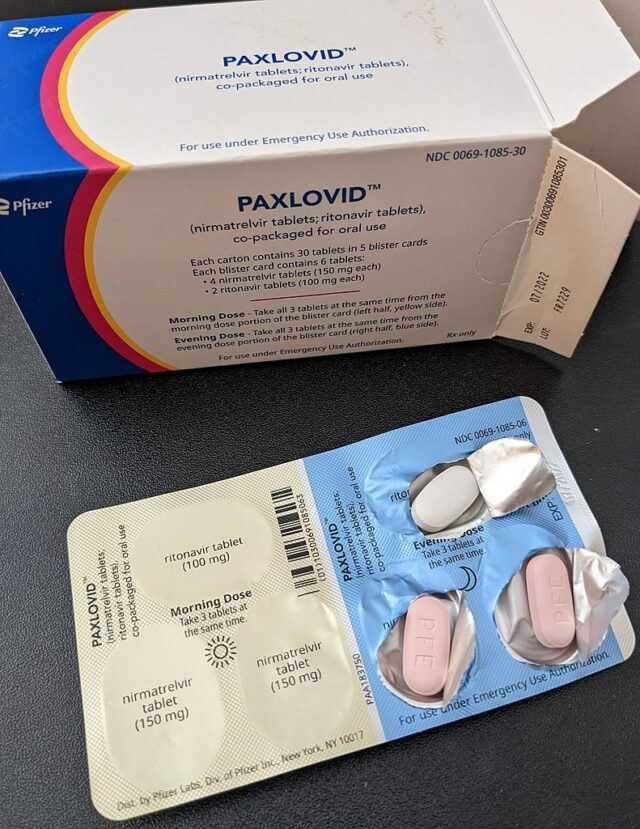
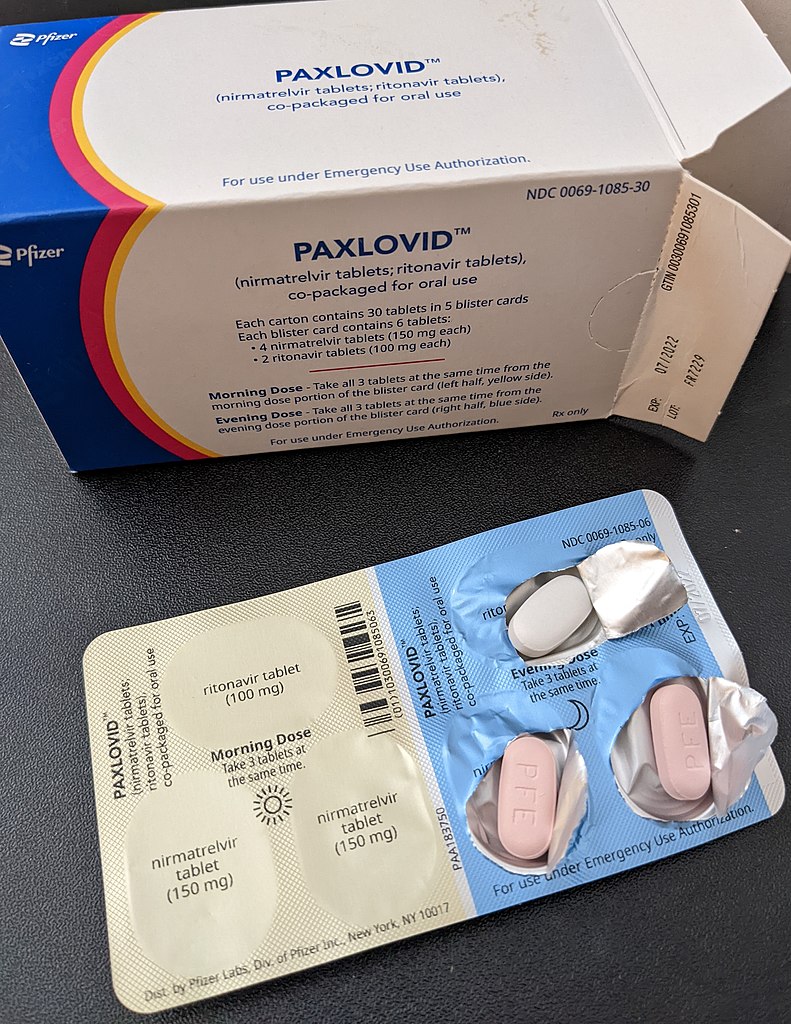
Paxlovid, which combines a new Pfizer pill with the old antiviral ritonavir, is currently authorized for use in the first days of a COVID infection to prevent severe disease in high-risk patients. Pfizer spokesman Kit Longley said the company does not have any long COVID studies underway and did not comment on whether it would consider them.  

The drugmaker has two large clinical trials testing whether Paxlovid can prevent initial COVID infection. That “may provide us with relevant data to help inform future studies,” Mr. Longley said. 

Patients who have been suffering for months are growing frustrated with the lack of pharmaceutical research for their condition.  

There are currently fewer than 20 clinical trials led by individual researchers or small drugmakers testing treatments for long COVID, only a handful of which have moved beyond early stages, a Reuters review found.  

Diana Berrent, founder of grassroots COVID advocacy group Survivor Corps, has been lobbying the Biden Administration to fund large long COVID clinical trials.  

“We shouldn’t be doing our research based on anecdotal reports,” she said. “That’s not good enough.”  

‘BACK TO NORMAL’
In one of the case reports, published as a preprint ahead of peer review, a previously healthy and vaccinated 47-year-old woman became infected with COVID in the summer of 2021. Most of her acute symptoms dissipated within 48 hours, but she continued to have severe fatigue, brain fog, exhaustion after exercise, insomnia, racing heartbeat, and body aches severe enough that she could no longer work.  

About six months after her initial infection, she was reinfected, likely with COVID, and many of her acute symptoms also returned. Her doctor prescribed a five-day course of Paxlovid.  

On day 3, she noticed a rapid improvement of long COVID symptoms. “She’s back to normal,” said Dr. Linda Geng, co-director of Stanford Health Care’s long COVID clinic and author of the case report posted on Research Square.  

In the second case, Lavanya Visvabharathy, 37, an immunologist working at Northwestern Medicine’s long COVID clinic, was infected in Dec. 2021. Her initial symptoms were mild, but she later experienced chronic fatigue, headaches and sleep disturbances for four months after infection. She also kept testing positive on rapid antigen tests, a sign of viral persistence  

Ms. Visvabharathy was aware of the NIH study and the Stanford case, and decided to try Paxlovid to see if it could clear any lingering virus. Toward the end of the five-day course, her fatigue and insomnia had improved, and her headaches were less frequent. Two weeks after treatment ended, her fatigue was gone.  

“That’s 100% fixed,” she said. But to prove Paxlovid provides that kind of relief would require carefully controlled clinical trials, Ms. Visvabharathy said.  

Dr. Igor Koralnik, who heads Northwestern Medicine’s clinic focused on the neurological effects of long COVID, noted the long list of widely-used medications that are affected by ritonavir and said Paxlovid “can’t be used willy nilly.”  

“Paxlovid is not a benign medication,” he said. “There should be studies.” — Reuters