Home Blog Page 597

Peso declines vs dollar

BW FILE PHOTO

THE PESO declined against the dollar on Monday after the United States urged its allies to impose tariffs on countries that are buying oil from Russia.

The local unit closed at P57.181 versus the greenback, dropping by 8.1 centavos from its P57.10 finish on Friday, Bankers Association of the Philippines data showed.

The peso opened Monday’s session weaker at P57.20 versus the dollar. Its intraday high was at P57.16, while its worst showing was at P57.38 against the greenback.

Dollars traded went up to $1.52 billion on Monday from $1.48 billion on Friday.

The dollar was generally stronger on Monday as US President Donald J. Trump said they could impose more sanctions on Russia, Rizal Commercial Banking Corp. Chief Economist Michael L. Ricafort said in a Viber message.

Mr. Trump said on Saturday that the US is prepared to impose fresh energy sanctions on Russia, but only if all North Atlantic Treaty Organization (NATO) nations cease purchasing Russian oil and implement similar measures, Reuters reported.

In recent weeks, the US has stepped up pressure on NATO countries to tighten energy sanctions on Russia in a bid to help end its war with Ukraine — a conflict Mr. Trump has struggled to bring to a close despite repeated threats of harsher penalties on Moscow and its partners.

For Tuesday, a trader said the peso could move between P57 and P57.40 per dollar, while Mr. Ricafort expects it to range from P57.10 to P57.30. — A.M.C. Sy with Reuters

Proptech firm Lhoopa eyes doubling housing delivery in 2026

PHILSTAR FILE PHOTO

LHOOPA, INC., a property technology (proptech) startup, hopes to double the number of housing units it delivers to Filipino families in 2026 as demand for affordable homes continues to outpace supply, its chief executive officer (CEO) said.

“Looking ahead, our target is to double the number of homes we deliver year on year from 2025 to 2026,” Lhoopa CEO and Co-Founder Marc-Olivier Caillot said in an e-mailed reply to questions.

The Philippines faces a persistent housing shortage, with the backlog projected to hit 22 million units by 2040 if unaddressed, according to the United Nations Human Settlements Programme.

Mr. Caillot said affordability, accessibility, and information gaps remain the main obstacles.

Many units marketed as “below market value” still exceed 30% of household income, while affordable projects are often located far from jobs, schools, and transport hubs, he noted.

Complex loan applications also discourage low-income families from buying homes, he also said.

Through its digital platform, Lhoopa streamlines the housing process from land acquisition to move-in.

In the first half, about 7,000 families acquired homes through the platform, with 88% being first-time buyers, according to Lhoopa.

Women accounted for 51% of purchases, while most clients were young working families and members of the essential workforce such as clerks, construction workers, and community service providers.

To expand its reach, the company is focusing on underserved markets outside Metro Manila by establishing local networks in fast-growing cities.

Lhoopa said it is also broadening partnerships with brokers, contractors, developers, and banks to improve financing access.

It uses data and artificial intelligence to evaluate long-term demand, development trends, and disaster risks.

The company is also enhancing its broker and contractor apps to better track loan applications and project timelines, it said.

“Our direction is clear: consistent growth, quality service, and a bigger share of the backlog addressed each year,” Mr. Caillot said. — Beatriz Marie D. Cruz

Grab expands partnership with Alipay+, enabling in-app ride bookings

PEOPLE are seen using their mobile phones along Claro M. Recto Avenue in Divisoria, Manila, Dec. 27, 2022. — PHILIPPINE STAR/EDD GUMBAN

RIDE-HAILING superapp Grab has integrated its services into artificial intelligence (AI)-powered travel assistant Alipay+ Voyager, allowing users to book rides across Southeast Asia without downloading the Grab app.

The partnership enables travelers to access Grab’s services in over 800 cities across eight countries — the Philippines, Singapore, Vietnam, Malaysia, Thailand, Cambodia, Indonesia, and Myanmar — directly from the Alipay+ Voyager app.

“With Southeast Asia growing in popularity as a travel destination, making Grab’s services directly available within Alipay+ partner apps offers users the most comprehensive and trusted local transportation across the region,” Scarlett Xing, general manager of Alipay+ Travel Solutions at Ant International, said in a statement.

The integration is expected to make transportation more convenient in a region that hosts millions of tourists annually.

Launched in June by Chinese fintech provider Ant International, Alipay+ Voyager is an end-to-end AI travel assistant that allows users to plan and book trips. It is linked to digital wallet providers such as Alipay (Mainland China), AlipayHK (Hong Kong), and GCash (Philippines), with plans to expand to additional partners this year.

“Alipay+ Voyager will continue to expand our ecosystem, particularly across essential travel services, to connect more partners with mobile-savvy travellers, while we collaborate to create new ways of engagement across the entire travel journey,” Ms. Xing said.

The move strengthens Alipay+ and Grab’s partnership, which began in 2023 with users able to pay on Grab via the e-wallet provider.

“This collaboration underscores our shared commitment to enhancing the travel experience and providing greater convenience for millions of users,” Grab Head of Mobility Samir Kumar said.

Alipay+ connects about 36 leading payment partner apps with over 1.7 billion users and more than 100 million in-store merchants across 70 markets. — Beatriz Marie D. Cruz

After LA wildfire scare, Guillermo del Toro auctions part of horror collection

THE golden egg containing the Last Elemental that was used on screen in the 2008 Universal film, Hellboy II: The Golden Army. — ENTERTAINMENT.HA.COM

TORONTO — Director Guillermo del Toro is facing his own mortality and confronting the reality of frequent natural disasters by auctioning part of his collection of monsters and fantasy objects that are frequently the subject of his gothic films.

After a third of the items in his collection of film mementos and artwork are sold in a three-part auction starting this month, Mr. Del Toro joked that visitors to his Bleak House collection in suburban Los Angeles (LA) wouldn’t be able to tell anything is missing. Still, choosing what to part with was hard.

“I’m not just going to auction things without them hurting a little,” Mr. Del Toro said in an interview in Toronto, where he lives part time. His latest film Frankenstein screened at the Toronto International Film Festival last week.

Items for sale include concept sketches from his 1992 film Cronos, an original figure of the amphibian from The Shape of Water, and two original plates from the adaptation of Frankenstein by Bernie Wrightson.

Mr. Del Toro, known for blending fantasy and horror in films, says he has been obsessed with Mary Shelley’s novel, first published in 1818, since he was a boy and had always wanted to create his own film version.

Deadly wildfires in Los Angeles earlier this year influenced Mr. Del Toro’s decision to auction. Friends were able to move about 120 pieces as fires approached. It was the third time fires have threatened Bleak House, which has also survived an earthquake, Mr. Del Toro said.

“I’m 60. You have to have a plan. These are all my children. I got to make sure they go to good homes,” he said.

The Guillermo del Toro Collection will be offered in a live auction by Heritage Auctions beginning on Sept. 26. Reuters

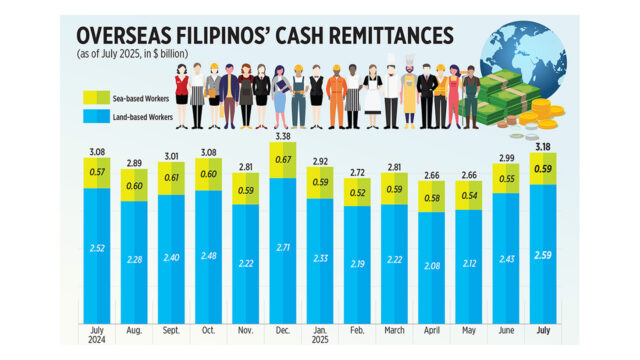
Overseas Filipinos’ Cash Remittances

FILIPINOS ABROAD sent more money home in July, hitting a seven-month high as remittances from sea-based workers grew at a slightly quicker pace than those from land-based workers, the Bangko Sentral ng Pilipinas (BSP) said on Monday. Read the full story.

250916OFW_Remittances

‘It feels like, almost, he’s here’: How AI is changing the way we grieve

ETERNOS

By Hani Richter

DIEGO FELIX DOS SANTOS never expected to hear his late father’s voice again — until AI made it possible. “The tone of the voice is pretty perfect,” he says. “It feels like, almost, he’s here.”

After the 39-year-old’s father unexpectedly passed away last year, Dos Santos traveled to his native Brazil to be with family. It was only after returning to his home in Edinburgh, Scotland, that he says he realized “I had nothing to actually remind [me of] my dad.” What he did have, though, was a voice note his father sent him from his hospital bed.

In July, Dos Santos took that voice note and, with the help of Eleven Labs — an artificial intelligence-powered voice generator platform founded in 2022 — paid a $22 monthly fee to upload the audio and create new messages in his father’s voice, simulating conversations they never got to have.

“Hi son, how are you?” his father’s voice rings out from the app, just as it would on their usual weekly calls. “Kisses. I love you, bossy,” the voice adds, using the nickname his father gave him when he was a boy. Although Dos Santos’ religious family initially had reservations about him using AI to communicate with his father beyond the grave, he says they’ve since come around to his choice. Now, he and his wife, who was diagnosed with cancer in 2013, are considering creating AI voice clones of themselves too.

Dos Santos’ experience reflects a growing trend where people are using AI not just to create digital likenesses, but to simulate the dead. As these technologies become more personal and widespread, experts warn about the ethical and emotional risks — from questions of consent and data protection to the commercial incentives driving their development.

The market for AI technologies designed to help people process loss, known as “grief tech,” has grown exponentially in recent years. Ignited by US startups such as StoryFile (an AI-powered video tool that lets people record themselves for posthumous playback) and HereAfter AI (a voice-based app that creates interactive avatars of deceased loved ones), this tech markets itself as a means to cope with, and perhaps even forestall, grief.

Robert LoCascio founded Eternos, a Palo Alto-based startup that helps people create an AI digital twin, in 2024 after losing his father. Since then, more than 400 people have used the platform to create interactive AI avatars, LoCascio says, with subscriptions starting from $25 for a legacy account that allows a person’s story to remain accessible to loved ones after their death.

Michael Bommer, an engineer and former colleague of LoCascio’s, was among the first to use Eternos to create a digital replica of himself after learning of his terminal cancer diagnosis. LoCascio says Bommer, who died last year, found closure in leaving a piece of himself behind for his family. His family has found closure from it too. “It captures his essence well,” his wife Anett Bommer, who lives in Berlin, Germany, told Reuters in an e-mail. “I feel him close in my life through the AI because it was his last heartfelt project and this has now become part of my life.”

The goal of this technology isn’t to create digital ghosts, says Alex Quinn, the CEO of Authentic Interactions, Inc., the Los Angeles-based parent company of StoryFile. Rather, it’s to preserve people’s memories while they’re still around to share them. “These stories would cease to exist without some type of interference,” Quinn says, noting that while the limitations of AI clones are obvious — the avatar will not know the weather outside or who the current president is — the results are still worthwhile. “I don’t think anyone ever wants to see someone’s history and someone’s story and someone’s memory completely go.”

One of the biggest concerns surrounding grief tech is consent: What does it mean to digitally recreate someone who ultimately has no control over how their likeness is used after they die? While some firms such as Eleven Labs allow people to create digital likenesses of their loved ones posthumously, others are more restrictive. LoCascio from Eternos, for example, says their policy restricts them from creating avatars of people who are unable to give their consent and they administer checks to enforce it, including requiring those making accounts to record their voice twice. “We won’t cross the line,” he says. “I think, ethically, this doesn’t work.”

Eleven Labs did not respond to a request for comment.

In 2024, AI ethicists at Cambridge University published a study calling for safety protocols to address the social and psychological risks posed by the “digital afterlife industry.” Katarzyna Nowaczyk-Basińska, a researcher at Cambridge’s Leverhulme Centre for the Future of Intelligence and co-author of the study, says commercial incentives often drive the development of these technologies — making transparency around data privacy essential.

“We have no idea how this (deceased person’s) data will be used in two or 10 years, or how this technology will evolve,” Nowaczyk-Basińska says. One solution, she suggests, is to treat consent as an ongoing process, revisited as AI capabilities change.

But beyond concerns around data privacy and exploitation, some experts also worry about the emotional toll of this technology. Could it inhibit the way people deal with grief?

Cody Delistraty, author of The Grief Cure, cautions against the idea that AI can offer a shortcut through mourning. “Grief is individualized,” he says, noting that people can’t put it through the sieve of a digital avatar or AI chatbot and expect to “get something really positive.”

Anett Bommer says she didn’t rely on her husband’s AI avatar during the early stages of her own grieving process, but she doesn’t think it would have affected her negatively if she had. “The relationship to loss hasn’t changed anything,” she says, adding that the avatar “is just another tool I can use alongside photos, drawings, letters, notes,” to remember him by.

Andy Langford, the clinical director of the UK-based bereavement charity Cruse, says that while it’s too soon to make concrete conclusions about the effects of AI on grief, it’s important that those using this technology to overcome loss don’t “get stuck” in their grief. “We need to do a bit of both — the grieving and the living,” he says.

For Dos Santos, turning to AI in his moment of grief wasn’t about finding closure — it was about seeking connection. “There’s some specific moments in life … that I would normally call him for advice,” Dos Santos says. While he knows AI can’t bring his father back, it offers a way to recreate the “magical moments” he can no longer share. — Reuters


NHA turns over 1,099 housing units in Laguna for PNR relocations

FACEBOOK.COM/PIAGOVPH4A

THE National Housing Authority (NHA) has distributed 1,099 housing units in San Pablo City, Laguna to families displaced by the government’s railway projects.

The houses are located at St. Barts Southville Heights in Barangay San Bartolome, San Pablo City, and form part of the relocation program for the Philippine National Railways (PNR) South Long Haul Project-Segment 2-7, the NHA said in a statement on Monday.

It said several community facilities are under construction, including a three-storey, 15-classroom school building, a two-classroom daycare center, a multi-purpose covered court with a training area, a health center, a wet and dry market, a livelihood training center, a tricycle terminal, and a material recovery facility.

In Quezon province, the NHA said five more housing projects are lined up to accommodate other families affected by the PNR project.

The PNR South Long Haul, spanning 577 kilometers, will have 33 stations linking Metro Manila to Batangas and the Bicol region.

The NHA is a government-owned and -controlled corporation under the Department of Human Settlements and Urban Development.

It was recently granted a 25-year extension of its corporate life under Republic Act No. 12216, which also doubled its capitalization to P10 billion, payable over 10 years.

The law authorizes the NHA to engage in public-private partnerships, undertake land banking, and issue bonds to support housing programs.

It also expands its mandate to include building climate-resilient communities and establishing a Disaster and Emergency Response Housing Office to address post-disaster resettlement needs. — Beatriz Marie D. Cruz

BankCom completes core system upgrade

BANK of Commerce (BankCom) has fully replaced its legacy core infrastructure, upgrading its branch and automated teller machine (ATM) network to deliver improved services to its clients.

“These enhancements are a significant part of our digital transformation, as we continue to innovate to help ensure we’re delivering better banking experiences for our customers,” BankCom President and Chief Executive Officer Michelangelo R. Aguilar said in a statement on Monday.

The upgrade was supported by solutions from Infosys and IBM. BankCom said the system migration took only one weekend to complete.

This is expected to result in improvements in both in-person and online transactions, the bank said.

“Apart from bringing flexibility to our product and service offerings, we will also have the capability to deliver a more efficient, reliable, and secured banking experience for all,” Mr. Aguilar said.

BankCom has 140 branches and 272 ATMs.

Its net income rose by 53% year on year to P993.31 million in the second quarter. For the first half, its net earnings increased by 31% to P1.86 billion.

The bank’s shares declined by 18 centavos or 2.28% to close at P7.70 apiece on Monday. — A.M.C. Sy

Cebu Pacific posts 15% increase in Jan.-Aug. passenger traffic

CEBUPACIFICAIR.COM

CEBU PACIFIC AIR, Inc. reported a 15.2% increase in passenger traffic to 18.13 million in the first eight months of 2025, with demand expected to pick up in the fourth quarter.

Domestic passengers grew 14% to 13.51 million, while international traffic climbed 18.8% to 4.62 million, the airline said in a statement on Monday.

For August alone, Cebu Pacific carried 2.1 million passengers, slightly down 0.4% from the same month last year.

“The softer year-on-year traffic in August reflects the usual lean travel season in the Philippines, particularly for domestic routes, while international passenger growth remained strong,” Cebu Pacific Chief Executive Officer Mike Szucs said.

He added that the dip is temporary, with traffic expected to rebound as peak travel season begins and aircraft availability improves.

Cebu Pacific said overall seat capacity rose 15.1% to 21.3 million, while the local seat load factor averaged 85.2%.

Mr. Szucs noted that domestic capacity growth in August was moderated due to unscheduled engine removals, a flyadeal wet-lease, and scheduled maintenance in preparation for the busy holiday months.

The airline operates 37 domestic routes and 26 international destinations. — Sheldeen Joy Talavera

Paramount criticizes pledge by entertainers to boycott Israeli film institutions

WASHINGTON — Paramount said on Friday it condemned a pledge signed earlier this week by more than 4,000 actors, entertainers and producers, including some Hollywood stars, to not work with Israeli film institutions that they see as being complicit in the abuse of Palestinians by Israel.

Paramount became the first major studio to respond to the pledge released on Monday last week.

Some organizations have faced calls for boycotts and protests over ties with the Israeli government as the humanitarian crisis in Gaza from Israel’s military assault grows, and images of starving Palestinians, including children, spark global outrage.

“We do not agree with recent efforts to boycott Israeli filmmakers. Silencing individual creative artists based on their nationality does not promote better understanding or advance the cause of peace,” Paramount said.

“We need more engagement and communication — not less,” it added.

The pledge from last week said it was not urging anyone to stop working with Israeli individuals but instead “the call is for film workers to refuse to work with Israeli institutions that are complicit in Israel’s human rights abuses.” Film Workers For Palestine, which published the original pledge, reiterated as much after Paramount’s statement.

Israeli film institutions had engaged in “whitewashing or justifying” abuse of Palestinians, the pledge had said, drawing parallels with how entertainers had made a similar pledge in the past against apartheid-era South Africa.

Signatories included actors Olivia Colman, Emma Stone, Mark Ruffalo, Tilda Swinton, Riz Ahmed, Javier Bardem, and Cynthia Nixon.

“We sincerely hope that Paramount, in its statement today, isn’t intentionally misrepresenting the pledge in an attempt to silence our colleagues in the film industry,” Film Workers for Palestine added.

US ally Israel’s assault on Gaza since October 2023 has killed tens of thousands of people, internally displaced Gaza’s entire population, and set off a starvation crisis. Multiple rights experts and scholars assess it amounts to genocide.

Israel casts its actions as self-defense after an October 2023 attack by Palestinian Hamas militants in which 1,200 people were killed and more than 250 taken hostage. Reuters

How PSEi member stocks performed — September 15, 2025

Here’s a quick glance at how PSEi stocks fared on Monday, September 15, 2025.


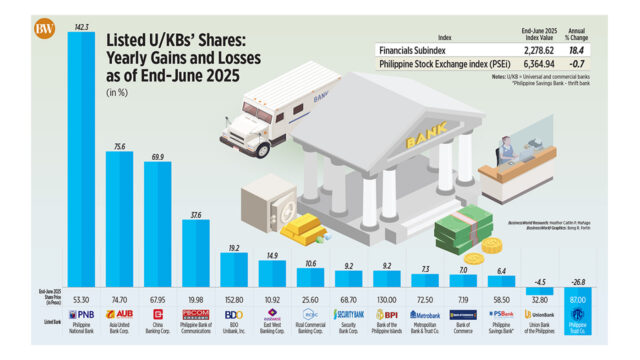
Listed U/KBs’ Shares: Yearly Gains and Losses as of End-June 2025

BANKING STOCKS rose in the second quarter as rate cuts coupled with steady inflation impacted profit margins, analysts said. Read the full story.

Listed U/KBs’ Shares: Yearly Gains and Losses as of End-June 2025