Home Blog Page 5939

Australia eyes record farm export earnings from bumper wheat harvests

 – Australian farmers are expected to earn a record amount from agriculture exports this financial year, the country’s chief commodity forecaster said on Tuesday, as it raised its estimate on the back of favorable weather and high global prices.

The Australian Bureau of Agricultural and Resource Economics and Sciences (ABARES) said farm export earnings could total a record A$70.3 billion ($48 billion) for 2022-23. That is up around 8% from its previous forecast in June.

Australia‘s east coast has been dominated by La Nina, typically associated with increased rainfall, over the last two years. While triggering flooding in several places, the weather pattern has also brought good rains across the eastern wheat belt.

ABARES has forecast wheat production of 32.2 million tons and 6.6 million tons for canola, just shy of their records hit last year. Barley production is expected to total 12.3 million tons, the fourth largest on record.

“Winter crop prospects in Australia are looking very promising at the beginning of spring – we’re forecasting a 55.5 million ton harvest,” ABARES Executive Director Jared Greenville said in a statement.

Planting of summer crops is forecast to be well above average for the current season supported by suitable soil moisture and more land previously left fallow during winter.

The forecast could bring relief after Russia’s war in Ukraine limited shipments from one of the top grain exporting regions. The conflict has tightened global food supplies, sending prices higher and fueling concerns of a food crisis.

Though favorable seasonal conditions are expected to persist, soaring global inflation, a sluggish Chinese economy and rising costs of fertilizers and farm equipment could take some shine off a bumper harvest, Greenville said.

Greenville said the latest forecasts have also factored in tapering global growth and the likelihood of a third straight La Nina, roughly a once in a 30-year weather event.

The country’s weather bureau last month said Australia was facing a 70% chance of La Nina returning in Spring. Read full storyReuters

August inflation eases to 6.3%

Headline inflation slowed to its two-month low of 6.3% in August as food and transport costs eased, the Philippine Statistics Authority (PSA) reported on Tuesday morning.

August’s inflation print eased from the nearly four-year high of 6.4% in July but remained higher than 4.4% in August a year ago, preliminary data from the PSA showed.

This was lower than the 6.4% median estimate in a BusinessWorld poll conducted last week. It also settled within the 5.9-6.7% forecast range of the Bangko Sentral ng Pilipinas (BSP) for that month. It was also the fifth consecutive month that inflation went above the BSP’s 2-4% target range.

Last month’s inflation print was the slowest in two months, or since the 6.1% in June.

Month on month, inflation picked up 0.4%. Stripping out seasonality factors, month-on-month inflation inched up 0.4% in August as well.

Inflation averaged 4.9% in the eight months to August, faster than the 4% seen in the same period a year ago. This was also lower than the central bank’s revised 5.4% inflation forecast this year.

Core inflation, which excludes volatile prices of food and fuel, jumped to 4.6% year on year in August. This was higher than 3.9% seen in July and 2.8% in August last year.

Heavily weighted food and beverages slowed to 6.3% year on year in August from 6.4% in July. Transport likewise eased to 14.6% from 18.1%.

Meanwhile, inflation as experienced by the poor households, which still remained under 2012-based prices, steadied at 5.9% in August from July and 5.3% a year ago. — AMPY 

Welcome to DigiCon Valley: Celebrating the entrepreneurial spirit

The Internet & Mobile Marketing Association of the Philippines (IMMAP)’s DigiCon, the flagship event for the Philippine marketing, advertising, and digital industries is back this year with its new theme: DigiCon Valley, which will take place from Oct. 10 to 14, 2022.

Celebrating innovation, problem-solving, and the entrepreneurial spirit, DigiCon Valley looks ahead to what will be a tipping point in the country’s start-up scene: an increase in investments for Philippine firms in the next three years, much higher compared to what industries received over the past five years combined.

Four program tracks will set the digital agenda for brands, and, in turn, open doors for those in the digital space to connect with Philippine businesses:

1. Launchpad that will discuss the tools and techniques for digital excellence

2. Hypergrowth that will level-up digital skills and showcase stories of growth from the most successful start-ups

3. Breakthrough that will teach digital strategy and how to think like an innovator

4. Enterprise that will chart what it means to be a digital-first organization

To give a preview of the upcoming conference, the IMMAP DigiCon Committee was present at a press launch held at The Astbury in Poblacion, on Aug. 31. IMMAP DigiCon Co-Chair Denise Haak officially unveiled the theme and program tracks to media guests and sponsors.

IMMAP DigiCon Co-Chair Trish Elamparo-Esteban also covered the Program Tracks and introduced this year’s Keynote Speakers, which include Huffington Post Founder Arianna Huffington; Rappler Founder and the first Filipino Nobel Peace Prize laureate Maria Ressa; internationally acclaimed marketing expert and academic Mark Ritson; Design Sprint inventor Jake Knapp; and Award-winning Global CMO of Dole Sunshine Company Rupen Desai.

Ritz Tan, who is heading one of IMMAP DigiCon’s programs, also discussed a new addition to this year’s event, After Hours. While the conference itself will be virtual, After-Hours will be night-set face-to-face networking sessions that will allow attendees to meet each other and make business connections.

For more information about IMMAP DigiCon Valley 2022, please visit our official website at www.digicon.com.ph, and follow their social pages on Facebook, Twitter, and Instagram.

IMMAP DigiCon Valley 2022 is co-presented by Angkas, and would like to thank the following:

Platinum Sponsors: Manulife Philippines, Share Treats, and TikTok

Gold Sponsors: Investing in Women, an initiative of the Australian Government, Grab Ads, Kroma Entertainment, McDonald’s Philippines and Meta Philippines

Silver Sponsors: Digital Turbine, Hepmil Philippines, and Metrobank

IMMAP DigiCon would also like to thank its media partners:

Platinum Media Partners: Manila Broadcasting Company and Rappler

Gold Media Partners: CNN Philippines, Manila Bulletin, AGC Power Holdings, Podcast Network Asia, The New Channel, and The Asian Parent

Silver Media Partners: BusinessWorld, Inquirer.Net, Kroma Entertainment, and The Philippine STAR

Event Partners: Creators and Influencers of the Philippines (CICP), Endeavor, and Kickstart Ventures


Spotlight is BusinessWorld’s sponsored section that allows advertisers to amplify their brand and connect with BusinessWorld’s audience by enabling them to publish their stories directly on the BusinessWorld Web site. For more information, send an email to online@bworldonline.com.

Join us on Viber to get more updates from BusinessWorld: https://bit.ly/3hv6bLA.

Peso trades at P57 for the first time

US one hundred dollar notes are seen in this picture illustration taken in Seoul, Feb. 7, 2011. — REUTERS

THE PHILIPPINE PESO touched the P57 level against the US dollar for the first time during intraday trading on Monday, as investors continued to flock to the safe-haven currency.

The local unit closed at a fresh all-time low of P56.999 per dollar on Monday, down by 22.90 centavos from its P56.77 finish on Friday, Bankers Association of the Philippines data showed.

The peso has weakened by 11.76% or P5.999 from its P51-per-dollar close on Dec. 31, 2021.

The local currency opened Monday’s session at P56.85 against the dollar. The peso’s weakest showing was at P57 versus the greenback, while the intraday best was at P56.80.

Dollars exchanged inched up to $976.45 million on Monday from $936.95 million on Friday.

“The peso closed near the P57 level today following the release of strong US employment reports for August 2022,” a trader said in an e-mail.

Data from the US Labor department showed the economy added 315,000 jobs in August, marking the 20th straight month of jobs growth.

However, the US unemployment rate also rose to a six-month high  as nearly 800,000 people entered the labor market, driving the size of the labor force to also a record high. 

The jobs data could support further rate hikes by the US Federal Reserve this month, Rizal Commercial Banking Corp. Chief Economist Michael L. Ricafort said in a Viber message.

“Peso was also weaker after the new record-high outstanding national debt,” Mr. Ricafort added.

The National Government debt hit another record as of end-July, inching up 0.8% or P96.09 billion to a record-high P12.89 trillion from P12.79 trillion as of end-June. This was attributed to additional domestic and local borrowings, as well as a weaker peso.

The Bureau of the Treasury (BTr) said the debt pile jumped by 9.9% since the year started, after the government borrowed P1.16 trillion more.

“However, the local currency might recover as expectations of elevated Philippine inflation might bolster hawkish policy bets for the BSP,” the trader said.

Bangko Sentral ng Pilipinas (BSP) Governor Felipe M. Medalla on Friday said they have done enough to stabilize the peso after a series of rate hikes.

“We can say we have done enough. There is no peso problem, it’s a dollar problem,” Mr. Medalla said during the virtual Reuters NEXT Newsmaker event on Friday.

The BSP has raised benchmark rates by 175 basis points since May to tame inflation. It sees inflation averaging 5.4% this year, beyond its 2-4% target.

Mr. Medalla said the Fed’s next policy move will be a “big factor” for the Monetary Board to consider at their Sept. 22 meeting, especially as the US central bank will also meet on Sept. 20-21.

The Philippine Statistics Authority is scheduled to release the August consumer price index data today (Sept. 6).

A BusinessWorld poll of 13 analysts yielded a median estimate of 6.4% for August inflation, well within the BSP’s 5.9-6.7% forecast for the month and unchanged from July pace.

The trader expects the peso to move between P56.80 and P57 against the dollar on Tuesday, while Mr. Ricafort gave a higher forecast range of P56.80 to P57.05. — K.B.Ta-asan

Rural banks concerned over higher capital requirements

BW FILE PHOTO

By Keisha B. Ta-asan

MANY RURAL BANKS may have difficulty in meeting the higher minimum capital requirements set by the Bangko Sentral ng Pilipinas (BSP), which may force them to scale down operations, according to an industry group.

Rural Bankers Association of the Philippines (RBAP) President Atty. Mary Ann Tupasi-Saddul said that while she supports the BSP’s efforts to strengthen local banks, the hike in capital requirements comes at a time when many small lenders are still recovering from the coronavirus disease 2019 (COVID-19) pandemic.

“Coming as it does on the heels of more than two years of economic slowdown, and a little more than two years after the completion of the last capital call by BSP, not all rural banks are in an ideal position to deal with a 500% hike in the minimum capital requirements,” Ms. Tupasi-Saddul said in an e-mail.

The BSP last week raised the minimum capital requirements for rural banks to at least P50 million from P10 million previously, as part of the Rural Bank Strengthening Program (RBSP).

BSP Governor Felipe M. Medalla told BusinessWorld that rural banks that want low capital requirements “should not be receiving deposits.”

“It’s very clear that if a rural bank is too small, it will barely earn enough just to pay salaries. So how will it run well? You need a certain minimum size to operate as a rural bank,” Mr. Medalla said on the sidelines of a central bank event on Friday.

Under the new rules, a rural bank with a head office and up to five branches needs to have a minimum capitalization of P50 million, regardless of location.

Rural banks with six to 10 branches are required to have a minimum capital of P120 million, while those with more than 10 branches should have capital of at least P200 million.

Ms. Tupasi-Saddul said the higher capital requirements would allow rural banks to grant bigger loans, as well as enhance risk management systems and prudential standards.   

However, she noted many rural banks operate in low-income municipalities where credit demand “is more than adequately met by existing rural bank resources.”

“The greatly disadvantaged are single unit banks established in unbanked areas, especially when the borrowing needs of the locality do not substantiate the capital increase,” Ms. Tupasi-Saddul said. 

According to the RBAP president, the higher capital requirements is counterproductive to the BSP’s financial inclusion drive, as rural banks may be forced to scale back the number of branches.

“Even assuming that universal banks are now able to reach these areas through digitalization, it is unlikely that they will serve the typical credit needs of farmers, fisherfolk, small and microenterprises, given the small scale of these needs. It was precisely to cater to these sectors, regarded as both marginalized and special, that rural banks were created,” Ms. Tupasi-Saddul said.

“Should some rural banks be unable to comply with the new requirements and be subject to sanctions, operations will be curtailed and so will their mandate of countryside development,” she added.

Rural banks whose capital falls below the new minimum requirements can refer to available options under the RBSP, and submit the capital buildup plan within six months to the BSP. They are given five years to meet the minimum capital requirements.

Mr. Medalla said the BSP is giving rural banks enough time to comply.

“We’re giving them time. And then we’ll give them other options like merging, infusing capital, so there are many options and there’s time,” he said.

However, Ms. Tupasi-Saddul said the BSP should consider that many lenders are still recovering from the pandemic, and that the five-year period is not enough to comply with the new rules.

“Once the BSP lays out a clearer definition and guidelines of the given tracks, we will plot out and simplify the options for our members,” she said.

The RBAP is also exploring possible partnerships with government agencies that implement social amelioration programs.

“We envision these comprehensive partnerships to include not only rural banks as access points and disbursement channels for government programs, but also direct investments by the implementing agencies in the capital of rural banks,” Ms. Tupasi-Saddul said.

Pork prices to continue fueling PHL inflation — MUFG report

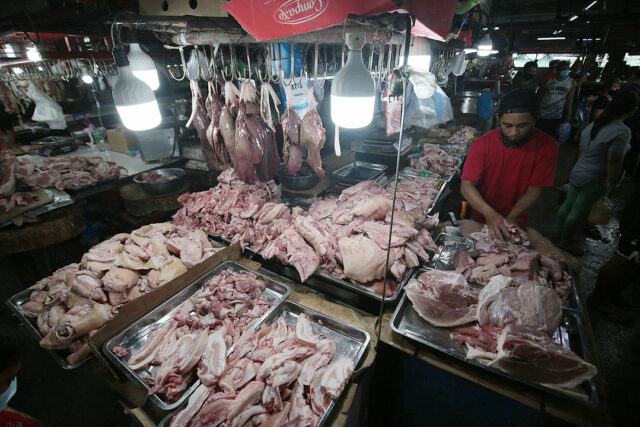
Customers buy pork at Commonwealth Market, Jan. 7, 2021. — PHILIPPINE STAR/ MICHAEL VARCAS

PORK PRICES in the Philippines will continue to climb this year, mainly due to the ongoing African Swine Fever (ASF) outbreak, more expensive animal feeds, and higher pump prices, according to MUFG Global Markets Research.

MUFG Global Markets Research analyst Sophia Ng said in a report that higher pork prices will keep inflation elevated in the country.

Inflation is expected to peak at 7% in November, she said. MUFG Global Markets upwardly revised its full-year forecast to 5.5% from 5.2% previously. The Bangko Sentral ng Pilipinas (BSP) estimates inflation to average 5.4% this year.

“Since early 2020, food inflation has been the key driver of overall inflation in the Philippines on top of higher energy inflation, and food inflation itself has been mainly pressured by higher prices of meat and fish,” she said.

Ms. Ng said food inflation is still the biggest component fueling overall inflation, adding 1.4 percentage points (ppts) on average in the first seven months of 2022, followed by transport prices at 1.2 ppts. Prices of meat and fish added 0.4 ppt each to overall inflation so far this year.

“Given that pork is one of the most consumed meat per capita in the Philippines, the share of pork prices under the meat category is likely to be high,” she said.

Aside from ASF, pork prices have also been affected by rising cost of animal feeds as the Russia-Ukraine war disrupted the global supply of feed wheat. The price of corn, which is used as a substitute, has also gone up due to the surge in fertilizer costs.

The spike in pump prices also raised transport costs for farmers, Ms. Ng said.

In June, the price of hogs for slaughter that were bred in backyard farms reached a record P186.54 per kilogram, and is expected to rise further.

“The ongoing supply deficit of pork due to the prevalence of the African Swine Fever, with recovery still a long way to go will keep farmgate prices of hog for slaughter in backyard farms elevated, possibly between 14-18% year on year in the second half of 2022 based on our own estimates, from 12.2% year on year in the first half of 2022 and a 39.1% year-on-year jump for the whole of 2021,” Ms. Ng said.

The ASF outbreak continues to weigh on local hog population, which fell by 4.5% to 9.4 million as of Jan. 1, from 9.9 million at the start of 2021.

Ms. Ng said the supply of pork is expected to remain low this year, citing the National Economic and Development Authority (NEDA) estimate of a pork supply deficit of 65,800 metric tons.

While the government lowered tariffs to increase imports of frozen pork, Ms. Ng said this had little impact on prices.

“Based on the current trend, total pork imports this year are likely to exceed those recorded last year. But this is not enough to bring down pork prices substantially as vendors take advantage of the scarcity in domestic supply to keep prices elevated. In addition, the ongoing ASF crimps farmers’ ability to ramp up pork production,” she said.

The Philippine Statistics Authority is scheduled to release the latest consumer price index data today (Sept. 6). — K.B.Ta-asan

PDP to focus on agro-industry development

A community garden is seen in Marikina City, April 22 — PHILIPPINE STAR/ MICHAEL VARCAS

THE UPCOMING Philippine Development Plan (PDP) will focus on developing the country’s agro-industry, according to a National Economic and Development Authority (NEDA) official.

“The longer-term solution is really to improve the productivity of our agricultural sector and then increase the linkages between agriculture and the rest of the economy,” said NEDA Undersecretary Rosemarie G. Edillon in a television interview with BusinessWorld Live on Monday.

“So, for our PDP, we are looking at developing more of the agro-industry… Previously, our targets had to do with increasing the gross value added of agriculture but now we will be looking at indicators that are really about the linkages,” she added.

Protecting the purchasing power of Filipinos through food security, as well as targeting social protection to indigents, is also reflected in the strategy framework for the PDP 2023-2028.

President Ferdinand R. Marcos, Jr. had pledged to boost agriculture production through modernization.

“It’s really about the farm to plate, so we also consider the logistics cost, the storage facilities, the processing facilities… so we have to look at availability, affordability, [and] accessibility of the food products at the market,” Ms. Edillon said.

Socioeconomic Planning Secretary Arsenio M. Balisacan previously said that the agriculture sector can contribute to long-term growth and poverty reduction.

Ms. Edillon said that there are still some sectors below pre-pandemic levels of growth, including transportation, accommodation, and recreation, among others.

“We think we should be targeting for a faster growth rate because we need to catch up on those lost growth opportunities, and next year would be a very crucial year for us; it’s really [about] addressing the scarring [and] catching up,” she added.

The government aims to attain 6.5-7.5% gross domestic product (GDP) growth this year, and 6.5-8% next year until 2028. At the same time, it wants to bring down the poverty rate to single digit or 9%.

According to Ms. Edillon, poverty incidence was reduced to 16.7% from 23.7% between 2015 and 2018; only to rise to 18.1% between 2018 and 2021 due to the coronavirus disease 2019 (COVID-19) pandemic.

“We saw that certain regions where there was really economic activity, and there were programs to assist the poor, the poverty actually went down. So, it’s still the same strategy; make sure that the economic activity really is very vibrant and that the poor are able to participate in this economic activity,” Ms. Edillon said, adding that it is doable provided the growth targets are achieved.

“In the short term, it really has to be a mix of government assistance especially to the most vulnerable, and we’re looking at ensuring food security for the most vulnerable,” she added, naming farmers, fisherfolks, and the poor as its beneficiaries.

Last month, Ms. Edillon told reporters that NEDA is working to fast-track the submission of the new PDP before its deadline in December.

The PDP serves as the government’s overall guide in development planning. — Diego Gabriel C. Robles

SEC approves IT retailer Upson’s P4.3-B IPO

THE Securities and Exchange Commission (SEC) announced on Monday its approval of Upson International Corp.’s initial public offering (IPO).

Upson, an IT product retailer, aims to raise up to P4.34 billion.

“In its Sept. 1 meeting, the Commission En Banc resolved to render effective the registration statement of Upson International covering 3,289,473,900 common shares, subject to the company’s compliance with certain remaining requirements,” the SEC said in a statement.

Upson will offer up to 789,473,600 common shares priced at up to P5.50 per share.

According to the commission, Upson’s offer will include 98,684,200 common shares “to be issued by a selling shareholder at up to P5.50 per share, with an additional 98,684,200 common shares as an overallotment option.”

The shares will be listed and traded on the main board of the Philippine Stock Exchange.

At the same time, the SEC noted that net proceeds from the offer could reach up to P4.153 billion.

The company said that proceeds from the maiden offering will be used to expand its store network and open 250 branches or an additional retail space of 25,000 square meters until 2026.

“The company will not receive any proceeds from the sale of the secondary shares by the selling shareholder,” the SEC said.

A company representative said in an e-mail that the updated target listing date is set on Oct. 14, with the public offer set to run from Oct. 3 to Oct. 7.

“We are grateful for the support of the SEC for their confidence in Upson’s vision to help transform the Philippines into a more digitally-ready country,” Upson Chief Executive Officer and President Arlene Sy said in a statement.

“Upson aims to continuously adapt to the rapid growth of digital technology. We shall consistently provide the most relevant and latest IT products through our network expansion across the country.”

The company tapped First Metro Investment Corp. as the issue manager and book-runner for the transaction and assigned RCBC Capital Corp. and First Metro as joint lead underwriters.

The company operates under the brand names Octagon Computer Superstore, Micro Valley, and Gadget King.

If realized, Upson will be the first IT retailer company to go public.

“We assure the public that Upson shall be a significant catalyst to these developments guided by the Company’s knowledge and expertise in the business,” Ms. Sy said. — Justine Irish D. Tabile

Property, bank, consumer sectors to sustain recovery in second half— analysts

PROPERTY, banking, and consumer sectors are expected to sustain recovery from the impact of the public health crisis in the second half of the year, as they benefit from the further reopening of the economy, according to analysts.

“Recovery from the pandemic is anticipated in the property sector after being significantly hit by the imposed restrictions. We expect that its rebound will continue in the second half,” Philstocks Research Analyst Claire T. Alviar said in the recently released Midyear 2022 Review of the financial firm.

“The consumer sector in the Philippines has already been continuously showing signs of recovery from the pandemic,” Philstocks Research and Engagement Officer Mikhail Philippe Plopenio said.

Meanwhile, Japhet Louis O. Tantiangco, senior research analyst of Philstocks, said that if confidence in the economy is sustained, loans will continue to grow and support the profitability of local banks.

“Bank borrowing or lending has been gaining strength amid the rising confidence towards the economy’s prospects. This is despite the tightening of monetary policies,” Mr. Tantiangco noted.

According to the review, property stocks in the main index  in the first half recorded an earnings growth of 16.23% year on year.

Ms. Alviar said that if the economy continues to reopen, the property sector will gain, particularly mall and hotel segments.

However, rising interest rates may dampen the growth of the sector, specifically those whose revenues come from the residential segment as Philstocks review sees mortgages to be negatively affected by rate hikes.

“Higher rates may tend to discourage home buyers,” Ms. Alviar added.

Mr. Plopenio said that consumer sentiment is already improving as shown in the Bangko Sentral ng Pilipinas’ (BSP) second-quarter consumer confidence survey.

“This is on the back of expectations that more jobs will be provided and the easing of COVID-19 restrictions,” Mr. Plopenio added.

The consumer sentiment in the country was less pessimistic in the second quarter, as the overall confidence index improved to -5.2% from -15.1% in the first quarter, BSP data showed.

“Consumer sentiment for the next quarter and next year also showed positive results, which indicate that investors have huge confidence in the industry moving forward,” Mr. Plopenio said.

According to the review, the consumer leaning stocks is the best performing sector next to Semirara Mining and Power Corp. and International Container Terminal Services, Inc., which are the sole representatives of their respective industries.

The said sector’s bottomline grew 42.31% year on year despite inflation risks, which Philstocks said was led by the swing to the profitability of Monde Nissin Corp. and the 351.70% growth in net income of Jollibee Foods Corp.

Mr. Plopenio said that the consumer sector still faces downside risks, such as shortages of several raw materials amid the ongoing Russia-Ukraine war and rising prices, which could slow down supply and demand.

“We may look into consumer staples and essentials retailing companies as demand for their products is always present regardless of any economic situation, making their businesses attractive,” he noted.

According to the review, bank lending has already been expanding for 12 consecutive months with growth posting an uptrend on a year-on-year basis.

In July,  lending in universal and commercial banks went up by 12%, the fastest since the 12.7% in April 2020.

“This is also above the last five year’s compounded annual growth rate of 9.8%,” Mr. Tantiangco said.

Meanwhile, the Philippines’ universal and commercial banks’ June loans-to-deposit ratio was at 70.61%, higher than June last year’s 69.33%, which Mr. Tantiangco said implies higher utilization of the sector’s loanable funds.

Philstocks reported that June gross non-performing loans (NPL) went down by 10.2% to P356.75 billion, which Mr. Tantiangco said reflects “the better asset quality of our universal and commercial banks.”

“The rising interest rates caused by the BSP’s monetary tightening is also expected to boost banks’ interest incomes,” Mr. Tantiangco said.

He noted that a further build-up in the headwinds to our local economy — inflation and global challenges — can weaken confidence and bank lending. — Justine Irish D. Tabile

ICTSI’s Abbotsford ties up with Pampanga-based Prime Alta for logistics business

LISTED port operator International Container Terminal Services, Inc. (ICTSI) announced on Monday that its subsidiary Abbotsford Holdings, Inc. had signed a partnership deal with Pampanga-based Prime Alta Holdings, Inc. to operate a freight forwarding and logistics business.

The two companies will form Fortune Logistics Corp., which will “primarily operate, engage in and carry on the business of domestic and international ocean, air and land freight forwarding and logistics,” ICTSI said in a disclosure to the stock exchange.

The joint venture aims “to reduce costs and improve operational efficiency associated with the processing of cargo that are intended to be used by ICTSI for its various operations in the Philippines,” it added.

Abbotsford, a wholly owned subsidiary of the Razon-led company, and Prime Alta target to obtain regulatory permits and licenses within one to two months after the signing of the shareholders’ agreement for the joint venture.

The joint venture’s initial capitalization is P25 million, with a 51:49 ownership split.

Abbotsford will own 51% or P12.75 million from the initial subscription while Prime Alta will own 49% or P12.25 from the initial subscription.

“The joint venture company will distribute a percentage of its available distributable cash flow and such dividends will be paid to the shareholders pro rata on the basis of their respective shareholding,” ICTSI said.

Its board of directors will be tasked to oversee the management and operations of the joint venture company in which Abbotsford will appoint three directors and Prime Alta will appoint two.

ICTSI’s net income attributable to equity holders for the first half of the year reached $294.5 million, 50% more than the $196.7 million it earned in the first half of 2021.

The improvement was “primarily due to higher operating income; higher net foreign exchange gain, increase in equity share in net profit of joint ventures; and strong contribution of new terminals; partially tapered by an increase in depreciation and amortization, and interest on loans, concession rights payables and lease liabilities,” the company said. — Justine Irish D. Tabile

Gov’t partially awards T-bill offer as rates climb

BW FILE PHOTO

THE GOVERNMENT partially awarded the Treasury bills (T-bills) it auctioned off on Monday as investors wanted higher yields and as its recent retail Treasury bond (RTB) offering siphoned off liquidity from the market.

The Bureau of the Treasury (BTr) raised just P7.068 billion from the T-bills it auctioned off on Monday, lower than the P15-billion program, even as bids reached P26.653 billion.

Last week, the government did not award any T-bills as rates climbed after the US Federal Reserve chief said rates in the world’s largest economy could remain elevated for longer. Tenders at that auction reached P17.289 billion, higher than the P15-billion plan.

Broken down, the Treasury borrowed just P4.543 billion from the 91-day securities on Monday versus the P5-billion plan, even as the tenor attracted P10.923 billion in bids. The average rate of the tenor went up by 24.8 basis points (bps) to 2.318% from the 2.07% fetched on Aug. 22 or the last successful award. Accepted rates ranged from 1.975% to 2.4%.

The BTr likewise raised only P2.525 billion from the 182-day debt papers out of the P5-billion program, even with demand for the tenor reaching P10.629 billion. The debt paper’s average rate rose by 14.9 bps to 3.485% from 3.336% fetched at the previous successful auction as the government accepted offers ranging from 3.435% to 3.5%.

Meanwhile, the government rejected all bids for 364-day securities on offer on Monday, even as tenders reached P5.101 billion. Had they been fully awarded, the average rate of the tenor would have gone up by 57.4 bps to 4.356% from the 3.782% fetched for the last award.

At the secondary market before Monday’s auction, the 91-, 182- and 364-day T-bills were quoted at 2.383%, 3.3304%, and 3.8911%, respectively, based on the PHP Bloomberg Valuation Reference Rates published on the Philippine Dealing System’s website.

The BTr made a partial award of the T-bills on Mondays as the rates sought by investors were “way above current levels,” National Treasurer Rosalia V. de Leon told reporters in a Viber message after Monday’s auction.

“Nothing surprising because the BTr still has leeway to reject T-bills following its RTB issuance,” the first trader said.

The first trader said the market wanted higher yields amid expectations of elevated inflation, which could lead to another aggressive rate hike from the Bangko Sentral ng Pilipinas (BSP).

The second trader said T-bill yields climbed as liquidity was mopped up by the government’s RTB offer that ended last week, resulting in tepid bids from banks.

A BusinessWorld poll of 13 analysts yielded a median estimate of 6.4% for August headline inflation, well within the BSP’s 5.9-6.7% forecast for the month and unchanged from July pace.

However, if realized, this would mark the fifth straight month that inflation would go beyond the central bank’s 2-4% target and would also be above its 5.4% forecast for the year.

BSP Governor Felipe M. Medalla last week said the Fed’s next policy move will be a “big factor” to consider for the Monetary Board at their Sept. 22 meeting as the US central bank’s review will happen on Sept. 20-21.

The BSP has increased borrowing costs by 175 bps since May as it seeks to rein in rising inflation. 

Fed Chair Jerome H. Powell said at the Jackson Hole symposium on Aug. 26 that the US central bank will hike interest rates as needed and keep them high for some time to bring inflation back within target. The US central bank has raised rates by 225 bps so far since March.

Meanwhile, the Treasury raised a total of P420.448 billion from the 5.5-year retail bonds it offered from Aug. 23 to Sept. 2, with P108.517 billion coming from the bond exchange program. The RTBs carry a coupon of 5.75% and will be issued on Sept. 7.

On Tuesday, the BTr will auction off P35 billion in reissued 3.5-year Treasury bonds (T-bonds) with a remaining life of three years and five months.

The Treasury wants to raise P200 billion from the domestic market this month, or P60 billion through T-bills and P140 billion via T-bonds.

The government borrows from local and external sources to help fund a budget deficit capped at P1.65 trillion this year, equivalent to 7.6% of gross domestic product. — Diego Gabriel C. Robles

The 10th QCinema presents QC Shorts lineup

Full-length tilt to return this year

STORIES about a missing corpse, a sex worker and her cat, and an OFW neanderthal are among the six short films that will be shown at this year’s QCinema International Film Festival (QCinema). This as the festival is set to bring back its full-length film competition after a halt due to the COVID-19 pandemic.

The QC Shorts lineup was presented at the film festival’s kick-off event on Aug. 31 at the Gallery MiraNila in Quezon City.

“Ang daming talentadong mga kabataan (There are so many talented youths). Our philosophy is that we give opportunities to our talented filmmakers, give them support and create an environment where they can thrive,” Quezon City Mayor Joy Belmonte said in her opening speech at the event.

Founded in 2013, QCinema is organized by the Quezon City Film Development Foundation. Through the years, the film festival has produced and co-produced 88 films: 38 full length movies, 38 shorts, and 12 documentaries. It has also screened more than 160 award-winning international titles from various local and international film festivals.

The 10th QCinema Film Festival will run from Nov. 17 to 26 in selected cinemas in Quezon City.

The QCinema Short films for 2022 are:

• Jaime Morados’ Ang Pagliligtas sa Dalagang Bukid (Saving the Country Maiden), set in 1921 the film follows 16-year-old Joaquin who attempts to save the film reel of the first movie he watched in the midst of a studio fire;

• Whammy Alcazaren’s Bold Eagle which follows an anonymous online-sex worker who seeks validation from his cat;

• Glenn Barit’s Luzonensis mula 7 hanggang 9 is about a “neanderthal” man who is about to leave for work abroad, but then discovers that his passport is missing hours before departing;

• Rocky de Guzman Morilla’s Mga Tigre ng Infanta, is about Katrina’s wild hunt deep into the psyche of her grandmother, whose corpse has gone missing;

• Austin Tan’s Ngatta Naddaki y Nuang? (Why did the Carabao cross the Carayan?) follows Oyo’s return to his hometown in Cagayan in search of a carabao; and,

• JT Trinidad’s sa ilog na hindi nagtatapos, which is set in areas surrounding the decaying Pasig River and narrates four individuals’ stories which unfold through Baby, a middle-aged trans woman.

The six films, which each received grants of P350,000, are currently in production.

FULL LENGTH FILM COMPETITION
The film festival’s official main competition for full-length films is set to return in this year’s edition.

“We are reviving our main competition, Asian Next Wave, with new films from Southeast Asia directors including Filipinos,” QCinema festival director Ed Lejano said in his speech at the festival’s kick-off.

He added that the international film lineup to be screened this year will include films from international film festivals such as the Cannes Film Festival, the Berlin International Film Festival, the Sundance Film Festival, and the Toronto International Film Festival.

Details on the rest of the films to be shown under the festival’s sections — such as Screen International, RainbowQC, New Horizons, and Special Screenings — are yet to be announced.

Meanwhile, newly appointed Film Development Council of the Philippines (FDCP) Chairman Tirso Cruz III announced that the agency will give grants to next year’s competing films.

“[The] FDCP will be granting competing filmmakers next year P100,000 for short film finalists, and P1 million for the full-length finalists,” Mr. Cruz said at the event.

For more information and updates, visit https://www.facebook.com/QCinemaPH/. — Michelle Anne P. Soliman