Home Blog Page 593

Stuff to Do (09/26/25)



Learn about skin at Shangri-La mall

AT Shangri-La Plaza, an immersive space about the beauty of skin, showcased in a way that art comes to life, will open this weekend. The space, set up by Lactacyd, focuses on skin science. Admission is free. The Museum of Speaking Skin opens on Sept. 25 and will run until Sept. 28.


Got to a benefit concert for Pablo Tariman

FOR the benefit of veteran performing arts and classical music journalist Pablo Tariman, who is battling multiple health complications, longtime friends are putting up a concert. Internationally renowned tenor Arthur Espiritu is one of many musicians headlining the fundraising show Let the Wind Blow: A Bouquet for Pablo, set for Sept. 26, 7:30 p.m., at the Mirror Theatre Studio, SJG Center, Poblacion, Makati City. Other musicians performing are sopranos Stefanie Quintin Avila and Angeli Benipayo, theater actress Jay Valencia Glorioso, baritone Ruzzel Clemeno, guitarist Aaron Aguila, cellist Renato Lucas, pianists Gabriel Allan Ferros Paguirigan and GJ Frias, clarinetist Herald Sison, and violinists Ghio Karylle Esteban and Cedie Nuñez. Tickets are available via 0920-954-0053 or 0918-347-3027, or the e-mail josephuy@yahoo.com.


Catch The Bodyguard The Musical

THE BODYGUARD THE MUSICAL — 9 Works Theatrical’s latest production — opens this weekend on Sept. 26, and runs until Oct. 19. It is an adaptation of the 2012 stage musical with a book by Alexander Dinelaris, which in turn was based on the 1992 film The Bodyguard with songs by Whitney Houston. Directed by Robbie Guevara, and with musical direction by Daniel Bartolome, it will be the first theater production staged at the brand-new Proscenium Theater in Rockwell, Makati City. Telling the story of a musical superstar and her bodyguard as their relationship develops while she is under threat, the musical features West End stars Christine Allado and Matt Blaker as the leads, alongside Sheena Palad, Elian Santos and Giani Sarita, Tim Yap, John Joven-Uy, Vien King, Jasper Jimenez, CJ Navato, Paji Arceo, and Radha. Tickets are available at TicketWorld.


Visit the Gateway Art Fair

THE Gateway Art Fair is back, on view at Gateway Mall 1 and 2 in Quezon City’s Araneta City from Sept. 26  to Oct. 5. Gateway Gallery brings to life Big Works around the mall that include Leeroy New’s sculptures at the UGB, walkways at Gateway Mall 2, Agnes Lenon’s The Giving Canopy, a crochet canopy at the Courtyard in Gateway Mall 1, and Franxyz Paulo’s Shaping Sounds, the Vinyl records Renaissance life-size figurines around Araneta City.


Catch pop-R&B artist HILLARI

HILLARI has been making waves globally and on Sept. 26, the rising artist will be headlining her own show in the Philippines, at the Linya-Linya HQ. The venue is located on the 5th floor of the Magnitude Bldg. in Libis, Quezon City. Doors open at 7 p.m. Tickets can be purchased via https://hillariliveinmanila.helixpay.ph/.


Attend a Cecile Licad piano concert

FAMOUS FILIPINA pianist Cecile Licad will be having a series of concerts around the country. She will be playing at the Baguio Country Club, Baguio City, on Sept. 27; at the Pinto Art Museum, Antipolo City, on Sept. 28; at the Miranila Heritage House, Quezon City, on Oct. 1; the Sta. Ana Parish on Oct. 6 and UPV Museum on Oct. 7, both in Iloilo City; and the ECrown Hotel in Virac, Catanduanes, on Oct. 11.


Watch a fencing competition

THE Philippine Fencing Association is back in Araneta City for its 3rd leg Minime and Veterans ranking competition. This will be held at the Quantum Skyview, Upper Ground B, Gateway Mall 2 on Sept. 27 and Sept. 28. Watch the country’s rookie fencers showcase their prowess and emerge as upcoming fencing stars. Meanwhile, the high-ranking fencers will duel it out to victory as the top dog in the country. 


Play some chess and scrabble

ARANETA CITY has opened an area for chess enthusiasts and Scrabble players to play the games and challenge one another. This is located at the Upper Ground Floor of the Farmers Plaza in Quezon City, and will be open on Sept. 27 and 28, from 1-6 p.m.


Admire Malang Santos’ drawings at Ateneo

THE drawings of Mauro “Malang” Santos will go on view at the Ateneo Art Gallery starting Sept. 28. The exhibition brings together a selection of works on paper from the artist’s six-decade career, from drawings to paintings rendered in oil, watercolor, and gouache. It aims to provide insight into Malang’s way of thinking about life and work. The show will be on view at the 2F Wilson L Sy Prints and Drawings Gallery and runs until Feb. 28, 2026. It opens on Sept. 28, at 2 p.m.


Join the Mars PetCare AFK pet run

THE pet run “Run Fur Life” marks its 10th year, continuing Mars Petcare’s commitment to supporting rescues, reducing pet homelessness, and promoting responsible pet ownership. Mars Petcare is holding the fun run on Sept. 28, starting 5 a.m., at Central Park, Bridgetowne Estate, Pasig City. The registration fee of P1,000 will benefit cats and dogs rescued by the Animal Kingdom Foundation.


Watch a thriller starring Dicaprio

FILMMAKER Paul Thomas Anderson started working on One Battle After Another 20 years ago, and it is now finally on screens. The film tells the story of washed-up revolutionary (Leonardo DiCaprio), who exists in a state of stoned paranoia, surviving off-grid with his spirited, self-reliant daughter (Chase Infiniti). When his evil nemesis (Sean Penn) resurfaces after 16 years and she goes missing, the former radical scrambles to find her. It also stars Benicio Del Toro, Regina Hall, and Teyana Taylor. Distributed by Warner Bros. Pictures, the film is now in theaters and IMAX nationwide.


See K-pop star Cha Eun-Woo on the big screen

THE immersive film Cha Eun-Woo: Memories in Cinemas is having limited screenings exclusively in Ayala Malls. Select cinemas showing the concert film are in Glorietta, Bonifacio High Street, Circuit, UP Town Center, Abreeza, Vermosa, Solenad, Marquee Mall, Harbor Point, Central Bloc, Capitol Central, Feliz, and Ayala Malls Manila Bay. The film includes performances and backstage moments, released to celebrate his 9th anniversary in the entertainment industry. For each purchase of a Memories in Cinemas movie ticket, cinema patrons will get a Cha Eun-Woo photocard.


Listen to J-pop stars Yonezu, Utada’s collab

J-POP superstars Kenshi Yonezu and Hikaru Utada have teamed up for a new collaborative track titled “JANE DOE,” the ending theme song of the anime movie Chainsaw Man: Reze Arc. The song marks the first collaboration between the two Japanese artists and was written and composed by Mr. Yonezu, with Ms. Utada joining in on vocals. The official music video, directed by Tomokazu Yamada and featuring both artists, has also been released.


Take the kids to see Gabby’s Dollhouse: The Movie

AYALA Malls Cinemas is inviting families to come watch Gabby’s Dollhouse: The Movie. It follows the worldwide hit children’s cartoon characters Gabby and the Gabby Cats, in their cinematic debut. Laila Lockhart Kraner reprises her role as Gabby, heading out on a road trip with her Grandma Gigi (four-time Grammy Award winner Gloria Estefan) to the urban wonderland of Cat Francisco. The film is exclusively showing at Ayala Malls.


Listen to Tilly Birds, Ben&Ben joint single

THAI alternative pop-rock band Tilly Birds is continuing their journey into English-language music with their new single “Heaven,” a collaboration with Filipino folk-pop band Ben&Ben. The track brings together the fresh, playful pop sound of Tilly Birds with Ben&Ben’s signature heartfelt melodies. It came to fruition after both bands were in the same lineup at a concert in Malaysia. The three members of Tilly Birds later flew to Manila to co-write the song with Ben&Ben and shoot the music video. “Heaven” is now available worldwide on all streaming platforms.


Listen to NU volleyball coach Kenan’s music

KNOWN as a professional volleyball trainer and coach at the National University (NU), Kenan has opened the door to a career in music through his first official single, “Sabi Mo.” The track captures the struggles of moving on after promises of forever are broken, drawn from his own past experiences with heartbreak. It was produced by Rye Sarmiento of 6cyclemind, and was inspired by the sound of 1990s and early 2000s pop-rock. “Sabi Mo” is out now on digital music platforms.


See Dagitab’s transformation to stage from screen

FOLLOWING a debut run in July, Scene Change is bringing back Dagitab, a stage adaptation of the award-winning Cinemalaya film of the same name by Giancarlo Abrahan. Written and directed by Guelan Varela-Luarca, the story examines the longtime marriage of two professors, Issey and Jimmy, who are on the brink of separation. The original cast returns: Agot Isidro, Jojit Lorenzo, Elijah Canlas, and Benedix Ramos. They are joined by Sam Samarita. The limited two-weekend run from Sept. 20 to 28, takes place at the Power Mac Center Spotlight Blackbox Theater in Circuit, Makati. Tickets are available through Ticket2Me.


Catch the newbies’ works in Shorts & Briefs

FIRST-TIME theater creatives and performers will grace the stage for Eksena PH’s 11th edition of Shorts & Briefs, a theater festival for newbies. This year, the lineup of entries boasts of adult themes: Ang Babae at ang Mangga, Josefino at ang Statwa, The Red Hotel, Reklamasyon Headquarters, Shit, and Warla Arena. The theater festival will run for three weekends, from Sept. 20 to Oct. 5, with 2 and 7:30 p.m. shows, at Café Shylo at the Skyway Twin Towers Condominium, 327 Capt. Henry P. Javier St., Pasig. For tickets send inquiries via Eksena PH on Facebook and Instagram.


Figure out the complexity of Para Kay B

BASED ON National Artist Ricky Lee’s bestselling novel of the same name, Para Kay B weaves together five interconnected love stories, as written by Eljay Castro Deldoc and directed by Yong Tapang, Jr. The production initially ran in March and returns to the Doreen Black Box Theater, Ateneo de Manila University, Quezon City, ongoing until Sept. 28. Returning cast members include Ava Santos, Liza Diño, Martha Comia, Sarah Garcia, Via Antonio, AJ Benoza, Esteban Mara, Jay Gonzaga, Aldo Vencilao, Divine Aucina, and Vincent Pajara. Joining the cast are Mario Magallona, Sarina Sasaki, Maria Alilia “Mosang” Bagio, Ingrid Joyce, Phi Palmos, Manok Nellas, Drew Espenocilla, and Air Paz. Tickets are available through Ticket2Me.


See why Pingkian was named Best Musical

ADJUDGED the Best Musical at the 2024 Aliw Awards, Tanghalang Pilipino’s Pingkian: Isang Musikal is being restaged, with performances ongoing until Oct. 12. The full-length musical follows the journey of Emilio Jacinto (played by Vic Robinson), a young revolutionary who navigates the complexities of leadership in the final years of the Philippine Revolution and the beginning of the Philippine-American War. It stars Vic Robinson as Emilio Jacinto/Pingkian. Also in the cast are Gab Pangilinan, Tex Ordoñez-De Leon, Kakki Teodoro, Paw Castillo, Almond Bolante, Joshua Cadeliña, Marco Viaña. Directed by Jenny Jamora and written by Juan Ekis with music by Ejay Yatco, it will run at the Tanghalang Ignacio Gimenez, CCP Complex, Pasay City. Tickets are available at TicketWorld and Ticket2Me.


Watch Dear Evan Hansen at Solaire

GMG PRODUCTIONS presents the Manila run of the UK touring production of Tony Award-winning musical Dear Evan Hansen at The Theatre at Solaire in Parañaque until Oct. 5. It tells the story of Evan, an anxious high school student longing for a sense of belonging, and features music by Benj Pasek and Justin Paul and a book by Steven Levenson. It stars Ellis Kirk in the titular role. Tickets are available through TicketWorld.


Catch PETA’s Walang Aray

TWO YEARS after its debut, the original Filipino musical Walang Aray is back at the PETA Theater Center, running until Oct. 12. It is centered on the love story between Julia and Tenyong, set during the Philippine revolution of 1896. Many of the award-winning lead cast from 2023 are returning: Shaira Opsimar and Marynor Madamesila who alternate in the role of Julia, and Gio Gahol and Jon Abella as Tenyong. They are joined by a new cast member, Lance Reblando who also plays the role of Julia. Tickets are available through Ticket2Me.


Bring the kids to Rep’s Wonderland

REPERTORY THEATER for Young Audiences presents the fantastical world of Alice in Wonderland every weekend until Dec. 14. Based on the book by Lewis Carroll, with music and lyrics by Janet Yates Vogt and Mark Friedman, it is directed by Joy Virata and Cara Barredo. As Alice follows the rabbit into Wonderland, the production highlights audience participation with kids in attendance. It runs at the REP Eastwood Theater in Quezon City. For ticket inquiries and showbuying opportunities, message REP’s pages @repertoryphilippines, call 0962-691-8540 or 0966-905-4013, or e-mail info@repphil.org or sales@repphil.org.
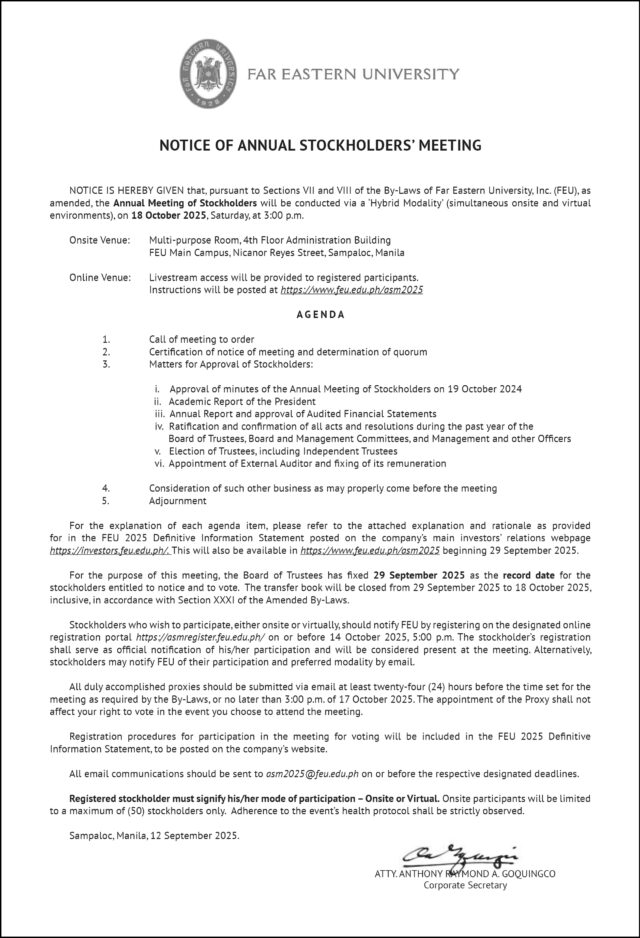
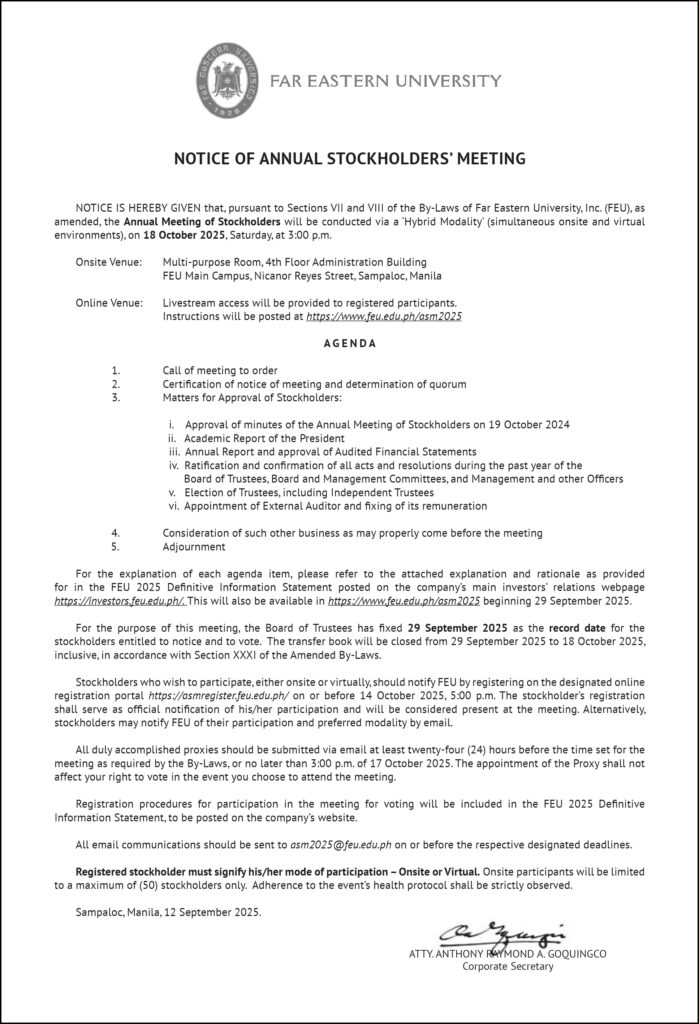
Far Eastern University, Inc. (FEU) to conduct 2025 Annual Meeting of Stockholders via a hybrid modality on Oct. 18


Spotlight is BusinessWorld’s sponsored section that allows advertisers to amplify their brand and connect with BusinessWorld’s audience by publishing their stories on the BusinessWorld Web site. For more information, send an email to online@bworldonline.com.

Join us on Viber at https://bit.ly/3hv6bLA to get more updates and subscribe to BusinessWorld’s titles and get exclusive content through www.bworld-x.com.

Ayala Land injects P2.7B into New World Hotel, Mandarin Oriental, and Arbor Lanes

NEW WORLD/PHILSTAR FILE PHOTO

LISTED property giant Ayala Land, Inc. (ALI) has disbursed over P2.7 billion raised from last year’s sale of 75 million shares in its real estate investment trust unit, AREIT, Inc., using the proceeds to fund hotel and residential developments.

The company disbursed P1.44 billion to New World Hotel, a five-star property in Makati City that ALI acquired in July, it said in a regulatory filing on Thursday.

About P699.21 million was allocated to Arbor Lanes, a five-tower mid-rise development under ALI’s luxury residential brand, Ayala Land Premier. The property is located within the 74-hectare ARCA South in Taguig City.

ALI also disbursed P559.42 million to the 276-room Mandarin Oriental. The project, located within Ayala Triangle Gardens in Makati City, is slated to open by 2026.

In September last year, the company raised P2.72 billion from the block sale of AREIT shares at P36.20 apiece under a placement agreement with UBS AG Singapore Branch and BPI Capital Corp.

Last month, ALI announced plans to launch P57 billion worth of property development projects in the second half of the year, covering the completion of upgrades to its malls and hotels.

Around two-thirds of the planned launches will be under the premium segment, while the remaining one-third will be part of the core segment, ALI President and Chief Executive Officer Anna Ma. Margarita Bautista-Dy said earlier.

ALI’s hospitality arm, Ayala Land Hospitality, also noted plans to invest $500 million (around P28.63 billion) over the next five years to increase its room capacity to 8,000.

The company recorded an 8% increase in first-half net income to P14.2 billion, while its property development revenue rose slightly by 0.77% to P52.3 billion, driven by strong commercial and industrial lot sales and bookings in its premium residential segment.

At the local bourse on Thursday, ALI shares declined by 2.26% or 60 centavos to close at P26 apiece, while AREIT were up by 0.23%, or 10 centavos, to close at P43.45 each. — Beatriz Marie D. Cruz

SC: Banks liable for moral damages due to negligence

PHOTO BY MIKE GONZALEZ

BANKS may be held liable for moral damages arising from negligence, even without proof of bad faith or malice, the Supreme Court (SC) has ruled.

In a decision written by Associate Justice Samuel H. Gaerlan, the SC’s Third Division ordered Banco de Oro (BDO) to pay depositors Remedios and Angelita Antonino the proceeds of their time deposits, along with P100,000 in moral damages.

The Antoninos, US green card holders residing abroad, had placed more than $150,000 in three-time deposits with BDO’s San Lorenzo branch. The funds, stored in a Banco Filipino deposit box, were not released after the branch closed without notice.

BDO claimed the deposits had been withdrawn through a draft allegedly signed by one of the depositors. However, handwriting experts and immigration records confirmed that the depositor was abroad at the time.

Both the lower court and Court of Appeals ruled in favor of the Antoninos. The SC affirmed these rulings, stressing banks’ obligation to exercise “very high diligence” in safeguarding deposits.

The tribunal said moral damages for mental anguish and anxiety may be awarded when negligence is proven, citing BDO’s failure to verify the identity of the withdrawer and to produce key documents despite the significant amount involved. — Erika Mae P. Sinaking

Both hunger and obesity stalk our children

STOCK PHOTO | Image by imdadul hussain from Unsplash

By Dinesh Arora and Nina Badgaiyan

FOR THE FIRST TIME in history, childhood obesity worldwide has overtaken the problem of being undernourished.

Among older children and adolescents aged five to 19, overweight and obesity more than doubled between 2000 and 2022, rising from 194 million to 391 million. Low- and middle-income countries now account for more than 80% of these cases.

In Asia and the Pacific, nearly one in 10 children remains underweight even as obesity rates are climbing in East and Southeast Asia, showing how undernutrition and obesity increasingly coexist within the same region.

Food environments are central to this crisis. The number of people consuming fast food and sugary drinks nearly equals those consuming the five recommended food groups, according to the 2024 International Food Policy Research Institute report.

Weak food safety systems add further risks, with unsafe food causing 600 million illnesses and 420,000 deaths every year — many of them children. Marketing of unhealthy products is pervasive: children in some countries see more than 100 online ads for sugary snacks and drinks each week.

A global UNICEF poll of young people found that three out of four had seen such ads in the previous week, and most said these increased their desire to consume the products.

The costs are immense. Malnutrition in all its forms — including undernutrition, micronutrient deficiencies, and obesity — can cut GDP by up to 3% annually. At the household level, obesity drives medical costs for diabetes and heart disease, while undernutrition continues to rob children of growth, learning, and opportunity.

The double burden of malnutrition is not inevitable.

Solutions exist, but they require bold choices. Nutrition guidelines from the World Health Organization and UNICEF stress food diversity and reduced consumption of ultra-processed foods. Yet these diets remain unaffordable for many households, as government subsidies still prioritize cereals over diverse nutrition. This policy paradox leaves families consuming what they can afford, not what is healthiest.

Governments and partners can act decisively to address the double burden of malnutrition by redesigning subsidy models — moving beyond cereal-heavy rations to diversified food baskets, tailoring meals in public programs to local food cultures and nutrition needs.

They can also promote dietary literacy by mainstreaming nutrition guidelines through schools, health centers, and community networks, while mobilizing self-help groups and frontline workers to improve household awareness.

Supporting local food systems is another step, leveraging indigenous crops such as pulses and millets, expanding nutrition-sensitive agriculture, and strengthening logistics to make diverse fresh foods more affordable.

Regulation and food safety can be strengthened by enforcing clear labeling, mandating front-of-pack warnings on sugar, salt, and fat, eliminating harmful trans fats, and ensuring stricter food safety oversight.

Healthier school environments can be created by setting nutrition standards for meals, banning junk food sales, and integrating food literacy programs, as Mexico has done for over 34 million children.

Fiscal measures can be implemented to tax sugary drinks and ultra-processed foods while subsidizing healthy staples. Mexico’s soda tax decreased purchases by 10% in two years, with the strongest impact among low-income households.

Policy should also be safeguarded from industry interference by adopting conflict-of-interest safeguards to ensure public health remains the priority.

Governments and partners can measure what matters by tracking dietary diversity, marketing exposure, and nutrition outcomes to hold systems accountable and inform evidence-based reforms.

The double burden of malnutrition is not inevitable. It is the result of policy choices and weak regulation. With stronger food safety systems, smarter fiscal tools, and regulation that prioritizes health over profit, countries across Asia and the Pacific can reshape food environments to nurture healthier generations.

The stakes are high, but decisive action today can yield lasting returns in education, productivity, and sustainable development.

The views expressed are those of the authors and do not necessarily reflect the views of the Asian Development Bank, its management, its Board of Directors, or its members.


Dinesh Arora is a principal health specialist at ADB’s Sectors Department. Nina Badgaiyan is a senior consultant on Public Health at ADB.

One Battle After Another: this insane movie about leftwing radicals and rightwing institutions is a powerful exploration of US today

Movie Review
One Battle After Another
Directed by Paul Thomas Anderson
MTRCB Rating: R-16

THE recent death of Robert Redford was a reminder of just how much All the President’s Men unsettled old certainties about American democracy. An exposé of the Watergate scandal of 1972 (when members of the campaign to re-elect Richard Nixon were caught planting secret recording devices at the Democratic National Committee’s Watergate building), Alan J. Pakula’s film fed into an increasing sense that the institutions of American governance were riddled with corruption.

Maybe not everyone agreed with Pakula’s dark vision. But he was not alone. Over the years since, Oliver Stone could also be relied on to make state-of-the-nation cinema, as could Martin Scorsese — or before them, Frank Capra. Such films attempted to capture, usually to critique, the national mood at that moment in time.

Paul Thomas Anderson’s new film, One Battle After Another, suggests that there is still a place for challenging filmmaking in today’s culture. Along with the recently released Eddington by director Ari Aster, these new state-of-the-nation films explore an America that is in crisis and throw it in our faces in staggering, epic narratives.

Both films speak to the chaos of a social order that is falling apart. Both, but particularly Eddington, also threaten to be so overwhelmed by this chaos that they end up by falling into incoherence.

The term, “incoherence,” is not chosen at random. One of the seminal texts for film scholars of the 1980s was Robin Wood’s The Incoherent Text, Narrative in the ’70s. Looking back at a series of films from this decade, Wood argued that “here, incoherence is no longer hidden and esoteric: the films seem to crack open before our eyes.” These two films do much the same, exposing through chaos something incomprehensible about our times and falling into incoherence in the process.

Set during the pandemic in a desert town, Eddington hurls itself from one flashpoint to the next. The sheriff, Joe Cross (Joaquin Phoenix) refuses to wear a mask and this apparently minor infraction soon pits him against his old enemy and competitor in love, Mayor Ted Garcia (Pedro Pascal). Borrowing from MAGA-style campaigning, Cross enters the election as candidate for new mayor.

At home, Cross is living with his conspiracy theory-loving mother-in-law, Dawn (Deirdre O’Connell). His wife Louise (Emma Stone) is retreating further into mental illness and isolation.

On the edges of this, a mysterious conglomerate is building a data center just outside of town. Race riots are also breaking out following the George Floyd killing. But there is much more to come.

Director Ari Aster could hardly have dreamed up more issues than he does here. With so much weight piling onto the narrative, Eddington concludes with an extended shoot-out that tips an already over-extended film into terminal disarray.

One Battle After Another, like Eddington, is a truly American film. Where Aster shot his neo-western in classic Panavision, Anderson goes one further, following The Brutalist in creating a VistaVision print, a format that is best experienced on a 70 mm screen. These formats hark back to Hollywood’s grandiose epics of the 1950s, adding to the films’ evocation of history — both filmic and social.

A further historical layering is Anderson’s source material for One Battle, Thomas Pynchon’s Vineland. Anderson updates Vineland’s kaleidoscopic exhumation of the revolutionary movements of the ’60s by casting his ageing hippie hero, now called Bob (Leonardo di Caprio), as a relic of a fictional noughties brigade, the French 75. Led by his lover Perfidia Beverley Hills (Teyana Taylor), they robbed banks, bombed buildings, and liberated detention centers in the name of their ideology of “free borders, free choices, free from fear.”

Left to bring up their daughter, Willa (Chase Infiniti) as a single parent, Bob spends his days off-grid unshaven, smoking weed, and watching the classic political drama, The Battle of Algiers. All is (somewhat) well until the brutal army veteran, Colonel Lockjaw (Sean Penn), who believes himself to be Willa’s real father, barrels back into their lives in pursuit of his “daughter.”

In common with Eddington, One Battle is at heart a family melodrama. It draws on the classic tropes of bad versus good father and conflicted mother, questioning the legitimacy of the family unit. On to these narratives bones, Anderson grafts a vision of a post-Obama America in thrall to shadowy corporate interests, a legacy of rounding up and deporting immigrants, and an old white male order hell-bent on its own agenda of personal revenge.

Robin Wood concluded his thoughts on American cinema of the ’70s with the prognosis that in their incoherence they pointed to one inescapable solution: the logical necessity for radicalism.

Aster and Anderson have looked radicalism in the eye and dismissed it as yet another failed ideology. Neither names the forces behind their vision of the end of American democracy and, to be fair, the current political crisis postdates both films’ completion in early 2024.

Where Aster sees only bloodshed and impotence, Anderson clings on to a fragile utopianism that in the present day is as unlikely as it is consoling. After the lights have gone up, it may well be that what his film leaves behind is its terrifying imagery of detention centers and the horror of immigrant round-ups. It is this certainly that led Steven Spielberg to acclaim “this insane movie” as more relevant than Anderson could ever have imagined.


Ruth Barton is a professor in Film Studies, Trinity College Dublin.

Credentials track addresses upskilling needs

ONLINE LEARNING platform Coursera said its new Skills Track program is designed to help provide credentials to workers that will be instrumental in building their careers.

“Companies are deploying new technology faster than their people can keep pace, and they need learning solutions that are adaptive and personalized,” Coursera Chief Executive Officer Greg Hart said in a statement.

Skills Track offers credential-earning courses where student progress is assessed by industry experts from Microsoft and Amazon Web Services as well as academics from Yale and Stanford.

“Learners make progress toward credentials based on real-world assessments, providing motivation and proof that skills are not only learned but also demonstrated,” Coursera said.

The Future of Jobs Report 2025 by the World Economic Forum (WEF) found that around 68% of Philippine employers identified skills gaps as the biggest barrier to business transformation.

The report added that Philippine employers expect nearly three in 10 workers to be upskilled and redeployed to new roles.

By 2030, the WEF expects the most in-demand skills globally will include AI and big data, networks and cybersecurity, technological literacy, creative thinking, resilience, flexibility and agility, and curiosity and lifelong learning.

The four Skills Tracks offered by Coursera are Software and Product, IT, Data, and GenAI.

“Each Skills Track offers a structured learning experience that clearly defines the critical skills and courses employees need at each role and experience level,” it said.

“The solution integrates expert content, hands-on practice, and skills verification, enabling employees to apply new skills immediately and drive measurable business outcomes faster,” it added.

Coursera plans to roll out additional Skill Tracks and enhanced features in the coming months, including skill diagnostics to guide learners at the appropriate level and verified skills paths with performance-based evaluations to provide credentials that reflect practical, job-ready expertise.

“It’s a major step towards helping learners master the right skills to grow their careers,” Mr. Hart said. — Almira Louise S. Martinez

DoTr reviews LRMC proposal to finish Unified Grand Central Station

DEPARTMENT OF TRANSPORTATION

THE UNSOLICITED proposal of Light Rail Manila Corp. (LRMC) to complete the terminated contract for the construction of the Unified Grand Central Station at North Avenue-EDSA, Quezon City, is now under review, the Department of Transportation (DoTr) said, noting that it hopes to award the contract by the end of the year.

“We have received LRMC’s proposal. We are currently reviewing it, then we will process it, and our target is by the end of the year to agree with them on how they could help us in finishing the common station,” Transportation Undersecretary for Railways Timothy John R. Batan told reporters on the sidelines of the Arangkada Investment Forum 2025 on Thursday.

LRMC is the operator of Light Rail Transit Line 1 (LRT-1).

In May, the DoTr issued a notice of termination to the contractors of the Unified Grand Central Station, also known as the common station for the Metro Rail Transit (MRT) and Light Rail Transit (LRT) lines and the Metro Manila Subway.

The contractors — BF Corp. and Foresight Development and Surveying Co. (BFC-FDSC) — were terminated due to excessive delays, the DoTr said.

The DoTr is now evaluating the cost of the common station, Mr. Batan said, adding that since the project is under a public-private partnership (PPP), reasonable investment recovery would be part of the contract agreement.

“Again, since it is a PPP, there will be reasonable investment recovery,” he said.

Mr. Batan declined to disclose the value of LRMC’s proposal, noting that it would be premature to reveal details while the project is still under evaluation and approval.

“But our next step, once we have clarified it, is to submit it to DEPDev (Department of Economy, Planning, and Development). Once we have gotten approval, then we will find out what the cost will be,” he said.

The BFC-FDSC consortium signed a P2.8-billion agreement with the government in 2019 for the construction of Area A of the Unified Grand Central Station project.

The project aims to link Metro Manila’s main commuter rail lines, including LRT-1, MRT-3, MRT-7, and eventually the Metro Manila Subway.

It was initially targeted for completion in the first quarter of 2021 and was designed to have three sections, each built separately: Area A by BFC-FDSC, Area B by Ayala Corp., and Area C by San Miguel Corp., the concessionaire for the MRT-7 project. 

LRMC is a joint venture of Ayala Corp., Metro Pacific Light Rail Corp., and Macquarie Infrastructure Holdings (Philippines) Pte Ltd. Metro Pacific Light Rail is a unit of Metro Pacific Investments Corp., one of three Philippine subsidiaries of Hong Kong’s First Pacific Co. Ltd., the others being PLDT Inc. and Philex Mining Corp.

Hastings Holdings, Inc., a unit of PLDT Beneficial Trust Fund subsidiary MediaQuest Holdings, Inc., maintains interest in BusinessWorld through the Philippine Star Group, which it controls. — Ashley Erika O. Jose

IC sets 2-month window for PUV insurance accreditation

PHILIPPINE STAR/MIGUEL DE GUZMAN

THE INSURANCE COMMISSION (IC) said it would accept applications for accreditation under the passenger personal accident insurance (PPAI) program for public utility vehicles (PUV) only from Oct. 1 to Nov. 30.

“Thereafter, no applications shall be given due course,” the regulator said in a circular dated Sept. 24.

The IC added that accreditations would be valid for five years, with no additional approvals to be granted during that period.

Earlier this month, the regulator updated the PPAI framework, raising the required claim fund for insurance pools to at least P50 million, based on risk profiles and coverage data.

Claims not settled within five working days without valid justification will also be subject to 12% annual interest, computed from the sixth working day until payment.

Other revisions include mandatory use of the standard PPAI policy form with an “all risk, no fault” clause, and a requirement for management companies to submit quarterly claim processing reports.

Latest IC data showed the nonlife insurance sector’s gross premiums written rose by 9.92% to P65.6 billion in the first half from a year earlier, while net income inched up 2.71% to P5.12 billion. — Aaron Michael C. Sy

Beyond collection: Reforming tax systems for inclusive growth in ASEAN+3

STOCK PHOTO | Image by Vectorjuice from Freepik

By Yasuto Watanabe and Seung Hyun (Luke) Hong

ACROSS the ASEAN+3 region (comprising 10 members of the ASEAN and China; Hong Kong, China; Japan; and Korea), governments are facing mounting pressure to raise revenue. Even before the COVID-19 pandemic, many economies were seeing tax-to-GDP ratios drift downward. Since then, revenue collection has struggled to keep pace with post-pandemic recovery, while public spending needs have only grown. Aging populations, climate adaptation, infrastructure financing, and social investment are placing ever greater demands on national budgets. The central question now is: how can policymakers strengthen and adapt revenue systems to meet growing needs and safeguard fiscal stability?

The situation is not without hope. There is still significant room to broaden tax bases, modernize collection systems, and improve fairness and efficiency. Doing so would not only create fiscal space to meet rising demands but also strengthen trust in public institutions. This moment offers a window for reform — one where decisive action can secure long-term fiscal sustainability and more inclusive growth.

DIVERGING TRENDS ACROSS THE REGION
A closer look at the data reveals diverse trajectories over the past decade. Indonesia, Malaysia, and Singapore saw tax-to-GDP ratios fall and then rebound, while Thailand and Vietnam experienced a longer decline before stabilizing more recently. Cambodia and the Philippines gradually increased revenues, though momentum has eased recently. Among the Plus-3 economies, China’s ratio declined gradually, Japan’s rose steadily until FY2022 before dipping, and Korea’s has remained largely stable, with a brief peak in FY2022 followed by a recent decline.

These diverging patterns reflect the complexity of fiscal landscape shaped by varying structural conditions, economic structure, and political pressures. But the consequences are clear: elevated debt and shrinking fiscal space, even as demands for pensions, healthcare, climate adaptation, and digital infrastructure continue to grow. In some economies, dependence on commodities or a narrow set of industries adds another layer of risk. At a deeper level, weak tax systems can erode public trust and undermine the state’s capacity to deliver on development goals.

STRUCTURAL AND CYCLICAL CHALLENGES
The drivers of declining revenue performance in ASEAN+3 economies — are both cyclical and structural. These forces interact in complex ways and are often highly country specific, shaped by differences in institutional capacity, tax system design, and economic structure.

Structural weaknesses continue to limit revenue potential and tend to amplify cyclical shocks. Widespread tax incentives, exemptions, and misaligned tax structures constraint expansion of tax bases. High informality in employment and business operations also keeps large parts of the economy outside the tax net, while the rapid rise of digital platform-based work has further complicated tax administration. A weak tax compliance culture and administrative constraints — such as limited digital infrastructure, under-resourced enforcement, and inadequate taxpayer registries — often become obstacles to reform efforts. Expanding regional trade and investment flows add further challenges, particularly cross-border leakages from transfer pricing and profit shifting.

Cyclical shocks, particularly the pandemic, compounded these issues. Output shrank, tax bases narrowed, and governments introduced wide-ranging emergency relief measures, such as deferred payments and temporary rate cuts and tax exemptions. Many of these temporary measures remain in place amid post-pandemic inflation. Lingering post-pandemic economic scarring, sluggish global trade, and commodity price swings continue to weigh on revenue collections. In economies with entrenched structural weaknesses, these cyclical pressures have slowed the pace of fiscal recovery.

Often, the two reinforce each other. Weak compliance systems hinder the withdrawal of exemptions, temporary reliefs evolve into long-term leakages, and incomplete taxpayer data hampers both audits and broader reform planning.

Faced with declining revenues, many ASEAN+3 economies are strengthening tax administration, while some are adjusting tax policies directly. Digitalization — through e-invoicing, e-filing, data-driven audits, and integrated national ID systems — is gaining traction, albeit unevenly. Several economies have raised consumption tax rates, broadened income tax bases, or begun scaling back inefficient incentives. These are encouraging steps, but they remain partial.

THE ROAD AHEAD
Meaningful domestic revenue reform requires more than technical fixes. Policymakers will need to rationalize tax incentives, strengthen administrative capacity, and bring informal sectors into the formal tax system. Digital tools must be scaled up, enforcement made more data-driven, and political capital must be spent on rebalancing the tax mix. As international tax rules evolve, the region must also avoid harmful tax competition and resolve implementation challenges.

Importantly, the magnitude and nature of tax challenges vary widely across ASEAN+3. Closing tax gaps will require tailored approaches that reflect not only the economic cycle but also institutional and structural realities in each economy.

Ultimately, domestic revenue mobilization is not just about increasing collections. It is about doing it better by establishing more efficient, equitable, and sustainable systems that enable a fair distribution of tax burden, build public trust, and secure long-term fiscal stability. Success will demand commitment at both national and regional levels. The task is urgent, but the opportunity is also clear: with the right reforms, ASEAN+3 can strengthen fiscal resilience and lay the foundation for more inclusive growth.


Yasuto Watanabe is director of the ASEAN+3 Macroeconomic Research Office (AMRO). Seung Hyun (Luke) Hong is group head and lead economist at AMRO.

Missouri woman sentenced for trying to steal Graceland from Elvis Presley’s family

Graceland Memphis Tennessee — COMMONS.WIKIMEDIA.ORG

A MISSOURI woman was sentenced to nearly five years in prison for scheming to defraud the family of singer Elvis Presley of millions of dollars and steal their ownership interest in Mr. Presley’s iconic Graceland estate, the Department of Justice said on Wednesday.

The department said in a written statement that US District Court Judge John Fowlkes in Memphis sentenced Lisa Jeanine Findley, 54, to four years and nine months in federal prison on Tuesday. Ms. Findley, who had faced up to 20 years in prison, pleaded guilty to mail fraud in February.

Ms. Findley organized a scheme to conduct a fraudulent sale of Graceland — Mr. Presley’s former home which was opened to the public in 1982 and is designated as a National Historic Landmark — by falsely claiming Mr. Presley’s daughter, Lisa Marie, had pledged the estate as collateral for a non-existent $3.8-million loan that she failed to repay before her death in 2023, the department has said.

Elvis Presley died in 1977 at the age of 42 and is buried on the grounds of Graceland.

Ms. Findley, who used a fake company, forged documents, and false court filings to carry out the scheme, threatened to foreclose the property and auction it to the highest bidder if the Presley family did not pay the claim against the estate, according to the department.

Lisa Marie’s daughter, Riley Keough, who inherited the estate after her mother’s death, sued Naussany Investments, the company Ms. Findley used in her attempt to auction Graceland, saying her mother had never taken out the loan and that Naussany was engaged in fraud.

The sale was blocked by a judge, which led Naussany last May to withdraw all claims to the property, a popular tourist attraction that draws more than 600,000 visitors a year. — Reuters

Inspiring workers to volunteer outside of work

I’m the human resources (HR) manager of a medium-sized enterprise. My boss gave me the task of organizing and managing a new volunteer program for employees. How do I start it right? — Doctor Why.

Convincing employees to participate in weekend activities such as tree planting, feeding programs, or community clean-ups can be challenging. After all, weekends are sacred for many people.

That’s when people recharge with their family and relatives. Even unmarried workers spend their Saturdays and Sundays dating or pursuing hobbies.

With the right approach, volunteering can be enjoyable for employees as activities can foster camaraderie, instill a sense of purpose, and make them proud of their workplace.

Here’s how you can start. But first, ensure that your volunteer program encourages real volunteerism without compulsion. Don’t make them feel like they have no choice but to follow.

BEST PRACTICES
Here are certain best practices that you could emulate:

One, align with the company’s mission, vision, and values. Know the specific values that your organization can use to promote volunteer activities. This means practical application. If you’re in food manufacturing, it’s best to create activities that support hunger relief. However, it doesn’t mean giving away food nearing its expiry date.

Two, consult workers about their interests. You can start with workers belonging to an interest club. From there, you can create a committee composed of experienced volunteers. They can help you create programs and policies close to their interests. If necessary, conduct a survey to determine where to focus your activities.

Three, recognize and celebrate contributions. Acknowledge employees who spend personal time volunteering. Recognition can come via bulletin boards, newsletters, social media, or awards. Write brief articles featuring “volunteer champions” and their success stories. Focus on how they benefited from those programs.

Four, management must lead by example. Invite middle managers and top executives to roll up their sleeves. They can lead in planting saplings or serving food at shelters in evacuation centers. Imagine the value of seeing the CEO holding a shovel in muddy jeans. Employees will notice and should be proud of working for such managers.

Five, connect with the general interest of the workers. They don’t volunteer just because they’re told to. They show up because they believe their efforts matter. Your company must go beyond the logistical requirements. Emphasize why you have to be in a particular spot early in the morning. Share how planting 2,000 saplings can restore a watershed, or how one feeding program nourishes children who might otherwise skip a meal.

Six, make the program entertaining. Humans are social creatures. If an activity feels like an outing with friends, participation skyrockets. Add simple twists: play upbeat music while tree planting, create a “before and after” photo wall for clean-up drives, or hold a lighthearted contest between departments.

Seven, offer schedule flexibility. Instead of a rigid weekend schedule, provide options where the workers can do volunteer work during weekdays, say for two hours per day, morning or afternoon. Some may prefer tutoring kids or help out with NGOs to joining the company’s flagship program.

Eight, recognize and celebrate milestones. Recognition is a powerful motivator. Celebrate volunteers publicly with the greatest number of trees planted. Feature their photos in company newsletters, post highlights on social media, or create a “Volunteer of the Month” board. Small gestures work wonders.

Nine, make it an integral part of the company culture. Over time, volunteer programs can be woven into the company’s DNA. You can also use it as an occasional PR stunt to reflect on organizational values. When employees see that their organization invests in communities, they begin to view volunteerism as part of what it means to work there.

Ten, start small and level up in time. Don’t expect 100% participation on your first attempt. Start with light, high-impact projects, like a one-hour community clean-up or food distribution. Once employees experience the positive energy, they’ll be more open to bigger commitments. Momentum builds trust.

PURE VOLUNTEERISM
Encouraging employees to volunteer isn’t about filling buses with reluctant workers every weekend. It’s about creating meaningful opportunities, making them enjoyable, and ensuring people feel proud of their impact.

When organizations, through their executives and line leaders, lead by example, connect activities to purpose, and recognize efforts sincerely, volunteering stops being a “weekend sacrifice” and starts becoming a privilege.

And that’s when the real magic happens: employees discover that serving others not only helps communities but also deepens their sense of belonging and pride in their work.


Ask questions and receive Rey Elbo’s insights for free. E-mail elbonomics@gmail.com or DM him on Facebook, LinkedIn, X, or via https://reyelbo.com. Anonymity is guaranteed.