
How PSEi member stocks performed — September 6, 2022

Here’s a quick glance at how PSEi stocks fared on Tuesday, September 6, 2022.


Here’s a quick glance at how PSEi stocks fared on Tuesday, September 6, 2022.
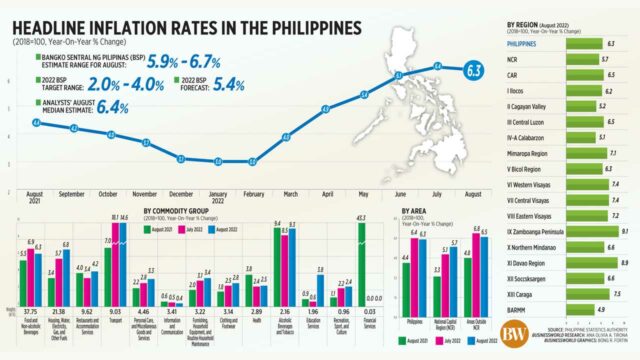
INFLATION eased to a two-month low of 6.3% in August, as the rise in food and transport costs slowed, the Philippine Statistics Authority (PSA) said on Tuesday. Read the full story.

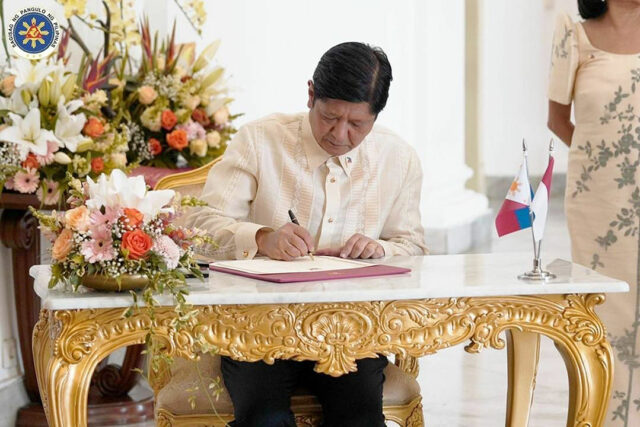
By Kyle Aristophere T. Atienza, Reporter
PHILIPPINE President Ferdinand R. Marcos, Jr. on Tuesday said he would consider a 2014 sea border deal with Indonesia to settle the country’s sea dispute with China.
The strategy used by the two countries to settle overlapping claims in the Mindanao and Celebes seas is “worthwhile to explore at the very least,” he told reporters in Jakarta, according to a transcript sent by the presidential palace.
“It is one instance that this kind of discussion, we came to a conclusion and we came to a resolution,” he said. “We should try it.”
The 2014 sea border agreement set the exclusive economic zone borders between the Philippines and Indonesia in the Mindanao and Celebes seas. The deal came after more than two decades of negotiations.
“Hopefully it works,” Mr. Marcos said. “If it doesn’t work, we’ll try something else. At least we have a beginning point.”
China has ignored a United Nations-backed arbitral award that voided its claim to more than 80% of the South China Sea, parts of which are claimed by the Philippines.
Mr. Marcos said the delimitation talks between the Philippines and Indonesia could also be used in settling sea disputes with other countries.
“That could be the template for delimitation talks on the continental shelf that we are undergoing now,” he said. “We can use it even if we are talking to others on the similar delimitation.”
“We should show it to the rest of ASEAN (Association of Southeast Asian Nations) as an example, that it is something that actually, it can be done.”
Ex-President Rodrigo R. Duterte, Mr. Marcos’ predecessor, and the Indonesian Parliament ratified the deal in 2017. The Philippine Senate concurred with the ratification in 2019.
The Philippines and Indonesia are both signatories to the 1982 UN-backed sea borders convention, which allows states to explore, exploit, conserve and manage natural resources within their exclusive economic zones.
Meanwhile, the Philippines and Indonesia renewed a deal that reaffirmed their commitment to a 1997 Defense Cooperation Agreement. The pace complements the 1975 border patrol and crossing agreements between the two countries.
In a statement, Philippine Defense officer-in-charge Jose C. Faustino, Jr. said the renewal would let the Philippines and Indonesia collaborate on shared concerns, particularly in the Southeast Asian region.
“The Philippines and Indonesia also work together with Malaysia to pursue trilateral cooperation in view of security challenges in maritime areas of common concern,” he said.
Mr. Faustino signed the pact with Indonesian Defense Minister Prabowo Subianto on Monday.
Mr. Marcos left Indonesia on Tuesday for his state visit to Singapore.
“Our economic cooperation with Singapore has grown by leaps and bounds for the past half-century, and more opportunities are just waiting to be tapped by both sides,” he said earlier
There are about 200,000 migrant Filipino workers in Singapore, 84,000 of whom are domestic workers, while the rest are professionals and skilled workers, according to the Department of Migrant Workers.
Singapore has become the Philippines’ top trading partner in the region and the top source of approved investments in 2021.
The Philippines should cooperate with Indonesia on the South China Sea dispute and boost economic activities in areas being claimed by China, political analysts said on Monday.
Mr. Marcos should look at Indonesia’s plan to set up a special economic zone in its key territory in the South China Sea that China claims, they added.
Indonesia is seeking to convert the Natuna Islands, also known as the Natuna Regency, into a special economic zone to boost maritime security while attracting investments there. Indonesia’s exclusive economic zone off the coast of Natuna slightly overlaps with China’s widely disputed South China Sea claim.
Indonesia wants to introduce incentives to boost tourism, fishing, energy and security sectors in the region. The plan came after Indonesian President Joko Widodo signed a decree dividing the Natuna Islands into different regulated zones including exploration, defense and fishing.
It seeks to counter China’s island-building activities at sea.
The South China Sea, a key global shipping route, is subject to overlapping territorial claims involving the Philippines, Indonesia, Brunei, Malaysia, Taiwan, Vietnam and China.
Mr. Duterte led a foreign policy pivot to China when he took office in 2016. He has been accused of gambling Philippine territories to appease China, which pledged P1.2 trillion in investments and loans to fund big-ticket infrastructure projects.
Critics said few have materialized.
Mr. Marcos, 64, took office in June amid tensions in the disputed waterway and naval competition for influence among Southeast Asian countries.
In his first address to Congress on July 25, he promised to protect Philippine territories though he did not name China as an aggressor. He neither sided with China nor the United States, saying the Philippines “shall continue to be a friend to all and an enemy to none.”
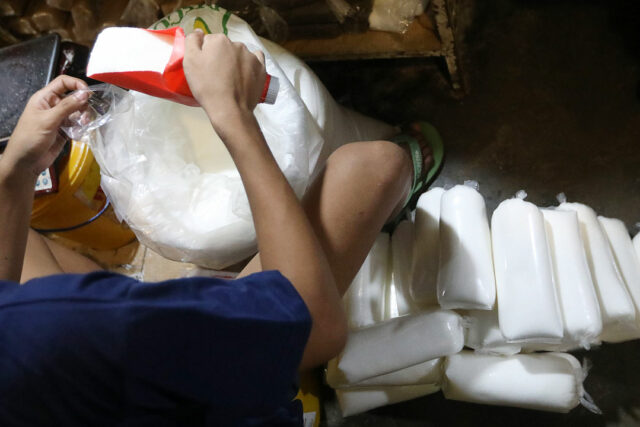
PRESIDENT Ferdinand R. Marcos, Jr. had proposed to import 600,000 metric tons (MT) of sugar amid rising prices and tight supply, according to the former chief of the Sugar Regulatory Administration (SRA).
“The president mentioned about a volume of 600,000 MT,” Hermenegildo R. Serafica, who resigned last month after signing an order to import 300,000 MT of sugar that the president later vetoed, told a Senate blue ribbon committee hearing on Tuesday.
Executive Secretary Victor D. Rodriguez denied the claim. “I categorically deny that there was an instruction from the president to even consider or to import 600,000 metric tons of sugar. There was no such pronouncement or order.”
Mr. Serafica, who said Mr. Marcos had suggested the amount at a “hybrid” meeting, told senators he disagreed with the proposal.
He claimed to have told the president on Aug. 4 that 600,000 MT was too much since cane delivery from farmers had started and milling was about to begin.
Former SRA board member Aurelio Gerardo J. Valderrama, Jr. affirmed Mr. Serafica’s claim about the Aug. 4 meeting, and that Mr. Marcos had mentioned the 600,000 MT of sugar.
“This was discussed in our Zoom meeting together with the president and he mentioned the 600,000 but former Administrator Mr. Serafica said that it might be too much because the milling season was about to open,” he told the hearing.
Senate President Juan Miguel F. Zubiri said he did not believe Mr. Serafica’s testimony. “The president does not even want 300,000 metric tons, what more if it was 600,000? I don’t believe the president had said that. Impossible,” he said in mixed English and Filipino.
“You’d better clarify [that], Mr. Serafica. You are very close to being cited in contempt,” he said at the hearing.
Mr. Rodriguez said the president never mentioned any amount. “The amount of 300,000 metric tons has been mentioned many times by the SRA board, and that is precisely why we were asking them to submit to us an import plan so they can justify why they are so fixated with 300,000 metric tons if importation.”
United Sugar Producers Federation President Manuel R. Lamata told senators Mr. Serafica was lying. “There is no truth to whatever he said. There is no shortage.”
He also said he never heard of the suggestion to import 600,000 MT of sugar.
Senator Aquilino Martin D. Pimentel III said there might have been inaccuracies in Mr. Serafica’s testimony, but “let us all remember as well that Mr. Valderrama confirms such a meeting.”
He said Mr. Rodriguez should not have ignored inquiries from the SRA about the import plan.
“I purposely did not respond because these are the matters that were still on the table of the acting secretary of the Department of Agriculture that we had yet to act upon and that he had yet to decide on.”
“It’s such a waste, reputations are damaged, it taints the start of the Marcos administration that there’s a fiasco like this,” Mr. Pimentel said. “Just a little improvement in the communication. You could have answered that we are not yet ready to give you approval, or wait for a while.”
Mr. Rodriguez wasn’t supposed to attend Tuesday’s hearing “per instructions of President Ferdinand R. Marcos, Jr.”
In an earlier letter to the blue ribbon committee, he promised to answer written inquiries about the sugar fiasco. On Tuesday morning, 14 of 17 members of the committee then voted to summon him to the hearing.
Mr. Rodriguez arrived at the Senate for questioning around noon and apologized. “I have no intention whatsoever to disrespect the honorable members of the Senate and the Senate as an institution.”
He noted that as soon as heard about the subpoena, he informed Mr. Marcos, who was on a state visit to Singapore, about it and sought his permission to go to the Senate.
The committee ended the investigation and agreed to issue a report before hearing to come up with one final report, approve it before the congressional break on Oct. 1. — A.N.O. Tan

THE PHILIPPINE government has sought executive clemency for Mary Jane Veloso, who has been on death row for more than a decade after she was arrested in 2010 for smuggling heroin into Indonesia, according to Malacañang.
Indonesian Foreign Minister Retno L. P. Marsudi would consult the Ministry of Justice on the matter, the Philippine Department of Foreign Affairs (DFA) said in a statement issued by the presidential palace.
It did not explain how Philippine Foreign Affairs Secretary Enrique A. Manalo made the appeal, but said the two envoys had met on the sidelines of President Ferdinand R. Marcos, Jr.’s state visit to Indonesia this week.
The Filipino overseas worker was sentenced to death in October 2010 and was granted a stay of execution in April 2015. Filipino lawyers claim Ms. Veloso, who was caught smuggling 2.6 kilos of heroin hidden in the lining of a suitcase, was a victim of human trafficking.
“DFA said that the Philippine Embassy in Jakarta had retained the services of an Indonesian law firm to serve as a legal counsel for Veloso in accordance with Indonesian laws and procedures,” the palace said.
Ms. Veloso has maintained her innocence throughout, saying she had been an unwitting drug mule for a Filipina recruiter who had promised her a job and gave her $500, some new clothes and the black suitcase.
Ms. Veloso was in good health at the Wonosari Women’s Penitentiary in Yogyakarta, the palace said, citing DFA.
Mr. Marcos left Indonesia on Tuesday and headed to Singapore, whose court in 1991 convicted Filipino domestic worker Flor R. Contemplacion of killing the three-year-old son of her employer.
Experts and civic leaders have said the evidence against her was not strong. She was hanged at dawn on March 17, 1995 at the Changi Women’s Prison and Drug Rehabilitation Centre despite a plea for clemency to the Singaporean government from the late Philippine President Fidel V. Ramos. — Kyle Aristophere T. Atienza

GOVERNMENT prosecutors have dismissed a cyber-libel complaint against several congressmen who had accused police of planting evidence and labeling some people communists.
The Department of Justice (DoJ) junked the complaint against Party-list Reps. Arlene D. Brosas and former Party-list Rep. Carlos Isagani T. Zarate, according to a copy of a six-page resolution sent to reporters on Tuesday.
Also cleared were Gabriela Spokesperson Luzviminda Calolot-Ilaga and former Party-list Rep. Liza L. Maza.
Prosecutors dismissed for lack of merit the complaint filed by the Philippine National Police Criminal Investigation and Detection Group (PNP-CIDG).
The complaint stemmed from statements made by the lawmakers published in 2015 on several news websites accusing law enforcers of red-tagging and planting evidence during a police operation that year.
Prosecutors said the lawmakers could not be held liable for cyber-libel since they were not the authors or creators of the allegedly libelous posts and were only being interviewed for their comments on the police operation.
“This demonstrates the absence of participation in the publication or showing lack of probable cause to indict the respondents for the offense charged,” state prosecutors Bryan Jacinto S. Cacha and Moises Y. Acayan said in the order.
The PNP-CIDG claimed the officials’ statements were false and were meant to damage police reputation.
Mr. Zarate said the lawsuit was just another form of harassment against government critics. “The police are wasting taxpayers’ money in filing trumped-up and frivolous cases against the opposition and those critical of the government,” he said in a statement in mixed English and Filipino.
Last month, the Justice department charged 16 members of the Rural Missionaries of the Philippines (RMP) of financing the activities of the Communist Party of the Philippines (CPP) and its armed wing, the New People’s Army (NPA).
The country’s Anti-Terrorism Council has labeled the communist party a terrorist group.
In June, Solicitor General and former Justice Secretary Menardo I. Guevarra said the country’s communist task force should file complaints rather than label people as communists. — J.V.D. Ordoñez
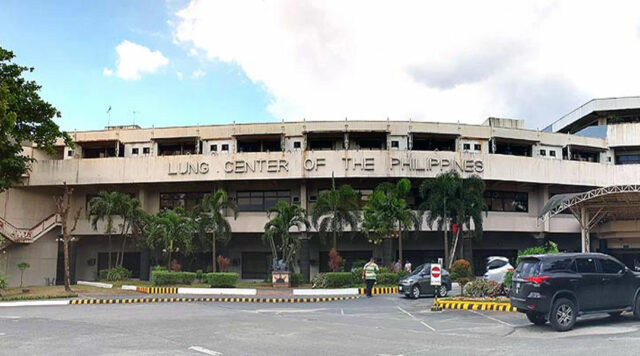
A CONGRESSMAN on Tuesday said he would push to restore the 2023 budgets of at least four hospitals in the capital region after these were cut.
The budgetary subsidies for Lung Center of the Philippines, Philippine Heart Center (PHC), National Kidney and Transplant Institute and Philippine Children’s Medical Center will be restored as Congress did in the past, Batangas Rep. Ralph G. Recto said in a statement.
Lung Center has a proposed budgetary subsidy of P630.2 million for the 2023, 7.87% lower than this year, while the Heart Center’s budget was cut to P1.76 billion from P1.88 billion.
The Kidney Institute’s budget also fell by 23% to P1.15 billion, while the Children’s Medical Center’s budget was cut by P344 million.
The four hospitals must be spared the budget cuts because they provide basic services, Mr. Recto said.
“The Philippine Heart Center is an indispensable national necessity,” he said. “It is a referral hospital,” he added, noting that the Philippine General Hospital and Heart Center are the last resort for someone who needs to vulcanize a vein in the heart.
President Ferdinand R. Marcos, Jr. in his first state of the nation address to Congress on July 25 said the four hospitals are worthy of replication in regional centers.
Mr. Recto said the budgeting philosophy of frontline hospitals should be followed and these hospitals must be safe from cuts.
Party-list Rep. France L. Castro also expressed concern about the budget cuts in crucial programs of the Department of Health (DoH).
She cited cuts in the budgets for epidemiology and surveillance, health regulation, public health and health emergency management.
“These programs of the DoH are crucial programs that should be strengthened and should be readily accessible to the public,” she said in a separate statement.
Meanwhile, the Department of Social Welfare and Development (DSWD) sought a budget increase for pensions of poor senior citizens, centenarians and the supplementary feeding program. The agency’s proposed budget for 2023 is P197 billion, 3.8% lower than this year.
DSWD sought P25.77 billion more for senior citizens’ stipends. It also requested P66.20 million more to cover pensions of 662 eligible waitlisted centenarians.
Nueva Ecija Rep. Rosanna V. Vergara said the agency should choose what to prioritize given limited funding.
Social Welfare Secretary Erwin T. Tulfo said funding for these pensions should be prioritized. — Kyanna Angela Bulan

THE DEPARTMENT of Trade and Industry (DTI) on Tuesday said it had inspected two supermarkets and two bookstores in Caloocan City as part of efforts to monitor compliance with suggested retail prices (SRP) for basic goods, including school supplies.
In a statement, DTI said its Fair Trade Enforcement Bureau visited the four stores on Aug. 19, with one store getting a letter of inquiry for a school supply item that was priced higher than SRP.
“The store has to submit a written explanation within 72 hours from receipt of the letter,” it said.
One of the supermarkets did not carry any of the 16 stock keeping units of canned sardines included in the SRP bulletin, while the inspection deemed that all brands complied with suggested retail prices.
“Even if the noncompliant firms expressed their commitment to comply, they will still be issued a letter of inquiry,” Trade Assistant Secretary Ann Claire C. Cabochan said in the statement.
The DTI issued separate SRP bulletins for basic goods and school supplies on Aug. 12 to protect consumers from unscrupulous sellers. — Revin Mikhael D. Ochave
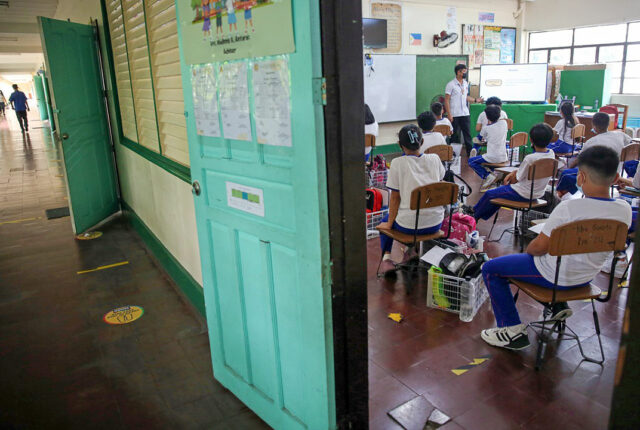
THE DEPARTMENT of Interior and Local Government (DILG) on Tuesday said it favors a proposal to increase the annual real property tax by 1 percentage point to cover a special fund for education, with reservations.
The special education fund given to public schools should be used to improve learning quality, such as building school infrastructure and buying books, instead of uniforms and bags, DILG representative and lawyer Keith B. Mengullo told a House of Representatives hearing.
She said school uniforms and accessories such as bags and shoes are unlikely to improve the quality of education, adding that more important items should be prioritized.
Ms. Mengullo said the agency had supported a similar bill in the past Congress.
Several bills have been filed seeking to expand the coverage of the special education fund. One of the measures, House Bill 558, also increases the real property tax imposed by local government to 2%.
The Local Government of Code of 1991 mandates an additional 1% tax on real property collected by local governments that goes to public schools.
The law limits the allocation to the operation, maintenance, construction and repair of these schools, as well as the purchase of books and sports development.
Ms. Mengullo said Congress should also review the provision on contractual employment for teaching staff. — Matthew Carl L. Montecillo

THE FISHING sector needs a bigger budget for fuel subsidies amid spiraling oil prices, according to a fishers’ group.
“No one is exempted from the oil price increases, so we are calling on the department to increase the budget for fuel assistance and other stimulus programs to boost agriculture and fisheries production,” Pamalakaya National Chairman Fernando L. Hicap said.
The Department of Agriculture (DA) proposed a P6.2-billion budget for the Bureau of Fisheries and Aquatic Resources, an attached agency. Its fuel assistance budget for fishermen is P489.6 million. — Luisa Maria Jacinta C. Jocson
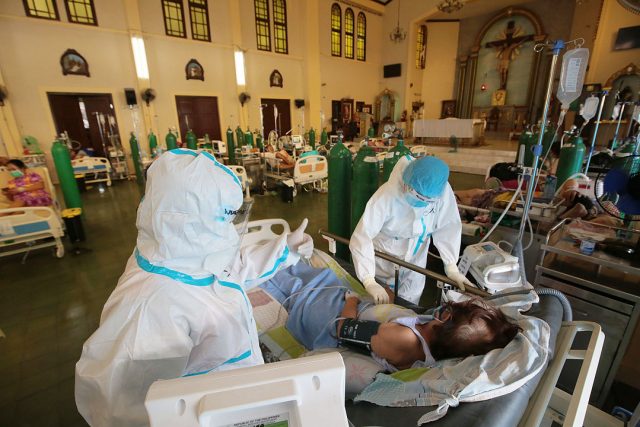
FILIPINO health workers on Tuesday stormed the Department of Health headquarters in Manila to demand their unpaid allowances related to the coronavirus pandemic.
They slammed the government for allegedly failing to allot enough funds for healthcare.
The benefits include two allowance packages, one of which was expected to be released from January to June this year, the Alliance of Health Workers (AHW) said in a statement.
The state had yet to fully pay workers their coronavirus allowance for January to June, as well as their retroactive emergency allowance for July to December last year, Sally Ejes, acting president of the Philippine Heart Center Employees Association-AHW, said in the statement.
The health workers hit the Budget and Health departments for the delay.
The Budget department last week said the release of the P63-billion coronavirus allowance was awaiting documentary requirements that should be prepared by the Health department. In February, it released P7.92 billion to the DoH for the allowance.
Overworked and underpaid nurses and other health workers threatened to quit their jobs amid a major breakdown of the country’s healthcare system last year as coronavirus infections surged.
“Two years of pandemic and yet nothing has changed with regard to our appalling condition,” alliance President Robert T. Mendoza said in the same statement. “The benefits are always delayed and not provided, the salary remains low and far from the living wage we desire.” — Kyle Aristophere T. Atienza

THE PESO slipped to a new record low versus the dollar on Tuesday on renewed global inflation concerns after petroleum exporting countries said they would cut oil production.
The local unit closed at a fresh all-time low of P57 per dollar on Tuesday, inching down by less than a centavo from its P56.999 finish on Monday, Bankers Association of the Philippines data showed. Year to date, the peso has weakened by 11.76% or P6 from its P51-per-dollar close on Dec. 31, 2021.
The local unit opened Tuesday’s trading session at P56.888 against the dollar. The peso’s weakest showing was its close of P57, while the intraday best was at P56.86 against the greenback.
Dollars exchanged declined to $812.19 million on Tuesday from $976.45 million on Monday.
“The peso settled at the P57 level today amid renewed global inflation concerns after the OPEC+ (Organization of Petroleum Exporting Countries and allies led by Russia) decided to reduce its daily production target by 100,000 barrels this month,” a trader said in an e-mail.
OPEC+ said the cut will help boost prices that have slid on expectations of a global economic slowdown.
Benchmark Brent crude oil has dropped to about $95 a barrel from $120 in June on fears of an economic slowdown and recession in the United States.
On Tuesday, Brent crude futures fell 0.7% to $95.07 a barrel. US crude futures, however, were still up 2.12% at $88.71 a barrel.
Meanwhile, Rizal Commercial Banking Corp. Chief Economist Michael L. Ricafort said in a Viber message that the peso moved sideways on Tuesday after the slower-than-expected inflation rate in August.
Headline inflation slowed to 6.3% in August from the near four-year high of 6.4% seen in July, the Philippine Statistics Authority (PSA) reported on Tuesday.
While the result was within the Bangko Sentral ng Pilipinas’ (BSP) 5.9-6.7% forecast for the month and below the 6.4% median estimate in a BusinessWorld poll of analysts, it was the fifth consecutive month inflation went beyond the central bank’s 2-4% target. It was also faster than the 4.4% headline print logged in August 2021.
Month on month, inflation picked up by 0.4%.
For the first eight months, inflation averaged 4.9%, faster than 4% in the same period a year prior but below the BSP’s 5.4% forecast for 2022.
The peso was also mostly steady following the latest rollback in local fuel pump prices, Mr. Ricafort added. Petroleum firms announced a P1.55 per liter price decrease for diesel and P2.60 per liter on gasoline following a big-time price hike last week.
For Wednesday, the trader said the peso may rebound ahead of a potentially weaker US non-manufacturing report.
The trader expects the peso to move between P56.90 and P57.10 against the dollar, while Mr. Ricafort gave a forecast range of P56.85 to P57.05. — K.B. Ta-asan
