Home Blog Page 5918

Investors mull ICTSI unit, Pampanga firm logistics venture

SHARES in Razon-led International Container Terminal Services, Inc. (ICTSI) moved sideways last week as investors assessed its subsidiary’s partnership agreement with Pampanga-based Prime Alta Holdings, Inc. to form a freight forwarding and logistics business.

Data from the Philippine Stock Exchange (PSE) showed ICTSI ranking seventh in value turnover with P816.76 million worth of 4.48 million shares having exchanged hands on the trading floor from Sept. 5 to 9.

ICTSI shares closed at P184.30 apiece on Friday, inching up 0.7% from its Sept. 2 close. For the year, the stock has fallen by 5.5%.

“ICTSI moved sideways for the week as investors digested news on its newly formed joint venture with Prime Alta Holdings, Inc. and the sharp decline in Asia-US shipping rates,” RCBC Securities, Inc. Research Analyst Inzaghi Rafael D. Cabacungan said in an e-mail.

“The shipping rates went down because of slower global trade from lower demand for goods,” he added.

In a separate e-mail, IB Gimenez Research Securities, Inc. Research Head Joylin F. Telagen said ICTSI is consolidating at this price level that closed this week at P184.30 apiece.

“Investors are on the sidelines [last] week. However, this joint venture news will fundamentally improve the company’s bottom line over the long term. But I think traders are waiting for a technical breakout before buyback,” said Ms. Telagen.

For Mr. Cabacungan, the joint venture is beneficial for the port operator.

“We’re still waiting for further disclosures to assess the impact to the stock’s earnings,” he added.

Last week, the Enrique K. Razon, Jr.-led port operator saw developments that include ICTSI’s subsidiary, Abbotsford Holdings, Inc., signing a partnership deal with Prime Alta Holdings, Inc. to put up a freight forwarding and logistics business.

The joint venture is to be named Fortune Logistics Corp., which aims “to reduce costs and improve operational efficiency associated with the processing of cargo that are intended to be used by ICTSI for its various operations in the Philippines,” as said in a disclosure to the stock exchange.

Fortune Logistics will primarily operate, engage in and carry on the business of domestic and international ocean, air and land freight forwarding and logistics.

The two companies expect regulators to issue permits and licenses within one to two months after the signing of the shareholders’ agreement for the joint venture.

The deal has an initial capitalization of P25 million, where Abbotsford will invest an initial subscription of P12.75 million or owning 51%, while Prime Alta will invest P12.25 million, owning 49%.

ICTSI said that this joint venture will distribute a percentage of its available distributable cash flow and such dividends will be paid to the shareholders pro rata based on their respective shareholding.

Based on a report published in PortCalls, the Freightos Baltic Global Index, Asia-US East Coast prices decreased by 4% to $8,688 per forty-foot equivalent unit last week and were 61% lower compared with rates last year.

“This decrease reflects falling demand for freight, both because of excess inventories among some importers as inflation reduces spending among some consumers and others shift to other types of goods and services as the pandemic recedes, and because many retailers pulled peak season orders earlier in the year to avoid delays,” Freightos said.

ICTSI reported a 42.3% increase in its attributable net income to $152.200 million in the second quarter from $106.592 million in the same period in 2021.

This brought its attributable net income in the first half of the year to $294.475 million, up by 49.7% from the $196.662 million a year ago.

Likewise, gross revenues from port operations in the second quarter grew by 19.5% to $534.642 million from $447.037 million in the same period last year.

For the first half, port operations revenue went up by 20.4%, to $1.063 billion from $882.624 billion previously.

“With ICTSI’s impressive [first-half] performance from improved volumes due to loosening of COVID-19 restrictions and additional terminals, its first half earnings already account for 63% of our full year 2022 forecasts at P25.9 billion,” Mr. Cabacungan said.

“It may surpass our forecasts,” he said. “However, it may face headwinds as a possible recession in the US may cause a slowdown in global trades.”

ICTSI has a diverse portfolio of ports all around the world such as Europe, Middle East, Africa, Asia-Pacific, and America.

Ms. Telagen sees earnings for the third quarter reaching $155.62 million while $600-million net income attributable to equity holders of the parent for the entire year.

“At this point, with possible risk of stagflation and a few days before the Fed meeting this month, I think it’s better to stay on the sidelines and wait for technical breakout,” she said.

She noted for market players to trade and invest cautiously.

“While ICTSI continues to trade sideways near its 52-week low at P168.50, immediate resistance is at P190.00 while support is at P80.00,” Mr. Cabacungan said.

Meanwhile, Ms. Telagen pegged support and resistance levels at P173.00 and P194, respectively. — Abigail Marie P. Yraola
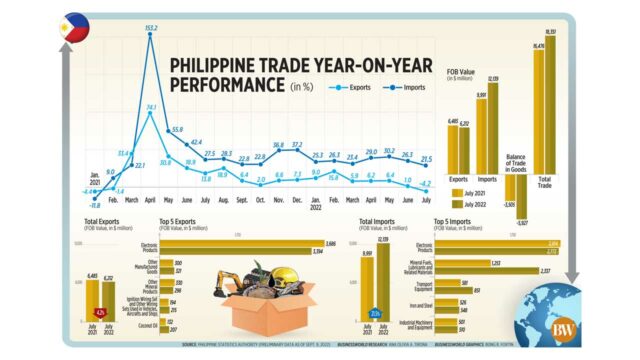
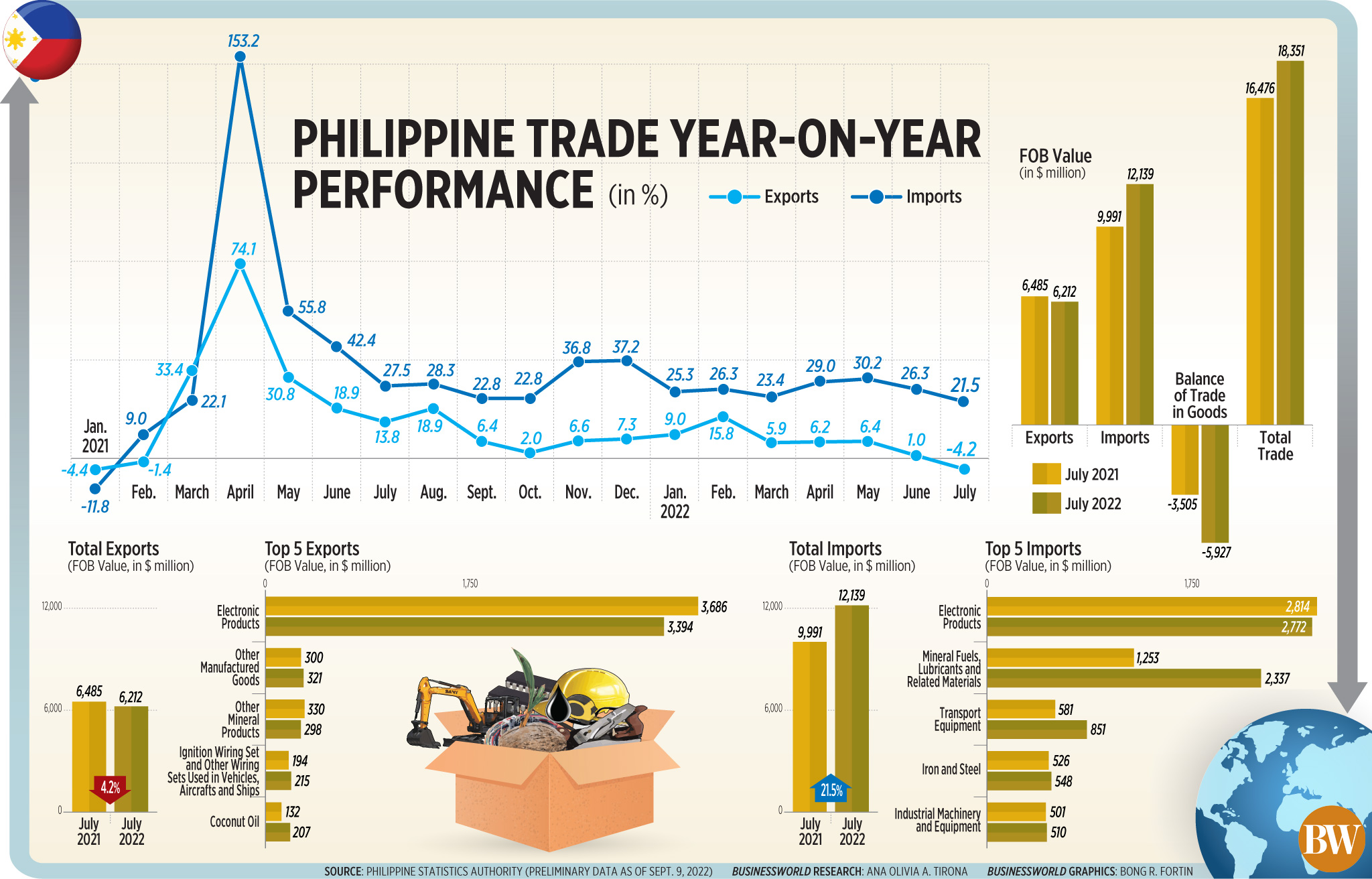
Philippine trade year-on-year performance

The demand for locally made products contracted for the first time in over a year in July while imports eased, bringing the trade deficit widening to another record, the Philippine Statistics Authority (PSA) reported on Friday. Read the full story.

Philippine trade year-on-year performance

Gov’t debt yields rise on inflation, hawkish Fed

YIELDS on government securities (GS) rose last week following a slower but still elevated August inflation print and hawkish remarks from the US Federal Reserve chief.

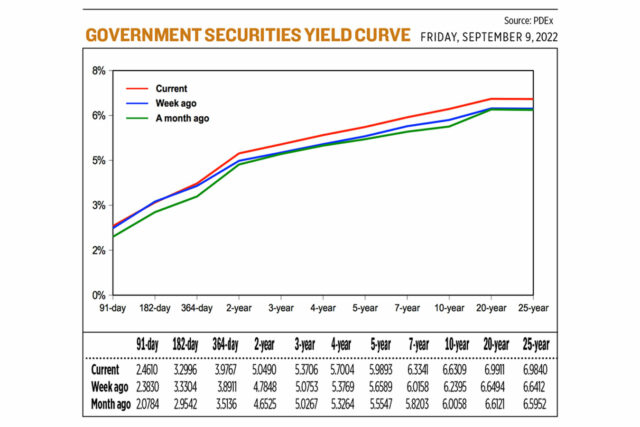
GS yields, which move opposite to prices, went up by a week-on-week average of 24.91 basis points (bps), according to the PHP Bloomberg Valuation Service Reference Rates as of Sept. 9 published on the Philippine Dealing System’s website.

GS volume on Friday reached P12.402 billion, higher than the P10.298 billion recorded on Sept. 2.

Yields climbed nearly across the board last week, except for the 182-day Treasury bills (T-bills), which lost 3.08 bps to fetch 3.2996%.

The rates of the 91- and 364-day T-bills rose by 7.80 bps and 8.56 bps to 2.461% and 3.9767%, respectively.

The belly of the curve also went up as yields on the two-, three-, four-, five-, and seven-year Treasury bonds (T-bonds) increased by 26.42 bps (5.0490%), 29.53 bps (5.3706%), 32.35 bps (5.7004%), 33.04 bps (5.9893%) and 31.83 bps (6.3341%).

Likewise, the rates of the 10-, 20-, and 25-year papers increased by 39.14 bps (6.6309%), 34.17 bps (6.9911%) and 34.28 bps (6.984%), respectively.

“Despite the slower-than-expected inflation pace in August, market participants are still concerned about it, as the print is still elevated and far off from the government’s target inflation range of 2-4%,” a bond trader said in a Viber message.

Preliminary data from the Philippine Statistics Authority showed headline inflation eased to a two-month low of 6.3% year on year in August from the near four-year high of 6.4% in July.

Still, this was faster than the 4.4% recorded in August 2021 and marked the fifth consecutive month that inflation went above the 2-4% target of Bangko Sentral ng Pilipinas (BSP).

In the first eight months of 2022, inflation averaged 4.9%, faster than the 4% a year ago. This is still below the BSP’s 5.4% full-year inflation forecast.

The bond trader added that continued hawkish comments from the Fed chief on their commitment to increase interest rates to temper surging inflation in the United States caused local yields to climb.

“Bond investors can’t help but be defensive and refrain from aggressively building up their bond positions given the foreseen rise in interest rates in the coming months,” the bond trader said.

Fed Chief Jerome H. Powell on Thursday said the US central bank is “strongly committed” to fighting inflation.

“We need to act now, forthrightly, strongly as we have been doing, and we need to keep at it until the job is done,” Mr. Powell said in a webcast interview Cato Institute President Peter Goettler.

The Fed will hold its next policy meeting on Sept. 20-21.

Security Bank Corp. Chief Investment Officer for Trust and Asset Management Group Noel S. Reyes said in an e-mail last week that yield movements were volatile last week after Mr. Powell said in a symposium held in Jackson Hole on Aug. 26 that rates will be higher for longer, which could cause other central banks to follow suit to reduce pressure on their respective currencies. 

“Market sentiment and direction of local yields were dictated by a steepening US curve as the 10-year US bellwether breached 3.3% on Wednesday from 3.2% to start the week despite safe haven demands,” UnionBank of the Philippines, Inc. (UnionBank) said in an e-mail.

UnionBank added that the local curve has steepened in the last two weeks due to the risk of hefty supply of government securities following the recent issuance of retail Treasury bonds as well as the Bureau of the Treasury’s (BTr) weekly auctions of debt papers.

For this week, the bond trader expects yields to see some upward pressure as the Fed’s and BSP’s policy meetings near. The BSP Monetary Board will meet on Sept. 22, a day after the Fed.

“Market will continue to adopt to its defensive stance and thereby may cause yields to higher in the near-term,” the bond trader said.

UnionBank said the local market will continue to track the two-year and 10-year US bellwether rates as markets position ahead of the release of US August inflation data and other economic reports before the Federal Open Market Committee meeting.

“As government debt supply risk starts to normalize and with likelihood of Philippine inflation peaking this month, bargain hunting may show up in the steeper segment of the local curve, particularly if US Treasuries do not overreact to US inflation data,” UnionBank said. — Lourdes O. Pilar

Style (09/12/22)


Keds offers 1950s-inspired sneakers

KEDS has just released its latest collection featuring pieces inspired by 1950s Tennis Heritage retro stylings. This selection of sporty yet chic sneakers are modern takes on iconic 1950s fashion updated for the present. The Jump Kick Rib Knit, dubbed the “crew neck sweatshirt of the sneaker world,” is casual and comfy with a dash of preppy yet sporty school look. It’s a clever combination of classic sneaker style and sweatshirt design, making for a completely new and totally of-the-moment look. Its red accents give the shoe an unmistakable ’50s retro vibe best paired with pleated tennis skirts or polo-dresses. Playing to the nostalgic collegiate trend, The Varsity Collection also features the Triple Up Varsity. This shoe gets a swipe of ivy league prep in the form of varsity stripes in its comfy yet chunky sole. For an easygoing feel, the Kickback Stripe Foxing is a slip-on that looks like a sneaker but has a broken-in feel straight out of the box thanks to relaxed uppers, super soft jersey lining, and cushiony footbed. Keds also released a Workwear collection inspired by the ’50s with classic tan colorways. This includes Keds favorites such as the Champion, Chillax, and Crew Kick 75. Shop for these shoes and more in Keds concept stores nationwide and at www.keds.com.ph.


Selsun Blue’s newest moisturizing anti-dandruff shampoo

SO, having finally addressed the source of one’s dandruff, giving one’s scalp much-needed TLC to keep the white flakes away, one may find that one’s hair still looks dry, dull, and lifeless. Scalp health expert Selsun Blue offers the new and innovative Selsun Blue Pro Extra Moisturizing anti-dandruff shampoo which can shake those white flakes off while keeping hair beautifully conditioned in one easy step. Always effective with its Selenium Sulfide 1%, an anti-infective and anti-fungal agent approved by the US FDA, to treat the source of dandruff, Selsun Blue Pro Extra Moisturizing includes three nourishing ingredients: Honey Extract, Arginine HCL, and Lysine HCL. To get the best results, apply enough Selsun Blue Pro Extra Moisturizing shampoo to clean hair and scalp. Massage gently over the entire scalp for approximately one minute and rinse. Repeat process but this time leave the shampoo on the scalp for two to three minutes. Be sure to thoroughly rinse after. Use at least two times a week. Selsun Blue Pro Extra Moisturizing anti-dandruff shampoo is available for P365 for the 120mL bottle and P40 for the 6mL sachet. The bottle can be purchased at any Watsons and Mercury Drug store starting this month, and the sachet in October.


Boss enlists stars for fall/winter 2022 campaign

FOR Fall/Winter 2022, Boss delves deeper into what it means to be your own boss with a campaign capturing a group of today’s most influential stars. The campaign features TikTok creator Khaby Lame, Italian tennis player Matteo Berrettini, German runner Alica Schmidt, and British boxer Anthony Joshua. For the first time, legendary British supermodel Naomi Campbell joins the cast. American model Kendall Jenner, American rapper Future, and South Korean singer and actor Lee Min-ho round out the talents in the campaign, where they talk in their own words about what makes a Boss.


Gap Kids spotlights real special kids

GAPKIDS new campaign was inspired by the children’s book Everyone Belongs by Heather Avis — a mother, best-selling author and founder of The Lucky Few Foundation for Down syndrome advocacy. The GapKids campaign features a wide range of real kids of all abilities and special talents, including  Avis’ own children with Down syndrome.  Gap’s latest GapKids campaign has a diverse group of kids styled in organic loose denim, khaki, dresses, and more. “Celebrating individuality has always been iconic to the Gap brand,” said Mary Alderete, Global Head of Gap Marketing, in a statement. “‘Everyone Belongs’ shares an important message for kids and adults alike, and we are excited to continue to encourage individuality, acceptance, and the joy we feel when we embrace our unique selves.” The campaign was launched globally in July. In the Philippines, visit the following Gap stores to see the new pieces for kids: Glorietta 4, Shangri-la Mall, SM Mall of Asia, SM Megamall, Trinoma, and Abreeza, Davao, or shop online at gap.com.ph.

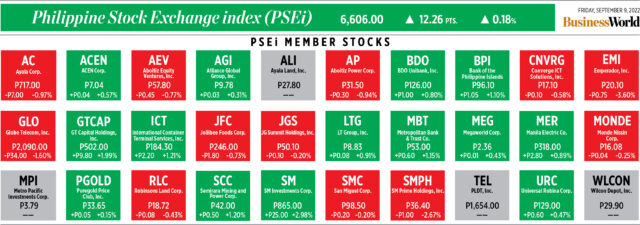
How PSEi member stocks performed — September 9, 2022

Here’s a quick glance at how PSEi stocks fared on Friday, September 9, 2022.


Cautious trading seen as recession fears linger

REUTERS

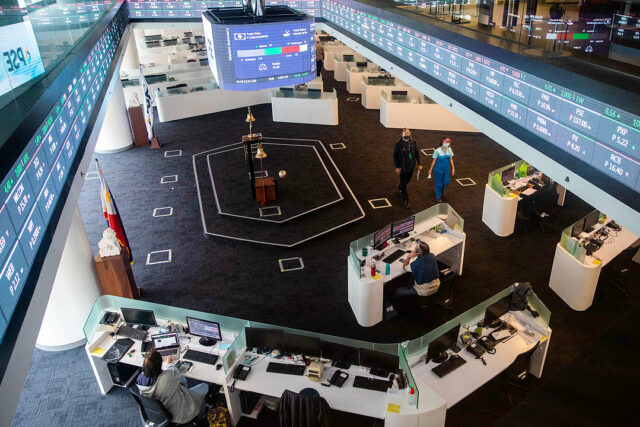
PHILIPPINE SHARES may see volatile trading this week as the peso remains weak against the dollar amid lingering recession fears as global central banks continue to raise rates to combat inflation.

The Philippine Stock Exchange index (PSEi) inched up by 12.26 points or 0.18% to close at 6,606 on Friday, while the broader all shares index rose by 1.27 points or 0.03% to 3,506.47.

Week on week, the PSEi declined by 146.5 points or 1.29% from its close of 6,752.50 on Sept. 2.

“Profit taking prevailed after hawkish Fed remarks supported another 75 bps (basis points) hike,” online brokerage 2TradeAsia.com said in a report.

“Philippine shares ended the week above 6,600 equities as traders digested further Fed Chair Jerome H. Powell’s latest comments on inflation,” Regina Capital Development Corp. Head of Sales Luis A. Limlingan said in a Viber message.

Mr. Powell on Thursday said the US central bank is “strongly committed” to fighting inflation.

“We need to act now, forthrightly, strongly as we have been doing, and we need to keep at it until the job is done,” Mr. Powell said in a webcast interview with Cato Institute President Peter Goettler.

The Fed will hold its next policy meeting on Sept. 20-21, where markets expect another aggressive hike.

The US central bank has raised benchmark rates by 225 bps since March, including back-to-back 75-bp hikes in June and July, amid rising prices.

For this week, Philstocks Financial, Inc. Senior Research Analyst Japhet Louis O. Tantiangco said peso-dollar trading will affect the stock market’s performance.

“A continuation of [peso’s] recovery momentum is seen to boost sentiment in the stock market. A depreciation is expected to lead to otherwise, however,” Mr. Tantiangco said in a Viber message.

“Lingering worries over the recession risks in the US and in Europe may continue to weigh on the market,” he added.

The peso closed at P56.82 per dollar on Friday, rebounding by 36 centavos from its P57.18 finish on Thursday, data from the Bankers Association of the Philippines’ website showed.

This followed a six-day decline that saw it logging new record lows for five straight sessions.

Mr. Tantiangco said investors will watch out for upcoming data on overseas Filipino workers remittances, foreign direct investments, and balance of payments.

Meanwhile, Mercantile Securities Corp. Head Trader Jeff Radley C. See said: “The market will rally and may visit the resistance levels as investors are gaining confidence that the economy is stable.”

“Recession fears are slowly fading as well. We expect consumer and financial sector rally,” Mr. See said.

Online brokerage 2TradeAsia.com said the market may remain range-bound in the coming days.

It put the PSEi’s support at 6,500 and resistance at 6,900, while Mercantile Securities’ Mr. See placed support at 6,500 and resistance at 6,750 and 6,900. — Justine Irish D. Tabile

Peso may decline ahead of US data

BW FILE PHOTO

THE PESO may weaken this week as the dollar continues to strengthen, with the US Federal Reserve chief saying they are committed to keeping inflation low and ahead the release of August US consumer price index (CPI) data.

The local unit closed at P56.82 per dollar on Friday, rebounding by 36 centavos from its P57.18 finish on Thursday, Bankers Association of the Philippines data showed.

However, week on week, the peso lost five centavos from its P56.77 finish a week earlier.

The peso opened at P57.05 per dollar on Friday. Its weakest showing was at P57.07, while its intraday best was at P56.78.

Dollars exchanged were steady at $1.15 billion on Friday.

Rizal Commercial Banking Corp. Chief Economist Michael L. Ricafort said in a Viber message that the peso recovered against the dollar on Friday amid a “healthy correction” following its six-day decline that saw it logging new record lows for five straight sessions.

This was “in line with the healthy downward correction of the US dollar versus major global currencies recently, as well as some measures by some Asian central banks to stabilize their respective local currencies after the recent increase in the US dollar amid hawkish signals from the Fed and the European Central Bank,” Mr. Ricafort said.

For this week, UnionBank of the Philippines, Inc. Chief Economist Ruben Carlo O. Asuncion said the market will look at US inflation data to be released on Tuesday, as this could affect the Fed’s policy path moving forward.

Fed Chair Jerome H. Powell said at the Jackson Hole symposium last month that the US central bank will hike interest rates as needed and keep them high for some time to bring inflation down.

On Thursday, Mr. Powell said the central bank is “strongly committed” to fighting inflation.

The Federal Open Market Committee is set to meet on Sept. 20-21. It has raised rates by 225 basis points (bps) so far since March, including back-to-back 75-bp hikes in June and July.

Mr. Asuncion added that the market may remain cautious ahead of the Bangko Sentral ng Pilipinas’ (BSP) policy meeting on Sept. 22, where he sees another aggressive hike.

The BSP has increased borrowing costs by 175 bps since May to keep rising prices in check.

Headline inflation eased to a two-month low of 6.3% year on year in August from the near four-year high of 6.4% in July, However, this was faster than the 4.4% recorded in August 2021 and marked the fifth consecutive month that inflation went above the BSP’s 2-4% target.

In the first eight months, inflation averaged 4.9%, faster than the 4% a year ago. Still, this is below the BSP’s 5.4% full-year inflation forecast.

For this week, Mr. Asuncion expects the peso to move within P56.90 to P57.40 per dollar, while Mr. Ricafort gave a forecast range of P56.50 to P57. — Diego Gabriel C. Robles

Senate targets passage of 2023 budget bill by mid-December

PHILSTAR FILE PHOTO

THE SENATE is hoping to pass its 2023 budget bill by mid-December, according to the senator who chairs the upper chamber’s Finance Committee.

“We start the DBCC hearings on Tuesday… and hope to finish our committee hearings in early to mid-October; then plenary debates in early to mid-November leading up to the passage of the budget bill in late November; then bicam(eral session) and signing by the President in early to mid-December, that is target schedule,” Senator Juan Edgardo M. Angara said in a statement Sunday.

The House of Representatives has begun deliberating on next year’s budget, with its own target of ending hearings by Sept. 16. Plenary debate is set to begin on Sept. 21, with the chamber hoping to pass its bill by Oct. 1.

The P5.268-trillion budget as proposed in the 2023 National Expenditure Program (NEP) is 4.9% higher than this year’s budget, and is equivalent to 22.2% of gross domestic product.

Mr. Angara said the Senate’s priorities include the health sector; the poor; the micro, small and medium enterprises; and youth employment. “We hope to continue strengthening the health sector and health system, particularly PGH (Philippine General Hospital),” he said, adding that its budget has been increasing in the last few years.

Under the proposal submitted by the Department of Budget and Management (DBM), health funding will rise 10.4% next year to P296.3 billion. Funding for the Department of Health (DoH) will increase 6.6% to P196.08 billion, while the Philippine Health Insurance Corp. (PhilHealth) will get P100.23 billion.

“Marginalized sectors and those hard hit during the pandemic hopefully will be given support through programs that aid recovery and help them get back on their feet,” Mr. Angara said.

The allocation for the Department of Social Welfare and Development (DSWD) is due to fall 3.8% to P197.03 billion next year.

This includes P115.6 billion for the Pantawid Pamilyang Pilipino Program (4Ps) of cash transfers; P25.3 billion for the Social Pension for Indigent Senior Citizens; P19.9 billion for Protective Services for Individuals and Families in Difficult Circumstances; and P4.4 billion for the Sustainable Livelihood program.

“We intend to include support for our entrepreneurs through credit programs (and) small business shared support services like equipment,” Mr. Angara said.

“We hope to ramp up training and skills programs for our young people, that greatly aid in… making our workforce attractive to investors,” he added.

The budget for the Department of Labor and Employment (DoLE) is P25.90 billion, down 29.9%, reflecting the creation of the Department of Migrant Workers (DMW), which has a P15 billion proposed budget, including P11.7 billion for the Overseas Workers Welfare Administration, previously a DoLE agency.

Most of the DoLE’s proposed budget is for its Livelihood and Emergency Employment program, earmarked for P18.4 billion. This includes the Tulong Panghanapbuhay sa Ating Disadvantaged/Displaced Workers (Tupad) program, allocated P14.9 billion and the DoLE Integrated Livelihood Program, allocated P2.5 billion.

“These are a few initiatives we hope to work together to push going forward,” Mr. Angara said.

Most of next year’s proposed budget will go to social services — P2.071 trillion or 39.31%, and economic services — P1.528 trillion or 29.01%. — Alyssa Nicole O. Tan

Rise of lithium not seen threatening nickel demand

BW FILE PHOTO

By Luisa Maria Jacinta C. Jocson, Reporter

THE increasing use of lithium in the production of electric vehicles (EV) is not expected to threaten demand for nickel, which is one of the Philippines’ major minerals, with industry officials calling the two metals complementary.

“We’re not worried about the development of lithium because lithium can be complementary to nickel but nickel is still the preferred metal for use in cathodes. All cathodes store energy (and) nickel (has) high energy density,” Rocky G. Dimaculangan, vice-president for communications of the Chamber of Mines of the Philippines, said in a phone interview.

According to the International Energy Agency, an electric car has six times the mineral content as a conventionally fueled car. 

Most batteries used in EVs are lithium-ion batteries that depend on key minerals like cobalt, nickel, graphite, and manganese, among others.

“Nickel can be used in combination with cobalt, manganese, aluminum and also lithium. Nickel will not be replaced,” he added.

In 2021, nickel-based cathodes powered 80% of the battery capacity deployed in new plug-in EVs.

The Philippines accounted for a quarter of mined nickel production in Asia in 2021, according to S&P Global.

The lithium industry is expected to post strong growth amid rising demand from EV manufacturers, according to a report by Fitch Solutions.

“The outlook for the lithium sector on a 10-year horizon is very upbeat, amid fast production and demand growth and plenty of opportunities across a variety of markets,” the report said.

“In fact, the backdrop for lithium, used mainly in lithium-ion batteries for electrification in transportation and grid storage, is as bright as ever, as we are witnessing since 2020 a clear acceleration towards decarbonization, which will be achieved to a great extent via the electrification of autos and energy storage,” it added.

The study found the lithium industry to be fast-growing, fast-evolving and subject to key changes in the coming years as demand and price fundamentals improve.

“The lithium market is seeing the emergence of many new players across a variety of regions, from a geographical production and consumption perspective, as well as from a competitive landscape perspective. Constant technological advancements in the supply and demand sides pose risks to the market outlook,” it said.

“Meanwhile, lithium is now considered a strategic mineral, which will lead to rising government intervention, in its production and sourcing,” it added.

It forecast global lithium production to nearly quadruple between 2022 and 2031, posting 13.6% growth annually over the period.

“Well-established lithium-producing markets will record further growth, while a number of new lithium-producing markets will emerge in the next 10 years,” according to the report.

It said annual lithium consumption by the EV industry is expected to triple between 2022 and 2031 while annual EV sales will grow to 30.3 million units from 11.4 million.

RE firms want reform of competitive selection

RENEWABLE ENERGY (RE) companies asked Congress to reform the competitive selection process, calling it excessively complex and not always awarding contracts to the lowest-cost producer.

Ruth P. Briones, chairman and chief executive officer of GreenEnergy Solutions, Inc., said at the Future Energy Philippines forum last week that the complexity of the rules is also a factor in high power prices apart from the volatile price of imported fuel. 

“The competitive selection process (CSP) is very complicated, the lowest price is not always the winner,” she added, referring to the Department of Energy’s (DoE’s) prescribed method for distribution utilities seeking to procure power.

“Electricity is very (expensive) because the regulatory framework is very complicated, I hope the Congress will look deeper into the structure,” she said.  

Quintin Jose V. Pastrana, president of WEnergy Power Pilipinas Inc., said power in off-grid areas in particular is expensive, and called for scaling up power solutions for remote areas to make electricity more affordable.   

“Our supply sometimes is outstripped by demand. If power doesn’t keep up because regulation is a bit slower or not as fast as the demand, then we’re going to have a demand asymmetry with supply and that is going to raise prices,” Mr. Pastrana said.   

Pedro H. Maniego, executive director of the Institute for Climate and Sustainable Cities (ICSC), said separately in an email on Sept. 9 that the Philippines is also alone in the region in not subsidizing electricity prices, as per the rules set out by the Electric Power Industry Reform Act (EPIRA), the privatization law that governs the industry.   

“The major challenge is how we can be energy independent by utilizing indigenous resources, so as to minimize the country’s exposure to price fluctuations in the international market,” Mr. Maniego added. — Ashley Erika O. Jose

2022 budget 96.5% released as of end of August

BW FILE PHOTO

THE DEPARTMENT of Budget and Management (DBM) said Friday that P4.85 trillion, or 96.5% of the 2022 budget has been released to national agencies and local government units (LGUs) as of the end of August.

The DBM’s Allotment Releases data indicate that P177.73 billion has yet to be distributed.

The release rate is running ahead of the pace in 2021. At the same stage that year, the DBM had released P4.15 trillion or nearly 92.1% of the budget.

In August 2022, releases to government agencies and departments amounted to P2.8 trillion, or 97.2% of the total.

Special Purpose (SP) funds released by the end of the month amounted to P311.18 billion, or 68.1%.

SP funds include budget support for local government units (LGUs), the Contingent Fund, the Miscellaneous Personnel Benefits Fund, and the National Disaster Risk Reduction and Management Fund.

Automatic Appropriation releases amounted to P1.47 trillion, representing 87.5% of the funding total.

This includes P10 billion for the Rice Competitiveness Enhancement Fund and P1.91 billion in funding for retirement and life insurance premiums of various National Government agencies, the DBM said.

Other automatic appropriations include the National Tax Allocation for LGUs, block grants, interest payments, and the tax expenditure fund.

The national budget for 2022 is configured around recovery efforts from the pandemic. The budget is equal to 21.8% of projected gross domestic product, with about a fifth set aside for capital outlays, which include infrastructure spending.

The proposed P5.268 trillion budget for 2023 is currently in Congress, and looks to allocate even more funding for education, health, agriculture, and infrastructure. — Diego Gabriel C. Robles

PHL urged to decentralize power generation with more solar plants

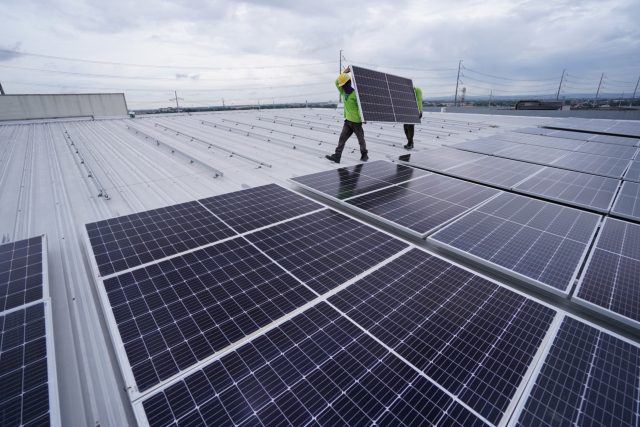
Solar panels are being installed on the roof of a mall. — GREEN HEAT HANDOUT PHOTO

THE Institute for Climate and Sustainable Cities (ICSC) said the Philippines needs to move towards more “distributed” power generation, which would involve the construction of more solar generation facilities while abandoning the current model of centralized baseload power, currently dominated by coal-fired plants.

In an e-mail interview on Sept. 9, Pedro H. Maniego, senior policy advisor of ICSC, a climate and energy policy group, said that the dependence on coal renders the Philippines vulnerable to volatile international  energy prices, and put forward solar as an alternative.

“We lack sufficient power to support our developing economy and increasing population. We need to augment our power supply now,” Mr. Maniego added.

He called solar power the best technology for distributed generation in the context of the Philippines’ archipelagic geography, which results in many remote areas unserved by the grid.

“Given the country’s geography and minimal domestic fossil fuel sources, the country really has no option but to tap technological innovation to meet its twin goals of low carbon and reliable energy,” Mr. Maniego said.

Last week, Energy Secretary Raphael P.M. Lotilla said that the government will review the power outlook for next year because of the volatility of the gas market.

“Fossil fuel prices tend to go up over the long term, and to spike whenever there are international crises,” Mr. Maniego said.

Mr. Maniego added that the Philippines has sufficient RE potential to meet its energy needs, noting that “solar and wind have much lower levelized cost of electricity compared to fossil fuel power plants. Prices are expected to further decrease.”

Renato Redentor Constantino, ICSC’s executive director, said in a statement last week that government and banks should provide more financing for RE.

“The banks and Department of Finance should (abandon) the ‘pawnshop mentality’ and step up to provide more lending opportunities for RE investment,” Mr. Constantino said. — Ashley Erika O. Jose

ADVERTISEMENT
ADVERTISEMENT