Home Blog Page 5904

NPC backs international certification system for data protection

REUTERS/KACPER PEMPEL/FILE PHOTO

THE National Privacy Commission (NPC) said it is participating in setting up an international certification system that will allow interoperability among various jurisdictions with different data protection rules.

In a statement on Wednesday, the NPC said it joined the Asia-Pacific Economic Cooperation Cross-Border Privacy Rules  (APEC CBPR) System in setting up the Global CBPR Forum, with the goal of international recognition for the various data protection regimes.

The certification system will be based on the APEC CBPR and the privacy recognition for processors (PRP) systems. However, the forum’s system will be independently administered from the APEC systems.

“Cross-border data flows will greatly benefit from an interoperable privacy framework. Now more than ever, the world is witnessing how the acceleration of digitalization is giving way to a rapid increase in the collection, use, and transfer of data across borders,” Privacy Commissioner John Henry D. Naga said.

“The Global CBPR Forum’s goal of promoting worldwide expansion and uptake of the Global CBPR and PRP Systems is aligned with the NPC’s vision of upholding the right to privacy and data protection while ensuring free flow of information,” he added.

According to the NPC, the Global CBPR Forum will periodically monitor data protection and privacy standards among members and provide a forum for sharing best practices.

“All approved Accountability Agents and certified companies will automatically be recognized in the new Global CBPR Forum based on the same terms of recognition under the APEC CBPR and PRP Systems,” the NPC said.

“According to the declaration, participating economies in the APEC CBPR System plan to transition operations of the APEC CBPR and PRP Systems to the Global CBPR Forum and will provide at least 30 days’ notice to Accountability Agents,” it added.

The Philippines signed on to the APEC CBPR system in March 2020. The system requires organizations to create and implement privacy policies and practices for all personal information that they have gathered or received that is subject to cross-border transfer to other participating members.

The other economies currently part of the declaration are Canada, Japan, South Korea, Singapore, Taiwan, and the US. — Revin Mikhael D. Ochave 

FTAs locked in, unaffected by change in gov’t, DTI says  

ICTSI

TRADE RELATIONS are not expected to be affected with the imminent change in government, according to the Department of Trade and Industry (DTI).

Trade Assistant Secretary Allan B. Gepty said in a webinar hosted by the Economic Journalists Association of the Philippines on Wednesday that free trade agreements (FTAs) that include the Philippines are locked in and will not be altered by who is in charge.

“Our economy is well integrated in the global economy. One big factor that fortifies this integration to the global economy is our free trade agreements. In other words, take note (that) these FTAs are international agreements. Regardless of the administration, the fact remains that we are working under a rules-based set-up,” Mr. Gepty said.

“Our businesses, our investors are well mindful of this and this is the primary reason why countries are very active in pushing for a very comprehensive economic partnership agreement, not just covering market access but also rules. Whenever there are changes, let’s say in administration, they know that the direction would still be consistent,” he added.

The government is due to step down on June 30. Former Senator Ferdinand R. Marcos, Jr. is currently leading the partial unofficial count with over 31 million votes, according to the Commission on Elections.

Meanwhile, Mr. Gepty said that the DTI has been pursuing negotiations for planned upgrades to the ASEAN-Australia-New Zealand Free Trade Area.

He said that with the FTA, the Philippines is pushing to become one of the manufacturing hubs in the region, a leading innovation hub, and a training and education hub.

“With the strengthening of our international trade relations, we basically ensure smooth flow of goods and services while maintaining a conducive environment for our businesses and investors. Through FTAs, tariff rates have been liberalized, which in effect lowers the prices of goods which includes raw materials, intermediate goods, and final goods,” Mr. Gepty said. — Revin Mikhael D. Ochave 

The tax landscape: Where we are and what is ahead

“Out with the old, in with the new” seems to be the prevailing mood. With the government’s term expiring, the Philippines will soon usher in a new President and install a new set of administrators. The Bureau of Internal Revenue (BIR) is naturally one of the government agencies affected by the turnover of leadership, with the Commissioner of Internal Revenue (CIR), who heads the BIR, being a presidential appointee.

Turning the page may also be in the air for BIR regulations and issuances. Looking back to the July 2016 edition of this column, I would like to revisit some of the significant changes in our tax landscape and look ahead at developments that we can anticipate.

SUSPENSION OF JUNE 2016 ISSUANCES
Upon appointment of the then new CIR, Revenue Memorandum Circular (RMC) No. 69-2016, dated July 1, 2016, suspended the implementation of BIR issuances from June 2016. Upon review, many of these issuances were subsequently reinstated by RMC Nos. 80-2016, 88-2016, and 127-2016.

Notably, one issuance that remained suspended was Revenue Memorandum Order (RMO) No. 27-2016, dated June 23. 2016. This RMO was to set the guidelines for availing of tax treaty relief on dividends, interest, and royalties. Instead, the coverage of this RMO was tackled in newer issuances in 2017, 2020, and 2021, as discussed below.

REINSTATEMENT OF WITHHOLDING TAX RULES ON DEDUCTIBILITY OF EXPENSES
Under Revenue Regulations (RR) No. 12-2013, no deduction for income tax purposes was allowed in case of failure to withhold tax, notwithstanding subsequent payment of such withholding tax at the time of audit investigation or reinvestigation/reconsideration. This RR was revoked in 2018 with the issuance of RR No. 6-2018, reverting to the previous rule allowing expenses as a deduction, provided that the required withholding tax is remitted to the BIR during a tax audit/investigation, with the concurrent penalties from under-withholding or non-withholding.

It is noteworthy, though, that in tax cases, the Court of Tax Appeals has held that payment of deficiency withholding tax after the issuance of a Final Decision on Disputed Assessment is not considered a remittance during a tax audit/investigation; hence the tax court upheld the disallowance of expenses and sustained the assessment of deficiency income tax thereon.

REGULATIONS IMPLEMENTING TRAIN AND CREATE
Republic Acts 10963 and 11534, also known as the Tax Reform for Acceleration and Inclusion (TRAIN) and the Corporate Recovery and Tax Incentives for Enterprises (CREATE) laws, were signed in 2017 and 2021, respectively. These laws are two of the major tax reform packages, which primarily tackled personal (TRAIN) and corporate (CREATE) income tax.

Numerous regulations were issued to implement the Tax Code amendments from these tax reforms, including the amended RR Nos. 11-2018 and 5-2021, primarily touching upon the personal and corporate income tax changes under the respective tax reform laws. Other important issuances include: RR No. 12-2018 (donor’s and estate taxes); RR Nos. 13-2018, 4-2021 and 21-2021 (value-added tax); RMC No. 19-2022 (tax-free exchange); and the CREATE Implementing Rules and Regulations covering Title XIII of the Tax Code.

TRANSFER PRICING AUDIT AND COMPLIANCE
While the transfer pricing guidelines were promulgated in RR No. 2-2013, which required the maintenance of contemporaneous transfer pricing documentation to support the pricing of intercompany transactions, more transfer pricing rules and guidance were introduced starting in 2019. Revenue Audit Memorandum Order No. 1-2019 prescribes the procedures and audit guidelines to be followed in the event of a transfer pricing audit. Moreover, the Related Party Transaction Form (or BIR Form No. 1709) now forms part of annual income tax compliance, as mandated for certain taxpayers pursuant to RR No. 19-2020, as amended by RR No. 34-2020.

TAX TREATY RELIEF AND TAX SPARING
In a welcome development, tax treaty relief for dividends, interests, and royalties was initially simplified with the issuance of RMO No. 8-2017, under which accomplishment and submission of a Certificate of Residency for Tax Treaty Relief (CORTT) Form by the Philippine tax resident-payee and the foreign income recipient domiciled in a treaty country would be considered sufficient compliance. However, the 2017 RMO was superseded by RMO No. 14-2021, which provides updated procedures for availing of tax treaty benefits covering all types of income payments, including dividends, interest, and royalties. While the 2021 RMO was issued in compliance with the Ease of Doing Business Act in mind, its requirements are arguably less simple than the CORTT Form requirement under the 2017 RMO.

Meanwhile, RMO No. 46-2020 provides for the guidelines and procedures for availing of the reduced 15% dividends tax paid to a nonresident foreign corporation under Section 28(B)(5)(b) of the Tax Code, also known as the tax sparing rule. While arguably the Tax Code provision is self-executing, this 2020 RMO nonetheless provides more consistent guidance to taxpayers, who previously sought BIR rulings as a conservative measure when using such reduced dividends tax rate.

FUTURE TAX DEVELOPMENTS
There are still two pending major tax reform proposals in Congress, covering real property valuation and taxation of passive income and financial intermediaries. There is also a pending proposal to include non-resident digital service providers within the 12% value-added tax coverage, being deliberated currently at the Senate Committee on Ways and Means level, as of this writing. It remains to be seen whether the incoming administration will prioritize these tax measures, but if passed into law before the new administration takes over, we can expect the promulgation of implementing regulations covering the same, perhaps soon.

The changes in the tax landscape these last six years were unprecedented, and more changes could be coming soon. Dutifully keeping on top of tax updates is a must for taxpayers and tax experts alike.

The views or opinions expressed in this article are solely those of the author and do not necessarily represent those of Isla Lipana & Co. The content is for general information purposes only, and should not be used as a substitute for specific advice.


Marion D. Castañeda is a senior manager at the Tax Services Department of Isla Lipana & Co., the Philippine member firm of the PwC network.

Marcos Jr. visits father’s grave as he widens lead

FACEBOOK.COM/BONGBONGMARCOS

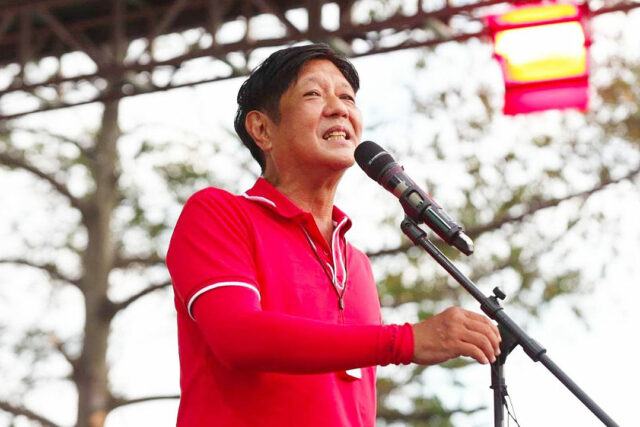
FERDINAND R. Marcos, Jr., the only son and namesake of the late Philippine dictator, visited the grave of his father on Wednesday, as he widened his lead against his closest rival in the presidential election to more than 16 million votes.

Based on partial and unofficial results with 98.3% of the vote counted, Mr. Marcos, better known as “Bongbong,” had 31.09 million votes as of 5 p.m., more than double that of Vice-President Maria Leonor G. Robredo.

He will be the first candidate to win a majority in a presidential election since his father’s two-decade rule.

Mr. Marcos’ Twitter page showed photos of him placing flowers on his father’s grave at a national cemetery in Taguig City near Manila, the capital.  Another photo showed him standing in front of a large photo of the dictator beside the grave while covering his face with his right hand.

Mr. Marcos, who shied away from debates and interviews during the campaign, recently praised his father as a genius and a statesman but has also been irked by questions about the martial law era.

His landslide victory heralds the return to power of the country’s most notorious political family.

Mr. Marcos fled into exile in Hawaii with his family during a 1986 “people power” street uprising that ended his father’s autocratic 20-year rule. He has served as a congressman and senator since his return to the Philippines in 1991.

Several of Mr. Marcos’ presidential rivals have conceded, including Manila Mayor Francisco M. Domagoso, labor leader Leodegario “Ka Leody” de Guzman and Senator and boxing champion Emmanuel “Manny” D. Pacquiao.

The Commission on Elections en banc on Tuesday affirmed the dismissal of several motions seeking to overturn the dismissal of disqualification cases against him.

The Senate, which will tally the votes for president and vice-president together with the House of Representatives, had received three certificates of canvass as of Wednesday morning, it said in a statement. Ballot boxes containing the certificates came from Malabon City, Cambodia and Vietnam,

The certificates and election returns are brought to the Senate before they are delivered to the House of Representatives where the canvassing will take place.

As of Wednesday noon, Comelec had finished validating 32 certificates of canvass out of 327 that will be included in the official tally of votes for the senatorial and party-list race, Election Commission George Erwin M. Garcia told a news briefing.

Comelec spokesman John Rex C. Laudiangco said they expect to proclaiming the winning senators this week.

As of Wednesday, about 835 cities and towns have proclaimed local winners, he said.

Mr. Garcia said about 2% of clustered precincts have yet to transmit their election results.

CONTEMPT CASE
Under the 1987 Constitution, both houses will hold a joint public session to canvass the votes for president and vice-president and proclaim the winners.

Mr. Sotto said there should be 173 ballot boxes in total, including certificates of canvass from overseas. He earlier said they expect to proclaim the winners by May 27 or 28.

In a related development, Marcos’s spokesman Victor D. Rodriguez declined to answer questions about how he plans to handle a United States contempt case against his family.

“Next question please,” he said at a news conference when asked to comment on the suit, which could prevent Mr. Marcos from visiting the US as Philippine president. 

The US Court of Appeals has ordered Mr. Marcos and her mother Imelda to pay $353.6 million (P18.46 billion) for violating a US court order not to dissipate their assets, which have been earmarked as compensation for the victims of his father’s martial rule. 

If Mr. Marcos refuses to pay or face a subpoena while in the US, the court could hold him in criminal contempt and imprison him until he answers questions about their assets, according to Robert Swift, a US lawyer who is working to recover the Marcoses’ ill-gotten assets, based on a report by Rappler, Inc.

Mr. Rodriguez’s refusal to answer the question gives Filipinos a glimpse of how the incoming government will treat the media, said Maria Ela L. Atienza, a political science professor from the University of the Philippines.

“The campaign team and Mr. Rodriguez follow a strategy of evading questions that would put Marcos in a bad light,” she said in a Viber message. “Declining to answer questions and distracting people by focusing on trivial issues and motherhood statements indicate a lack of accountability and respect for both the media and the public.” — Norman P. Aquino, Kyle Aristophere T. Atienza, Alyssa Nicole O. Tan and John Victor D. Ordoñez

Election watchdog cites need to fix automated system

REUTERS

By John Victor D. Ordoñez
and
Kyle Aristophere T. Atienza, Reporter

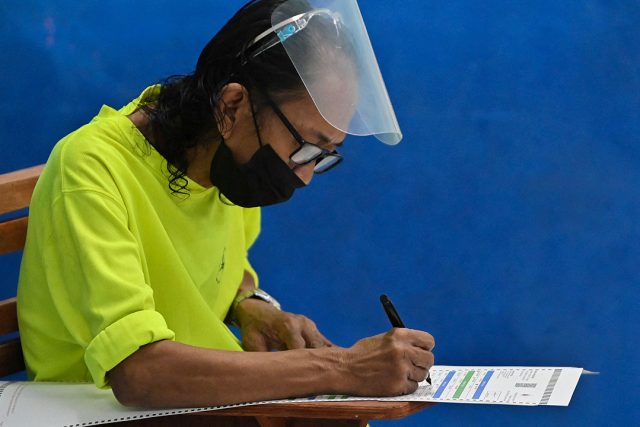
AN ELECTION watchdog on Wednesday said it had received 577 reports of vote-counting machine failures that caused long queues and delayed voting on May 9.

“Kontra Daya maintains that the massive number of reports received this year only serves to prove the failure of the automated election system in guarding the sanctity of the ballot,” it said in a statement.

It said Comelec, private contractor Smartmatic SGO and logistics partner F2 Logistics should be held accountable for these technical blunders caused by the lack of timely, thorough and transparent testing of the voting machines.

“It is difficult for voters to be confident in election proceedings marred by machine errors and breakdowns, as these cast doubt on the capacity of the machine to count their votes,” the watchdog said.

It added that reports of thousands of voters not being able to vote due to malfunctions could cast doubt on the accuracy of election results.

Election Commissioner George Erwin M. Garcia on Tuesday told reporters in a Viber message paper jams, rejected ballots, and vote-counting machines not printing returns properly were common problems encountered on election day.

He said 1,867 machines encountered these “common issues,” which were promptly resolved.

More than 900 defective vote-counting machines were replaced, while 469 SD cards were regenerated on Monday, Comelec said on Tuesday.

Kontra Daya said it had received 152 reports of illegal campaigning, 109 reports of vote-buying, and 55 reports of red-tagging on election day.

“The Comelec must replace the current automated election system with one that is transparent, open-source, and locally made,” it said. “An election system that maximizes local talent and allows for greater public scrutiny will allow voters to be confident that their vote has been correctly cast and counted.”

Comelec would investigate an incident shown in a viral video of unidentified men in police uniforms tearing ballots allegedly shaded in favor of Vice-President Maria Leonor G. Robredo, reportedly in Cotabato City.

“All of these videos will be referred to the National Bureau of Investigation (NBI) with instruction to verify the truth,” Election Commissioner George Erwin M. Garcia told reporters in a Viber message on Wednesday.

The Comelec Committee on the Ban on Firearms and Security Concerns would also look at the incident, spokesman John Rex C. Laudiangco told a news briefing. “It will be investigated thoroughly and we will be transparent with all of you.”

The election body would also look into an alleged ballot snatching incident in Lanao del Sur province in southern Philippines, where soldiers allegedly snatched ballots and vote-counting machines and added ballots favoring a local candidate, he added.

Comelec should promptly investigate reports of irregularities, political analysts said.

“That the people have trust issues with Comelec is evidenced by a litany of controversies that have not been fully explained, much less resolved,” Kontra Daya convenor Danilo A. Arao said in a Facebook Messenger chat.

Hansley A. Juliano, a former political science professor studying at Nagoya University’s Graduate School of International Development in Japan, also cited “the fact” that most recent commissioner appointees were allied to President Rodrigo R. Duterte.

“They have not built good rapport with the media. You had the debate scandals on payments. Then you had the flat-out breakdown of the voting machines on the day,” he said in a Messenger chat. “That’s beyond three in a row of issues.”

But Mr. Juliano noted that since the shift to automated elections in 2010, “very few fraud allegation cases have prospered.”

“Even if irregularities happened, that period was the time people wanted to believe we had clean elections,” he said. “There’s a big possibility that this sentiment continues to persist.”

Comelec must provide satisfactory and factual responses and “make no excuses,” Maria Ela L. Atienza, a political science professor from UP, said in a Viber message. “Otherwise, people will continue to distrust the electoral process and integrity of the elections.”

Ms. Robredo and some of her supporters have appealed for sobriety while the results are being validated.

“The quality of democracy is not only about the outcome of the process but the quality of the process,” Ian Jayson R. Hecita, who teaches political science at De La Salle University, said in a Messenger chat.

He added that any iota of doubt on the electoral process could cause political instability. “Fundamental to democracy is the trustworthiness and credibility of the electoral process including electoral administration — how the Comelec performed its mandate,” he said.

“Aside from the accuracy of the electoral results, the trustworthiness of the system and perceptions about the credibility of the process are critical.”


China to keep ties with Philippines under new leader 

PHOTO FROM PHILIPPINE COAST GUARD

CHINA on Wednesday said it would continue bilateral relations with the Philippines as the country transitions to a new government. 

Foreign Ministry spokesman Zhao Lijian in a statement said China would stay committed to the friendship of both nations, focus on post-pandemic growth, expand cooperation and bring more tangible benefits to both parties. 

“China congratulated the Philippines on the smooth presidential election,” he said. “Our congratulations also go to the leading candidates.” 

“We hope and believe that various political forces in the Philippines will continue to work in solidarity for national renewal and development,” he added. 

Presidential frontrunner Ferdinand “Bongbong” R. Marcos, Jr. is expected to keep the country’s close ties with China, which President Rodrigo R. Duterte started. 

Mr. Duterte had ignored the country’s arbitral victory against China in exchange for infrastructure pledges from its neighbor. The tough-talking leader also agreed to pursue a joint exploration with China in the South China Sea. 

The South China Sea, a key global shipping route, is subject to overlapping territorial claims involving China, Brunei, Malaysia, the Philippines, Taiwan and Vietnam. Each year, trillions of dollars of trade flow through the sea, which is also rich in fish and gas. 

During the campaign period, Mr. Marcos said he would seek a bilateral agreement with China to resolve differences in the disputed waters. — Alyssa Nicole O. Tan 

Sara to be named Education chief 

PHILIPPINE STAR/KRIZ JOHN ROSALES

LEADING vice-presidential bet Sara Duterte-Carpio will be appointed Education secretary in a Marcos Cabinet.  

“The incoming vice-president has agreed to take the Department of Education,” her running mate Ferdinand “Bongbong” R. Marcos, Jr., who is headed for a landslide presidential victory, told a news briefing on Wednesday night.  

Ms. Duterte last year said she wanted to become Defense chief.  

The Education secretary is expected to play a crucial role in improving the country’s coronavirus pandemic-hit school system. 

The Philippines was among the last two countries that reopened schools during the pandemic, according to the United Nations International Children’s Emergency Fund (UNICEF).  

The impact of prolonged school closures on children’s future productivity has resulted in the “most serious education crisis in the last 100 years,” according to the World Bank.  

Victims of the martial rule of Mr. Marcos’ late father have raised concerns about efforts to revise the country’s history regarding martial law.  

Legislators under the administration of Ms. Carpio’s father had sought to review the status of martial law education in the country.  

Mr. Marcos has kept a wide lead in the initial tally of the Commission on Elections. — Kyle Aristophere T. Atienza 

Robredo asks supporters to respect results, prepare for bigger fights 

VP LENI MEDIA BUREAU

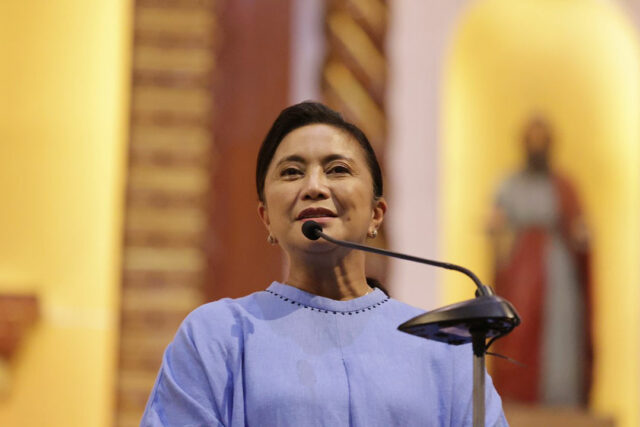
VICE PRESIDENT Maria Leonor LeniG. Robredo asked her supporters to accept the results of the May 9 polls and prepare for a bigger fight after the election period.  

Whatever the final result is, although we have yet to see it, lets accept it,she said in Filipino at a public gathering on Tuesday in her home province Camariñes Sur attended by volunteers and supporters. This is where we will draw our strength.”  

There are bigger fights and ours does not end with this election,she said. Many eyes were opened. Many minds woke up. The fight continues.”  

At the same time, Ms. Robredo said her camp would still look into the issues being raised about the conduct of the May 9 elections.  

Ms. Robredo made the statement at the Naga Metropolitan Cathedral after a Mass organized by her supporters for unity and thanksgivingwhile unofficial election results showed a landslide victory for Ferdinand BongbongR. Marcos, Jr.  

Mr. Marcos and his family were forced into exile in the United States after his fathers martial rule was toppled by a popular uprising in February 1986.  

Mr. Marcosrunning mate, Sara Duterte-Carpio, has also clinched a wide margin.  

There will be a new era of unityonce Mr. Marcos and Ms. Carpio assume their posts, according to their camp.  

What the public should expect in the next six years is a new era of unity where the President and the Vice President are going to be working in harmony,Ms. Carpios spokesperson, Liloan Mayor Ma. Esperanza Christina Ga. Frasco, told ABS-CBN News Channel. That has been their message all along.”  

That unity promise remains to be seen. It is easier said than done,said Jean Encinas-Franco, who teaches political science at the University of the Philippines.  

They have different sets of people,she said in a Messenger chat. They are both neophytes in the field so they will heavily rely on people who have different mindsets.”  

Temario C. Rivera, who heads the Center for People Empowerment in Governance, said the tandem must consider that the May 9 election has given birth to a broad coalition of opposition forces that is prepared to make authorities more accountable for their actions.  

“As long as legitimate issues of corruption, human rights abuses, red-tagging, and other forms of impunity against the Marcoses and Dutertes are not effectively addressed, the call for unity will ring hollow especially to at least 15 million voters who voted against the team,he said in a Messenger chat.  

Political analysts have warned of potential instability under a Marcos presidency, saying hes unlikely to pursue political reforms that could address the concerns of various sectors. Kyle Aristophere T. Atienza 

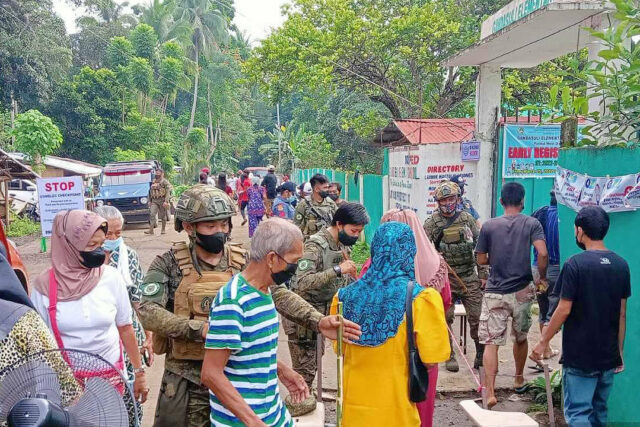
Sulu holds ‘most peaceful’ election in local history; 5 arrested in Cotabato City 

PHILIPPINE ARMY

NO ELECTION-RELATED violence was reported in Sulu, a remote island province in the southwestern part of the Philippines that has been known as a lair of the bandit Abu Sayyaf group, according to a top military official.  

“We are happy and proud to say that the election in Sulu is successful with zero election-related violent incident. In all areas we were deployed, election went on smoothly as scheduled and planned,said Major General Ignatius N. Patrimonio, commander of the military-police Joint Task Force Sulu. 

The presence of the security forces has provided confidence to our people to vote and prevented those who have planned to conduct atrocities. This is remarkably the most peaceful election in the history of Sulu,he said in a statement on Wednesday.   

He said there were three minor incidents involving heated verbal exchanges and fistfights, but responding security officers were able to immediately stabilize the situation.  

There has been such a big change in the security landscape in Sulu,Mr. Patrimonio said.  

In the last couple of years, there were several bombing incidents in the provincial capital Jolo involving the Islamic State-affiliated Abu Sayyaf.   

The military said members of the joint task force performed election duties as well as strengthened operations against the group known for its kidnap-for-ransom activities.       

In Cotabato City, the political center of the Bangsamoro region where political rivalry for local posts has been fierce, five people were arrested on the evening of May 9 for attempting to vote using other peoples identity.   

The regional police office said the five were all caught in the same precinct for violating the Omnibus Election Code provision that prohibits voter substitution for another whether with or without the latters knowledge and/or consent.”  

The five suspects were identified as supposedly poll watchers.   

Several election-related incidents at the weekend leading up to voting day prompted authorities to deploy Commission on Election-trained police officers to take over the functions of electoral boards. MSJ 

Comelec to hold special elections in some Lanao del Sur areas 

THE COMMISSION on Elections (Comelec) will hold special elections in some areas in Lanao del Sur, a province under the Bangsamoro region, after a failure of elections was declared in several municipalities due to violent and irregular incidents.   

“Considering that the election for local positions in the concerned municipalities may still be affected by the number of registered voters in the above precincts, and so as not to disenfranchise the voters in the above precincts, The Commission resolves with modification the recommendation,” the Comelec en banc said in a memo dated May 10.  

The election body will still decide on the date for the special polls.  

Bangsamoro Regional Election Director Ray F. Sumalipao, who reported the failure of elections, recommended holding the special elections on May 15.  

Among the incidents recorded were ballots being stolen, and an instance of violence that resulted in damaged vote-counting machines.   

In a barangay in Butig, Lanao del Sur, military personnel were unable to retrieve the ballots and a policeman was stabbed trying to protect the vote-counting machines, Mr. Sumalipao reported.  

The Comelec full court said they will designate personnel from the Philippine National Police as a special board of election inspectors for the special polls.  

New official ballots and other equipment will be prepared specifically for the barangays listed in the regional report.  

Election Commissioner George Erwin M. Garcia told reporters in a Viber message that the barangays will vote for national and local positions.  

Comelec will also delegate Mr. Sumalipao to supervise the special elections.  

Prior to the May 9 voting, three towns Tubaran, Malabang, and Maguing and Marawi City in Lanao del Sur were placed under Comelec control. John Victor D. Ordoñez 

Outgoing Bacolod mayor considers contesting election result 

BACOLOD CITY PIO

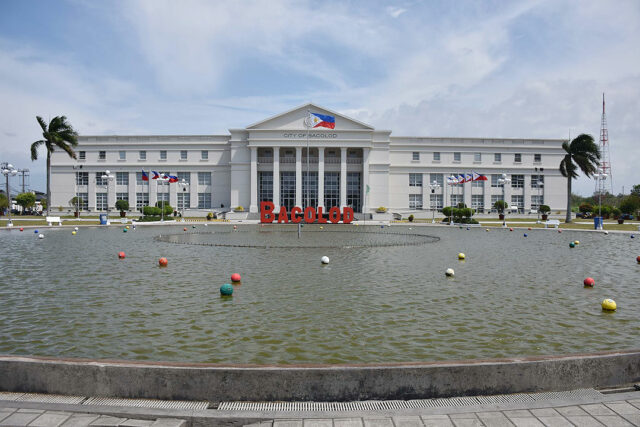
BACOLOD Mayor Evelio R. Leonardia, who lost his reelection bid, is looking at contesting the May 9 outcome, which he called mysterious and unbelievableas several of his party mates also lost.   

For now, we will leave the matter with our legal team. It will be up to the lawyers to study and look into possible legal remedies so that we can have the vote counting machines rechecked to satisfy the questions raised by the GP (Grupo Progreso) slate and all our supporters,Mr. Leonardia said in a statement released Wednesday.   

The winning mayor, former Negros Occidental congressman and businessman Alfredo Abelardo “Albee” B. Benitez, was proclaimed Tuesday.    

Many of our Grupo Progreso supporters are still in shock over the results of the May 9 local elections in Bacolod City. They chorus that the results are mysterious and unbelievable,the incumbent said.   

He also cited observations made by some quarterson irregularities in the casting of votes, malfunctioning vote-counting machines, and other incidents reported by their poll watchers.   

Mr. Benitez, who served three terms as Negros Occidental representative from 2010 to 2029, got 171,893 votes while Mr. Leonardia received 107,447, based on the final count.  

The partys candidate for vice mayor, reelectionist El Cid Montilla Familiaran, won against two rivals with 128,893 votes.  

For the Sangguniang Panlungsod or city council, GP won four of the 12 seats. MSJ 

USAID gives health, educational supplies to over 100 schools in Maguindanao  

BANGSAMORO.GOV.PH

THE UNITED States Agency for International Development (USAID) has donated health and educational supplies to over 100 schools in Maguindanao, it said in a statement on Wednesday.  

This comes following the recent launch of the Beginning Reading Program for learners in Cotabato City and Maguindanao, a program undertaken with the Bangsamoro Ministry of Basic, Higher, and Technical Education (MBHTE).  

The goal of this program is to ensure that every Bangsamoro child has access to learning,said USAID Philippines Office of Education Director Thomas LeBlanc in a statement.   

The technology-based program uses low-cost electronic tablets that can function without internet connection to help children from Kindergarten to Grade 3 learn to read. Each device includes early-grade reading materials and video-based reading modules in the local language.  

By teaching children to read, USAID is opening the door to economic opportunity and lifelong learning,he added. 

USAID also introduced the school-in-a-bag program for Bangsamoro learners. They provided 20 packages containing a laptop and 10 tablets each for schools in far-flung and conflict-affected areas. 

Education is very, very important to us, and we are extremely thankful that USAID is supporting the use of our language,said MBHTE Minister Mohagher Iqbal. This is very critical to our continuing efforts to the recognition of our identity as Bangsamoro.”  

USAID has worked with the Philippine government and local organizations for 60 years, investing more than P247.5 billion as support. Alyssa Nicole O. Tan