Home Blog Page 5897

Lightyear star Chris Evans calls critics of on-screen representation ‘idiots’

LOS ANGELES — Walt Disney Co.’s new animated Pixar movie Lightyear features a gay couple, the latest step by the company to show traditionally under-represented groups on the big screen.

Actor Chris Evans, who voices the main character in Lightyear, applauded moves to reflect all types of people and said those who react negatively should be disregarded.

“The real truth is those people are idiots,” Mr. Evans said in an interview with Reuters Television ahead of the debut of Lightyear in theaters on Friday.

“Every time there’s been social advancement as we wake up, the American story, the human story is one of constant social awakening and growth and that’s what makes us good,” he added.

Lightyear was banned in the United Arab Emirates because it depicts homosexuality, and Disney has been unable to secure permission to show the movie in 13 other Middle Eastern and Asian countries.

The movie is Pixar’s imagining of the movie that inspired the toy version of Buzz Lightyear featured in the acclaimed Toy Story franchise.

Mr. Evans voices Buzz Lightyear, a legendary space ranger. Buzz’s close friend in the film is a female space ranger who marries another woman. A scene showing milestones in the couple’s relationship includes a brief kiss.

“There’s always going to be people who are afraid and unaware and trying to hold on to what was before. But those people die off like dinosaurs,” Mr. Evans said. “I think the goal is to pay them no mind, march forward and embrace the growth that makes us human.”

Producer Galyn Susman asked why viewers “don’t get more upset showing failed relationships.”

In Lightyear, “We have a relationship here which lasts an entire lifetime. It’s loving, it’s supportive and it shows Buzz exactly what he doesn’t have and that’s the whole point.

“We should all be so lucky to have that kind of relationship in our life,” she added. — Reuters
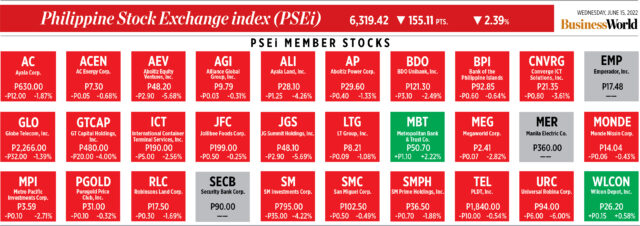
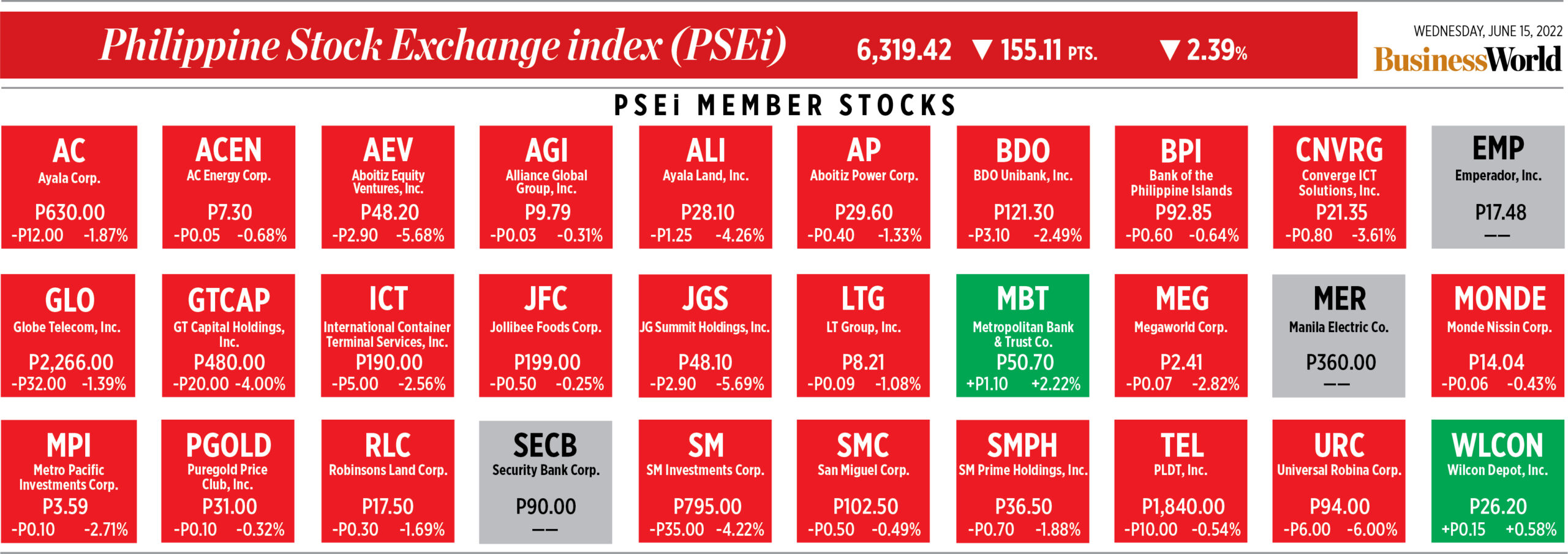
How PSEi member stocks performed — June 15, 2022

Here’s a quick glance at how PSEi stocks fared on Wednesday, June 15, 2022.


Stocks sink as market expects aggressive Fed hike

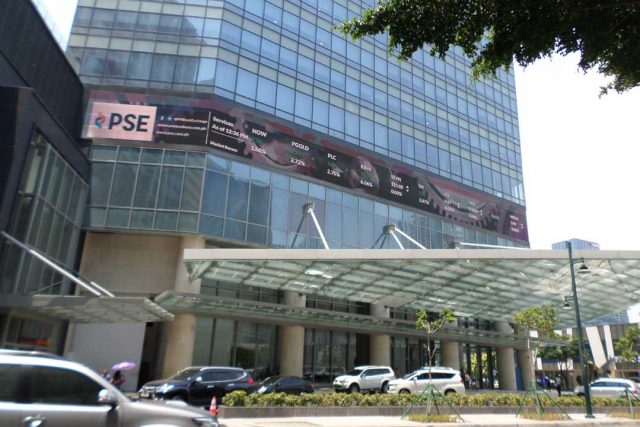
BW FILE PHOTO

PHILIPPINE STOCKS sank on Wednesday ahead of the US Federal Reserve’s rate-setting meeting, where analysts are forecasting an aggressive 75-basis point (bp) hike amid rising inflation.

The benchmark Philippine Stock Exchange index (PSEi) sank by 155.11 points or 2.39% to close at 6,319.42 on Wednesday, while the broader all shares index dropped by 61.35 points or 1.76% to 3,409.70.

“Philippine shares fell ahead of the Fed’s decision later tonight, while carrying the negative sentiment from last night’s US market performance. The market is betting on a 75-bps rate hike, the biggest increase since 1994,” Regina Capital Development Corp. Head of Sales Luis A. Limlingan said in a Viber message on Wednesday.

“The PSEi declined today after US stock markets again mostly lower overnight. The Fed starts its rate-setting meeting with consensus building around a 75-bps hike,” Rizal Commercial Banking Corp. Chief Economist Michael L. Ricafort said in a text message.

He added that the market is concerned that the Fed’s aggressive stance in fighting inflation would lead to a US recession.

Investors have dramatically raised their bets that the Fed will raise interest rates by 75 bps rather than 50 bps on Wednesday, a swing in expectations that has fueled a violent sell-off across world markets, Reuters reported.

Expectations for a 75-bp hike at the June meeting jumped to 89% on Tuesday from only 3.9% a week ago, according to CME’s FedWatch Tool.

Traders see the 75-bp rate increase negatively impacting the valuation of equities, particularly technology stocks, and possibly jeopardizing post-coronavirus disease 2019 (COVID-19) recovery.

The Fed ends its two-day Federal Open Market Committee meeting on Wednesday.

The US consumer price index (CPI) surged to 8.6% in May, the largest year-on-year increase in roughly 40 years.

Fed policy makers had signaled half-point interest rate hikes at their meeting next week and again in July ahead of the release of the May CPI report.

Back home, all sectoral indices posted losses on Wednesday. Holding firms fell by 225.41 points or 3.74% to 5,800.37; property declined by 79.31 points or 2.63% to 2,936.28; services gave up 27.12 points or 1.55% to end at 1,713.40; industrials dropped by 121.40 points or 1.35% to 8,853.30; financials went down by 11.95 points or 0.76% to 1,547.73; and mining and oil retreated by 36.08 points or 0.31% to 11,588.35.

Decliners beat advancers, 137 versus 40, while 53 names ended unchanged.

Value turnover surged to P11.03 billion with 3.65 billion shares changing hands from the P5.60 billion with 827.41 million issues seen on Tuesday.

Net foreign selling slipped to P1.22 billion from the P1.25 billion seen the previous trading day. — Luisa Maria Jacinta C. Jocson with Reuters

Peso drops vs dollar on tightening bets

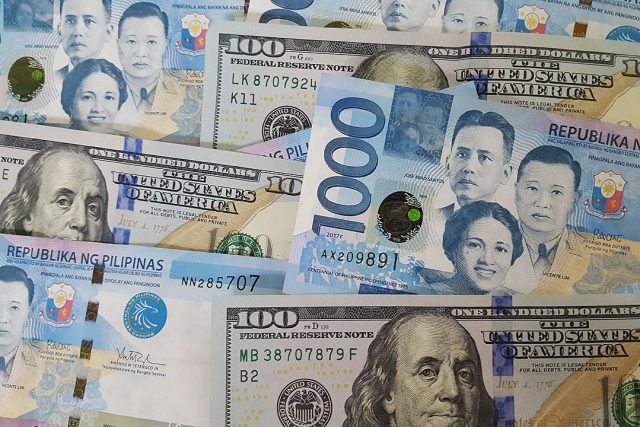
BW FILE PHOTO

THE PESO declined anew against the greenback on Wednesday on expectations of aggressive tightening by the US Federal Reserve and losses at the local stock market.

The local unit closed at P53.435 versus the dollar, sinking by 18.5 centavos from its P53.25 finish on Tuesday, data from the Bankers Association of the Philippines showed.

The peso opened Wednesday’s session at P53.30 against the dollar, which was also its intraday best. Its weakest showing for the day was at P53.47 against the greenback.

Dollars exchanged slipped to $1.164 billion on Wednesday from $1.167 billion on Tuesday.

Rizal Commercial Banking Corp. Chief Economist Michael L. Ricafort said the local unit weakened ahead of the conclusion of the Fed’s policy review.

The first trader in an e-mail likewise said the local unit weakened due to expectations that the Fed would hike rates aggressively.

“The local currency might weaken further as the US central bank is highly anticipated to provide further statements on their aggressive aim to bring down US inflation,” the trader added.

A second trader in a Viber message said the peso was weaker after the higher-than-expected US inflation of 8.4% in May that prompted bets of a hike as large as 75 basis points (bps) from the Fed at its meeting.

“All eyes will be on the FOMC (Federal Open Market Committee),” the second trader said.

The Fed ends its two-day policy meeting on Wednesday. Investors have dramatically raised their bets and now expect the Fed to raise interest rates by 75 bps rather than 50 bps at its meeting, a swing in expectations that has fueled a violent sell-off across world markets, Reuters reported.

Expectations for a 75-bp hike at the June meeting jumped to 89% on Tuesday from only 3.9% a week ago, according to CME’s Fedwatch Tool.

Traders see the 75-bp rate increase negatively impacting the valuation of equities, particularly technology stocks, and possibly jeopardizing post-COVID-19 recovery.

Mr. Ricafort also blamed the peso’s decline on losses at the local stock market.

The benchmark Philippine Stock Exchange index dropped by 115.11 points or 2.39% to close at 6,319.42 on Wednesday, while the broader all shares index declined by 61.35 points or 1.76% to 3,409.70.

For Thursday, the first trader sees the peso moving between P53.35 and P53.55, while Mr. Ricafort expects the local unit to range from P53.30 to P53.50 versus the dollar. — T.J. Tomas with Reuters

FIRB flags PEZA over incomplete locator data

THE Fiscal Incentives Review Board (FIRB) said the Philippine Economic Zone Authority (PEZA) has inadequately accounted for the investments brought in by its locators and cannot provide complete data on some companies’ operations.

In a statement on Wednesday, the Department of Finance (DoF) said that PEZA submitted incomplete information regarding some of its locators’ investment levels and markets served, after being asked to produce such data.

Finance Secretary Carlos G. Dominguez III chairs the FIRB.

In a statement, PEZA said its deadline to submit its reports to the FIRB has not yet lapsed.

The FIRB was seeking the information to monitor the locators’ compliance with the Corporate Recovery and Tax Incentives for Enterprises (CREATE) law, in order to determine their eligibility for incentives like tax holidays and a special corporate income tax.

“PEZA did not give us the data on the actual investment. They said they are not monitoring that,” Finance Assistant Secretary and FIRB Secretariat Head Juvy C. Danofrata was quoted as saying in her report during a recent DoF meeting.

Asked to comment, PEZA Director General Charito B. Plaza said in a statement that the report issued by the FIRB was “erroneous and misleading” and designed to “embarrass PEZA as an Investment Promotion Agency (IPA).”

“PEZA is confident that benefits of incentives to investments outweigh the foregone taxes,” she added.

On the specific matter of incomplete data, PEZA said the “accepted practice” for IPAs before Republic Act No. 11534 or the CREATE Act took effect was to submit monthly reports on approved foreign investments to the Department of Trade and Industry. Similar reports were filed on a quarterly basis to the Philippine Statistics Authority (PSA).

“This is the accepted practice for all IPAs including PEZA, to monitor the committed investments of our enterprises. The PSA posts on its website quarterly reports on approved foreign investments based on the consolidated submission of the IPAs. When the CREATE Act took effect in April 2021, the FIRB (was) included in the monthly submission of our reports.”

“The requirement to monitor the approved and actual amount of investments of the (registered business enterprises) is a report imposed only under the CREATE Act under Section 205 with the filing of the annual benefits report. Most of our RBEs submitted these reports to the FIRB on June 15, while PEZA has until July 15 to submit our reports to the FIRB.”

Of the 196 businesses registered with PEZA, reports on 12 contained no information regarding the levels of capital invested, while another 11 contained no information about the markets they served, the DoF said.

The DoF said that as of April 30, only four investment promotion agencies were able to fully comply with the requirements — the Bases Conversion and Development Authority, the John Hay Management Corp., the Poro Point Management Corp., and the PHIVIDEC Industrial Authority. 

“These reports are important to enable the FIRB to fulfill its monitoring and oversight function over the IPAs and the overall administration and grant of tax incentives,” Ms. Danofrata said.

She added that these reports are also shared with other government agencies, especially the Bureau of Internal Revenue, for monitoring and audit purposes. She also said that the FIRB Secretariat had sent follow-up letters to IPAs that have incomplete and missing submissions.

The FIRB found that the 136 companies registered with the Board of Investments invested capital of P43.12 billion, with 127 serving the domestic market and the remaining nine export-oriented.

The other IPAs are the Authority of the Freeport Area of Bataan, Aurora Economic Zone and Freeport Authority, Cagayan Economic Zone Authority, Clark Development Corp., Regional Board of Investments-Bangsamoro Autonomous Region in Muslim Mindanao, Subic Bay Metropolitan Authority, Tourism Infrastructure and Enterprise Zone Authority, and Zamboanga City Special Economic Zone Authority.

All IPAs, including PEZA, registered 348 companies as of the end of April, of which 237 serve the domestic market while 100 are exporters.

“The real estate, services, and manufacturing sectors are the industries with the highest number of registered firms. Of the 348 firms, 25 have no information on their industry classification,” Ms. Danofrata said. — Tobias Jared Tomas

PCCI backs agrarian reform amendments allowing bigger farms

PHILSTAR FILE PHOTO

AMENDMENTS are needed to the Comprehensive Agrarian Reform Law that will relax the rules on land consolidation and ownership to allow the more efficient farming of larger tracts of land, the Philippine Chamber of Commerce and Industry (PCCI) said.

“The weak agriculture system is principally driven by the low productivity of farmers and despite the implementation of the comprehensive land reform law and various support services, the Philippines continues to lag her neighbors in ASEAN in terms of development,” the chamber said in a statement.

“Land fragmentation as a result of the land reform program negatively impacts agricultural productivity and efficiency,” Foundation for Economic Freedom (FEF) Senior Policy Consultant George S. Katigbak added.

Currently, agrarian reform beneficiaries (ARBs) are prohibited from leasing or selling their property within 10 years of award. Also prevented from disposing of their land are those with unpaid obligations to Land Bank of the Philippines, or approximately 71% of all ARBs.

“The evidence on land pawning and selling show that land consolidation is actually taking place underground. In essence, we are not bringing in anything new, we are just formalizing what is happening on the ground which is an economic efficiency argument,” Mr. Katigbak said.

PCCI Agriculture Committee Chairman Paul Cuyegkeng said that land consolidation is the right direction to take and has a successful track record for driving efficiency.

“In my area, we have tried to consolidate a few hectares and it is working. We are grouping the farmers to form a cooperative and trying to put them together with the Cooperative Development Authority (CDA). The key thing is to make sure that we got the right representatives to manage the coop because you need people that can be trusted, honest in serving the coop members,” he said.

The FEF recommended amendments like the conversion of CLOAs (certificate of land ownership awards) to fee simple titles in order to increase the land values and efficiency in land transactions. — Luisa Maria Jacinta C. Jocson

Philippines ready to join coalition of WTO trade ministers to address climate change

PHILIPPINE STAR/ MICHAEL VARCAS

THE Trade department said on Wednesday that the Philippines is ready to join the coalition to be formed by the members of the World Trade Organization (WTO) working to address the impact of climate change.

Trade Undersecretary Ceferino S. Rodolfo represented the Philippines at a mini ministerial meeting on climate change in Geneva on June 13, the Department of Trade and Industry (DTI) said in a statement.

The meeting was held on the sidelines of the 12th WTO Ministerial Conference, which took place from June 12 to 15, in which ministers reviewed the functioning of the multilateral trading system.

“During the meeting, ministers committed to strengthen engagement and dialogue with a view to creating a Coalition of Trade Ministers to address climate change,” the DTI said.

Mr. Rodolfo said the Philippines, a climate vulnerable country, “supports the vision of a coalition of Trade Ministers to respond to climate change and supports revitalizing plurilateral engagement on environmental goods and services that builds on work in other fora like APEC (Asia-Pacific Economic Cooperation).”

The department noted that the coalition can provide guidance on the “scope and approach” to future negotiations.

Mr. Rodolfo also said during the meeting that the Philippines has aggressive goals in terms of supporting the transition to clean energy.

“For us to meet these ambitions, developing countries must forge partnerships with the developed world on financing, technology transfer, and technical assistance,” he noted.

The Philippines is following a sustainable finance roadmap, the DTI said, adding that it has just enacted a law aimed at developing the electric vehicle industry.

“The Philippines is now co-leading with Australia a work stream on promoting trade to tackle plastics pollution,” it added.

Mr. Rodolfo said countries must continue to share experiences in dealing with the problem and contribute to the multilateral treaty on plastics.

“He called for further cooperation on this front to pursue strategies that would reduce single-use plastics and support sustainable plastic packaging,” the DTI said.

It noted that packaging accounts for almost 50% of the plastics market in the Philippines. — Arjay L. Balinbin

Duterte issues EO abolishing Municipal Development Fund Office

PCOO.GOV.PH

PRESIDENT Rodrigo R. Duterte has issued an executive order (EO) abolishing the Municipal Development Fund Office (MDFO), which provides technical assistance and credit finance or grants to local government units (LGUs) pursuing sustainable socio-economic development projects.

Executive Order 173, signed on June 10, dissolves the MDFO within 90 working days from the order’s effectivity. The EO designated the Secretary of Finance to implement the order and to oversee the disposition or transfer of the office’s functions, personnel and assets.

“There is a need to promote economy, efficiency and effectiveness in the delivery of public services across all executive departments and office,” Mr. Duterte said in the order, “including the rationalization of functions and activities carried out by the public sector.”

The MDFO made available funds to LGUs and was itself funded by foreign loans, development assistance, or grants.

All assets and liabilities of the office are to be transferred to the Department of Finance (DoF), including its remaining funds, except cash on hand and in bank accounts, which will instead be remitted to the National Treasury.

MDFO’s rights and obligations as administrator of official development assistance funding will also be transferred to the DoF.

The DoF has been instructed to absorb the office’s personnel without change in their rank, salaries and benefits. Workers who are not absorbed will receive corresponding separation and retirement benefits. — Alyssa Nicole O. Tan

Tax violations and responsible corporate officers and employees

With great power comes great responsibility. In the corporate world, the management team, especially those holding executive positions, possesses immense responsibility under the law.

Government policy views the acts of certain corporate officers as equivalent to the acts of the corporation, such that when these corporate officers enter into certain undertakings, they also commit the corporation. Generally considered alter egos of the corporation, people holding such positions are, most of the time, liable in case of violations committed by the company. This principle applies when a corporation is criminally charged with an offense punishable with imprisonment, since a corporation, as an artificial being created by the fiction of law, cannot be arrested and imprisoned. As early as the 1930s, the Supreme Court has held that the responsible officer must personally bear the criminal liability because a corporation can act only through its officers and agents.

Specifically, in the case of criminal violations under Section 255 of the Tax Code committed by associations, partnerships, or corporations related to the failure to file a return, supply correct and accurate information, remit the tax withheld, and refund excess taxes withheld on compensation, the criminal penalty is to be imposed upon the responsible corporate officers, partners, or employees. These are the partner, president, general manager, branch manager, treasurer, officer-in-charge, and employees responsible for the tax violations of the enterprise.

Imposing the criminal penalty on a specific corporate position will clearly identify a person who is to be held liable. The challenge, however, is when the liability is not imposed on a specific position but on the person responsible for the violation due to the latter’s acts or omissions. How do we determine who among the corporate officers or employees is responsible for the tax violation?

To help determine whether a particular individual is liable for the violation, the following elements must be proven:

(a) A corporate taxpayer is required under the Tax Code to pay any tax, make a return, keep any record, or supply correct and accurate information;

(b) The corporate taxpayer failed to pay the required tax, make a return or keep the required record, supply the correct and accurate information, withhold or remit taxes withheld, or refund excess taxes withheld on compensation, at the time or time required by law or rules and regulations; and

(c) The accused, as the employee or officer, is responsible for the violation, and he/she willfully did the above acts.

Generally, proving the first two elements is easier than the third one. Determining whether an individual is a responsible officer who may be charged and convicted of failure to pay taxes and willfully did so is contentious, especially if the position held by the individual is not among those specifically identified by the Tax Code to be criminally liable.

In one criminal case, a Manila City Prosecutor charged an Executive Vice-President of a company for violating Section 255 in relation to Sections 253(d) and 256 of the Tax Code due to alleged willful neglect and refusal of the company to pay its tax liabilities despite the notices issued by the Bureau of Internal Revenue (BIR). The charge against the Executive Vice-President is mainly because she signed a letter to the BIR, asking for an extension to pay the company’s tax liabilities and signifying her intent as the corporate representative to settle through compromise. The issue is whether such an act is enough to make her criminally liable as a corporate officer. The Supreme Court held that such an act is not an indication of the individual’s significant role in the management of corporate affairs to be liable for the tax violation.

The Supreme Court explained that the individual’s position as Executive Vice-President does not automatically make her liable for the failure of the company to pay its tax liabilities. What the Tax Code requires is that the individual must have been the employee or officer responsible for the violation. The letter executed by the Executive Vice-President is not enough to find her guilty beyond reasonable doubt as it does not prove that she actively participated in or has failed to prevent the company’s violations of the law.

The Supreme Court noted that the BIR, as the prosecution, failed to present evidence that the Executive Vice-President’s duties and responsibilities contributed to the company’s failure to pay its tax liabilities through active participation; neither was there evidence that she yielded the power to prevent such violation. Absent such proof, the Court cannot convict the Executive Vice-President for violating the Tax Code.

This Supreme Court case might give some comfort to other corporate officers (other than the partner, president, general manager, branch manager, treasurer and officer-in-charge) that when they exercise their functions, proof beyond reasonable doubt that they actively participated in or failed to prevent the company’s tax violations is necessary before they can become criminally liable for such violations. Nevertheless, getting charged with a criminal violation is no small thing. I can only begin to imagine the weight of the responsibility that high-ranking corporate employees and officers bear every time they exercise their functions and the pressure and anxiety they experience whenever an action is questioned by no less than the taxing authority.   

The views or opinions expressed in this article are solely those of the author and do not necessarily represent those of Isla Lipana & Co. or Cabrera & Company. The content is for general information purposes only, and should not be used as a substitute for specific advice.


Maria Ysidra May Y. Kintanar-Lopez is a senior manager at the Tax Services Department of Isla Lipana & Co. and a senior legal advisor of Cabrera & Company, member firms of the PwC network.

+63 (2) 8845-2728

may.y.kintanar@pwc.com

DoH: Waning immunity may spur severe infections

PHILIPPINE STAR/EDD GUMBAN

By Alyssa Nicole O. Tan, Reporter

MORE Filipinos are expected to suffer from severe and critical coronavirus infections by August amid lax health protocols, slow booster uptake and the entry of more contagious Omicron variants, according to the Department of Health (DoH).

“There will be a rise in hospitalizations by August — about 4,800, which is much more than the projected hospitalizations when we encountered the Delta variant,” Health Undersecretary Maria Rosario S. Vergeire told an online news briefing in mixed English and Filipino on Wednesday.

“These are projections, these are not cast in stone,” she said. “These projections are made so that we can prepare and be guided in our preparations and our planning.”

An inter-agency task force has recommended that Metro Manila and most areas of the country be kept under Alert Level 1, presidential spokesman Martin M. Andanar said in a statement.

Ms. Vergeire traced Filipinos’ waning coronavirus immunity to the entry of more contagious Omicron variants. Booster shots would increase one’s immunity to the virus, she added.

The Health department has said 69.8 million people or 78% of the target population had been fully vaccinated against the coronavirus as of June 13, while 14.56 million people have received booster shots.

Only immunocompromised people, senior citizens and health workers can get their second booster shot. About 580,000 of them have been injected with their fourth vaccine shot.

Meanwhile, DoH said it has detected six more people with the BA.5 Omicron subvariant, two of whom came from the National Capital Region and one each from Ilocos, Cagayan Valley, Western Visayas and Northern Mindanao.

Two had mild symptoms, while the others were still being verified. Five of them have recovered, while one was still under home quarantine.

The agency also said 10 more people had been infected with the BA.2.12.1 Omicron subvariant, four of whom came from the capital region, two from Calabarzon, and one each from Ilocos, Cagayan Valley, Bicol and Western Visayas.

Two had mild symptoms, three did have any symptoms, while the others were still being verified. Eight of them have recovered, one remained active, while the other was still being verified.

Ms. Vergeire said Congress should extend the state of national calamity, which will end on Sept. 12 after being extended twice.

She said emergency use authorizations for coronavirus vaccines and drugs against the disease, emergency procurement, tax exemptions, price control and the benefits of health workers could be affected once the law lapses.

“All of these must first be arranged by the government before we can recommend the lifting of the country’s state of emergency,” she said. “The incoming administration will have that authority to decide.”

The country needs to stay under a state of calamity since infections could still rise as more variants are detected, Ms. Vergeire said.

Daily COVID-19 infections in the Philippine capital and nearby cities could hit as many as 500 by the end of the month, Fredegusto P. David, a fellow from the OCTA Research Group, said on Tuesday.

Coronavirus cases in Metro Manila have surpassed the 10% weekly increase seen recently, he added, while its positivity rate has climbed to 2.7%, with the virus’ reproduction number increasing to 1.59.

On June 13, the capital region had the most infections at 188.

The DoH recommended the use of face masks until the end of the year to ensure protection from not only COVID-19, but also other diseases.

“The mask did not only protect us against COVID-19,” Ms. Vergeire said. “It also protected us from other respiratory infections, even with this monkeypox. We can be protected from monkeypox by just wearing a mask.“

People should remove masks only when or exercising, she added.

Drug war mostly successful despite ‘excesses’ — DoJ

PHILSTAR FILE PHOTO

PRESIDENT Rodrigo R. Duterte’s deadly war on drugs was largely successful despite “excesses” committed by rogue cops, according to his Justice chief.

“People now feel safer in the streets even at night due to the visible reduction in drug pushing incidents,” Justice Secretary Menardo I. Guevarra told an online forum on Wednesday. “In that aspect, the campaign against drugs was fairly successful.”

“But then clearly there were excesses that have even been brought to the attention of international groups, which is why the Department of Justice (DoJ) has led a campaign to address these abuses in its implementation,” Mr. Guevarra told the Kapihan sa Manila Bay forum, based on a video posted on Facebook.

The Justice department has faced increasing pressure from domestic and international groups to prosecute more erring cops.

Government prosecutors have filed charges in court against law enforcers in four cases and planned to probe 250 more of what could have been wrongful deaths in Mr. Duterte’s war on drugs, Mr. Guevarra told the United Nations Human Rights Council in February.

“We are very much aware of these excesses,” he told the forum. “We have a drug war committee that really investigates reports of abuse or use of unnecessary force by law enforcement agents.”

An inter-agency committee formed 15 teams last year that probed extralegal killings and human rights violations.

The International Criminal Court (ICC), which investigates and prosecutes people charged with genocide and other war crimes, had probed the country’s anti-illegal drug campaign.

Mr. Guevarra said the ICC had not targeted Mr. Duterte himself, but it wanted to find out whether crimes against humanity were  committed.

Filipino lawyers have been calling on the ICC to resume its probe of the anti-drug campaign, saying the DoJ was only looking into 52 deaths out of the tens of thousands killed.  

Detained Senator Leila M. de Lima, who has been in jail since 2017 on drug trafficking charges, earlier said the justice system was broken.

“No judicial system is perfect since this is a human creation,” Mr. Guevarra told the online forum. “It is prone to corruption and manipulation but our justice system works.”

The DoJ on Tuesday said it would continue prosecuting Ms. De Lima, who is one of Mr. Duterte’s most outspoken critics, even after at least four witnesses retracted their testimonies against her.

Political and human rights experts have said Ms. De Lima’s detention showed how the Philippine justice system could be easily abused.

Meanwhile, Mr. Guevarra said the country’s anti-communist task force should file complaints rather than simply labeling people as communists.

“The DoJ has been clear about its stance on red-tagging,” he said. “If you think some people are violating laws, file a case. What’s the point of labeling people?”

Incoming Justice Secretary Jesus Crispin C. Remulla earlier said he would look at the results of the DoJ’s review of extralegal killings by police in the government’s war on drugs.

He also vowed to abide by the Constitution when he assumes office amid worries from various human rights groups over his history of accusing individuals of being communists.

As justice chief, Mr. Remulla will become a member of the newest anti-terror law’s Anti-Terrorism Council. He will also head a committee that investigates the killings of activists and dissenters.

The Philippine Human Rights Commission said the Duterte government had encouraged a culture of impunity by hindering independent inquiries and by failing to prosecute erring cops involved in the government’s anti-drug campaign. — John Victor D. Ordoñez

Marcos discusses energy security with more envoys

FERDINAND R. MARCOS, JR. — PHILIPPINE STAR/KRIZ JOHN ROSALES

PRESIDENT-ELECT Ferdinand R. Marcos, Jr. on Wednesday discussed energy security, foreign investments and the impact of global conflicts during separate meetings with envoys from Norway, Finland, Hungary, Romania and South Africa, his office said in a statement.

He met with Norway Chargé d’Affaires Bjorn Jahnsen, Finland Ambassador Juha Markus Pyykko, Hungarian Ambassador Titanilla Toth, Romanian Ambassador Raduta Dana Matache and South African Ambassador Bartinah Ntombizodwa Radebe-Netshitenzhe.

Mr. Jahnsen said Mr. Marcos and he discussed climate change and renewable energy particularly offshore wind, floating solar and hydropower.

“That’s the plan for the future for Norway and the Philippines — really to increase our imprint on renewable energy in the country,” he told a news briefing.

He said the Philippines should create a new sector especially for offshore wind to attract more foreign investors and generate as many as 50,000 high-paying jobs. 

Meanwhile, Ms. Toth said Hungarian companies were eyeing business-to-business partnerships with the Philippines. “Our companies are searching for partnership with local companies and local entities,” she said.

The Philippines can also expect more collaboration in the education and labor sectors, she said, citing a possible increase in scholarships and work for Filipinos in Hungary.

Hungary is accepting 35 Filipino scholars and is home to about 800 migrant Filipino workers, she said.

Mr. Pyykko said he underscored the value of upholding international law and international rule-based order during his meeting with Mr. Marcos, citing the Russia-Ukraine war.

“The Philippines has been in the group of countries condemning the aggression and what I convey to the President-elect is that I hope his administration will continue to appreciate and respect this approach from the Philippine side in the future as well,” he said.

Mr. Pyykkö said Russia’s invasion of Ukraine “has totally changed the security situation in my country and in the neighborhood there.”

Meanwhile, Ms. Radebe-Netshitenzhe told Mr. Marcos South Africa is ready to supply oil to the Philippines. — Alyssa Nicole O. Tan