Home Blog Page 5801

Undermanned Letran battles age-old rival San Beda

NCAA/SYNERGY/GMA
FRAN Yu would have to steer the Knights wheel one more time. — NCAA/SYNERGY/GMA

Games Today
(Filoil EcoOil Centre)
12 p.m. — Mapua vs JRU
3 p.m. — Letran vs San Beda

FOR the past two games, Fran Yu has been manning Letran’s ship with aplomb.

But with two of the Knights’ vital cogs out due to suspension, Mr. Yu would have to steer the wheel one more time.

Mr. Yu would have to step up even more as a Letran team minus starters Brent Paraiso and Louie Sangalang tackles age-old bitter rival San Beda today in the NCAA Season 98 at the Filoil EcoOil Centre.

The scrappy skipper had a Herculean effort in their last two games, unleashing 15 points, five assists, four rebounds and three steals in a bruising 67-62 win over the Mapua Cardinals Tuesday and 12 points, nine boards, five dimes and six swipes in an 81-75 win over the College of St. Benilde Blazers a week ago.

A win for the three-peat-seeking Dominican school would catapult it back to the top alongside idle CSB and Lyceum of the Philippines University on identical 4-1 records.

For San Beda, which is currently in a logjam at No. 5 with San Sebastian and University of Perpetual Help on 2-2 slates, it would barge into the magic four with a win in their 3 p.m. showdown.

It might help the San Beda Lions a bit that the sharp-shooting Mr. Paraiso and the energetic, bulldozing Mr. Sangalang would serve their one-game suspension slapped by league commissioner Tonichi Pujante for their unsportsmanlike play last game.

Mr. Paraiso got the boot after he hit Mapua’s Adrian Nocum dangerously on the nape that resulted to a disqualifying foul while Mr. Sangalang was ejected due to two technical fouls for taunting.

Now it will be up to Mr. Yu to take charge again.

Mapua (1-4), a runner-up a season ago, aims to come out of a rut while Jose Rizal U (2-2) shoots for a third win in row as they square off at 12 p.m. — Joey Villar

UP Maroons’ Tamayo seen as favorite to win Most Valuable Player award

UP FIGHTING Maroons’ Carl Tamayo — THE UAAP

WITH an expected leap from his national team stint, Carl Tamayo looms as the favorite to win the Most Valuable Player (MVP) plum when University of the Philippines shoots for a successful title defense in the UAAP Season 85 firing off tomorrow.

Mr. Tamayo, fresh from consecutive international stints with Gilas Pilipinas, has been declared by coaches to be at the forefront of the UAAP MVP derby with La Salle’s Mike Phillips and reigning MVP Ange Kouame of Ateneo in the mix.

But as huge of a feat it would be for the versatile 6-foot-7 cager only in his second year, ensuring that the UAAP crown stays in Diliman remains his lone, ultimate goal over any possible individual recognition.

“The goal is just to win the championship all the time, that’s the only goal,” vowed Mr. Tamayo after being hailed as Season 84’s Rookie of the Year.

Mr. Tamayo last season took the UAAP by storm with averages of 13.0 points, 7.5 rebounds, 1.5 assists and 1.3 steals to win the ROY award and a Mythical Five citation as UP dethroned Ateneo for its first title in 36 years.

This year, those numbers are expected to only increase following a fruitful trip with Gilas in the 2022 FIBA Asia Cup and the fourth window of 2023 FIBA World Cup Asian Qualifiers, which he’s hoping to carry over to the UAAP.

Tamayo’s meteoric rise also led to some rumors that he might be the next rising star set for an overseas stint but for now, the Cebu native assured that he will play nowhere else but in Diliman.

“I’m just focusing on UP, trying to help the team to win the championship again. I’ll never close my door to play abroad. But for now, I’m here in UP, to play in UP,” he vowed as UP opens its campaign against La Salle tomorrow. — John Bryan Ulanday

New York Yankees slugger Aaron Judge matches AL record with 61st home run

AARON JUDGE — REUTERS

YANKEES slugger Aaron Judge tied the American League (AL) home run record when he socked his 61st of the season on Wednesday night in New York’s road game against the Toronto Blue Jays.

Mr. Judge hit a two-run shot against Blue Jays left-hander Tim Mayza in the seventh inning, giving the Yankees a 5-3 lead. The blast to left also scored Aaron Hicks, who led off the inning with a single.

He pulled level on the AL single-season homer list with Roger Maris, who hit 61 for the Yankees in 1961. The only other AL player ever to hit 60 in a season was Babe Ruth, who had 60 for the Yankees in 1927.

Roger Maris, Jr., the former slugger’s son, and Patty Judge, the current star’s mother, shared an embrace in the first row of the stands after No. 61 cleared the fence.

Mr. Judge said after the Yankees’ 8-3 win, “It’s an incredible honor, getting a chance to be associated with one of the Yankee greats, one of baseball’s greats, words can’t describe it.

“That’s one thing so special about the Yankees organization, is all the guys that came before us and kind of paved the way and played the game the right way, did things the right way, did a lot of great things in this game and getting a chance to be mentioned with those guys now is, I can’t even describe it, it’s an incredible honor that’s for sure.”

Mr. Judge, 30, had gone homerless in seven consecutive games since hitting his 60th against the Pittsburgh Pirates on Sept. 20. He finished the Wednesday game 1-for-4 with a walk.

Regarding the record-tying blast, Mr. Judge said, “When I hit it, I thought I got enough, but it’s been a couple of games since I did that, so you never really know if it was going to get out or, so, I tried to sprint around the bases a little bit then once it got over the fence, just relief that now we’re leading the game.

“Getting a chance to tie Roger Maris, you dream about that kind of stuff, it’s unreal.”

The all-time single-season record is 73, set by the San Francisco Giants’ Barry Bonds in 2001. Sammy Sosa topped 60 three times for the Chicago Cubs from 1998-2001, and Mark McGwire exceeded 60 for the St. Louis Cardinals in both 1998 and 1999.

The Yankees have seven regular-season games remaining after Wednesday. — Reuters

LeBron James firm buying a major league pickleball team

FOUR-TIME NBA champion LeBron James is getting into the pickleball business, as his firm LRMR Ventures headlines a new ownership group buying a team with Major League Pickleball (MLP).

The four-time NBA MVP is joined by fellow basketball greats Draymond Green and Kevin Love, as well as investment firm SC Holdings and others, the elite North American league said on Wednesday.

MLP founder Steve Kuhn said the investment would be instrumental in helping the league achieve its goal of reaching 40 million pickleball players by 2030.

Pickleball is a fast-paced paddle sport with similarities to tennis, though played on a much smaller court with a net using a perforated plastic ball.

MLP is expanding its league to 16 teams from 12 and is due to wrap up its 2022 season in Columbus, Ohio next month.

Mr. James’ business partner Maverick Carter told CNBC that the sport’s community and “capacity to be both fun and competitive” were motivating factors in the deal. — Reuters

Sendoff fit for a king

Longtime tennis habitues know injuries have been part and parcel of Roger Federer’s campaigns on the back end of his career. The last decade, in particular, is littered with long absences from competition off necessary surgeries and compelled convalescence. It’s why he failed to claim any Grand Slam titles after Wimbledon in 2012 and heading into the Australian Open in 2017. It’s also why the next year was his last great one, and why the remainder simply proved to be a stepping stone to retirement.

True, Federer wanted to extend his stay at the top of the sport. He could have chucked his racket in the closet at anytime during his hobbled years and still been assured of his spot as the greatest player tennis has ever produced. True, major championships do count in the assessment of many, and, in this regard, Rafael Nadal and Novak Djokovic — currently at 22 and 21 with more likely to come — trump his single score aggregate. Then again, there can be no doubting his status as the best of the best of all time.

Needless to say, the writing on the wall had already been clear to Federer for a long while before he formally hung up his sneakers. As he would explain, however, he used the prospect of returning to the court at 41 as motivation to recover from yet another bout with the scalpel. Even as he held out hope, he understood that he was done. And so he prepared for his valedictory, with, as things turned out, the Laver Cup serving as the perfect venue.

Considering his accomplishments, Federer arguably deserved a better exit. A fairy-tale ending would have had him winning his doubles match alongside noted rival and good friend Nadal. Instead, they lost a close one, and, ultimately, the team-based competition itself. That said, he is universally beloved for a reason, and the crowd — and, significantly, his peers — in London couldn’t care less what the scoreboard reflected. They gave him a sendoff fit for a king, capped by a prolonged standing ovation with not a dry eye in the house. Which was why he left with happy tears, his heart full and place in history secure.


Anthony L. Cuaycong has been writing Courtside since BusinessWorld introduced a Sports section in 1994. He is a consultant on strategic planning, operations and Human Resources management, corporate communications, and business development.

Delivering on business and consumer expectations

There was clear convergence among the three major international financial institutions (IFIs) in terms of the Philippines’ growth prospects for 2022. True, the International Monetary Fund (IMF) slightly downgraded its prognosis but both the World Bank and the Asian Development Bank (ADB) actually upscaled their forecasts. The three institutions were one in estimating that the Philippine economy will grow by 6.5% this year. The outlier is the Singapore-based ASEAN+3 Macroeconomic Research Office (AMRO) that topped the three IFIs’ common forecast, by elevating its April forecast of 6.5% to 6.9%.

Except for AMRO’s, the growth forecasts of the three intersect the Philippines’ official target of 6.5-7.5% at its tail.

It is quite interesting that despite the directions of their updates, they all collapsed into one single growth rate.

They have their own reasons. The IMF is worried that the potential recession in the United States and China could affect local conditions. Such global shocks could come from reduced external trade with both countries such that the country’s growth momentum in the first half of the year is likely to slow down. For the World Bank, the sentiment is very bullish because of accommodative fiscal policy that is expected to recover domestic demand. For the ADB, the easing of mobility restrictions is expected to motivate a rebound in domestic demand and business activities. Like the ADB, AMRO holds that the growth driver is the reopening of the economy. Infrastructure projects will be key to investment demand.

But what is happening on the ground?

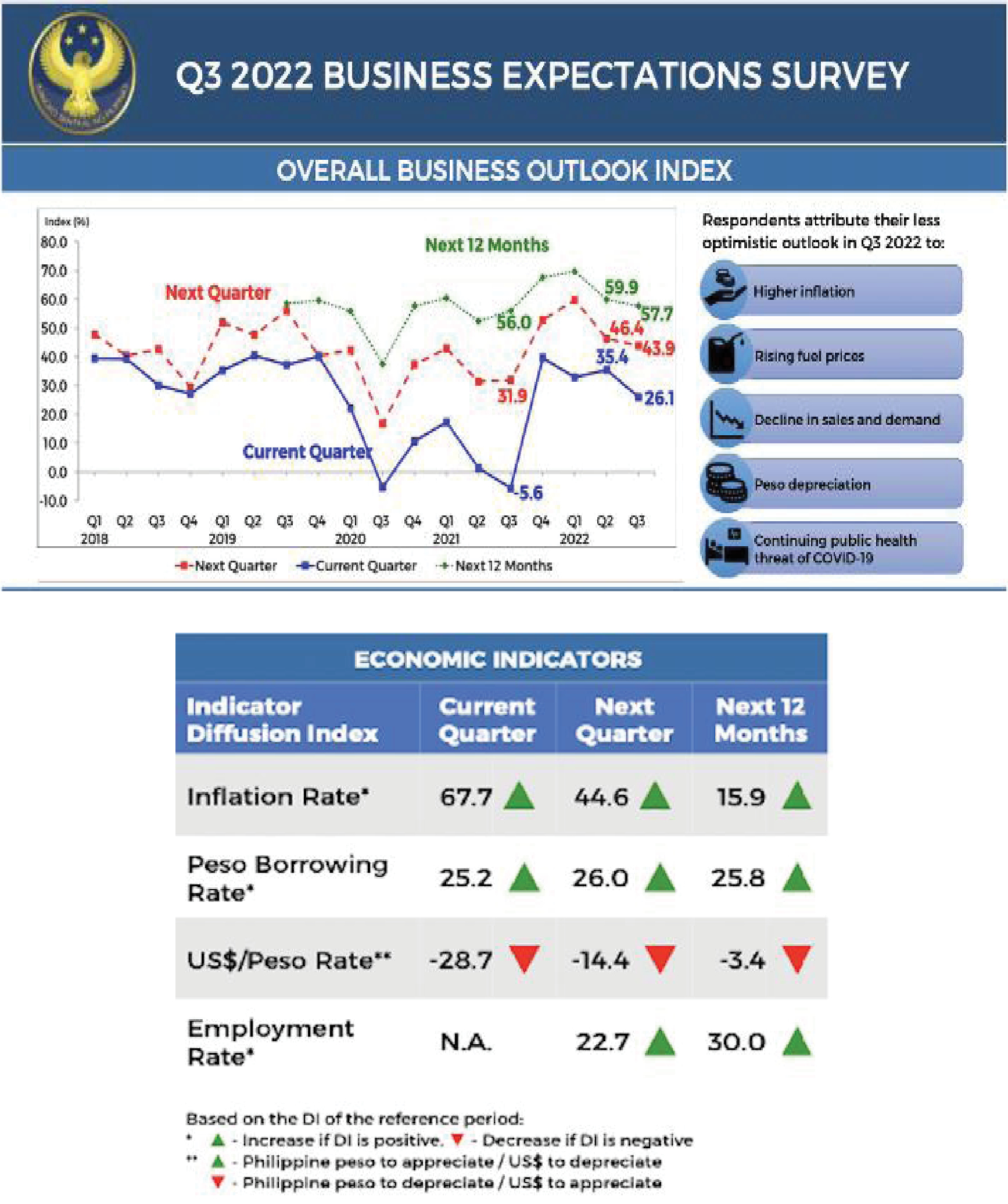
Based on the Bangko Sentral ng Pilipinas’ (BSP) Business Expectations Survey (BES) for the third quarter of 2022 conducted between July 6 to Aug. 15, overall business sentiment dropped for the same quarter, next quarter, and the next 12 months.
This quarterly survey has been reliable in terms of the representativeness of its sample as well as the reasonable correlation between business sentiment and actual economic growth. Loosely, the results may be considered good predictor of economic growth. If we take the BES as a proxy for gross capital formation in the national income accounts, it covers 25% of total gross domestic product (GDP). The BES is useful for planning purposes because the actual national income accounts are available only after more than two months from the subject quarter.

Respondent firms are drawn at random from the list of Top 7,000 corporations ranked based on total assets. The BSP represents in its regular survey results that BES provides “advance indication of the direction of change in overall business activity in the (Philippine) economy and in the various companies’ operations as well as in selected economic indicators.”

If the third quarter 2022 BES results point to the south, these may not be exactly positive for the Philippines’ actual GDP numbers. The respondents explained their less optimistic sentiment in terms of five factors: one, higher inflation of consumer goods, services, raw materials and production costs; two, rising fuel prices; three, decline in sales and demand; four, peso depreciation; and five, continuing public scare of COVID-19.

Less optimism or more pessimism appears to be the more prevailing sentiment across the global economies. This spirit is pervasive because of the risk of recession on account of an unprecedented rise in inflation and the subsequent monetary tightening by central banks all over the world. Undue rise in consumer prices destroys the public’s purchasing power and disincentivizes business from expanding the scale of their operations and hiring more workers. This is how poverty and inequality are birthed and intensified.

China, Croatia, France, Germany, Greece, Hungary, Mexico, South Korea, and the United States also reported less optimistic business sentiment for the same quarter. While business sentiment was more optimistic in Australia, Bulgaria, Israel, and the Netherlands, it turned pessimistic in Brazil, Canada, and Thailand and more pessimistic in New Zealand and the United Kingdom.

For the fourth quarter 2022, Philippine businessmen were less optimistic about the prospects of doing business. The reasons are basically of the same cut: rising prices of relevant commodities; lower demand/sales of construction materials and medicines; higher fuel prices; weaker peso and higher interest rates; and the usual decline in business due to the rainy season.

What about the business prospects for the next 12 months?

As the chart shows for the two more forward-looking periods of reckoning — next quarter and the next 12 months — business sentiment is expected to trend lower. If we invoke the correlation between business sentiment and actual GDP, the slowdown of real GDP from the first to the second quarter might continue in the third quarter of this year and for the next 12 months. Those factors behind the weak business sentiment are just too overriding. In fact, for the next 12 months, business respondents also added the burning issue of “shortage in (the) supply of food and raw materials” like fuel and construction materials.

On specific business operations, the sentiment is discouraging. Firms expect their financial condition and access to credit to be tighter, showing an actual decline. The BSP noted in its report that this specific finding was consistent with the second quarter Senior Bank Loan Officers Survey (SLOS) which indicated “an expectation of a net tightening of overall credit standards for loans to enterprises for the third quarter 2022.”

For the fourth quarter 2022, the employment outlook looks dim. A decline was reported even as the prospects for the next 12 months are more optimistic. Among the business constraints were stiff domestic competition and insufficient demand.

All told, business respondents expect a weak peso, and higher borrowing and inflation rates for the third quarter. Their inflation rate expectation of 5.6% for the whole year 2022 coincides with the latest BSP forecast. While the average exchange rate expectation of P55.2 for the year is weaker than the emerging P53.02 for the first nine months of the year, for business purposes, the prevailing exchange rate might be more relevant considering that their operations are forward-looking. It is likely that the last quarter of the year could see the peso averaging at least P57 to a dollar.

The other quarterly BSP survey covers the consumers as respondents. This is also an important survey because it gives us a glimpse of things to come from the consumption side of economic growth. Household consumption accounts for more than 70% of total GDP and therefore is the one big important driver of overall business activities. Consumer respondents are a random sample of some 5,000 households all over the Philippines.

The consumer outlook is based on three components namely, economic condition which captures their perception of the economic situation; family financial situation which covers the household income level, savings, debts, investment, and assets; and family income which includes primary income and receipts from other sources.

There is bad news and good news from our consumer expectations survey.
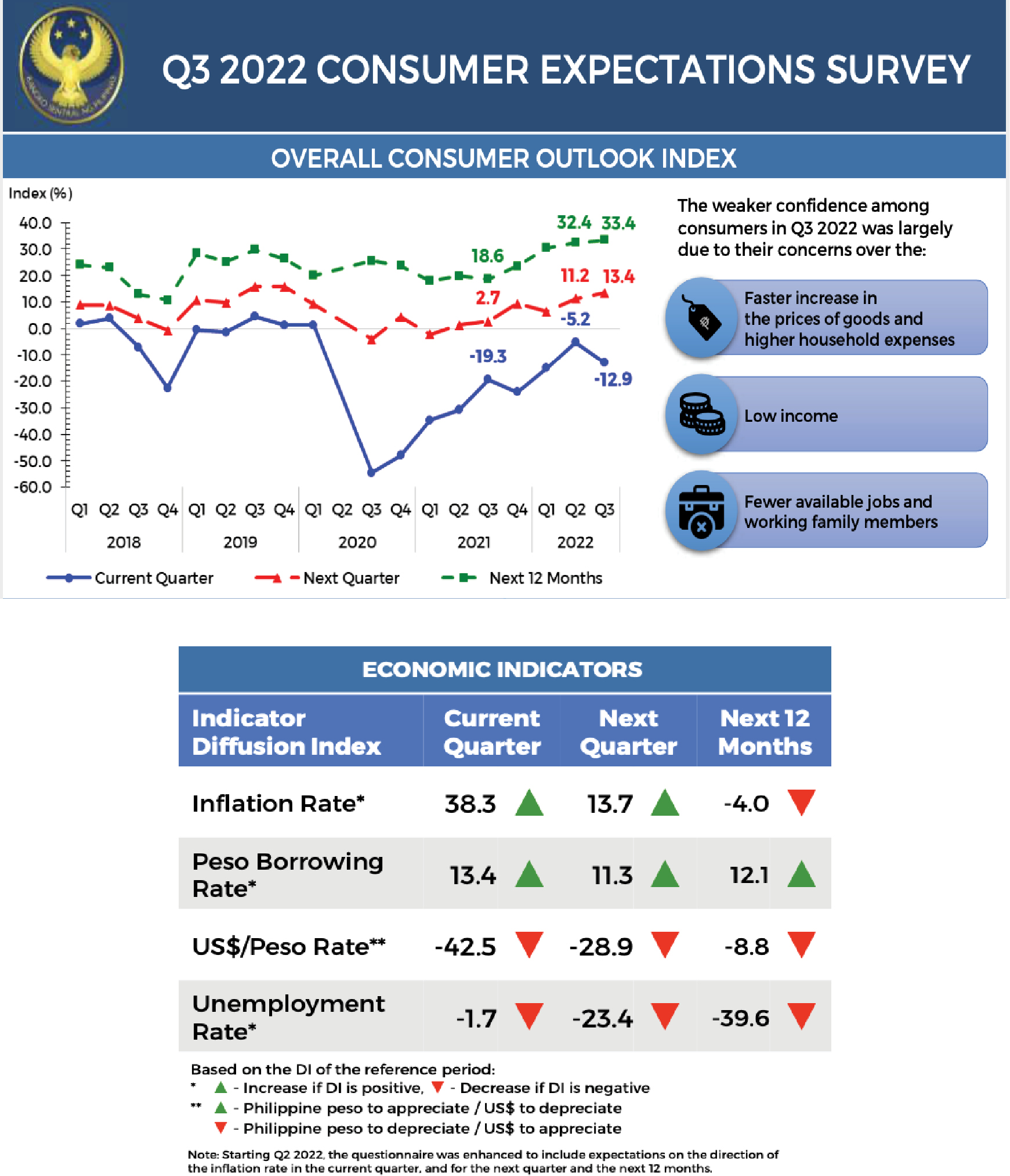
Bad news is the current quarter sentiment which turned more pessimistic as the index turned more negative, from -5.2 to -12.9. The reasons behind such pessimism are quite analogous with those of their business counterparts: higher inflation and household expenses; lower income; and limited job opportunities.

More countries also reported the prevailing negative sentiment for the third quarter particularly Australia, the Czech Republic, Finland, France, Italy, Japan, South Korea, Switzerland, and Taiwan.

The good news is that for the next quarter and 12 months, the consumer outlook index indicates more optimistic sentiment, being positive and rising. Consumer respondents point to more jobs, additional income, good governance, good public policies, and financial assistance.

It is also useful to know the consumers’ expectations about key economic indicators. For all the reckoning periods, they expect unemployment to decline — meaning, output growth could rise; interest rates to increase; and the peso-dollar rate to depreciate. As expected, households believe that inflation may rise this quarter and the next, breaching the official target of 2-4%. Inflation, however, is expected to ease in the next 12 months. This is consistent with the current BSP forecasts of 5.6% for this year and 4.1% next year although both are in excess of the target.

It will be a big challenge to deliver on this favorable household sentiment because the underlying assumptions require effective government policies, sufficient supply of goods and services, and stable health conditions. While IFIs could take the extra mile of encouraging their member countries to pursue sensible policy and structural reforms, it is our own political leaders and their economic managers who have the mandate to make things happen, and convert those conditional propositions of economic growth with price stability to reality.

True, Nobel laureate in Physics Niels Bohr was once quoted to have said “Prediction is very difficult, especially if it’s about the future.” For this very reason, it would be best for those in authority to take on Peter Drucker’s challenge that “the best way to predict your future is to create it.”


Diwa C. Guinigundo is the former deputy governor for the Monetary and Economics Sector, the Bangko Sentral ng Pilipinas (BSP). He served the BSP for 41 years. In 2001-2003, he was alternate executive director at the International Monetary Fund in Washington, DC. He is the senior pastor of the Fullness of Christ International Ministries in Mandaluyong.


On the Philippines’ ‘fake news’ problem

FREEPIK

Senator Jose Pimentel Ejercito, Jr., more widely known as Jinggoy Estrada, has filed a bill (Senate Bill No. 1296) that would amend the Cybercrime Prevention Act of 2012 (Republic Act 10175) to include “fake news” among the many offenses the Act penalizes.

The Estrada bill defines “fake news” as “misinformation and disinformation of stories (sic) which is (sic) presented as a (sic) fact, the veracity of which cannot be confirmed, with the purpose of distorting the truth and misleading its (sic) audience.”

The grammatical lapses of its “definition” are not the only infirmities of the latest bill criminalizing the dissemination of false information.

The use of the term “fake news,” is one. It was popularized by former US President Donald Trump and his minions in their tirades against the media. But the phrase is an oxymoron — a contradiction in terms.

If a piece of supposed information is false, it is not news; and if it is news, it is by definition accurate. For instance, if not verified, a newspaper account that claims that University of the Philippines students are being recruited by New People’s Army agents among the staff is not “fake news”; simply false information. But another report that the Department of Health has declared residents of the National Capital Region as once again at moderate risk of COVID-19 infection would be news if its accuracy has been established through interviews, documentation, and those other means available for journalists to confirm the truthfulness of their reports.

The “fake news” oxymoron has nevertheless been legitimized in public discourse among other reasons because it has been used in the US and elsewhere to attack the media as supposedly deliberate purveyors of false, misleading, or distorted information.

The media, whether old (print, television, radio, film) or new (online news sites, blogs, social media), do at times fall short of providing accurate and meaningful information on issues and events of public concern. In some instances, as we saw during the last campaign and election, they do so intentionally in behalf of advancing a pre-determined end such as convincing their audiences that they should support this or that candidate. But it is also true that many media practitioners exert every effort to get at the truth and to report it despite such difficulties as being barred from covering a public event or even being threatened with physical harm.

The problems with anti-“fake news” legislation is that of distinguishing between the first and the second, as well as between deliberate misinformation or disinformation and an error committed in good faith — information which turns out to be false but which the media practitioner thought was accurate.

It is in determining which is which that things become problematic. Under the provisions of RA 10175, and those of previously proposed anti-“fake news” bills, fabricating and spreading false information would be punishable with huge fines and even long prison sentences. Preventing the Act’s being unjustly used against journalists and other communication professionals will require both a complainant and an enforcing agency to establish, through documentation and consultation with experts among others, the truth or falsehood of, say, the claims of a blogger or an online news site.

Whether the alleged offense was deliberate or not is even more difficult to determine. But the Estrada bill’s definition of that dubious “fake news” phrase assumes bad faith in every case of misinformation or disinformation. That much is evident in its declaring that every such incident is “with the purpose of distorting the truth and misleading its (sic) audience.”

Already weaponized against free expression and press freedom, the 2012 Cybercrime Prevention Act would be even more repressive if “fake news” as defined by the Estrada bill were to be added to the list of offenses the Act penalizes.

That it is government — whether the Philippine National Police, the Department of Justice, the Office of the Press Secretary or any other agency — that will most likely claim that a report that puts it in a bad light is false is even more dangerous to free expression and press freedom.

Government and its instrumentalities have used RA 10175 in their attempt to silence not only critical reporting but even truthful coverage of government affairs. Adding the prerogative of prosecuting groups and individuals for supposedly generating and spreading false information to the vast powers of government will make the already difficult and even dangerous journalistic enterprise more uncertain, and will have a devastating impact on the people’s right to know what is going on in the government to whose officials they have delegated their sovereign powers. Any law penalizing the making and spreading of false information will, for the above reasons, more likely be part of the misinformation and disinformation problem rather than part of the solution.

Like the many attempts in this country to legislate it out of existence (the Estrada bill was preceded by two other similar attempts in Congress), manufacturing and spreading false information is neither new nor rare. Neither has its impact on human affairs ever been beneficial. More than a hundred years ago, for instance, many Americans’ support for the Spanish-American War of the late 19th century, which among other consequences led to the US occupation of the Philippines, was at least partly encouraged by the false claims of the William Randolph Hearst and Joseph Pulitzer tabloids then that Spain had blown up the battleship USS Maine while it was docked at Cuba’s Havana Harbor.

More recently, in 2003 a majority of the US population supported the invasion of Iraq on the basis of the disinformation that it had weapons of mass destruction and was protecting Osama bin-Laden’s Al-Qaeda terrorist group. That invasion cost over 100,000 civilian and military lives and led to the perennial instability and regression of what was previously one of the more developed countries in the Middle East.

But the problems of disinformation have since been multiplied by the trolls and keyboard armies funded by political and economic interests as well as by those well-meaning but untrained individuals who recklessly upload unverified information and who share them with innumerable others.

The resulting crisis in information has thus become a major factor in the further decline of citizen understanding of the issues and events around them, thereby contributing to the ascendancy in many countries of the authoritarianism that flourishes in mass ignorance.

The antidote to false information, however, is not the enactment of laws that will worsen rather than remedy the problem, but in educating the media audiences on how to distinguish between false and accurate information as well as on responsible Netizenship.

Some media organizations are themselves already so engaged. They fact-check themselves and each other, and provide their audiences information on how they can distinguish false accounts from the true, in addition to improving Netizen capacity to critically read social media and online blogs and news sites.

But the involvement of the educational system is even more vital in this crucial undertaking. Instead of focusing on restoring mandatory military training and appropriating millions in “confidential funds” to monitor the alleged terrorist infiltration of public schools, the Department of Education could more wisely spend its budget on improving its severely inadequate media literacy programs at the basic education level, which have been mostly limited to teaching students the use of video and still cameras. Unfortunately, that has never been, and still seems to be farthest from, the priorities of the Department.


Luis V. Teodoro is on Facebook and Twitter (@luisteodoro).

www.luisteodoro.com

Toward a more confident Philippine foreign policy

OFFICE OF THE PRESS SECRETARY

The address at the 77th UN General Assembly was given by the Philippine president in the morning of Sept. 21, 2022 (Philippine time). Identifying himself simply as “Ferdinand Marcos,” he definitely would have known that, almost to the day, 40 years earlier, his father, Ferdinand Marcos the Elder, gave his own remarks before the Assembly.

The elder Marcos spoke of alleviating poverty for what was then designated as the “third world”: “The problems cannot wait. The price of inaction multiplies in severity for nations and the world alike.” The Philippines had just signed on to the GATT (General Agreement on Tariffs and Trade) and the liberalizing effects of the ASEAN FTA (Association of Southeast Asian Nations Free Trade Agreement) was still years away.

Interestingly, Marcos the Elder also spoke of the need for “intensive efforts to employ science and technology” to destroy “nuclear weapons on their launching sites or in flight,” with the hope of limiting warfare to the more conventional and less lethal.

This was echoed by the younger Marcos: looking at the still “unresolved problem: inequalities and inequities within and among countries continue to persist, and they continue to demand urgent action.” “This injustice,” he continued, “was evident during this pandemic, when the richer nations immediately received vaccines at the expense of the have-nots. We see, for example, dangers of this lurking in the persistent digital divide and in ballooning debt burdens.”

On nuclear weapons, such “continue to pose an existential threat despite our efforts to build norms that resoundingly prohibit them. We must reject the notion of deterrence and remain committed to decreasing the global stockpile of these weapons. At the same time, we must also address the scourge of the proliferation of all weapons, be they small arms, light weapons, or improvised explosive devices.”

Thus, while media labeled the New York trip as a “rebranding,” for Marcos the Younger, it could just as well be a necessary continuation of what should have been.

This is all the more evident with regard to international affairs. After the unnecessarily trenchant but ultimately unthought through China policy of Noynoy Aquino, followed by the quite unfortunate China-centric obsequiousness of the Duterte administration, Marcos is seemingly more surefooted and clearer eyed on foreign policy.

Speaking with former Australian prime minister Kevin Rudd, Marcos declared that the position “the Philippines takes is that we have no territorial conflict with China. What we have is China claiming territory that belongs to the Philippines.” That indeed is the more accurate way to frame the matter: our territory is ours, China is just trying to illegally usurp it.

Two additional but quite telling statements: “With our American partners, we have promoted that position.” Also, “I would like to point out this is the first national election in the Philippines where foreign policy was an issue with the people.”

Indeed. After 12 years of contradictory policy towards China, along with the relentless efforts of well-funded foreign and local China propagandists, the Philippines still prefer maintaining its distance from its large domineering neighbor. A Pulse Asia survey found 67% of Filipinos distrust China, while 89% favor the US, as well as Australia (79%), Japan (78%), Germany (69%), South Korea (65%), UK (64%), Indonesia (60%), and India (51%).

Hence, Marcos the Younger’s reminder at the General Assembly about the Philippine’s “solid contributions to the cause of peace and justice. By shepherding the Manila Declaration of 1982, we helped affirm that differences should only be resolved through peaceful means. By reinforcing the predictability and stability of international law, particularly the 1982 United Nations Convention on the Law of the Sea, we provided an example of how states should resolve their differences: through reason and through right.”

He also called attention to the fact that “widening geopolitical polarities and sharpening strategic competitions are transforming the international political landscape. A profound lack of trust is putting enormous strains on our multilateral system. Our very Charter is being violated around the world as we speak. In Asia, our hard-won peace and stability is under threat by increasing strategic and ideological tensions.”

The solution is “to uphold the ideals that led to the establishment of this parliament of nations, and to reject any attempt to deny or redefine our common understanding of these principles.”

It is correct for Marcos to speak of common principles, particularly democratic values. And it is correct that we redeclare our commitment to our relationship with the United States, as well as ASEAN and other traditional allies.

Foreign policy should serve as an extension of our domestic policy and Philippine interests require that it recovers its position as an active player in the world stage: regardless of the supposed shift to ballistic and aerial warfare, our country’s waters maintain huge value in relation to maritime transport and commercial trade. The Philippines must assert its natural position as the gateway to Asia, the same role Great Britain inherently assumes vis-à-vis Europe and which Singapore tries but continually fails to achieve.


Jemy Gatdula is a senior fellow of the Philippine Council for Foreign Relations and a Philippine Judicial Academy law lecturer for constitutional philosophy and jurisprudence

https://www.facebook.com/jigatdula/

Twitter @jemygatdula

Global appetite for oil is peaking

WIRESTOCK

I’VE RARELY FELT more trepidation about writing a column than this one. But here goes: After more than a century of almost continual growth, the world’s appetite for oil is peaking, and will soon enter terminal decline.

That’s hard to write, because those who’ve called a top in oil have a forecasting record on a par with film producer Harry Warner’s skepticism that people in the 1920s wanted to see talking pictures.

As far back as 1919, the chief geologist of the US Geological Survey wrote that domestic output — then running at about 960,000 barrels a day, about 6% of levels nowadays — would start falling within two to five years. In the 2000s, a dearth of oilfield discoveries led to febrile worries that supplies were running out, before the shale revolution prompted a surprise jump in production. BP Plc in 2020 predicted that consumption of liquid hydrocarbons would at best plateau for 15 years around the 97.9 million barrels a day mark it hit in 2019, before revising its forecast to a peak between the middle of this decade and 2030.

Through all that, oil demand has continued to grow as the indispensable energy carrier fueling rising global incomes and development. Still, the reserves of stamina that crude has called on to maintain its upward trajectory are finally giving out — and US Federal Reserve Chairman Jerome Powell may have just delivered the coup de grace.

Consider what is happening in financial markets right now. Equities have been plummeting and bond yields surging after the Fed passed its third consecutive 75-basis-point rise in interest rates, and Powell signaled his willingness to send the US economy into a recession to bring inflation back to target. A soaring greenback has pushed the British pound to record lows, while the yen and euro slumped to their lowest levels in two decades or more. One analyst this week argued there’s now a 98% chance of a global recession.

Then consider just how close to peak oil we already are. Every forecaster has a different estimate for this number, but the median of 12 who see a future date is for a maximum level of about 103.2 million barrels of liquid fuels a day — something most see occurring some time between the mid-2020s and the mid-2030s. In contrast to a history where consumption grew by more than a million daily barrels per year, that’s a modest enough rise that debates about the precise timing of the peak are almost academic. Still, the median target is only a sliver above levels of about 101.6 million daily barrels which both the International Energy Agency and US Energy Information Administration expect to see by the end of this year.

Now think about what a global recession would do to that outlook. Oil consumption fell by more than 2% from peak to trough after the 1973 oil crisis and the 2008 financial meltdown, with output taking three years to recover to its former level. The drop was closer to 10% during the COVID-19 pandemic and in 1980, when the aftermath of the second oil crunch and the Iran-Iraq war collided with the monetary squeeze Powell’s predecessor Paul Volcker inflicted to wipe out the inflation of the previous decade. In each case, consumption didn’t just suffer a temporary blip — the direction of oil demand was permanently set back.

A global recession on the scale that equity and bond markets are now pricing in could easily push liquid fuel consumption back below 100 million barrels until the middle of the decade. That starts bringing things close to the point where most forecasters see long-run shifts in demographics, economic growth, and technology sending oil into terminal decline. Crude itself accounts for only around 80 million daily barrels of total liquids demand, with most of the remainder coming from products derived from gas, plant matter, and coal.

The state of gasoline is a foretaste of what is to come. Demand for the fuel, which uses more than a quarter of the world’s crude, has already peaked. Part of that is about electric cars — BloombergNEF estimates that they’re already subtracting about 1.7 million daily barrels from global consumption. Still, much of it is just that plain old internal combustion engines are sipping less gas. New US cars now travel nearly twice as far per gallon as they did at the start of the Obama administration, with light trucks and SUVs increasing efficiency by a more modest 59%.

As older, less efficient cars are phased out of the fleet, the entropy of the scrapyard is reducing gasoline demand as rapidly as the innovation of the electric vehicle manufacturer. It’s no accident that major refiners such as Reliance Industries Ltd. are already looking beyond road transport, and reconfiguring their plants to produce aviation fuel and petrochemicals instead.

That’s not enough for those who paint a rosy future for oil demand to point to historic correlations with economic growth and argue that the pattern will repeat once again. Away from forecasters’ spreadsheets, OPEC spare capacity is already wafer-thin, and upstream investment is running at not much more than half its level last time crude prices were in the vicinity of $100 a barrel. The oil industry responsible for supplying additional barrels isn’t spending the money to ensure they’ll turn up — and if that doesn’t happen, consumption has no prospect of growing.

Ultimately, it will be central banks that will read crude its last rites. Faced by inflation caused in part by our stubborn failure to produce enough cheap energy to fuel the recovery from COVID-19, they’ve put the global economy on a bed of Procrustes — cutting economic demand until it’s feeble enough to sit within the constraints of current supply.

That makes current levels of oil production look like some sort of hard cap. Since it emerged as our most crucial commodity more than a century ago, oil has always lived on GDP growth. With the Fed planning to push the world economy into a slump to cure the inflation epidemic, we’re about to see it die by the same hand.

BLOOMBERG OPINION

Russia set to annex swath of Ukraine territory

ZAPORIZHZHIA, Ukraine — Russia was poised to annex a swath of Ukraine within days, releasing what it called vote tallies showing overwhelming support in four provinces to join it, after what Ukraine and the West denounced as illegal sham referendums held at gunpoint.

On Moscow’s Red Square, a stage with giant video screens has been set up, with billboards proclaiming “Donetsk, Luhansk, Zaporizhzhia, Kherson — Russia!”

The head of the upper house of the Russian parliament said it could consider the incorporation of the four partially occupied regions on Oct. 4, three days before President Vladimir Putin’s 70th birthday.

The Russian-installed administrations of the four provinces have formally asked Mr. Putin to incorporate them into Russia, which Russian officials have suggested is a formality.

“This should happen within a week,” Rodion Miroshnik, the Russia-installed ambassador to Moscow of the self-proclaimed Luhansk People’s Republic, told the RIA state news agency

“The main thing has already happened — the referendum has taken place. Therefore, let’s say: the locomotive has already started and it’s unlikely to be stopped.”

To annex the territories, which represent about 15% of Ukraine, some sort of treaty will need to be struck and ratified by the Russian parliament, which is controlled by Putin allies. The areas will then be seen as part of Russia and its nuclear umbrella will extend to them.

Mr. Putin has warned he would use nuclear weapons to protect Russian territory from attack.

‘NOBODY VOTED’
Residents who escaped to Ukrainian-held areas in recent days have told of people being forced to mark ballots in the street by roving officials at gunpoint. Footage filmed during the exercise showed Russian-installed officials taking ballot boxes from house to house with armed men in tow.

“They can announce anything they want. Nobody voted in the referendum except a few people who switched sides. They went from house to house but nobody came out,” said Lyubomir Boyko, 43, from Golo Pristan, a village in Russian-occupied Kherson province.

Russia says voting was voluntary, in line with international law, and that turnout was high. The referendums and notion of annexations has been rejected globally, as was Russia’s 2014 takeover of Crimea from Ukraine.

Ukrainian President Volodymyr Zelensky sought to rally international support against annexation in a series of calls with foreign leaders, including those of Britain, Canada, Germany and Turkey.

“Thank you all for your clear and unequivocal support. Thank you all for understanding our position,” Mr. Zelensky said in a late-night video address.

The United States has unveiled a $1.1 billion weapons package for Ukraine that includes 18 High Mobility Artillery Rocket System (HIMARS) launchers, accompanying munitions, various types of counter drone systems and radar systems. The announcement brings the US security aid to $16.2 billion. 

The United States has also said it would also impose new sanctions on Russia for the referendums and the European Union’s executive proposed more sanctions, but the bloc’s 27 member countries will need to overcome their own differences to implement them.

Kremlin spokesman Dmitry Peskov said Russia would need to keep fighting until it had taken control of all of Donetsk. About 40% is still under Ukrainian control.

Russia has announced it will mobilize some 300,000 reservists to bolster its forces in Ukraine. The conscription drive has sent thousands of Russian men fleeing to other countries.

On the ground, Ukraine and Russian forces are engaged in heavy fighting in the four disputed provinces.

Ukraine’s armed forces conducted strikes on Russian forces in four areas near the city of Kherson as part of their counter-offensive, while its aircraft hit six targets, the Ukrainian military’s southern command said.

Reuters was not able to verify battlefield reports.

EUROPEAN ENERGY
Leaking gas bubbled up in the Baltic Sea for a third day after suspected explosions tore through undersea pipelines built by Russia and European partners to send natural gas to Europe.

The Nord Stream 1 pipeline, once the main route for Russian gas to Germany, was already shut but cannot now be easily reopened.

NATO and the European Union warned of the need to protect critical infrastructure from what they called “sabotage,” though officials stopped short of assigning blame.

Russia’s FSB security service is investigating the damage to the pipelines as “international terrorism,” the Interfax news agency cited the general prosecutor’s office as saying.

The Nord Stream pipelines have been flashpoints in an expanding energy war between Russia and European countries that has damaged Western economies and sent gas prices soaring. — Reuters

Hurricane Ian batters Florida Gulf Coast with fury

VENICE, Fla. — Hurricane Ian plowed into Florida’s Gulf Coast with catastrophic force on Wednesday, unleashing howling winds, torrential rains and a treacherous surge of ocean surf that made it one of the most powerful US storms in recent years.

Crashing ashore as a Category 4 hurricane with sustained winds of up to 150 miles per hour (241 kph), Ian quickly transformed an idyllic stretch of sandy beaches and coastal towns into a disaster zone inundated by seawater.

Early video images of the storm’s fury on local TV and social media showed floodwaters sweeping away cars, nearly reaching rooftops in some communities and the ruins of homes as palm trees were bent almost in half.

Up to 30 inches (76 cm) of rain is forecast to fall on parts of central Florida as the storm moves inland, threatening to cause extensive flash floods. Nearly 2 million homes and businesses statewide were without power as of an hour before sunset, utilities reported.

“This storm is doing a number on the state of Florida,” said Governor Ron DeSantis, who asked US President Joseph R. Biden to approve a major federal disaster declaration providing a wide range of US emergency aid to the entire state.

US border authorities said 20 Cuban migrants were missing after their boat sank off the Florida coast as Ian neared the coast on Wednesday.

There were no immediate official reports of other storm-related casualties.

An unknown number of people were stranded in “high-risk” evacuation zones and in need of help after defying orders to seek higher ground, but rescue crews were unable to immediately reach them, the governor said.

Having swept past Cuba on Tuesday, leaving it without power for hours, Ian made landfall in Florida at 3:05 p.m. EDT (1905 GMT) on Wednesday near Cayo Costa, a barrier island just west of Fort Myers, the US National Hurricane Center (NHC) reported.

The storm’s peak wind speeds put it just shy of a Category 5 designation on the Saffir-Simpson scale, the maximum classification.    

Ian then churned ashore on Florida’s mainland, south of the harborside town of Punta Gorda, with slightly diminished winds topping out at 145 mph.

Mr. DeSantis said Ian had generated life-threatening storm surges — waves of wind-driven seawater rushing in along the coast — of up to 12 feet (3.7 meters) in some places. Forecasters also warned of intense thunderstorms and possible tornadoes.

“This is a storm that we will talk about for many years to come, an historic event,” said Ken Graham, director of the National Weather Service.

The sprawling, slow-moving storm pushed farther inland as darkness fell, and within six hours of landfall was downgraded to Category 2, with top sustained winds of 105 mph (170 kph), the NHC reported.

Further weakening was forecast over the next day or so as Ian crosses the Florida peninsula on a northeasterly track, expected to reach the Atlantic Coast on Thursday afternoon.

The region around the landfall is home to miles of sandy beaches, scores of resort hotels and numerous mobile home parks, a favorite with retirees and vacationers alike. 

An hour after landfall, video posted on social media and TV news outlets showed water fueled by storm surges rushing through several communities.

The town of Fort Myers Beach was nearly submerged by floodwaters. A view of Sanibel Island posted on Twitter showed the ocean sweeping over a seawall into a resort hotel’s swimming pool. Other video from the island showed roads inundated by the storm surge, rising to the tops of street signs.

In terms of its sustained wind speeds, which peaked at 155 mph before landfall, Ian ranks as one of the most ferocious hurricanes to strike the US mainland in recent years. By comparison, Hurricane Michael came ashore in Florida’s panhandle in 2018 with steady winds of 155 mph, while Ida last year packed sustained winds of 150 mph when it landed in Louisiana.

TO STAY OR GO
Even as Ian lashed the coast in the final hours before it swept ashore, authorities warned residents it was too late for anyone who had yet to evacuate to safely do so.

Earlier this week, more than 2.5 million residents had been told to evacuate. Doug Coe of Venice was one of those who chose to ignore warnings and stay put.

“I’m staying vigilant, but trying not to worry,” he said.

Most residents abandoned the area’s mobile home parks, taking refuge in local schools and other facilities converted to emergency shelters. The area’s numerous assisted-living facilities were mostly evacuated, too.

Climate change is making hurricanes wetter, windier and more intense. There is also evidence that it is causing storms to travel more slowly, meaning they can dump more rain in one place, scientists say. — Reuters

13 killed as Iran Revolutionary Guards target Iraq’s Kurdish region

DUBAI/SULAIMANIYA, Iraq — Iran’s Revolutionary Guards said on Wednesday they fired missiles and drones at militant targets in the Kurdish region of neighboring northern Iraq, where authorities said 13 people were killed.

The strikes were reported after Iranian authorities accused armed Iranian Kurdish dissidents of involvement in unrest now shaking Iran, especially in the northwest where most of the country’s population of over 10 million Kurds live.

Thirteen people were killed and 58 wounded in the attacks near Erbil and Sulaimaniya in Iraqi Kurdistan, Iraq’s state news agency said citing its counter-terrorism service in Kurdistan.

Iraqi Kurdish sources said drone strikes targeted at least 10 bases of Iranian Kurds near Sulaimaniya in Iraqi Kurdistan on Wednesday morning, without elaborating about possible casualties.

The US Army Central Command said it downed an Iranian drone on Wednesday while it was on its way to Erbil, adding that the drone posed a threat to US personnel in the region.

“No US forces were wounded or killed as a result of the strikes and there is no damage to US equipment,” it said in a statement.

A senior member of Komala, an exiled Iranian Kurdish opposition party, told Reuters that several of their offices were struck as well.

Tariq Haidari, mayor of the Iraqi Kurdish city of Koye, told Reuters that two people including a pregnant woman were killed and 12 wounded. Some of the wounded were rushed in critical condition to hospital in Erbil, he said.

The Revolutionary Guards, Iran’s elite military and security force, said after the attacks that they would continue targeting what it called terrorists in the region. 

“This operation will continue with our full determination until the threat is effectively repelled, terrorist group bases are dismantled, and the authorities of the Kurdish region assume their obligations and responsibilities,” the Guards said in a statement read on state television.

Iraq’s foreign ministry condemned the attacks.

Iraq’s foreign ministry spokesman said in a statement on Wednesday that the ministry would summon the Iranian ambassador to inform him of Iraq’s objection to the attacks on Iraqi territories and that Iraq considers this action as a violation of sovereignty.

Protests erupted in Iran this month over the death of a young Iranian Kurdish woman, Mahsa Amini, in police custody.

Amini, 22, from the northwestern Kurdish city of Saqez, was arrested on Sept. 13 in the capital Tehran for “unsuitable attire” by the morality police, who enforce the Islamic Republic’s strict dress code.

She died three days later in hospital after falling into a coma, sparking the first big show of opposition on Iran’s streets since authorities crushed protests against a rise in gasoline prices in 2019. — Reuters