Home Blog Page 5743

More US firms charging workers job training costs if they resign

REUTERS

WASHINGTON — When a Washington state beauty salon charged Simran Bal $1,900 for training after she quit, she was shocked.

Not only was Ms. Bal a licensed esthetician with no need for instruction, she argued that the training was specific to the shop and of low quality.

Ms. Bal’s story mirrors that of dozens of people and advocates in healthcare, trucking, retail and other industries who complained recently to US regulators that some companies charge employees who quit large sums of money for training.

Nearly 10% of American workers surveyed in 2020 were covered by a training repayment agreement, said the Cornell Survey Research Institute.

The practice, which critics call Training Repayment Agreement Provisions, or TRAPs, is drawing scrutiny from US regulators and lawmakers.

On Capitol Hill, Senator Sherrod Brown is studying legislative options with an eye toward introducing a bill next year to rein in the practice, a Senate Democratic aide said.

At the state level, attorneys general like Minnesota’s Keith Ellison are assessing how prevalent the practice is and could update guidance.

Mr. Ellison told Reuters he would be inclined to oppose reimbursement demands for job-specific instruction while it “could be different” if an employer wanted reimbursement for training for a certification like a commercial driving license that is widely recognized as valuable.

The Consumer Financial Protection Bureau (CFPB) has begun reviewing the practice, while the Justice department and Federal Trade Commission have received complaints about it.

The use of training agreements is growing even though unemployment is low, which presumably gives workers more power, said Jonathan Harris who teaches at the Loyola Law School Los Angeles.

“Employers are looking for ways to keep their workers from quitting without raising wages or improving working conditions,” said Mr. Harris.

The CFPB, which announced in June it was looking into the agreements, has begun to focus on how they may prevent even skilled employees with years of schooling, like nurses, from finding new, better jobs, according to a CFPB official who was not authorized to speak on the record.

“We have heard from workers and worker organizations that the products may be restricting worker mobility,” the official said.

TRAPs have been around in a small way since the late 1980s primarily in high-wage positions where workers received valuable training.

But in recent years the agreements have become more widespread, said Loyola’s Mr. Harris.

One critic of the CFPB effort was the National Federation of Independent Business, or NFIB, which said the issue was outside the agency’s authority because it was unrelated to consumer financial products and services.

“(Some state governments) have authority to regulate employer-driven debt. CFPB should defer to those governments, which are closer to the people of the states than the CFPB,” it added.

Ms. Bal said she was happy when she was hired by the Oh Sweet salon near Seattle in August 2021. But she soon found that before she could provide services for clients, and earn more, she was required to attend training on such things as sugaring to remove unwanted hair and lash and brow maintenance.

But, she said, the salon owner was slow to schedule the training, which would sometimes be postponed or canceled. They were also not informative; Ms. Bal described them as “introductory level.”

While waiting to complete the training, Ms. Bal worked at the front desk, which paid less. When she quit in October 2021, Ms. Bal received a bill for $1,900 for the instruction she did receive.

“She was charging me for training for services that I was already licensed in,” said Ms. Bal.

Karina Villalta, who runs Oh Sweet LLC, filed a lawsuit in small claims court to recover the money. Court records provided by Ms. Bal show the case was dismissed in September by a judge who ruled that Ms. Bal did not complete the promised training and owed nothing.

Ms. Villalta declined requests for comment.

In comments to the CFPB, National Nurses United said they did a survey that found that the agreements are “increasingly ubiquitous in the healthcare sector,” with new nurses often affected.

The survey found that 589 of the 1,698 nurses surveyed were required to take training programs and 326 of them were required to pay employers if they left before a certain time.

Many nurses said they were not told about the training repayment requirement before beginning work, and that classroom instruction often repeated what they learned in school.

The International Brotherhood of Teamsters said in comments that training repayment demands were “particularly egregious” in commercial trucking.

They said firms like CRST and C.R. England train people for a commercial driver’s license but charge more than $6,000 if they leave the company before a certain time.

Neither company responded to a request for comment.

The American Trucking Associations argues that the license is portable from one employer to another and required by the government.

It urged the CFPB to not characterize it as employer-driven debt.

Steve Viscelli, a sociologist at the University of Pennsylvania who spent six months training and then driving a truck, said the issue deserved scrutiny.

“Anytime we have training contracts for low-skilled workers, we should be asking why,” he said. “If you have a good job, you don’t need a training contract. People are going to want to stay.” — Reuters


Warburg Pincus to invest $350M to set up Southeast Asia digital insurance firm

JOHN SCHNOBRICH-UNSPLASH

SINGAPORE — Warburg Pincus LCC is investing $350 million to set up a Southeast Asian digital general insurance platform called Oona Insurance, marking the US-based private equity firm’s largest investment in the insurance sector in Asia.

Warburg Pincus is partnering with Abhishek Bhatia, a former group chief officer of Asian insurance company FWD Group’s new business models unit, to set up the new business, the buyout firm said in a statement on Thursday.

The private equity firm is one of the largest in Southeast Asia, having invested nearly $3.5 billion in 17 companies in the region since 2013. Headquartered in New York, it has more than $85 billion in assets under management, according to the statement.

Warburg Pincus said Oona comprises its insurance assets — Indonesia’s PT Asuransi Bina Dana Arta Tbk and Philippines’ Mapfre Insular Insurance Corp. — which will give the platform an immediate foothold in Southeast Asia to build business and scale up.

“With consistently rising incomes and accelerating digital adoption, we believe Oona is well positioned to capture the tremendous growth opportunity for digital insurance across Southeast Asia,” Saurabh Agarwal, Managing Director at Warburg Pincus, said in the statement.

The two assets, which will be rebranded as Oona, will provide the digital insurance platform with an initial product portfolio including motor, property and group health insurance, according to Warburg Pincus.

Oona plans to introduce new products such as travel, health and others that are emerging on the back of increasing adoption of internet, e-commerce and digital payments in Southeast Asia, Warburg Pincus added.

“General insurance is a significantly underpenetrated industry in the region and a sector that’s ripe for digital disruption,” Mr. Bhatia, Oona’s group CEO, said.

“All the assets and operations will be consolidated under a coherent operating model and a common brand and tech stack, positioning us well to capture the rapidly growing opportunities for digital general insurance in the region,” he added. — Reuters

Simon Cowell’s new TikTok project gives users unreleased music

SOLEN FEYISSA-UNSPLASH

RENOWNED talent scout Simon Cowell is back, but this time he is focused on the social media platform, TikTok.

With the international Got Talent TV series, American Idol, and many more projects already under his belt, Mr. Cowell is ready to help aspiring musicians on TikTok share their unique sounds with the world.

Mr. Cowell is partnering with TikTok to give users access to new unnamed songs by famous producers through the service StemDrop, which launches through the TikTok app on Oct. 26. After getting each song, TikTokers can take the elements of it and interpret them in any way they like, including different genres, tempos, and more. The idea is for them to make the music their own.

The challenge is meant to invite social media musicians to record something special and possibly have it noticed by a talent scout, but unlike Mr. Cowell’s other projects, there is no guaranteed record deal. The goal is to give each participating user a head start in their careers without any set outcome.

The first song is written by Swedish record producer, Max Martin, who has worked with big-name stars ranging from Britney Spears to Bon Jovi.

“You will have the ability to co-write a song with one of the greatest songwriters of all time and that just doesn’t happen in the real world,” Mr. Cowell explained during an exclusive TV interview with Reuters.

From his Malibu mansion, Mr. Cowell shared that his and Mr. Martin’s mutual interest in a project outside of a conventional TV show came after TikTok sparked in popularity.

When Mr. Cowell pitched Mr. Martin, they both loved the idea of writing a song for the TikTok community instead of giving it to an artist that is already well-known in the industry, like Ariana Grande or The Weeknd.

StemDrop is expected to drop a new song roughly every 10 weeks, though Mr. Cowell has not revealed who he has lined up to work with on each tune.

Other partners include Samsung and Universal Music Group/Republic. — Reuters

ICTSI’s flagship operation receives ‘green port’ seal

COMPANY HANDOUT

AN EVALUATION system for ports has recognized the Philippines’ international trading gateway, Manila International Container Terminal (MICT), for its “green” strategy.

In a media release on Thursday, International Container Terminal Services, Inc. (ICTSI), which operates MICT, said that the Asia-Pacific Economic Cooperation (APEC) Port Services Network (APSN) had given the recognition to its flagship operation during the 2022 Green Port Award (GPAS).

The GPAS program, which evaluates ports in the APEC region, was developed by APSN with the endorsement of the APEC Forum.

ICTSI described the recognition as given to “high caliber and excellent environmental actions and leadership demonstrated by ports in the Asia-Pacific region.” It said the award is valid for three years.

Christian R. Gonzalez, ICTSI executive vice-president and chief sustainability officer, said the company’s work as a port operator “demands that we maintain efficient operations all the time while contributing to continued sustainability of resources and decreasing adverse impact on the environment.”

“We thank the APSN, with the support of our regulator, the Philippine Ports Authority (PPA), for recognizing our efforts in championing environmentally sustainable port activities at the [MICT],” he added.

In the release, ICTSI said that MICT had a green strategy that integrates climate change management into its day-to-day operations, “with the goal of becoming the most sustainable terminal in the Philippines.”

“Aligned with the commitment to operate in an environmentally responsible and sustainable manner, MICT has implemented several environmental programs and activities, including improving waste and water management, circular economy initiatives, ecological protection and biodiversity programs, and decarbonization efforts,” it said.

With the recognition, MICT joins 10 other ports from six APEC member economies that received the GPAS in 2022, it said.

Listed firm ICTSI has a portfolio of terminals and projects located in developed and emerging market economies in the Asia-Pacific region, the Americas, and Europe, the Middle East, and Africa.

The importance of core values

DURING the height of the pandemic in 2020, the MIT Sloan School of Management studied how corporate culture and values changed and impacted the top companies in the US by examining employee perception. The researchers found out that average culture and values rating across the Culture 500 companies (those winning during the pandemic) “spiked during the early months of the COVID-19 pandemic in the US (April-August 2020), and those five months occupy the top five spots in terms of average culture and values ratings for the preceding five years.”

This highlights the importance of communicating and reinforcing organizational core values in times of crisis and uncertainties. While we consider our current situation as “post-pandemic,” there are still many uncertainties and challenges organizations face such as hybrid work, tough business environment, and the more recent phenomenon called “quiet quitting.”

This is why organizations need to revisit its purpose, vision, mission, and core values and examine if they are still aligned to the changing environment.

At the core is the organization’s purpose — the “why.” It a single statement that defines the reason your company exists — beyond simply making a profit. It defines why employees, management, and shareholders exist together beyond financial gain, like Microsoft’s purpose statement, “We believe in what people make possible.”

The next layers are the mission and vision statements. They define the “what” and “where,” respectively. The mission statement describes what the organization does, and what product or service does the business provide. A vision statement, on the other hand, describes where the organization wants to go in five to ten years; and the difference organization members create in the customers’ lives or the larger world when the organization ultimately realize its purpose.

The core values define the “how” — how can the organization achieve its purpose, mission, and vision, and how it can navigate through tough times and crucial decision. Hence, core values need to be reinforced and lived by all organization members, because they guide the behavior of employees towards excellence.

It our consulting practice, apart from revisiting and formulating the purpose, vision, and mission, and core values of the organization, we emphasize to the business owner or CEO the need to communicate, reinforce, and practice the core values among all organization members.

The programmatic approach involves primarily defining the behavioral indicators that describe the value. For example, the core value Integrity is defined by behavioral indicators such as being transparent, open, and honest at all times. This ensures clarity on how to practice and live the core values when faced with demanding situations.

The next phase is conducting values training among business leaders through workshops and role plays. The latter is especially important to demonstrate the application of behavioral indicators in specific and common situations encountered in the workplace. The business leaders need to live and lead by example because employees always watch them. Setting core values, and then failing to abide by them, is worse than not establishing core values at all.

The following phase is conducting values training among all employees, through workshops, and role plays. Again, specific situations are role-played by employees to demonstrate how to apply and practice the core value in a workplace dilemma. Core values need to be translated to the local dialect or language for rank-and-file employees to learn the core values by heart.

The last phase involves sustaining programs to ensure that the core values are communicated to the employees and that they live and practice them. This can be done though online tests that allow employees to read through sample situations and choose the course of action that applies the value. Regular communication updates through e-mail, chat, and townhall meetings that convey the practice of the core values are also effective as a sustaining program.

The core values do not only help the organization navigate through difficult times, but also in guiding the employees to excellent performance. In the book of Jim Collin, Build to Last, the authors cited their research that showed “purpose and values driven organizations outperformed the general market and comparison companies by 15:1 and 6:1, respectively.”

Corporate values guide in the collective behavior of people in any organization.


Reynaldo C. Lugtu, Jr. is the CEO of Hungry Workhorse Consulting, a digital and culture transformation consulting firm. He is the chairman of the Information and Communication Technology Committee of the Financial Executives Institute of the Philippines (FINEX). He is fellow at the US-based Institute for Digital Transformation. He teaches strategic management in the MBA Program of De La Salle University. The author may be e-mailed at rey.lugtu@hungryworkhorse.com

Hollywood’s Anna May Wong to become first Asian American on US currency

USMINT.GOV/COINS/
USMINT.GOV/COINS/

THE US Mint will feature an Asian American on its currency for the first time when it issues a coin next week engraved with the image of actress Anna May Wong, who worked in Hollywood during a time of open racism and stereotyping.

A quarter-dollar coin featuring a profile of Ms. Wong with her signature bangs and long fingernails will begin circulating on Tuesday as part of the American Women Quarters Program, the US Mint said in a statement.

“Along with the hard work, determination and skill Anna May Wong brought to the profession of acting, I think it was her face and expressive gestures that really captivated movie audiences, so I included these elements,” said Mint designer Emily Damstra, who helped create the coin.

Wong was born in 1905 in Los Angeles as Wong Liu Tsong. She was cast in her first role as an extra in the film The Red Lantern in 1919 at age 14 and her first leading role in 1922 in the The Toll of the Sea.

She went on to appear in more than 60 films including one of the first movies made in Technicolor. She became the first Asian American lead actor in a US television show for her role in The Gallery of Madame Liu-Tsong in 1951.

Despite her success, Ms. Wong faced anti-Asian discrimination and racism in Hollywood where she was typecast, underpaid, and passed up for leading roles, forcing her to go to Europe to act in films, and to London and New York to perform in theater. Ms. Wong died in 1961.

“The fifth coin in our American Women Quarters Program honors Anna May Wong, a courageous advocate who championed for increased representation and more multi-dimensional roles for Asian American actors,” Mint Director Ventris Gibson said.

Author and civil rights champion Maya Angelou and astronaut Sally Ride, the first American woman to go into space, have also been honored with coins in the series. — Reuters

Mishandled resignations

I told my boss, the chief executive officer (CEO) that a major competitor is pirating me with a lucrative offer. He asked me, “Are you expecting a counteroffer?” I was shocked. I told him that I’m resigning with 30 days’ notice. To which the CEO replied: “The sooner, the better.” I left the room sadly. Please help me understand and manage my situation. — Lone Wolf.

Once upon a time, a young man consulted the Socrates to learn from the great philosopher. The moment he arrived, the young man began to speak, until interrupted by Socrates: “Young man, I regret I will have to charge you double fee for that.”

“Why is that?” the young man replied.

Socrates replied: “I will be teaching you two skills. First, how to hold your tongue. Second, how to use it at an appropriate time.”

I’m not sure about your motivation for disclosing that you’re being pirated by a competitor. It’s not advisable to tell your boss about a prospective employer. If you want to resign, then resign without making it appear that you wanted to negotiate a package. Therefore, the CEO was right in humiliating you.

Most CEOs would not be baited into making a counteroffer for many reasons. They’re too smart for that. If they do, you’ll feel indispensable, thereby setting a bad precedent that others could emulate.

If you’ve already made up your mind about your resignation, do it without hesitating. Be firm. But hold your tongue until you’ve filed a resignation letter. No amount of verbal preliminary notification will sway your boss into making a counter-offer, unless management is incompetent enough to neglect putting together a succession plan.

THE CURE
File your resignation right away. There’s no turning back. Retreating is the worst thing you can do. The CEO has already spoken: “The sooner, the better.” He’s telling you the company is ready to work without you. He may have somebody in mind as a temporary or permanent replacement which may come from within.

Therefore, you have no recourse but to file a professionally-written letter that includes the following elements:

One, give 30-day advance notice as required by law. This is to allow your employer to make preparations for a smooth turnover. This may be waived by management to protect the organization’s interests. One scenario that calls for immediate effectivity of resignations is to prevent a resigned person from accessing confidential files and other sensitive records.

Even if the CEO has allowed you to resign “the sooner, the better,” you must protect yourself against claims for damages resulting from lack of a formal, advance notice. Put the specific date of your last working day and be open to exhausting your remaining leave credits, subject to management approval.

Two, offer assistance towards ensuring a smooth turnover. Commit to train your replacement even if your boss may not be receptive. Even if your boss rejects your offer, ensure that you will be available physically according to a mutually-agreed schedule. Or else, leave your e-mail address for any questions that may arise.

Make a complete list of all documents and equipment and turn them all to your department second-in-command. Require that person to acknowledge receipt.

Three, request clearance and an employment certificate. Be specific about these requests in your letter. Also, ask the human resource (HR) department to return your basic documents, which may include the original copy of your transcript or anything that you may have been required to submit previously.

If this creates some difficulties with HR, then forget about it. At least you tried.

Four, ask the CEO’s secretary to sign upon receipt of your letter. This is your best proof that you’ve resigned in accordance with the dictates of the law. It’s not important that a resignation is approved by a boss even under normal circumstances. What’s important is that there is a formal document to prove that you’re no longer interested in continuing with your employment.

There’s also a chance the CEO’s secretary may ask to consult the boss. If the secretary refuses to sign, move on to the HR department head or a representative to sign your copy.

Last, express sincere gratitude to top management. Even under the most difficult circumstances, don’t forget to thank management for giving you the chance to work and be trained in that organization. Expressing gratitude is the professional move. You should be grateful even if you botched your initial attempt to resign.

Professionalism gives you a long-lasting sense of satisfaction that you’ve done the right thing with the people you met on your way up or down.


Chat your workplace questions with Rey Elbo on Facebook, LinkedIn, Twitter or e-mail elbonomics@gmail.com or go to https://reyelbo.com

Manila slips in financial center ranking

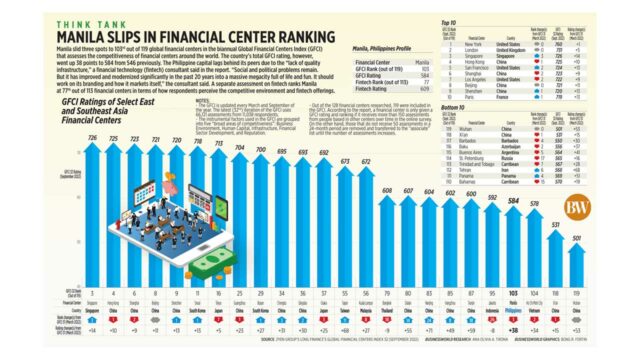
Manila slid three spots to 103rd out of 119 global financial centers in the biannual Global Financial Centers Index (GFCI) that assesses the competitiveness of financial centers around the world. The country’s total GFCI rating, however, went up 38 points to 584 from 546 previously. The Philippine capital lags behind its peers due to the “lack of quality infrastructure,” a financial technology (fintech) consultant said in the report. “Social and political problems remain. But it has improved and modernized significantly in the past 20 years into a massive megacity full of life and fun. It should work on its branding and how it markets itself,” the consultant said. A separate assessment on fintech ranks Manila at 77th out of 113 financial centers in terms of how respondents perceive the competitive environment and fintech offerings.

Manila slips in financial center ranking

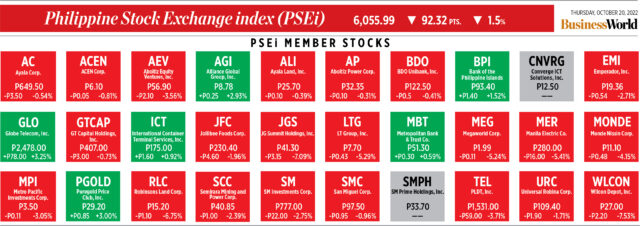
How PSEi member stocks performed — October 20, 2022

Here’s a quick glance at how PSEi stocks fared on Thursday, October 20, 2022.


Peso moves sideways on hawkish Fed, profit taking after hitting record low

BW FILE PHOTO

THE PESO moved sideways on Wednesday on profit taking after it hit its record low of P59 intraday amid hawkish signals from a US Federal Reserve official.

The local unit closed at P58.94 per dollar on Thursday, inching up by 0.5 centavo from its P58.945 finish on Wednesday, based on Bankers Association of the Philippines data.

The peso opened Thursday’s trading session at P58.92 per dollar, which was also its intraday best. Its weakest showing was its current record low of P59 against the greenback.

Dollars exchanged rose to $707.45 million on Thursday from $654 million on Wednesday.

“The peso closed slightly stronger due to profit taking after hitting the 59-peso level intraday following hawkish remarks by Fed official Bullard,” a trader said in an e-mail.

Rizal Commercial Banking Corp. Chief Economist Michael L. Ricafort said in a Viber message that the dollar was propped up against major global currencies by St. Louis Fed President James Bullard’s comments.

Mr. Bullard said he expects the “frontloading” of rate hikes to be done by early 2023 and shift to keeping policy restrictive with small adjustments as inflation cools.

The trader said the peso may weaken anew on Friday “as more Fed officials are expected to reiterate the US central bank’s plan to raise policy rates further.”

The trader expects the peso to trade between P58.90 and P59 per dollar on Friday, while Mr. Ricafort gave a forecast range of P58.80 to P59 versus the greenback. — KBT

PSE index declines on profit taking, BoP data

STOCKS dropped on Thursday on profit taking and fears that the country’s wider balance of payments (BoP) deficit may cause the peso to weaken further versus the dollar.

The benchmark Philippine Stock Exchange index (PSEi) declined by 92.32 points or 1.5% to finish at 6,055.99 on Thursday, while the broader all shares index went down by 43.01 points or 1.31% to 3,223.61.

Philstocks Financial, Inc. Research Analyst Claire T. Alviar said the market declined as investors pocketed gains from the PSEi’s rise.

“Moreover, a wider balance of payments deficit in September weighed on sentiment as this may adversely affect the peso,” Ms. Alviar said in a Viber message.

The country posted a $2.3-billion BoP deficit in September, bigger than the $572-million deficit the prior month. This was also wider than the $412-million deficit seen in September 2021 and is the biggest since the $2.696-billion gap recorded in September 2018.

In the first nine months, the country’s BoP gap widened to $7.83 billion from the $665-million deficit posted in the same period in 2021.

The central bank expects the country’s BoP position to end the year at an $8.4-billion deficit equivalent to -2% of gross domestic product amid weaker global demand.

Meanwhile, the local unit closed at P58.94 per dollar on Thursday, inching sideways from its P58.945 close on Wednesday.

“Philippine shares took a breather after successive sessions in the green as funds decided to trim positions following Wall Street’s struggles to extend its two-day winning streak amid a sharp rise in yields,” Regina Capital Development Corp. Head of Sales Luis A. Limlingan said in a Viber message.

US stocks closed lower on Wednesday. The Dow Jones Industrial Average declined by 99.99 points or 0.33%, to 30,423.81; the S&P 50 lost 24.82 points or 0.67% to 3,695.16; and the Nasdaq Composite went down by 91.89 points or 0.85%, to 10,680.51.

Back home, almost all sectoral indices ended lower on Thursday. Industrials slumped by 228.37 points or 2.58% to close at 8,606.01; holding firms went down by 151.71 points or 2.56% to 5,755.35; mining and oil lost 93.97 points or 0.87% to end at 10,669.25; property shed 18.17 points or 0.67% to close at 2,673.41; and services declined by 10.59 points or 0.66% to 1,576.36.

Meanwhile, financials gained 3.68 points or 0.23% to 1,545.21.

Value turnover went up to P8.23 billion on Thursday with 597.62 million shares changing hands from the P4.15 billion with 379.72 million issues traded on Wednesday.

Decliners outnumbered advancers, 107 versus 58, while 51 names closed unchanged.

Net foreign selling was recorded at P362.68 million on Thursday, a reversal from the P119.99 million in net buying seen on Wednesday. — Ashley Erika O. Jose

Manila to get choppers from US instead of Russia

RUSSIAN Air Force Mil Mi-17 — VITALY V. KUZMIN

THE PHILIPPINES will get military helicopters from the United States after canceling a contract with Russia, President Ferdinand R. Marcos, Jr. said on Thursday.

Mr. Marcos told reporters the termination of the contract would proceed. “Now, we have secured an alternative supply from the United States.”

He also said the government wanted to get “at least a percentage” of the downpayment to Russia.

Russia on Wednesday asked the Philippines to honor a P12.7-billion deal to buy 16 military helicopters, which former-President Rodrigo R. Duterte had canceled for fear of potential US sanctions after Russia invaded Ukraine in February.

Marat Pavlov, Russia’s ambassador in Manila, told reporters they had yet to get officially notified about the termination of the contract.

“We are ready to fulfill all our obligations as a reliable partner of the Philippine side in the field of technical and military cooperation and we consider that it will also be done by the Philippines,” he said, based on an e-mailed transcript.

“I’m not discussing how it should be done but I would like to reaffirm that the Russian side is continuing to fulfill all obligations regarding this contract and we consider this valid until now,” he added.

The Philippine Defense department had started formalizing the termination of the contract with Sovtechnoexport LLC, it said in August.

The government was also preparing to start a diplomatic dialogue with the Russian side regarding matters arising from the project’s cancellation.

But Mr. Pavlov said the chopper maker continues to assemble the helicopters since the Philippines had paid a downpayment. Filipino pilots had also been trained, he added.

“Because we received the amount of the money, therefore we’re fulfilling all the contractual obligations,” he added.

They envoy said one fully assembled helicopter, a free bonus from the deal, had been delivered to the Philippines in June but was rejected.

Mr. Pavlov said the deal was struck by the Duterte government “without any pressure from the Russian side, citing the Philippines’ independent foreign policy.

He also said Mr. Duterte had said then the Russian helicopters were robust and solid and that the choppers were to be used for humanitarian and transportation purposes.

“The current administration would like to continue the course of independent foreign policy, and I think it is in favor of independent foreign policy the fulfillment of this very important contract of the Russian Federation and the Philippines,” he added.

The US is willing to strike a deal for the amount the Philippines was set to spend on the 16 Russian Mi-17 choppers, Philippine Ambassador to the US Jose Manuel G. Romualdez said in August.

The Chinooks would replace existing hardware used for the movement of troops and in disaster preparedness in the Philippines, he added.

The Philippines is in talks with Russia to recover its $38-million downpayment for the helicopters, the delivery of which was supposed to start in November next year, or 24 months after the contract was signed.

The Philippines is at the tail-end of a five-year P300-billion modernization of its outdated military hardware that includes warships from World War II and helicopters used by the US in the Vietnam War.

Aside from military deals, the Philippines under President Ferdinand R. Marcos, Jr. also wants increased economic exchanges with the US including in manufacturing, digital infrastructure, clean energy and modular nuclear power, Mr. Romualdez said.

He also said the Philippines would ally itself with the US in case tensions with China regarding Taiwan lead to a war.

The envoy, a second cousin of the president, said the Mutual Defense Treaty with the US does not automatically tie Manila to all US conflicts. It is based more on the country’s area of responsibility that includes the South China Sea and surrounding waters, he said.

The treaty requires both sides to help each other in case of any external aggression.

US Ambassador to the Philippines Mary Kay L. Carlson on Monday said the US had given the Philippines a $100-million military grant for its defense modernization plan, which could offset the cancelation of the Russian contract.

Meanwhile, the Philippine Department of Foreign Affairs said its embassy in Warsaw and consulate in Kyiv, Ukraine was “constantly monitoring the conditions and circumstances of Filipinos who remain in Ukraine” after Russia declared martial law in some regions there.

Twenty-five Filipinos in Ukraine had been accounted for, most of them living in Kyiv, and none from the four regions where martial law was declared — Kherson, Zaporizhzhia, Donetsk and Luhansk, it said in a statement on Thursday.

“The department, embassy and the honorary consulate general stand ready to repatriate our kababayans should they request assistance for immediate return to the country,” DFA spokesperson Ma. Teresita C. Daza told reporters in a WhatsApp message.

DFA had helped about 400 Filipinos in Ukraine come home in the first half of the year, she said. — Alyssa Nicole O. Tan, Norman P. Aquino and Kyle Aristophere T. Atienza