Home Blog Page 5721

Jobs and the private sector
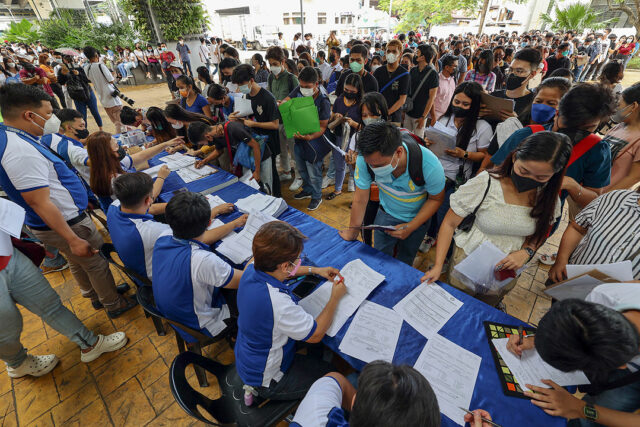
Applicants fill up documents at a job fair in Manila, June 20, 2022. — PHILIPPINE STAR/KRIZ JOHN ROSALES

If you really want to get to know an economy, one of the first numbers you look at is jobs. Do people have a regular source of income, which they can use to buy their basic needs? How many people are out of a job and could be contributing more to the economy if only they had one?

More than that, jobs convey a value that goes beyond numerals. Are people actively engaged in economic activity, which enables them to support their families without relying on anyone? Do they have some measure of security about their future? Jobs are more than a source of income; they are a source of dignity. 

Small wonder that the creation of jobs ranks the highest among Filipinos’ concerns.

In a Stratbase-commissioned survey held between Sept. 17 and 21 this year, Pulse Asia asked respondents nationwide to give three issues that the private sector can address to boost the Philippine economy. Sixty-nine percent of respondents identified job creation — the most frequently cited issue.

The dominance of job creation as an area of cooperation with the private sector is consistent across all regions in the Philippines, and was cited the most by respondents from the National Capital Region (77%) and those from socioeconomic class D (71%).

A comparison with figures from December 2021, the last time Pulse Asia asked the same questions to its respondents, revealed a significant increase in the percentage of those who believed jobs are the primary issue the private sector can help address.

Nine months ago, some 58% of respondents nationwide believed the same, representing a jump of 11 percentage points. This is a strong message that more Filipinos give high value on how the private sector is the primary employer of the workforce population.

The marked increase from December 2021 to September 2022 is most pronounced in the National Capital Region (NCR), which saw jumps of 16 and 18 percentage points, respectively. Respondents from socioeconomic class D also had the same sentiment; responses from this group showed a 14-percentage point increase from 57% in December to 71% nine months later.

This is the same Pulse Asia survey which revealed that 86% of Filipinos nationwide agree that the private sector plays a crucial role in accelerating economic growth. In the NCR and Balance Luzon, more respondents — 90% and 88%, respectively — believe the same. Ninety-four percent of respondents from the ABC socio-economic group had the same sentiment.

The Pulse Asia survey, conducted via face-to-face interviews among 1,200 respondents from the NCR, Balance Luzon, Visayas and Mindanao has a margin of error of plus/minus 2.8% at the 95% confidence level.

The survey respondents’ emphasis on job creation is not misplaced. Official government figures show us that employment and unemployment remain a crucial concern for the country, especially as we try to recover from the crippling effects of the pandemic-induced lockdowns.

According to the Philippine Statistics Authority (PSA), unemployment in August 2022 hit 5.3%, up from 5.2% in July. The difference translates to 79,000 more Filipinos out of a job.

Meanwhile, underemployment also increased in August 2022 from the previous month, with the number of workers looking for more jobs or more working hours increasing to 14.7% (7.03 million) from 13.8% (6.54 million) in July 2022.

The PSA said in July that the services sector remained the top employment hub with 58.8% of the total number of employed persons. The agriculture and industry sectors employed 23.5% and 17.7%, respectively.

Through all these, there are several sectors that saw an increase in employment. Year on year, or from July 2021 to July 2022, the following sub-sectors saw the largest increase in the number of employed persons: wholesale and retail trade, repair of motor vehicles and motorcycles (2.14 million); agriculture and forestry (1.74 million); accommodation and food service activities (498,000); other service activities (354,000); and public administration and defense, compulsory social security (206,000).

Within this year, between the first quarter and the second quarter, the largest increases in the number of employed persons were in the following sub-sectors: wholesale and retail trade, repair of motor vehicles and motorcycles (840,000); agriculture and forestry (268,000); accommodation and food service activities (170,000); administrative and support service activities (137,000); and construction (137,000).

A look at the industries and sub-sectors experiencing growth despite the still-precarious economic environment would tell us that the vast majority of these jobs are in the private sector, also validating the sentiments of the survey respondents.

Then and now, the private sector has consistently proven itself to be an indispensable partner of the government in economic development in general, and job generation in particular. The private sector’s strengths, resources, and know-how complement the government’s own capabilities.

The challenge to the new administration is to make a longtime commitment to work in tandem with the business community, not only through pronouncements, but more importantly by fostering transparency and accountability in government affairs, by establishing a fair, predictable, and business-friendly regulatory environment, and by respecting the rule of law.

In turn, more domestic and foreign investments will come, providing much-needed jobs for our people and enabling them to live the life they desire and deserve.


Victor Andres “Dindo” C. Manhit is the president of the Stratbase ADR Institute.

IT-BPM industry drives economic growth

PETR MACHACEK-UNSPLASH

(Part 2)

The developed world is due to suffer stagflation — high inflation and low economic growth — in the near future. Because of the high prices of commodities, partly caused by the Russian-Ukraine war — another recession is expected in the next three to four years. Even China has slowed down dramatically at a GDP growth rate of 3 to 4%.

Recent World Bank forecasts show that countries in the ASEAN will lead the world in growth with Vietnam and the Philippines still able to grow at 6 to 7%. India is expected to grow at even more than 7%.

I expect the economic difficulties to be faced by the developed countries in Europe, North America and Japan to actually benefit the information technology and business process management (IT-BPM) industry of the Philippines and India.

As costs of operations in the US grow because of the strong dollar, there will be greater pressure on their business enterprises to outsource non-core IT-BPM services to countries like the Philippines and India in which wages are much lower. This was actually the good news that I received when I attended a conference organized by the BPO-IT (business process outsourcing-information technology) industry association in Boracay from Oct. 20 to 23.

The main players actually expect a recession in the developed world to increase demand for Philippine BPO-IT services. They were so bullish that they expect to add 1 million more workers to their industry in the next six years. I considered their optimism quite realistic.

The Philippines serves countries spanning multiple time zones for contact center (CC) and business process (BP) delivery. It is actually providential that it is the US whose currency is getting stronger and stronger that continues to be the largest client because of cultural affinity and neutrality of the Filipino accent with the nature of work supported evolving from transactional to complex, such as customer experience management (chats and social media interaction, customer analytics, etc.).

Furthermore, especially after the health crisis during the pandemic, certain sectors such as clinical healthcare and nursing assistance have increased the share of North America. On the other hand, the Asia-Pacific region and Europe contribute the remaining BP services, with each having a share of 15%.

The IT-BPM sector is especially contributing to equitable economic growth because of its leveraging more and more cities and other municipalities outside of the National Capital Region in which income and employment opportunities have been overly concentrated to the detriment of the other regions.

Not only are IT-BPM enterprises locating in other major urban centers like Metro Cebu, Davao, Iloilo, and Cagayan de Oro. They are increasingly expanding to secondary cities and municipalities like Puerto Princesa, Tuguegarao, Dumaguete, Tanjay (Negros Oriental), Angeles (Metro Clark), and Capiz, among others.

In fact, there are provinces like Ilocos Norte whose medium-term strategic plan is to significantly improve internet connectivity so that they can attract locators in the burgeoning data center services.

Now that foreign enterprises can own 100% of telecom companies under the amended Public Service Act (PSA), greater competition in the telecom industry will actually benefit the move of the IT-BPM industry to the countryside.

One of the most promising prospects for improvements in telecom services presented at the Boracay industry conference was delivered by the representative of Elon Musk’s Starlink whose future operations in the Philippines can make internet connections even in the most remote islands of the country possible.

Another major contribution of the IT-BPM industry to Philippine equitable economic growth is the role it will play in the upskilling and reskilling of Filipino human resources.

The obvious challenge to the leadership of our Department of Education is to improve the quality of basic education which has descended to very low levels as evidenced by the very poor performance of the products of basic education in international achievement tests in reading comprehension, mathematical literacy, and scientific know-how. Our 15-year-olds are notorious for getting the lowest scores in these tests.

Another problem, however, is how to upskill, reskill and retool those who are already in the labor force among whom are those who are either unemployed (2.6 million in 2022) or underemployed (6.54 million). A whole session was devoted to the issue of talent development during the Boracay seminar. This is probably the biggest challenge to the industry in the next six years, considering that new job prospects for one more million workers in the industry are expected till 2028.

The Philippines has been delivering contact center management for end users in key demand markets since the late 1990s. Since then, this industry has undergone a fundamental shift from transactional to complex BP services, driven by the impact of automation and digital transformation that has been further accelerated by the pandemic.

Going forward, the continuing growth of the Philippines IT-BPM industry will depend on the country’s ability to ensure a continuous supply of talent and skills in demand, along with an enlightened and favorable environment and enabling physical infrastructure.

Given the high demand for contact-center services and business processes in the Philippines, there already exists a demand-supply gap in metropolitan areas such as Metro Manila and Cebu. The shortage is even more critical in the secondary cities like Davao, Bacolod, Iloilo, Angeles-Clark, etc. Furthermore, most of the talent is concentrated in the metropolitan areas with limited availability in the provincial locations such as Davao, Iloilo, Bacolod, etc. The shortage becomes more acute when it comes to such services as analytics, complex CC processes, Finance and Accounting, etc.

Special attention in talent development should be given to data and analytics services. The consumption of these data-oriented services has witnessed a very rapid rise globally with increasing investments from enterprises to transform internal as well as external processes, reduce time-to-insights, repair obsolete analytical models, and understand the fast-evolving customer behavior.

Some estimates show that global data and analytics services demand could grow by as much as 15–20% annually in the coming years. The pandemic further fueled the need for these services across different industries.

For example, while data modernization and data-driven customer experience enhancement continue to be major drivers of Data and Analytics (D&A) services adoption in the Banking, Financial Services and Insurance (BFSI) sector, the pandemic expedited the need for fraud and risk analytics use cases to prevent increasing fraudulent transactions and to analyze risks in insurance grants.

Likewise, the Healthcare and Life Sciences sector saw an unprecedented need to develop the life-savings drugs and provide timely treatment as a result of the COVID-19 crisis, a phenomenon that was met by the rapid adoption of data and analytics, Artificial Intelligence, and other cognitive technologies aiding in drug discovery, DNA genome sequencing, COVID-19 detection, and digital therapeutics.

In producing the talents required in these emerging fields of data and analytics services, the role of the institutions of higher learning is indispensable. The leaders of the industry should work closely with the Commission on Higher Education (CHED) and the top universities to develop the appropriate knowledge and skills among the most intellectually capable university students and graduates.

Fortunately, there are already doctoral, masteral and undergraduate programs on data sciences and business analytics being offered by the top schools such as the Asian Institute of Management, the University of the Philippines, De La Salle University, Ateneo de Manila University, the University of the East, Far Eastern University, Southwestern University (PHINMA), and the University of Asia and the Pacific (UA&P).

In the last mentioned (where I teach), there is a very successful masteral program in business analytics that, in close cooperation with data analytics enterprises, is upskilling and reskilling professionals with different specializations as varied as law, economics, engineering, the sciences and others to become data analysts.

I would suggest that all these programs to address the increasing demand for data and analytics (D&A) services adopt the dual training system that the Germans have made popular. This means that as the future data analysts are receiving classroom instruction on the theories and tools of the profession, they are given on-the-job experiences in cooperating enterprises engaged in data analytics.

This very close cooperation between the academe and the business enterprises in the IT-BPM sector was highly emphasized in the session on talent development at the Boracay conference which I attended. I suggested that their industry leaders study very closely the success story of the Dualtech Foundation that over the last 40 years has produced more than 10,000 highly skilled workers for the industrial workforce, using the “dualvoc” system perfected in countries like Germany, Switzerland, and Austria.

(To be continued.)


Bernardo M. Villegas has a Ph.D. in Economics from Harvard, is professor emeritus at the University of Asia and the Pacific, and a visiting professor at the IESE Business School in Barcelona, Spain. He was a member of the 1986 Constitutional Commission.

bernardo.villegas@uap.asia

The ‘new normal’: The revised rules on telecommuting

BOJITHA WIMALASIRI-UNSPLASH

Due to rapidly evolving technology, coupled with the enduring risks of the coronavirus disease 2019 (COVID-19) pandemic, employers and employees alike have forged a “new normal” working environment — the work-from-home arrangement.

However, this setup is hardly new at all considering that Republic Act No. 11165, or the “Telecommuting Act,” which recognizes telecommuting as a legitimate work arrangement in the private sector, was approved on Dec. 20, 2018.

Subsequently, Department Order No. 202, Series of 2019, was issued by the Department of Labor and Employment (DoLE) on March 26, 2019, as its implementing rules and regulations prior to its recent revision in Department Order No. 237, Series of 2022, issued Sept. 16.

In fact, in recognition of the work-from-home arrangement as the new model of operations, and to settle the continuing issue on tax incentive claims concerning the conduct of business operations outside economic zones, the Fiscal Incentives Review Board (FIRB) has agreed to allow the transfer of registered Information Technology and Business Process Management (IT-BPM) companies to the Board of Investments (“BoI”).[1]

To effect the easy transfer of these registered business entities to the BoI, the 70-30 work-from-home arrangement for the IT-BPM sector has then been extended until Dec. 31, in accordance with Presidential Proclamation No. 57 which extended the country’s declared state of calamity until year-end.[2]

Telecommuting refers to a work arrangement that allows an employee in the private sector to work from an alternative workplace with the use of telecommunication and/or computer technologies.[3] This basically allows an employee to work outside the premises of the employer’s place of business under such terms and conditions as mutually agreed upon without loss of the minimum labor standards set by law,[4] without diminishing or impairing the terms or conditions of employment in any applicable company policy or practice, individual contract or collective bargaining agreement,[5] and ensuring fair treatment as that of comparable employees working at the employer’s premises.[6]

In its most recent issuance, the DoLE expansively defined “alternative workplace” as any location where work, through the use of telecommunication and/or technology, is performed at a location away from the principal place of business of the employer, including but not limited to the employee’s residence, co-working spaces or other spaces that allow for mobile working.[7]

Meanwhile, the regular workplace refers to the principal place of business or any branch office or physical premises established or provided by the employer where employees regularly report to or perform work.[8]

Despite this remote setup, work performed in the employee’s alternative workplace will still be considered as work performed in the employer’s regular workplace without considering such telecommuting employees as field personnel except when their actual hours of work cannot be determined with reasonable certainty.[9]

Considering the flexibility of this work-from-home set-up, the employer is still mandated to take appropriate measures in ensuring protection of data used and processed by the telecommuting employee for professional purposes, and in turn, the latter will also ensure that confidential and proprietary information are protected at all times.[10]

As already emphasized and highly encouraged, this work-from-home setup is completely voluntary on both employers and employees.[11]

Given the likelihood that this arrangement may be subject to ill execution, however, the telecommuting program mutually agreed upon must still abide by the minimum labor standards[12] and offer fair treatment to telecommuting employees as much as it does to employees working in their employers’ premises.[13]

As the dawn of the new “normal” arises, it is highly welcome that DoLE has taken upon itself to come up with rules to ensure the proper implementation of this work-from-home arrangement. With this current trend of working remotely, it must be ascertained that employees and their employers, especially, still maintain the same level of professionalism and mutual protection of rights as is done when working “traditionally.”

This article is for informational and educational purposes only. It is not offered as and does not constitute legal advice or legal opinion.

1 “FIRB approves transfer of registered IT-BPM enterprises to BOI, irons out long-standing WFH problem,” Sept. 16, 2022, available at https://firb.gov.ph/firb-approves-transfer-of-registered-it-bpm-enterprises-to-boi-irons-out-long-standing-wfh-problem/, last accessed on  Sept. 19, 2022. 

2 Ibid.

3 Republic Act No. 11165, Section 3. 

4 Republic Act No. 11165, Section 4; and Department Order No. 237, Series of 2022, Section 4. 

5 Department Order No. 237, Series of 2022, Section 4. 

6 Republic Act No. 11165, Section 5; and Department Order No. 237, Series of 2022, Section 8. 

7 Department Order No. 237, Series of 2022, Section 3(a). 

8 Department Order No. 237, Series of 2022, Section 3(c). 

9 Department Order No. 237, Series of 2022, Section 4.

10 Republic Act No. 11165, Section 6. 

11 Republic Act No. 11165, Section 4; and Department Order No. 237, Series of 2022, Section 5. 

12 Department Order No. 237, Series of 2022, Section 4. 

13 Department Order No. 237, Series of 2022, Section 8.


Carmella Gaye D. Perez  is an associate of the Cebu Branch of the Angara Abello Concepcion Regala & Cruz Law Offices (ACCRALAW).

cdperez@accralaw.com

Jaywalking shouldn’t be a crime, and now it isn’t — in California

THE “Freedom to Walk Act” adopted this month by California warms my libertarian heart. Contrary to some reports, the state hasn’t legalized jaywalking. But by protecting the rights of pedestrians who cross the street illegally but safely, the legislation challenges a century of thinking about roads.

It’s about time.

The idea that jaywalking is bad is the result of decades of indoctrination by the victors in a century-long struggle over control of the street. As the journalist Tom Vanderbilt puts it, “the word jaywalking is often used as a sort of blanket justification for the dominating presence of cars on city streets” and “reflects a social bias against those people not in cars.”

It’s a bias with a history; and a history that involves bias.

Nowadays, we tend to take it for granted that pedestrians should be kept out of traffic, but matters were not always thus. In 1915, the New York Times editorialized that requiring that walkers cross only at corners would be “silly and intolerable” and inappropriate for “this complicated town.”

It was hardly an extreme view. At the time, streets were still contested territory. Most urbanites considered them public spaces, where anyone should be free to stroll. Ranged against this notion stood a coalition of interest groups — car dealers and auto clubs, among others — who insisted that safety required that pedestrians stay off the roads. In his excellent book on the battle, the historian Peter D. Norton summarizes the campaign this way: “motordom defended motorists as a persecuted minority suffering under a majority tyranny.”

These pro-regulation forces were determined to change public opinion. “Because jaywalker bore the right connotation of rural backwardness, it was just the tool for the reeducation effort,” Norton notes. But the main argument involved public safety. If drivers were maiming and killing pedestrians, the fault obviously lay with the victims.

The elites were soon on board. Civil engineers began designing streets with automobile traffic in mind. Governments in turn adopted new safety rules. By the late 1920s, jaywalking had been outlawed across the country. But the laws were rarely enforced.

After World War II, the popularity of the automobile — and the rise in traffic fatalities — led cities across the country to either adopt new regulations or revive the ones they had. When New York City’s ban took effect in August 1958, the Times reported with evident glee that city police issued 479 summonses on the first day.

In the end, the streets-are-for-cars forces prevailed. But, as so often, the nation took the benefits for granted without considering the costs. Now we know a lot more.

We know, for example, that although laws against jaywalking are generally defended on safety grounds, the data are more complex than we tend to think. (That’s a fascinating topic, but one for another day.) We also know that the sparkling new jaywalking laws often provided the legal excuse for arresting peaceful civil-rights demonstrators; and for exercising ordinary racial prejudice.

In 1962, a Black student at Ohio State University was locked up for jaywalking while two White friends who crossed the street alongside her were unaccosted. In a similar vein, a 1957 letter to an Indianapolis newspaper complained about the enforcement of jaywalking laws by police officers watching Black pedestrians “from the shadows.”

The problem hasn’t gone away. Many cash-strapped municipalities have used jaywalking laws to raise revenue, a practice that tends disproportionately to burden the marginalized.

Finally, let’s not forget a fundamental libertarian caution: Every law, no matter how innocuous, carries the potential for violent enforcement, because enforcement entails an interaction between the citizen and the armed representative of state authority. In fact, in 1966, the Boston Globe reported that one George H. Calustian, the first person arrested under the city’s new jaywalking law, had been fined $20 for jaywalking … and $100 for assaulting a police officer.

It’s fantasy to imagine that we can perfect these interactions so that they never turn sour.

That’s why, on the first day of law school, I always warn my students to support only laws for which they are, in principle, willing to kill. This isn’t an argument that we shouldn’t have laws; it’s an argument that we should be realistic in our expectations.

If that sounds extreme, consider: The softening of California’s law was sparked in large part by a 2020 incident where police in San Clemente shot and killed a Black homeless man who’d been stopped for jaywalking. The episode was hardly unique. In 2018, Sacramento agreed to pay $550,000 to settle a claim that one of its officers savagely beat a Black suspect who’d been arrested for the same offense. Atlanta faces a lawsuit by a Black man who was tasered during a jaywalking stop. During a 2014 anti-jaywalking campaign on Manhattan’s Upper West Side, an 84-year-old Asian-American restaurateur was knocked unconscious by police and woke up handcuffed to a hospital bed.

Anecdotes aren’t the same as data, but one needn’t be anti-police — I’m certainly not — to recognize that the fewer laws we have, the less chance for an interaction between police and public that could end in tragedy.

California’s reform of its jaywalking laws to favor walkers is … well … a step in the right direction.

BLOOMBERG OPINION

Filipinas head to South America, Europe as part of World Cup preps

FILIPINAS (a.k.a Malditas) — PFF

PHILIPPINE Football Federation (PFF) officials reiterated the goal in the 2023 FIFA Women’s World Cup is to “play to win” and vowed to get the Filipinas battle-ready for the global showpiece.

In this regard, an intensive buildup highlighted by friendlies against elite opposition from South America and even Europe is being lined up over the next eight months leading to the July 20 to Aug. 20 extravaganza.

The 53rd-ranked Filipinas are up against No. 12 Norway, No. 21 Switzerland and No. 22 co-host New Zealand in the Group A preliminaries to be held in the cities of Dunedin, Wellington and Auckland.

“We’re the lowest-ranked team but I think we have a fighting chance, based on the results of our friendlies so far,” PFF President Nonong Araneta said during yesterday’s PSA Forum.

The Filipinas faced New Zealand last month in a friendly in California where they took a one-goal advantage before conceding, 2-1. Prior to this, they narrowly lost to No. 27 Ireland, 1-0, beat Bosnia and Herzegovina twice (3-0 and 2-1) and posted a draw (1-1) and a loss (2-1) to No. 37 Costa Rica.

“We’re happy with the draw. We’ll just move on from here and we might have to play more with some European teams to adapt to the European style. We have to play European teams on the level of Switzerland and Norway,” said Mr. Araneta.

The PFF is making the most of the FIFA international days to get the Pinay booters in action.

Next month, PFF General Secretary Edwin Gastanes said the Filipinas will head to South America for a camp and two matches against a side that has competed in the World Cup and the Tokyo Olympics. Aside from friendlies, Alen Stajcic’s charges are also set to shoot for a breakthrough gold in the Southeast Asian Games in Cambodia in May and possibly a pocket tournament against Euro sides in Manila in June as part of their World Cup buildup.

“The motto of all football teams is play to win and our team will play to win in the World Cup,” said Mr. Gastanes. “I’ve seen the development of the team. This is different from the January 2022 team because they’ve been training regularly and their fitness level is going up.”

Mr. Gastanes also revealed that FIFA has selected the Philippines as one of the stops of the FWWC Trophy Tour — the first time the country is getting such honors. — Olmin Leyba

Second round of UAAP elimination resumes on Saturday

WITH UP rising as the only team to create a separation from the pack, the second round is expected to feature a royal rumble en route to the Final Four. — PHILIPPINE STAR/ RUSSELL PALMA

AFTER an unpredictable first round, teams get a much-needed calm before the storm as the UAAP Season 85 will not resume to action until this weekend for the crucial second phase of the elimination round.

Originally slated to play during Wednesdays, the UAAP is taking an off for now to give squads ample time to recharge and prepare for the resumption on Saturday featuring La Salle (3-4) against Santo Tomas (1-6) and Ateneo (5-2) versus at Adamson (3-4).

Reigning champion and pacesetting University of the Philippines (6-1) then follows suit on Sunday against National U (5-2) in a revenge bid while University of the East (3-4) clashes against Far Eastern U (2-5).

With UP rising as the only team to create a separation from the pack, the second round is expected to feature a royal rumble en route to the Final Four as perennial contenders stumbled while new forces sprung surprises and rose to the ladder.

One of them was La Salle, which after ruling the PBA D-League Aspirants’ Cup got off to a shaky start only at 3-4 card for a share of fourth to sixth spot with Adamson and this season’s revelation UE.

FEU, owner of the longest active Final Four streak (8 seasons in a row), also tripped to 0-5 salvo before stringing two straight wins to stay alive while NU and UE made heads turn with an impressive first-round play.

NU, then the hottest squad with four straight wins, could have actually snatched the No. 1 spot from UP if not for a 47-44 loss against FEU entering the second round.

Coach Goldwin Monteverde said the unpredictable first-round result was what he expected as early as the preseason, thus bracing his wards for an even all-out war as teams gun for each other’s heads in playoff positioning.

Other notable schedules in the second round feature the iconic Ateneo-La Salle rivalry match on Nov. 5 as well as the Battle of Katipunan II between Season 84 finalists Ateneo and UP on Nov. 26 to end the eliminations.

The UAAP, which is tipped to lend Carl Tamayo, Kevin Quiambao and Ange Kouame, will take a break from Nov. 6 to 16 to give way for the campaign of Gilas Pilipinas in the fifth window of the 2023 FIBA World Cup Asian Qualifiers slated Nov. 10-13 in the Middle East. — John Bryan Ulanday

Carlos Yulo ready for gymnastics world championship in Liverpool

CARLOS EDRIEL YULO — GYMNASTICS ASSOCIATION OF THE PHILIPPINES

FILIPINO pocket-sized wonder Carlos Edriel Yulo has set himself lofty goals as he braces for the 41st FIG Artistic Gymnastics World Championships slated Oct. 29 to Nov. 6 in Liverpool, England.

“My goal is to finish in the top six in the individual all-around and hopefully three gold medals in the events I won in the World Championships,” said Mr. Yulo, who left his training camp in Paris, France and flew to Liverpool yesterday, during Monday night’s online presser set up by the Gymnastics Association of the Philippines.

The apparatuses Mr. Yulo was referring to were floor exercise and vault where he struck gold in Stuttgart, Germany three years ago and vault in Kitakyushu, Japan last year and parallel bars where swooped down on a silver also in Kitakyushu.

Mr. Yulo vowed to especially focus in redeeming himself from his forgettable fifth-place performance in his pet floor exercise in Kitakyushu where he made one glaring mistake after he fell and stumbled out of the mat that cost him a medal.

“We made upgrades in floor and vault and we will try new elements,” said the quintuple Southeast Asian Games gold winner.

Mr. Yulo said he is already fully healed after injuring two fingers in his right hand two months ago and will come into full strength in the Liverpool tilt where he is expected to face world and Olympic champions including world individual all-around titlist Zhang Boheng of China.

“I don’t fear it (re-injuring his fingers). But it will be decided in how well I fare during practices,” he said.

Mr. Yulo’s coach, Japanese Munehiro Kugimiya agrees.

“He’s very good now and he has no more problems with his fingers,” said Mr. Kugimiya of Mr. Yulo. “In Liverpool, he will try the highest element in vault and will target 85 points in all-around.

“If he can do that, he can get in the top six or eight in the all-around,” he added. — Joey Villar

Filipino athlete skips his way to second jump-rope record

RYAN ALONZO — PHILSTAR FILE PHOTO

FILIPINO athlete Ryan Alonzo has set a second Guinness World Record in the high-intensity activity of jump rope, the organization said in October.

Nicknamed “Skipman”, the 35-year old completed 3,731 consecutive crossovers, which are done by crossing the arms in and out while skipping over the rope as it goes around the body. The previous record was 2,405 consecutive crossovers.

Alonzo’s earlier record was set in 2021, when he performed 40,980 double-under skips in 12 hours. That involves the rope passing around the body twice in a single jump.

Endurance was a common factor in setting the two records, he said, crediting previous marathon training with helping him prepare both physically and mentally.

Jump rope, or skipping, is usually used as a warm-up for other sports but some athletes around the world engage in the activity competitively. — Reuters

‘I am not retired,’ Serena says

SERENA WILLIAMS — REUTERS

SERENA Williams on Monday said she has not retired from tennis and that the chances of her returning are “very high” after she previously indicated that she would step away from the sport after last month’s US Open.

“I am not retired,” Ms. Williams said at a conference in San Francisco while promoting her investment company, Serena Ventures. “The chances (of a return) are very high. You can come to my house, I have a court.”

Ms. Williams, 41, said she was “evolving away from tennis” in an essay in August and, while she did not confirm the US Open as her farewell event, she was given lavish tributes before each match in New York and waved an emotional goodbye after losing in the third round.

The 23-time Grand Slam champion, who took the tennis world by storm as a teenager and is considered by many the greatest of all time, said not preparing for a tournament after the US Open did not feel natural to her.

“I still haven’t really thought about (retirement),” Ms. Williams said.

“But I did wake up the other day and go on the court and (considered) for the first time in my life that I’m not playing for a competition, and it felt really weird”. — Reuters

Padao-Gilbuena tandem moves to last-16 in men’s double

YOUTHFUL sensation Jude Michael Padao continued to make heads turn as he teamed up with Harvey Gilbuena as they bested Jackey Mirabueno and Vince Serino, 6-2, 6-4, yesterday to advance to the round-of-16 in the men’s doubles of the PCA Open Tennis Championships in Plaza Dilao, Paco.

Mr. Padao, a 16-year-old gem of a find from Digos, Davao del Sur, and Mr. Gilbuena, however, may run into a collision course with the top-ranked Johnny Arcilla and Ronard Joven, who were battling Jules and Alex Lazaro at press time.

The honor student at Corjeso College, who made it to the main draw as a qualifier, has been making a noise in the men’s singles after he eked out a giant-sized 6-2, 2-6, 6-3 win over 11th seed Alberto Villamor the day before to join the big boys in the next round.

It was a win that came a couple of days after Mr. Padao slew Rodolfo Barquin, a two-time UAAP champion when he was still with University of the East, in another three-setter, 6-4, 3-6, 6-3, in the opener last Saturday.

And Mr. Padao isn’t about to slow down. “I will keep going for a win,” said Mr. Padao in this meet bankrolled by Smart/PLDT, official ball Dunlop, Manila councilor Jong Isip, San Jose Salt, W. L. Food Products, Palawan Pawnshop and Pagcor.

Interestlingly, Mr. Padao was the last of the qualifiers and joined an elite group in the next phase headed by former champions Mr. Arcilla, who won nine times here, Jeson Patrombon (2018) and Joseph Victorino (2002).

In men’s doubles, second seed Leander Lazaro and Fritz Verdad dumped Jose Bernardo and Mateo Rivas, 6-2, 6-0, to surge through the round-of-16 in this tilt backed by GAC Motors, GIMACA Convenience Store and Development Corp., Ourzen Chicken, HEAD, Ms. Rina Caniza, Mr. Benito Tan, Primo Dept Fuel Station, Kaizan Steel Trading, Cazneau, Inc. and Knaut Art Glass.

Also making the cut were Kristian Tesorio and Rafael Liangco, who edged John Altiche and John Jeric Accion, 6-4, 5-7, 10-5; Alberto Villamor and Rash Manatad, who downed Andrei Cagamat and Elvin Geluz, 6-4, 6-0; John Tomacruz and Franklin Encarnacion, who waylaid Mathew Crisosto and Maraphael Teng, 6-0, 6-4; Alexis Acabao and Erik Tangub, who ousted Gab Bandoquillo and Feb Deja, 6-3, 7-5; and Jose Antonio Tria and Bryan Saarenas, who slammed Abdulqouhar Allian and Argil Lance Canizares, 6-3, 6-2. — Joey Villar

Olympic qualified athletes will train a full month in France before the Games

FILIPINO athletes who will make the 2024 Paris Olympics cut will earn the privilege of training a full month before the quadrennial games in the French capital.

“The goal is to have our qualified athletes to be in Paris at least one month before the Olympics,” said Philippine Olympic Committee president Abraham Tolentino, who in Paris to make an early reservation.

“It’s not only us [Philippines] who’s making a reservation for a training facility, but several other countries as well. It’s first come, first served so we’re making sure we get the best one for our athletes,” he added.

The mayor from Tagaytay was impressed with the state-of-the-art facilities in Paris.

“I personally inspected the venues to make sure they’re fitted to the needs of our athletes,” said the PhilCycling chief. “We wanted a 3-in-1 facility, which should be at least 10 minutes to and from the athletes accommodation or should also be equipped with a kitchen.”

Mr. Tolentino said they would ask the Philippine Sports Commission chared by Noli Wala to shoulder the one-month pre-Olympics training camp aside from actual participation.

“We will ask the PSC to cover the expenses as part of the Olympic journey,” he said.

The country is optimistic it could eclipse, if not match, its historic performance in the 2021 Tokyo Games—a breakthrough gold by lifter Hidilyn Diaz-Naranjo and two silvers and a bronze by boxers Nesthy Petecio, Carlo Paalam and Eumir Marcial respectively. — Joey Villar

Losing scoring title to LeBron will be a ‘bitter pill’ for Kareem, says Magic

LOS ANGELES — Lakers’ forward LeBron James is on track to surpass Kareem Abdul-Jabbar as the NBA’s all-time leading scorer this season and when he does it is unlikely to sit well with the Hall of Fame center, Magic Johnson said.

James needs 1,244 points to eclipse Abdul-Jabbar, who has held the record since April 1984.

“I don’t think well,” Johnson said when asked in a podcast how he thinks Abdul-Jabbar will handle losing the title he has held for nearly four decades.

“Let’s be honest. And the fact that it’s a dude playing for the Lakers too. It’s a dude playing in LA. I think it will be a hard pill to swallow.”

Abdul-Jabbar, a six-time champion and six-time MVP whose signature “skyhook” shot was nearly unstoppable, is sometimes unfairly overlooked in conversations over the greatest ever to play the game but his advocates have always been able to point to the scoring title.

Johnson said Abdul-Jabbar probably never believed anyone would surpass his total of 38,387 regular season points.

“I think he thought he was going to have it forever,” Johnson said.

James raised eyebrows earlier this month when he was asked about his thoughts on potentially passing Abdul-Jabbar and his relationship with him and offered a short and frosty reply.

“No thoughts and no relationship,” James said.

Abdul-Jabbar, who like James is a vocal advocate for social justice causes, criticized James when he said that getting the COVID-19 vaccine was a personal choice. He has also called some of James’ on-court celebrations “stupid and childish.”

Johnson said he wishes the pair had a better relationship and believes they will come together down the road.

“I think that one day that’s going to happen, and if I can play a part in that, I would love to,” Johnson said.

“But let him pass him first. Let that soak in for a minute, and then put the two men together because they are going to find out they are similar.” — Reuters

ADVERTISEMENT
ADVERTISEMENT