Home Blog Page 57

Meralco seeks bids for 200-MW renewable energy supply

PHILIPPINE STAR/ MICHAEL VARCAS

MANILA ELECTRIC CO. (Meralco) has launched a competitive selection process (CSP) to procure 200 megawatts (MW) of baseload renewable energy (RE) to comply with its renewable portfolio standards (RPS) obligations, the company said on Monday.

The CSP aims to secure a four-year power supply agreement (PSA) that will cover Meralco’s baseload requirement starting Jan. 26, subject to approval by the Energy Regulatory Commission (ERC), it said in a statement.

The launch follows the Department of Energy’s (DoE) issuance of a certificate of conformity on Dec. 4, confirming that the CSP aligns with Meralco’s latest DoE-approved power supply procurement plan.

Power generation companies can submit expressions of interest (EoI) to Meralco’s Bids and Awards Committee by Jan. 6. A pre-bid conference is scheduled on Jan. 15, and the bid submission deadline is Feb. 16.

“This CSP is consistent with Meralco’s ongoing efforts to expand its supply portfolio from renewable energy while ensuring RPS compliance through a competitive and transparent bidding process,” said Jose Ronald V. Valles, senior vice-president and head of regulatory management.

Distribution utilities conduct CSPs to procure power through a competitive process that results in a PSA at a least-cost basis.

Meralco has already contracted 1,536 MW of renewable energy from various suppliers, exceeding its initial target of 1,500 MW. Through these initiatives, renewable energy is expected to account for 22% of Meralco’s supply portfolio by 2030.

Earlier this year, the DoE approved Meralco’s 2025 power supply procurement plan, which aims to secure nearly 3 gigawatts of electricity supply from 2026 to 2052.

Meralco’s controlling stakeholder, Beacon Electric Asset Holdings, Inc., is partly owned by PLDT Inc.

Hastings Holdings, Inc., a unit of PLDT Beneficial Trust Fund subsidiary MediaQuest Holdings, Inc., has an interest in BusinessWorld through the Philippine Star Group, which it controls. — Sheldeen Joy Talavera

Women are not just entrepreneurs

STOCK PHOTO | Image from Freepik

Women entrepreneurs have been flourishing in the Philippines. They continue to be innovative, resourceful, and able to break barriers. However, numerous challenges still stand in the way: digitalization, access to funds and markets, and multiple other hindrances. Data from the Philippine Commission on Women (PCW) in 2025 shows that 66% of MSMEs and 62% of newly registered Department of Trade and Industry (DTI) businesses are owned by women.

While the contributions of Filipina entrepreneurs have been recognized, women’s participation in the Philippine economy should be examined more broadly as not all women are entrepreneurs.

Women in the Informal Sector. It is estimated that 70% of Filipinos work in the informal sector with a disproportionate amount being women. The informal sector is wide, ranging from small home businesses, contractual jobs in the manufacturing and service sectors, and other underdeveloped sectors of the economy. Women make up a significant portion of this informal workforce, often working in unstable and low-paying jobs without any legal protections or social security as their work does not give them access to fair wages, benefits, or job security. Despite their hard work and contributions to the economy, they do not receive even a minimum amount of care or social and legal protection. Lack of data and the lack of attention given by lawmakers deny women their basic rights as workers. Nonetheless, they continue to work and contribute to the economy; without benefiting from the fruits of their labor.

Women Professionals. In 2024, the Philippine Statistics Authority (PSA) reported that one million women entered the workforce, driven by the growth of the digital economy and emerging sectors. Women reach higher levels of education, such that the share of male and female employment in high-skilled jobs is almost equal. The services sector, made up of education, human health, and social work, are dominated by women. Women are nurses, doctors, lawyers, and teachers, among many other professions.

Apart from women’s participation in the domestic workforce, women Overseas Filipino Workers (OFWs) also contribute significantly. PSA statistics for 2023 show that of the 2.16 million OFWs, 1.20 million were women. Women make up a large number of the OFW population, still dominating in the services sector. This number equates to larger remittances to the Philippines, supporting their families and boosting the economy.

Women in the C-Suite. Workplace gender equality is necessary as the inclusion of women in decision-making positions demonstrates good governance and innovation. Gender equality and diversity in the workplace pose numerous benefits for individual companies, society, and the economy.

Two organizations I lead — the Philippine Women’s Economic Network (PhilWEN) and the Philippine Business Coalition for Women Empowerment (PBCWE) — published the Census on Women in Executive Leadership Teams (ELTs) in Philippine Publicly Listed Companies (PLCs), which looked at women’s corporate leadership. The census showed that women’s participation and representation is improving; 2022 statistics reveal that 13% of CEOs in Philippine PLCs were women; women hold 22% of board seats; women make up 40% of the ELTs in Philippine PLCs in 2022. The data proves that the visibility and decision-making power of women in the corporate sector is steadily on the rise. While not as quantifiable, women having such influence in corporations in the Philippines attests to their roles in and contributions to the Philippine economy.

BARRIERS TO PARTICIPATION
Numerous barriers for working women remain: discrimination, lack of access to skills training, existing wage gaps, care responsibilities, and societal beliefs and attitudes towards working women. Women want to work and continue to fight for the ability to work and be properly compensated for it. The sustained barriers for women in the workforce are often overlooked, thus preventing their greater economic participation and their potential contribution.

One key burden is unpaid care work which women have to perform in addition to the work they do to gain income. A 2025 study by the Philippine Institute for Development Studies (PIDS) concluded that unpaid housework negatively impacts the economy, owing to women being prevented from economic participation because of care work. Women typically tend to outperform men in housework and often cite that as the reason they cannot seek employment. When they do get employed, they receive lower pay due to their marital status, in comparison to their married male counterparts. Patriarchal and social constructs contribute to women being forced to do unpaid care work, making unpaid care work a norm.

UPLIFTING WOMEN, UPLIFTING THE NATION
Women want to work and continue to fight for the ability to work and be properly compensated for it. Women should not be boxed into certain roles. Economic participation beyond entrepreneurship, and the recognition of women’s roles and challenges is a step forward in empowering women.

The challenges for women’s participation in the economy seem insurmountable, but the simple acknowledgement that these issues exist can light the spark to create change. The entirety of women’s economic empowerment should be a priority. We can focus on policies and programs that boost economic participation, such as improving the rights of workers in the informal sector through the passage of the Magna Carta for Workers in the Informal Economy, providing alternatives for care work, and addressing gendered social norms that affect women’s participation in the economy. We must ensure that women across all sectors are given the support they need.

Women already make significant contributions, which can be improved to not only boost the economy but also to support and protect women. Support for women means that their children, families, and communities are equally supported. It is imperative that women, who represent almost 50% of our population, be prioritized — after all, nations that uplift their women uplift the whole nation.


Ma. Aurora “Boots” D. Geotina-Garcia is a member of the MAP Diversity, Equity & Inclusion Committee and the MAP Education Committee. She is founding chair and president of PhilWEN and chair of the Governing Council of the Philippine Business Coalition for Women Empowerment. She was the first female chair of the Bases Conversion & Development Authority. She is president of Mageo Consulting, Inc., a corporate finance advisory and consulting firm.

map@map.org.ph

magg@mageo.net

Jollibee sets Jan. 24 redemption for $300-M securities

BW FILE PHOTO

By Alexandria Grace C. Magno

JOLLIBEE FOODS Corp. (JFC) will redeem its $300-million guaranteed senior capital securities on Jan. 24, 2026, through its wholly owned subsidiary Jollibee Worldwide Pte. Ltd. (JWPL).

The securities, originally issued on June 24, 2020, under the $300-million Guaranteed Senior Capital Offering Circular, will be canceled and subsequently delisted from the Singapore Exchange Securities Trading Limited upon redemption, the company said in a disclosure to the stock exchange on Monday.

JFC said the Global Certificate representing the securities must be presented or surrendered by Euroclear and/or Clearstream, Luxembourg, to the trustee and/or the paying agent.

SIMPLIFYING AND OPTIMIZING CAPITAL STRUCTURE
According to Toby Allan C. Arce, head of sales trading at Globalinks Securities and Stocks, Inc., the redemption is aimed at simplifying and de-risking Jollibee’s capital structure, taking advantage of the company’s improved operating performance and access to funding.

“These perpetual instruments were originally useful in providing balance-sheet support during expansion phases, but they typically carry higher effective funding costs and add complexity to leverage metrics,” he said in a Viber message.

“By redeeming them now — after successfully raising new, more competitively priced senior debt earlier this year — Jollibee is taking advantage of improved market conditions and investor confidence to streamline its liabilities,” he added.

Mr. Arce noted that the move reflects management’s confidence in the company’s cash flow and balance sheet strength.

“This is a combination of cost optimization and capital-structure cleanup rather than a defensive maneuver. Retiring perpetual securities reduces long-term financing costs, improves transparency in the capital stack, and enhances financial flexibility ahead of further expansion or refinancing needs. While not a strategic reset in terms of business direction, it is a strategic financial housekeeping step that reinforces Jollibee’s positioning as a more mature, globally scaled consumer company with a cleaner and more efficient balance sheet,” he said.

Similarly, Shawn Ray R. Atienza, equity research analyst at AP Securities, Inc., said the redemption shows that JFC has sufficient internal cash flow and visibility into future inflows to streamline its balance sheet without issuing new hybrid securities.

“The move should primarily be viewed as a cost-optimization decision, specifically aimed at lowering interest expenses over the foreseeable future, with capital-structure simplification emerging as a secondary but favorable outcome,” he added.

In March, JFC announced plans to raise at least $300 million through a five-year, US dollar-denominated senior unsecured guaranteed notes issuance under Regulation S to refinance debt. Regulation S issuances are securities offered outside the United States that are not registered under the US Securities Act or any US state securities laws.

On Monday, JFC shares rose 2.64%, or P4.80, to P186.80 apiece.

BTr fully awards last T-bill offer as yields mostly move sideways

BW FILE PHOTO

THE GOVERNMENT made a full award of the Treasury bills (T-bills) it offered on Monday at mixed rates amid weakening market activity before the yearend and following the US Federal Reserve and Bangko Sentral ng Pilipinas’ (BSP) policy decisions.    

The Bureau of the Treasury (BTr) raised P20 billion as planned via the T-bills it placed on the auction block as the offer was more than four times oversubscribed, with total tenders reaching P87.456 billion. However, this was slightly below the P88.225 billion in bids recorded last week for a P22-billion offering.

The Auction Committee made a full award as the T-bills were quoted at yields that were all lower than secondary market rates, the Treasury said in a statement.

Broken down, the government raised P6 billion as planned from the 91-day T-bills as demand for the tenor reached P30.985 billion. The three-month paper fetched an average rate of 4.731%, down by 2.8 basis points (bps) from 4.759% in the previous auction. Yields accepted were from 4.709 to 4.779%.

The Treasury also made a full P7-billion award of the 182-day debt as bids hit P28.9 billion. The average rate of the six-month T-bill rose by 3 bps to 4.903% from 4.873% last week. Tenders awarded carried yields from 4.848% to 4.943%.

Lastly, the BTr likewise sold the programmed P7 billion in 364-day securities as the tenor attracted bids totaling P27.571 billion. The one-year paper’s average yield was at 4.924%, declining by 3.8 bps from 4.962% the previous week. Accepted rates were from 4.91% to 4.924%.

At the secondary market before Monday’s auction, the 91-, 182-, and 364-day T-bills were quoted at 4.8683%, 4.9989%, and 5.0583%, respectively, based on PHP Bloomberg Valuation Service Reference Rates data provided by the Treasury.

“Mixed yields and lower offerings were likely due to the approaching yearend, as well as the lack of strong catalysts in the following weeks. As a result, market players have lessened their activity,” a trader said in a text message.

T-bill rates were mostly lower and moved sideways after both the Fed and the BSP cut benchmark borrowing costs last week, Rizal Commercial Banking Corp. Chief Economist Michael L. Ricafort said in a Viber message.

The Fed cut interest rates by a quarter-percentage point on Wednesday in an uncommonly divided vote, but signaled it would likely pause further reductions in borrowing costs as officials look for clearer signals about the direction of the job market and inflation that “remains somewhat elevated,” Reuters reported.

Wednesday’s cut brought the policy rate to a range of 3.5%-3.75%.

The Fed’s projection for a slower easing path contrasts with market expectations for two 0.25% cuts in 2026, which would bring the fed funds rate to about 3%. Policymakers see only one cut next year and one in 2027.

Investors face uncertainty over next year’s monetary policy as inflation trends and labor market strength remain unclear.

Meanwhile, on Thursday, the BSP cut benchmark interest rates by 25 bps for a fifth consecutive meeting to bring the policy rate to a three-year low of 4.5%.

It has now lowered borrowing costs by 200 bps since it began its easing cycle in August 2024.

BSP Governor Eli M. Remolona, Jr. said manageable inflation gives the Philippine central bank room to cut rates further to help support weakening domestic demand as a corruption scandal involving government infrastructure projects has affected both public and private investments.

He said their current easing cycle is nearing its end, but left the door open to one last 25-bp reduction next year amid expectations of a protracted economic slowdown.

Monday’s T-bill auction was the last for the month and for the year. The government raised P102 billion from the domestic market in December, higher than the P99-billion borrowing program for the month as it upsized its award at one T-bill offering.

The government borrows from local and foreign sources to help fund its budget deficit, which is capped at P1.56 trillion or 5.5% of gross domestic product this year. — A.M.C. Sy with Reuters

Police investigate deaths of filmmaker Rob Reiner and wife as apparent homicide

AMERICAN actor, director, producer, writer, and political activist Rob Reiner and his wife Michele Singer Reiner at the Human Rights Campaign’s 2025 Los Angeles Dinner held at the Fairmont Century Plaza on March 22 in Century City, Los Angeles. — REUTERS FILE PHOTO/XAVIER COLLIN/IMAGE PRESS AGENCY/NURPHOTO

LOS ANGELES — Actor-director and political activist Rob Reiner and his wife were found dead in their Los Angeles home on Sunday, and police detectives are investigating the circumstances as an apparent homicide, city officials said.

While police declined to publicly identify the two people found deceased, Mayor Karen Bass and California Governor Gavin Newsom each released statements confirming that Mr. Reiner, 78, and his wife, Michele, 68, had died.

“This is a devastating loss for our city and our country. Rob Reiner’s contributions reverberate throughout American culture and society, and he has improved countless lives through his creative work and advocacy fighting for social and economic justice,” the mayor wrote.

Los Angeles Police Department (LAPD) Deputy Chief Alan Hamilton on Sunday evening told reporters that LAPD patrol officers called to the home late Sunday afternoon discovered two bodies inside the residence.

Detectives of the LAPD’s robbery-homicide unit were waiting for a search warrant before entering the home to conduct a thorough search and investigation of the premises, Mr. Hamilton said.

The LAPD issued a statement on social media earlier in the evening calling the case an investigation of an “apparent homicide,” although Mr. Hamilton said police had not identified a suspect as of Sunday night.

A cause of death will be made public by the Los Angeles County Medical Examiner’s Office, Mr. Hamilton said.

As an actor, Mr. Reiner was best remembered for his role on the TV comedy All in the Family as Mike “Meathead” Stivic, the son-in-law and liberal foil of the lead character, working-class bigot Archie Bunker, played by Carroll O’Connor.

Mr. Reiner went on to have a prolific Hollywood career as a director, helming popular movies such as The Princess Bride, This is Spinal Tap, When Harry Met Sally…, Stand by Me, A Few Good Men, Misery, and The American President.

A sequel to the mockumentary This is Spinal Tap was released this year.

His wife, Michele, was at one time a photographer. She took the image of Donald J. Trump that appears on the cover of his book Trump: The Art of the Deal.

Rob Reiner, a native of New York City and son of the late comedy writer and actor Carl Reiner, also was well known for his political activism.

In the 2004 presidential election, he backed Democratic candidate John Kerry and featured in advertisements taking aim at incumbent President George W. Bush. Mr. Reiner also supported Democratic presidential hopefuls Al Gore and Hillary Clinton.

Mr. Reiner was first married to Penny Marshall, who played Laverne in Laverne & Shirley and was also a producer and director. He later married actor Michele Singer, with whom he had three children. — Reuters

Asialink secures $50M in fresh funds under ADB credit facility

ASIALINK FINANCE Corp. (AFC) has secured $50 million in additional funding support as it looks to expand its lending to micro, small, and medium enterprises (MSME) across the Philippines.

Additional funders joined the Asian Development Bank’s (ADB) existing credit facility for Asialink through accession, the nonbank financial institution said in a statement on Monday. This brings the total loan facility to $165 million.

“[The] additional $50 million from the ADB credit facility will provide crucial resources to further empower MSMEs across the country, creating more opportunities and supporting their vital role in driving economic growth, generating jobs, and fostering inclusive development,” it said.

“With its growing nationwide presence, strategic backing from the ADB, and a clear vision for the future, AFC enters 2026 ready to continue scaling its mission: to provide smarter, more accessible, and more empowering financial solutions for every Filipino.”

The ADB in December 2024 signed an agreement with Asialink to help provide $115 million in working capital to support lending to MSMEs, with a focus on female-owned businesses.

The initial financing package consisted of a $50-million loan from the ADB, $50 million from HSBC through the HSBC ASEAN Growth Fund, and $15 million from Security Bank Corp.

Asialink said that for 2026, it is looking to continue diversifying its loan offerings and expanding its presence across the country to bring its branches to less than 300 by yearend.

The nonbank financial institution now has over 250 branches nationwide, serving a total of 19,265 MSMEs as of December 2025.

Its loan disbursements also grew by 6% this year to P16.6 billion across its portfolio.

Asialink added that the launch of its Women’s Access to Inclusive Support or WAIS Loan, which is partly funded by the financing facilities it secured from the ADB and the International Finance Corp., was a key milestone for the company for 2025.

“This product was designed to empower women entrepreneurs seeking practical, flexible, and fast financing solutions. Early adoption has shown strong demand, with more than 2,600 women-led MSMEs served since its launch in July 2025, signaling its potential to become one of AFC’s flagship offerings in the coming years.”

“2025 has been a monumental year for Asialink. From expanding our network to reach more Filipinos, launching new products tailored to the evolving financial needs of our communities, and receiving prestigious industry awards, each milestone reflects our unwavering commitment and passion to serve Filipinos better and fuel their aspirations,” Asialink President and Chief Executive Officer Samuel Z. Cariño said. — BVR

Ghosts we have to face: An introduction to the trilogy

PHILIPPINE ARMY FACEBOOOK ACCOUNT

(First of three parts)

THE PHILIPPINES is haunted — not by spirits, but by the ghosts of warnings ignored and promises broken. For decades, scientists and global institutions sounded the alarm: climate change would bring stronger storms, rising seas, and catastrophic floods. The United Nations (UN) and the Intergovernmental Panel on Climate Change (IPCC) urged nations to act, emphasizing that developing countries like the Philippines must prioritize adaptation.

Yet here we are, facing the same devastation year after year. Why? Because adaptation — the shield that could have saved lives — remains weak, underfunded, and often lost in the maze of bureaucracy and corruption.

“Ghosts We Have to Face” is a trilogy about these failures. It is about the signs we saw, the commitments we made, and the reality we now endure. It is about ghost projects — flood control systems that exist only on paper — and the haunting truth that the government has failed to protect its people.

This series unfolds in three acts:

1. The Warning of Climate Change – How decades-old alarms from the UN and IPCC foretold the crisis we now face.

2. The Ghosts We Live With – A haunting look at recent typhoons like Uwan and Tino, and the phantom flood control projects that never came to life.

3. The Help; The Demand – The urgent call for accountability, climate justice, and a shift from reactive recovery to proactive resilience — ending the political tug-of-war, the civil war of priorities, and the drama that only benefits those in power.

PART 1: WARNING OF CLIMATE CHANGE
“There will be floods, one after another. Be prepared.”

For decades, the world warned us. Scientists, the United Nations, and the IPCC sounded the alarm: climate change would bring stronger storms, rising seas, and catastrophic floods. The message was clear — prepare now, or pay later. Yet here we are, still drowning in the same cycle of devastation.

In 1988, the United Nations created the Intergovernmental Panel on Climate Change (IPCC). Its first report in 1990 warned that unchecked greenhouse gas emissions would lead to rising seas, stronger storms, and irreversible damage. By 2007, the IPCC declared climate change “unequivocal,” predicting that Southeast Asia would suffer more intense typhoons and flooding.

The Philippines was repeatedly named among the most vulnerable nations. Our geography — on the typhoon belt, the Pacific Ring of Fire, and with low-lying coastlines — made us a prime target. Yet, despite these warnings, adaptation planning remained slow, fragmented, and underfunded. Government agencies acknowledged the threat — but acknowledgement without action is negligence.

NUMBERS BEHIND THE WARNINGS
• 30+ years of warnings: IPCC reports since 1990 have consistently flagged Southeast Asia as high-risk.

• 20 typhoons per year: on average, the Philippines experiences 20 tropical cyclones annually, with five to seven making landfall (Pagasa Annual Report).

• 6,300 lives lost: Typhoon Yolanda (Haiyan) in 2013 killed 6,300 people and caused P95 billion in damages.

• P1.3-trillion economic loss: Between 2010 and 2020, climate-related disasters cost the Philippines P1.3 trillion in damages.

With these past events, can’t we say these warnings should have been enough?

THE PREPARATION
We said we would prepare. We signed the Paris Agreement in 2015, pledging to cut emissions and build resilience. We created the Climate Change Commission in 2009 under the Climate Change Act. We drafted the National Climate Change Action Plan in 2011. We accessed climate funds. We promised flood-control systems, early warning systems, and resilient infrastructure.

On paper, it looked like progress. In reality it was a patchwork of plans, delays, and ghost projects — initiatives that existed only in reports, not in communities.

As UN Special Rapporteur Ian Fry noted after his visit to the Philippines, “Despite numerous policies, the government is still coming up short in implementing these laws… It is without doubt that the Philippines is one of the most vulnerable countries to the impacts of climate change.”

THE ASSESSMENT
Were we really ready? Typhoon Yolanda killed over 6,000 people in 2013. Typhoon Ulysses submerged Metro Manila in 2020, displacing 1.7 million Filipinos. Each disaster exposed the truth: our preparations were not enough. Many projects were unfinished or abandoned. Coordination among agencies was poor. Local governments lacked technical capacity. Corruption eroded trust.

The science existed. The policies existed. The action did not.

THE ECONOMIC AND HUMAN COST
The World Bank’s Climate and Development Report (2022) warns that climate shocks — whether sudden typhoons or slow-onset trends like rising seas — will cripple economic activity, damage infrastructure, and deepen social disruption.

Current annual losses from typhoons already reach 1.2% of GDP, spiking to 4.6% in extreme cases like Yolanda. Without decisive action, damages could soar to 7.6% of GDP by 2030 and 13.6% by 2040.

Temperatures have risen 0.68°C since 1951, and projections show an increase of 1-2°C by 2100, bringing stronger storms and unpredictable rainfall. Yet, institutional fragmentation and weak local government capacity remain major barriers to effective climate action.

Now, the question haunts us: Can we fix this? Can the Philippines still rebuild resilience — or is it too late? Every peso spent on rebuilding what could have been prevented is a peso stolen from the future. The ghosts of past warnings demand an answer.

THE HARD TRUTH
The Philippines is not failing because of ignorance. We knew. We were warned. We signed agreements. We created agencies. Yet, decades later, we face the same floods, the same deaths, the same despair.

Why? Because climate action has been trapped in a political tug-of-war — a civil war of priorities — a drama that only benefits those in power. While leaders argue, communities drown. While budgets are politicized, families lose homes. This is not just inefficiency; it is injustice.

The ghosts of past warnings haunt us because our leaders chose short-term politics over long-term survival.

THE FINAL CRY
Now, we need to answer the cries of future generations who will inherit this problem. Who is to blame? Silence is complicity. Accountability is not negotiable — it is a moral imperative. Someone must answer for decades of broken promises and ghost projects. If no one is held responsible, then the cycle of disaster will never end.

If warnings become ghosts, what happens when broken promises turn into graves? We’ll unearth that in the second part of the trilogy.

(To be continued.)


Lucky Wilmar L. Cimatu is the senior managing consultant for the Advisory Services Practice Area at P&A Grant Thornton, one of the leading audit, tax, advisory, and outsourcing firms in the Philippines.

business.development@ph.gt.com

www.grantthornton.com.ph

CEB expects double-digit passenger growth despite November dip

CEBUPACIFICAIR.COM

CEBU AIR, INC., the listed operator of budget carrier Cebu Pacific (CEB), expects double-digit growth in passenger volume in the coming months despite a decline in November.

The airline carried over 24.2 million passengers from January to November 2025, up 10% from 22 million a year earlier, the airline said in a statement on Monday.

Domestic passenger traffic rose 8.5% to 18 million, while international traffic increased 14.9% to 6.2 million, it said. Overall, the year-to-date seat load factor (SLF) averaged 84%, slightly higher than November’s 81.8%, as overall seat capacity reached 28.8 million, up 10.3% from last year.

For November alone, Cebu Pacific transported 2.1 million passengers, down 9.1% year on year, the company said.

Domestic traffic fell 11.5% on 12.2% fewer available seats, resulting in an SLF of 83.8%, while international passengers dipped 1.8% despite a 7.1% increase in seat capacity, bringing international SLF to 76.8%.

Cebu Pacific Chief Executive Officer Mike Szucs said the decline reflected proactive capacity adjustments for the December and January peak period, severe weather events including Typhoons Tino and Uwan, and Airbus software reinstallation at month-end.

“We now look forward to returning to double-digit capacity growth over the coming months to align with the strong forward booking outlook,” Mr. Szucs said.

At present, Cebu Pacific operates 37 domestic and 26 international routes and has flown over 270 million passengers since its inception in March 1996.

The airline also operates a fleet of 99 aircraft, among the youngest in the world. — Sheldeen Joy Talavera

Ovialand plans mini-malls in Laguna, Bulacan projects next year

OVIALAND

RESIDENTIAL developer Ovialand, Inc. plans to launch three mini-malls by next year as it seeks to diversify revenue streams and enhance services within its housing communities, its top executive said.

“For 2026, we will start including commercial buildings in our capital expenditure so we can better serve our communities,” Ovialand President and Chief Executive Officer Pammy Olivares-Vital told reporters last week.

The company plans to open two commercial developments near its townships in San Pablo, Laguna, and another in Bulacan, she said.

“These will be two- to three-storey buildings located within communities where we already have an existing presence,” Ms. Olivares-Vital said.

The commercial facilities, with floor areas ranging from 3,000 square meters (sq.m.) to 5,000 sq.m., are expected to house essential services such as grocery stores, pharmacies, educational and tutorial centers, and banking facilities.

“As a young and growing company, we want to strengthen our base by building income streams under a different business model,” she said.

Ovialand currently has nine residential projects across Bulacan, Laguna, Quezon, and Batangas.

This year, the company built 770 housing units and turned over 645 units to buyers.

Founded in 2014, Ovialand focuses on horizontal residential developments in Luzon catering to the middle-income market, with housing units typically priced between P3 million and P5 million.

The company recently partnered with Japan-based real estate firm Takara Leben Co., Ltd. for the development of Anara, its housing project in Bulacan.

Ms. Olivares-Vital earlier said the company maintains a “pessimistic but not fearful outlook” for 2026, citing risks from reduced public infrastructure spending and softer consumer demand.

For 2025, Ovialand expects revenues to rise by 22% to P2.43 billion from P2 billion last year, supported by strong housing sales.

The company reported a 37% increase in consolidated net income to P420 million for the first half, while revenues grew by 20% to P1.1 billion. — Beatriz Marie D. Cruz

First anti-tobacco film fest showcases youth-led short films

THE TobacOFF NOW! Film Festival, organized by Amber Studios and the Metro Manila Development Authority (MMDA), was launched on Dec. 13. This inaugural edition boasts films by 25 young Filipino filmmakers who are challenging tobacco and vape culture.

All the festival films “offer powerful, eye-opening stories on youth culture, identity, and the powerful tobacco control narratives.” It is part of this year’s Metro Manila Film Festival (MMFF), and is supported by health advocacy groups like HealthJustice Philippines, Parents Against Vape, Action for Economic Reforms, Social Watch, Philippine Smoke-Free Movement, and the Philippine Legislators’ Committee on Population and Development.

Jacque Manabat, journalist and co-founder of Amber Studios, said at the media launch on Dec. 10 that the festival “gives young people the platform to tell their own stories — raw, authentic, and unfiltered.”

“We’ve seen how tobacco and vape products increasingly target the youth through appealing designs, flavors, and online strategies. These films help make sense of the realities behind those tactics and the impact they leave on young lives,” said Ms. Manabat.

“Compared to other more pressing issues in our society today, this one is more of a slow burn, and we have to convince people we have to act on it now. This is what we challenged the young filmmakers and the six advocacy groups to do,” she added.

YOUTH-DRIVEN NARRATIVES
The film festival is part of a national movement to empower the next generation to use storytelling and creativity as a tool for social change. This year’s cohort of creators underwent an intensive film and storytelling boot camp led by Ms. Manabat, journalist Chiara Zambrano, filmmaker Tops Brugada, and video editor Jobert Monteras.

“We’re trying to spark conversations that our peers are often too afraid to start,” said Jia Santorias of the Philippine Smoke-Free Movement and one of the young filmmakers this year. “Our goal is not to villainize smokers, because they are victims too, but to share the information that it is not safe.”

Mentoring sessions, hands-on workshops, and collaborative ideation helped the participants develop their short film concepts. Each explores the evolving landscape of youth culture, shedding light on the struggles, influences, and transformation shaped by tobacco and other nicotine products.

Throughout the bootcamp, mentors guided participants in developing their narrative voice, strengthening their visual style, and exploring the deeper emotional truths behind their stories.

Rochelle Ona, MMFF executive director, said in a statement that it was the youth creators’ “honesty” that moved her the most.

“These films don’t preach; they reveal. And when young people reveal their own truths, it becomes impossible to ignore,” she said.

Beyond showcasing cinematic talent, the TobaccOFF NOW! Film Festival forms part of a broader campaign advocating stronger protections for minors, according to Ms. Santorias. Their movement pushes for “a shift to healthier, more empowered lifestyle choices.”

Ms. Manabat, who spoke on the intersection of art, dialogue, and community mobilization, expressed pride in this new cultural momentum.

“What we basically provided through this program was mentorship in storytelling and filmmaking. After that, we let the kids express using their own creative voices,” she said. “This is a good mix of advocacy and creative expression.”

Details about future screenings will be announced online via TobacOFF NOW!, MMDA, and MMFF’s pages. The films are set to be shown in different schools and provinces across the Philippines. — Brontë H. Lacsamana

Quantifying the economic fallout of the corruption scandal

The ongoing Philippines corruption scandal revolving around flood control and other projects in the Department of Public Works and Highways (DPWH) surfaced last July when prolonged habagat or southwest monsoon rains poured for over two weeks and flooded many provinces and cities in the country.

This resulted in a quick negative economic impact. GDP growth in 2025 quickly declined from 5.5% in the first two quarters (Q1-Q2) to 4% in Q3. The Bangko Sentral has projected Q4 growth of only 3.8%. If this comes true, then the Philippines’ full year growth would be 4.7%, lower than 2024’s growth of 5.7%.

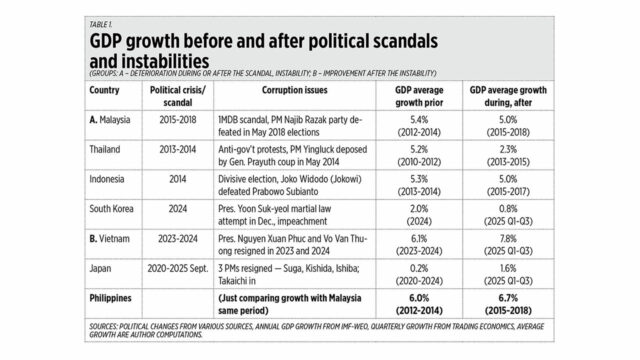
I want to estimate the Philippines’ short-term growth slowdown for 2026, and possibly 2027, based on the trends and experiences of our East Asian neighbors that also had political scandals and instability recently (see Table 1). This piece is bordering on political analysis, which is not my field, so I will limit my political commentary and focus on economic growth trends.

Malaysia experienced a three-year-long political crisis with the 1Malaysia Development Berhad (1MDB) scandal, a case of massive multi-billion dollar corruption where former Prime Minister Najib Razak was accused of channeling approximately $700 million from 1MDB into his personal bank accounts. The impact was historic — the 2018 general election ended 61 years of single-coalition rule.

Thailand experienced another military coup in 2014, and the coup leader, General Prayut Chan-o-cha, led the country for almost nine years, during which time there was a steep growth slowdown.

In 2014, Indonesia changed leadership via election and it was a highly divisive one. Its growth slowdown was mild. In 2015 President Joko Widodo faced pressure from the chairperson of his own party (PDI-P) and former President Megawati Sukarnoputri.

South Korea President Yoon Suk Yeol declared martial law in December 2024 — the second time since 1980 that martial law was imposed in the country (although, counting 2024, South Korea had been under martial law 17 times since the foundation of the republic in 1948). The 2024 martial law was very shortlived, ending after a few hours. The political backlash was severe and the growth slowdown was also severe.

Vietnam recently had internal squabbles, with two presidents resigning in the last two years.

And Japan has welcomed its very first female prime minister, Sanae Takaichi, just last October.

The numbers in Table 1 show that when instability is resolved or addressed within a year, economic recovery follows. When instability drags on for two to three years or more, an economic slowdown follows.

In the Philippines, two possible scenarios can emerge from the current situation: a.) a quick resolution of the current corruption scandal, say in 12 months (July 2025-June 2026); and, b.) a 1MDB type of scandal taking roughly three years to be resolved.

If  it is (a), then it will be like Vietnam and Japan’s economic recovery from political instability, and GDP growth can recover from 2025’s possible 4.7% and rise again to around 5.7% in 2026.

If it is (b), then it will be like Malaysia’s 1MDB scandal, dragging the instability on and further pulling growth down in 2026 to around 4.5%. So far the fiscal deficit has been muted because spending has slowed down while revenues have shown improvement (see Table 2).

I hope and wish that it will be scenario (a). So the challenge now is for the mandated agencies — like the Independent Commission on Infrastructure or its successor body (to be created by legislation), the Ombudsman, and other constitutional bodies — to come up with strong proof and cases against some of the “big fish” that have been named and implicated, leading to jailtime. Then let it serve as a lesson so that corruption at this level will not occur again.

The rest of the population — both public and private sectors — should continue doing their hard productive work. Keep producing more goods and services the honest way — that will create more jobs and further industrialize the country.

Meanwhile, notice the media’s silence on the deep work behind the scenes as the new Executive Secretary monitors the various departments. Then note the fast action on red tape and corruption in audits and letters of authority from the Finance department. And the consistent Presidential communication of new projects and policy reforms.

The three high-level secretaries, plus the other secretaries and officials, are doing quick confidence-building work in the economy. These lead to renewed business confidence, governance reforms, non-wasteful spending, and non-tax increase revenue expansion and public debt reduction.


Bienvenido S. Oplas, Jr. is the president of Bienvenido S. Oplas, Jr. Research Consultancy Services, and Minimal Government Thinkers. He is an international fellow of the Tholos Foundation.

minimalgovernment@gmail.com

PHL office market seen sustaining growth in 2026

STOCK PHOTO | Image by Pooja Singh from Unsplash

THE PHILIPPINE office market is expected to maintain gradual growth next year, driven by rising demand from information technology-business process management (IT-BPM) tenants and renewed take-up from traditional sectors, according to property consultancy Leechiu Property Consultants (LPC).

“While challenges persist, the Philippine office sector has repeatedly proven its resilience, and all signs suggest that momentum will continue into the coming year,” said Mikko Barranda, LPC director for commercial leasing, in a statement on Monday.

Year to date, office take-up rose 10% to 1.22 million square meters (sq.m.), the consultancy said in its Fourth-Quarter Property Market Report.

Of the total, the IT-BPM sector accounted for 32% (549,000 sq.m.), while other tenants — including traditional corporates, government agencies, and Philippine inland gaming operators — took up 68% (671,000 sq.m.) of space.

“This performance underscores the sector’s enduring relevance despite ongoing global headwinds, geopolitical uncertainty, and economic volatility,” Mr. Barranda added.

Among submarkets, Bonifacio Global City (BGC) led with 218,000 sq.m., a 73% increase in transactions, followed by Quezon City (169,000 sq.m.) and the Ortigas-Mandaluyong area (155,000 sq.m.). In the provinces, Cebu topped with 150,000 sq.m., or 55% of provincial take-up.

Net take-up rose 13% to 476,000 sq.m. in 2025, up from 422,000 sq.m. a year earlier. LPC noted that steady demand and fewer large-scale exits helped stabilize net absorption, despite elevated vacated space earlier in the year.

Vacated spaces fell 59% to 205,000 sq.m. in the fourth quarter, largely due to reduced downsizing and ongoing consolidation, mainly among IT-BPM firms.

LPC projects 2.3 million sq.m. of upcoming office supply nationwide over the next five years, with 1.9 million sq.m. expected to come online in Metro Manila from 2026 onwards.

Mr. Barranda said the office market is likely to sustain demand as companies continue to prioritize onsite work, while developers remain flexible to meet tenants’ evolving requirements.

“Occupiers are embracing flexible strategies, consolidations, flight-to-value opportunities, and long-term growth planning, while landlords are responding with improved terms, more efficient spaces, and investments in sustainability and smart-building features,” LPC said.

Over the next three years, lower interest rates and a tighter supply pipeline are expected to support transaction activity.

“However, the country’s success in attracting long-term investment flows will depend on its ability to enhance competitiveness through manufacturing revival, office space reimagination, and workforce upskilling,” LPC added, highlighting the need for key sectors such as real estate, tourism, manufacturing, and retail to address pricing gaps, infrastructure bottlenecks, and global competition. — Beatriz Marie D. Cruz