Home Blog Page 5691

San Beda faces Arellano to firm up top 4 NCAA spot

THE SAN Beda Red Lions devoured the Emilio Aguinaldo College Generals, 72-64, last week, keeping them entrenched at No. 3 with a 7-4 record. — NCAA/GMA-SYNERGY

Games Today
(Filoil EcoOil Centre)
12 p.m. — San Beda vs AU
3 p.m. — Mapua vs JRU

SAN BEDA hopes to solidify its place in the magic four as it tackles an unpredictable Arellano University (AU) today in NCAA Season 98 at the Filoil EcoOil Centre.

Drawing a career effort from Tony Ynot, the Lions devoured the Emilio Aguinaldo College Generals, 72-64, last week, keeping them entrenched at No. 3 with a 7-4 record.

It trails top teams College of St. Benilde (9-2) and Letran (10-3).

Mr. Ynot will try to replicate his unforgettable performance last time after unleashing 25 points, 10 rebounds, three assists and three steals — his best effort in San Beda uniform.

The Chiefs have likewise come from a win, a 77-63 result over Lyceum of the Philippines (8-5) last Thursday, breathing life into their Final Four bid with a 5-6 mark.

Like Mr. Ynot, AU’s Cade Flores will be seeking a fitting follow up to his 25-point, 13-rebound effort last game.

“It feels good but we want to get this run going,” the Fil-Aussie banger said. Game time is at 12 p.m.

Also trying to remain in the Final Four hunt are Jose Rizal U (JRU) (5-4) and Mapua (4-9), which clash at 3 p.m. — Joey Villar

Paul George sinks late winner as LA Clippers edge Rockets

LA CLIPPERS guard Paul George (13) dribbles down court in the first half against the Houston Rockets at Crypto.com Arena. — RICHARD MACKSON-USA TODAY SPORTS

PAUL George made a contested 15-foot baseline jumper with 6.2 seconds left to give the Los Angeles Clippers a 95-93 victory over the visiting Houston Rockets on Monday night.

Mr. George had 35 points, nine rebounds, eight assists and six steals for the Clippers, who scored the game’s final seven points to break a four-game losing  streak. Los Angeles never led in the fourth quarter until Mr. George sank his tiebreaking basket in the final seconds.

Clippers forward Kawhi Leonard missed his fourth consecutive game due to a knee ailment that will keep him out for at least two more contests. John Wall was held out for rest.

Ivica Zubac recorded 16 points, 12 rebounds and four blocked shots while Marcus Morris Sr. added 11 points for Los Angeles.

Kenyon Martin, Jr. scored 23 points off the bench and Alperen Sengun had 14 points and nine rebounds for Houston, which completed a winless four-game road trip and dropped to 0-6 on the road this season.

Kevin Porter Jr. and Jalen Green scored 13 points apiece and Eric Gordon had 12 for the Rockets.

Houston led by five points on four occasions in the final quarter, but Mr. George’s fifth 3-pointer of the game knotted the score at 93 with 40.2 seconds remaining.

After a Houston timeout, George stole the ball from Gordon. The Clippers then used a timeout of their own and the ball went to Mr. George, who outmaneuvered Mr. Gordon to hit the deciding shot.

Mr. Gordon had an opportunity to tie the score but missed a left-handed layup just before the buzzer while being defended by Nicolas Batum.

The Clippers shot 42.5 % from the field, including 9 of 36 (25%) from 3-point range.

Houston connected on 38.6% of its shots and was 8 of 28 (28.6%) from behind the arc.

Los Angeles held a 71-65 lead after Norman Powell’s basket with 3:08 left in the third quarter.

The Rockets answered with 11 straight points to take a five-point lead.

Mr. Martin’s three-point play gave the Rockets a 74-71 lead, and Tari Eason made two free throws with 4.4 seconds remaining to end the spurt.

Houston led 76-73 entering the fourth quarter and later scored five straight points to hold an 83-78 lead with 7:08 left in the game.

Mr. Porter stole the ball from Mr. George and drove in for a dunk to make it 90-86 with 4:02 to play.

Mr. Zubac slammed home a dunk with 1:17 left to cut the Clippers’ deficit to 93-90. Mr. Martin scored 13 and Mr. Gordon added 12 as the Rockets led 52-51 at the break.

Mr. George had 14 in the half for Los Angeles. — Reuters

Game Three of World Series postponed due to inclement weather

GAME Three of the World Series between the host Philadelphia Phillies and Houston Astros originally scheduled for Monday was postponed due to inclement weather and a forecast for sustained rainfall throughout the evening.

The third game of Major League Baseball’s best-of-seven championship series, which is tied at 1-1, will now be played on Tuesday with the remainder of the games and the travel day back to Houston, if necessary, also pushed back by a day.

The Astros were set to send right-handed pitcher Lance McCullers, Jr. to the mound for Monday’s game while the Phillies were going to counter with right-hander Noah Syndergaard.

Phillies left-hander Ranger Suarez will now start Tuesday’s contest while the Astros will stick with Mr. McCullers as their Game Three starter.

Astros manager Dusty Baker said his team would treat Monday as a regular off day and players would get treatment and some extra batting practice in to get ready for Tuesday.

“So you just got to turn it off and then get a good night’s rest,” Mr. Baker told reporters. “It’s part of the game. You can’t control the weather. So you just deal with it.”

The fourth and fifth games will now be played on Wednesday and Thursday and, in the event the series has not been decided, Friday will be a travel day back to Houston.

A potential Game Six would be played on Saturday — which would make it the latest World Series game in terms of date — with a decisive Game Seven, if necessary, set for Sunday. — Reuters

Lakers snap their losing streak

The Lakers were in a festive mood in the  aftermath of their win against the Nuggets the other day, and with reason. It was their first in six contests, close to two weeks after they began their 2022-23 season. And so they celebrated in the locker room, giving each other hugs and exchanging high fives, even dousing head coach Darvin Ham with water.

They may not have claimed a title, but they could be forgiven for their exuberance. After all, they got over a hump that critics figured they would have difficulty negotiating for the foreseeable future.

Not that the Lakers can be assured of stringing together victories from here on. Even with seven of their next nine outings at the Staples Center, their schedule gives them little comfort. All of the opponents they will face have records better than theirs, and few, if any, can match the intrinsic unevenness of their roster. For all the goodwill their triumph engendered, they remain infirm and in need of a change — perhaps any change — in order to come remotely close to being competitive.

Unfortunately, that change doesn’t seem to be coming anytime soon, the entreaties of the Pacers’ Myles Turner notwithstanding.

The good news is that the Lakers appear to have found a workable formula that minimizes the negative impact of giving significant minutes to one-time Most Valuable Player Russell Westbrook. Given his poor fit with LeBron James and Anthony Davis, he found himself relegated to the role of sixth man, and, lo and behold, it looks to be suiting him to a T. The sample size is small, true, but the results are nonetheless encouraging; in the two games he has served as the head of the second unit, he has put up decent, if efficient, numbers.

The Lakers know they’re walking a tightrope all the same. The 17 banners on the rafters place pressure on them to deliver, and inexplicably heightened expectations come with the territory. Fans have been so spoiled by previous successes as to deem anything but a championship unacceptable. Under the circumstances, James and Company are doomed to fail. That said, there can be no giving up. Getting better with every set-to is a must, and they’ll take their wins any which way.


Anthony L. Cuaycong has been writing Courtside since BusinessWorld introduced a Sports section in 1994. He is a consultant on strategic planning, operations and Human Resources management, corporate communications, and business development.

IT-BPM drives inclusive economic growth

DCSTUDIO-FREEPIK

(Part 3)

Although institutes of higher education are indispensable in turning out the talents needed by the new types of skills being demanded by more and more complex forms of information technology and business process management  (IT-BPM) services (such as those in data analytics), even more important in the coming five to 10 years are short, non-degree courses that will upskill, reskill, and retool the 1.4 million workers already employed in the industry and others who have graduated from formal education programs but are either still unemployed or underemployed.

As pointed out by the Everest Group Study conducted for the Business Processing Association of the Philippine (BPAP), as the usage of alternate channels such as social media, mobile, web, and chat proliferates and experiences enabled by data and analytics becomes the norm, contact centers are taking up the role of customer experience hubs. Furthermore, the traditional contact center model has changed drastically in the face of COVID-19, accelerating several pre-existing trends with a reinforced push for Artificial Intelligence (AI) and automation, a preference for cloud-based /modernized infrastructure, and an accelerated shift toward the use of self-service solutions such as conversational IVAs (intelligent virtual agents) and messaging platforms. As a result, increasingly in the near future, many contact center (CC) and business process (BP) companies in the Philippines believe that the larger share of volume in traditional call centers will come from complex transactions covering the entire extent of service-to-sales activities.

As the Everest study refers to as Acceleration lever 2, talent development will require a sustainable supply of skilled talents by introducing newer educational courses (formal, nonformal, and informal), revising existing curricula, strengthening training programs, and proactively positioning IT-BPM as a high-impact career option. Already, there is a growing talent shortage for a majority of new technologies skills as well as domain expertise. This is exacerbated by the serious demographic crisis being faced by practically all the developed countries in North America, Europe, and Northeast Asia. Populations are increasingly aging and there are fewer young people needed for all the manpower requirements of economies that are increasingly service-oriented. Despite all the talk about Artificial Intelligence and Robotization under Industrial Revolution 4.0, human beings are still indispensable in the delivery of most services. There are very few countries, at least in East Asia, that can compare with the Philippines in having a young, growing, and, for purposes of the IT-BPO sector, English-speaking population.

For the government and leading national associations, increasing the talent supply and upskilling/reskilling the existing workforce have become necessary in order to bridge the huge talent and skill gap that is being faced by the industry. The industry being basically a knowledge-based one, the first key intervention required is to increase the number of universities/colleges and quality of IT-BPM-related programs along with enrollment rates with a dedicated focus on cities outside the National Capital Region.

Since the Philippines is expected to be a major player in the global economy over the long-term (say, the next 20 years), every effort must be exerted to solve the current crisis of the low level of basic education which can be partly explained by the very meager resources being devoted by the State to public education. Now that the Secretary of Education is the Vice-President herself, there is greater probability that in the next six years, our public spending on education can be increased from the very low level of 2% of GDP to the average of the ASEAN countries of 6% of GDP. Instead of unreasonably multiplying the number of state colleges and universities, the policy of the State should be to subsidize the leading private universities through a voucher program that will enable the best and the brightest among the children of the lower-income families to enroll in the University of the Philippines (and a few other high-quality state universities and colleges) and the leading private universities. In the non-formal and informal educational institutions, there should be industry-entry mechanisms for a wider pool of ready workforce, especially for high-school and college dropouts, vocationally trained students, and the female workforce.

In the medium term, the emphasis should be the upskilling, reskilling, and retooling of both those already among the 1.4 million working in the sector as well as those already in the labor force (employed, underemployed, or unemployed) through courses offered in tandem with the Technical Education and Skills Development Authority (TESDA) to ensure scalability and quality of programs by introducing proper assessment and training regulations which are strictly followed by course providers. TESDA (that is now under the Department of Labor and Employment) should ensure proper training to course developers and faculty of academic institutions on how to create courses that are aligned with the Philippine Skills Framework (PSF). The International Labor Organization (ILO) should strengthen and scale up its “Women in STEM Workforce Readiness and Development” to increase outreach. Currently, only 15% of the TESDA’s budget is for IT-BPM courses. This can be increased to 25%. There should be a centralized government mechanism to bring efforts (e.g., skill surveys, PSF development) from all the agencies (currently more than 10 agencies/institutions are involved) which are the leading talent reform initiatives.

Another Acceleration Lever suggested in the Everest Study is to enhance the focus on creating awareness through marketing efforts to scale the outreach of educational programs and other training initiatives. This reminds me of the time I was in high school in the 1950s when the many of the best students graduating from high school considered accounting as the most attractive profession. Today, there should be an effort of the BPO-IT industry to present working in that sector as more glamorous and “sexy” than wanting to be a Certified Public Accountant. This is not difficult to do as regards the most exciting field of Big Data and data analytics. We should constantly repeat the new aphorism that “Data is the new gold.” Increase in the awareness of the IT-BPM sector as a profession can be achieved through job fairs, webinars, industry interaction, and social media branding to encourage and attract the youth to acquire the relevant skills or to pursue relevant degrees. Here, I must insist that the emphasis should be on competencies and skills and not on degrees (as Secretary of Trade and Industry Alfredo Pascual has been advocating in many of his public pronouncements).

(To be continued.)


Bernardo M. Villegas has a Ph.D. in Economics from Harvard, is professor emeritus at the University of Asia and the Pacific, and a visiting professor at the IESE Business School in Barcelona, Spain. He was a member of the 1986 Constitutional Commission.

bernardo.villegas@uap.asia

Prioritize state-level cyber defense

MAX BENDER-UNSPLASH

These days we talk about digital infrastructure, digital readiness, and the possibilities that technology offers. On a grander scale, digital advances have furthered the interconnectedness of states in the geopolitical and economic spheres and heightened the connectivity of the global community.

In recent years and especially during this pandemic, we saw how technology enabled us to do many things even from the confines of our homes. But during this period, we also saw an alarmingly increasing number of electronic breaches both at the individual and at the organizational level. Identities have been stolen, privacy has been violated, personal information has fallen into the hands of strangers who misuse it for their own gain.

Magnify the scenario if the breach were to involve entire corporations, industries, government institutions, or critical infrastructure. The damage will be untold and the consequences will be crippling, not only for a handful of people but for entire geographical areas or segments of society. The estimated costs are mind-boggling.

Imagine the consequences of a data breach involving our own military, for instance, where sensitive state secrets and key defense capabilities are compromised, through attacks by malicious nation-states. Indeed, the cybersecurity capabilities of states are being tested by cyberattacks, cyberespionage, and other illegal digital operations.

No matter the amount of investments in digital infrastructure, we will continue to be insecure and vulnerable without a robust cyber defense posture.

We at the Stratbase ADR Institute, in partnership with the United States Embassy in the Philippines, organized a hybrid roundtable discussion that tackled exactly this last Tuesday, Oct. 25. Entitled “Establishing a Strong and Credible Cyber Defense Posture in the Philippines,” the forum gathered experts in defense and cybersecurity from the government, private sector, and the academe.

The consensus is that having a strong cyber defense posture will be a result of cooperation between and among the private sector, the government, and like-minded nations.

Cybersecurity and Infrastructure Security Agency Program Manager Paolo Pascetta said the United States’ relationship with treaty allies in the region, including the Philippines, is important to them as they confront threats from state and non-state actors.

Cybersecurity, he said, is not a separate technology, because critical infrastructure is both cyber and physical. Thus, digital creation that is unsustainable, exclusive, or untrustworthy, no matter how valuable, is unacceptable.

Their group has committed to hold training sessions in early 2023 in Manila on cyber hygiene and cyber work force development.

The commitment stems from the paramount importance placed by the US on its relationship with five of its treaty allies in the region — including the Philippines — in confronting threats from both state and non-state actors.

The former Director of the Threat Operations Center of the US National Security Agency, Dan Ennis, also said that government and private sector partnership is key in this endeavor. This can be done by setting priorities, taking a risk management approach, and then communicating the priorities, the approach, and the focus of one’s resources.

In an attempt to protect everything, we may exactly protect nothing, he said. The biggest gain that we could have is a strategy that sets out key priorities, both to protect key infrastructure and key economic targets, and a risk management approach to solving the problem.

Cybercrime can be defeated by sector, by entity, by company, by government agency, he added.

In the end, he said, it would be the critical infrastructure that would be key to the health of the economy and of our democratic institutions. Capacity must be built against both nation-states and cyber-criminals.

Meanwhile, the Philippine government is all too aware of our cybersecurity challenges.

“The first step in solving a problem is to acknowledge that it exists. We acknowledge that the cybersecurity issue is a global concern,” said Paul Joseph Mercado, Undersecretary for Special Concerns at the Department of Information and Communications Technology (DICT).

Despite the disparity between the problem and the budget allocated to the agency for next year — they asked for P34 billion but were only given P5 billion — the DICT intends to make do with what it has.

“There are ways ahead even with a limited budget. We will try to pursue public-private partnerships. If we spend this correctly, I think we will still have a very good future ahead of us in terms of these ICT projects,” Mr. Mercado said.

The problem is daunting, indeed, and even more frightening when we think of the state actors that are, at this moment, preparing to launch cyber-attacks on critical infrastructure, threatening to shut down entire industries, or plotting to cripple specific geographic areas.

We should be prepared to deal with this not only at the corporate or government level, but on a regional level as well. As individual companies or countries must work on their cyber defense posture, so should this be a common aspiration — and a great opportunity for cooperation — among states in the region.


Victor Andres “Dindo” C. Manhit is the president of the Stratbase ADR Institute.

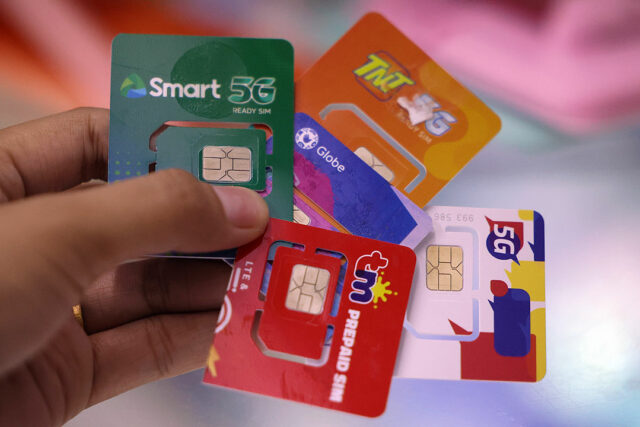
The SIM Card Registration Act

PHILIPPINE STAR/KRIZ JOHN ROSALES

The unregulated purchase, use, and deactivation of SIM cards made it difficult for law enforcement agencies to identify and apprehend those who commit wrongdoings with the use of cellular phones. For years, it has been common to see news articles of victims falling prey to scams and/or other cybercrimes, only for us just to be reminded to be more careful in dealing with unknown contacts who reach out to us out of the blue.

Aimed at putting an end to the perpetration of crimes through the use of unregulated SIM cards, President Ferdinand Marcos, Jr. signed into law on Oct. 10 the SIM Registration Act or RA No. 11934.

Section 4 of RA 11934 introduces the system of mandatory registration of SIM cards as a pre-requisite to its activation. All SIMs to be sold by Public Telecommunications Entities (PTEs) or resellers shall be in a deactivated state. All existing SIM subscribers shall register their SIMs with their respective PTEs within 180 days from the effectivity of the law, which may be extended by the Department of Information and Communications Technology (DICT) for a period not exceeding 120 days. Failure to register the existing SIM shall result in the automatic deactivation of the SIM, which may only be reactivated after registration.

For existing postpaid subscribers, the PTE shall include their data in the SIM Register to align with the registration requirements of the law.

Under Section 6 of RA 11934, a SIM Register shall serve as the PTEs’ database containing information required under the Act, which are the full name, date of birth, sex, and address of end-users. PTEs shall ensure that the data is secured and protected at all times, and shall comply with the minimum information security standards prescribed by the DICT consistent with internationally accepted cybersecurity standards and relevant laws, rules, and regulations.

In case of any change in the information of the end-user, or the loss of the SIM, death of the end-user, or any request for deactivation, the end user shall immediately inform or report to the PTE which in turn shall deactivate the SIM within 24 hours. However, the PTE is obliged to retain all information for 10 years after deactivation.

Should an end-user receive a suspicious or potentially fraudulent text or call, the PTE is obliged to provide reporting mechanisms for their subscribers, and shall, upon due investigation, deactivate, either temporarily or permanently, the SIM used for the fraudulent text or call.

Under Sections 9 and 10 of RA 11934, all information obtained during the registration process shall be absolutely confidential. However, disclosure of the full name and address of an end-user shall be made only in four instances: a.) in compliance with any law obligating the PTE to disclose such information in accordance with the Data Privacy Act; b.) in compliance with a court order or legal process upon finding of probable cause; c.) upon the issuance of a subpoena by a competent authority based on a sworn complaint that a specific mobile number was or is being used in the commission of a crime or that it was utilized as a means to commit a malicious, fraudulent, or unlawful act, and that the complainant is unable to ascertain the identity of the perpetrator; or, d.) with the written consent of the subscriber.

Section 12 of RA 11934 provides that within 60 days from the effectivity of the law, the National Telecommunications Commission shall set the guidelines for the monitoring and proper implementation of the law and shall promulgate the implementing rules and regulations for the effective implementation thereof.

RA 11934 shall take effect 15 days after its publication in the Official Gazette or in a newspaper of general circulation. Considering that the law was published in the Official Gazette on Oct. 12, it took effect on Oct. 27.

The views and opinions expressed in this article are those of the author. This article is for general informational and educational purposes only and not offered as and does not constitute legal advice or legal opinion.


Luke Morgan B. Codilla is an associate of the Angara Abello Concepcion Regala & Cruz Law Offices (ACCRALAW), Davao Branch.

(6382) 224-0996

lbcodilla@accralaw.com

Too much English in our universities?

CLARISSA WATSON-UNSPLASH

PROFESSORS and researchers in the Philippines compete within a global arena of science and scholarship. To do so, they use English, even when English is not their native language. Do those who play the academic game do right by their own country? Are they doing right by the students in their classrooms?

The encroachment of English is happening in the Philippines, Mexico, Japan, and Italy; it is not unique to any particular setting. And in some countries, perhaps the shift to English has not gone far enough. English opens doors to the international exchange of knowledge. In many countries, however, the shift towards English in academic settings has gone too far.

Does the pull of English among professors in the Philippines serve the people of the Philippines? There are pluses and minuses. The trade-offs involved need to be understood.

Using English turns attention to topics that are of global interest— and international journals often do not have much interest in affairs particular to the Philippines. Rather, they are interested in the United States and other major countries, or universal truths and abstract theories. When research is conducted solely in English aimed for publication in international journals, there is a risk that nationally important issues are overlooked and institutional details are ignored.

In teaching, the pull of English turns course readings and instructions to English. Students are then caught up having to study and communicate in English, rather than learning how to use their native language to make sense of the world and to tackle research questions.

We explore these problems in an article available online (in English!). We illustrate with examples from our own country, Sweden, and our own discipline, economics. Two commentaries are published alongside our article, one by a fellow Swede and one by an Italian.

LANGUAGE, ECONOMICS, AND TEACHING
When students are not taught in their native language, understanding becomes more difficult. Most students will work in the public or private sector of their home country, where deep knowledge of the relevant institutional setting is essential. They will need to communicate in their native language to non-specialists. If they read solely in English during their university studies, hear lectures exclusively in English, and hear about topics — often theoretical abstractions — they learn little of the actual affairs of their own country. They will be less well prepared for the future jobs they are most likely to meet.

In Sweden, only one university offers an Economics master’s program in Swedish, and thus few economics graduates are well prepared to talk about economic ideas and findings to a home audience. English as the language of instruction makes it hard to lecture about home institutions, not least because the relevant literature rarely exists in English.

LANGUAGE, ECONOMICS, AND COMMUNICATION
There are benefits from doing research in English; academia needs to be open to the world and researchers often need to build on previous knowledge. But economists influence policymakers and policymaking, and native economists need to master communicating insights in their native language.

How should we view Economics in light of these issues? In physics, local conditions and institutions do not affect how physics works. Therefore, the choice of language is of less importance, especially since mathematics is a universal language.

Literature and history are at the other end of the spectrum. Studies in the humanities tend to be deeply embedded in a specific cultural and temporal context. In law, each individual word carries specific meaning and domestic conditions are crucial to understanding the field.

Economics falls somewhere in between these two extremes; knowledge is often conveyed in the form of diagrams, equations, and econometric estimates. One might argue that English should be the primary working language. On the other hand, in economics, it is important to understand institutions, culture, and local conditions.

In a survey, 32% of social science researchers in Sweden said they would engage more in communication of research if it was more highly valued. If there were stronger incentives to communicate one’s insights, researchers would be more inclined to express their insights in their native tongue, in a way that ordinary people understand. Lacking such incentives, insights from research risk not being communicated.

The choice of language affects how and what we learn. Domestic conditions are easier to describe in one’s native language and therefore have more room to breathe when discussed in the native language.

Language is not a neutral bearer of meaning. Language affects what we consider and what we value.

A change of language is a change of worlds. We need to ask whether our own native world is well served. If competitiveness in the global research market becomes the top priority, national issues are correspondingly downplayed, as are communication skills in one’s native language. As a result, important economic insights may never spread to society at large.


Eva Forslund holds a Master’s degree in economics from Uppsala University. She is executive secretary of the Swedish Economic Association and works on an economics dictionary in Swedish.

Eva.Forslund@nationalekonomi.se

Magnus Henrekson is professor of economics and senior research fellow at the Research Institute of Industrial Economics (IFN) in Stockholm, Sweden. He was IFN president until 2020, after 15 years of service. Until 2009, he was Jacob Wallenberg professor at the Department of Economics at the Stockholm School of Economics.

https://www.ifn.se/mh

Magnus.Henrekson@ifn.se

Asia’s factory output weakens on global economic slowdown

REUTERS

TOKYO — Asia’s factory output weakened in October as global recession fears and China’s zero-COVID policy hurt demand, business surveys showed on Tuesday, adding to persistent supply disruptions and darkening recovery prospects.

Further US interest rate hikes are also expected to force most Asian central banks to prevent sharp capital outflows by tightening their own monetary policies, even if it means cooling already soft economies, analysts say.

Manufacturing activity shrank in South Korea, Taiwan and Malaysia in October, and expanded at the slowest pace in 21 months in Japan, highlighting the pain from slowing Chinese demand and stubbornly high import costs.

China’s Caixin/S&P Global manufacturing purchasing managers’ index (PMI) stood at 49.2 in October, up from 48.1 in September but remaining below the 50-point mark that separates growth from contraction.

The private sector survey was in line with an official PMI survey released on Monday that showed China’s factory activity unexpectedly fell in October.

“Asia is extremely reliant on China. Its zero-COVID policy continues to disrupt supply chains and keep Chinese travelers from returning to Asian tourist destinations. It’s also hurting the region’s exports,” said Toru Nishihama, chief economist at Dai-ichi Life Research Institute in Tokyo.

“Another big risk is the pace of US rate increases. If the Federal Reserve continues to hike rates steadily, that could ignite capital outflows from Asia and hurt exports.”

Japan’s au Jibun Bank Japan Manufacturing PMI fell to 50.7 in October from September’s 50.8 final, marking the weakest growth since January last year.

Highlighting how the pain from soaring material costs and supply constraints outweighed the boost from a weak yen, auto giant Toyota Motor Corp. on Tuesday posted a 25% drop in quarterly profit and cut its annual output target.

South Korea’s factory activity shrank for a fourth straight month in October as orders for exports fell for an eighth month, the PMI showed.

That followed data that showed South Korea’s exports fell the most in 26 months with shipments to China, its largest market, extending declines.

“Given the country’s open economy and its subsequent reliance on exports, the looming global downturn certainly poses a downside risk for future growth,” Laura Denman, an economist at S&P Global Market Intelligence, said on South Korea’s PMI.

Taiwan’s PMI slid to 41.5 in October from 42.2 in September, while that for Malaysia fell to 48.7 from 49.1, surveys showed.

Factory activity in Indonesia expanded at a slower pace in October with the PMI standing at 51.8, down from 53.7 in September.

India was an outlier with factory activity expanding at a stronger pace in October as demand remained solid.

The International Monetary Fund cut Asia’s economic forecasts as global monetary tightening, rising inflation blamed on the war in Ukraine, and China’s sharp slowdown dampened the region’s recovery prospects.

The fallout from China’s strict COVID-19 curbs continues to broaden. This week, restrictions forced the temporary closure of Disney’s Shanghai resort and hit production of Apple, Inc. iPhones at a major contract manufacturing facility. — Reuters

South Korea vows tough action, moving to quell anger over Halloween crush

A WOMAN places a floral tribute near the scene of a crowd crush that happened during Halloween festivities, in Seoul, South Korea, Nov. 1. — REUTERS

SEOUL — South Korea moved to calm public outrage on Tuesday over a Halloween party crush that killed more than 150 people, most of them young, promising a speedy and intensive inquiry and calling for tough new safety measures to prevent similar disasters.

The death toll from the crush at a crowded Halloween street party on Saturday climbed to 156 with 151 injured, 29 of whom were in serious condition. At least 26 citizens from 14 countries were among the dead.

Tens of thousands of revelers — many in their teens and twenties and dressed in costume — had crowded into narrow streets and alleyways of the popular Itaewon district for the first virtually unrestricted Halloween festivities in three years.

National Police Commissioner General Yoon Hee-keun said that crowd control at the scene was “inadequate”. The country’s chief security officer, Interior Minister Lee Sang-min, had said deploying more police would not have prevented the disaster.

“I feel limitless responsibility about public safety over this accident and I will do my best to make sure such a tragedy as this does not occur again,” Yoon told a news conference.

“The police will speedily and rigorously conduct intensive inspections and investigation on all aspects without exception to explain the truth of this accident,” Yoon added.

President Yoon Suk-yeol has declared a week of national mourning, saying the country had too many safety disasters. He said better responses was critical, including improved crowd control.

“We should come up with concrete safety measures to manage crowds, not only on these streets where this massive disaster took place but at other places like stadiums and concert venues where large crowds gather,” he said at a cabinet meeting.

All the victims have been identified and memorial altars have been set up at the Seoul city hall and in the Itaewon district, where citizens paid their respects.

Mr. Lee has come under sharp public criticism for his comments about the role of police. On social media, some Koreans said precautions were inadequate for an event that had been expected to draw large crowds. — Reuters

India to press wealthy countries to keep climate fund pledge

REUTERS

NEW DELHI — India will use next week’s U.N. climate conference to urge rich countries to keep their promise to give $100 billion a year in funding to help developing nations deal with climate change and switch to cleaner energy, two government sources said.

New Delhi will also reiterate its commitment to do its best to help slow global warming at the COP27 event, the sources said.

“The cost of both decarbonization and coping with the impact of climate change will be huge and that is why those who have disproportionately contributed to greenhouse gas emissions shouldn’t delay the funding,” one of the sources said.

“And that is why India will speak for itself and other developing nations to ensure that there is a clear, complete roadmap for the funding that should immediately start flowing,” he added.

In 2009, the developed countries most responsible for global warming pledged to provide $100 billion per year by 2020 to help developing nations deal with its consequences.

The commitment has still not been met, generating mistrust and reluctance among some developing nations to accelerate their emissions reductions.

India, is the world’s third largest emitter of greenhouse gases after China and the United States — though it is much lower down the rankings of emissions per capita, according to Our World Data.

It has been ramping up its share of renewable energy, but coal continues to be India’s main fuel for power generation, as the country strives to provide energy for its 1.4 billion people using a cheaper fuel.

The sources said India had already initiated steps such as meeting half of its energy demand from non-fossil fuels and building 500 gigawatts of non-fossil energy capacity by 2030.

“These goals need a lot of money and that is why it is important to press for the implementation of climate actions promised by developing countries,” the second source said.

“Developed countries also need to realize that overall costs have gone up, so the pledge to provide $100 billion per year cannot be static. It needs to go up.” — Reuters

Biden threatens to impose windfall tax on oil, gas firms

MODELS of oil barrels and a pump jack are displayed in this illustration photo taken on Feb. 24, 2022. — REUTERS

WASHINGTON — US President Joseph R. Biden on Monday called on oil and gas companies to use their record profits to lower costs for Americans and increase production, or pay a higher tax rate, as he battles high pump prices with elections coming in a week.

In remarks at the White House, Mr. Biden criticized major oil companies who are bringing in big profits while Americans, weary of inflation, pay a tidy sum to fill up their cars.

The oil industry “has not met its commitment to invest in America and support the American people,” he said. They’re not just making a “fair return” he said, they’re making “profits so high it is hard to believe,” Mr. Biden said.

“Their profits are a windfall of war,” he said, of the conflict that is ravaging Ukraine, and they have a responsibility to act.

“I think it’s outrageous,” he said. If they passed those profits on to consumers, gasoline prices would be down about 50 cents, he said.

“If they don’t, they’re going to pay a higher tax on their excess profits, and face other restrictions,” he said. The White House will work with Congress to look at these options and others. “It’s time for these companies to stop war profiteering.”

Mr. Biden said oil and gas companies should invest their profits in lowering costs for Americans and increasing production and that if they do not, he will urge Congress to consider requiring oil companies to pay tax penalties and face other restrictions.

The president held the event with a week to go until Americans decide whether his Democrats will remain in control of the US Congress. Republicans are favored to take command of the House of Representatives, while the Senate is viewed as a toss-up.

Global energy giants including Exxon Mobil Corp. and Chevron Corp. posted another round of huge quarterly profits, benefiting from surging natural gas and fuel prices that have boosted inflation around the world and led to fresh calls to further tax the sector.

Whether Democrats or Republicans take control of Congress, passing a law taxing energy companies for excess profits would likely be difficult, energy experts believe.

The White House for months has been considering congressional proposals that could tax oil and gas producers’ profits as consumers struggling with higher energy prices.

British lawmakers in July approved a 25% windfall tax on oil and gas producers in the British North Sea that was expected to raise 5 billion pounds ($5.95 billion) in one year to help people struggling with soaring energy bills. — Reuters

ADVERTISEMENT
ADVERTISEMENT