Home Blog Page 5683

Investing in deep technology through research & development: The Leave a Nest way

Interconnected webs of societal issues in the Philippines are still unaddressed with the lack of deep technology focus in the country. Deep tech, a niche focus area of Leave a Nest, aims to give solutions to deep issues in different aspects of the community through extensive technological and scientific research, which require unique and complex strategies for implementation into society.

Undeniably, similar to some parts of the world, the startup ecosystem in the Philippines has been dominated by founders and technologists who focus on the improvement and innovations in the fintech and e-commerce industry. With the increasing dependency of Filipinos on online transactions (like online shopping, banking and loans, social media, etc.), a market was created and was huge enough that app-based startups started sprouting and doubled in half a decade. But along with this, confounding societal issues still plague the Filipino society — most of which are not solved by existing startups. This is where deep technology enters the picture.

In an effort to further mainstream this type of technology, Leave a Nest Philippines will hold the Hyper Interdisciplinary Conference in the Philippines 2022 (HIC PH 2022) on Nov. 5, 2022. This year’s conference will be a face-to-face implementation comeback with the theme of “Philippines in 3D: Data-Driven Deep Technology.” This initiative is co-organized with Batangas State University (BSU) and conducted in partnership with Focus Systems Corp., a Japanese IT company interested in collaborations and innovations together with Filipino researchers. Panel Sessions are brought by Japanese startups: Melody International Ltd., Sagri, Co. Ltd., and ZIP Infrastructure, all of whom will be physically attending the conference, and talking about their startups. BSU and Central Bicol State University of Agriculture (CBSUA) are also part of the conference as Publication Partners through their respective university research journals.

The conference will dive into the merging of research areas with data-driven technologies in the form of applied information technology (IT), artificial intelligence (AI), machine learning, and big data, among others. It aims to collect and share knowledge about existing issues and solutions so that S&T stakeholders, especially academic researchers and industry partners, can occupy the underserved spaces in deep technology innovations.

Panel sessions focused on healthcare, forestry, and energy will be conducted. Additionally, research project presentations, through HIC PH’s Research Splash and Engineering Splash sessions, will be held to exhibit selected researchers’ topics and recent discoveries in their respective fields through short pitch formats, which will represent their own “splash of ideas.”

As a testament to Leave a Nest’s continuous pursuit of enhancing deep technology to help solve issues in society, Leave a Nest Co., Ltd., the Japanese parent company of Leave a Nest Philippines, Inc., will be announcing partnership agreements with two Philippine deep-tech startups in the form of investments and research grants. These two startup companies hope to solve issues in the inefficiency in reforestation efforts and the integration and management of energy in the country. This follows the first investments made by Leave a Nest Co., Ltd. last 2019 with Wela Online Corp., which has grown into an EduTech powerhouse in the Philippines since the investment and currently focusing on their expansion overseas.

Leave a Nest Philippines hopes that this could be a vessel of knowledge manufacturing for academia, private companies, government agencies and other attendees and that this can ignite the passion to foster deep technologies in research projects here in the country.

The Hyper Interdisciplinary Conference (HIC) in the Philippines is the first leg of the HIC ASEAN Series 2022-2023 organized by Leave a Nest Group in six ASEAN countries. The HIC serves as an avenue for researchers, individuals from the private sector, government agencies, academic institutions and startup companies to showcase innovative research ideas and formulate groundbreaking opportunities with all attending stakeholders.

HIC Philippines will be followed by HIC Indonesia on Nov. 12, 2022, HIC Thailand on Nov. 19, 2022, HIC Vietnam on Feb. 11, 2023, HIC Malaysia on Feb. 18, 2023, and lastly HIC Singapore on Feb. 25, 2023.


Spotlight is BusinessWorld’s sponsored section that allows advertisers to amplify their brand and connect with BusinessWorld’s audience by enabling them to publish their stories directly on the BusinessWorld Web site. For more information, send an email to online@bworldonline.com.

Join us on Viber to get more updates from BusinessWorld: https://bit.ly/3hv6bLA.
October factory output growth slows

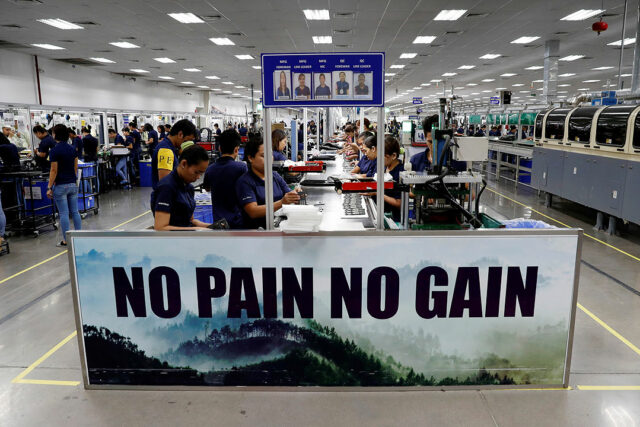
Filipinos work at the assembly line of Kinpo Electronics factory in Malvar, Batangas, August 10, 2018. — REUTERS

By Luisa Maria Jacinta C. Jocson, Reporter

FACTORY OUTPUT in the Philippines expanded at a slower pace in October, reflecting a modest uptick in new orders despite elevated inflation and supply chain disruptions, S&P Global said on Wednesday.

The S&P Global Philippines Manufacturing Purchasing Managers’ Index (PMI) stood at 52.6 in October, lower than 52.9 in September.

Despite the slightly slower expansion, S&P Global said the Philippine index was still above the historical average.

Manufacturing Purchasing Managers’ Index (PMI) of select ASEAN economies, October (2022)A PMI reading above 50 denotes better operating conditions than in the preceding month, while a reading below 50 signals the opposite.

“The latest PMI data revealed yet another round of expansion across the Filipino manufacturing sector. Demand conditions continued to improve, resulting in a further rise in output and new business placed at goods producers,” Maryam Baluch, an economist at S&P Global Market Intelligence, said in a report.

The headline PMI measures manufacturing conditions through the weighted average of five indices: new orders (30%), output (25%), employment (20%), suppliers’ delivery times (15%) and stocks of purchases (10%).

Philippine manufacturing companies reported improved demand in October, driving growth in production and new orders for a second straight month, S&P Global said.

“While overall factory orders increased, volumes of new work from abroad contracted at the sharpest pace since the recent sequence of decline began in March,” it said.

Manufacturers also increased their workforce for a sixth straight month, while input-buying activity rose for a second month in a row although slower.

“Despite the pace of the latest upturns easing slightly on the month, firms continued to increase capacity and stocks to support future growth,” Ms. Baluch said.

S&P Global noted that supply-side constraints had plagued the manufacturing sector, as vendor performance declined sharply and extension of delivery times lengthened. The shipping delays were mainly attributed to bad weather and port congestion.

Higher demand and supply chain disruptions led to more work backlogs for a second straight month.

However, S&P Global said increasing inflationary pressures were felt by manufacturing firms in the Philippines.

In September, headline inflation quickened to 6.9%.

“Average costs increased at a quicker rate compared with that seen in September. Additionally, while factory gate charges rose at a marginally softer rate during October, the latest reading ranked amongst the fastest on record (since January 2016),” it said.

After easing to a 20-month low in September, input price inflation rose in October due to higher energy and material costs as the peso weakened against the US dollar.

Despite this, manufacturers hiked charges at the slowest pace since February.

They remained optimistic on output estimates for the next 12 months as they expect a continued rise in demand, S&P Global said.

Factory activity remained expansionary despite elevated inflation and the peso depreciation, Security Bank Corp. Chief Economist Robert Dan J. Roces said

“This may be attributed to inventory buildup amid peak demand season and sustained looser mobility curbs,” he said in an e-mail.

While this bodes well for economic growth for the rest of the year, Mr. Roces said rising input prices and supply constraints might hamper expansion in the manufacturing sector.

The industry’s expansion might have been driven by local demand since exports have been declining, UnionBank of the Philippines, Inc. Chief Economist Ruben Carlo O. Asuncion said

FASTEST IN ASIA
The Philippines recorded the highest PMI reading among six Southeast Asian countries, followed by Indonesia (51.8), Thailand (51.6) and Vietnam (50.6).  Manufacturing activity in Malaysia (48.7) and Myanmar (45.7) contracted in October.

On average, the Association of Southeast Asian Nations (ASEAN) headline PMI stood at 51.6 in October, easing from 53.5 in September.

S&P Global said this was the slowest improvement in operating conditions across the region since the series of expansion began in October 2021.

“ASEAN’s PMI is finally coming back down to earth,” Pantheon Chief Emerging Asia Economist Miguel Chanco said.

“The ASEAN-wide details suggest that more headline softness is coming. We reckon that any convergence implies a further deceleration in output gains, especially when considering the still-rapid buildup in inventories of finished goods, and the third decline in backlogs of work in the last four months,” he added.

China slowdown likely to send significant shock to Philippines and its peers

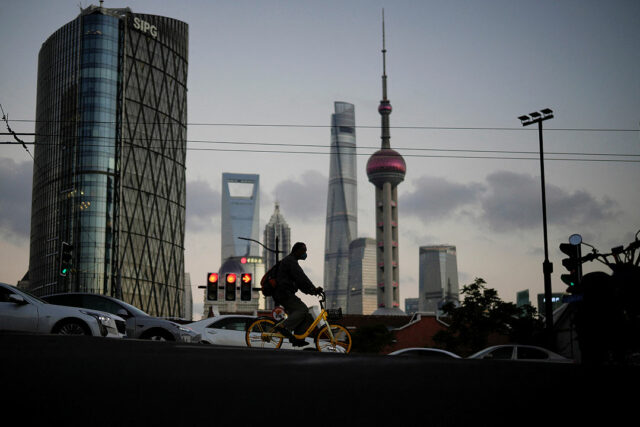
A man rides a bike on a street in Shanghai, China, Oct. 13, 2022. — REUTERS

SLOWER GROWTH in China may send a “significant shock” to the Philippines and other Asian countries by causing a decline in investments and business confidence, according to Moody’s Investors Service.

“A growth shock originating from China would affect the region through bilateral trade and financial flows, including through foreign direct investment,” Moody’s said in a report dated Nov. 2

“In addition to affecting trade and financial channels, slower growth in China could also transmit a significant shock to regional economies by depressing confidence and investment,” it added.

Citing a World Bank working paper published in 2015, the credit rater said a contraction in China’s gross domestic product (GDP) would affect growth rates in other countries, including the Philippines. 

“The World Bank’s most recent economic update estimates that a  one percentage point decline in China’s growth rate would shave 0.4 to 0.8 percentage point off the GDP growth rates of Indonesia, Malaysia, Thailand and the Philippines,” Moody’s said. 

Moody’s expects the Philippines to expand by 6.6% this year, well within the government’s 6.5-7.5% full-year target.

Moody’s sees China growing by 3.5% this year and 4.8% next year.

In the report, Asia-Pacific economies with direct trade exposure to Chinese demand for a range of goods may bear the brunt of a sustained slowdown in China.

“Growth in Asia’s goods exports to China peaked last year and has been slowing year over year since the end of 2021,” Moody’s said.

Northeast Asian economies have the most significant direct exposure to Chinese demand for a range of goods, including electrical machinery and equipment, general machinery, chemicals and plastics, according to the report

Association of Southeast Asian Nations (ASEAN) economies also have moderately high direct exposures in certain areas. Moody’s said 68% of China’s nickel ore imports are from the Philippines.

“Slower economic growth would also translate into diminished demand for commodities such as iron ore, copper, aluminum and other base metals.”

“While we have lowered price assumptions for a number of base metals on account of slower growth in China this year, a more sustained downturn would add further pressure to metal prices over the next three to five years,” it added.

China was the Philippines’ biggest source of imports in August as it shipped $2.71 billion worth of goods into the country, government data showed.

It was the third-biggest export destination, receiving $839.18 million in goods from the Philippines.

Exporters that can diversify to other markets will be better positioned to reduce demand shocks, Moody’s said.

“The disinflationary pressure in a sustained China slowdown would be in the form of a negative aggregate demand shock, which while achieving lower inflation would also lead to lower growth,” it added.

“Therefore, central banks might tighten monetary policy less than currently envisaged to offset the effects of slower global demand. Lower expected inflation, alongside a more moderate nominal interest rate profile, would mitigate the effects on the debt-servicing ability of sovereigns and companies in a lower growth environment.” 

The Bangko Sentral ng Pilipinas (BSP) has so far raised 225 basis points (bps) since May to tame inflation.

For October, the BSP projects inflation to settle within the range of 7.1% to 7.9%, exceeding the central bank’s 2-4% target for the seventh straight month if realized. This would also be faster than the 6.9% seen in September.

A BusinessWorld poll of 14 analysts conducted last week yielded a median estimate of 7.2% for annual inflation in October. The local statistics agency will release October inflation data on Nov. 4.

“Ongoing efforts to normalize monetary policy across the region will give central banks more headroom to engage in supportive monetary policy measures and mitigate the effects on growth, should there be a sustained economic slowdown in China,” the credit rater said.

In September, Moody’s Investors Service kept the Philippines’ “Baa2” credit rating with a “stable” outlook, as economic recovery is unlikely to be hampered by “challenging global credit conditions.” — Keisha B. Ta-asan

UNDP zeroes in on human development to-do’s for PHL

PHILIPPINE STAR/ WALTER BOLLOZOS

THE PHILIPPINES should focus on critical areas of human development such as climate-resilient infrastructure and education to help boost its recovery from the coronavirus disease 2019 (COVID-19) pandemic, a United Nations Development Programme (UNDP) official said.

“The Philippines has been hit by COVID-19 and has pushed back some of the development indicators that the country had invested in, so we did see a drop in the human development indicators. This was not unexpected, the question is how we can recover and move back to this track,” Kanni Wignaraja, United Nations assistant secretary-general and UNDP regional director, told BusinessWorld in an interview on Oct. 28.

She visited the Philippines last week on an official mission, meeting with senior government officials to discuss ways to accelerate recovery.

The Philippines ranked 116th out of 191 countries in the latest UNDP Human Development Index, down three places from 113th.

The index ranks countries based on three dimensions of human development: a long and healthy life, knowledge and a decent standard of living.

With a score of 0.699 out of 1, the Philippines was below the East Asia and the Pacific’s average of 0.749 and the global average of 0.732.

“In the process of recovery, how does one move very quickly to generating jobs and new livelihoods for young people? That was a big focus of the conversation and this has to be done from the barangay level onwards, so you look at community livelihoods and incomes and how to protect and promote these,” Ms. Wignaraja said.

The Philippine economy grew by 7.8% in the first half, still above the government’s 6.5-7.5% full-year target. The unemployment rate eased to 5.3% in August from 8.1% a year ago.

Ms. Wignaraja said the Philippines should look at investing in climate-resilient, green infrastructure at the local level, especially since an average of 20 typhoons hit the country every year. 

“This country is hit over and over again by climate shocks that are not by its own doing. Investing more in these areas will put this country in a better human development track moving forward,” she added.

Climate-related hazards have resulted in P506.1 billion in losses and damage to the Philippines in the past decade, according to the Department of Finance.

The Philippines should also invest more in education, especially as students suffered significant learning losses due to prolonged school closures.

“I would say the biggest area when I look at the Philippines vis à vis its neighbors is that we see underinvestment in education. At the end of the day, people are the wealth of a nation. Reinvesting or investing more in learning and education is really going to propel this country forward,” Ms. Wignaraja said.

In the latest State of Global Learning Poverty report by the World Bank, the Philippines’ learning poverty was at 90.9%, the highest among the Association of Southeast Asian Nations.

“The government should develop an education system that generates the new skills and capabilities of the young generation,” she added. — Luisa Maria Jacinta C. Jocson

BusinessWorld’s One-on-One interview with Kanni Wignaraja, United Nations assistant secretary-general and United Nations Development Programme (UNDP) regional director, will be shown on the Facebook pages of BusinessWorld  and The Philippine Star at 11 a.m., Nov. 4 (Friday).

Entrepreneurial CEO

The Entrepreneur Of The Year Philippines 2022 has concluded its search for the country’s most undaunted and unstoppable entrepreneurs. Entrepreneur Of The Year Philippines is a program of the SGV Foundation, Inc., with the participation of co-presenters the Asian Institute of Management, the Department of Trade and Industry, the Philippine Business for Social Progress, and the Philippine Stock Exchange. BusinessWorld will feature each finalist in the next few weeks.


Mica F. Tan
Chief Executive Officer
MFT Group of Companies

AT A YOUNG AGE, Mica F. Tan already knew what she wanted to become — a businesswoman. Seeing her mother go about her jewelry business, the young Ms. Tan knew she could do the same. So she spent her time selling little treats at the hospital where her father, an oncologist, would do his rounds.

“My mother is passionate about building relationships and taking care of people. And I think growing up, seeing that, I knew perhaps I could do the same,” she said.

Supporting their daughter’s knack for doing business, Ms. Tan’s parents introduced her to businesspeople from whom she could learn. From her small beginnings, Ms. Tan eventually gained hands-on experience in stock trading and in foreign exchange markets under the mentorship of top industry experts. She was set to pursue her finance studies in New York but wanting to get immediately into the game, she stayed put and got going on her own.

In the early years, she continued under the tutelage of uncles who were in business. But it was with the late Jose “Joseling” Tambunting’s guidance that Ms. Tan laid out the blueprint for the MFT Group of Companies.

“MFT Group is a young private equity firm. We buy, we transform and we maximize the value of businesses. And we focus only on fundamentally sound industries like healthcare, financial services, food and beverage, and real estate,” she said.

The MFT Group maximizes the value of its portfolio of companies and strategic partnerships through long-term capital and transformative solutions that impact and deliver value for customers, employees, shareholders and communities. It also enables corporations, through shared services, focus on finance, marketing, operations, business development, succession and corporate restructuring, and legal services.

Ms. Tan believes that creating wealth should not be the core of a private equity firm. On the contrary, the prospect of creating opportunities that reshape the business, such as job creation, partnerships, value creation and innovation, and the impact on the community and people matter more.

“Private equity is an instrument that transforms enterprises to become agents of positive influence in the world,” Ms. Tan said, recalling how she was adamant about making difference in the healthcare sector during the early days of the MFT Group.

Having been exposed to healthcare from her father who was a doctor, Ms. Tan knew the pain points of the industry, one of which is getting the medical results to patients as soon as possible.

“Every day counts in the healthcare industry. You can’t keep the sick waiting. That’s why we’re passionate in ensuring we provide the best in the medical equipment distribution business which ultimately assists in the delivery of quality healthcare service that every Filipino rightfully deserves,” she said.

In the face of challenges, the company harnesses its core value of grit. For the company, Ms. Tan said this means exhibiting passion, perseverance and stamina to remain focused on achieving its long-term goals. It comes as no surprise that the company considers one of its biggest battles to be among its greatest milestones — having endured the coronavirus pandemic.

“We really did everything to keep COVID response at the heart of our work; we built emergency quarantine facilities for several hospitals that were also our clients. And I think more importantly, we did everything to keep our workforce,” Ms. Tan said.

She believes in moving forward together, harnessing the potential of people and fulfilling the MFT Group’s mission to create lasting value across 100 business areas in the future.

“The road to 100 business areas is not going to be easy but one that we are willing to go through. I believe we are poised to become one of the most recognized strategic partners of local and international businesses,” she said.

On a rapid growth trajectory, Ms. Tan is confident that the MFT Group’s mission of 100 business areas is within reach. The company’s footprint covers the Philippines, Spain, United States, Japan, Hong Kong, Singapore, Vietnam, Indonesia, Myanmar and Malaysia.

Her achievements at a young age have earned her the moniker the “Millennial CEO.” She is also a sought-after resource speaker, sharing her insights on television, and having been featured twice as an investor-judge of The Final Pitch. Ms. Tan is also an active member of the Young Presidents Organization, Philippine Chamber of Commerce and Industry, Management Association of the Philippines and People Management Association of the Philippines.

For her work with the MFT Group, Ms. Tan has received awards from several prestigious organizations, such as the 2018 Inspiring Filipina Enabler Award, Asia Tatler’s Gen T List 2019 and the Filipina Women’s Network’s 100 Most Influential Filipina Women in the World. Passionate about continuing professional development, she recently completed the executive program with a focus on mergers and acquisitions at the Columbia Business School in New York.

Getting into business at such a young age has taught Ms. Tan a lot of things, one of which is to never stop trying and to never stop doing one’s best.

“I think being an entrepreneurial CEO is a very difficult job. I’ll never stop trying to be qualified for it,” she said.

The media sponsors of the Entrepreneur of the Year Philippines 2022 are BusinessWorld and the ABS-CBN News Channel. Gold Sponsors are SteelAsia Manufacturing Corp., Uratex, and Navegar. Silver Sponsors are Intellicare, OneWorld Alliance Logistics Corp., and Regan Industrial Sales, Inc.

The winners of the Entrepreneur Of The Year Philippines 2022 will be announced on Nov. 21 in an awards banquet at the Grand Hyatt Manila. The winner will represent the country in the World Entrepreneur Of The Year 2023 in Monte Carlo, Monaco in June 2023. The Entrepreneur Of The Year program is produced globally by Ernst & Young (EY).

Semirara Mining profit more than doubles to P10B

SEMIRARA Mining and Power Corp. (SMPC) recorded a third-quarter net income of P10.15 billion, more than double the P4.01 billion reported a year ago, boosted by high coal production and electricity prices.

“Historically, the third quarter is our slowest because of the rainy season and sluggish demand. But because of improved market prices, we did much better than expected,” SMPC President and Chief Operating Officer Maria Cristina C. Gotianun said in a statement on Wednesday.

For the third quarter, the company’s revenues went up by 51.1% to P21.16 billion from the P14 billion recorded in the same period last year.

Of its revenues, coal accounted for the biggest share at P15.04 billion or 71%, with power contributing P6.12 billion or 28.9%.

For the nine-month period, SMPC said it “set a new profit record” of P35.95 billion, more than three times higher than the P10.29 billion recorded in the same period last year.

Further, its revenues for the three quarters were up by 92.4% to P73.17 billion from P38.03 billion in the corresponding last year.

SMPC said that the rise in net income was due to elevated market prices, all-time high coal production, and higher spot electricity sales volume.

From January to September, the average selling price of its coal rose by 122.2% to P5,224 per metric ton (MT) from P2,351 per MT a year ago, fueled by the surge in the global index prices due to Russia’s war on Ukraine.

The company said average Newcastle prices surged by 191$ to $353.80 from $121.70 while the average Indonesian Coal Index 4 rose by 50% to $84.30 from $56.10.

SMPC’s coal production also went up 26.9% to 13.7 million metric tons (MMT) from 10.8 MMT due to controlled water seepage levels in one of its mines and better coal access in two mining blocks.

Its power business posted a 216% increase in spot market sales to 1,546 gigawatt-hours (GWh) from 489 GWh. It attributed the increase to a 5% rise in plant availability, a 7% improvement in gross power generation, and a “pivot away from bilateral contracts.”

The company said the average spot selling price of electricity rose by 38.3% to P7.33 from P5.30, citing “recovering demand, higher fuel costs and thin power supply margins.”

Last month, SMPC’s board approved the declaration of special cash dividends of P3.50 per outstanding common share for shareholders on record as of Oct. 31. The payment will be made on Nov. 15.

The dividends are double the P1.75 special cash dividends declared last year, and the highest dividend ever declared by the company.

In April, the company paid out P1.50 per share in regular cash dividends, bringing the total payout this year to P5.00 per share, which it said is the highest in its corporate history.

At the stock exchange on Wednesday, shares in the company declined by 3.29% to finish at P33.80 apiece. — A.E.O. Jose

Daring and joy turn sangria bar into something very special

OKAY Tostada

WHEN one thinks of joy, one thinks of light, and fire, and sparks. Despite the dark and imposing interiors of BGC’s Alegria Manila (“alegria” means “joy” in both Spanish and Portuguese), the tasting menu takes one on a journey that makes one feel as if they’re walking through fire and light, moving towards joy.

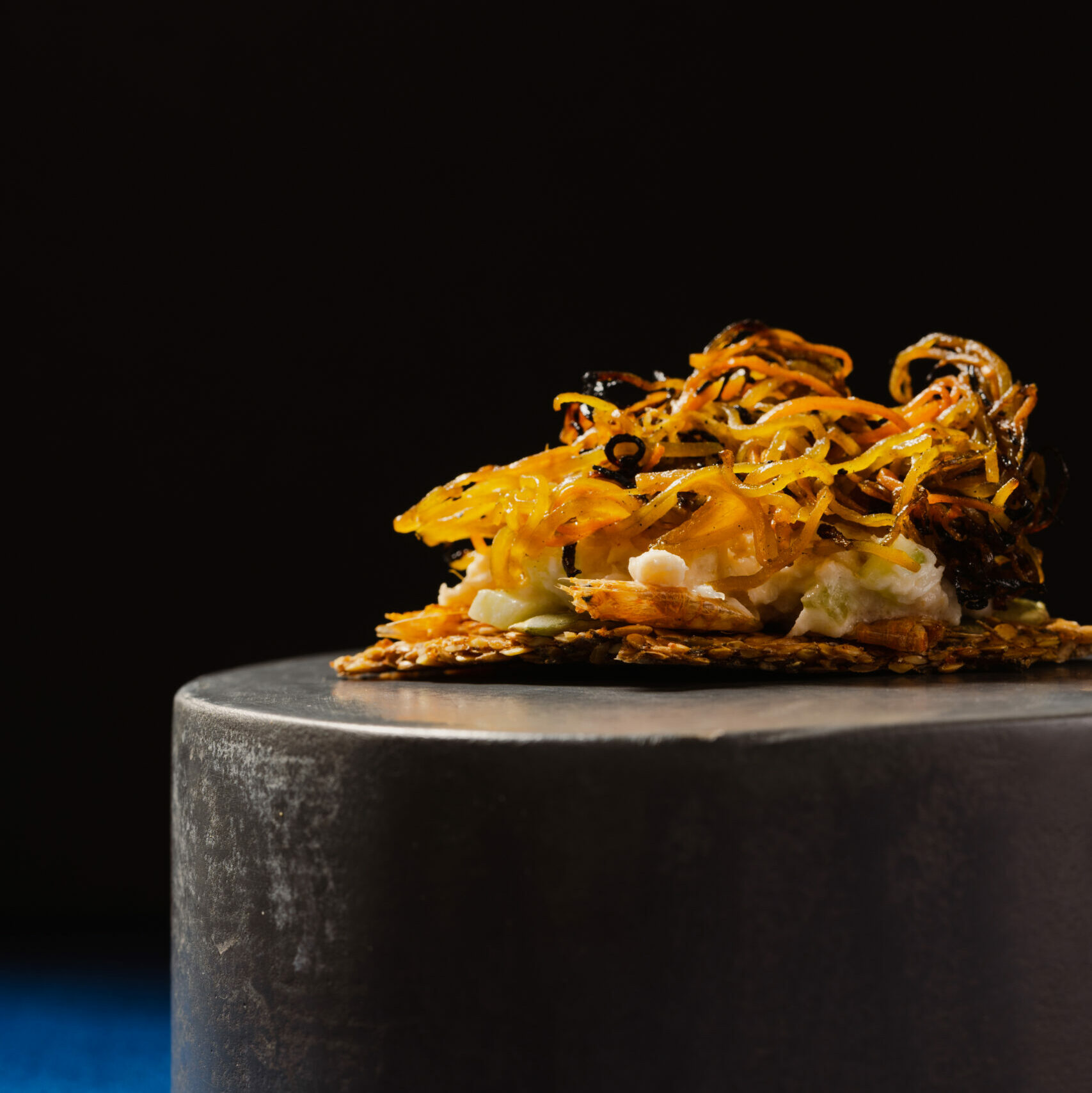
We’re going to be honest, it was just the interpretation of Alegria co-founder and chef Charles Montanez of Okoy that first made us feel things on Oct. 20. Flax seed and baby prawn was formed to make a tostada (a sort of crispy taco), and that was topped with blue crab and smoked mussel creme. That was served in a little wooden box, like a little treasure. All the smokiness of all the flavors landed squarely on the tongue, tasting as if one were inhaling smoke, then the crunch of the tostada made it feel as if one were hearing the fire’s crackle. Now that’s a dish.

The tasting menu consisted of 16 courses, all of them served in small bites, of course. We skipped two dishes for constraints of time and personal aversion to some ingredients (sorry). The menu was called ¡Trancultural!, but if we’re being honest, going by what we experienced with the Okoy, that experience was transcendental, and we recommend a stop here if one needs to feel again. The menu is crafted with Latin American and Filipino influences, and we guess that sort of experience fits right in with those cultures’ reputations for passion.

The full course with 16 dishes costs P5,400 per person, with an additional P1,200 for a wine and cocktail pairing. A steep price, but can you really put a price on passion?

Some of our favorites from the 16 courses were the Dinuguan Sinuglaw (market fish, grilled pork, blood cup, aji amarillo (yellow pepper), ikura, and potato). There was a sudden burst of flavor and texture from the ikura (salmon roe) that pops and spreads flavor, blending with the tender chunks of pork and fish. Now imagine all that with the morbid (but crispy) shell made of blood.

The Inihaw na Talaba (Grilled Oyster; Aklan oyster, Yakult Leche Tigre, a Peruvian marinade) was fragrant with the smell of the sea, and explosive in flavor and felt like a wave washing over the tongue. The Elote (a corn snack) was made with a large baby corn from the Cordilleras, glazed with chipotle and smoked Baguio strawberries, and coated with puffed quinoa. This in turn was pleasantly mild. This was followed by another homage to corn, the Nicuatole with Grilled Maja Blanca, Corn Foam, Pop Corn, Corn Caviar, and Kesong Puti. It was creamy, and puts one in a pleasant mood.

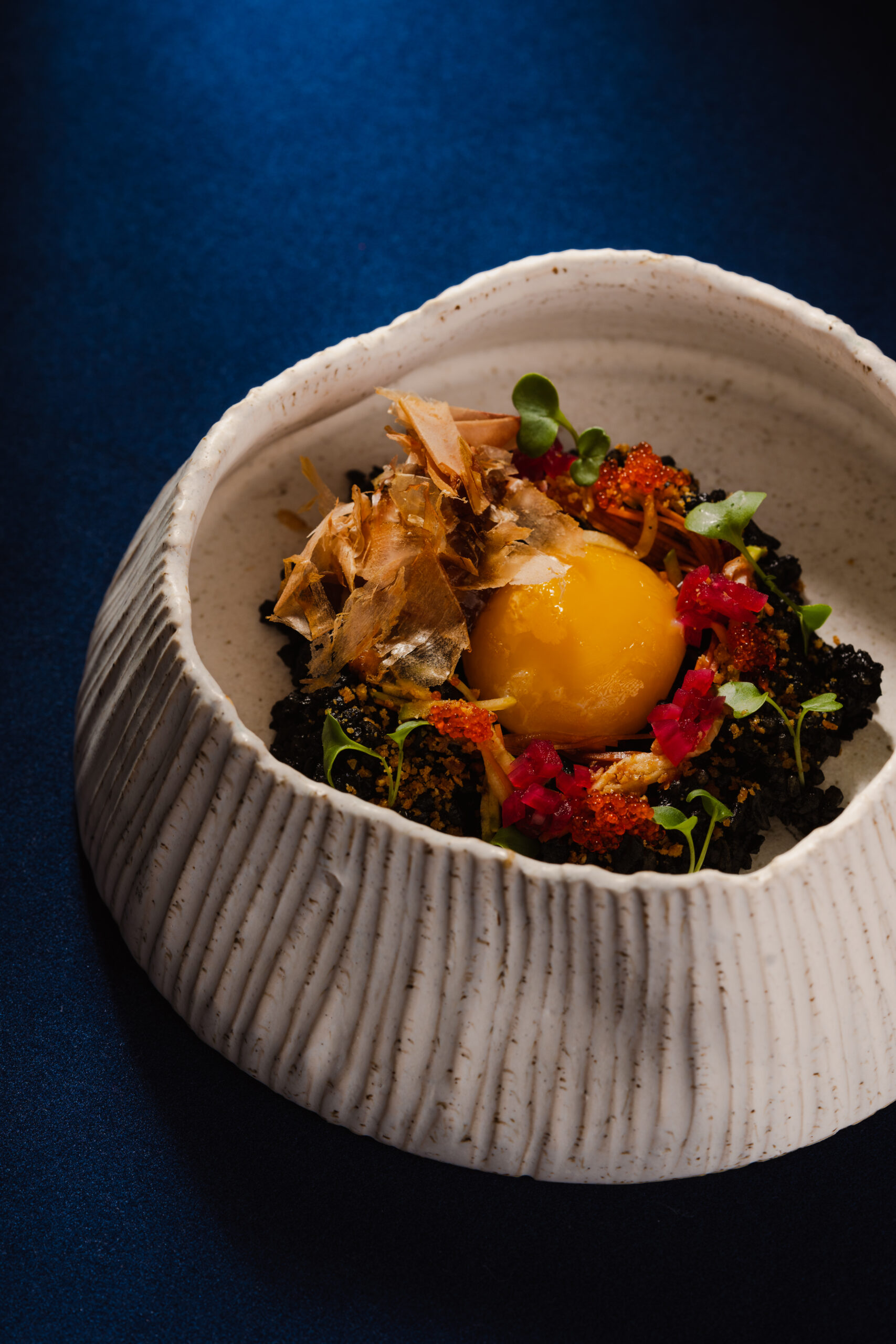
A Squid-silog had a squid stuffed with forcemeat of aligue (crab fat), prawns and chives, rice sauteed in squid, then topped with dried squid powder and an egg yolk confit. We would have it every day if we could. A fancy kare-kare (Filipino peanut stew) was made with Kurobota pork, almond puree, flowers (including those of the squash), and served with a side of Salsa X.O. (made with fermented shrimp and chilies). Just with two slices, it was still over-the-top and verges on the caricature of what expensive food is like, but was much too good to make fun of — the sauce was velvety and the grilled pork an education in what kare-kare could be.

The meal ended with a Champorrado interpretation with Palitaw, Chocolate Foam, Pinipig (toasted rice), and a gold-dusted anchovy; as well as a rendition of Sundot Kulangot (a sugary treat from the Cordilleras with a pedestrian name evoking picking one’s nose), made with muscovado caramel and encased in a dark chocolate praline.

Mr. Montanez first opened Alegria as a bar in 2017, but when the chance to expand came along, they moved from BGC’s High Street to BGC’s Uptown Parade. Along with the move came the decision to reform the former sangria bar and change it to a restaurant with a sophisticated tasting menu. In the span of five years, Alegria (now Grupo Alegria, Inc.) has Cafe Alegria, Buena Vida by Alegria, Alegria in Singapore, and upcoming properties in Tagaytay and Boracay. Opening in Singapore in 2021 was a personal goal, since becoming head chef in two Latin American restaurants there was part of his training to open Alegria.

Pandemic notwithstanding, the group has expanded fiercely in the last five years.

“I think it’s self-fulfillment for us to be able to open up opportunities and give people jobs… we’ve always had faith that it was all going back to normal. I felt like it was the right time to strike.”

How they did it was another story.

“We figured that during the height of the pandemic that everything was negotiable,” he said, learning of desirable spaces that were being let go: “The price was [hard] to resist.”

The name, back in 2017, was the last thing that he thought of. “I found it in my football boots,” he said. “Ousadia e Alegria” was a motto of football player Neymar, roughly meaning “daring joy.”

“We’re very daring with what we’re doing. But we get a lot of fun with it.”

Alegria Manila is located in Uptown Parade BGC, Taguig. — Joseph L. Garcia

Sausage as a canvas

Flatdog- The Greek

MIGUEL Gianan’s card says “Professional Carnivore.” With a job title like that, one has to trust the chef of One World Butchers.

One World Butchers had a street party at the Poblacion, Makati block occupied by some of their restaurants last month. A few steps away was Sawsaw, their concept with chef Sau del Rosario. One World Butchers is owned by PYC Foods Corp., under the Tao Corp. group founded by Julio “Jun” Sy. Its siblings include Pardon My French and the One World Kitchen and Deli.

During the street party, grills fired up sausages from all over the world: think slim and pale German Nürnbergers (allegedly a favorite of Goethe) with pork flavored with marjoram, and English Cumberland coil sausage, thick with pork and spiraling around itself and flavored with different spices and herbs. Mr. Gianan made sure the Philippines was equally represented, with a Sisig sausage made from pork mask, pork, liver, and Knorr seasoning. While the origins are international, the sausages themselves are made by Mr. Gianan and his team in a commissary on-site (which can be viewed through a window, despite the aphorism about sausage making — “Anyone who loves the law or sausages should never watch either being made”). The meats are sourced from all over the world through the Butchers’ sister companies. That makes for a smooth operation.

But Mr. Gianan doesn’t exactly like it smooth. He told BusinessWorld during an interview how he doesn’t like his sausages as finely ground as hotdogs. “Country-style, not fine, with specks of meat,” was how he described his sausages.

Frankly (get it?), we don’t see how one can be so creative with sausage. It’s just ground meat with seasonings, but in Mr. Gianan’s hands, sausage skins encase more than meat but memory. The sausage thus becomes akin to an artist’s canvas. He recalls making pizza sausage while watching his parents eat pizza (while he was thinking of sausage concepts), and another sausage was born while he watched his parents eat Mexican food.  “I can express how I eat, the concept that I want to have,” he said.

The memories held in meat go back to his training with the late master German butcher Michael Beck, who opened Mickey’s Deli in Manila almost 15 years ago. “He introduced me to charcuterie, cold cuts, hams, and all that. I enjoyed that stay, I enjoyed being the kitchen chef. When he passed away, when I was working with meats again, I was craving for the best sausages,” said Mr. Gianan.

“From memory, I recreated his style of sausage,” he said.

More than fond memory, obviously, what was passed down to him was technical skill and knowledge of the meat. For example, while sausages were a way to preserve meat in the days before refrigeration, Mr. Gianan makes his sausages fresh every day. “To have the snap, the flavor, and it’s not frozen.”

The commissary has a walk-in chiller with meticulous temperature controls. “In sausage-making, temperature is key,” he said. “If you freeze a sausage, the fat and the meat will break down.”

“At a certain temperature, meat can bind with fat. If you f**k up (he apologizes) the temperature, you can’t have a nice sausage.”

From cooling, we go to grilling. Mr. Gianan showed off his asador grill, fed with wood and charcoal. It smokes and grills the meat at the same time, imparting a smoky flavor to everything it touches. “Wood. Macho,” he said, trying to describe the flavor. “If you cook it slow, the meat gets tender, juicier,” he said, pointing to the steaks and the porkchops also served that evening.

We go back to his card, and how he got the title of Professional Carnivore. “I work with meat, and I love meat so much.”

One World Butchers is located at 8491 Kalayaan Ave. corner Matilde St., Makati. Store hours are from 11 a.m. to 10 p.m., Sunday, Tuesday, and Wednesday, and 11 a.m. to midnight, Thursday to Saturday. For reservations, contact 0917-823-6631. — Joseph L. Garcia

AboitizPower’s core net income up 65% on Dinginin power plant’s contribution

ABOITIZ Power Corp. reported a 65% increase in third-quarter net income to P9.2 billion largely due to the two units of its coal-fired power plant in Bataan that started contributing to the company.

“We have seen peak energy demand continue picking up in Luzon and Visayas during this past quarter, exceeding pre-pandemic levels. Our new capacities have been delivering much-needed energy to the grid during its commissioning period,” Emmanuel V. Rubio, president and chief executive officer of AboitizPower, said in a regulatory filing on Wednesday.

Aside from the fresh contributions from GNPower Dinginin Ltd. Co.’s units 1 and 2, the energy arm of the Aboitiz group also cited higher water inflows and gains from commodity hedges for the profit rise.

Including one-off gains, the company also reported a consolidated net income of P9.6 billion, 72% higher than a year ago.

The company said it booked non-recurring gains of P310 million in the third quarter, in contrast to the P41-million non-recurring losses recorded in the same quarter last year.

JANUARY-SEPTEMBER PERFORMANCE
For the nine-month period, the company reported a core net income of P18.3 billion, 16.6% higher than the P15.7 billion booked in the same period last year.

With one-off gains, its consolidated net income climbed by 24.2% to P19.5 billion from P15.7 billion in the same period last year.

As of September, AboitizPower said it recorded non-recurring gains of P1.2 billion, driven by the appreciation of the US dollar, compared with P36 million in non-recurring losses recorded a year ago.

Its generation and retail supply business recorded a 20.7% increase in earnings before interest, taxes, depreciation, and amortization (EBITDA) to P39 billion from P32.3 billion in 2021.

The company attributed the rise to fresh contributions from GNPower’s two units, higher availability of the GNPower Mariveles Energy Center Ltd. Co. facility, higher water inflows and gains from commodity hedges.

AboitizPower’s distribution businesses recorded an EBITDA of P4.8 billion, 21.3% lower than the P6.1 billion recorded in the corresponding period last year.

Further, nine-month electricity sales stood at 21,892 gigawatt-hours (GWh) versus the 18,442 GWh sold last year.

“We remain focused on our objective to grow our renewable energy portfolio, with our latest foray into wind power taking us closer to our targets. At the same time, we are ensuring our existing facilities continue to meet the Philippines’ baseload needs,” Mr. Rubio said.

Last month, AboitizPower through its subsidiary Aboitiz Renewables, Inc., inked a joint venture agreement with Mainstream Renewable Power for the development of a 90-megawatt (MW) onshore wind project in Libmanan, Camarines Sur.

AboitizPower plans to grow its portfolio to 4,600 MW of sustainably sourced energy by 2030. The company and its partners currently own a total net sellable capacity of 1,248 MW.

At the stock exchange on Wednesday, shares in the company closed 1.11% higher to close at P32 apiece. — Ashley Erika O. Jose

Oktoberfest beer awarded EU seal of approval

DES RÉCITS-UNSPLASH

BERLIN — The European Commission said on Friday it has made Oktoberfestbier, brewed in Munich and made famous by the city’s annual beer-guzzling festival, a protected geographical indicator of Germany.

The title is intended to guarantee the drink’s quality while protecting against imitation and the misuse of product design, a spokesperson for the Commission’s representation in Bavaria said.

One special feature of the beer is the use of water from deep springs in Munich in a production process that has been developed over centuries, he added. — Reuters

Emperador’s Mexican unit plans to expand winery

EMPERADOR, Inc.’s subsidiary in Mexico plans to plant more vineyards and update equipment to the latest technology of its winery as part of its expansion program.

Casa Pedro Domecq, a 50%-owned subsidiary of Emperador, has a winery called Bodegas Domecq that specializes in making wine and tending vineyards.

“While improvements have been made at the winery’s technical facilities in the last couple of years, there are ongoing plans that call for the planting of vineyards in the Ojos Negros Valley, as well as equipping the winery with the latest technology,” the company said in a press release.

It added that Bodegas Domecq has contributed to maintaining the growth of Casa Domecq since 2017.

“While Casa Domecq is essentially known for its popular brandies in Mexico – Presidente, Don Pedro, and Azteca de Oro – the winery business is showing great promise and prospects,” Grupo Emperador Spain Chief Executive Officer Joan Cortes Vilardell said.

“We are very much honored to have a role in the advancement and recognition of the wine-making tradition in Mexico through Bodegas Domecq,” he added.

Bodegas Domecq winery is a hub for wine tourism and private events, which Emperador said had been “recognized by visitors and the local public for its commitment to sustainability and the environment.”

In its 50 years, Bodegas Domecq has developed wines including Los Reyes, Calafia, XA, and Chateux Domecq.

Emperador is a listed company on both the Philippine Stock Exchange (PSE) and the Singapore Stock Exchange.

It is a global spirits conglomerate that owns Emperador Brandy and Whyte and Mackay. Other brands under it include Fundador Brandy, The Dalmore, Jura, and Tamnavulin Single Malt Scotch whiskies, which are available in more than 100 countries.

At the PSE on Wednesday, shares in Emperador closed eight centavos or 0.41% lower at P19.50 apiece. — Justine Irish D. Tabile

World wine output dips slightly after year of torrid weather

TOBIAS RADEMACHER-UNSPLASH

PARIS — World wine production in 2022 is expected to dip slightly below last year’s level, with a better than anticipated volume in drought-hit Europe mostly offsetting a forecast drop in southern hemisphere output, an intergovernmental wine body said.

In initial projections this year, the International Organization of Vine and Wine (OIV) pegged world production at between 257.5 million and 262.3 million hectoliters (mhl), with a mid‑range estimate at 259.9 mhl.

That would be around 1% lower compared with an estimated 2021 volume of 262 mhl and below the average of the past 20 years, the OIV said in a note.

A hectoliter is the equivalent of 133 standard wine bottles.

“Overall, in 2022 the dry and hot conditions observed across different regions of the world have led to early harvests and average volumes,” it said. “Nonetheless an overall good quality is expected.”

In Europe, rain at the end of summer helped to limit the impact of drought in Italy and France, the world’s two biggest producers, although heatwaves damaged prospects in Spain, the number three producer.

European Union output was forecast at 157 mhl, up 2% from last year, with the OIV echoing previous projections that anticipated a stable volume in Italy, a sharp rebound in France after a poor 2021 harvest, and a decline in Spain.

For the United States, the world’s fourth-biggest wine producer, the 2022 volume was seen down 4% from last year and 6% under the five-year average, reflecting the effects of frost followed by summer drought and related water scarcity, the OIV said.

Southern hemisphere production was projected to have fallen 7% from a record level in 2021 following less favorable weather, but it would be in line with the five-year average.

The OIV cautioned that it did not have 2022 data for China and Russia, but anticipated a structural decline in Chinese production would continue. — Reuters