Home Blog Page 5675

‘Breaking through the noise’

KARGO by TM Malones

Cinemalaya brings back full-length films, onsite screenings

THE 2022 CINEMALAYA Independent Film Festival returns with onsite screenings of full-length and short feature films competing for the Balanghai Award and cash prizes.

The 18th edition, which carries the theme “Cinemalaya: Breaking Through the Noise,” will feature 11 full-length films and 12 short features from August 5 to 14.

“One of the saddest things to happen in the festival, which had no options other than going online, was the absence of the new full-length competition films. But now, the good news is, two years later, we have the finished films meant for showing in 2021 and 2022,” Laurice Guillen, president of Cinemalaya Foundation, Inc., said in a video shown at a press conference at the Cultural Center of the Philippines (CCP) on July 6.

The full-length films in this year’s competition were the finalists selected for the 2020 and 2021 editions of the film festival. However, pandemic restrictions delayed film production.

In his speech, Chris B. Millado, former CCP vice president and artistic director and Cinemalaya festival director, referred to filmmakers as culture-bearers “cutting through noise” (referencing the film festival’s theme) of social media, revised histories, misinformation and disinformation, personal anxieties, and international goings-on.

“How do we cut through these [stories] … — the genuinely discreet, unique voices of our filmmakers and artists who collaborated in this year’s batch of Cinemalaya,” Mr. Millado said.

The 11 full-length films in this year’s film festival are:

• 12 Weeks by Anna Isabelle Matutina, about a 40-year-old woman who finds out she is pregnant a few weeks after ending a romantic relationship;

• Angkas by Rain Yamson, about two estranged friends rebuilding their relationship while traveling together to retrieve the body of a deceased friend;

• Bakit ’Di Mo Sabihin? by Real S. Florido, about a deaf couple struggling to keep their marriage;

• Batsoy by Ronald Espinosa Batallones, about two young siblings in a fantastical adventure to satiate their craving for batsoy;

• Blue Room by Ma-an L. Asuncion-Dagńalan, about young musicians who get arrested for possession of illegal drugs;

• Bula Sa Langit by Sheenly Gener, about a soldier who comes home from a siege and finds himself faced with a different battle;

• Ginhawa by Christian Paolo Lat, about an aspiring boxer who gets exposed to the sport’s grim reality while in training;

• Kaluskos by Roman S. Perez, Jr. about a single mother fighting for her child’s custody;

• Kargo by TM Malones, about a woman who seeks revenge from the man who killed her family;

• Retirada by Milo Alto Paz and Cynthia Cruz-Paz, about a retired government employee whose new hobby leads her to desperation and financial problems; and

• The Baseball Player by Carlo Obispo, about a Moro child soldier who dreams of becoming a baseball player in the midst of war.

The 12 short films, meanwhile, were praised by director Jose Javier Reyes, main competition and monitoring chair of the Cinemalaya: “This year was an exceptional batch which only proved that nitong pandemiya [ay] nahasa at na-develop (the pandemic trained and developed) the art of short filmmaking. … For the first time, the entire archipelago is represented by these short films.”

“This also opens an impetus that we should really encourage and develop our regional filmmakers because they are as Filipino as Filipino can get,” he added, noting that only two films were shot in the National Capital Region (NCR). 

The short films in the main competition are:

• Ampangabagat nin Talakba ha Likol (It’s Raining Frogs Outside) by Maria Estela Paiso;

• Black Rainbow by Zig Dulay;

• City of Flowers by Xeph Suarez;

• Dikit by Gabriela Serrano;

• Distance by Dexter Paul de Jesus;

• Duwa-Duwa by Nena Jana Achacoso;

• Kwits by Raz de la Torre;

• Mata Kang Busay by Nińo B. Maldecir and Cypher John T. Gayorgor;

• Mga Handum nga Nasulat sa Baras (The Dreams that are Written in the Sand) by Arlie Sweet Sumagaysay and Richard Jeroui Salvadico;

• See You, George! by Mark Moneda;

• Si Oddie by Maria Kydylee Torato; and

• Roundtrip to Happiness by Claudia Fernando.

The competing films will be screened in CCP venues from Aug. 5 to 14; in partner cinemas from Aug. 10 to 17; in regional theaters from Aug. 22 to 29; and online via the CCP’s Vimeo account from Oct. 17 to 31.

OTHER ACTIVITIES
The film festival will open on Aug. 5 with the 2022 Sundance Film Festival Jury Prize Winner Leonor Will Never Die written and directed by Martika Ramirez Escobar. Starring Sheila P. Francisco, the film follows a retired screenwriter who falls in a coma and finds herself as the protagonist of her unfinished screenplay.

The film festival will close with two documentaries: Karl Malakunas’s Delikado about illegal logging in Palawan; and Stafanos Tai’s We Don’t Dance for Nothing about the lives of overseas Filipino workers during the protests in Hong Kong.

One of the film festival’s major components is the Gawad CCP Para sa Alternatibong Pelikula at Video which gathers the best films which will compete in categories such as Short Feature/Narrative, Experimental, Documentary and Animation. Finalists from the different categories will be screened from Aug. 6 to 8 at the CCP Tanghalang Manuel Conde and will be awarded on Aug. 13.

Meanwhile, the Cinemalaya Awards Night for the main full-length films will be held on Aug. 14 at the Tanghalang Nicanor Abelardo (CCP Main Theater).

According to Mr. Millado, the film festival will open a new category for documentaries in 2023.

Since 2005, Cinemalaya has supported and promoted the production of Filipino full feature independent films and short films. Various films have won awards in local and international competitions and festivals. Cinemalaya has since showcased over 1,000 works by independent filmmakers.

For the past two years, the independent film festival held online screenings of competing short features and exhibition films. Last year, it sold 3,800 online tickets (worth P800,000) during its four-week run. 

For more information, visit the CCP and Cinemalaya websites and social media pages. — Michelle Anne P. Soliman


SSC-R Lady Stags eye Final Four slot

SAN Sebastian College Lady Stags — SYNERGY/GMA NETWORK, INC

SAN SEBASTIAN College – Recoletos (SSC-R) shoots an outright Final Four while Lyceum of the Philippines University (LPU), San Beda and José Rizal University (JRU) fight for dear life in NCAA Season 97 volleyball at the Paco Arena.

The Lady Stags (5-2) will battle the Lady Pirates (3-4) at 2:30 p.m. while the Lady Red Spikers (2-5) and the Lady Bombers (3-4) tackle each other at 12 p.m. with all four eyeing exactly the same thing — a Final Four spot.

Powered by super rookie Katherine Santos’ career-high 24-hit explosion, SSC-R clawed its way from a deep hole and eked out a 25-21, 23-25, 30-32, 25-23, 15-13 win over San Beda on Tuesday to inch a step closer to the semis.

If it wins, SSC-R will join College of St. Benilde (7-0) and Arellano University (7-1) there.

Ms. Santos, who leads the league in scoring with an average of 18.2 points a game, is expected to be the focal point of the Lady Stags’ attack while Reyann Cañete continued to struggle.

Ms. Cañete has normed just six points in SSC-R’s last two games after once leading the league in the scoring category with an 19-hit average.

SSC-R coach Roger Gorayeb is hoping that their every win will boost his charges’ low confidence.

Also eyeing semis entry are San Beda and JRU, both of which are desperate to sweep their remaining two games to stay alive. — Joey Villar

Supreme Court upholds mayor’s authority to order disciplinary action vs council employee

THE Supreme Court (SC) said it overturned a Court of Appeals ruling that had nullified the suspension of a Valenzuela City council employee charged with sexual harassment.

The SC decision came in the form of a granted appeal which had been filed by former Valenzuela City mayor and now Senator Sherwin T. Gatchalian.

In a 13-page decision dated March 16 and made public on July 6, the court’s Second Division ruled that as mayor, Mr. Gatchalian had the authority to discipline Romeo V. Urrutia, the former chairman of the employee cooperative of the city council.

“In fine, the Court of Appeals (CA) committed reversible error in dismissing Gatchalian’s petition on the basis that the city mayor had no power to discipline Urrutia and that only the vice-mayor has the sole jurisdiction to discipline Urrutia,” according to the ruling issued by Associate Justice Ramon Paul L. Hernando.

The CA affirmed a ruling of the Civil Service Commission (CSC) which said that Mr. Gatchalian had no power to issue the formal charge and preventive suspension order against the city council employee.

Under the Local Government Code of 1991, mayors may impose penalties they deem appropriate on subordinates and employees under their jurisdiction.

The case stemmed from a sexual harassment complaint filed by a female intern who was working in the Valenzuela City government in 2012.

On Feb. 15, 2012, Mr. Gatchalian issued an executive order creating a committee to investigate sexual harassment cases within the city government.

Based on the committee’s findings on the incident, he issued a formal charge of sexual harassment and ordered a 60-day preventive suspension on the employee.

Mr. Urrutia then appealed to the CSC, which ruled in his favor.

“The law is clear and explicit,” the High Court said. “There is legal basis for not reinstating Urrutia to his former position since Gatchalian, through the committee on sexual harassment cases, had jurisdiction and authority to try the sexual harassment case against Urrutia.” — John Victor D. Ordoñez

Reserves inch down to $101.983B at end-June

THE COUNTRY’S dollar reserves inched down at end-June as the government paid its foreign currency debt obligations and amid a decline in the value of the central bank’s gold holdings. 

Preliminary data from the Bangko Sentral ng Pilipinas (BSP) showed the country’s gross international reserves (GIR) — which shield the country from liquidity shocks — stood at $101.983 billion at end-June.

This is 1.6% lower than the $103.646 billion recorded at end-May and by 3.5% from the record $105.762-billion level seen as of June 2021.

The BSP sees the country’s reserves ending the year at $105 billion.

“The month-on-month decrease in the GIR level reflected mainly the National Government’s payments of its foreign currency debt obligations and downward adjustment in the value of the BSP’s gold holdings due to the decrease in the price of gold in the international market,” the central bank said. 

At the end-June level, the country’s GIR is enough to cover 8.5 months’ worth of imports of goods and payments of services and primary income.

It is also equivalent to about 7.3 times the country’s short-term external debt based on original maturity and 4.6 times based on residual maturity.

GIR is made up of foreign investments, gold, foreign exchange, the country’s reserve position in the International Monetary Fund (IMF), and special drawing rights (SDR).

The BSP’s gold holdings were valued at $8.94 billion as of end-June, a 1% decline from the $9.03 billion as of end-May. Still, this was 0.68% higher than the $8.88-billion level a year earlier.

Rizal Commercial Banking Corp. Chief Economist Michael L. Ricafort said in a Viber message that the lower value of the government’s foreign investments by the government amid the sell-off in the global stock and bond markets also caused GIR to decrease.

The BSP’s foreign investments amounted to $85.66 billion at end-June, down 2.6% from $87.95 billion in the prior month and by 7.11% from the $92.22 billion seen a year ago.

Meanwhile, the level of foreign exchange reserves rose by 34.89% to $2.83 billion at end-June from $2.098 billion as of May, and was 6.79% higher than the $2.65 billion seen last year.

Our reserve position in the IMF was at $755.9 million, down 1.61% from $768.3 million the month prior and by 5.32% from the $798.4 million logged a year ago.

SDRs were, meanwhile, at $3.8 billion as of June, steady from the previous month but more than double the $1.22 billion seen a year prior.

Mr. Ricafort said the decline in the GIR “somewhat correlated” with the peso’s decline versus the dollar in recent months.

“Nevertheless, GIR is still equivalent to 8.5 months of imports or still way above the minimum international threshold of 3-4 months and could still provide enough buffer/support versus any speculations versus the peso,” Mr. Ricafort added. — KBT

Bank avails of P7.52-B rediscount loan

BW FILE PHOTO

A LONE BANK tapped the Bangko Sentral ng Pilipinas’ (BSP) peso rediscount window in June after the facility was left untouched last month.

A universal bank took out a P7.52-billion loan from the BSP’s peso rediscount facility in June, data from the central bank showed. This followed its P4.08-billion loan in April.

The lender’s two loans made up the P11.6 billion in total availments made under the peso rediscount window for the first semester.

In 2021, lenders only tapped the facility in June, July, and September. These peso rediscount loans amounted to P6.12 million.

“These availments are secured by the bank’s credit instruments arising from Commercial and Other Credits, as authorized under Section 282 of the Manual of Regulations for Banks,” the BSP said.

“Other Credits, comprising 97.72% of the total availments, represent the rediscount of loans that financed capital asset expenditures while the remaining 2.28%, under Commercial Credits, represent the rediscount of loans that funded importation activities.”

Meanwhile, the Exporters’ Dollar and Yen Rediscount Facility (EDYRF) remained untapped last month. The last time an availment was made under the EDYRF was a dollar rediscounting loan in 2016, the BSP said.

The BSP’s rediscount window gives banks access to additional money supply by posting their collectibles from clients as collateral.

In turn, banks may use the cash — denominated in peso, dollar or yen — to extend more loans to their corporate or retail clients and service unexpected withdrawals.

Bank lending growth was at a two-year high in May as economic activity continued to recover and as borrowers secured financing amid rising interest rates, with liquidity also sustaining its expansion.

Latest data from the BSP showed outstanding loans by big banks, net of reverse repurchase placements with the central bank, rose by 10.7% in May to P9.97 trillion in the same month last year.

This was the fastest growth in lending seen in 24 months or since the 11.2% expansion logged in May 2020.

As lending growth continued to pick up, domestic liquidity expanded by 6.9% to P15.3 trillion in May. This was slower than the revised 7.2% growth in March.

JULY RATES
For July, the applicable rate for peso rediscount loans will be at 3.3969% for 90 loan maturity days, and at 3.7938% for 91-180 days. 

Meanwhile, dollar borrowings will be priced at 4.68204% (1-90 days), 5.07894% (91-180 days), 5.87274% (181-360 days).

Yen-dominated borrowings will be priced at 2.3658% (1-90 days), 2.7627% (91-180 days), 3.5565% (181-360 days). — K.B. Ta-asan

Pilipinas Shell offers EV charging, carbon offset program

PILIPINAS Shell Petroleum Corp. launched Thursday its electric vehicle (EV) charging service in the country that it described as the first of its kind on local expressways.

It also started offering what it calls nature-based solutions (NBS) carbon offset service for drivers, specifically its B2B fleet customers.

“Shell is rapidly becoming the Philippines’ leading mobility company and this launch is a testament to the range of its offer to motorists,” said Istvan Kapitany, global executive vice-president for Shell Mobility, in a media release.

He said the offerings are among the company’s drive to reduce carbon emissions and cater to a growing number of customers with fast-changing needs.

Pilipinas Shell said both initiatives mark its drive “toward decarbonizing mobility by helping customers in avoiding, reducing, and compensating for carbon emissions, as well as its transformation toward becoming the mobility destination of choice for motorists.”

EV charging, called Shell Recharge, and the carbon offset service are part of the steps that Pilipinas Shell is doing to lower its carbon footprint.

Shell Recharge will initially be available in Shell Mamplasan in Biñan City, Laguna starting this month and will be rolled out to more Shell Mobility stations within the next 12 months.

The carbon offset service will be available in 15 sites, including Shell Mamplasan by this month, with a target of 100 sites by yearend.

Shell Recharge comes with two EV charging points with CCS2 connectors allowing two vehicles to charge simultaneously.

With a 180 kilowatt-hour charger, an average EV vehicle can recharge to optimal battery charge levels in just 30 minutes. This varies per vehicle type and their respective battery management systems.

For the carbon offset service, customers can opt to compensate the equivalent carbon emissions from their fuel purchase for an additional service fee per liter.

The total number of liters bought with carbon offsets by customers are then assigned the equivalent carbon credits from Shell’s independently verified global portfolio of afforestation, reforestation, and conservation projects. These carbon credits are then retired by Shell on behalf of the customer.

“By being the first Shell market in Asia to offer this particular service to everyday customers, Pilipinas Shell underscores its commitment to continue powering progress to achieve a more sustainable future,” said Pilipinas Shell Country Head Lorelie Quiambao-Osial.

“These two new low-emission energy solutions encapsulate what Pilipinas Shell means when we say sustainability. It’s about providing energy in a responsible manner to our consumers so that we can minimize the impact we make on the environment while achieving a lower-carbon future,” she added.

Netflix greenlights a Stranger Things spin-off series

STRANGER THINGS season 4

LOS ANGELES — Netflix, Inc. said on Wednesday it is developing a spin-off of science fiction series Stranger Things as the streaming service works to build its biggest English-language hit into a broad entertainment franchise.

The new series will be based on an original idea from Matt and Ross Duffer, the twins who created Stranger Things, Netflix said in a statement. No details on the story or characters were provided.

Netflix also announced a stage play set in the world of Stranger Things.

The supernatural thriller starring Winona Ryder and David Harbour has set viewing records for Netflix, surpassing the Regency-era drama Bridgerton as the company’s most-watched English-language show.

Stranger Things reverberated through the cultural zeitgeist when it debuted in 2016 and turned then-12-year-old Millie Bobby Brown into a global star. The most recent season propelled Kate Bush’s hit song “Running Up That Hill” to the top of the iTunes and Spotify charts 37 years after its original release.

The fourth season concluded with the final two episodes last week, briefly crashing the Netflix app as fans rushed to view it. The series has logged 1.15 billion hours in viewing time on Netflix, behind only South Korean drama Squid Game.

“One of the reasons why Stranger Things has really broken out in the way that it has is that there’s a universality at the center of it,” said Matthew Thunell, the Netflix vice president who first read the script and advocated for the series. “It really is about the strength of friendship, how friendship triumphs over evil.”

The series is the first that Netflix has sought to develop as a traditional entertainment franchise, whose characters and stories traverse film, television, games and consumer products. Its popularity took Netflix by surprise — “candidly we could never have predicted what ‘Stranger Things’ has become,” said Mr. Thunell.

As the show’s audience expanded beyond so-called genre nerds, or science-fiction fans, to include adults captivated by its 1980s pop culture references, Netflix began contemplating ways to extend the story through spin-offs and merchandise.

That resulted in a range of Stranger Things tie-ins that include a Surfer Boy pineapple and jalapeno frozen pizza at Walmart and a Magic 8 ball toy from Hasbro. Fans also have been able to participate in mock sleep studies at a Hawkins National Laboratory attraction in New York, San Francisco and London.

“We’re starting from scratch and so it gives us a lot of freedom to be innovative and try new things,” said Josh Simon, Netflix’s vice president of consumer products.

The new series is part of a production deal with the Duffers, who will also develop a live-action TV adaptation of Japanese manga and animé series Death Note, among other projects. — Reuters

Eala advances in single, double in W25 Corroios-Seixel Ladies Open

ALEX M. Eala kicked off her campaign for a third professional title bid on a high note with big wins in both the singles and doubles tilts to advance in the W25 Corroios-Seixal Ladies Open on Thursday in Portugal.

Ms. Eala, the Women’s Tennis Association (WTA) No. 337, hacked out a 6-3, 2-6, 6-2 victory over Spanish Eva Guerrero Alvarez, WTA. No. 372, in the singles Round of 32 while gaining a first-round walkover in the doubles play with partner Lizette Cabrera of Australia.

The 17-year-old Filipina ace was to play Australian Alexandra Bozovic, WTA No. 466, in the second round last night.

Also scheduled at press time was the crucial quarterfinal duel of Mses. Eala and Cabrera against the top-seeded duo of Lithuania’s Justina Mikulskyte and Hong Kong’s Hong Yi Cody Wong for a Final Four ticket.

The Filipina-Australian duo marched on to the next round right away with a walkover over Brazil’s Mariana Galvão Borges and Portugal’s Maria Beatriz Teixeira in the first round.

Ms. Eala is coming off a pair of foiled outings in W60 Madrid and W25 Palma del Rio in Spain last month with hopes of finally getting over the hump this time.

She last won a title in the W25 Chiang Rai in Thailand last April for her second trophy after ruling the W15 Manacor in Spain last year. — John Bryan Ulanday

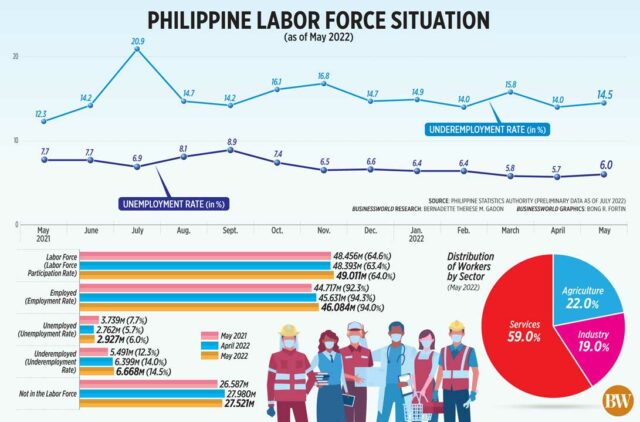
Philippine Labor Force Situation

THE UNEMPLOYMENT RATE in the Philippines jumped to a three-month high in May while job quality deteriorated despite increased economic activity, data from the Philippine Statistics Authority (PSA) showed. Read the full story.

Philippine Labor Force Situation

Youth anger over Indian army hiring shakeup fuels jobs demands

NEW DELHI/BHOJPUR, India — Catching his breath after a set of push-ups, Indian teenager Neeraj Kumar said waking before dawn for a grueling military-style training session had become part of his routine — even as his dreams of an army career turn to dust.

Joining the military has long been seen as a route out of poverty in India, but a recruitment shakeup that aims to hire young troops on capped four-year contracts with less favorable terms has angered would-be recruits like Mr. Kumar — sparking mass protests in June.

“All I ever wanted in my life was to join the army because it is a dream of every Indian man to be able to serve our motherland, but the government snatched this from us,” Mr. Kumar, 18, told the Thomson Reuters Foundation in Bhojpur, a district in Bihar, one of India’s poorest states.

“After four years, we will be left unemployed and people will call us retired,” he said. For Indians from poor rural areas, the nation’s 1.38 million-strong armed forces is one of their few realistic options of securing permanent employment with a guaranteed pension and additional benefits.

A military job can also raise a young recruit’s social status, and that of his family, convincing many to pay for years of training to boost their chances of being accepted.

Mr. Kumar said his parents had mortgaged their small plot of land to help pay for the training, which included math lessons and fitness.

The violent protests in poor northern areas over the army plan, which promises to retain 25% of recruits beyond four years, followed unrest in January when protesters denounced alleged hiring flaws by the railways department — another major public sector employer.

Thousands of demonstrators attacked train coaches and clashed with police during the protests, which economic analysts said were a symptom of India’s rolling youth unemployment crisis.

“We are very far behind the curve and we sort of missed the bus a little … in terms of creating enough jobs for the youth coming into the labor force,” said Deepanshu Mohan, an associate professor of economics at O.P. Jindal Global University on the outskirts of the capital, New Delhi.

He said the protests over military and railway hirings stemmed from poor government communication, and the sudden loss of a potential socio-economic safety net that had plunged legions of low-income youth into an uncertain future.

The move to contractualize military jobs highlights a steady erosion of quality employment due to a broader shift towards ad hoc work contracts with little to no protections or benefits, he added. The Defense Ministry did not respond to repeated requests for comment.

Government jobs always attract huge numbers of candidates in India. Despite the outcry over the recruitment plan, the Indian Air Force received more than 200,000 applications within a week of opening registrations. A total of 46,000 troops will be selected in the military this year.

When Prime Minister Narendra Modi took office in 2014, he promised economic development that would create millions of jobs for the surging ranks of young, educated Indians. But national unemployment peaked at 23.5% in 2020 — at the height of COVID-19 lockdowns — and has stubbornly remained well above 7% since, according to data from the Mumbai-based Centre for Monitoring Indian Economy (CMIE), much higher than the global average.

In 2017, approximately 7% of those in the 15-19 age group were employed, slipping even further to only about 2% since 2020, CMIE data shows. Things are somewhat better for the 20-24 age group, where the employment rate stands at about 20%, according to a June 20 CMIE statement.

Without suitable jobs available, many out-of-work young Indians have simply given up the hunt, said Abhijit Mukhopadhyay, a senior fellow in the economy and growth program at the Observer Research Foundation (ORF) think-tank.

“If the economy is unable to create enough jobs for these people, these protests will keep happening periodically,” he said, adding that jobless youth were often targeted by “politically motivated people” who paid them to join demonstrations.

Critics of the military hiring shakeup fear the exit of three-quarters of young recruits after four years will only serve to swell the ranks of unemployed youth. The retired soldiers will receive a one-time payout and could be offered federal or state government jobs, including in the country’s various paramilitary forces or in the police.

Mr. Kumar said now that he had all-but abandoned his army ambitions, he hoped to join the state police force in either Bihar or neighboring West Bengal.

“I’ll be able to be in the service until the age of 60,” he said. “If I fail … I’ll go to my uncle’s place in West Bengal and help him with his dairy business.”

The military reform called Agnipath, or “path of fire,” aims to reduce the average age of lower-ranking personnel in the armed forces to about 24 from 32 at present.

Younger, fitter forces will be stationed on India’s hostile borders with nuclear-armed Pakistan and China, at a time of rising tensions, and the plan will trim pay and pension costs that consume more than half of India’s defense budget, analysts say.

But Varun Gandhi, an MP from Mr. Modi’s ruling party, argued that “rather than downsizing or simply avoiding the cost of pensions and benefits, one should right size the government” in a recent newspaper editorial.

He called on the government to fill more than 6 million vacant federal and state jobs. From the solar energy and electric vehicles markets to waste management, Mr. Gandhi pointed to the growing sectors in India as potential “green jobs” creators.

His suggestions came about two weeks after Mr. Modi announced his government would go “on a mission mode” to hire 1 million people for government jobs over the next year-and-a-half.

Such promises offer little hope to 22-year-old Ravi Ranjan Rai in Bihar, who had his heart set on an army job to lift his farming family out of poverty. He said he felt betrayed by the Agnipath military plan.

“I’m the only brother among three sisters and I have a lot of responsibilities on my shoulders,” said Mr. Rai. “We are willing to give our lives for the country and the government is literally shattering our dreams.” — Thomson Reuters Foundation

ACEMC – Tacloban to conduct annual stockholders’ meeting on July 25

Arts & Culture (07/08/22)

Ace Banzuelo’s “Muli”

Music video features ABS-CBN stars

ABS-CBN stars Francine Diaz and Seth Fedelin appear in the music video of Ace Banzuelo’s chart-topping electronic ballad “Muli,” which has been the most streamed OPM song on Spotify and Apple Music for more than a month now. It continues to make an impact on several music charts worldwide, reaching No. 1 on Apple Music Viral Hits — Philippines, No. 2 on Spotify Top 50 — Philippines and Spotify Viral 50 — Philippines, No. 3 on Apple Music Top 100: Philippines, and No. 6 on Spotify Viral 50 — Global. “Muli” has also landed on Spotify Viral 50 charts in four other territories: UAE, Singapore, Canada, and New Zealand.

GMA Network tops Facebook, TikTok

ON FACEBOOK, GMA Network is the top Philippine media organization with 22,126,213 likes as of June 2022. According to Sprout Social, for the first half of 2022, GMA Network’s Facebook page similarly leads in terms of Public Engagements by 72% against its closest media competitor. GMA Network also has 1.1 million followers on Tik Tok. Some of its top posts are from the daily showbiz news updates Kapuso Showbiz News and the #GMAPaNoticeChallenge, an acting challenge where fans can make their own versions of scenes from GMA shows with the best ones getting featured on the GMA Network account. GMA Network is @gmanetwork on Facebook, Twitter, Instagram, YouTube, and TikTok.

Kenneth Cobonpue in Smart Infinity documentary

FURNITURE designer Kenneth Cobonpue will headline the next episode of Smart Infinity’s Infinite Legacies documentary series on July 10, 7 p.m., on Cignal, Cignal Play, or Smart GigaPlay. Mr. Cobonpue will also speak about his advocacies at an Infinity Exclusives event happening on July 8 at the Interior Crafts of the Islands, Inc., in Cebu City. Replays are available on Smart’s GigaPlay App. For more details, follow Smart Infinity’s Instagram account @smartinfinity or visit smart.com.ph/infinity.