Home Blog Page 5658

Over P2 billion needed for rehab of quake-hit classrooms; emergency employment rolled out for affected workers 
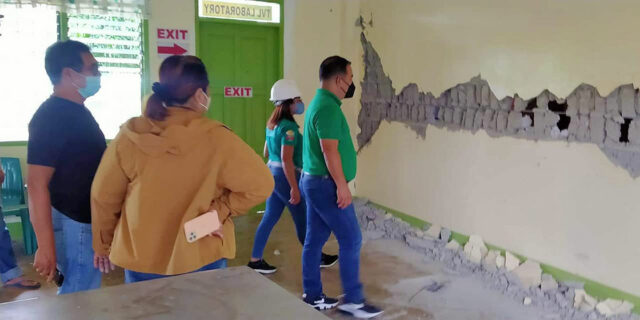
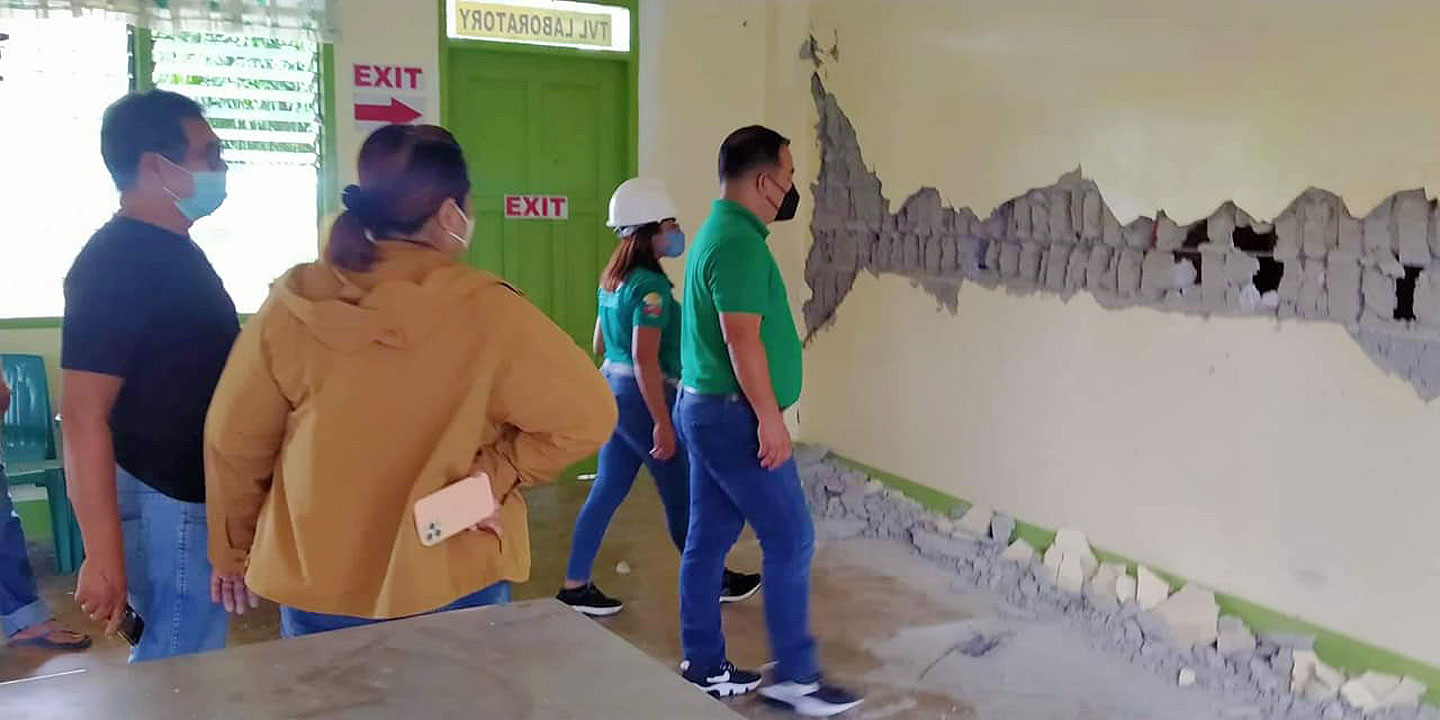
Damage validation Teams from the Department of Education central office validate damage reports on schools in Abra, the epicenter of the magnitude 7 earthquake that struck northwestern Luzon on July 27. — DEPED-ABRA
Damage validation
Teams from the Department of Education central office validate damage reports on schools in Abra, the epicenter of the magnitude 7 earthquake that struck northwestern Luzon on July 27. — DEPED-ABRA

MORE than P2 billion is needed for the rehabilitation of classrooms damaged by the magnitude 7 earthquake that rocked northwestern parts of the country last week, the Department of Education (DepEd) said on Thursday.  

In a news conference, DepEd Spokesperson Michael T. Poa said the cost for repairs and reconstruction of damaged classrooms has increased to P2.1 billion.  

Mr. Poa said the agency is considering building “temporary learning spaces” or “tent-style” makeshift classrooms for the damaged schools, noting that the number of schools affected by the major earthquake rose to 427.  

He said the agency was realigning funds for the construction of the learning spaces.   

If there are projects which are not priorities or would not push through or if there are savings, we will realign these for our quick intervention,he said.  

DepEd earlier said schools in areas hit by the quake are still expected to proceed with the opening of classes on Aug. 22.  

Mr. Poa said about 15.2 million learners have enrolled for the new school year as of Thursday morning.  

Abra province was the epicenter of the earthquake that also affected other parts of the Cordillera region as well as Ilocos and Cagayan Valley.  

Its tremors were also felt in the capital region Metro Manila, forcing workers to evacuate buildings and halting train operations.  

In a post, DepEds office in Abra said the agencys central office visited the province to validate local risk-based reports.   

The findings of their assessment will be the basis of a streamlined and well-coordinated rehabilitation and recovery plans,DepEds Abra office said.   

There is also an on-going identification of schools who will be needing temporary learning shelters this next school year.”  

Last week’s major quake, which has claimed 10 lives and injured 410 others, has affected 118,207 families or 443,152 people, the National Disaster Risk Reduction Management Council (NDRRMC) said in an 8:00 am situation report on Thursday.  

The earthquake also damaged 30,066 houses, 549 of which were totally destroyed, the agency said. 

Damage to infrastructure has reached almost P1.27 billion, NDRRMC said.   

Meanwhile, the Department of Labor and Employment (DoLE) on Thursday said 21 business establishments have yet to reopen after the earthquake. 

In a live-streamed news briefing, DoLE administrator for the Cordillera Administrative Region Nathaniel V. Lacambra said about 426 formal sector workers are out of work as of Thursday.  

“We also have what we call informal sector workers like our farmers and fisherfolk who can’t work because of the earthquake,” he said. 

The Labor department has allocated P50 million for emergency employment and rehabilitation in the Cordillera and Ilocos regions.  

He noted that DoLE’s Cordillera regional office has already given 4,625 affected workers emergency employment involving clearing operations and recycling.    

AID
NDRRMC reported that more than P90 million worth of assistance has so far been provided, including those from the national and local governments, non-government organizations, and the private sector, among others. 

The European Union said on Thursday that it will provide 800,000 (P45.3 million) in emergency funds to assist victims of the earthquake. 

The funding will provide for safe drinking water and sanitation, hygiene, mental health and psychosocial support services, and education for the most vulnerable in the hardest-hit areas. 

Chargé d’Affaires Ana Isabel Sánchez Ruiz of the Delegation of the European Union to the Philippines, said: “With this assistance, the European Union reaffirms its commitment and solidarity towards the victims of humanitarian disasters in the Philippines.” 

China has donated P10 million worth of rice to Abra and nearby areas, according to a Facebook post made by the Chinese Ambassador to the Philippines on Thursday. 

We are confident that under the leadership of President Marcos the Filipino people will rise above difficulties and rebuild their home soon,Chinese Ambassador Huang Xilian said.  

The Chinese Embassy handed over the donation, sponsored by the embassy and the Philippine Chinese Chamber of Commerce and Industry, Inc., to the Department of Social Welfare and Development on Tuesday.  

Meanwhile, the United States joined Australia, South Korea, the United Kingdom, and other partners in Puerto Princesa, Palawan for the Pacific Partnership 2022 (PP22) on Wednesday, the US Embassy said in a Thursday statement. 

PP22 is the largest annual multilateral humanitarian assistance and disaster preparedness exercise conducted in the Indo-Pacific, it said. 

Activities began on July 27 with the arrival of the USNS Mercy, a 1,000-bed hospital ship commissioned in 1986 to provide medical services to support US disaster relief and humanitarian operations worldwide. 

The impact of disaster emergencies transcends borders and requires comprehensive coordination among nations for an effective response,PP22 Mission Commander Hank Kim said in a statement on Thursday.  I am confident that the planning and hard work that we have invested with our partners will have a long-lasting impact here in the Philippines.” Kyle Aristophere T. Atienza, John Victor D. Ordoñez, and Alyssa Nicole O. Tan

Iloilo City eyes more PPP projects after partnership with SM Prime on development of 2 markets 

AN INITIAL concept design for the Iloilo City Terminal Market. — PPP.GOV.PH

THE ILOILO City government is pursuing at least three more projects under a public-private partnership (PPP) arrangement, its mayor said on Thursday. 

I am awaiting for a waste-to energy-proposal which will probably be submitted by next week,Mayor Jerry P. Treñas said in a statement.  

This is also one of the areas where we requested the PPP Center for assistance when we first entered into administration in 2019, he said, referring to the government agency in charge of facilitating PPP programs and projects.  

Two other projects that have been offered to investors are the development of a reclamation area, and the citys slaughterhouse.  

On Tuesday, the city government formally signed a 25-year lease contract with SM Prime Holdings, Inc. for the redevelopment of the city’s Central Market and Iloilo Terminal Market.   

SM Prime will be investing about P3 billion for the combined projects, which are targeted for completion within two years.    

Mr. Treñas assured existing legitimate stall holders that they will not be displaced by the development of the two markets. MSJ 

FVR was a ‘symbol of stability’, peace broker — Marcos

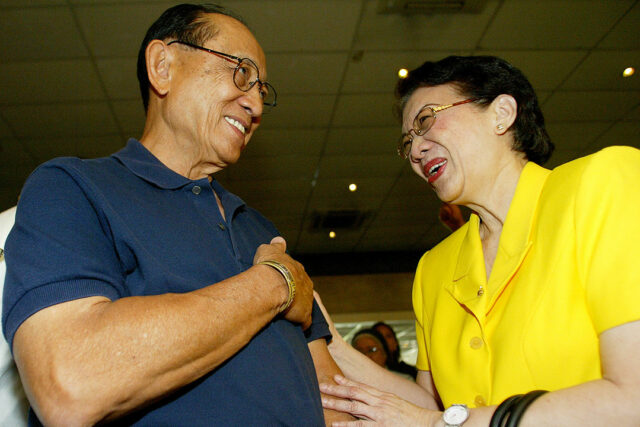
THE LATE Presidents Fidel V. Ramos (L) and Corazon C. Aquino share a light moment after attending a mass celebrating the 20th anniversary of "People Power" at EDSA Shrine in Manila on Feb. 25, 2006. — REUTERS

By Kyle Aristophere T. Atienza, Reporter 

PRESIDENT Ferdinand R. Marcos, Jr. on Thursday said the late President Fidel V. Ramos (FVR) was a symbol of stabilityafter a popular uprising in 1986 that restored the countrys democracy.  

Mr. Marcos made the statement during his visit at the wake of Mr. Ramos, who supported an anti-dictatorship campaign that sent the Marcoses into exile in the United States. 

I just reminded Mrs. Ramos of how FVR, when he became president, was a symbol of stability after all the tumultuous events of 1986,Mr. Marcos said, based on a transcript sent by his office.  

When he came into the presidency, he brought calm and he brought stability to our country,he said. For that, we will always be grateful to him and for all his service all throughout his life as a soldier and as a public servant.”   

Mr. Ramos helped topple the regime of his second cousin, the late dictator Ferdinand E. Marcos, Sr. Mr. Ramos was a military general and headed the police force under Marcos Sr.s government.   

We clearly have suffered a loss for our country,the younger Marcos said. But the memories of him will be good because of all the good work he did for the Philippines.”  

Mr. Ramos, who died at the age of 94 on Sunday, will be given a state funeral on August 9, according to Mr. Marcosoffice.   

FVR, a United States-trained soldier who became a fighter during the wars in Korea and Vietnam, oversaw the recovery of institutions and sectors ravaged by the Marcos dictatorship.  

He was a minority president who managed to improve the Philippine economy in the 1990s,Arjan P. Aguirre, who teaches political science at the Ateneo De Manila University, said in a Messenger chat. 

But Mr. Ramosrule had not been spared from criticisms, most of which stemmed from his pro-market policies involving privatization and liberalization of several economic sectors. 

PEACE BASED ON JUSTICE
Makabayan, a progressive bloc in the House of Representatives that had been critical of his policies, said he was a leader who understood that for our country to prosper we need peace based on justice and that it can only be attained by addressing the root causes of armed conflict.”  

Pres. Ferdinand Marcos Jr. would do well to follow his example on the question of peace,the bloc said in a statement.   

Mr. Ramos oversaw the revision of a 1981 anti-subversion law, which human rights advocates said was used during Martial Law years to justify mass arrests, mass detention, and torture of critics. The law outlawed membership in the local communist party and other organizations supposedly associated with it.   

The Marcosian law was repealed during Mr. Ramosadministration in 1992, allowing membership in the local communist party.  

By assuring communist insurgents of political space, we also challenge them to compete under our constitutional system and free market of ideas which are guaranteed by the rule of law,Mr. Ramos said in a 1992 speech.  

Law experts and several government officials have said mere membership in the communist group does not constitute a crime. It is allowed as long as activism remains in the realm of ideology, they said.  

As an intelligence guy during his military days, he is known for his data-driven and evidence-based analysis of any situation,Mr. Aguirre of Ateneo said.   

After his stint as president, FVR remained as one of the sought-after figures and seasoned politicians. 

Maria Ela L. Atienza, a political science professor at the University of the Philippines, remembered Mr. Ramos as a staunch supporter of decentralization and autonomy.”  

He vetoed a bill that sought to ‘recentralize’ health services,she said in a Viber message. He and his administration brokered a [peace] deal with the [separatist] Moro Islamic Liberation Front.” 

VP’s office aims to expand free transport program

OVP INDAY SARA DUTERTE OFFICIAL FACEBOOK PAGE

THE OFFICE of Vice President Sara Duterte-Carpio on Thursday said it would pursue partnerships with the private sector to expand its program offering free rides to commuters. 

Ms. Carpios office is planning to get additional buses and open more routes for the program, spokesperson Reynold S. Munsayac told a news briefing. 

Its clear that the government needs more buses that will provide services, especially at no cost,he said. Our goal is to find private partners that will also lend buses. We will shoulder the fuel, the salary of the drivers and, if needed, the repair and maintenance of the buses. 

Ms. Carpios office launched the program on Wednesday with five buses, two of which have been deployed to a bus carousel along EDSA, the capital regions major thoroughfare. The other three were deployed in Bacolod City and Cebu City in central Philippines and Davao City in the countrys south. 

Mr. Munsayac said the office now targets the bus route from Commonwealth and Fairview in Quezon City to Quiapo in the capital Manila. We received reports that there were many passengers there. 

Mr. Munsayac said students can avail of the free rides. 

The new school year is opening on Aug. 22 under a hybrid setup, but the Department of Education, which is headed by Ms. Carpio, is set to implement five days of face-to-face classes starting November. 

The Transport department earlier assured that public transport could cope with a potential spike in demand as a result of the resumption of physical classes this year. Kyle Aristophere T. Atienza

PHL draws mighty Israel, 2-2, with board two win of Barcenilla

GR STOCKS-UNSPLASH

GRANDMASTER (GM) Banjo Barcenilla showed incredible grit in delivering a match-saving victory in an upset 2-2 draw by the Philippines with a heavily favored Israel in the sixth round on Wednesday night to stay in the 44th World Chess Olympiad hunt in Chennai, India.

Mr. Barcenilla punished GM Tamir Nabaty for his faulty sacrificial queenside attack with a devastating rook invasion that won a piece and the game in 64 moves of a King’s Indian duel on board two.

GM Mark Paragua, who saved the day in the Filipinos’ shock 2.5-1.5 upset of Sweden in round five, tried again to squeeze out a win out of what looked like an equal position against GM Avital Burochovsky on board one but wound up splitting the point in 59 moves of their Four Knights showdown that sealed the standoff with the Israelis.

The pair of results erased a 1.5-.5 deficit following a draw by GM Darwin Laylo with grizzled Olympiad vet GM Ilya Smirin on board three and a crushing loss by International Master (IM) Paulo Bersamina to GM Evgeny Postny that was exacerbated by the Filipino’s poor opening play.

The draw kept the Filipinos, who are backed by the Philippine Sports Commission, in striking distance with the big guns as they share 14th place with 10 other nations with nine match points in this 11-round, 12-day event that gives two points for a match victory and a point for tie.

After a much-needed break on Thursday, they play a mighty Poland side that is seeded fifth on Friday night’s seventh round for a chance for the GM Eugene Torre-mentored Philippines to reclaim its spot in the top 10.

GM John Paul Gomez will be re-inserted into the roster in place of a still dazed Mr. Bersamina in anticipation of their much-awaited collision with the powerful Poles.

“We’ll just fight and play on until the end for our country,” said Mr. Barcenilla, who was accompanied by wife, also former Olympiad veteran, Lilibeth.

The Filipinas, for their part, received another mighty blow after drawing with the lower-ranked Ecuadorians, 2-2, that sent them spiraling down to a 13-nation logjam at 48th spot with seven points.

Woman FIDE Master Shania Mae Mendoza lost to WIM Anahi Ortiz Verdezoto on board two, while WGM candidate Kylen Joy Mordido won on board four, and WIMs Jan Jodilyn Fronda and Marie Antoinette San Diego drew on boards one and three, respectively.

They face Bolivia next. — Joey Villar

Fajardo leads race for Best Player of the Conference

Jun Mar Fajardo-led San Miguel Beer — PHILIPPINE STAR/RUSSEL PALMA
JUNE MAR FAJARDO towers over rivals. — THE PHILIPPINE STAR/RUSSEL PALMA

SAN MIGUEL Beer (SMB) stalwart June Mar Fajardo kept pole position in the race for the PBA Philippine Cup’s Best Player of the Conference (BPC) award at the end of the quarterfinal phase with teammate CJ Perez on his tail.

Mr. Fajardo, who has been enjoying a return-to-from after getting sidelined by a shin injury in 2020, stayed ahead of the field with 42.7 statistical points while Mr. Perez maintained No. 2 spot with 39.7 SPs.

The 6-foot-10 Mr. Fajardo is making a strong case for his ninth BPC plum with eye-popping averages of 17.9 points, league-best 13.3 rebounds, 3.7 assists, 1.1 steal and 1.5 block.

Mr. Perez, for his part, posted impressive stat lines of 17.5 markers, 7.4 boards, 6.0 dimes, and 2.4 steals.

The SMB duo looms as the strongest bets for the coveted award with their closest rivals Scottie Thompson (37.5) Japeth Aguilar (33.1) and Christian Standhardinger (32.8) of Barangay Ginebra having played their last games of the tournament already.

After the Gin Kings troika were Robert Bolick (32.63) and Jamie Malonzo (32.60) both from NorthPort, a team that didn’t make it past the elims.

Meralco’s Chris Newsome (32.5) and Magnolia’s Jio Jalalon, whose teams are still playing in the semifinals, shared eighth and ninth while Calvin Oftana of losing quarterfinalist NLEX (32.4) rounded out the Top 10.

Meanwhile, Blackwater’s Ato Ular (21.1 SPs) continued to show the way among rookies with Converge’s Justin Arana (21.5), NorthPort’s JM Calma (19.1), Phoenix’ Tyler Tio (18.2) and Converge’s Jio Ambohot (17.9) trailing him. — Olmin Leyba

Adamson, National University collide in battle of unbeaten

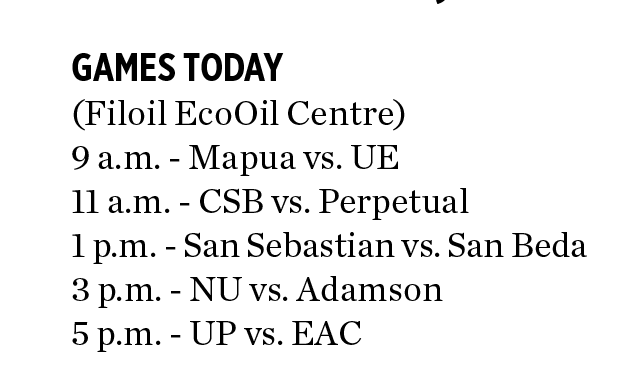
ADAMSON and National University (NU) lock horns in a battle of unbeaten squads for a goal of staying on the coattails of Group A leader University of the Philippines (UP) in the Filoil EcoOil Preseason Cup at Filoil EcoOil Centre in San Juan.

The Soaring Falcons (3-0) and the Bulldogs (2-0) take centerstage at 3 p.m. to banner the quintuple header of the 17-team preseason tilt serving as a prelude to the University Athletic Association of the Philippines (UAAP) and NCAA next month.

A win by Adamson would catapult it to a joint lead with UP (4-0) while a victory for NU would push it to a solo second place midway through the elimination round, making it an explosive duel according to their coaches.

But more than that, mentors Jeff Napa and Nash Racela only want continuous improvement from their wards approaching their bigger battle in the UAAP, where they finished just outside the Final Four last season.

“We don’t want to focus on teams na lalaruin namin but rather, we just want to play the games as they come. We play the same way regardless of who the other team is,” said Adamson coach Nash Racela.

Reigning UAAP champion and undefeated leader UP (4-0) wants no letup in its 5 p.m. tussle against Emilio Aguinaldo College (EAC) (1-2).

University of the East (UE) (1-3) and Mapua (0-2)  battle at 9 a.m., College of St. Benilde (1-2) and University of Perpetual Help System DALTA (1-2) clash at 1 p.m. while San Beda and (0-2) and San Sebastian (0-1) duel at 1 p.m. — John Bryan Ulanday

Tropang Giga, Beermen target 2-0 series lead

TNT Tropang Giga lead Magnolia 1-0. — PHILIPPINE STAR/ RUSSEL PALMA

TNT and San Miguel target a 2-0 lead but have to be cautious enough against their respective rivals who are expected to make adjustments in their bids to level the PBA Philippine Cup semifinal series on Friday.

The Tropang Giga tore through the usually impenetrable Magnolia defense in a 108-96 Game 1 romp, but the defending champions perfectly understand it won’t necessarily be the case all the time.

“We know that the other team is a very good team, especially as they take a lot of pride in their defense. So we’re pretty sure they’re going to come up with something different the next time and it’s upon us to be ready for it,” said TnT coach Chot Reyes ahead of the 3 p.m. Game 2 at the Smart Araneta Coliseum.

That’s what Hotshots counterpart Chito Victolero is actually cooking up.

The protagonists believe this series, a rematch of the Season 46 All-Filipino finale won by TnT in five, is just about to heat up.

“It’s going to be a tough series; it’s a great team we’re playing against,” said TnT star Mikey Williams who torched their rivals with 26 points and felt the Hotshots’ physical plays in a rough sequence in the second half.

Like TnT, the top-seeded Beermen flexed their muscles in the initial clash with the Bolts, 121-97, and are determined to make it a two-game headstart at 3 p.m. in their own race-to-four duel.

SMB tactician Leo Austria said aside from reclaiming the jewel they last held in 2019, his charges are drawing extra drive from avenging their two playoffs setbacks to Meralco prior to this.

“We were just a step slower all around,” rued interim coach Luigi Trillo, also noting the legs just weren’t there coming off the grueling best-of-three quarters showdown with Barangay Ginebra that ended only last Sunday. “For us to have a chance in this series and give them a fight on Friday, we have to be better.” — Olmin Leyba

Swimmer Otom emerges as first PH triple gold medalist in 11th ASEAN Para Games

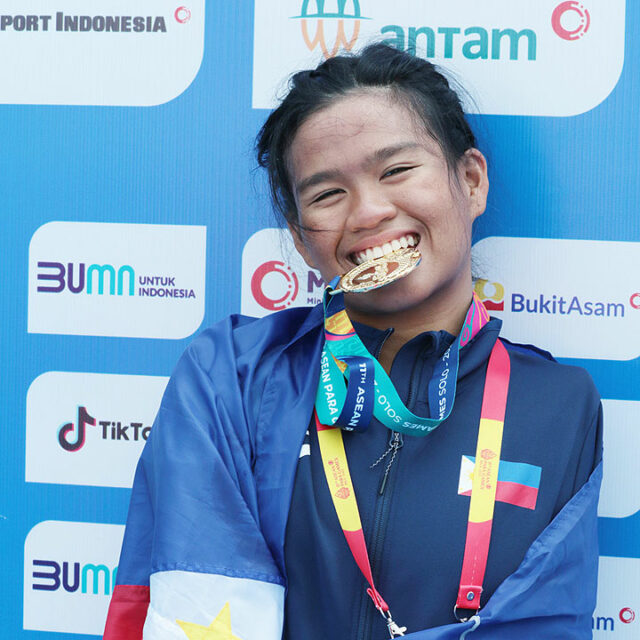
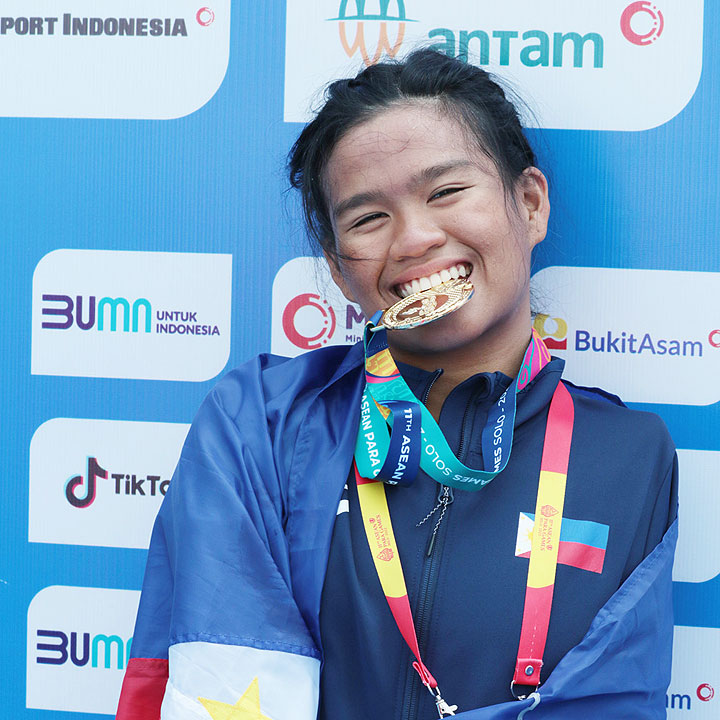
ROOKIE Angel Otom takes a bite at her gold medal after winning the women’s 50-meter butterfly S5 event on the way to emerging as the country’s first triple gold medalist in the 11th ASEAN Para Games at the Jatadiri Sports Complex pool in Semarang, Indonesia on Thursday.

SURAKARTA — Angel Otom bagged two more gold medals, including one in record-breaking time, to emerge as the country’s first triple gold medalist as the Philippine para swimmers emerged with four mints from the Jatidiri Sports Complex pool in Semarangin here in the 11th Association of Southeast Asian Nations (ASEAN) Para Games on Thursday.

Picking up from where she left off, Ms. Otom was a runaway winner in the women’s 50-meter butterfly S5 event in 48.070 seconds, nearly eight seconds faster than the 17-year-old mark of 56.80 set by Singapore’s R.T. Goh in the Manila ASEAN Para Games in 2005.

She finished so far ahead of Vietnamese tankers Thi Sari Nguyen and Thi My Thanh Dan, who were second and third in times of 1:14.150 and 1:32.460, respectively.

As an encore, the 19-year-old pride of Olongapo City added her second mint in the women’s 50-meter freestyle S5 event, leading the way from start to finish in clocking 41.40 seconds, much to the delight of her parents Marlou and Mila Otom, who flew all the way from Manila just to watch their daughter perform.

“I am so happy but it has not sunk in yet that I am the country’s first triple gold medalist,” said Ms. Otom of her outstanding achievement as a rookie in the biennial sportsfest.

Ernie Gawilan scooped up his second gold medal in topping the men’s 200-meter individual medley SM7 in record-breaking fashion as well in 2:49.530, sinking the 14-year-old mark of 4:00.02 by Salungyoo Rawin of Thailand in the 2008 Bangkok Games.   

A pleasant surprise was rookie Marco Tinamisan, who won the swimming team’s fourth mint in topping the men’s 50-meter freestyle S3 event in 54.660 seconds in the outing supported by the Philippine Sports Commission.

Over at the Manahan Stadium, wheelchair racer Jerrold Mangliwan secured his second gold in ruling the men’s 400-meter T5 race in 1:06.20 while teammate Rodrigo Potiotan, Jr. finished third but did not get a medal since there were only three entries in the event (1:09.870).

Gary Bejino lost by a touch to Thailand’s Aekkharin Noithatto and settled for a silver in the men’s 50m butterfly S6 event in 35.440 seconds to the former’s 35.300 seconds before securing another silver in the men’s 50m freestyle (34.40).

The duo of Russel Cundangan and Mary Ann Taguinod likewise took the silver in the J1-J2 women’s team event of judo.

With the combined five golds of athletics and swimming, the Philippines raised its overall medal tally to 19 golds, 16 silvers and 34 bronzes, just one gold shy of the 20 golds the PH para-athletes won in the 2017 edition of the meet held in Kuala Lumpur, Malaysia.

The Philippines was poised to add another gold in the men’s P1 team event after FIDE Master Sander Severino and Jasper Rom downed their separate rivals in the fifth and penultimate round at the Lo-rin Hotel.

With their victories, the Filipino chessers were assured of their fifth gold regardless of the outcome of the final round.

Adalem, Marinero eye Final Four slots against separate foes

ARMED with twice-to-beat incentives, higher-ranked squads Adalem Construction-St. Clare and Marinerong Pilipino shoot for quick Final Four passages against separate counterparts in the PBA D-League Aspirants quarterfinals at the Smart Araneta Coliseum.

The third-seeded Saints take on No. 6 Builders Warehouse at 11 a.m. after the 9 a.m. collision of No. 4 Skippers and No. 5 Centro Escolar University.

A win would push both squads straight into the semifinals, where No. 1 Apex Fuel-San Sebastian and second-running EcoOil-La Salle are already waiting after similar 5-2 cards in the elimination round.

The mission for St. Clare and Marinero, however, will not be a walk in the park especially against capable squads that have made late runs into the playoffs.

Santo Tomas, for its part, strung three straight victories after a 0-4 start including a huge upset of NCAA champion Letran in the virtual knockout match for the last and sixth playoff spot.

That alone should be enough reason for St. Clare to not lower its guard despite a win-once bonus.

Marinero mentor Yong Garcia echoes caution as his wards go up against the Scorpions, who dealt them an 84-77 defeat in their elims meeting. — John Bryan Ulanday

Lakers at a crossroad

All eyes remain on the Lakers, and not simply because they seem to be dragging their heels on a deal involving Russell Westbrook. It’s clear that the latter no longer wants to stay in the fold, not after a disastrous 2021-22 season that saw his numbers decline across the board, and certainly not after he found himself being dangled in just about every potential deal so far in the offseason. Heck, he even fired longtime agent Thad Foucher, and then signed with influential Excel Sports ostensibly to get better leverage on is way out.

If the grapevine is to be believed, the Lakers are balking at the inclusion of their future draft picks. Due to a rule named after former Cavaliers owner Ted Stepien, they’re not able to trade consecutive first-round picks; the provision likewise prevents them from dangling their 2026 option until the Pelicans decide on the third of consecutive choices generated by the deal for then-six-time-All-Star Anthony Davis in 2019. This means that acquiescing to demands for them to sweeten any Westbrook trade would be tantamount to giving up any freedom at the draft until 2030.

True, it’s a problem in and of itself. That said, surefire talent in the present is more valuable than the promise of What Ifs. And, needless to say, the Lakers should understand that housing a marquee player who’s pushing 38 effectively places them in Win Now mode; continuing to give the keys to LeBron James — admittedly on the backside of an all-time-great career — necessitates the capacity to go all in. It’s what they did when they acquired Davis, and what they did when they spread the welcome mat for Westbrook.

Recency bias does play a role in the Lakers’ reluctance to open the bank for the possibility of taking in mercurial guard Kyrie Irving from the Nets. No doubt, the latter’s flaky character also gives them pause. What if the solution is worse than the problem? Then again, they have few paths to success, and none as currently constructed. Later this month, James will be eligible for a contract extension, and whether he ensures his status as the principal protagonist in purple and gold may well be predicated on how close he believes he is to a fifth ring.

So, yes, the Lakers are at a crossroads. And, yes, they’re playing high-stakes poker. The question is this: Does the hand they have give them the conviction to bluff? They have a tell, and, right now, conventional wisdom has them folding one way or the other.

Postscript: Coca-Cola Beverages Philippines, Inc. (CCBPI) and Coca-Cola Foundation Philippines, Inc. (CCFPI) recently held the Coca-Cola Charity Golf Classic 2022 and raised P3.5 million in pledges as a result. The Sta. Elena Golf Club played host to 123 captains of industry, partners, and customers — a significantly higher number than when the event was last held in 2019.

CCBPI CEO and President Gareth McGeown envisions the tournament as “a tradition wherein the Coca-Cola community and our partners in the business gather for a greater goal.” Proceeds from the 2019 endeavor were used by CCFPI for pandemic-related initiatives.

And then there is the golf itself, which proved climactic as the winning team of JP Reyes, Ace Stehmeier, Frank Garcia, and Vic Gregorio turned in a nine-under gross score off birdies in the last three holes to win by a single stroke. It was a fitting result for the charity event, which had been staged regularly since 2003, but which needed to be postponed due to the pandemic.


Anthony L. Cuaycong has been writing Courtside since BusinessWorld introduced a Sports section in 1994. He is a consultant on strategic planning, operations and Human Resources management, corporate communications, and business development.

FVR’s continuing legacy and learning curve

BW FILE PHOTO

Five years ago in 2017, the Philippine Star published an interesting piece entitled “Debt, Deprivation and the Spoils of the Dictatorship,” written by Camille Diola, reporting that there were attempts to institutionalize the idea that the Marcos’ years were the Philippines’ golden years. In what came to be called the “prosperity myth,” the story could not have been true because the Philippines was pushed into deeper debt and more severe deprivation, as it was not exclusively driven by external shocks in the 1970s and 1980s, or the political crisis following the assassination of the late Senator Ninoy Aquino.

University economists alike shared the view that “while the Philippines experienced more or less the same external shocks as other developing countries, there is a residual variation in its performance and response which makes it fall below the average for countries in its class.”

This residual variation, to Diola’s piecing together the various accounts of the times, consisted of institutions bowing to corruption, red tape, inefficiency, and political cronyism. External factors and the Aquino assassination simply exposed the economy’s peaking vulnerabilities.

If ever there is anything most historic that former President Fidel V. Ramos (FVR) left behind, it must be his participation in the 1986 EDSA revolt. For the next six years, he would be defending the Republic against seven coup attempts both by various groups within the Armed Forces and those loyalists who were deposed in the February 1986 uprising. And for the period 1992-98, FVR was to nurture the economy into a generally resilient one as its 12th head of state.

It was a beautiful journey for FVR, having fought for democracy and freedom in Korea by enlisting as a member of the 20th Battalion Combat Team of the Armed Forces of the Philippines, and in the hills of Pampanga against the Huks. But during the military regime, he was its face being the head of the Philippine Constabulary, and later vice-chief of staff. He never attempted to recant his story, or collaborated to perpetuate the urban legend that deceived a whole generation of youngsters and oldies alike. He shed all the military in him and embraced his role as a father to the nation during his presidency and even long after that until his departure. His story is one of tenacity and constancy to the cause of the nation that was very taken with his thumb up and his Filipino slogan “kaya natin ito!” (“We can do it!”)

It was a beautiful journey for FVR, having transitioned from an easily irritable man in uniform to Cory Aquino’s armed forces chief of staff and later defense secretary. As Philippine Star’s Ana Marie Pamintuan wrote: “…when he secured President Cory’s endorsement, he changed overnight. Perhaps he recognized the role of the press in the attainment of his vision for the nation.” The media would be receiving his faxed annotation of their pieces on him, or on his policy pronouncements. Perhaps, it was more his cabinet members who dreaded receiving those faxes at four in the morning when they had hardly read the news. By that time, almost every morning, FVR had already formed a good sense of what was in the papers and what to say to the media in ambush interviews. That advantage must have eased his nerves and lengthened his understanding of the press.

It was a beautiful journey for FVR, the quintessential salesman of the Philippines. But unlike a salesman, FVR sold products of his own making. We recall joining those fund-raising exercises in Asia, Northern America, and Europe for both the National Government and some government corporations. With a hollow economy, volatile consumer prices, and weak public finance, selling bonds was a tall order. It was likely to be undersubscribed. Ours were junk bonds with stiff risk premia, which means it was very expensive to borrow from abroad. But we found a good messaging, all ostensibly because of a single unifying element: FVR. He was instrumental in EDSA, he fought for democracy, he defended it against seven coup attempts, he was serious in ensuring democracy and pursuing economic growth in a “big” nation of 65 million, then our population in 1992.

We talked of the past, and there was very little to talk about, and there was work in progress, and there were so many in the pipeline. As the International Monetary Fund (IMF) itself described it, the Ramos administration embraced a “comprehensive reform strategy” that ranged from opening up the economy to international trade and investment, addressing the so-called macroeconomic imbalances, and managing structural rigidities especially on the supply side and the labor market.

We would return to Manila with the good news of oversubscription of the country’s global bonds. FVR was an excellent selling point.

Of our economic prospects, we would always argue that we did not repudiate the old system to exchange it for another. The folded sleeves of the President and his unlit tobacco should convince our investors that we meant business. FVR’s open arms policy towards the secessionist movement in Mindanao and the communist movement demonstrated his broad-minded approach to long-lasting peace that should be music to the ears of foreign investors. Based on his many initiatives in the oil, telecommunications, power, and banking industries, FVR’s focus on political governance and institutions should be able to count for something in terms of the durability of reforms and the promise of good macroeconomic performance.

As rightly pointed out by former NEDA Secretary Dante Canlas, in his lecture before the National Graduate Institute for Policy Studies in Tokyo in 2007: “Political institutions and good governance have now joined economic factors like savings, investments in human and physical capital, and technological progress as key determinants of growth.”

In the six years of Ramos, we experienced a dramatic turnaround in our economic performance. There were only two IMF programs that were initiated under his watch. The first was the Extended Fund Facility of June 24, 1994 to March 31, 1998 amounting to $791 million, while the second was the Standby Arrangement of April 1, 1998 to Dec. 31, 2000 worth $783 million. With good performance after the Asian Financial Crisis, the Philippines decided not to draw the entire amount.

This could only result from implementing sound macroeconomic policy. The FVR government pursued a good fiscal consolidation program without compromising economic growth. Prudent spending and new revenue measures supported an active pro-growth demand management policy. Congress enacted the new BSP Act giving the central bank more fiscal autonomy and independence with a focused mandate of price stability. The BSP started to pursue an independent float of the peso, benefiting from its automatic stabilizing features. Industrial restructuring was also pursued by the FVR government. Import liberalization and tariff reduction began to re-orient industrial direction. The Philippines also acceded to the World Trade Organization during this time. To help provide more credit and liquidity support to the growing economy, FVR also asked Congress to liberalize the banking industry.

FVR will therefore be remembered by his singular contribution in putting the Philippines on the radar of foreign investors and the global markets. The country became more integrated with the global economy through more open trade in goods and services as well as investments. Over time, this has allowed us to reap the benefits of global competition and greater economic productivity and efficiency.

In Ramos, because he decided based only on complete staff work within a reasonably short period of time, there was no need to look for the off-switch. He did not overthink, or overanalyze. Armed with the guidance of his cabinet backstop, like a combatant, he would decisively act. His trust in his people never wavered nor changed. His life ethics should make future leaders’ learning curve much shorter.


Diwa C. Guinigundo is the former deputy governor for the Monetary and Economics Sector, the Bangko Sentral ng Pilipinas (BSP). He served the BSP for 41 years. In 2001-2003, he was alternate executive director at the International Monetary Fund in Washington, DC. He is the senior pastor of the Fullness of Christ International Ministries in Mandaluyong.