Home Blog Page 5644

How travel-friendly is the Philippine passport?

A Philippine passport holder can travel to 67 visa-free or visa-on-arrival locations out of 227 possible travel destinations. With this, it moved up three spots to 80th out of 199 passports in the third quarter release of the Henley Passport Index, which ranks passports according to the number of destinations their holders can access without prior visa. The Philippine passport tied with Cape Verde Islands and Uganda.

How travel-friendly is the Philippine passport?

Security Bank raises P16 billion from offer of 1.5-year peso bonds

BW FILE PHOTO

SECURITY BANK Corp. has raised P16 billion from 1.5-year corporate bonds, more than the original plan of P1 billion as the offer was oversubscribed.

The bank said in a disclosure to the stock exchange that the bonds maturing in 2024 were successfully issued and listed on the Philippine Dealing & Exchange Corp. on Wednesday.

“Security Bank raised P16 billion worth of bonds at 3.7407% per annum, with a tenor of 1.5 years. Due to strong demand for the bonds, the bank exercised its oversubscription option and accepted offers above the initially announced P1-billion issue size,” the lender said.

“Security Bank offered the bonds to support its lending activities and expand its funding base,” it added.

Security Bank Executive Vice-President and Financial Markets Segment Head Raul Martin A. Pedro said the successful issuance and oversubscription is testament to investor confidence in the lender.

The bonds were issued out of Security Bank’s P100-billion peso bond and commercial paper program.

The offer period for the bonds was July 5-15. The bonds were offered at a minimum investment of P1 million and increments of P100,000 thereafter.

The lender tapped Philippine Commercial Capital, Inc. (PCCI) to be the sole bookrunner for the issuance, it said in a previous stock exchange disclosure.

The joint lead arrangers and selling agents for the transaction were PCCI and SB Capital Investment Corp.

Security Bank recorded a higher net income in the first three months of the year amid lower loan loss buffers and an improvement in its core earnings.

The lender’s net profit rose by 66% to P2.7 billion in the first quarter. This translated to a return on shareholders’ equity of 8.81%, while return on assets stood at 1.55%.

It was the 10th biggest private bank in the country with total assets of P707 billion as of end-March.

Security Bank shares closed at P89 apiece on Wednesday, down by 0.56% or 50 centavos. — K.B. Ta-asan

Bayan Muna asks SC to reverse ruling on Meralco price hike

PHILSTAR FILE PHOTO

BAYAN MUNA party-list group on Wednesday asked the Supreme Court (SC) to reconsider its decision upholding a 2013 approved rate hike application of P22.6 billion by Manila Electric Co. (Meralco).

In a 37-page motion, the group said the Energy Regulatory Commission (ERC) abused its discretion when it approved the “highest power hike in history.”

“The highest rate hike is not at all the consumers’ fault, but those of the power sector,” said Bayan Muna. “Despite this, it will be the consumers who will bear this great burden and ultimately pay for the rate hike as part of our electricity bill.”

The group added that the court committed a reversible error when it held that the ERC did not abuse its discretion when it “hastily” approved Meralco’s rate increase.

Under the latest High Court decision, Meralco is allowed to implement an additional charge of P4.15 per kilowatt hour, SC Associate Justice Amy C. Lazaro-Javier said in her separate dissenting opinion.

Bayan Muna pointed out that the ERC’s approval of the price hike violated the Electric Power Industry Reform Act of 2021.

Under the law, the ERC is mandated to enforce the rules and regulations that ensure the rational pricing of electricity.

The distributor is also tasked to “protect the public interest as it is affected by the rates and services of electric utilities of electric power.”

In 2014, the tribunal issued a temporary restraining order on Meralco’s staggered charges and recovery costs totaling P22.6 billion.

The country’s biggest electricity distributor applied for the rate increase after the maintenance shutdown of Shell Philippines Exploration B.V.’s Malampaya gas-to-power project, which forced the company to buy more expensive supplies from the Wholesale Electricity Spot Market.

Bayan Muna noted that the ERC neglected its duty to protect the consumers from unreasonable prices of electricity.

“From where we sit, the consumers do not feel that their interests are being protected and promoted. There is a failure of regulation,” former Bayan Muna Rep. Carlos Isagani T. Zarate said in a separate statement.

“With the current dispensation, the consumers’ welfare is not only at the mercy of the power players, but also at the mercy of how well (or badly) the ERC would exercise its vast powers,” he added.

Meralco’s controlling stakeholder, Beacon Electric Asset Holdings, Inc., is partly owned by PLDT, Inc. Hastings Holdings, Inc., a unit of PLDT Beneficial Trust Fund subsidiary MediaQuest Holdings, Inc., has an interest in BusinessWorld through the Philippine Star Group, which it controls. — John Victor D. Ordoñez

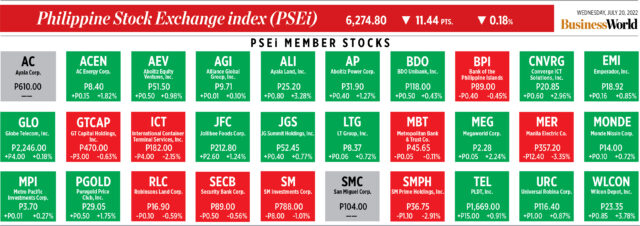
How PSEi member stocks performed — July 20, 2022

Here’s a quick glance at how PSEi stocks fared on Wednesday, July 20, 2022.


Peso weakens on latest balance of payments data

BW FILE PHOTO
THE PESO declined against the dollar on Wednesday as latest data showed the country posted another balance of payments deficit in June. — BW FILE PHOTO

THE PESO weakened against the dollar on Wednesday as the country’s balance of payments (BoP) position was at a deficit in June.

The local unit closed at P56.29 per dollar on Wednesday, losing 3.5 centavos from its P56.255 finish on Tuesday, based on Bankers Association of the Philippines data.

Year to date, it has weakened by 10.3% or by P5.29 from its close of P51 versus the dollar on Dec. 31, 2021.

The peso opened Wednesday’s session at P56.18 versus the dollar, which was also its intraday best. Its weakest showing was at P56.35 against the greenback.

Dollars exchanged rose to $710.05 million on Wednesday from $663.05 million on Tuesday.

Rizal Commercial Banking Corp. Chief Economist Michael L. Ricafort said the peso weakened versus the dollar as latest BoP data released by the Bangko Sentral ng Pilipinas (BSP) on Tuesday showed the country’s external position was at a deficit last month.

The country’s BoP position stood at a $1.57-billion deficit, wider than the $312-million gap booked a year ago. Still, this was lower than the $1.61-billion deficit recorded in May, which was the widest gap since $2.019 billion seen in February 2021.

In the first half of the year, the country’s BoP deficit widened to $3.1 billion from the $1.9 billion recorded in the same period in 2021. 

The BSP expects the country’s BoP to yield a deficit of $6.3 billion this year or equivalent to -1.5% of gross domestic product.

The peso also weakened due to concerns over rising coronavirus disease 2019 (COVID-19) cases in the country, Mr. Ricafort said.

“The peso weakened due to some caution ahead of the US existing home sales report,” a trader said in an e-mail.

“The local currency might appreciate [on Thursday] as expectations of an ECB (European Central Bank) rate hike could taper some of the greenback’s strength,” the trader added.

ECB policy makers are considering raising interest rates by a bigger-than-expected 50 basis points at their meeting on Thursday to tame record-high inflation, two sources with direct knowledge of the discussion told Reuters.

To cushion the impact of the higher borrowing costs, policy makers are also expected to announce a deal to help indebted countries like Italy on the bond market. The deal will require they stick to European Commission rules on reforms and budget discipline, the sources said.

The ECB is set to deliver its first rate hike in more than a decade on Thursday against a difficult economic backdrop exacerbated by the war in Ukraine. Inflation is high and rising while economic growth has slowed and a political crisis in Italy is keeping investors on edge.

That dynamic creates a balancing act for the ECB, between raising rates to curb price growth and ensuring that the most indebted of the euro zone’s 19 member countries don’t run into financial trouble as a result.

The trader expects the local unit to move within P56.20 to P56.40 per dollar on Thursday, while Mr. Ricafort gave a forecast range of P56.15 to P56.35. — K.B. Ta-asan with Reuters

Main index slips as focus shifts to US reports

REUTERS

THE main index  inched lower on Wednesday ahead of the release of corporate earnings reports of companies here and abroad due to profit taking amid a less positive outlook for the country.

The benchmark Philippine Stock Exchange index (PSEi) went down by 11.44 points or 0.18% to close at 6,274.80 on Wednesday, while the broader all shares index increased by 0.17 point to 3,381.53.

“Philippine shares were flat as fund managers’ attention was diverted to the US, with traders betting on robust corporate earnings reports and wagered that markets had found a bottom,” Regina Capital Development Corp. Head of Sales Luis A. Limlingan said in a Viber message.

“Oil prices rose as traders worried about tight supplies and a weaker dollar,” Mr. Limlingan added.

“The market opened in the positive territory due to the positive spillover effects in the US market driven by strong US corporate earnings. However, the PSEi ended the day eking out today’s gains as profit taking pressures dominated the afternoon, snapping its two-day rally,” Unicapital Securities, Inc. Equity Research Analyst Ralph Jonathan B. Fausto said in a Viber message on Wednesday.

“We can attribute the profit-taking done by investors today from the downward 2022 GDP (gross domestic product) growth forecast revision by Fitch, which cited inflationary pressures to impede the economic growth,” Mr. Fausto added.

Fitch Ratings cut its GDP growth forecast for the Philippines to 6.5% this year, from 6.9% previously, citing continued inflationary pressures due to high prices of food and other commodities.

The revised forecast is within the Philippine government’s target of 6.5-7.5% this year.

The majority of sectoral indices ended in the green on Wednesday except for property, which went down by 17.91 points or 0.62% to 2,841.91, and holding firms, which decreased by 4.61 points or 0.07% to 5,888.41.

Meanwhile, mining and oil went up by 268.70 points or 2.45% to 11,201.53; services climbed by 3.43 points or 0.20% to 1,643.47; industrials increased by 17.56 points or 0.18% to 9,428.83; and financials inched up by 0.18 point or 0.01% to end Wednesday’s session at 1,481.07.

Advancers outnumbered decliners, 103 versus 81, while 40 names closed unchanged.

Value turnover climbed to P5.03 billion on Wednesday with 733.64 million shares changing hands from the P3.793 billion with 1.07 billion issues seen the previous trading day.

Foreign sellers turned buyers anew to P22.65 million on Wednesday from the P227.51 million in net selling seen the previous trading day.

“We expect the market to continue to trade sideways [on Thursday] as investors wait on the sidelines ahead of the US interest rate decision in its FOMC (Federal Open Market Committee) meeting on July 26-27,” Unicapital Securities’ Mr. Fausto added.

Mr. Fausto placed the PSEi’s support at 6,100 and resistance at 6,400, while Regina Capital’s Mr. Limlingan put support at 6,160 and resistance at 6,400. — J.I.D. Tabile

Debt service bill seen rising when PHL refinances short-term loans

REUTERS

THE Philippines and India are “most at risk” of having to refinance debt in an environment of rising interest rates because of the short-term debt they are carrying in their financing mix, ANZ Research said in a report on Wednesday.

“The maturity profile of government debt is an important consideration. The greater the proportion of short-dated debt, the faster it takes for the budget squeeze to materialize. In this context, India and the Philippines appear to be most at risk of a quicker jump in debt servicing costs,” it said.

The Philippines and India had “the highest share of debt maturing in the next one to three years that may need to be refinanced at higher rates.”

The Philippines’ debt maturity profile indicates that largest slice of its debt is due to mature in three to five years. The next-largest component is debt maturing in one to three years.

The report came to this conclusion after analyzing India, Indonesia, Malaysia, Thailand, and the Philippines.

Relative to pre-pandemic levels, end-2021 public debt was higher by an average of 14.6% of gross domestic product (GDP) in the countries studied.

“The largest increase amounted to nearly 20% of GDP in the Philippines, with that in India and Thailand only marginally lower,” the report said.

“Consequent to the adoption of these aggressive fiscal policies, mandated public debt ceilings were relaxed in India, Indonesia, Malaysia and Thailand. The Philippines does not have a mandated ceiling but nonetheless, debt has exceeded 60% of GDP, the threshold regarded by policymakers as prudent,” it added.

The National Government’s (NG) outstanding debt was down 2.1% at P12.5 trillion at the end of May.

At the end of the first quarter, the Philippines’ debt-to-GDP ratio was 63.5%, against 60.5% at the end of 2021 and 39.6% at the end of 2019.

The highest debt-to-GDP on record was 65.7% in 2005.

“In our view, the National Government debt has already peaked… Although fiscal policy is becoming more conservative, bringing debt back to the pre-pandemic level of around 40% will be challenging. The government is also looking at a gradual reduction of the pandemic-related debt of around P3.2 billion (about 14.8% of GDP),” ANZ Research said in a separate report.

The interest payments to revenue ratio could also further rise “considering the steady increase in interest rates.”

“Official estimates suggest that for a 1% increase in the interest rate, debt-servicing costs rise by around 0.5 percentage point. Meanwhile, the growth to interest rate differential, an important determiner of debt sustainability, is also likely to narrow as economic growth stabilizes amidst rising borrowing costs,” it said.

However, it is also possible that “a structural rise in public indebtedness will decrease policy space to cope with unforeseen shocks, particularly against the backdrop of rising interest rates and slower global growth,” ANZ Research said.

On the fiscal side, the NG is targeting to reduce the budget deficit from 7.6% to just 3% by 2028.

ANZ Research gave its own estimate at 7.7%, accounting for a possible incremental rise in revenue that does not offset the supplementary spending requirements.

“The pre-pandemic medium-term objective was to stabilize the budget deficit at this level. Underlying this reduction is a combination of expenditure reduction and revenue enhancement, the latter recovering to its 2019 pre-pandemic level of 16.1% of GDP,” ANZ Research said.

The NG projects to hit the 16% mark by 2025.

“While this is not a tall order, the underlying assumptions of annual real GDP growth being sustained at 6-7% will be challenging,” it added.

Economic managers recently revised their growth projections, targeting 2022 growth of 6.5-7.5%.

For 2023 to 2028, the growth target was 6.5-8%. — Diego Gabriel C. Robles

Marcos urged to support agri, manufacturing without relying on FDI

PHILIPPINE STAR/KRIZ JOHN ROSALES

THE GOVERNMENT should seek to grow the economy to ease its debt burden by offering incentives for agricultural and manufacturing projects, following the failure of its efforts to attract foreign direct investment (FDI), the Freedom from Debt Coalition said on Wednesday.

“Rather than relying on FDI inflows, which have not materialized despite the passage of investor-friendly legislation such as CREATE (the Corporate Recovery and Tax Incentives for Enterprises), government should focus on reviving and strengthening the domestic economy by providing support and incentives to key sectors such as agriculture and manufacturing,” the coalition said in a statement.

These industries, it added, have been neglected for decades due to “ill-advised policies such as the infamous Rice Tariffication Law which failed to deliver its promise of cheaper rice even as it resulted in bankruptcy of millions of farmers.”

The coalition also called for significant investment in human capital by ramping up spending on education, healthcare, housing, and nutrition.

“The current obsession with chasing after investors at the expense of people’s needs could backfire if we end up with lower human capital stock than before the pandemic, jeopardizing our long-term development prospects,” it said.

The national debt was P12.5 trillion at the end of May, putting the government under pressure to curtail spending, particularly on social services, and impose additional taxes, the coalition said. “Both moves risk further widening the inequality that was only exacerbated by the pandemic.”

Other issues that need to be addressed include inflation and the expansion of the current account deficit, it added. — Alyssa Nicole O. Tan

Support for growers of feed corn seen having follow-on benefits for livestock

REUTERS

SUPPORT for growers of yellow corn, the variety used in animal feed, will be beneficial to downstream users of the grain like the livestock and poultry industries, industry officials said.

“The first thing that needs to be done is to help yellow corn farmers… When you support yellow corn farmers, you support the entire industry, from poultry farmers, livestock farmers — you help everyone, even fishermen and those in aquaculture,” United Broiler Raisers Association President Elias Jose M. Inciong said in an interview on One News.

“We need to help our farmers… President Ferdinand R. Marcos, Jr. must… bring back the confidence of our farmers. If our farmers have confidence, then we have the chance to win. These past years, our farmers have not had the chance to win. That is the sad reality of our situation,” he added.

Federation of Free Farmers Chairman Leonardo Q. Montemayor said economic managers should immerse themselves in agriculture to gain a grasp of the situation, which will guide policymaking.

“The problem is the mindset of some key economic managers and economists. They are too far away in the city. They are far away from the reality of what our everyday Filipinos go through, especially in rural areas. They do not feel the problems of the agriculture sector,” he said.

“This is why they are unable to give the proper attention to the sector. We lack the right policies and budgetary support. When they say that agriculture is useless, this is a result of wrong policymaking,” he added.

The administration should also focus on ramping up production through fertilizer subsidies, according to Mr. Montemayor.

“The priority now is production. For example, providing more fertilizer subsidies because many if not most farmers have really cut down on their fertilizer usage,” he said.

“It’s possible, for example, in the coming harvest period around October or November, (that) the harvest could drop by anywhere from 10% to 15%. That is a big drop. To arrest or minimize that, we need to ramp up the distribution of more subsidies,” he added.

Mr. Marcos has announced that he is considering government-to-government deals with Russia and China to ensure favorable fertilizer pricing.

“It will take a little time for negotiations to (conclude) and for the fertilizer to actually arrive and be available to farmers,” Mr. Montemayor said.

“In fact, we (must first) address the issue of the price of palay (unmilled rice). To me, that’s the most critical. The price and the market for palay should be attractive enough to cover the basic costs of farmers. Otherwise, they are just producing to make themselves lose money,” he added.

Samahang Industriya ng Agrikultura President Rosendo O. So said separately that the price of fertilizer was rising even before the Russia-Ukraine conflict.

“Before the war between Russia and Ukraine, the price of fertilizer (rose) because of demand from other countries. Since urea comes from the countries that produce oil, this is (effectively) a byproduct of oil,” he said on BusinessWorld Live.

“What we need now, immediately, is the fertilizer subsidy for the farmers. If we will not give subsidies, we will have high prices of palay… and the price of our rice will not go down,” he added. — Luisa Maria Jacinta C. Jocson

RCEF aid called inaccessible as bid to repeal rice law intensifies

PHILSTAR FILE PHOTO

THE industry modernization component of the Rice Tariffication Law, which is funded by tariffs on rice imports, has been inefficiently handled, with rice farmers unable to tap the program’s benefits, resulting in rice production remaining stagnant, a peasant organization said.

“The P10 billion (in annual funding) could not compensate for the losses of the rice industry. Not all rice farmers can access the (Rice Competitiveness Enhancement Fund). We have received complaints from farmers that they have not received or accessed RCEF, even though they are registered. In some areas, seed distribution is delayed,” Amihan National Federation of Peasant Women Secretary-General Cathy Estavillo said in an e-mail.

RCEF receives P10 billion from rice import tariffs a year for six years to drive farm mechanization, seed development, propagation and promotion, credit assistance, and extension services.

Ms. Estavillo called for the repeal of the Rice Tariffication Law because the liberalization of rice imports did not lower prices after the National Food Authority (NFA) was stripped of its function as the primary importer of the grain.

“The flood of rice imports as a result of the liberal import (policy) resulted in the drop in the farmgate prices of palay and losses in the first two years of its implementation…rice farmers were pushed deeper into poverty and bankruptcy due to the low prices of palay,” she said.

“It also limited the (ability) of the NFA to (put together a buffer stock); thus, it can no longer regulate the market price through subsidized (rice), which is no longer available in markets. The proponents of the law promised that retail prices of rice would fall to P25 per kilo, but our experience for the first three years of implementation proved otherwise,” she added.

Magsasaka at Siyentipiko para sa Pag-unlad ng Agrikultura Regional Coordinator Rowena A. Buena said that the law “virtually obliterated the rice market and buried rice farmers neck-deep in debt.”

“It basically intensified the food security problem both in the peasant and consumer sector… food security (has) always been problematic in the Philippines. On the production level, with chemical-based agriculture as the dominant production system, farmers are trapped in a cycle of expensive production costs and unpredictable yields,” she said in an e-mail.

“Paired with neoliberal policies such as the (Rice Tariffication Law) that allows the unregulated entry of foreign rice… farmers are once again burdened (by) unfair market prices. If not, farmers are totally removed from the market (losing the) chance to sell their milled rice at a price that would sustain them,” she added.

Ms. Buena said that conventional farmers and agricultural workers were also falling ill due to the continuous usage of glyphosate, a herbicide.

“It tells us that both the current agricultural production system and the neoliberal policies that govern it are not actually built to achieve food security. Ironically, it… serves only the profits of agri-transnational corporations (which) is the very reason we have food insecurity in the first place,” she said.

“Addressing food insecurity and malnutrition will start with shifting from chemical-based agriculture to sustainable organic agriculture that puts emphasis on a diversified and integrated farming system ultimately championing a diversified, accessible, and nutritious diet for the masses,” she added.

“The seeds distributed under RCEF are dependent on massive use of chemical farm inputs which [also] increases the cost of production, instead of promoting local and traditional varieties,” Ms. Estavillo added.

Ms. Estavillo recommended that the government provide a P15,000 production subsidy, build accessible post-harvest facilities, and improve irrigation services. — Luisa Maria Jacinta C. Jocson

Marcos needs to focus on job-generating production industries, think tank says

REUTERS

THE weak job market and the declining quality of jobs are the result of the government’s failure to develop industries involved in production, which President Ferdinand R. Marcos, Jr., should prioritize during his term, according to a think tank.

“The jobs crisis and inflation have worsened due to the lack of production sectors that can provide steady employment and incomes and deliver the requirements for national development,” Ibon Foundation said in a statement.

The agriculture and manufacturing industries have been stunted due to decisions taken to open up the economy to foreign investment and products, Ibon Executive Director Sonny Africa said.

He noted that the respective shares of agriculture and manufacturing in the 2021 economy of 9.6% and 19.2% are at multi-year lows — “in the case of manufacturing, in 70 years.”

Unemployment hit a three-month high in May, while job quality deteriorated despite increased economic activity, the Philippine Statistics Authority reported.

The 6% unemployment rate in May compares with the 5.7% posted in April. February saw the recent for the indicator at 6.4%.

Mr. Africa said the new government must address the country’s “weak” agriculture and “shallow” industry to make the Philippines resilient to economic shocks, including inflation.

Inflation has forced the government to temper its economic growth targets for this year. Economic managers are now aiming for gross domestic product growth of 6.5-7.5%, against the previous 7-8% target.

The “strategic measures” that Mr. Marcos should consider to develop agriculture and industry include the repeal of the Rice Tariffication Law, Mr. Africa said.

The President must also reconsider the push for expanded economic liberalization and trade deals that are not beneficial to the Philippines, he said.

Before the previous Senate adjourned, it failed to ratify the Regional Comprehensive Economic Partnership, a free trade agreement involving Australia, China, Japan, South Korea, New Zealand and ASEAN. Senators expressed concerns about lack of protections for agriculture and other industries.

Mr. Marcos, who heads the Agriculture department, will deliver his State of the Nation Address on July 25. Since his first day in office, the President has promised to boost domestic food production and limit imports where possible.

“The Philippines is the most food-insecure country in emerging Asia due to its reliance on imported food to feed its expanding population,” Trinh Nguyen, an economic research analyst, said in an article published by the Carnegie Endowment for International Peace.

The share of food bought by the Philippines from other countries stood at 13.18% in 2021, according to the World Bank. — Kyle Aristophere T. Atienza

PESO Act amendment seeks to add entrepreneurship assistance services

PHILSTAR

A SENATE BILL seeking to amend the PESO Act, which created a government office for job referrals, hopes to add facilitation services for aspiring entrepreneurs, with the creation of a cohort of self-employed workers intended to address high unemployment levels.

Senate Bill 7, refiled by Senator Lorna Regina B. Legarda, adds services for applicants seeking to start businesses. It proposes to amend Republic Act 8759 or the Public Employment Service Office (PESO) Act of 1999.

“Inarguably, entrepreneurs play a key role in creating job opportunities and consequently in stimulating the country’s economic growth,” she said in a statement on Wednesday.

The PESO Act created the Public Employment Service Office. If the amendment passes, this agency will be renamed the Public Employment and Entrepreneurship Service Office (PEESO), with Barangay Employment and Entrepreneurship Service Offices (BEESO) operating at the community level.

Unemployment hit a three-month high in May while job quality deteriorated despite increased economic activity, the Philippine Statistics Authority said.

Preliminary data from the statistics agency indicate that the jobless rate in May hit 6%, higher than the 5.7% posted in April but easing from the 7.7% rate in May last year.

Job quality deteriorated as the underemployment rate — the proportion of those already working but still looking for more work or longer working hours — rose to 14.5% in May from 14% in April. It was the highest underemployment rate since the 15.8% posted in March. — Alyssa Nicole O. Tan