Home Blog Page 5641

Palace denies Marcos signed sugar order
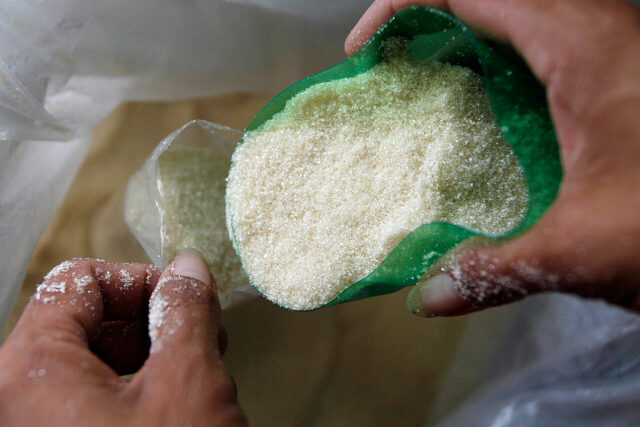
A MAN repacks sugar in packets at a public market in Taguig City, Aug. 27, 2008. — REUTERS/CHERYL RAVELO

MALACAÑANG late on Wednesday denied approving a sugar importation order that was uploaded on the regulator’s website, then taken down, saying that it was not signed by President Ferdinand R. Marcos, Jr.

Mr. Marcos, chairman of the Sugar Regulatory Administration (SRA) Board and Agriculture secretary, rejected the proposal to import 300,000 metric tons (mt) of sugar “in no uncertain terms,” Press Secretary Rose Beatrix L. Cruz-Angeles said in a statement. She did not elaborate.

A signed copy of Sugar Order (SO) No. 4 dated Aug. 9 was uploaded on the SRA website on Wednesday morning. The order, which showed it was received by the SRA Records Section and University of the Philippines Law Center Office of the National Registrar on Aug. 10, could not be found on the website by Wednesday afternoon.

The copy of the order showed a signature above Mr. Marcos’ name, as well as signatures by SRA Administrator Hermenegildo R. Serafica, board members Roland B. Beltran (miller’s representative) and Aurelio Gerardo J. Valderrama, Jr. (planters’ representative).

However, Ms. Cruz-Angeles said the President “did not sign that.”

Mr. Serafica, vice-chair of the SRA board, earlier on Wednesday said the sugar importation was approved by the board to “fill the gap in production.”

When asked about Malacañang’s statement, he declined to comment.

Sugar prices in the country have gone up due to tight supply.

According to SRA’s final estimate for crop year 2021-2022, raw sugar output would reach 1.8 million MT, a 16% drop from last season’s 2.14 million MT.

The SRA estimates that by end-August, sugar stocks will be in negative territory, with raw sugar balance at -35,231 MT and refined sugar balance at -20,748.65 MT.   

In early August, the average price of refined sugar in wet markets climbed to P95 per kilogram, or up 79.5% from P52.93 in the similar period a year ago. The average price of raw sugar in wet markets surged by 57.7% to P71.43 from P45.29 in 2021.

In February, the SRA issued SO No. 3, which authorized the importation of 200,000 MT of refined sugar.

“If you recall, after Typhoon Odette, the SRA already projected that we will be short in supply by August. Hence, the SRA issued SO No. 3. This volume was allocated exclusively for the industrial users at that time,” Mr. Serafica said on Wednesday morning. 

However, a court issued a temporary restraining order on the imports, after a case was filed by sugarcane planters led by the United Sugar Producers Federation.

“This caused the industrial users to scramble for sugar and buy whatever sugar they can to keep their factories running… this stalling of importation resulted in the tightness in supply such that even the sugar that was normally intended for the retail market was being used up by the industrials. Even the buffer stock was depleted,” Mr. Serafica said.

The SRA chief noted some mills began operations early to beef up sugar stocks.

“Mills normally start between September to December but this time some mills opted to start this August to help alleviate the supply situation,” he said.

‘A BREATHER’
Sought for comment, Philippine Chamber of Commerce and Industry (PCCI) President George T. Barcelon said sugar imports would provide a much-needed “breather” for food processing firms.

“The sugar shortage and high price issues are a recurring one over the years similar to rice,” Mr. Barcelon said in a Viber message.   

“The DA should institute a monitoring system to avoid inflationary impact. A system of balancing supply versus price so the local sugar farmers and mills would not be unduly impacted,” he added.

The PCCI, the Philippine Food Exporters, and Philippine Exporters Confederation urged the government to look into “the crippling supply of sugar that is expected to hurt both the local food processors and manufacturers and the consumers in general.” 

“While we recognize the need to protect our sugar producers and millers, we need to strike a balance and consider expanding our import requirement before the situation worsens, which could lead to higher inflation,” the groups said in a statement. 

Trade Undersecretary Ruth B. Castelo said in a Laging Handa briefing on Wednesday that the Department of Trade and Industry (DTI) is ready to help the DA in enforcing and monitoring the suggested retail price (SRP) for sugar, which has yet to be released.    

“Once the DA releases the SRP, the DTI can help in terms of monitoring since we are also checking in markets. We can include sugar,” Ms. Castelo said. — Kyle Aristophere T. Atienza, Luisa Maria C. Jocson and Revin Mikhael D. Ochave 

Philippine bookshops rush online as coronavirus pandemic boosts sales

BW FILE PHOTO

By Michelle Anne P. Soliman, Reporter

BEVERLY WICO SIY, 42, failed to publish a book on Filipino idioms in 2020 amid a coronavirus pandemic.

Like most sectors, the publishing industry had to adjust to countrywide lockdowns, forcing them to shift processes online.

“I also had Filipino poems that I wanted illustrated but that too didn’t happen,” Ms. Siy, who manages a publishing house, said via Zoom.

Canceled book fairs and industry events, nationwide lockdowns and global supply chain issues hit both the local and international publishing industry, forcing some of them to shift online.

Bookshops, publishers and printing presses were shuttered despite soaring book sales, while governments have largely neglected the publishing and creative sectors by failing to provide financial support, according to the International Publishers Association (IPA).

“While the long-term impacts of the pandemic are still unknowable, there is a real risk that many companies may not survive to see the consequences,” it said in a 2020 report. “Those that do will have to adapt to accelerating digitization trends that may outlive the pandemic and fundamentally transform our industry.”

In the Philippines, registered book sales jumped by 72% to P3.35 billion at the height of the coronavirus pandemic in 2020 from a year earlier, according to the National Book Development Board (NBDB). Sales further increased to 3.74 billion last year.

The Department of Education (DepEd) was the biggest institutional customer, having bought P1.86 billion worth of textbooks and instructional materials in 2020, it said in a report.

Registration automation and streamlining, online sales and digitalization, a more efficient distribution network, subsidies and grants also led to the revenue jump, NBDB Executive Director Charisse Aquino-Tugade said in an e-mail.

During the pandemic, the Educational Publishers Association partnered with the Book Development Association of the Philippines and online marketplaces Shopee and Lazada to host Aklatan, the biggest book fair in the country. Twenty-six participating publishers sold 28,000 books, generating $120,000 in revenue, the IPA said.

Ms. Tugade cited the wide gap between imported and exported books in the Philippines at 24:1 in favor of the former. “The pandemic has basically almost devastated the industry,” she separately said in a Zoom interview. “A lot of the procurement and institutional buying in the Philippines is through the DepEd.”

The book publishing industry contributed P4.74 billion to the Philippine economy in 2019, or less than 1% of economic output.

In 2020, the local publishing industry recorded 6,500 registrations for new book titles, compared with 6,666 in 2019 and 7,474 in 2018. Book registrations started increasing again last year to 9,497, Ms. Tugade said. During the pandemic, self-published authors also rose, she added.

ONLINE SHIFT
The pandemic has forced some publishers to embrace digitization, and it has paid off.

Local book publisher Bookshelf PH started operating in early 2020, just before most areas in the Philippines were locked down to contain the coronavirus.

“The pandemic and new normal shifted more of our processes online,” Monette Quiogue, head of operations at Bookshelf PH, said in an e-mail. “Instead of conducting face-to-face interviews with subjects and resource persons, we instead switched to remote interviewing. In addition to physical books, we also focused increasingly on distributing e-books and audiobooks.”

“Because we target a specific niche — Filipino nonfiction books telling very Filipino stories — we felt we were able to provide content that people were looking for,” she added.

The company has published books on the success stories of Filipinas, a history of blockchain in the Philippines and online business development. It has published more than 50 titles of physical books, e-books and audiobooks.

“We will continue to develop titles that feature the talent, knowledge and skills of Filipinos in various fields and show how they can educate and inspire readers,” Ms. Quiogue said. “That has been our objective from the start and we will continue to do so.”

Another publisher that managed to thrive online during the lockdown was comics publisher Komiket. Launched in 2015, it started as an affordable comics art market for first-time comics creators, artists and readers. A year later, it registered as a nonprofit group with the Securities and Exchange Commission.

In 2019, Komiket built its Secret HQ bookstore in Poblacion, Makati before  selling Filipino comics nationwide. During the pandemic, it continued to publish original comics and graphic novels in English. The company also started an international comics festival online.

“We saw that as an opportunity,” Komiket President and Co-Founder Paolo Alessandro Herras said in an interview. “As the community grew, we needed to increase our readership. We put up the Philippine International Comics Festival, and we became more active as a publisher.”

Komiket shortlists comic pitches annually to develop, publish and distribute these in its bookstore. “It gave us time to pause and focus on what we really wanted to do as an organization,” Mr. Herras said.

Komiket has published five titles including Tarantadong Kalbo Vol. 1 featuring comics by artist Kevin Eric Raymundo, which was released in 2020.

“If you look at their cultural behavior, Filipinos don’t want to pay for anything digital or online,” he said. “But that doesn’t mean that going online is useless. It has its use in terms of promotion and building your audience.”

“If the readers love the work, they will buy the book. That’s a path that works for some, but not for all. There are many ways to build your creators’ path,” he added.

As part of its pandemic recovery plan, the NBDB streamlined its registration by allowing applicants to submit documents online. There were 1,989 registrants — 359 companies and 1,630 people — last year, compared with 513 in 2020 and 690 in 2019. Registration allows the agency to track sales and the performance of publishers, authors and graphic designers, Ms. Tugade said.

The agency has a P100-million budget this year, which she said is not enough. “We need P400 million next year to help the industry survive.”

Aside from supporting the millions of authors, illustrators, printers, distributors and booksellers globally, publishing has also helped educate people, spread scientific research especially during the pandemic and open new worlds millions of people.

But the coronavirus has exposed vulnerabilities in the sector, the IPA said. “With disruptions at every link in the supply chain, fixed routes to market and sudden lockdowns have left countless books collecting dust in warehouses, bookshops and libraries.”

Some publishers failed to shift online, which left them sinking when the pandemic shut off all sales channels except e-commerce.

“For publishers of all sizes, this crisis has been a brusque wake-up call to the need to find new, innovative routes to market and adopt diversified, durable business models,” it said. “Now is the time to benefit from the cohesion built in adversity to craft a recovery strategy that enables the global publishing industry to rally stronger, more resilient and more adaptable.”

Ms. Siy, the author and publisher, finished an unplanned project online during the pandemic. In April 2020, she joined an online writing contest on Filipino flash fiction, where one of her 39 entries won.

Later that year, she added 11 Filipino flash fiction stories and tapped senior high school multimedia art students at iACADEMY for the illustrations. The book titled COVIDagli was published by Balangay Books last year.

“Some projects didn’t materialize, but there were also pleasant surprises,” she said.

PHL likely to hit growth goals — Moody’s Analytics

A JEEPNEY driver waits at a gasoline station in Pasay City. — PHILIPPINE STAR/KRIZ JOHN ROSALES

THE Philippine economy will likely achieve its full-year growth target of 6.5-7.5%, despite soaring inflation and a sluggish jobs market, Moody’s Analytics said.

“The Philippines will battle inflation pressures, slowing growth and a challenging labor market… Nonetheless, we expect the Philippine economy to still meet the official 2022 growth target of 6.5-7.5%,” it said in a note on Wednesday.

Gross domestic product (GDP) expanded by 7.4% in the second quarter, slower than 12.1% a year earlier and 8.2% in the first quarter, preliminary data from the Philippine Statistics Authority showed.

In the first half, GDP growth averaged 7.8%.

Socioeconomic Planning Secretary Arsenio M. Balisacan on Tuesday expressed confidence the full-year growth targets will be achieved.

He said the economy would need to grow by 5.3% in the second half to achieve the 6.5% target. To hit the 7.5% goal, he said GDP would have to expand by an average of 7.2% in the second semester.

Moody’s Analytics said policy rate hikes will also likely impact growth this year.

“The Bangko Sentral ng Pilipinas (BSP) is expected to put forward another rate hike in August, albeit a smaller one than July’s 75-basis point (bp) hike. The downside risk of higher interest rates is a squeeze on household spending, a key driver of GDP growth,” it said.

The Monetary Board will have its next policy review on Aug. 18. The BSP has raised rates by 125 bps so far since May.

Meanwhile, Moody’s Analytics said household spending may be vulnerable in the second half, as inflation continues to bite.

Second-quarter data showed household consumption expanded 8.6% year on year, but contracted 2.7% quarter on quarter, reflecting the impact of soaring inflation on domestic demand.

Inflation surged to a near four-year high of 6.1% in June, bringing average inflation to 5.5% for the second quarter.

“Election-related spending didn’t give growth much of a lift, and services surprised on the downside, contracting 0.4% quarter on quarter. The service sector employs the most people, so a contraction spells trouble for the labor market,” Moody’s Analytics said.

The services sector is the largest employer, accounting for 56.5% of jobs in June.

The unemployment rate stood at 6% in June, unchanged from May. However, the total number of unemployed Filipinos reached 2.990 million in June, 62,000 higher than the 2.927 million in May. — DGCR

Monde Nissin net income rises 8.7% as sales climb

MONDE NISSIN Corp. posted a P1.96-billion attributable net income in the second quarter, 8.7% higher than last year, after booking higher sales at a time when operational costs went up.

“We have sought to address global inflationary pressures by continuing to improve our efficiency and reduce our operational costs,” Monde Nissin Chief Executive Officer and Executive Vice-President Henry Soesanto said in a press release on Wednesday.

The company recorded P18.87 billion in net sales in the April-June period, higher by 13.1% than the previous year.

International revenues also grew, by 7.4% to P924 million during the quarter, which the company attributed to favorable foreign exchange rates.

For the first half, net income at ownership declined by 4.1% year on year to P4.08 billion, which the company attributed to slower growth in the first quarter.

“The growth is broad-based, all of our categories grew double digits in value terms,” Monde Nissin’s Chief Financial Officer Jesse C. Teo said during the company’s virtual media briefing on Wednesday.

Its first-half sales grew by 10.1% to P37.17 billion driven by volume increases in the Asia-Pacific branded food and beverage (APAC BFB) domestic business.

APAC BFB revenues grew by 18.1% year on year, driven by an 18.9% growth in the domestic business.

“Biscuits continues to recover with volume growth over pre-pandemic levels,” the company said.

However, Monde Nissin’s meat alternatives declined by 1.8% in the first half of the year.

For the second half, Mr. Teo expects a “dampening effect” after the company last month faced issues with its instant noodle products in the European Union (EU).

“Domestically, because of the noise that was caused by the incident, July had a soft month for instant noodles and it declined by 15% versus a year ago,” he said.

The company’s domestic noodle sales declined by 15% in July from the previous year, making overall domestic sales for the month flat.

Mr. Soesanto said: “While we had a disruption in July with EU ethylene oxide news, we will continue to work to recover the lost momentum.”

“Additionally, we are cautiously optimistic that the recent pullback in commodity prices will benefit our margin in the long term,” he added.

On Wednesday, shares of Monde Nissin inched up by 0.50% or P0.08 to P16.16 apiece. — Justine Irish D. Tabile

DITO denies forum shopping, cites violation of laws

DITO Telecommunity Corp. has denied Smart Communications, Inc.’s accusation of “forum shopping” in its bid to increase interconnection capacity to allow phone calls from the customers of the third telco player.

“There is no forum shopping in this case as the petitions with the NTC (National Telecommunications Commission) are for violations of the Telecom Policy Act and the corresponding NTC Memorandum Circulars,” DITO Chief Administrative Officer Adel A. Tamano said in a statement released on Tuesday night.

Meanwhile, the complaints versus Smart and Globe Telecom, Inc. — filed with the Philippine Competition Commission (PCC) — “are anchored on violations of the Philippine Competition Act for abuse of dominant position,” he also said.

“Two very different causes of action, with different tribunals, which have distinct jurisdictions.”

According to Smart, DITO has requested “additional” interconnection capacity and has taken the matter — through a petition — to the NTC, “where it is pending.”

“DITO’s filing of the PCC complaint on the same subject-matter is blatant forum shopping,” Roy Cecil D. Ibay, Smart Communications vice-president for regulatory affairs, said in an e-mailed statement.

“In the NTC petition, DITO asked for extra capacity for interconnection, citing congestion and overutilization of trunks,” he said.

Smart said, “Before asking for extra capacity, DITO should first clamp down on its subscribers who have abused the interconnection framework to make fraudulent international calls to Smart subscribers under local rates.”

Mr. Tamano said that such “calls are not made by DITO.”

“Rather, these are fraudulent calls made by third parties — and DITO is equally a victim of such calls,” he noted.

“We have the data and the facts to show the steps undertaken by DITO to minimize these… calls.”

Mr. Ibay pointed out that DITO “should have instead acknowledged that PLDT, Smart’s parent company, was instrumental in helping DITO fulfill its commitments to the NTC and Congress as a third telco, considering that PLDT built for DITO a big portion of its telco infrastructure.”

“This was paid for by DITO; it was not done gratis et amore,” Mr. Tamano said, responding to Mr. Ibay.

“The building of that infrastructure was done in compliance with the legal mandate for interconnection and not to help DITO fulfill its commitments to the NTC and Congress,” he added.

‘RIGHT TO REFUSE’
In an e-mailed statement on Wednesday, Terry L. Ridon, a public investment analyst and convenor of think tank InfraWatch PH, said that the “failure of any telco to stop or limit ISR (international simple resale) gives other parties the right to refuse to deal with noncompliant contractual partners, as it compromises network security and integrity.”

“Interconnection, ISR, (and) network security are interrelated concerns, obligations and transactions of telecommunications companies,” he noted.

To show an abuse of dominant position, there needs to be a showing that “transactions are subject to other obligations that have no connection with specific transactions,” he also pointed out.

“In the case of interconnection and ISR, telcos should not be made to expand interconnection agreements with competitors who fail to stop or limit fraudulent calls to other networks, as expanding interconnection without curbing fraud will only increase the likelihood of more fraudulent calls at scale.”

He added that all telcos should instead focus on providing faster and reliable mobile internet.

“Government regulators should see through this litigation as serving very narrow commercial interests and not the public interest.”

According to DITO’s Mr. Tamano, the complaint filed with the PCC is part of its goal “to fulfill our mandate to provide true competition in the telecom industry and to ensure that the Filipino people are given world-class telco services that they rightfully deserve.”

Hastings Holdings, Inc., a unit of PLDT Beneficial Trust Fund subsidiary MediaQuest Holdings, Inc., has a stake in BusinessWorld through the Philippine Star Group, which it controls. — Arjay L. Balinbin

PCC says telco competition probe won’t go past two years

THE competition complaints filed by DITO Telecommunity Corp. against Smart Communications, Inc. and Globe Telecom, Inc. is not expected to go over a two-year investigation period, an official of the Philippine Competition Commission (PCC) said on Wednesday.

“I don’t think we will exhaust a two-year investigation period because unlike other verified complaints that we receive from smaller businesses or even individuals, this is a fairly complete complaint that was filed by DITO,” said Johannes R. Bernabe, PCC officer-in-charge chairperson, in Agenda program on One News Channel that the complaints filed by DITO.

He said under the law, the preliminary inquiry will take 90 days. He was referring to Republic Act No. 10667 or the Philippine Competition Act.

“After that, we will have an opportunity if under that preliminary inquiry process, our enforcement office has not yet completed its investigation on whether or not there is anti-competitive behavior happening, they can proceed to a full administrative investigation that normally is conducted in a two-year period,” he added.

If proven that the two companies have violated the law, Mr. Bernabe said the PCC would ask them to fix any anti-competitive behavior and ask for interconnection.

He added that an administrative fine of up to P100 million can be imposed under RA 10667.

“This is a first offense so that is going to be P100 million each because there are two separate complaints filed in the commission against Smart and Globe,” Mr. Bernabe said.

On Aug. 8, DITO announced that the company had filed complaints against Smart and Globe after allegedly failing to provide sufficient interconnection capacity to allow phone calls from the new telco’s subscribers, claiming that the two firms are doing “an abuse of their dominant position.”

DITO Chief Administrative Officer Adel A. Tamano said that the company had been attempting to fix the issue with Globe and Smart for almost a year, adding that the interconnection issue had affected the company’s growth.

In a previous statement, the PCC defined interconnection as an “essential component of the telecommunications industry as it allows interoperability and exchange of calls, SMS (short message service), and other information from one network to another.”

The commission added that its competition enforcement office is currently evaluating the merits of DITO’s complaints.

Meanwhile, the PCC is looking to start the investigation on DITO’s complaints starting next week, adding that the commission has yet to be in touch with Globe and Smart on the matter.

“Under our process, we have to go through that in-take procedure where we have 10 days to determine whether we give due course to the complaint… There are other factors that we have to take into account in deciding whether to give due course and I think we shall do that by next week at the latest,” Mr. Bernabe said.

“Many of the elements that we are looking for are already there (DITO’s complaints). And therefore, it is a matter of confirming it and trying to understand whether or not there is indeed an unconditional requirement for interconnection and whether the arguments provided by Smart and Globe merit a conditioned response in terms of the interconnection request of DITO,” he added. — Revin Mikhael D. Ochave

Pilipinas Shell posts P7.8-B income

PILIPINAS Shell Petroleum Corp. posted a net income of P7.8 billion in the first semester, the oil firm disclosed on Wednesday, without giving a comparative figure for the previous year.

“Through the disciplined and resilient implementation of our strategy, we have recovered from the deficit in retained earnings in the past two years and are now able to deliver dividends to our shareholders,” Lorelie Q. Osial, its president and chief executive officer, said in a statement on Wednesday.

The company said its profit for the period would enable it to declare a dividend of P1 per share payable this September, or what it calls an “industry-leading” 5.6% dividend yield.

“This reflects our strong culture of sustained performance even in the midst of a prolonged volatile business environment,” Ms. Osial said.

Pilipinas Shell previously reported a net income of P2.2 billion in the first half of 2021. It has yet to disclose quarterly financial figures.

In the first half of the year, the company said that excluding movement in working capital, the company ended with a cash flow from operations of P13.7 billion compared with P7.6 billion in the same period last year.

It said that business-to-business (B2B) volume increased across all sectors in the first semester.

Aviation fuel sales improved with a 49% increase due to the continued increase in travel and the opening of international and domestic borders.

Commercial fuels increased volume sales by 5% due to a reliable supply of fuels, as well as spot sales in power, and other fuel oil customers.

Lubricants also saw a 5% volume increase while increasing premium sales volume two-fold across product categories.

The company’s offerings for the construction and road segment grew by 8% primarily through its premium products.

Meanwhile, Pilipinas Shell announced that its board of directors had approved an amendment to its articles of incorporation to include retail trade and to change its corporate name.

The company proposed to change its name from to Shell Pilipinas Corp.

It said the move introduces a “wider future-forward approach” towards energy transition that will reposition the company “beyond petroleum, shifting towards sustainable and cleaner energy solutions for the company, people, community and environment.”

The proposed amendment to its secondary purposes to include retail trade comes as the company targets to grow its non-fuel retail segment.

On Wednesday, shares in the company surged 6.44% or P1.14 to finish at P18.84 apiece. — Ashley Erika O. Jose

Megawide, real estate company PH1 tie up for Taytay, Rizal project

MEGAWIDE Construction Corp. and its sister company PH1 World Developers are working on the development of mid-rise condo buildings in Taytay, Rizal.

“The Ortigas Hills Project will consist of three mid-rise condominium buildings in a 16,470 sq m. property in Ortigas Extension, Brgy. San Isidro, Taytay, Rizal,” PH1, a real estate company and formerly MySpace Properties, Inc., said in an e-mailed statement.

“This is the company’s third offering following its flagship project, The Hive Residences, also located in Taytay, Rizal; and its first high-rise development, MyEnso Lofts, located in Timog Avenue, Quezon City,” it added.

Megawide Chairman and Chief Executive Edgar B. Saavedra said the listed construction company recognizes the location’s potential.

“This is where our own precast facility is located; and since 2012, we have been able to generate additional jobs for residents in support of construction projects,” he noted.

Megawide will utilize its precast technology for the project.

PH1 considers Taytay as an ideal residential location because of its access to the Ortigas business district and proximity to other areas in Rizal.

“We believe in Taytay’s potential as a residential location and with Ortigas Hills, we can guarantee another extraordinary project people can truly enjoy,” PH1 President Gigi Alcantara said.

The project promises “extra space at no extra cost” through its exclusive AddLoft Technology.

“The AddLoft Technology creates a dedicated space in the units which they can use for their lifestyle needs — at no extra cost,” Ms. Alcantara said.

“Whether for home schooling, home office, personal passions or even storage, our AddLoft Technology brings added value to every unit,” she added.

PH1 and Megawide broke ground for the project on Tuesday. — Arjay L. Balinbin

Emperador reports nearly 5% profit growth

EMPERADOR, Inc. posted a 4.7% increase in attributable net income to P3.14 billion in the second quarter from P3 billion a year earlier after booking higher brandy sales while whisky drove its international business.

“Our international business continued to perform well led by the single malt whisky portfolio, which continues to be amongst the fastest growing single malts in the world,” Emperador President and Chief Executive Officer Winston S. Co said in a press release on Wednesday.

The company’s topline in the second quarter rose to P15.72 billion, higher by 18.6% than the previous year’s P13.25 billion.

In the first half, Emperador reported a 3.03% increase in net income to P5.3 billion versus P5.08 billion last year.

Consolidated revenues during the semester reached P28 billion, up by 11% from last year, as the company booked a 9.5% growth in its brandy sales.

Likewise, Emperador’s international sales increased in the first half, recording a 13% growth year on year.

Growth continued to be strong in Asia, Europe, and North America, Mr. Co said, adding that overall, the company is looking forward to a “stronger” second-half performance.

Emperador is said to be exploring a joint venture in China to further strengthen its international business.

“Our focus on China is part of our internationalization strategy,” Mr. Co said.

Emperador owns Fundador Spanish Brandy de Jerez and Whyte and Mackay, among others. Its brandy and whisky products are available in more than 100 countries. It is a publicly listed company on both the Philippine Stock Exchange and the Singapore Exchange.

On Wednesday, shares in Emperador climbed by 0.42% or P0.08 to P19.06 apiece. — Justine Irish D. Tabile

SEC flags partnership for illegal investment scheme

THE Securities and Exchange Commission (SEC) announced that it revoked the registration of Katuwang Poultry Chicken Egg Producing Co. as a partnership due to its illegal investment scheme.

The SEC said in an advisory posted on Wednesday that Katuwang Poultry had been publicly offering securities to the public through Facebook without license or permission from the commission.

The partnership’s activities constituted serious misrepresentation as to what it can do, to the great prejudice of or damage to the general public, a ground for the revocation of its certificate of registration, according to the order.

In September last year, the commission warned the public against investing in Katuwang Poultry.

“Katuwang Poultry has been offering investment packages worth at least P50,000, with promised returns of supposedly 48% to 120% within six months, depending on the amount invested,” the regulator said.

“For instance, investors with P50,000 to P99,000 in capital can receive monthly dividends worth 8%, while those who invested more than P500,000 can earn monthly dividends of 20% over the course of six months. Investors can also earn referral commissions worth 10% for every new member they invite into the system,” it added.

Katuwang Poultry’s scheme involves securities, particularly an investment contract, whereby a person invests his money in a common enterprise and is led to expect profits primarily from the efforts of others, according to the SEC.

“As a form of security, investment contracts must be registered with the SEC before they can be sold or offered within the Philippines,” it added.

The commission said that Katuwang Poultry is a registered partnership, but it has never secured a secondary license to operate as a broker or dealer of securities, nor is it a registered issuer of any securities.

“Based on the evidence gathered, Katuwang Poultry is engaged in the offering, solicitation and sale of securities to the public without the required registration statement duly filed and approved by the SEC,” the advisory read.

“The investment scheme of Katuwang Poultry also operates to defraud investors as it deceives the investing public by making it appear that it has the authority to deal in securities,” it added.

The SEC also noted that the group was using the certificate of registration issued by the commission to “disguise itself as a legitimate investment.”

“This amounts to serious misrepresentation as to what it can do or is doing to the damage and prejudice of the investing public,” it added. — Luisa Maria Jacinta C. Jocson

Exploring the food scene in Singapore

Maxwell Hawker Centre

By Brontë H. Lacsamana, Multimedia Reporter

AS a tourist, it’s easy to get all shopped out and tired from strolling in the malls or exploring the wide range of cultural sights that Singapore has to offer, so the best thing to do in such instances is seek refuge in a cozy place and fill yourself with good food.

Homegrown cafés and restaurants keep Singapore’s food scene as vibrant as ever, featuring flavors from the country’s many influences, whether it’s Chinese, Malay, Indian, or even Western.

Though the pandemic did put up challenges for such places all over the world, many withstood the circumstances to continue showcasing the colorful cuisine of Singapore.

BREAKFAST & COFFEE
Kaya toast with eggs and coffee is popular breakfast fare in the straits, available in many of its oldest cafés. On Joo Chiat Road, Chin Mee Chin Confectionery (the pale blue shophouse on the far right) is an institution that has served this classic since 1925.

How to eat it? You can dip the buttered and kaya-filled toast in a plate of beaten eggs and/or in your coffee. You can even opt to eat it as is and drink the coffee separately. What is fun is that it’s all up to you.

HAWKER FOOD STALLS
If you haven’t eaten at a hawker center before, do yourself a favor and go for the char kway teow (stir-fried flat noodles), char siew (barbecued pork), chicken rice, fried oyster, or anything else that strikes your fancy. Find comfort in the many choices you have.

Even if you order a lot, you won’t have to spend more than $5 for a single meal. And go early because stalls cater to the breakfast and lunch crowd, which means ingredients can run out quickly.

Try these: Maxwell Food Centre, Tiong Bahru Market, Old Airport Road Food Centre.

TRENDY BUT CLASSIC
Though not as inexpensive as hawker centers, trendy restaurants in Singapore are putting their own twist on classic dishes, making them popular among tourists.

In Kampong Glam, many stores offer authentic Malay, Indian, and Middle Eastern food. For a taste of the local, visit The Coconut Club found along Beach Road, so you can grab a bite of their delicious nasi lemak before continuing your stroll in the area.

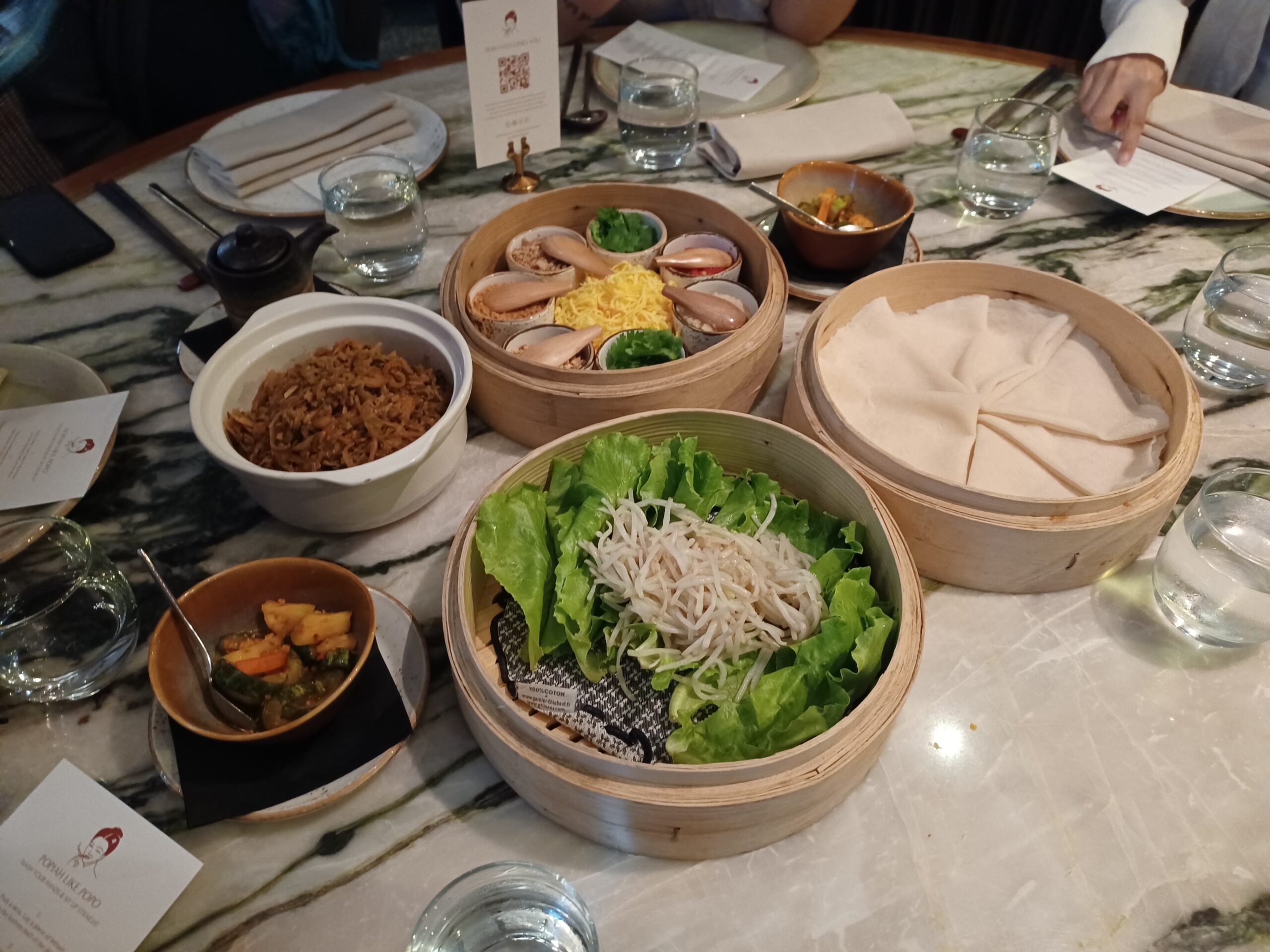
For popiah, or Singapore’s version of fresh spring rolls, go to the Po Restaurant inside The Warehouse Hotel on Havelock Road. After putting together your own popiah with fresh ingredients, its lowkey ambience is perfect for a leisurely cocktail at the bar.

Exploring the lush greens of Dempsey Hill in the middle of the city center can involve eating too — the Open Farm Community located in the area sources its ingredients from its own sustainable garden. Cauliflower wings are its bestselling vegan dish.

If you are a fan of chicken rice, visit Chatterbox, a longtime institution on Orchard Road. It’s been open since 1971 —  though it is now found in the Hilton Hotel — and is known for an elegantly prepared chicken rice set that ups the ante of the classic favorite.

PERANAKAN CUISINE
Originating from Chinese diaspora and incorporating Malay and Western elements, Peranakan culture can be credited for giving flavor and color to Singapore’s cuisine.

The neighborhood of Katong & Joo Chiat is your best bet at trying some traditional Peranakan food. Start in Chilli Padi Nonya, a humble local restaurant that opened in 1997 and was recently featured in the 2022 Singapore Michelin Guide.

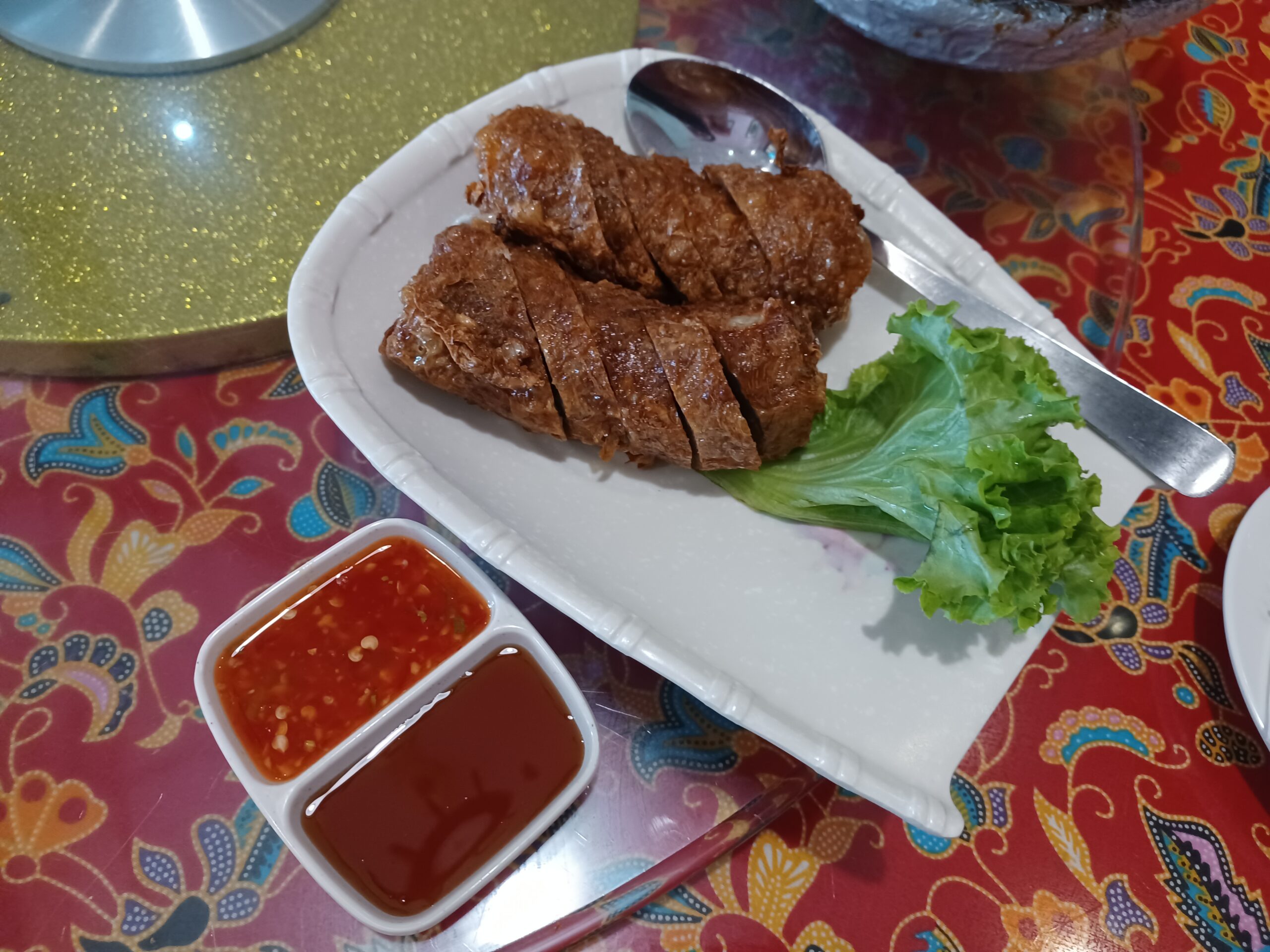
Must-try items on the menu include kueh pai ti (a crispy pastry tart shell filled with a sweet and spicy mix of shredded Chinese turnips, thinly sliced vegetables, and prawns) and ngoh hiang (fried pork rolls wrapped in beancurd skin — like the Philippines’ kikiam).

For those who like their food hot, there are also much spicier dishes like rendang.

Afterwards, as you stroll in Katong & Joo Chiat, keep an eye out for the go-to store for immersing yourself in the local culture: Rumah Kim Choo. Aside from Peranakan clothes, shoes, and souvenirs, its boutique center offers traditional sweets.

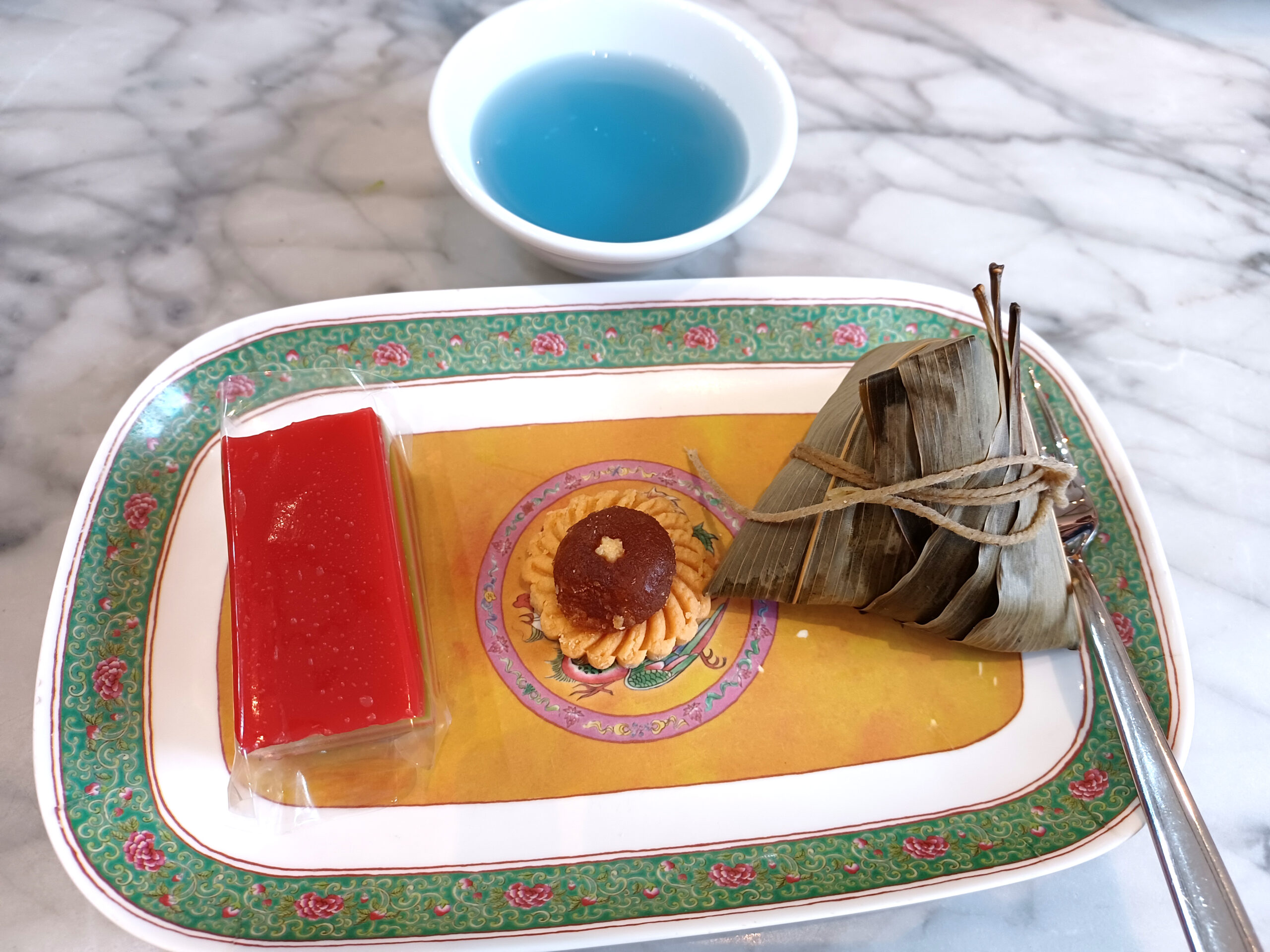
If you join a tour, you’ll have snacks, which includes kueh lapis (a rice treat like Filipino sapin-sapin but with multicolored layers eaten one by one), pineapple tart, and nyonya rice dumpling (a rice cake with sweet and savory meat, wrapped in pandan leaves).

To help gulp down this mini feast is butterfly pea flower tea with pandan and lemongrass in it, its blue color a satisfying balance to the eye-catching food on your plate.

THE NIGHTLIFE
As a booming financial center, Singapore is home to a slew of expats from all over the world, further livening up its multicultural image. These days, the hip nightlife scene caters to foreigners and tourists hoping to let loose in the Lion City.

In Chinatown, there are many relatively new places where everyone goes to socialize, one of which is Potato Head. Open since 2014, it takes up four floors of a shophouse on Keong Saik Road.

The lower floors have sit-down dining for those who want to try the burgers and fries or enjoy the occasional music gig. The rooftop bar is where it’s at, though — take pictures with your friends holding tiki-themed cocktails as the sun sets on the Singapore skyline.

Another hotspot in Chinatown is Native Bar, this time located in Telok Ayer Street. It’s known for its multi-awarded cocktail menu of regional flavors.

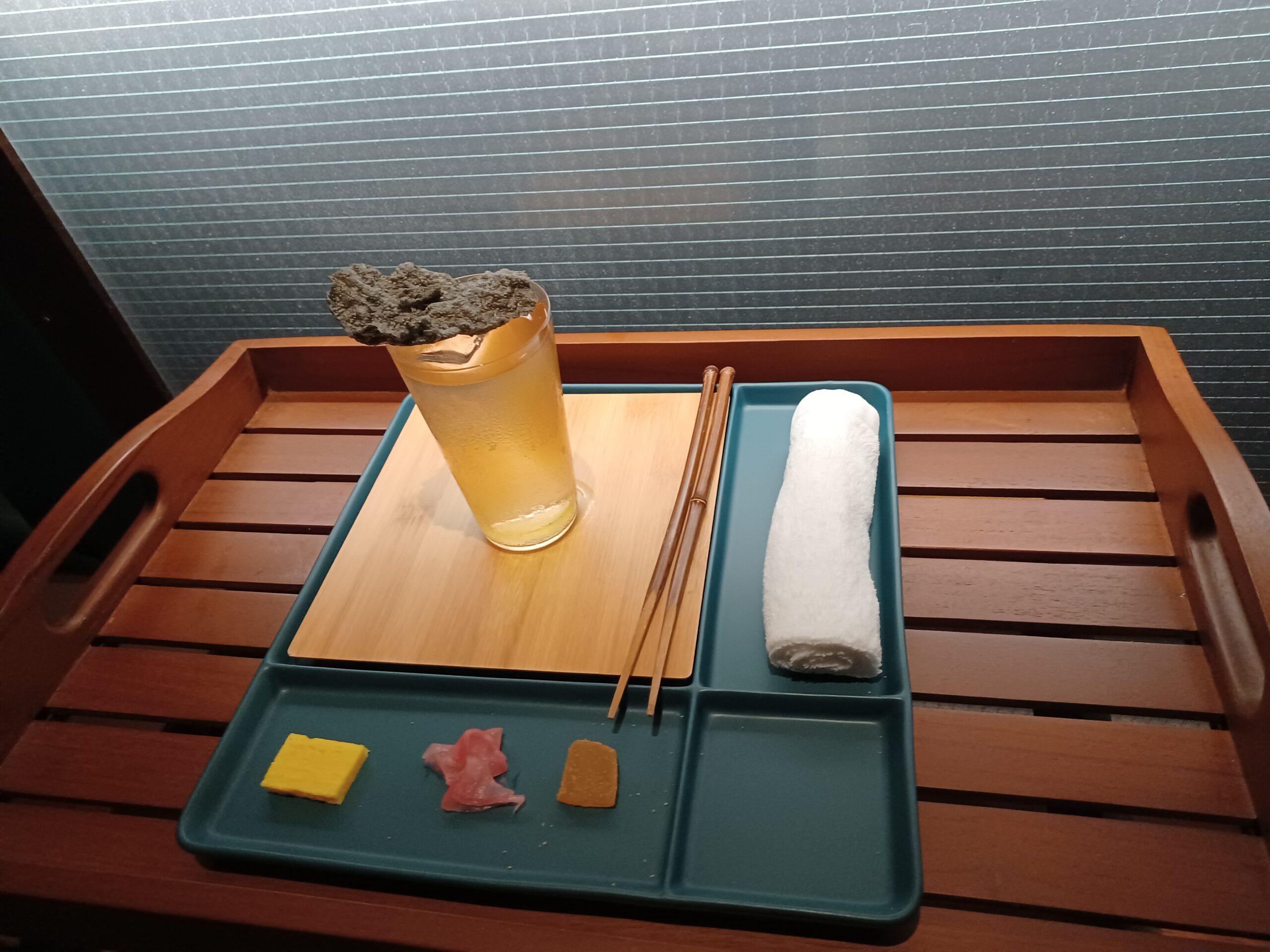
Vijay Mudaliar, the owner of the bar, told BusinessWorld that the menu is constantly updated to experiment with the various flavor trends in Asia. One of its recent stars is the Oolong Highball, which takes inspiration from the Japanese salaryman’s bento.

Meanwhile, those seeking out the hard stuff can venture towards the trees of Dempsey Hill to find a gin distillery sitting amidst the city’s peaceful slice of nature.

Tanglin Gin Distillery offers a tour and tasting experience that lets you try its handcrafted gin, featuring distinct Singaporean flavors — the Orchid Gin celebrates the tastes of hawker food and the Singapore Gin is citrusy with chili and ginger notes.

One of the brand’s partners, Bradley Young, will be able to explain what goes into smelling and later tasting the flavors in a gin. Make sure you have no other important places to be afterwards because this experience will set you up for the night.

Like Singapore’s own culture, the variety of smells and tastes in a single drink reflects just how exciting it can be to explore the city’s most unique offerings.

Maya Kitchen visits Davao through balbacua and Pakfry

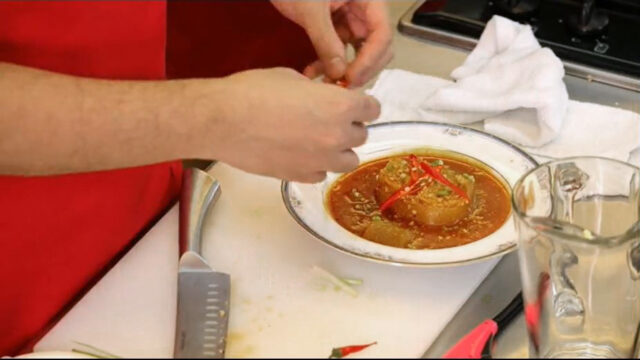
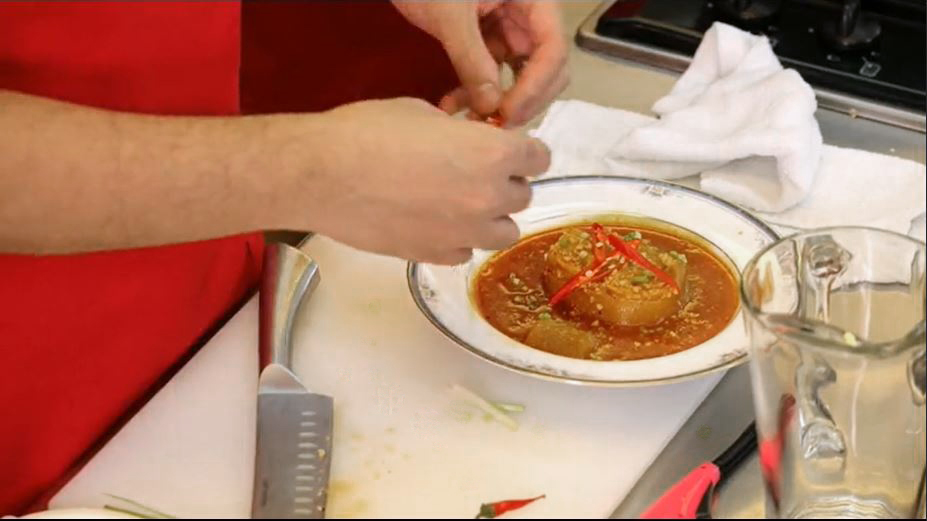
MR. PENDATUN plating the Balbacua

TO MANY people from outside the island, especially Luzon, Mindanao might as well be another country. A cooking webinar by Maya Kitchen last month found commonalities between Davao cuisine and those of the rest of the Philippines.

In its fourth stop for its Philippine Food Tour series streamed on Facebook, The Maya Kitchen featured essayist, food writer, and chef Datu Shariff Pendatun and former president of the Culinary Historians of the Philippines, Pia Lim Castillo, who discussed balbacua and Pakfry (we’ll explain that later).

“We’re talking about a region with a few provinces, Davao City included, of course,” said Mr. Pendatun. “Davao is a city of settlers,” he said, noting how various peoples, those from indigenous cultures as well as those from regions like Cebu, have made Davao their home.

“If in Luzon, there’s really a proclivity for bulalo (beef shanks in a bone broth) and lomi or mami (noodle soups), and all these things, when you go south to the Visayas and Mindanao, people have a knack for something they call balbacua.”

According to Ms. Castillo, balbacua comes from the Mexican barbacoa, itself transplanted into North America as barbecue. This used off-cuts like offal and trotters. “These are not the likely parts that you would use for most cuisines. But the Filipinos, we like to use that,” she said, noting the use of trotters in dishes like kare-kare (braised peanut stew). “You’ll get a very gelatinous soup that tastes really good.”

Mr. Pendatun said that for this recipe, they used ox trotters. To clean it and eliminate hair strands from the cow, one can use a blowtorch, a flame, or even a razor. This was placed in a pot of water, and some vinegar was poured over it. “The vinegar is not to make it sour. It’s really there to expel whatever odors or whatever things we don’t like about the ox feet,” he said. The liquid from this initial boiling is discarded, and both hosts calculated that in general, the dish would take between two to three hours to make (with TV magic, however, by pre-cooking the trotters, they shaved the cooking time to about 30 minutes).

Mr. Pendatun said that in some parts in the south of the Philippines, for reasons of economy, some families cook the dish with just ox skin. Said Ms. Castillo, “If you do it a day before, you create a dish that has so much gelatin, which is so flavorful.” Mr. Pendatun added ginger, which he pounded instead of slicing it, and he added the same rustic touch with some onions, which he chopped into large chunks. Some lemongrass was also bruised to release more flavor.

“I think the keyword when talking about things Davao, not just cuisine, is rustic,” he said.

The broth had, by this time, turned yellow from the fat. He joked, “You have collagen for the skin, and the fat for the soul.” To this he added annatto (atsuete) powder. “In terms of flavor, I would surmise that powder is just a little bit more intense,” he said, comparing this to using the seeds, which some people prepare by soaking them in warm water or cooking them in warm oil. Annatto seeds, known in Filipino cuisine to impart a fiery red color to dishes, also adds a mild peppery taste.

While the broth simmered, he sprinkled it with a little fried garlic, spring onion, and MSG. Said Ms. Castillo, “You don’t really need it [the MSG] if you cook it slowly and you allow the flavors [to come out].”

“For carinderias (streetside eateries), it’s a shortcut.”

After the broth had finished simmering, the dish was plated and served with another sprinkling of garlic and spring onion, and garnished with sliced chilies.

PAKFRY
“We know Davao is a coastal community, so the dishes that they serve there have a lot of seafood,” said Mr. Pendatun. “Among the seafood that is most prominent in and that Davaoeños love very much is tuna.”

Mr. Pendatun asked Ms. Castillo about what goes into a paksiw (a fish stew). She said that it is fish lightly stewed in vinegar, ginger, and onions, emphasizing that this dish uses no oil. “Some people posit that paksiw is actually like an older form of adobo (a stew of chicken or pork, or both, cooked in vinegar).” However, she did reveal one of her secrets: “Fry that fish the following day, after it has soaked [in the sauce].” It turns out that…that was the very essence of Pakfry, a portmanteau that means a previous day’s paksiw that has been deep-fried.

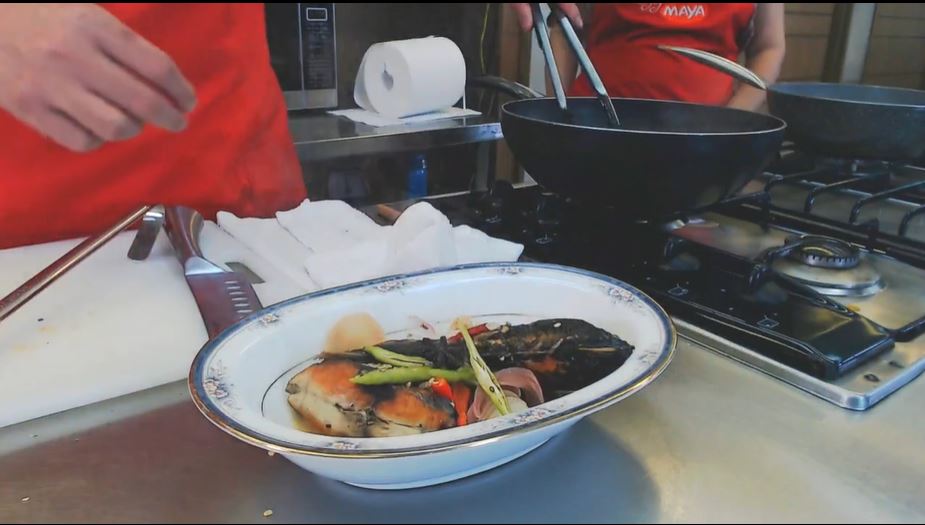
To Ms. Castillo’s recipe, Mr. Pendatun added star anise and garlic. He also uses tuna tails, an abundant ingredient which is considered an end cut in Mindanao. After the fish had been deep-fried, the simmering liquid is added to it before serving.

“I think it’s a great thing, because it has evolved,” said Mr. Pendatun. —  JL Garcia