Home Blog Page 5625

BPI sees loan book growing despite rising rates

BANK of the Philippine Islands expects its loan portfolio to continue growing despite rising interest rates. — BW FILE PHOTO

BANK of the Philippine Islands (BPI) is bullish on its consumer banking business and expects its loan portfolio to continue expanding despite rising interest rates due to faster inflation.   

“We are seeing the economy mobilizing and we see this in our loan releases on the consumer side,” BPI Head of Consumer Banking and Executive Vice- President Maria Cristina “Ginbee” L. Go said at a virtual briefing on Monday.

Ms. Go said BPI’s regular housing loan releases are 48% higher than last year’s. She added that the bank’s auto loan releases are growing at 29%.   

“These allow us to provide greater traction in the ensuing months as we continue to monitor the impact of interest rates in our loan books. However, we don’t think that the increase in interest rates will drastically change demand,” she added.

“I think we have to be watchful of inflation… We have to watch where interest rates might go to battle inflation,” BPI President and Chief Executive Officer Jose Teodoro K. Limcaoco said.

“We maintain a very conservative stance here at BPI. We are not reducing our provisioning that we started at the beginning of the year. We will continue to maintain that pace,” Mr. Limcaoco added.

The Bangko Sentral ng Pilipinas (BSP) has raised benchmark interest rates by a total of 125 basis points (bps) so far this year as inflation remains elevated.

BSP Governor Felipe M. Medalla last week signaled a hike of 25 or 50 bps at their Aug. 18 meeting, although he ruled out another off-cycle increase. The central bank had raised rates by 75 bps in a surprise move on July 14.

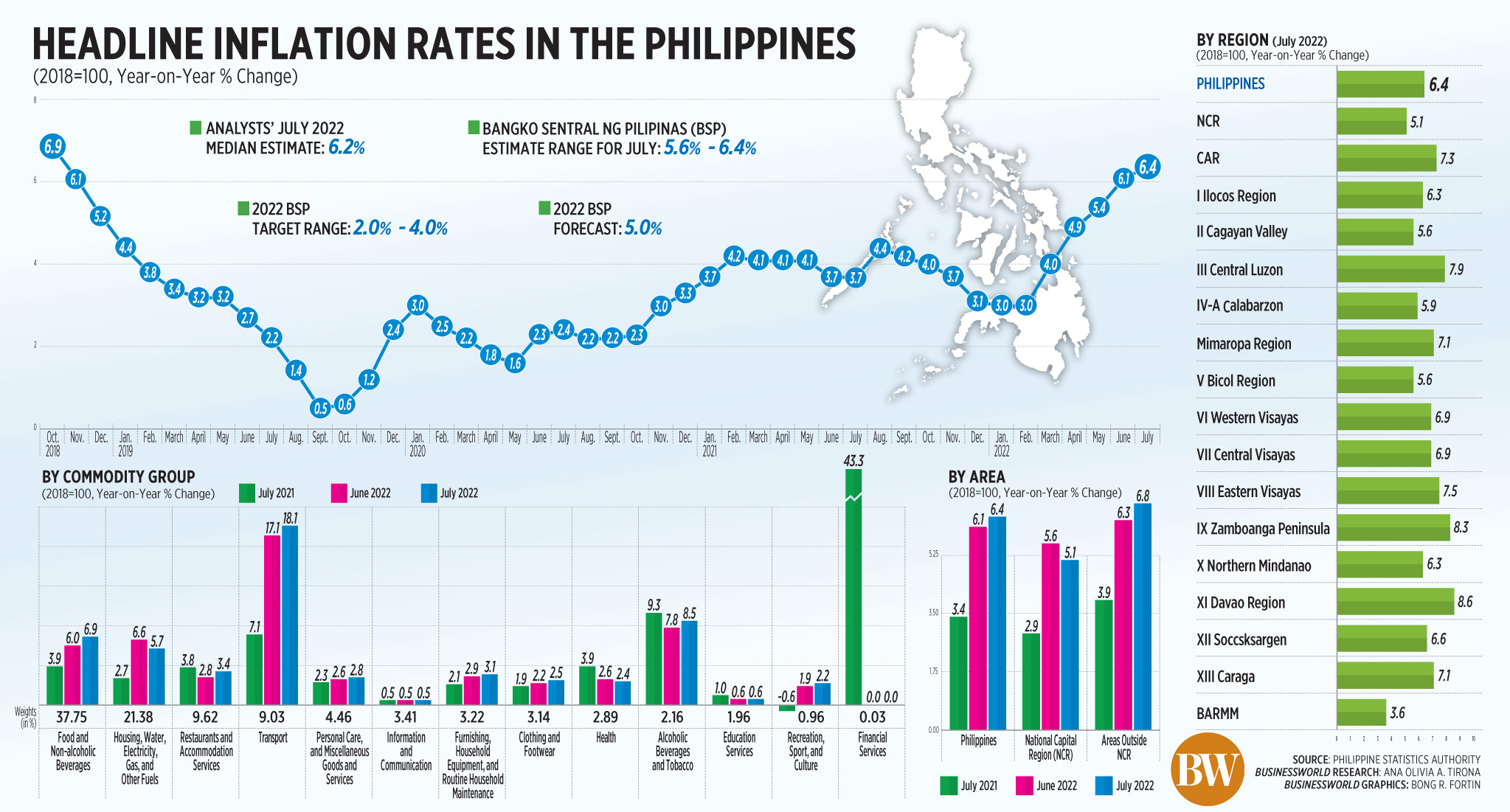
Headline inflation hit a near four-year high of 6.1% in June, bringing the first-half average to 4.4%, above the BSP’s 2-4% target and 5% forecast for the year.

The BSP expects the July reading to be in the 5.6-6.4% range. July inflation data will be released on Friday.

DIGITALIZATION
Meanwhile, BPI said it spent about P9 billion on technology in 2021, which included digital initiatives such as building customer engagement platforms and investments in cybersecurity.

The Ayala-led bank continues to focus on digitalization, customer obsession, and sustainability efforts as it celebrates its 171st year in the country this month, officials said on Monday.

“As the pioneer bank in the Philippines and Southeast Asia, BPI has developed a long and rich history of banking excellence. It is a testament to our unwavering commitment to maintain the deep trust our clients have placed in us by being prudent, innovative, and nurturing,” Mr. Limcaoco said.

“We also always continue to adapt in order to meet our customers’ changing needs and the demands of an evolving economy,” he added.

BPI Executive Vice-President and Chief Operating Officer Ramon L. Jocson said the bank’s spending on cybersecurity is at around 10% of its technology budget. 

“We are spending a lot on cybersecurity because it’s a growing concern for us given the increased malware introductions in the system. The second reason is that with technology adoption, we see more clients who can potentially be victims,” Mr. Jocson said.

As of 2021, 4.9 million of its 8.46 million client base were enrolled in the bank’s digital channels.

BPI’s net income rose by 82.9% to P12.5 billion in the second quarter from the P6.8 billion recorded in the same period last year. This brought the lender’s net earnings for the first half of the year to P20.4 billion.

The Ayala-led lender’s shares declined by P2.95 or 3.17% to close at P90.05 each on Monday. — K.B. Ta-asan

MPTC unit expects up to 10% rise in CAVITEX vehicle count by Nov.

AN INCREASE in average daily vehicle volume of up to 10% is expected on the Manila-Cavite Expressway (CAVITEX) when physical classes resume in November, according to Cavitex Infrastructure Corp. (CIC), a unit of Metro Pacific Tollways Corp. (MPTC).

“With more vehicles expected to ply the 14-kilometer CAVITEX going to different schools and universities in Metro Manila, CIC foresees a 5-10% increase in daily average vehicle count versus current traffic,” the company said in an e-mailed statement.

Currently, an average of 150,000 motorists traverse the expressway every day.

“To help manage the increasing number of traffic that has now surpassed pre-pandemic numbers, CAVITEX had been activating counterflow lanes for Class 1 vehicles at Manila-bound (in front of Waste Transfer Facility and after Parañaque Toll Plaza) and Cavite-bound (in front of PITX and after Parañaque Toll Plaza) during rush hours of morning and afternoon, respectively and as needed,” the company said.

It said customers should avail of its free Easytrip RFID (radio frequency identification) to avoid long queues at cash lanes and for faster lane transactions.

“Expressway motorists can drop by CAVITEX Customer Service Centers (Manila- and Cavite-bound) and at other stations along the expressway for free RFID installation and reloading services,” CIC noted.

MPTC officially introduced in February its MPT DriveHub, a smartphone application that houses the company’s mobility solutions for customers.

The application allows motorists to manage their trips through its three key features: RFID, trip planning, and roadside assistance.

“Our MPT DriveHub app was developed to further elevate our customer experience, so we really encourage them to download it. The app not only allows them to monitor their balance and passages but also provides them with traffic updates that are useful in planning their trips. The app may also be used to connect with us for queries or emergency roadside assistance,” said CIC President and General Manager Raul L. Ignacio.

MPTC is the tollways unit of Metro Pacific Investments Corp., one of three key Philippine units of Hong Kong-based First Pacific Co. Ltd., the others being Philex Mining Corp. and PLDT, Inc.

Hastings Holdings, Inc., a unit of PLDT Beneficial Trust Fund subsidiary MediaQuest Holdings, Inc., has a majority stake in BusinessWorld through the Philippine Star Group, which it controls. — Arjay L. Balinbin

BDO’s income climbs in Q2

BW FILE PHOTO

BDO UNIBANK, Inc. posted a higher net profit in the second quarter on better net interest earnings and service charges, fees and commissions, as well as foreign exchange gains.

The bank booked an attributable net income of P12.205 billion in the second quarter, up 10.64% from the P11.031 billion in the same period in 2021, according to its quarterly report disclosed to the stock exchange on Monday.

This brought its attributable net profit for the first half to P23.943 billion, 12% higher than the P21.421 billion seen in the comparable year-ago period, amid “strong” results across the lender’s core businesses.

The bank said in a statement that its pre-provision operating profit was at P39.2 billion, 18% higher year on year, showing the strength of its core income sources amid a tempered increase in operating expenses.

BDO’s first semester performance translated to a return on average common equity of 11.26%, up from 10.75% the year prior, and a return on average assets of 1.3%, also better than the 1.26% seen in the first half of 2021.

“BDO’s established business franchise, healthy capital position, and sustainable earnings performance reinforce the bank’s resilience against prevailing macro headwinds and put it in a good position to capitalize on the country’s structural opportunities for long-term sustainable growth,” the lender said.

The bank’s net interest income in the second quarter stood at P35.537 billion, rising by 9.6% from the P32.423 billion posted a year prior.

This was driven by the 5.64% growth in its interest earnings from loans and receivables to P32.705 billion, as well as the 31.94% increase in its income from trading and investment securities to P5.883 billion.

These helped offset the slight rise in its interest expenses to P3.514 billion from P3.47 billion.

For the first semester, BDO’s net interest income was at P69.449 billion, 8% higher than the P64.444 billion seen in the same period last year, amid an expansion in earning assets and improved funding costs.

Meanwhile, the bank’s non-interest income was at P17.596 billion in the second quarter, up by 22.95% year on year from P14.311 billion.

The increase came on the back of a 34.1% rise in its income from service charges, fees and commissions to P9.294 billion, as well as the 215.35% growth in its foreign exchange gains to P2.321 billion from P736 million, offsetting the P1.172-billion net trading loss seen in the quarter versus the P511-million net gain posted the year prior.

BDO’s non-interest earnings for the first half grew 15% to P34.276 billion from P29.681 billion on the back of an expansion in fees and insurance premiums.

On the other hand, the lender’s total operating expenses for the second quarter went up by 9.41% to P32.692 billion from P29.88 billion. For the first half, expenses climbed by 6% to P64.54 billion from P60.949 billion.

The bank’s net loans and receivables stood at P2.52 trillion as of June, up by 2.86% from the P2.45 trillion seen at end-2021, with customer loans growing by 9% year on year.

Its nonperforming loan (NPL) ratio declined to 2.39% at end-June from 3.12% a year prior.

Despite improved asset quality, BDO set aside P8.2 billion in provisions for impairment losses in the first half, up by 21% year on year. This brought its NPL coverage ratio to 138%.

Deposit liabilities grew by 5% to P2.96 trillion as of June from P2.82 trillion at end-2021 on the back of the expansion of demand (10%), savings (4%) and time (4%) deposits. BDO said current account, savings account deposits now comprise 85% of the total.

The bank’s capital adequacy ratio was at 14.48% as of June, inching down from 14.99% a year prior. Still, this remained well above the regulatory minimum of 10%.

Total resources rose by 10% year on year to P3.8 trillion as of June amid higher consumer loans and investment securities, mainly funded by deposits.

BDO’s shares went down by P5.70 or 4.77% to close at P113.80 apiece on Monday. — BVR

Bureau of Quarantine to open more satellite offices in Robinsons Malls

THE Bureau of Quarantine (BoQ) is opening more satellite offices in Robinsons Malls.

Robinsons Malls in a statement said it signed a partnership with the BoQ to open five satellite offices in Robinsons Galleria, Robinsons Place Manila, Robinsons Place Tacloban, Robinsons Galleria Cebu, and Robinsons Cagayan de Oro.

The BoQ satellite offices in malls will make it more convenient for overseas Filipino workers, seafarers and other individuals to secure an International Certificate of Vaccination (ICV).

The ICV, also known as the yellow card, is a certification recognized by the World Health Organization.

Applicants should register at www.icv.boq.ph, prepare documentary requirements and proceed to Robinsons Malls on their scheduled appointment date.

“Robinsons Malls is honored to have the Bureau of Quarantine as an important part of our Lingkod Pinoy programs nationwide. This partnership allows us to better provide our customers with easier and more convenient access to relevant government services,” Joel Lumanlan, Robinsons Malls VP for Operations, Marketing, and Business Development, said in a statement.

Metro Clark expands landfill capacity 

METRO CLARK Waste Management Corp. (MCWM) announced that it completed its expansion project at its landfill facility in Kalangitan in Clark, Pampanga as part of its efforts to meet the country’s growing waste disposal requirements.

“The country’s first engineered sanitary landfill was expanded to fulfill MCWM’s mission to provide world-class waste disposal services to more cities, municipalities, and industrial clients in Central Luzon. The company pointed out that all projections by both local and foreign experts show that the volume of Philippine waste will continue to increase, and already exceeds the total capacity of existing landfills in the country,” the firm said in a statement on Monday.

Citing a study by the Stockholm Resilience Center, MCWM said that the Philippines currently ranks as the top contributor to plastic pollution in the oceans, putting the country among the five largest producers of plastic waste worldwide.

“It is our job to monitor these studies and projections, and proactively plan accordingly. The yearly increase in solid waste in the Philippines, while sobering, was expected. While recycling and other trash reduction measures do help and must be done, there’s just so much waste that the only solution is to expand,” MCWM Executive Vice-President and General Manager Victoria E. Gaetos said.

“We made the decision to invest in this expansion even during the height of the COVID-19 (coronavirus disease 2019) pandemic because this is in the best interests of our clients, and ultimately, of the communities we serve,” she added.

The expansion covered the development of seven more hectares within MCWM’s 100-hectare grounds. It will be used for municipal waste disposal, the addition of leachate treatment plants for the proper eradication of waste by-products, and a new separate disposal cell for treated industrial waste.

The company also acquired new vehicles, equipment, and other fixed facilities to increase operational efficiency. The expansion will also allow the firm to dispose of its clients’ waste to the same international standards and according to global best practices.

Ms. Gaetos added that the firm hopes to widen its coverage as more local government units (LGUs) and industry players look for waste management solutions that are cost-effective, efficient, and strictly compliant with the Ecological Solid Waste Management Act.

MCWM is the country’s first engineered sanitary landfill. It is the exclusive developer of the solid waste management system of the Clark Freeport and Special Economic Zone, including New Clark City.

The 100-hectare landfill can handle up to 4,000 tons of waste per day, which services multiple industries as well as over 150 LGUs including the cities of Pampanga, Bataan, Nueva Ecija, and Pangasinan. — Luisa Maria Jacinta C. Jocson

Citi completes sale of PHL consumer unit to UnionBank

CITIGROUP, INC. has completed the sale of its Philippine consumer banking business to UnionBank of the Philippines, Inc. (UnionBank), it said on Monday.

The transaction covers Citi’s credit card, unsecured lending, deposit and investment businesses, as well as Citicorp Financial Services and Insurance Brokerage Philippines Inc., which provides insurance and investment products and services to its retail clients.

“The agreement covers related Citi staff, with approximately 1,540 consumer bank and supporting employees transferring to UnionBank,” the foreign bank said in a statement.

It said the transaction is expected to result in a capital benefit of about $700 million for Citi.

Citi will continue to maintain a corporate banking presence in the Philippines.

“The sale marks the second completed divestiture and underlines the progress we continue to make. UnionBank is the optimal owner for our local consumer business and we wish our former employees and customers continued success in the future… [We] will use the capital generated to invest in our strategic priorities,” Citi Chief Executive Officer (CEO) of Legacy Franchises Titi Cole said.

“This transaction represents a positive outcome for our clients, our colleagues and our firm. Citi will continue to serve institutional clients in the Philippines and across our global network as we have for over 120 years,” Citi Philippines CEO Aftab Ahmed said.

UnionBank’s acquisition of Citi’s local consumer unit, priced at P55 billion, was announced in December 2021.

Citi’s departure from the Philippine retail banking space was announced in April 2021 as part of the banking giant’s strategic refresh. Apart from the Philippines, the lender said it will also exit its consumer banking businesses in Australia, Bahrain, China, India, Indonesia, South Korea, Malaysia, Poland, Russia, Taiwan, Thailand and Vietnam.

“To date, the bank has signed deals for the sale of nine of these markets, including the previously announced completion of Australia and is in the process of winding down consumer banking in South Korea,” Citi said on Monday.

It will continue to offer consumer banking in Hong Kong, Singapore, London and the United Arab Emirates, the bank’s four wealth hubs.

UnionBank’s shares declined by P2.70 or 3.35% to close at P78 each on Monday. — BVR

Entertainment News (08/02/22)

BuKo channel celebrates first anniversary

THE COUNTRY’S first and only 24-hour comedy channel, BuKo, is now a year old. Launched on Aug. 2, 2021 by Cignal TV and APT Entertainment, Inc., BuKo has brought laughter to multi-platform audiences on Cignal and SatLite Pay TV, and on the video streaming service Cignal Play. BuKo has delivered over 220 episodes of original programming, as well as more than 1,000 episodes of Pinoy comedy classics. With the theme “Tawa’t Tuwa Fiesta: The First BUKO Anibersaya,” BuKo’s anniversary celebration offers new shows and back-to-back episodes of BuKo Originals. To start off the anniversary fiesta, BuKo will hold a daily three-hour long marathon, from 3 to 6 p.m., on Aug. 1 to 5. It will start with the second season of Kusina ni Mamang and #MaineGoals on Aug. 1 and 2. A Kusina Ni Mamang Season 1 marathon and #MaineGoals Season 1 marathon will be held on Aug. 4 and 5. The news parody show Balita One Nan with KaladKaren, Alex Calleja, and Wally Bayola, will air a special marathon and also includes episode replays on Aug. 3. Starting Aug. 6, the first episode of Pinoy Samurai premieres on the channel at 6 p.m., while the new schedule for Bubble Gang and Pepito Manaloto will be on Sundays from 8 to 10 p.m. On Aug. 8, Wow Meganon will air at 6 p.m., followed by Lokomoko U at 7 p.m. every Monday to Friday. Starting Aug. 13, the 1990s Filipino comedy Mongolian Barbecue will air at 7 p.m., and the sitcom Everybody Hapi will air at 9 p.m. every Saturday. BuKo channel is operated by Cignal TV, Inc., in partnership with APT Entertainment Inc., and is available on Cignal TV (Channel 2) and SatLite (Channel 2), and on the Cignal Play app, available via App Store and Google Play.

Beyoncé returns with new album   

THE 7th studio album from Beyoncé is now available on all major streaming platforms. From her own label Parkwood Entertainment and Columbia Records, Renaissance arrives six years after the globally lauded album Lemonade was released in 2016 as a complete surprise. Packed with 16 rousing anthems, Renaissance encourages jubilation, agency, and movement with abandon. “Creating this album allowed me a place to dream and to find escape during a scary time for the world,” singer Beyoncé Knowles said in a statement. “It allowed me to feel free and adventurous in a time when little else was moving. My intention was to create a safe place, a place without judgment. A place to be free of perfectionism and overthinking. A place to scream, release, feel freedom. It was a beautiful journey of exploration.”  While the visuals that will accompany the album are scheduled to be released at a later date, the album comes with a menu of formats. The music store on Beyoncé’s website offers album merch and multiple configurations of Renaissance, listing a CD, digital album, a limited-edition vinyl, and four box sets which include a T-shirt and CD in a special box (sold out). The breakout single, “Break My Soul,” comes as a digital single and is also available in acapella and instrumental versions. With the album release also comes a deluxe vinyl. It includes two black vinyl LPs, a 36-page booklet, and a folded collectable (24”x 36”) poster.

Netflix’s Seoul Vibe

THE NEW Korean action film Seoul Vibe is about the baby-drivers of Sanggye-dong who dreamed of the American dream during the 1988 Seoul Olympics. Directed by Moon Hyun-sung, it stars Yoo Ah-in, Koh Kyung-Pyo, Lee Kyoo-hyung, Park Ju-hyun, Ong Seong-wu, Oh Jung-se, Jung Woong-in, and Moon So-ri. Seoul Vibe (https://www.youtube.com/watch?v=lTMz8eC5Wos) premieres on Aug. 26.

GMA Affordabox announces price drop at P799

GMA Affordabox celebrates its second anniversary by dropping the price of GMA Network’s digital TV receiver from P888 to P799. GMA Affordabox is also introducing its mascot, Affordy. Over 2 million units of the GMA Affordabox have been sold since its launch in 2020. The Affordabox is part of the network’s initiatives in the country’s shift from analog to digital broadcast, enabling Filipino households to watch the GMA and GTV channels at a higher definition along with the GMA digital channels Heart of Asia, Hallypop, and I Heart Movies. Other free-to-air channels on digital broadcast are also available depending on the Affordabox user’s area. The device has unique features such as a video recorder which lets users re-watch highlights of GMA shows with instant or scheduled recording. It can also become a multimedia player through its USB port. It also has a nationwide Emergency Warning Broadcast System that receives alerts about calamity warnings in the user’s area as well as a functional auto-on alert feature. The GMA Affordabox is available at supermarkets, appliance and gadget stores, and online via the official GMA Store on Shopee and Lazada.

GMR Megawide sees pre-pandemic flight traffic by Q4

GMR MEGAWIDE Cebu Airport Corp. (GMCAC), the private operator of Mactan-Cebu International Airport (MCIA), expects domestic flight traffic to return to pre-pandemic levels by the fourth quarter.

“While we expect to return to pre-pandemic numbers (for domestic) by the fourth quarter this year, it still also depends on how quickly international traffic also resumes in Cebu and other airports such as Manila, Clark and Davao,” GMCAC said in a statement to BusinessWorld on Monday.

According to the company, 25% of its domestic traffic is connecting feeder traffic to and from international flights.

“We are working closely with airlines and regulators to support the steady return of traffic to Cebu at the soonest possible time,” it noted.

The Mactan-Cebu International Airport Authority said aircraft traffic, both domestic and international, surged 174% to 20,551 in the first half of 2022 from 7,489 in the same period last year.

GMCAC said the percentage of domestic flights at MCIA has already returned to 70%.

“International traffic, which has ramped up since May, is expected to achieve its pre-pandemic levels by end of the second quarter of 2023,” the company said in a separate statement.

More Korean airlines have resumed their direct flights to Korea from MCIA after over two years of economic downturn due to the pandemic, the company noted.

“The return of direct flights to Korea, apart from other international destinations, is a positive signal for the recovery of the travel and aviation sector,” said GMCAC President Louie B. Ferrer.

“Korea comprised our main international traffic pre-pandemic, followed by other ASEAN countries. We are very glad to welcome them back to Cebu and assist the return of tourism in the region,” he added.

Daily flights to Incheon, according to GMCAC, are operated by Korean Air, Jin Air, T’way and Jeju Air, while flights to Busan are operated by Jin Air and Air Busan.

Local budget carrier Cebu Pacific Air also operates flights from Cebu to Incheon.

GMCAC, a joint venture of Megawide Construction Corp. and Indian infrastructure company GMR Group, took over the development of the airport’s landside facilities in 2014 under a 25-year public-private partnership concession agreement with the government. — Arjay L. Balinbin

Most expensive condominium in Los Angeles hits market at $75M

A PENTHOUSE condo connected to the Four Seasons Los Angeles hotel is being listed for $75 million, a record asking price in a city known more for megamansions than high-rise housing.

Dubbed “One L.A.,” the duplex has 12,700 square feet (1,200 square meters) of living space, a private elevator and private six-car garage. A wraparound rooftop terrace with a swimming pool and two reflecting pools offers panoramic views of the Hollywood Hills, downtown LA and the Pacific Ocean from atop the 13-storey tower.

“LA wasn’t ready for this before,” Billy Rose, the broker with The Agency who has the listing, said in an interview. “It’s finally arrived with a chair at the table of global cities. This is something for people with multiple homes who aren’t here year-round but want a place that somebody’s overseeing 24/7 and with the service of the Four Seasons.”

While sprawling oceanfront and hilltop mansions dominate the high-end Los Angeles housing market, developers have stepped up offerings of condo towers targeting well-heeled buyers who want to add a Southern California pied-a-terre to their collection of residences. Condos in the LA area sold for a median of $910,000 in the three months through May, a 12% increase over the same period in 2021, according to a report this month by Polaris Pacific.

Buying has continued even as the broader housing market slows amid soaring mortgage rates, the faltering stock market and fears of a recession. A penthouse at the Pendry Residences West Hollywood sold this month for $21.5 million, the highest price for a LA-area condo this year.

The market’s priciest condo deal was in 2010, when Candy Spelling, widow of TV producer Aaron Spelling, bought a Century City penthouse developed by Related Cos. for $35 million.

Two side-by-side penthouse condos in West Hollywood are being prepared for marketing at $50 million each. Potential buyers who have toured the condos have said they’re interested in combining the two units, said Fredrik Eklund of Eklund-Gomes, the listing agent.

One L.A. is not to be confused with The One, a Los Angeles megamansion once touted with a $500 million asking price. That property sold in March for $141 million in a bankruptcy court-ordered auction. — Bloomberg

Manufacturing Purchasing Managers’ Index (PMI) of select ASEAN economies, July 2022

THE PHILIPPINES’ manufacturing sector slowed in July as production and new orders declined, signaling weaker global demand, S&P Global said on Monday. Read the full story.

Manufacturing Purchasing Managers’ Index (PMI) of select ASEAN economies, July 2022

How PSEi member stocks performed — August 1, 2022

Here’s a quick glance at how PSEi stocks fared on Monday, August 1, 2022.


PHL stocks flat ahead of key economic data

REUTERS

STOCKS opened the month flat ahead of the release of key economic data and more second quarter results of listed firms.

The Philippine Stock Exchange index (PSEi) fell by 3.90 points or 0.06% to close at 6,312.03 on Monday, while the broader all shares index dropped 5.90 points or 0.17% to 3,392.92.

“The market had a seesaw session today as investors await the next important catalyst: second quarter earnings,” AB Capital Securities, Inc. Vice President Jovis Vistan said in a Viber Message on Monday.

“Philippine investors welcomed the month of with a flat start as several economic data releases scheduled for this week,” Regina Capital Development Corp. Head of Sales Luis A. Limlingan said in a Viber message.

“The most awaited economic data this week back home is the Philippines’ CPI (consumer price index) data for July, as well as the PSEi rebalancing, both on Friday,” Mr. Limlingan said.

The market will also look at other reports to be released this week, including the June trade balance data and July unemployment numbers, he said.

“Aside from these, a handful of speaking engagements from the Fed (US Federal Reserve) are also expected to be monitored by investors this week,” Mr. Limlingan added.

A BusinessWorld poll of 14 analysts yielded a median estimate of 6.2% for July headline inflation, within the 5.6-6.4% forecast of the Bangko Sentral ng Pilipinas (BSP).

If realized, this would be faster than the 6.1% print seen in June and the 3.7% in July 2021 and would exceed the BSP’s 2-4% target band for the fourth straight month. It would also be the highest in 45 months or nearly four years since the 6.9% in October 2018.

Sectoral indices ended split on Monday. Financials went down by 49.99 points or 3.26% to 1,482.39; services declined by 33.92 points or 2.02% to 1,640.33; and mining and oil decreased by 34.63 points or 0.30% to 11,407.98.

Meanwhile, holding firms increased by 80.68 points or 1.35% to 6,015.41; property rose by 29.91 points or 1.05% to 2,862.12; and industrials added 88.09 points or 0.95% to end at 9,350.5.

Decliners beat advancers, 92 versus 85, while 55 names closed unchanged.

Value turnover climbed to P5.13 billion on Monday with 96.95 million shares changing hands from the P18.05 billion with 566.04 million issues seen on Friday.

Foreigners turned sellers anew, recording P288.4 million in net sales on Monday from the P1.97 billion in net purchases seen on Friday.

AB Capital Securities’ Mr. Vistan placed PSEi’s support at 6,200 and resistance at its 50-day average of 6,400, while Regina Capital’s Mr. Limlingan put the PSEi’s support at 6,200 and resistance at 6,380.