Home Blog Page 5596

Malaysia’s wait for PM continues for fourth day on election crisis

KUALA LUMPUR — The wait for a new Malaysian prime minister (PM) entered its fourth day on Wednesday, after the leading two contenders failed to secure enough support for a majority and break a hung parliament after last weekend’s election.

Malaysia’s king will pick the new premier, after opposition leader Anwar Ibrahim and former premier Muhyiddin Yassin missed his Tuesday afternoon deadline to put together an alliance with other parties to form a government.

The fallout from Saturday’s election prolongs political instability in the Southeast Asian nation, which has had three prime ministers in as many years, and risks delays to policy decisions needed to spur an economic recovery.

King Al-Sultan Abdullah is expected to meet with lawmakers from the incumbent Barisan Nasional coalition individually from 10:30 a.m. (2:30 a.m. GMT) on Wednesday to help him determine who will be prime minister.

The constitutional monarch plays a largely ceremonial role but can appoint a premier he believes will command a majority in parliament.

Mr. Anwar’s coalition won the most seats in the Saturday election with 82, while Mr. Muhyiddin’s bloc won 73. They need 112 — a simple majority — to form a government.

Barisan won only 30 seats — its worst electoral performance since independence in 1957 — but support from its lawmakers will be crucial for both Mr. Anwar and Mr. Muhyiddin to get to 112. Barisan said it would not align with either coalition on Tuesday.

Mr. Muhyiddin said he had declined the King’s suggestion for the two rivals to work together to form a “unity government.” Mr. Muhyiddin runs a Malay Muslim conservative alliance, while Mr. Anwar runs a multiethnic coalition.

Mr. Muhyiddin’s bloc includes an Islamist party whose electoral gains have raised fears in Malaysia, which has significant ethnic Chinese and ethnic Indian minorities following other faiths. It has also spooked investors amid worries over the Islamist party’s potential impact on national policies. 

Malaysian police this week cautioned the country’s social media users to refrain from posting “provocative” content on race and religion after the divisive election. — Reuters

Fauci pleads with Americans to get COVID shot in final White House briefing

WASHINGTON — Anthony Fauci, the US health official celebrated and vilified as the face of the country’s COVID-19 pandemic response, used his final White House briefing on Tuesday to denounce division and promote vaccines.

Fauci, who plans to retire soon as President Joe Biden’s top medical adviser and top US infectious disease official, has dealt with the thorny questions around health crises from HIV/AIDS to avian flu and Ebola.

But it was his handling of COVID — and his blunt assessments from the White House podium that Americans needed to change their behavior in light of the pandemic — that made him a hero to public health advocates while serving under former President Donald Trump, a villain to some on the right and an unusual celebrity among bureaucratic officials used to toiling in obscurity. Fauci has regularly been subjected to death threats for his efforts.

True to form, Fauci used his final press briefing to strongly encourage Americans to get COVID vaccines and booster shots, and touted the effectiveness of masks, all of which became partisan totems in the United States.

The United States leads the world in recorded COVID-19 deaths with more than one million.

After 13 billion doses of COVID-19 vaccines given worldwide, Fauci said, there is “clearly an extensive body of information” that indicates that they are safe.

“When I see people in this country because of the divisiveness in our country… not getting vaccinated for reasons that have nothing to do with public health, but have to do because of divisiveness and ideological differences, as a physician, it pains me,” Fauci said.

“I don’t want to see anybody hospitalized, and I don’t want to see anybody die from COVID. Whether you’re a far-right Republican or a far-left Democrat doesn’t make any difference to me.”

WHOM TO TRUST
White House COVID response coordinator Ashish Jha, who joined Fauci at the podium, said the administration is trying to promote physicians as sources of information about the pandemic rather than uninformed voices.

“You can decide to trust America’s physicians, or you can trust some random dude on Twitter,” said Jha.

“For journalists and for people who run platforms, what I would say is, you should be thinking about what your personal responsibility is. And do you want to be a source of misinformation and disinformation? That’s up to up to those individuals,” Jha said.

Fauci is stepping down in December after 54 years of public service. The 81-year-old has headed the US National Institute of Allergy and Infectious Diseases, part of the National Institutes of Health, since 1984.

The veteran immunologist has served as an adviser to seven US presidents beginning with Republican Ronald Reagan. He made his first appearance at the White House press briefing in 2001, according to the broadcaster C-SPAN.

In the first months of the pandemic in 2020, Fauci helped lead scientific efforts to develop and test COVID-19 vaccines in record time.

He became a popular and trusted figure among many Americans as the United States faced lockdowns and rising numbers of COVID-19 deaths, even inspiring the sale of cookies and bobblehead dolls featuring his likeness.

However, Fauci drew the ire of Trump and many Republicans for cautioning against reopening the US economy too quickly and risking increased infections, and for opposing the use of unproven or ineffective treatments such as the malaria drug hydroxychloroquine promoted by some on the right.

Democrats accused Trump of presiding over a disjointed response to the pandemic and of disregarding advice from public health experts including Fauci. Trump in October 2020, weeks before his reelection loss, called Fauci “a disaster” and complained that Americans were tired of hearing about the pandemic.

Republican lawmakers including fierce critic Senator Rand Paul, with whom Fauci tangled during Senate hearings, have vowed to investigate him.

On Tuesday, Fauci said he “will absolutely cooperate fully” in any congressional oversight hearings launched by Republicans next year, when they take control of the House of Representatives after November’s elections. — Reuters

Traumatised relatives await news of missing in quake-hit Indonesia

CIANJUR, Indonesia — Traumatized relatives awaited news on Wednesday of the fate of loved ones missing after an earthquake shattered a town in Indonesia’s West Java on Monday, with more heavy machinery deployed to clear landslides that have buried villages.

The death toll from Monday’s 5.6-magnitude quake in Cianjur has continued to rise as the full extent of the disaster has emerged. Authorities said 268 were now confirmed dead, up from about 160 on Tuesday, and more than 150 were missing.

Recovery efforts on Wednesday would focus on one of Cianjur’s worst-hit districts, Cugenang, where it is believed at least one village was buried by a landslide.

Footage from the area shows residents digging in brown earth with their bare hands, or using hoes, sticks, crowbars and other tools.

“If it was just an earthquake, only the houses would collapse, but this is worse because of the landslide,” said Zainuddin, who was searching for six missing relatives.

“In this residential area there were eight houses, all of which were buried and swept away.”

More than 1,000 police officers have been deployed to bolster search and rescue teams.

Indonesia is one of the most earthquake-prone nations on earth and regularly records stronger offshore earthquakes. But Monday’s 5.6-magnitude quake was particularly deadly as it struck in a densely populated area at a shallow depth of just 10 km (6 miles).

Officials also said poor building standards led to many deaths.

During a visit on Tuesday to Cianjur, about 75 km south of the capital Jakarta, President Joko Widodo called for reconstruction efforts to include earthquake-proof housing.

There was an urgent need to ensure surgery could take place immediately as hospitals had limited capacity due to damage from the earthquake, Health Minister Budi Gunadi Sadikin said.

“My priority is no more deaths,” he said during a visit to the disaster zone.

“The first priority is to make sure that badly injured patients are being taken care of so they can survive.” — Reuters

Drugmakers Teva, Sandoz make major push in production of biosimilars

GENERIC drug makers Teva Pharmaceutical Industries and Sandoz say they are planning a significant ramp-up in production of biosimilars — copies of high-priced drugs used to treat illnesses such as rheumatoid arthritis and cancer — aiming to increase their share of an expanding market.

More than 55 brand-name blockbuster biologic drugs, each with peak annual sales above $1 billion, are due to come off patent by the end of the decade, according to industry estimates.

Executives from Teva and Sandoz said they are targeting top-selling biologics such as Humira, AbbVie, Inc.’s top-selling arthritis drug, which came off-patent in Europe and is due to come off-patent in the US next year. But both companies face commercial and regulatory challenges, especially in the US, where biosimilars have not resulted in dramatically lower prices for consumers.

Biologics are complex molecules cultivated inside living cells, making it impossible to manufacture exact copies, as is the case with conventional pharmaceuticals made from chemical compounds.

Use of brand-name biologics typically account for an outsize proportion of drug spending in wealthier countries.

One of the biggest makers of generic drugs, Israeli-based Teva said it aims eventually to secure a 10% global market share of biosimilars. The company has been grappling with a heavy debt load since a 2016 acquisition and lawsuits arising from the US opioid epidemic.

Teva currently has three approved biosimilars and 13 in development.

“We are going full blast now,” Teva Chief Executive Kåre Schultz said in an interview with Reuters.

He said the company was targeting “80% of what’s going off-patent in the next 10 years” including big sellers like the cancer drug Keytruda.

A division of Novartis, Sandoz is currently the second biggest player after Pfizer, Inc. in the biosimilar market by gross sales globally, per IQVIA data, cited by Sandoz. (Amgen is in third place).

Sandoz has launched eight biosimilar drugs.

“We now have over 15 products in development, and in the next five years we would like to double the value of our marketed portfolio,” chief scientific officer Claire D’Abreu-Hayling told Reuters, adding that the biologics they intend to target are “really obvious opportunities”.

BLOCKBUSTERS COMING OFF PATENT
Novartis plans to spin off its Sandoz generics business in 2023. The Swiss drugmaker said the unit failed to attract a serious buyer earlier this year as it considered options for the unit’s future.

The more than 55 blockbuster biologics coming off patent protection in the United States and Europe over the next decade account for more than $270 billion in expected peak annual sales, according to a McKinsey analysis.

The analysis projected the value of the global biosimilar market could more than triple to an estimated $74 billion by 2030.

Next year could bring a test case in the US market, with the anticipated launch of at least six biosimilars for Humira, which brings in about $15 billion to $20 billion in annual sales and is approved for autoimmune conditions including rheumatoid arthritis, psoriasis and Crohn’s disease.

Sandoz and Teva are both working on biosimilars for Humira.

But the crowded field raises a tough question: Should the companies target the biggest selling biologics such as Humira, or aim for smaller brands that will likely attract fewer players, said Barclays pharmaceuticals analyst Emily Field.

Teva aims to ensure it is one of the first three biosimilars on the market for any given biologic, according to Sven Dethlefs, executive VP, North America commercial. He said the company intended to kick off multiple biosimilar development programs but would halt production if it could not make the top three.

While going after Humira, Sandoz is also targeting drugs like Biogen’s multiple sclerosis medicine Tysabri, which is used in a much smaller patient population. The company believes no other biosimilar is being actively developed for Tysabri, said Chief Operating Officer Pierre Bourdage.

A typical biosimilar costs $100 million to $300 million to develop and between six to nine years to win approval, according to McKinsey. About half of efforts launched across the US, European, and Japanese markets fail at the earliest stages, the report found. 

Generics, which can be priced as much as 80% to 90% less than branded pills, barely cost a few million to develop.

Biosimilars are viewed as “better than traditional generics, but nowhere near as good as branded pharma,” Emily Field said.

Commercial prospects will also depend on the regulatory environment. While more than 50 biosimilars have been introduced into the European market, the United States has taken longer to set up a regulatory pathway for biosimilars.

European regulators consider all approved biosimilars on par with the original biologic, which has helped boost uptake. Biosimilars have taken the majority of market share from brand-name biologics in Europe and resulted in savings between 75% to 90% off the reference product prices, according to a 2021 report by Duke University’s Margolis Center for Health Policy.

In the United States, the Food and Drug Administration (FDA) has approved 39 biosimilars and 22 products have been launched as of October, according to an Amgen analysis.

The FDA typically expects additional trial data before designating a biosimilar as “interchangeable” with the original biologic, which would allow it to be automatically replaced with a biosimilar at the pharmacy counter.

In a note last month, SVB Securities analysts predicted most US payers will likely stick with branded Humira next year, but seriously consider switching patients to interchangeable biosimilars by 2024.

Biosimilars launched in the US have only taken about 20% of the volume share of the biologics they are based on, according to the Duke Report, with knockoffs delivering discounts of about 30% to 40%.

Patent-focused court battles have stymied some launches of biosimilars. Aggressive pricing strategies from branded drug companies also helped neutralize the limited discounts initially offered by biosimilar makers. — Reuters


US says G7 should soon unveil price cap level on Russian oil, adjust regularly

Barrels for storing oil | STOCK IMAGE | Oil barrel photo created by jannoon028 - www.freepik.com

 – The Group of Seven nations should soon announce the price cap on Russian oil exports and the coalition will probably adjust the level a few times a year rather than monthly, a senior US Treasury official said on Tuesday.

The G7, including the United States, along with the EU and Australia are slated to implement the price cap on sea-borne exports of Russian oil on Dec. 5, as part of sanctions intended to punish Moscow for its invasion of Ukraine.

The aim of the unprecedented price cap mechanism is to reduce Russia’s petroleum revenues funding its war machine while maintaining flows of its oil to global markets to prevent price spikes. A cap on exports of Russian oil products is slated to begin on Feb. 5.

The Treasury official told reporters the European Union is consulting with members on the price cap. “Our hope is that they will finish that consultation relatively soon and put us in a position where our entire coalition can announce a price,” the official said.

A decision on the price cap level could come as soon as Wednesday or Thursday after a meeting of EU ambassadors, a source familiar with the discussion said.

The G7 price cap would allow companies to provide services including insurance, shipping and financing on Russian oil imports to coalition members, so long as the purchase of that petroleum is under the price cap.

On Tuesday, Treasury issued guidelines spelling out how US companies can provide such services without penalties, provided shipments they serve are purchased below the price cap. The cap is meant to provide a relief valve to Western bans on Russian oil exports.

The coalition has agreed to set a fixed price on Russian oil rather than a floating rate, discounted to an oil price index, sources said this month. The coalition worried that a floating price pegged below an oil benchmark might enable Russian President Vladimir Putin to easily game the mechanism by reducing supply, from Russia, one of the world’s largest oil exporters.

The official said Washington does not expect Russia to retaliate by withholding oil exports, as Putin has warned would happen. Such a move could send global oil prices higher, but risks damaging Russian oil fields.

“We have no reason to expect that they would do that because, ultimately, it’s not in their interest,” the Treasury official said. As the EU and the United States have put in place bans on Russian energy imports, big buyers including China and India have scooped up Russian oil at discounted prices.

“Any action they take to drive up prices would have an impact on their new customers, customers like India and China who they (Russia) want to remain oil customers going forward,” the US official said.

The US official said the coalition does not expect to adjust the price cap level on a weekly or monthly basis.

“Our goal is to revisit this on a regular basis, which from my standpoint, will look hopefully more like quarterly or even semi-annually because what we want to do is provide certainty to the marketplace.” – Reuters

Iran starts enriching uranium to 60% purity at Fordow plant

STOCK PHOTO | Image by jorono from Pixabay

DUBAI/VIENNA – Iran has begun enriching uranium to 60% purity at its Fordow nuclear plant and plans a vast expansion of its enrichment capacity, the UN nuclear watchdog said on Tuesday, detailing the latest acceleration of Iran’s atomic program over Western objections.

The International Atomic Energy Agency (IAEA) was confirming Iranian reports of Tehran’s step, taken in retaliation for the agency’s criticism of Iran in a board of governors resolution last week.

While Iran is already enriching uranium up to 60% purity elsewhere, its decision to do so at Fordow is likely to be viewed by Western nations as particularly provocative because the site is buried under a mountain, making it harder to attack.

That purity is below the roughly 90% needed for weapons-grade material but well above the 20% Iran produced before its 2015 agreement with major powers to cap enrichment at 3.67%.

The latest move is in retaliation to last week’s resolution by the IAEA’s 35-nation Board of Governors ordering Iran to cooperate with the agency’s years-long investigation into the origin of uranium particles found at three undeclared sites.

“Director General Rafael Mariano Grossi today said Iran had started producing high enriched uranium – UF6 (uranium hexafluoride) enriched up to 60% – using the existing two cascades of IR-6 centrifuges in the Fordow Fuel Enrichment Plant, in addition to such production that has taken place at Natanz since April 2021,” the agency said in a statement.

It was summarizing a confidential report to IAEA member states seen by Reuters on various moves taken and planned by Iran at enrichment plants at Fordow and Natanz.


CENTRIFUGES

Iran only has six cascades, or clusters, of IR-6 centrifuges in operation at three plants at Fordow and Natanz. Diplomats said the IR-6 is the most advanced model it is using on such a scale.

It plans to add 14 more IR-6 cascades at Fordow, six of which will replace first-generation IR-1 machines, the IAEA said. They will enrich to up to 5% or up to 20%, it added.

In the longer term, however, Iran plans an expansion of its underground, commercial-scale Fuel Enrichment Plant at Natanz, where it is also installing and bringing online more cascades of advanced centrifuges.

“Iran continues to advance its enrichment activities at the Fuel Enrichment Plant in Natanz and now plans to install a second production building, capable of housing over 100 centrifuge cascades,” it said.

The 2015 nuclear pact between Iran and six world powers lets Iran use only first-generation IR-1 centrifuges but, as the deal unraveled after then-President Donald Trump ditched it in 2018, Tehran has installed cascades of more efficient advanced centrifuges, such as the IR-2m, IR-4 and IR-6. It has also resumed enrichment at Fordow, which was barred under the deal.

US officials declined to confirm that Iran was enriching to 60% at Fordow, repeating their preference to use diplomacy to curb Iran’s nuclear program but saying all options – code for possible military action – were available to US President Joe Biden.

The IAEA resolution is the second this year targeting Iran over the investigation, which has become an obstacle to talks on reviving the 2015 deal because Iran demands an end to the probe.

Indirect US-Iranian talks to revive the accord have been stalemated since September.

Iran’s crackdown on anti-government protests after the death of a young woman, Mahsa Amini, in custody and its sales of drones to Russia have turned Washington’s focus away from reviving a nuclear deal. – Reuters

US appeals court grills Trump lawyer in seized documents dispute

Judges on an Atlanta-based federal appeals court signaled sympathy on Tuesday toward the US Justice Department’s bid to reverse the appointment of an independent arbiter to vet documents seized by the FBI from Donald Trump’s Florida home as they posed tough questions to the former president’s lawyer.

A three-judge panel of the 11th US Circuit Court of Appeals heard arguments in the department’s challenge to a judge’s September appointment of a “special master” to review the documents and consider whether some should be walled off from an ongoing criminal investigation. The department is also seeking immediate access to all of the seized documents.

It was one of a series of legal woes that Trump faced on Tuesday, a week after launching a fresh run for the White House, including the US Supreme Court clearing the way for a Democratic-led congressional committee to get access to his tax returns.

Trump lawyer James Trusty told the judges in Atlanta that Trump’s status as a former president made the documents dispute an unusual case that required a special master’s review.

But 11th Circuit Chief Judge William Pryor repeatedly questioned whether allowing a court to step into the criminal investigation now, before any indictment has been made, would create a bad precedent that would harm other investigations.

Pryor also questioned whether Trump’s lawyers had shown any evidence of unlawful activity related to the document seizures.

“If you can’t establish that, then what are we doing here?” Pryor asked.

Trusty acknowledged that the search of Trump’s property was not handled any differently than a typical criminal investigation, except for Trump being a former president.

Justice Department lawyer Sopan Joshi told the court that the department could find no other instance in which a judge exercised jurisdiction and effectively paused an ongoing criminal investigation when there was no evidence of an illegal search by the government.

FBI agents seized about 11,000 records, including about 100 marked as classified, during the Aug. 8 court-approved search at Trump’s Mar-a-Lago estate in Palm Beach as part of a criminal investigation into his possession of government documents after leaving office last year. U.S. Attorney General Merrick Garland last Friday named a special counsel, Jack Smith, to take over that investigation three days after Trump announced a 2024 presidential run.

US District Judge Aileen Cannon named Raymond Dearie, who also is a federal judge, to serve as special master. At issue in Dearie’s vetting process is be whether any of the documents are protected by a legal doctrine called executive privilege that enables presidents to withhold certain forms of confidential communications, and whether any of them qualify as “personal” records that also should be kept from investigators.

In another development on Tuesday, Republican US Senator Lindsey Graham testified before a special grand jury in Georgia investigating whether Trump and his allies attempted to overturn the state’s 2020 presidential election results. President Joe Biden defeated Trump in Georgia.

“Senator Graham appeared before the Fulton County Special Grand Jury for just over two hours and answered all questions,” the senator’s office said in a statement.

Also on Tuesday, Trump’s lawyers asked Cannon to unseal the complete version of the affidavit that the FBI used to obtain a warrant before conducting the search. A redacted version of the affidavit was made public in August after media organizations sought its release, with sections blacked out that prosecutors said should remain secret.

The Justice Department said the redactions included information from “a broad range of civilian witnesses” as well as investigative techniques that, if disclosed, could reveal how to obstruct the investigation.

Trump’s lawyers told Cannon that he must be able to review the full affidavit to determine whether the department violated the US Constitution’s Fourth Amendment prohibition on unreasonable searches and seizures.

Regarding the documents, the department has said Trump has not provided evidence that the seized documents are “personal” and that as a former president he cannot invoke executive privilege to shield records belonging to the current executive branch.

Cannon, who was appointed to her judgeship by Trump, also blocked investigators from reviewing all of the seized documents until Dearie concludes his work. Federal prosecutors have argued that Cannon’s rulings are hindering the investigation.

The 11th Circuit has ruled in favor of the Justice Department once before in the investigation, deciding in September that prosecutors can have access to the documents marked as classified. Judges Britt Grant and Andrew Basher, both Trump appointees, took part in that ruling and were on the three-judge panel on Tuesday. – Reuters

Okada Manila: A holiday season filled with light and magic

The Forbes 5-star integrated resort gears up for the Yuletide season

Forbes 5-star integrated resort Okada Manila gears up for the Yuletide season with amazing events to add to the holiday festivities. It was “A Night of a Thousand Lights” as the property lit up its magnificent Christmas Tree at the Fountain Foyer, attended by Okada Manila’s top management and witnessed by media guests and property visitors. The 38-foot Christmas tree was a sight to behold, inspired by a magical “Whimsical Dreamland” filled with bright lights and marvelous decorations such as ornate white twigs, a fairytale window likened to that of a dwarf’s house, festooned with sparkly green garlands, and accentuated with clear and white beautiful Christmas balls, as well as dazzling fairy lights.

The lighting ceremony was followed by the launch of a quaint Christmas Village and a wondrous Light Show at the newest events place at Okada Manila, the Crystal Pavilion. Guests at the Christmas Village can capture precious memories via interactive photo booths that showcase different holiday themes like the Fairy Garden, Giant Gift Box and Mistletoe booth. They can also visit the “North Pole”, or sing with carolers via augmented and virtual reality. As for the Light Show, there are over 300,000 individual pixel mapped LEDs, with more than 300 separate digital controllers, creating a spectacular light show synchronized with magical Christmas tunes.

The events marked the roll-out of Okada Manila’s holiday offerings. Guests can enjoy the festivities beginning Nov. 18, 2022 and all throughout the Yuletide season.

Extraordinary Holidays at Okada Manila

There’s more to enjoy at Okada Manila as it is abuzz with activities for the holidays. From fantastic staycation packages to dining experiences with festive menus and treats, and shopping thrills at Okada Manila’s diverse retail outlets for fabulous gift finds, the property is the place to be this season.

Fantastic Holiday Staycation

The holidays spell a good time for a staycation at Okada Manila! Avail the Yuletide Staycation deal with fabulous add-ons such as PHP 2,000 worth of dining credits at the property’s select restaurants, free vouchers from PLAY for a one-time access for 2, and a 30-minute massage for 2 adults at The Sole Retreat, as well as other perks. Book from Nov. 18, 2022 to Jan. 14, 2023 with stay dates from Nov. 19, 2022 to Jan. 15, 2023 in Okada Manila’s Deluxe and Suite rooms on all days of the week. Blackout dates apply.

Festive Offerings

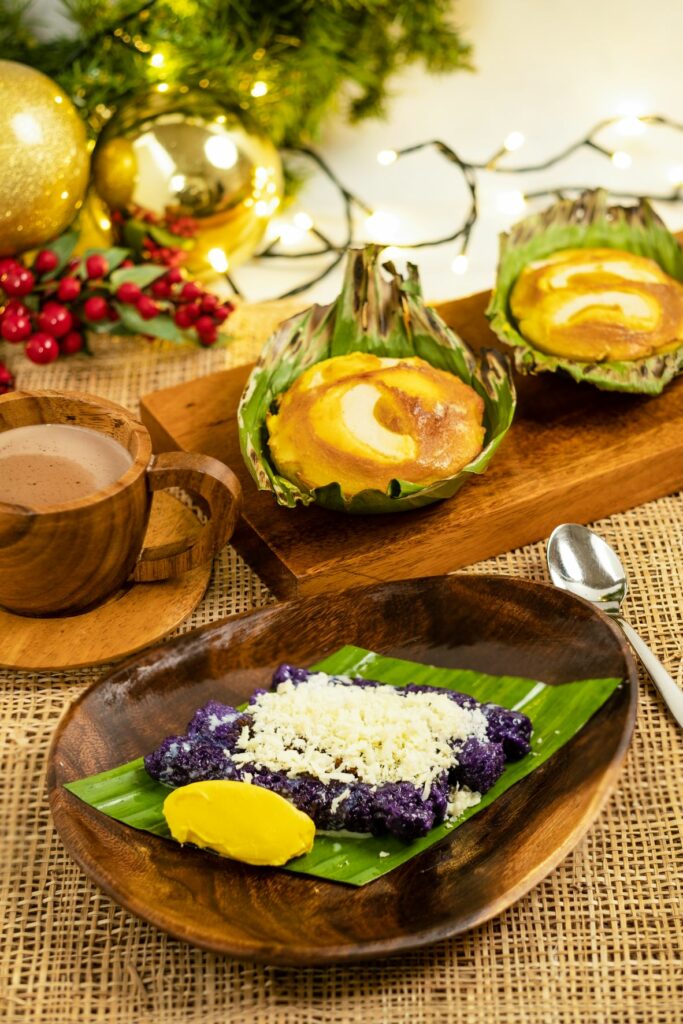
Holiday dining is made special with Okada Manila’s festive offerings. Feast on a bountiful spread at Medley Buffet’s “Holiday Medley Fiesta” for Christmas and New Year. And, for seasonal classic Filipino favorites, visit Kiapo for delectable puto bumbong (classic, cheese and leche flan flavors) and bibingka. At the Lobby Lounge, enjoy scrumptious sweets and treats such as decadent cakes, cookies, truffle chocolates, and pastries. The outlet also has Yuletide hampers filled with thoughtfully curated holiday goodies – a perfect gift that’s sure to impress.

A Season to Celebrate

With a diversified venue portfolio, Okada Manila makes a perfect venue for life’s milestone events and celebrations. Catering to groups of various sizes, the function rooms range from ballrooms to function rooms. Cove Manila, the biggest indoor beach club and night club is also open for bigger events. The award-winning Culinary team offers well-curated menus incorporated in events packages that make for memorable celebrations.

NYE Countdown to 2023

Ring in 2023 at Okada Manila’s simultaneous New Year’s Eve Countdown set to happen at the Grand Ballroom, Cove Manila, and The Fountain deck. Enjoy the revelry with distinctive Banquet and restaurant offerings, and an exciting line-up of live entertainment.

About Okada Manila

Touted as Manila’s grand icon, Okada Manila is known for its top-tier facilities and services. As a premier destination for hospitality and entertainment, the integrated resort has 993 exceptional accommodations ranging from 55-sqm deluxe rooms to 1,400-sqm villas complemented by extraordinary amenities such as the Retail Boulevard, the one-of-a-kind Cove Manila nightclub and indoor beach club, The Gardens by Manila Bay, an exciting array of dining options, a 3,000-sqm spa, and the world’s largest multi-color dancing and musical fountain.

Located just 10 minutes from the Ninoy Aquino International Airport, Okada Manila is just a few hours of air travel from neighboring China, South Korea, Japan, Singapore, and Hong Kong. It sets the new gold standard for five-star luxury with its many distinct innovations that combine advanced technology, top-class amenities, environment-friendly architectural planning, and world-class entertainment options, all delivered with the kind of exemplary service that personifies the unique blend of Japanese hospitality and Filipino warmth.


Spotlight is BusinessWorld’s sponsored section that allows advertisers to amplify their brand and connect with BusinessWorld’s audience by enabling them to publish their stories directly on the BusinessWorld Web site. For more information, send an email to online@bworldonline.com.

Join us on Viber to get more updates from BusinessWorld: https://bit.ly/3hv6bLA.

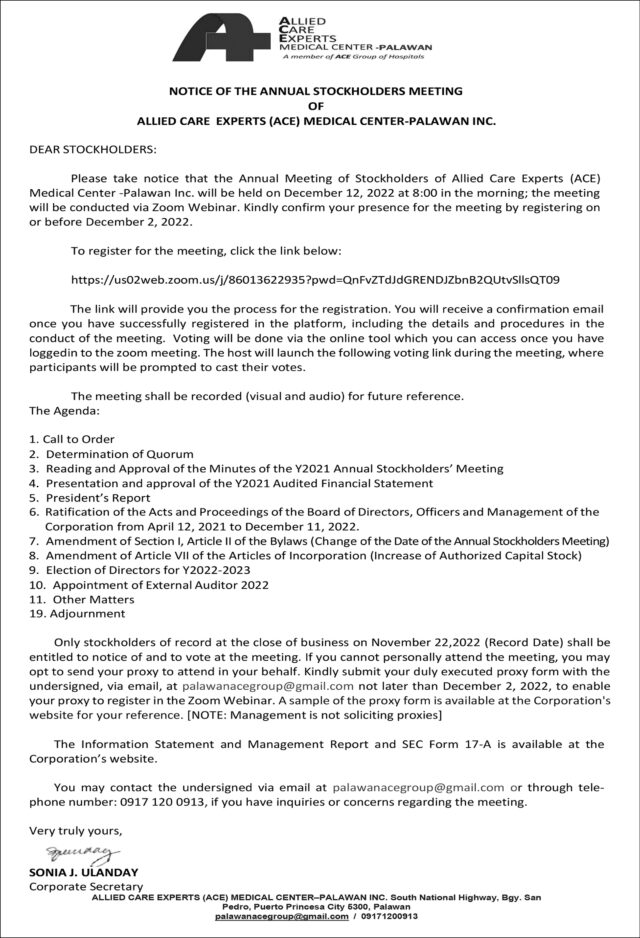
Allied Care Experts (ACE) Medical Center – Palawan, Inc. to hold annual stockholders’ meeting on Dec. 12


Spotlight is BusinessWorld’s sponsored section that allows advertisers to amplify their brand and connect with BusinessWorld’s audience by enabling them to publish their stories directly on the BusinessWorld Web site. For more information, send an email to online@bworldonline.com.

Join us on Viber to get more updates from BusinessWorld: https://bit.ly/3hv6bLA.

No more jumbo rate hikes — Medalla

BW FILE PHOTO

THE BANGKO SENTRAL ng Pilipinas (BSP) is ruling out another jumbo rate hike as it expects the US Federal Reserve to slow the pace of tightening in December.

BSP Governor Felipe M. Medalla said on Tuesday that the policy decision at its Dec. 15 meeting will depend on the latest move by the Fed, which will have its own meeting on Dec. 14-15.

“My own reading is that the US will keep on raising (rates) but no more 75 (basis points), so that will be a lot less painful for economic growth in the Philippines,” he told reporters on the sidelines of an event hosted by FinTech Alliance.PH. 

“But the outlook is that maybe the US will just do a 50 and a 25, of course I can be wrong. I think they are (done with 75 bps) and so are we.”

If the Fed will hike by 50 bps, Mr. Medalla said the BSP cannot afford to keep rates unchanged.

The US central bank raised rates by 375 bps since March, including its fourth 75-bp rate hike earlier this month, bringing its benchmark interest rate to a 3.75-4% range. 

Last week, the BSP increased its benchmark rate by 75 bps to 5% — the highest in nearly 14 years. It has so far hiked rates by 300 bps since May to tame inflation. 

Mr. Medalla said the Monetary Board’s next policy move will also depend on the latest inflation data.

Headline inflation stood at 7.7% in October, marking the seventh straight month that inflation breached the BSP’s 2-4% target range. In the 10-month period, inflation averaged 5.4%, still lower than the BSP’s revised 5.8% full-year forecast.   

Mr. Medalla said it is too early to tell if the BSP will likely pause its monetary tightening next year as inflation is still expected to stay above target in 2023.   

“Are we confident that inflation will return to the 2% (target) by second half next year? If inflation lasts longer than that, it could disanchor inflationary expectations,” he said.   

“What worried us is the last survey of analysts and economists, average inflation forecast is much higher than ours. It’s much higher than 3%. In the case of next year, it is much higher than 4%. That’s alright as long as they believe that it will be between 2% and 4%, possibly closer to 3%, by the second half,” he added.   

In 2023, the BSP sees average inflation settling at 4.3%, before easing to 3.1% in 2024. 

According to the BSP chief, its recent policy adjustments will help prevent lingering supply shocks.

Mr. Medalla said there is no need for another off-cycle move.

“I think we will succeed in controlling second order effects and when that happens, unless there are new shocks by the second half (next year)…wala na ’yung (there will be no) extra inflation,” he said.

Meanwhile, former BSP Deputy Governor Diwa C. Guinigundo said he believes the central bank is on the right track.

“While we may have different business and financial cycles, US Fed interest rate moves practically dictate the tempo and magnitude of monetary policy for many relevant economies,” Mr. Guinigundo said in a Viber message.   

“Otherwise, without an appropriate response, we might be seeing another round of peso depreciation with inflationary consequences,” he said, adding that the BSP needs to be careful in monitoring macroeconomic developments.   

Mr. Guinigundo said the fight against inflation might be less challenging next year.

“By next year, we should be reaping the rewards of this year’s tightening response. Those big moves somewhat compensated for the time lost in delayed policy response,” he said.

“The good economic outturn for the third quarter illustrates that the economy is resilient enough to absorb contractionary monetary policy and weaken those inflationary pressures,” he added.   

The Philippine economy grew by 7.6% in the third quarter, faster than the revised 7.5% in the second quarter. Growth in the first three quarters of the year averaged 7.7%. 

Bank of the Philippine Islands Lead Economist Emilio S. Neri, Jr. said staying in lockstep with the US Federal Reserve is necessary until inflation has been contained. 

“Otherwise, the authorities might be compelled to further deploy non-market-based policy tools to stabilize (the foreign exchange) along with domestic prices. The Philippines can afford to slow down on its hikes too if (by second half of 2023) inflation trends suggest a return to target by 2024,” he said.

“If, however, external and internal factors lead to persistence of above-target prints through late 2023, our inflation targeting central bank may not have the space to ease policy settings immediately,” he said. 

Mr. Neri also added that authorities should consider rebuilding the country’s dollar buffers before reversing its current policy tightening.

The country’s gross international reserves reached $94.1 billion as of end-October, up 1.9% from the $93 billion as of end-September. This was 12.8% lower than the dollar reserves of $107.89 billion as of end-October 2021. — Keisha B. Ta-asan

Rising rates may slow PHL credit growth

BW FILE PHOTO

PHILIPPINE BANKS may see slower credit growth next year due to the impact of higher interest rates, S&P Global Ratings said.   

In a report dated Nov. 17, S&P Global Ratings Primary Credit Analyst Nikita Anand said credit is expected to expand by 5-7% in the Philippines in 2023, slower than the 7-9% growth this year.

“This is because of our expectation of a 300-basis-point (bp) rise in policy rates in 2022. Given loan yields will rise with a lag, the full effect of the rate increase will be felt in 2023,” she said.

The Bangko Sentral ng Pilipinas (BSP) last week raised its benchmark rate by 75 bps to 5% — the highest in nearly 14 years.

Since May, the BSP has hiked rates by 300 bps to tame inflation and prevent the peso from further depreciating against the US dollar.

Ms. Anand said high inflation and interest rates will be downside risks for the Philippine economy “because they could dampen credit demand and affect highly indebted and lower-rated borrowers.”

S&P forecasts 6.3% gross domestic product (GDP) growth for the Philippines this year, slightly below the 6.5-7.5% government target.

It sees an average Philippine growth of 6.1% for the next three years, also below the government’s 6.5-8% goal.

Ms. Anand said interest rates may start to normalize in the next two years.

“We forecast policy rates could decrease by a total of 150 bps in 2023 and 2024 as inflationary pressures recede. However, if inflation persists and rates remain high, this could increase default risks for some leveraged and low-income borrowers,” she said.

Ms. Anand said large corporations are expected to remain resilient, which would reduce the impact on the banking sector’s asset quality. She noted banks will be able to absorb a “modest” rise in nonperforming loans (NPLs) from consumers and small businesses.

The banking sector’s credit losses are also seen to continue to decline next year.

“This is because most pandemic-related weak loans have either been recognized or restructured… If interest rates rise sharply and sustainably, this could also lead to higher defaults from the consumer and small to midsize enterprise segments. Banks’ disposal of NPLs to asset-management companies could bring down the level of weak loans visible in the system,” Ms. Anand said.

The banking industry’s NPLs dropped 14.6% year on year to P415.225 billion in September from P486.362 in the same month last year, , based on the latest data from the Bangko Sentral ng Pilipinas.

This brought the systemwide NPL ratio to 3.43% in September, easing from 3.53% in August, and 4.44% in September 2021. The September NPL ratio was the lowest in 25 months or since the 2.84% recorded in August 2020. — KBT

Prices of most noche buena goods rise ahead of holidays

PHILIPPINE STAR/ MICHAEL VARCAS
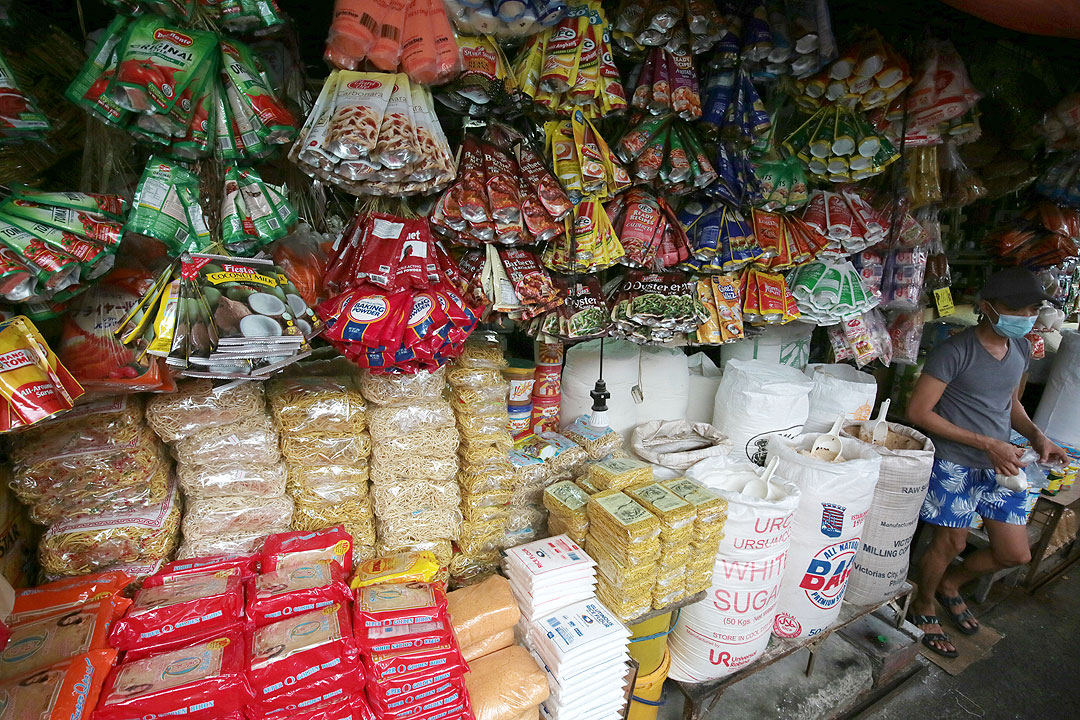
FOOD products typically used for Christmas meals, such as noodles and spaghetti sauce, are sold at Commonwealth Market, Nov. 8, 2020. — PHILIPPINE STAR/ MICHAEL VARCAS

MAJORITY of food products considered as Christmas staples by Filipinos will see an increase in prices ahead of the holiday season, with some pasta and spaghetti sauce items set to go up by more than 10%, the Trade department said.

The Department of Trade and Industry (DTI) is set to release on Wednesday (Nov. 23) its noche buena price guide, which includes prices of 223 shelf keeping units (SKUs) such as ham, fruit cocktail, pasta or spaghetti noodles, spaghetti sauce, and queso de bola.

In a statement, the DTI said the suggested retail prices (SRP) of 195 out of 223 SKUs of noche buena items will go up by 1-10%. The brands of these items were not released.

Of this, 94 food products will see a price hike of more than 10%. Prices of 51 items will go up by 6-10%, while another 50 products will go up by 1-5%.

The DTI said eight SKUs saw no price change, while two items reported lower prices. Eighteen new SKUs were included in the price guide.

“The prices of raw materials have gone up and we need to recognize that. (The price increases are) those (items) with heavy imported components and those that require heavy transportation demand,” Trade Secretary Alfredo E. Pascual told reporters on the sidelines of a conference in Makati City on Tuesday.

In a separate statement, the DTI Consumer Protection and Advocacy Bureau (CPAB) said the agency does not regulate or approve prices of noche buena products, unlike basic necessities and prime commodities included in the SRP bulletin as mandated by the Price Act.

“Also, retailers may have different prices because of the non-regulation of the prices of the Noche Buena products — but this is where free market competition comes into play,” CPAB said.

It added that price adjustments may have already been implemented by some manufacturers even before the guide is released.

“The price guide details were surveyed by the CPAB from Noche Buena products manufacturers. The manufacturers stated that these are their prices until the end of the year,” it said.

According to the DTI, the price of ham now ranges from P163-P892.50, versus P158-P862.50 a year ago. Most (13) ham products have increased prices by 1-5%, while seven had a 6-10% increase. Three ham products have raised prices by more than 10%, while four had no change in price and two had lower prices.

Prices of most spaghetti, elbow macaroni, salad macaroni and spaghetti sauce products went up by more than 10%.

For instance, a pack of spaghetti pasta now costs between P25.50 and P111, up by P4.50-P27 from a year ago.

The prices of elbow macaroni and salad macaroni have gone up by P4-P27.75 to P23-P119 and P39-P117, respectively.

Spaghetti sauce now retails for P23.55-P95.50, up by P1.55-P14.93, while tomato sauce is now at P17.25-P92.25, up by P1.20-P18.50.   

Fruit cocktail now costs P56-P288, up by 50 centavos to P33.05 from a year ago, while queso de bola has increased by P10-P56.65 to P199.50-P513.75.

The DTI said it continues to discuss with manufacturers how to ensure that consumers can access low-cost products in the market.

Meanwhile, the DTI-CPAB confirmed that it currently has notices of price increases for 55 SKUs (25 food and 29 non-food) from 15 manufacturers included in the SRP bulletin.   

The CPAB said it is still assessing the price increase petitions.   

“The increase is due to the high cost of imported and local materials, packaging materials, and overhead charges,” the CPAB said.   

Rising prices of goods are expected to further stoke inflation for the rest of the year. Headline inflation accelerated to 7.7% in October, marking the seventh straight month that inflation breached the Bangko Sentral ng Pilipinas’ (BSP) 2-4% target range.

In the 10-month period, inflation averaged 5.4%, still below the BSP’s revised average forecast of 5.8%.

Meanwhile, the DTI is boosting market monitoring efforts under a new program called the “Ikot Palengke Program Tamang Timbang, Tamang Presyo Para sa Mamimiling Pilipino.”

The program also seeks to establish the basis for the recommendations on the price ceilings of certain products, and boost consumer protection. — Revin Mikhael D. Ochave

ADVERTISEMENT
ADVERTISEMENT