Home Blog Page 5529

Fitch Solutions raises 2022 PHL GDP forecast to 6.6%

REUTERS

FITCH SOLUTIONS Country Risk and Industry Research said it raised its 2022 gross domestic product (GDP) growth forecast for the Philippines to 6.6%, citing its better-than-expected economic performance in the first half.

The full-year outlook factors in an expected growth slowdown in the second half due to headwinds in the global economy, Fitch Solutions said.

In a note on Thursday, Fitch Solutions said the new outlook represents an upgrade from the 6.1% estimate it issued in May. Its new forecast falls within the government’s 6.5% to 7.5% full-year target.

“The slowdown in growth (during the second quarter) was in line with our expectations, although the pace of deceleration — from 8.2% in Q122 to 7.4% in Q222 — was more modest than we had predicted,” Fitch Solutions said.

GDP growth in the second quarter slowed significantly from the 12.1% posted a year earlier, according to preliminary data from the Philippine Statistics Authority (PSA).

In the six months to June, GDP growth averaged 7.8%.

 “Overall, GDP growth in H122 benefited from the reopening of borders in February and election-related spending. Moreover, a relatively accommodative central bank has also supported consumption and investment to some extent,” Fitch Solutions said. 

The Philippines reopened its borders for foreign visitors on Feb. 10.  As coronavirus infections declined, Metro Manila and many other areas have been placed under the most permissive quarantine level since March.

The Philippines conducted national elections on May 9, with President Ferdinand R. Marcos, Jr. and Vice-President Sara Duterte-Carpio winning by a landslide.

“These tailwinds helped offset external headwinds stemming from elevated energy prices, a slowdown in the world economy, and tightening global monetary conditions. However, we believe that these tailwinds will continue to fade over the coming months, while growth headwinds intensify, leading to slower growth in H222,” Fitch said. 

Preliminary data from the PSA show the consumer price index rising 6.4% year on year in July, driven by food and transport costs.

July headline inflation was the highest in nearly four years, or since the 6.9% posted in October 2018.

In the year to date, inflation averaged 4.7%, against the 4% from a year earlier. This was also lower than the 5% forecast of the central bank. Inflation remains persistently above the 2-4% target band set by economic managers for the year.

“Against the backdrop of the ongoing Russia-Ukraine war and adverse weather conditions in a number of food-producing countries in the region, energy and food prices will continue to be a significant source of upward price pressure in the Philippines,” Fitch Solutions said.

The Bangko Sentral ng Pilipinas (BSP) has hiked benchmark rates by a total of 125 basis points (bps) so far this year, including the outsized 75-bp increase in an off-cycle move on July 14, to temper rising inflation expectations.

BSP Governor Felipe M. Medalla has signaled an increase of 25 bps or 50 bps at the monetary board’s Aug. 18 meeting and said further increases would be data dependent.

“We expect more monetary tightening by the BSP and central banks in developed markets over the coming months which will weigh on investment, and to an extent, private consumption,” Fitch Solutions said.

Fitch Solutions also expects the central bank toll hike rates by an additional 100 bps in its next meetings, bringing the policy rate to 4.25% by year-end.

The IBON Foundation, Inc. think tank called for more determined government action, with the growth slowdown in the second quarter reflecting a weakening recovery.

“Reopening the economy is not enough because too many Filipinos are still jobless, earn too little, and are forced to lower their consumption by inflation,” IBON said in a statement on Wednesday.

“Despite the economy reopening, the household spending of millions of Filipinos is repressed by high unemployment, (and the) pervasive poor quality … of work,” the group added.

According to preliminary estimates by the PSA in its Labor Force Survey, unemployment was 6% in June, unchanged from May.

However, the total number of unemployed hit 2.990 million in June, 62,000 higher compared to May.

According to IBON Foundation, inflationary pressures may drive unemployment higher in the coming months.

“This could worsen unless the new administration ensures that the 2023 national budget provides a substantial stimulus such as with significantly larger funds for social protection and support for small businesses and production sectors,” IBON said. — Keisha B. Ta-asan

Efforts to make fertilizer more affordable ongoing — DTI

THE Trade department is in discussions to help bring down fertilizer prices for farmers, an official said on Thursday.

“Regarding initiatives related to making fertilizer more affordable, discussions are ongoing,” Trade Undersecretary Carol P. Sanchez told reporters via Viber after being asked to comment. 

Discussions on providing more affordable fertilizer for local farmers are ongoing as part of government efforts to boost local food production and supply, an official from the Department of Trade and Industry (DTI) said on Thursday.

Ms. Sanchez declined to elaborate, saying that “it would be premature for Trade Secretary Alfredo E. Pascual to comment further at this time.”  

The Office of the President, through its official Facebook posted on Wednesday that President Ferdinand R. Marcos, Jr. met with DTI officials to discuss plans to access cheaper fertilizer.

Asked to comment, Samahang Industriya ng Agrikultura Executive Director Jayson H. Cainglet said that the current retail price of fertilizer has surged to P2,250 per 50-kilogram bag from P850 per bag last year.

“We met the President last week, together with the fertilizer industry. We laud efforts by the President in procuring cheaper fertilizer imports; either through government-to-government (G2G) or directly requesting importers to reduce prices,” Mr. Cainglet said via mobile phone.

Mr. Marcos has said the government will pursue fertilizer deals with China, Indonesia, Malaysia, Russia, and the United Arab Emirates on a G2G basis.

Federation of Free Farmers National Manager Raul Q. Montemayor said in a Viber message that the government should consider working on distribution plans while hammering out the G2G arrangements.

“I am not sure if the DTI is the right agency to handle fertilizer imports. Also, you need a lot of logistics to handle fertilizers. If price control is the objective, the local government units would be the better implementers,” Mr. Montemayor said. — Revin Mikhael D. Ochave

WB pledges support for PHL digitalization, government rightsizing

REUTERS

THE World Bank (WB) has expressed its intention to support the digitalization of Philippine government services en route to restructuring the bureaucracy, the Department of Finance (DoF) said.

“I am very pleased to hear of the World Bank’s willingness to extend support for further digitalizing our revenue agencies and modernizing civil service in line with the President’s goal of rightsizing the bureaucracy,” Finance Secretary Benjamin E. Diokno said in a tweet following a meeting with WB Group Country Director Ndiame Diop earlier in the week.

As of March, the WB was the Philippines’ third-largest source of official development assistance, with loans and grants representing 23.38% of the total.

“The bank has supported 68 program and project loans of the government since 2021 or over the last three administrations amounting to a total of $14.9 billion,” the DoF said in a statement on Thursday.

On Monday, Mr. Diokno and Mr. Diop discussed the alignment of the bank’s programs with the Philippines’ socioeconomic priorities.

Last month, the administration presented its eight-point socioeconomic agenda, which includes improving tax administration through digitalizing the collection agencies, broadening of financial inclusion, and rightsizing the bureaucracy.

“The World Bank is currently supporting the digitalization of the Bureau of Customs (BoC) through a $88.28 million financing for the Philippine Customs Modernization Program. The project focuses on transitioning from a largely manual and paper-based organization to a modernized BoC, achieving global standards and full modernization by 2024,” the DoF said.

The BoC has started ramping up the digitalization of its import and export processes, which were fast-tracked due to the pandemic.

At the meeting, Mr. Diokno also underscored the administration’s intent to modernize the civil service.

In his first State of the Nation Address, Mr. Marcos cited the National Government Rightsizing Program as a legislative priority.

The WB is currently supporting 15 ongoing programs and projects worth $4.96 billion, in areas like transport, rural development, disaster risk reduction and management, social protection, customs modernization, and COVID-19 response.

“Loans in the pipeline under the current administration include various programs and projects on health and nutrition, education, renewable energy, fisheries, transport, tourism, agriculture, and further reforms in the finance sector,” the DoF said.

“The DoF is also looking into tapping available support from the bank for natural disasters, including the recent strong earthquake that affected Northwestern Luzon,” it added. — Diego Gabriel C. Robles

NCR construction retail price growth at 13-year high of 6.8%

Workers are seen mixing cement at a construction site in Quezon City, May 19, 2020. — PHILIPPINE STAR/ MICHAEL VARCAS

RETAIL PRICE growth of construction materials in the National Capital Region (NCR) was 6.8% in the first half, the highest level in 13 years, the Philippine Statistics Authority (PSA) said.

An economist said on Thursday that the price growth was driven by inflation and the reopening of the economy.

Growth in the PSA’s construction materials retail price index (CMRPI) in the NCR accelerated from 6.2% in May and 1.2% a year earlier.

Metro Manila’s construction materials retail price index

In January 2009, the index posted growth of 7.4%.

In the first half, construction retail price growth averaged 5%.

Retail price growth in construction materials reflects activity by smaller-scale contractors or do-it-yourself hobbyists, as opposed to larger construction companies who buy their materials in bulk.

Asian Institute of Management Economist John Paolo R. Rivera said that inflation was a critical driver in the increase of the CMRPI.

He also added that international tensions such as the Russia-Ukraine conflict affect prices of materials due to supply chain disruptions. 

Inflation was 6.4% in July, the highest since the 6.9% reading in October 2018 as rising prices of fuel continue to affect other commodities and tight food supply pushes prices higher. 

The July inflation rate was at the upper end of the Bangko Sentral ng Pilipinas’ forecast for that month and well above the 2%-4% target band for 2022.

Among seven commodity groups, tinsmithry materials posted the highest growth rate to 9.4% in June from 8.3% in May.

The category’s year-earlier growth rate was 1.8%. 

Price growth also accelerated for plumbing materials (8.5% in June from 7.9% from May); painting materials and related compounds (4.6% from 4.1%); electrical materials (4.5% from 4%); miscellaneous construction materials (10.6% from 10.2%); masonry materials (4.3% from 3.9%); and carpentry materials (2.5% from 2.1%). — Bernadette Therese M. Gadon

Industry lobby says earthquake highlights threat from substandard steel products

OFFICE OF REP. ERIC GO YAP

THE Philippine Iron and Steel Institute (PISI), an industry lobby, said substandard steel products continue to proliferate, noting the widespread destruction caused by the recent northern Luzon earthquake.

PISI President Ronald C. Magsajo said the widespread use of low-quality steel bars was evident in the earthquake, whose epicenter was Abra province.

“The Philippines is prone to natural disasters. Just recently, we saw a magnitude 7 earthquake rock northern Luzon. We can only imagine the scale of destruction when low-quality steel products make their way into homes, buildings, bridges and other infrastructure,” Mr. Magsajo said in a statement on Thursday. 

Last year, PISI found that 35 stores carried substandard steel products in the wake of a “test buy” campaign in 16 provinces and six regions.

According to PISI, the campaign turned up 27 steel reinforcing bars that were substandard out of 130 purchased in test buys.

“One retailer in northern Mindanao was cited for violations while a request was sent to the Bureau of Philippine Standards (BPS) to also issue a notice of violation to Bukidnon Steel, which PISI found selling substandard steel,” it said.

In 2022, PISI conducted test buys in six provinces across four regions and found 10 stores selling substandard steel. 

“PISI has been helping regulators crack down on erring retailers and manufacturers as inflation together with the rising costs of fuel and energy, are causing less efficient mills to turn to producing substandard products,” it said. — Revin Mikhael D. Ochave

Intellectual property filings up 1.6% year on year in first half

FILINGS for intellectual property protection rose by 1.6% year on year in the first six months of 2022 amid a relaxation of quarantine restrictions, according to the Intellectual Property Office of the Philippines (IPOPHL). 

In a statement on Thursday, IPOPHL said that filings for patents, trademarks, utility models (UM), and industrial designs (ID) during the period totaled 23,410, up from 23,048 a year earlier.

The first half total also exceeded the equivalent pre-pandemic total by nearly 2%. In the first half of 2019, filings amounted to 22,968.

“The increase in the first half is reflective of the eased coronavirus disease 2019 (COVID-19) restrictions that reignited economic activity and IPOPHL’s amplified awareness and education initiatives,” IPOPHL Director General Rowel S. Barba said.

According to the agency, trademarks posted the largest increase during the period with growth of 2.9% to 20,300 filings. Residents of the Philippines accounted for 12,514 filings while non-residents filed 7,786 applications.

“Bulk of trademark filings were in pharmaceutical, health and cosmetic products (with 6,145 counts), followed by agricultural products and services (5,403) and scientific research, information and communication technology (4,697),” IPOPHL said.

It said patents posted a 0.10% improvement to 1,949 applications in the first half, of which 90% or 1,747 were filed by non-residents.

“The top fields for patent applications were in pharmaceuticals (1,272); organic fine chemistry (571); and biotechnology (370),” IPOPHL said.

ID filings, meanwhile, fell by 8.02% to 539.  

“Top industries for ID applications were in means of transport or hoisting (62); packages and containers for the transport or handling of goods (39); and furnishing (30),” IPOPHL said.

The agency added that UM filings in the first half of the year dropped by 21.7% to 622.

“Most of the UMs filed were in fields of food chemistry (211); other special machines (43); and information technology methods for management (39),” the IPOPHL said.

IPOPHL said copyright applications rose by 129% to 1,722, led by other literary, scholarly, scientific and artistic works (536); books, pamphlets, articles, e-books, audio books, comics, novels, and other writings (386); and photographic works (191), IPOPHL said. — Revin Mikhael D. Ochave

Bill seeks to develop handloom weaving industry

PHILSTAR FILE PHOTO

A SENATE bill is proposing to develop the handloom weaving industry and make its products more globally competitive.

Senate Bill 241 or the proposed Philippine Handloom Weaving Industry Development Act of 2022 hopes revive the trade and help weavers tap a broader global market.

Senate President Pro-Tempore Lorna Regina B. Legarda filed the bill to support the artisans “who continuously safeguard our country’s rich heritage.”

We must give our weaving industry a fighting chance,” she added. “Our handwoven fabrics deserve recognition.”

The National Handloom Weaving Department Council will be tasked with generating a roadmap for the industry, an intellectual property framework for textiles, and promoting textile-related Technical Skills and Vocational Education and Training.

It will be composed of representatives from the National Commission on Indigenous People, Technical Education and Skills Development Authority, National Commission for Culture and the Arts, and the Garments and Textile Industry Development Office of the Department of Trade and Industry.

“Handloom weaving is one of the most time-honored cottage industries in the Philippines and a resource for rural employment and income,” Ms. Legarda said. “The industry has a considerable role in rural development as well as a great source of cultural pride and national identity.”

If passed into law, P10 million will be appropriated from the national treasury for initial implementation. — Alyssa Nicole O. Tan

State of calamity extension rests on DoH, says presidential palace

PHILIPPINE STAR/ MICHAEL VARCAS

THE GOVERNMENT is leaving it to health authorities whether the Philippines should remain under a so-called state of calamity, the presidential palace said on Thursday, amid increasing infections spurred by more contagious Omicron coronavirus subvariants.

“It will depend on the recommendation of the Department of Health (DoH),” Press Secretary Trixie Cruz-Angeles told a news briefing. “We will make the announcement when the time comes,” she added.

The country’s state of calamity declaration will lapse on Sept. 12. The emergency use permits for coronavirus vaccines will also expire unless it is extended.

The state of calamity, which has been extended several times already, allows the government to continue its vaccination program, augment pandemic response funds, monitor and control prices of basic goods and provide basic services to affected people.

Emergency procurement, tax exemptions for donors, price controls for coronavirus drugs and benefits to health workers will also cease once the state of calamity is lifted.

President Ferdinand R. Marcos, Jr. last month ordered health authorities study whether there is a need to extend the declaration.

Meanwhile, Mr. Marcos said state decisions on pandemic response should be based on evidence.

“We can resolve… issues by employing cross-sectoral responsive evidence-based systems,” he told an event attended by scientists and health experts, according to a transcript sent by his office. “Evidence-based systems are all that we rely on.”

The president said the country should always be open to new findings, adding that information about COVID-19 has evolved so quickly.

“We cannot measure this pandemic by any other human experience,” he said. “And that is why we have to be very open and understanding and say… it is not something we already know, it is something that we very much do not know.”

“That is the openness that I speak about, especially whenever groundbreaking data or new findings debunk our usual beliefs,” he added. “This has happened. How many times did it happen during the pandemic where everything changed?”

He said a virology institute and local Center for Disease Control and Prevention would boost the country’s pandemic response. “I have presented to both houses of Congress the proposed creation of the Virology Center of the Philippines… so that we can consolidate in a better way all of the disparate research, all the different sources of knowledge,” he said.

The Philippines is also facing threats from monkeypox, for which the World Health Organization (WHO) declared a global emergency last month.

The Department of Health said 10 close contacts of the country’s first monkeypox case, which was confirmed last month, “are still undergoing the required quarantine period.”

The close contacts have not shown symptoms, it said in a Viber group message. “To date, there has been no new case of monkeypox in the country.”

Health officer-in-charge Maria Rosario S. Vergeire earlier said there should be sufficient immunity among Filipinos before the state of calamity is lifted. She also cited the need to increase booster coverage.

DoH has ordered the Food and Drug Administration to determine whether vaccine makers are ready to apply for a certificate of product registration so the drugs can be sold commercially.

The coronavirus has sickened 3.8 million and killed more than 60,000 people in the Philippines, according to the Worldometers website, citing various sources including data from the WHO. About 3.7 million have recovered from the virus.

There were more than 36,000 active cases, 737 or which were serious or critical.

Globally, the coronavirus has sickened almost 593 million people, killing more than 6.4 million. More than 564 million people have recovered.

At least 71.9 million Filipinos have been fully vaccinated against the coronavirus, with about 16.2 million having received their booster shots.

The Philippines added 3,181 coronavirus infections and 25 deaths on Wednesday.

Of the new infections, 1,100 came from Metro Manila, the Health department said.

The Philippines remained at low risk from the coronavirus despite rising infections, Ms. Vergeire said on Tuesday.

The average daily attack rate was 3.42 cases per 100,000 population, with national and all regions showing increased infections.

The use of intensive care units (ICU) in the country has steadily increased since the start of July, with 772 severe and critical admissions or 19.3% of the total, almost as high as the level in March.

ICU use in the Bangsamoro region was at moderate risk, while four other regions — Calabarzon, Western Visayas, Zamboanga Peninsula and Davao — were near the threshold at more than 40%.

Ms. Vergeire earlier reiterated projections that coronavirus infections in the capital region could hit 11,000 by the end of August.

Cases are expected to rise for the rest of the year if booster uptake remained low, people don’t comply with health standards and are allowed to move more freely, and more Omicron subvariants enter the country. — Norman P. Aquino and Kyle Aristophere T. Atienza

QC court stops NTC from blocking Bulatlat website

A QUEZON City trial court on Thursday granted Bulatlat.com’s plea to stop the National Telecommunications Commission (NTC) from blocking its news website.

In a resolution, the court said the order blocking access to the website violated freedom of speech and of the press.

“There is a violation or curtailment of plaintiff’s right to free speech and of the press when its publisher’s and readers’ access to its website was limited,” Associate Justice Dolly Rose R. Bolante-Prado said in the order.

“The court’s resolution is a powerful yet beautiful defense of constitutionally guaranteed press freedom,” Bulatlat tweeted. In June, the regulator ordered local internet service providers to block 26 websites that allegedly support the Communist Party of the Philippines, New People’s Army and the National Democratic Front.   

The order was issued upon the request of former National Security Adviser Hermogenes C. Esperon, Jr.

Bulatlat sued the NTC on July 8 and sought an injunction against the agency.

Meanwhile, the Commission of Human Rights (CHR) said it was consulting civic and grassroot groups on the United Nations’ (U.N.) mechanism to assess the human rights situation in the Philippines.

The U.N. universal periodic review is an important measure to ensure countries use the best practices in upholding human rights, CHR Executive Director Jacqueline Ann C. de Guia told a livestreamed news briefing.

“The purpose of the universal periodic review is actually laudable,” she said. “It aims to replicate and identify the best practices on human rights dimensions in a particular country.“

“We have been in dialogue with our partner civil society organizations in the past two months that gave us very robust discussions,” she added.

Ms. De Guia said the measure also draws attention to human rights issues in the country. The agency would submit a report to the  United Nations Human Rights Council.

Beverly L. Longid, an officer of Indigenous Peoples organization Katribu, told the same briefing indigenous groups still experience discrimination, red-tagging and land-grabbing.

Federation of Free Workers Vice President Julius H. Cainglet said the President Ferdinand R. Marcos, Jr.’s decision for the Philippines not to rejoin the International Criminal Court showed a lack of commitment to accountability.  

“This decision shows that inaction speaks louder than words,” he said.

Also on Thursday, lawyer Dino S. de Leon said the dismissal of bribery charges against his client former Senator Leila M. de Lima reinforces signs of fabricated evidence in her drug trafficking cases.

“The camp of Leila de Lima and Leila de Lima herself were glad that finally this particular case has been junked and has been called for what it truly is,” he told CNN Philippines. “It is a scam, it is a sham, it is inconsistent, it does not have a leg to stand on.”

“We are still hoping, and the reason why Senator Leila de Lima is fighting is that we cling to hope that one day justice will prevail.”

He added that Ms. De Lima, who has been in jail since Feb. 2017 for drug trafficking, was disappointed that it had taken the Ombudsman five years to dismiss the charges based on “sham testimonies.”

The Ombudsman dismissed bribery charges against Ms. De Lima and her former aide Ronnie Dayan as it found no probable cause for their indictment.

Ombudsman investigators filed a complaint against the former lawmaker and her aide accusing them of conspiracy to extort money from self-confessed drug lord Kerwin Espinosa

At least four witnesses have taken back their allegations on the former senator’s involvement in the illegal drug trade.

In a statement on Thursday, the Justice department said the Ombudsman ruling was consistent with a 2017 DoJ resolution that did not consider Mr. Espinosa’s testimony in the absence of corroborating evidence.

The drug trafficking charges are different from the bribery charges, it added.

In 2016, Ms. De Lima led a Senate probe into vigilante-style killings in Davao when former President Rodrigo R. Duterte was mayor and vice mayor of the city.

She was arrested a year later following allegations of her involvement in the illegal drug trade.

Ms. De Lima lost her reelection bid this year.

Political and human rights experts have said the former lawmaker’s detention showed how the Philippine justice system could be easily abused.

Human Rights Watch has said Ms. De Lima suffered five years in detention for a crime that key witnesses now dispute. — John Victor D. Ordoñez

Philippines ready with contingencies over US-China rift on Taiwan

The Arleigh Burke-class guided-missile destroyer USS Kidd and U.S. Coast Guard cutter Munro conduct Taiwan Strait transits August 27, 2021. — U.S. NAVY/HANDOUT VIA REUTERS

THE PHILIPPINES is prepared for disasters including a possible escalation of tensions between the US and China over Taiwan, its Department of Foreign Affairs (DFA) said on Thursday.

“There are always contingency plans in place, not just in China… but anywhere in the world,” Foreign Affairs Assistant Secretary Eduardo José A. de Vega told a news briefing. “They have contingency plans in place for any kind of disaster.”

“They are, in fact, in touch with employers, with local companies and Filipino community leaders to implement the strategic plans in case they are necessary,” he added.

“We hope that diplomacy and dialogue will always prevail in any flashpoint,” he added.

China has extended its military drills within the east and west coasts of Taiwan, despite an initial announcement of staying for only four days. Ballistic missiles have been launched, while attacks were simulated both within the skies and seas surrounding Taiwan.

China’s anger was sparked by House Speaker Nancy Pelosi’s visit to Taiwan. She was the highest-ranking official to visit Taiwan in 25 years. She said her visit is part of a “broader trip” to the Indo-Pacific region that focuses on “mutual security, economic partnership and democratic governance.”

DFA Assistant Secretary Daniel R. Espiritu told the same briefing the Association of Southeast Asian Nations had asked the US and China to hold a dialogue to resolve the issue peacefully.  — Alyssa Nicole O. Tan

Senate probes sought on flagged DepEd laptop contracts, CHED scholarship funds 

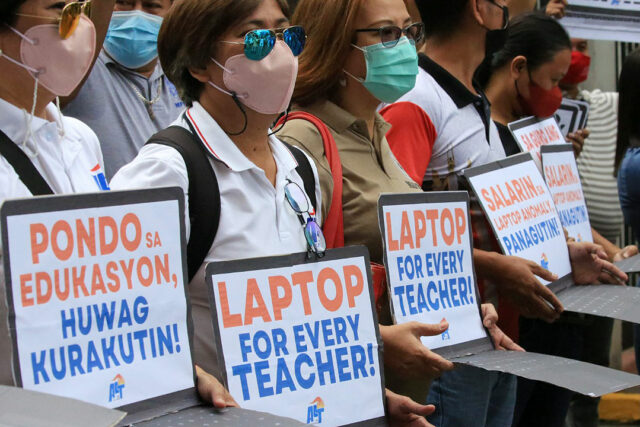
MEMBERS of the Alliance of Concerned Teachers hold a rally on Aug. 11 in front of the Department of Budget and Management office to call for accountability on laptop purchase contracts that were flagged by state auditors. — PHILIPPINE STAR/EDD GUMBAN

RESOLUTIONS have been filed at the Senate calling for separate probes on laptop purchases and scholarship fund disbursement by education agencies that were flagged by state auditors.   

Senate Minority Leader Aquilino Martin “Koko” D. Pimentel III filed Senate Resolution 120 to investigate the alleged overpriced and outdated laptops purchased by the Department of Education (DepEd) through the Department of Budget and Managements Procurement Service (DBM-PS).  

Mr. Pimentel said it is imperative for the DepEd and the DBM-PS to explain the basis for the charge in the unit price (from P35,046.50 to P58,300) and the number of laptop units (from 68,500 to 39,583) to be procured by the DBM-PS.”  

They must also explain the subsequent approval and acceptance of the DepEd of these laptops that were not in accordance with its budget and original specifications, he said.   

The laptops for public school teachers were procured for the implementation of distance learning amid the coronavirus pandemic. Funds were sourced from the Bayanihan to Recover as One Act with a budget of P2.4 billion.  

The Commission on Audit (CoA) said the price of the delivered units were too high for the technical specifications provided.  

The huge difference of P23,253.50 per unit price resulted in significant decrease by 28,917 laptop computers, purportedly for distribution to intended recipient-teachers which could have helped them in performing their tasks in the blended learning set-up, it said.  

The audit report also cited that the laptops were too slow as the processor was outdated.    

CoA also flagged the lack of documentary requirements, including one to support the fund transfer of the P2.4-billion budget to DBM-PS, which remained unliquidated at the end of last year. 

It is within the purview of the Senate Blue Ribbon Committee, and we look forward to the committee calling in these officials of PS-DBM so that these numerous issues are investigated,Senator Ana Theresia RisaN. Hontiveros-Baraquel said in a separate statement on Thursday.  

The characters from Pharmally seem to be reprising their earlier villainous roles in the new anomalies flagged by CoA,she added, referring to the allegedly overpriced medical supplies purchased by PS-DBM for the Health department.   

Meanwhile, Ms. Hontiveros filed a resolution to investigate the Commission on Higher Educations (CHED) scholarship unit over the questionable releaseof P7 billion worth of funds.  

State auditors reported that CHEDs Unified Student Financial Assistance System for Tertiary Education (UniFAST) had P3.4 billion worth of delayed and non-submissions of billings and documents to state and local universities and colleges.   

UniFAST is supposed to be the answer to the gap in education for millions of underprivileged youths. And yet the program is stained with suspicious overpayments and double reimbursements,Ms. Hontiveros said.  

We must be careful with the budget allocation for this, especially at a time when many are struggling to pay tuition,she added. This could be just the tip of the iceberg of dubious practices in CHED-UniFAST.”  

The resolution also cited that UniFAST made payments to universities and colleges without official receipts, released overpayments, gave funds to institutions that were already fully-subsidized, and had duplicate entries of beneficiaries, among other lapses.   

“For a country experiencing an education crisis, I am shocked by the billions we have been careless with,Ms. Hontiveros said. In the midst of these harsh circumstances that have affected the education of a whole generation, our agencies must shine light on these plausibly shady practices.Alyssa Nicole O. Tan 

Makati City to set up solar power systems in schools, gov’t offices 

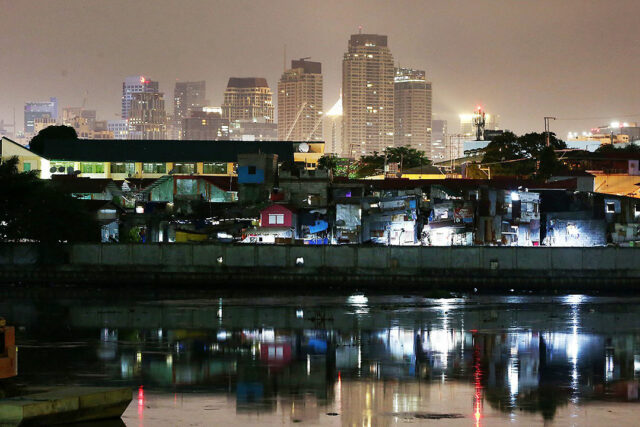
A VIEW of Makati City at night from across the Pasig River in Guadalupe, taken in May, 2020. — PHILIPPINE STAR/ MIGUEL DE GUZMAN

THE MAKATI local government will be installing solar power systems in schools and local government offices as part of its program towards a greener and more sustainable city, its mayor announced on Wednesday.   

“I am proud to announce that the city is procuring solar panels to provide a source of renewable energy in our schools and local government offices. This is part of our city-wide initiatives to reduce our carbon footprint and leave a greener and healthier environment for the next generation of Makatizens,Mayor Abigail Binay-Campos said at an event at the Comembo Elementary School as quoted in a press statement. 

Ms. Binay said the renewable energy source will also help the local government reduce power costs as well as provide an independent system to tap in case the main grid gets affected during disasters.      

The project, to be undertaken in phases, will cover 25 elementary schools, 10 junior high schools, and eight senior high schools. The Comembo Elementary School will be one of the pilot sites, according to the city government. 

The mayor said using green energy in schools will also be a way of creating awareness among students on the environmental impact of fossil fuel use and greenhouse emissions.  

On Friday last week, Ms. Binay formally declared a state of climate emergency in the city and announced initiatives to reduce greenhouse gas emissions in one of the countrys main business districts.   

Among the projects are the establishment of a smart public transport system with assistance from the Korea International Cooperation Agency (KOICA), which will provide $13 million.  

The fund will be used for the design and construction of an electric vehicle bus depot, control tower, electric vehicle buses, and systems for automatic fare collection, fleet management, and mobile passenger information. MSJ