Home Blog Page 5528

Lawmaker asks Malacañang to ensure funds for increased senior pension in 2023 budget 

PHILIPPINE STAR/MIGUEL DE GUZMAN

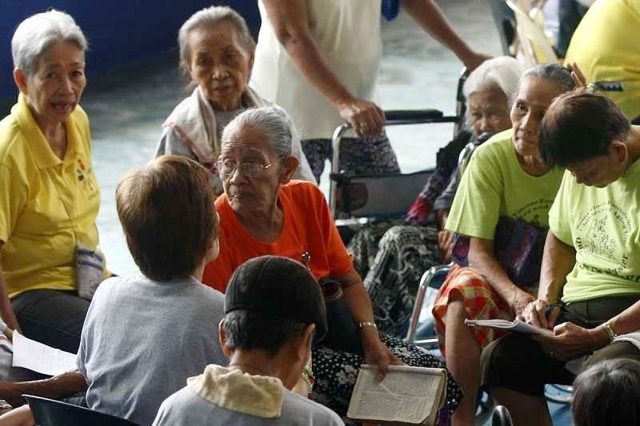
A SOLON has asked the executive branch to ensure the inclusion of a P25-billion additional fund in the 2023 budget to cover the increased monthly pension of indigent senior citizens provided under a new law.   

Republic Act No. 11916, which lapsed into law on July 30, doubled the pension rate of poor citizens at least 60 years old to 1,000 monthly from P500.  

We have to augment the allowance of poor seniors so that they can meet their daily subsistence, including health maintenance needs, considering the soaring cost of food and other basic commodities,Mr. Pimentel said in a statement on Sunday.   

This years P25-billion allocation for the Social Pension Program for Indigent Senior Citizens (SPPISC) covers 4.1 million beneficiaries identified by the Department of Social Welfare and Development. Matthew Carl L. Montecillo 

Senate bill filed on scholarship grants to public school teachers, their children 

DEPED.GOV.PH

A BILL that seeks to provide scholarship grants to public school teachers and their children has been filed at the Senate to entice more educators to join state-run institutions.   

In turn, more teachers would educate our growing number of public school students, enabling better quality of education to Filipinos and consequently resulting to more productive members of society,Senator Francis N. Tolentino said in a statement on Sunday.  

Mr. Tolentino, author of Senate Bill 399, said the proposed law is also a means of recognizing the important role of teachers.     

Under the proposed measure, eligible public school teachers will be given scholarship grants to obtain masters, doctorate, or post-graduate education related to the subjects or courses they are teaching.”  

Their children will automatically be given scholarship covering their elementary, secondary, and tertiary education.  

Eligible public school teachers include those in active service for at least two consecutive years prior to the date of application for the grant. Retired public teachers may also avail of the grant for their children in proportion to the number of years they were in service.    

Mr. Tolentino cited data from the National Center for Education Statistics showing there were about 3.3 million full-time and part-time public school teachers in the academic year 2017 to 2018. Alyssa Nicole O. Tan 

Solon says time to convene PHL Congress-Bangsamoro Parliament Forum 

PTV

A HOUSE representative from the Bangsamoro region has vowed to push for the immediate activation of a coordinating body between the Philippine Congress and Bangsamoro Parliament following Fridays appointment of the regions new transition team members.  

Lanao del Sur Rep. Zia Alonto Adiong said the Philippine Congress-Bangsamoro Parliament Forum is an important mechanism for ensuring aligned legislative initiatives between the national government and the autonomous regions own law-making body.   

It is therefore one of my sole priorities to lobby before the current House leadership to finally convene and activate the said legislative forum in order to facilitate the partnership between our national legislature and its counterpart in the Bangsamoro region which is essential in achieving synergy necessary for an inclusive growth and development in our country,Mr. Adiong said in tweet on Friday.   

The forum is required under Republic Act 11054 or the Bangsamoro Organic Law.   

It is intended as a mechanism for cooperation and coordination for legislative measures involving both regional and national governments.  

Among the common issues are the creation of new legislative districts, new laws that may affect the implementation of the Bangsamoro law, and proposed measures that will impact the work and public services of the Bangsamoro government.   

In November last year, the Bangsamoro Parliament approved a resolution supporting the forum through the establishment of a secretariat in the capital region and designating 11 members as representatives to the national-regional body.   

A new set of Bangsamoro Transition Authority (BTA) members composed mostly of reappointments and new ones from previously under- or un-represented groups were sworn into office Friday by President Ferdinand R. Marcos, Jr.  

The 80-member transition team, who will have a three-year term, is led by the Moro Islamic Liberation Front (MILF). They compose the regions administration and parliament.   

The transition period in the Bangsamoro Autonomous Region in Muslim Mindanao (BARMM) will end in 2025, during which the first regional elections will be held.    

UNITED BARMM
Presidential Peace Adviser Carlito G. Galvez, Jr. said the new transition team represents a United BARMMwith members from the Moro National Liberation Front (MNLF).  

With the joining of the MNLF and the MILF, and with the balancedand fair/equitable composition of the 39 (Philippine government) nomineesthis is now no longer just the BTA of the old BARMM but the BTA of a United BARMM,Mr. Galvez said during Fridays ceremony in Malacañang.  

The peace adviser said the BTA composition represents a convergence of all peace initiatives, namely: 1976 Tripoli Agreement, 1996 peace agreements with the MNLF, and the 2014 Comprehensive Agreement on the Bangsamoro signed by the MILF.   

Among those new members of the BTA, are Abdulkarim Misuari and Nurrheda Misuari, children of MNLF Chair Nur Misuari.  

Bangsamoro Parliament Minority Leader Laisa M. Alamia, among those reappointed, welcomed the confirmation of the new BTA members, whom she said underwent a rigorous vetting process.”  

We welcome the appointment of the new set of Parliament members, and we hope to continue working together given our new roles within different sectors in the region,she said in a statement. Our work towards just and lasting peace in the Bangsamoro continues.MSJ 

16 roads covered by number coding scheme; full implementation starts Aug. 18

PHILIPPINE STAR/ MICHAEL VARCAS

THE 7-10 a.m. number coding scheme in the capital region, which restricts private vehicles from roads once a week based on the plates last number, will be on a test run for three days and full implementation starts Aug. 18, a Metropolitan Manila Development Authority (MMDA) official said at the weekend.  

Number coding is not something new. We are just changing the window hours but then again, we will have a sort of a dry-run, Monday to Wednesday,Edison “Bong” L. Nebrija, MMDA head for special operations, said in mixed English and Filipino in an interview with TV5s One Weekend Balita on Saturday.   

This means no penalties will be imposed until Wednesday, but violators will be apprehended for information dissemination, he explained.   

Both physical and no-contact apprehension systems will be in effect for the full implementation of the vehicle reduction program.   

Mr. Nebrija said the coding scheme will cover 10 major roads and six circumferential roads, including Alabang Zapote road, E. Mabini Street, Marcos Highway, and MacArthur Highway in Valenzuela City.  

MMDA said last week the reimplementation of the traffic reduction program in the morning is in line with the expected increase in vehicle volume with the resumption of classes on Aug. 22.   

The number coding scheme will also remain in effect from 5-8 p.m. on weekdays.   

The following are exempted: Public utility vehicles, transport network vehicle services, motorcycles, garbage trucks, fuel trucks, marked government vehicles, fire trucks, ambulances, marked media vehicles, and motor vehicles carrying essential and/or perishable goods. MSJ 

The Jagna Baywalk Mangrove Belt and Mayor Joseph Rañola

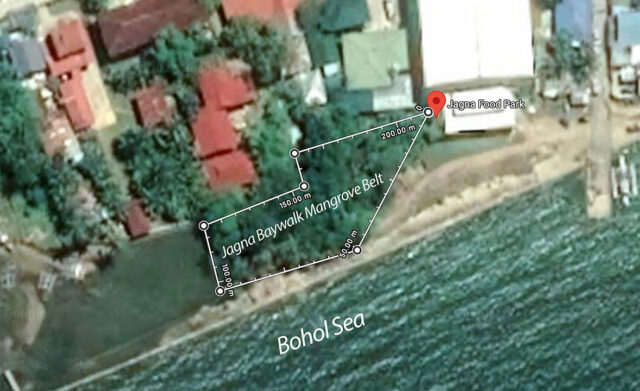
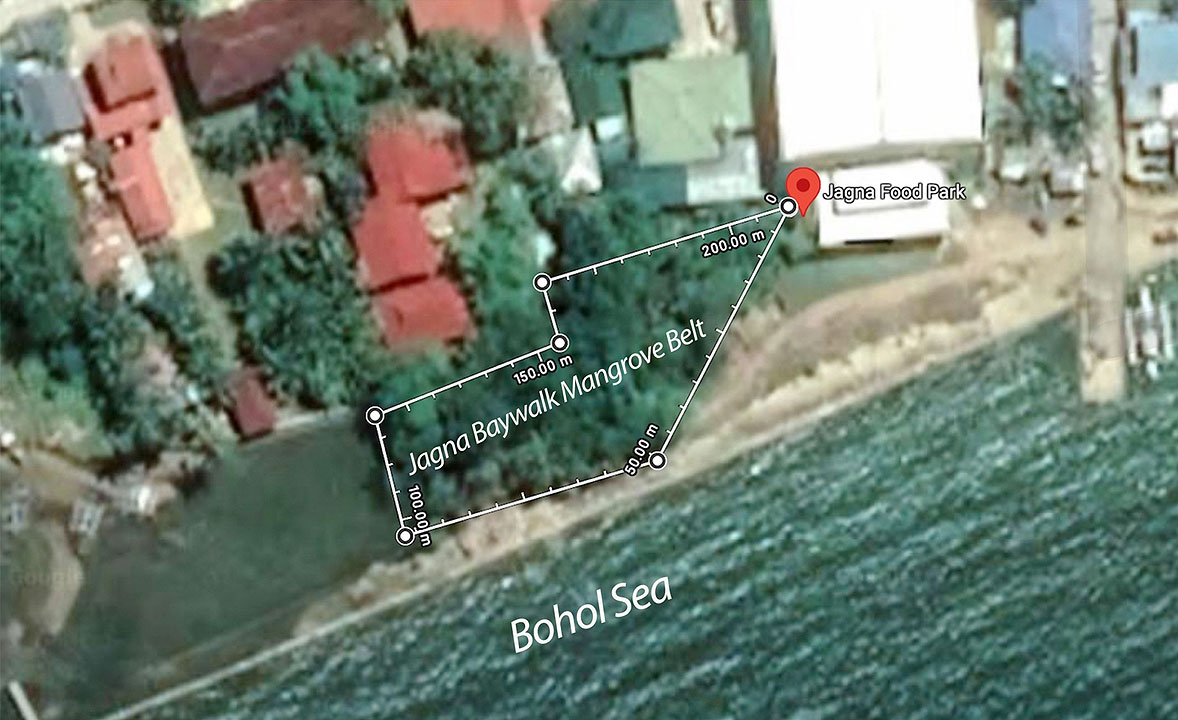
GOOGLE EARTH MAP showing the location of the Jagna Baywalk Mangrove Belt.

Jagna is a port town located 63 kms east of Tagbilaran, Bohol, or 76.3 km from the newly constructed Panglao International Airport. It faces the Bohol Sea to the south, facing Mindanao, and is otherwise surrounded by mountains of lush green forest. A town in a great hurry in the last decade, it has attracted a McDonald’s fastfood restaurant, a 7-Eleven 24-hour convenience store, a mall and supermarket of the Bohol Quality chain, a brand-new Jagna Food Court, newly concreted side-roads, and end-to-end solar street lighting. The latter means that the “grid down episodes” common in Bohol no longer mean night darkness for Jagna-anons.

More importantly, Jagna hosts the justifiably renowned Central Visayan Institute Foundation (CVIF), home of the Dynamic Learning Program (DLP) which has produced singular learning outcomes in secondary education, defying the landscape of learning poverty lately documented by the 2018 PISA (Program for International Student Assessment) performance league table. The DLP, which has attracted adoption by over a hundred private and public high schools, is the brainchild of the dynamic physicist duo and Magsaysay awardees in education, Drs. Christopher Bernido and Maria Victoria Carpio-Bernido (may she rest in peace).

The municipality has an ambitious and ongoing building program which includes the scenic Jagna Baywalk which is also designed to serve as a concrete storm surge protection.

Leading the charge in this journey to an aborning progressive rural Philippines is newly re-elected Mayor Joseph Rañola. That he won his second term by a mere hundred votes says something of his peculiar approach to politics — he has a dim view of the traditional politics of pressing flesh and endless individual patronage. Rather, his philosophy seems to go: “Ang buhat ang pasultion” (“Let accomplishments do the talking.”). That is, provide public goods projects that serve all at once, like the solar street lighting, the new Sports Complex, newly concreted side roads, and the Jagna Baywalk. As we go into the Mandanas era of a higher local government share in central government tax revenues, this is the type of local governance that re-assures us that the new revenue flows will not be squandered. It is, however, rather rare and is not without its pitfalls.

The ongoing construction of the Jagna Baywalk threatens to block access to the sea of a beautiful patch of mangroves. Being blocked from seawater access means a death sentence to any mangrove patch. Our position is that the Jagna Baywalk itself would be more effective and in keeping with Bohol’s green image if conjoined with a lush mangrove belt, the Jagna Baywalk Mangrove Belt.

Mangrove forests have suffered massive degradation in the Philippines and elsewhere due primarily to land-use change such as fishponds, resorts, and infrastructure development. But mangroves are hugely useful to humanity and Boholanos: they serve as a buffer against storm surges, as a nursery for fingerlings, as a home for crustaceans, and as a lush aviary. More apropos in this climate change era, they also sequester carbon that otherwise would aggravate global warming.

This Jagna Baywalk Mangrove Belt covers an area of 1,658 sq.m. of robust pagatpat and statuesque bakawan mangrove species. This tiny patch serves as a sink for about 22 tons of carbon stock or about 82 tons of carbon dioxide. The contribution is small by itself, but multiplied a million times it could mitigate the global climate imbalance. It served precisely as a shelter against the December 2021 storm Odette — exactly as Dr. Jurgenne Primavera’s “Greenbelt Initiative” envisioned. This also serves as an advance guard of the “concrete action” extension of National Academy of Science and Technology’s (NAST) Pagtanaw 2040. The nice thing is that mangrove greenbelts regenerate themselves quickly and beautifully, pushing back on the Second Law of Thermodynamics, while concrete walls do not. Resilience dictates that while we resort to concrete for quick results, surge protection is most effective and lasting when buttressed by nature itself, thus, mangroves.

To this effect, Dr. Christopher Bernido had written to Mayor Rañola about the fate of the Jagna Baywalk Mangrove Belt. The mayor in turn called an all-stakeholders meeting: himself presiding, ourselves, his development staff, the private contractor, and the local branch of the DPWH (Department of Public Works and Highways) in a freewheeling discussion of the issue.

It turns out there was a strong generalized awareness about mangrove protection but especially from the mayor himself. Having grown up in these parts, the mayor revealed that this patch was originally planted by Chris’ own parents, then Governor Esteban Bernido and Consuelo Bernido. It was agreed that a substantial canal be explicitly provided in the plan and maintained to permanently connect the mangrove patch with the sea. It is important that there is a continuing exchange of plant and fish life between the sea and the mangrove patch. Now adjacent to the mangrove patch is an open brackish water shore area perfect for the expansion of mangrove belt. The Jagna Mangrove Belt will best serve a better surge protection if extended unto this brackish shore space.

Upon ocular inspection, however, it appears that the dike being constructed suggests a creeping land reclamation project on top of the storm surge protection. The construction work, advertently or otherwise, now threatens to overrun the empty space ideal for mangrove reforestation. This open space has experienced reforestation efforts by private groups but which have not yet borne fruit and require local government reaffirmation.

In Panglao Island, Bohol, the provincial government under then Governor Edgar Chatto simply rejected the business community’s proposal to reclaim a portion of the sea as it would annihilate a very important mangrove forest. This was then a signal victory for Green Bohol. We are confident that Jagna Mayor Joseph Rañola will ensure that the Jagna Baywalk Mangrove Belt will become yet another signal victory for Green Bohol.

The battle for Mother Earth has to be fought and won one square meter at a time.


Raul V. Fabella is a retired professor of the UP School of Economics, a member of the National Academy of Science and Technology and an honorary professor of the Asian Institute of Management. He gets his dopamine fix from bicycling and tending flowers with wife Teena.

Getting the diagnostics right — 2

(Part 2)

To efficiently use scarce resources and political capital at this given time, we need a set of policy priorities that addresses the principal bottlenecks, or the binding constraints. The binding ones, if not addressed, would disrupt investments and growth. Thus, targeting the binding constraints has the largest effects and benefits. The first part of this paper (BusinessWorld, Aug. 7, 2022) presented the growth diagnostics approach, as elaborated by Ricardo Hausmann et al. (2005). For the concluding part, using the growth diagnostics framework, we do an exercise and examine the post-2022 elections challenges.

The first question to ask is: What constrains private investments in the Philippines?

Using the problem tree introduced by Hausmann et al., we test the first possible constraint: the high cost of finance. While debt sustainability is a key concern for the country, with the National Government’s total outstanding debt levels reaching P12.76 trillion at the tail-end of the Duterte administration in April 2022, the absolute amount of debt in itself is not worrisome. What matters more is the country’s capacity to pay.

Philippine interest rates remain low, notwithstanding the Bangko Sentral ng Pilipinas’ (BSP) recent series of increases in policy rate. The current rate is 3.25%, which is still below the current inflation rate of 6.4%.

While global interest rates are rising, the country is not dependent on external financing, with almost 70% of the National Government’s debt portfolio being sourced from domestic borrowings. Thanks to fiscal reforms put in place during the Aquino and Duterte administrations, we have an investment-grade credit rating and can thus avail ourselves of lower interest rates.

With regard to the country’s capacity to pay, our debt ratios are not yet at unmanageable levels. Some express concern over our 63.5% debt-to-GDP ratio, as it leans towards the end of the threshold for emerging markets (according to Thomas Grennes et al., 2013). However, this paper was written way before the COVID-19 pandemic. Extraordinary circumstances or catastrophes necessitate much heavier spending and borrowing. Further, as Oliver Blanchard (2022), wrote, one cannot have “some universal magic number” to determine what is unsafe debt.

To illustrate, our current external debt service ratio (DSR), or the ratio of principal and interest payments to exports of goods and receipts from services and primary income, stood at 4.1% as of end-March 2022. Our DSR ratio in 1988, on the other hand, went as high as 56.9% before rescheduling.

We do acknowledge, however, that we must be careful. The current debt levels, long-term economic issues brought about by the pandemic, and the current issues brought about by the Ukraine-Russia war compel the government to be fiscally responsible and ensure that debt is being spent productively.

The discussion above eliminates the high cost of finance as a binding constraint to economic growth in the Philippines at this moment. We then review the possibility of low returns to economic activities. This rubric has two sub-categories: low appropriability and low returns to investment.

Under low appropriability, one macro risk we identify as a binding constraint is the country’s shrinking fiscal space. Although we have access to financing, given sound debt management and creditworthiness, the pandemic has increased borrowing and spending, causing an abnormally high deficit.

Thus, we have to gradually unwind the deficit spending, as the economy begins to recover. While we still have fiscal space, we cannot ignore the combination of an abnormal deficit and the pressure for high, productive spending for pandemic response, social protection, infrastructure, climate change, etc. And of course, we need to be prepared for lingering and future economic shocks which are becoming frequent. We need revenues to grow out of our debt and must avoid additional borrowing; this calls for a fiscal consolidation and resource mobilization plan, which the Department of Finance (DoF) is currently pursuing.

Other issues we identified as binding constraints under low appropriability include our inflation rate that has significantly exceeded government target (macro risk) and the weakness of our agriculture sector (micro risk). Inflation, which is at its highest since 2018, is caused mostly by supply shocks for fuel and food. The BSP has increased policy rates to address inflation expectations (quite aggressively, with a hike of 75 basis points), but addressing supply bottlenecks requires other solutions.

To address the supply bottlenecks, it is crucial to look at the agricultural sector and address the issue of inadequate food supply, which causes worrisome inflation. Data from the Philippine Statistics Authority (PSA) showed that the agriculture sector only grew by 0.2% in the second quarter of 2022. The low productivity and high prices of agricultural commodities can be attributed to the high trade protection for commodities (such as out-of-quota rates for sugar, corn, coffee, pork, and chicken) and low budgetary support for agriculture and misallocation of resources.

Lastly, under the sub-category of low social returns (e.g., human capital), the COVID-19 pandemic remains to be a binding constraint for our economic growth. We have insufficient investments in health, making our health system extremely sensitive to surges in COVID-19 cases. The pandemic has deeply scarred our economy and aggravated other social concerns such as education, nutrition, care, and social protection. Universal healthcare is still far from becoming a reality for all Filipinos, and without a robust primary healthcare system, we cannot ensure decongestion of hospitals when COVID-19 cases rise. As the virus evolves, our health system is still very vulnerable to infection spikes. Surges and the corresponding tightening of restrictions would impede our economic recovery in our heavily service-based economy.

Given the four binding constraints identified above (shrinking fiscal space, high inflation, weak agriculture sector, and the COVID-19 pandemic), the policy reforms we need to prioritize are the following:

First, to address the shrinking fiscal space, we need smart taxes which result in efficiency (for example, taxing harmful products and thus addressing negative externalities). Complementing new taxes are improving tax administration and rationalizing spending by removing waste and combating corruption.

In line with this, we support the proposals to push for Packages 3 and 4 of the Comprehensive Tax Reform Program of the previous administration, namely the Real Property Valuation Act and the Passive Income and Financial Intermediary Taxation Act. We also support the DoF’s move to impose VAT on digital service providers. This, however, will only have an average annual revenue impact of P13.2 billion. A better source of revenue, as stated above, is an increase in excise taxes on sin products such as tobacco, e-cigarettes, alcohol, and sugar-sweetened beverages.

To address inflation expectations, we expect the BSP to pursue an independent monetary policy that will stabilize prices without sacrificing growth. We need to provide targeted, time-bound subsidies to protect the vulnerable, such as lower-income families, public utility vehicle (PUV) drivers, and farmers, from shocks. But we must also ensure the supply of food, even if it means increasing imports, while also increasing budgetary support for farmers’ productivity. We need to increase productivity and efficiency and boost farmers’ income by consolidating land to achieve economies of scale, introducing technological innovation, and making farmers “bankable” by allowing agricultural assets as collateral.

Lastly, to address COVID-19, we must make the country pandemic resilient by pushing for the adoption of the “health in all policies” framework. In this regard, we emphasize that 80% of health problems can be attributed to socio-economic factors and individual behavior, not to health or pharmaceutical care.

The prevention of severe diseases and deaths from COVID-19 requires a whole-of-government, whole-of-society mobilization. Take the case of airborne transmission, which is the dominant mode of COVID-19 infection. Everyone, not just the Department of Health or medical professionals, is now responsible for ensuring adequate ventilation in public spaces, especially in crowded spaces such as malls, schools, and public transportation.

The pandemic also highlights the urgent need to implement universal healthcare and anchor it in primary healthcare. Here, the tasks are: Strengthen the institutions that handle public health emergencies. Have sustainable health financing generated from a combination of general taxes, health taxes, premiums or contributions, and reallocation of general appropriations. Boost social protection through targeted cash transfers, unemployment insurance, and similar subsidies.

The objective of the growth diagnostics is to outline priorities and give attention to the binding constraints (and thus not to be distracted by the non-binding constraints). In this manner, we conserve political capital and use it wisely. Some can argue, understandably, that other issues are notably missing. However, the binding constraints identified are interconnected with other issues. Removing the binding constraints would likewise alleviate the constraints in other areas. For example, the education crisis in the Philippines is partially caused by the disruption brought about by the pandemic and the shift from face to face to online schooling. Mitigating the impact of the pandemic and capacitating ourselves to handle future shocks will subsequently aid the safe return of students to face-to-face classes. This is not enough, and much more needs to be done to strengthen the education system, but at this very moment, addressing COVID-19 will relieve much of the burden faced by our students, teachers, and administrators.

On infrastructure, the government must maintain higher spending as a proportion of GDP. But this can be enabled by having broad fiscal space.

The four binding constraints are deeply intertwined. The pandemic stands out as a critical bottleneck, as our poor pandemic response (which has consistently landed us at the bottom of global pandemic resilience indices) has been constraining economic recovery for the past two years. Even though we have reopened our economy and cases have significantly dropped, pandemic-induced supply shocks are still one of the primary causes behind soaring prices. These supply shocks, particularly addressing food and fuel, will require bold fiscal, trade, and agriculture policies. The pandemic, the supply shocks and the attendant high prices have led to shrinking fiscal space. This requires new revenues. Otherwise, we face the danger of budget cuts on key programs and the reversal of important gains made in fiscal reforms in the past decade.


The authors belong to Action for Economic Reforms.

How trade sanctions on Russia backfired in Europe

DANIELLE RICE-UNSPLASH

The stiff economic sanctions imposed by the US and Europe on Russia backfired. The biggest loser is Europe. Ironically, Russia has benefitted the most.

Following Russia’s invasion of Ukraine, the US and Europe waged a separate war on Russia, one fought not with bullets but with finance, food, and fuel.

It will be recalled that following Russia’s invasion of Ukraine last February, the US and Europe joined forces to impose stiff economic sanctions meant to cripple the Russian economy. With its economy impaired, it was expected that Russia would withdraw from its Ukrainian crusade and accept defeat.

In rapid succession, Russian exports were banned from NATO-associated economies. Multinational companies like Zara, Puma, Starbucks, and McDonalds withdrew from the Russian market, causing an exodus of capital and loss of jobs. Stiff duties — as high as 35% — were imposed on Russian vodka. Importation of Russian gold was banned. Russian forex reserves, worth some $300 billion, were frozen. Russia was banned from the global SWIFT network, cutting it off from the world financial system.

The US and Europe hit Russia hard in the realm of finance. But Russia hit back in food and fuel.

Russia and Ukraine account for 29% of the world’s supply of wheat, 20% of corn, and 80% of sunflower oil. When Russia cut off supplies of these commodities, food prices soared, especially in Europe. As of last May, food inflation across the EU was at its highest level in 20 years. Unprocessed food inflation stood at 11.1% while processed food inflation stood at 7.5%. Even wealthy economies of the EU felt the pinch.

But while the EU can still cope with food inflation, it cannot live without Russia’s gas. Fuel is Russia’s strongest leverage against Europe.

You see, 42% of Europe’s natural gas comes from Russia. It is transported to the continent via the Nord Stream 1 pipeline, a 1,224-kilometer underwater pipeline that runs from Vyborg in Russia to Germany via the Baltic Sea. From Germany, the gas is transported across the European continent through secondary pipelines.

Most European countries depend on Russian gas to sustain themselves. Finland is 94% dependent on Russian gas, Bulgaria 77%, Slovakia 70%, Germany 49%, Italy 46%, and Poland 40%.

Europe’s dependence on Russian gas is due to the fact that LNG gas requires multiple terminal facilities to turn the gas from a gaseous state to liquid and vice versa. It also requires a network of pipes to transport the gas from the terminals to various silos on the continent. Although Europe has many terminals to process LNG gas, it does not have sufficient pipelines to transport it to the hundreds of silos in 28 countries. This is because Europe’s system was built around the Russian gas supply. Its infrastructure was not built to accept gas coming from alternative gas suppliers like Qatar and the US. So even if the US and Qatar provide Europe with 100% of its fuel requirements, Europe will not be able to absorb it.

Putin made two strategic moves following the imposition of economic sanctions. First, he cut gas supply to Europe by 60%. This caused prices to skyrocket, allowing Russia a windfall of revenues for less fuel sold. This caused fuel prices to increase by 37% in the US and 144% in the EU, further impairing these economies. Second, Putin decreed that purchases of gas from Russia can only be transacted in Russian rubles. This caused the ruble to become the best performing currency worldwide. It made Russian imports cheaper.

Contrary to common belief, Russia was never cut off from world trade. She still has her allies in this war, notably China and India, the 2nd and 5th largest economies in the world, respectively. Trade between these countries never ceased, allowing Russia its steady supply of basic essentials like food and medicines. Conversely, the Chinese and Indians continued to purchase Russian agricultural and industrial products, thereby providing it a steady revenue lifeline.

As if things are not bad enough for Europe, their situation is looking bleaker as winter approaches. Without sufficient gas to warm the continent, Europe faces the prospect of worsening inflation. Unfortunately, stockpiling for the harsh winter months can only provide partial relief since fuel silos across Europe can only accommodate a 90-day supply.

So, despite all the sanctions meant to cripple the Russian economy, Europe finds itself at the mercy of Russia today. It will be interesting to see how Europe reacts as winter approaches. Europe’s next moves could be the deciding round in this war.

******

Spain was well represented in the World Food Expo Philippines (WOFEX) held in Pasay earlier this month. The Spanish delegation was headlined by the Inter-Professional Agri-Food Organization (Interporc), a non-profit organization that represents the Spanish pork sector. Interporc came to deepen Filipino appreciation of Spanish white pork and to expand its markets.

As many of my regular readers know, my wife and I are foodies who travel the world in pursuit of the best food and produce. I can attest that Spanish pork is second to none. We once tried preparing Crispy Pata while in Madrid using Iberico pork. It took the dish to the next level in all respects — crunchiness, succulence, and tenderness. Spanish pork is more flavorful as the pigs are fed acorns and corn.

Among the exhibitors at WOFEX whom I spoke with were Bopepor (www.bopepor.es) and Faccsa (www.faccsa.es), both of whom produce specialty pork cuts and whole pork carcasses for export. One company I found most interesting is Emcesa (www.emcesa.com,). Emcesa is in search of Filipino distributors for its line of ready-to-eat Spanish dishes such as cocido, callos, chorrizos, costillas (stew, tripe, sausages, ribs), etc. I sampled their products and they were excellent.

Filipinos can readily import Spanish pork products without complications. Last year, the Philippines imported 157,797 tons of pork from Spain, representing 27.03% of our total pork imports.

Also on offer were my personal favorite wines from Bodegas Frutos Villar. Grown in the region of Toro, Cigales, and Ribiera del Duero, wines from this vineyard are among the best that Spain has to offer. I personally prefer 100% verdejo grapes for white wine and 100% tempranillo grapes for red wines. Sold under the brands Moruve and Calderona, these wines are now available in the Philippines through a local distributor, Darras+Bowler.

Inasmuch as the Philippines imports massive amounts of food and wine from Spain, so do we export a commensurate amount of tuna and coconut oil there. However, Spain still enjoys a trade surplus over the Philippines. Filipino food producers must be more aggressive in selling to Spain to balance the trade.


Andrew J. Masigan is an economist

andrew_rs6@yahoo.com

Facebook@AndrewJ. Masigan

Twitter @aj_masigan

Open your mind to the benefits of nepotism

PRESSFOTO-FREEPIK

GREG LONG is one of the world’s best Big Wave surfers. He got his edge not just from his physical ability, comfort with risk, and skill on the water; he was literally born to be a surfer. His father was a lifeguard and took young Long and his brother surfing, exposing them to the sport and the surfing community when they were children. This is a typical story in that industry. When I went to the Big Wave Surfing Risk Assessment Group, a risk conference for surfers, nearly all the famous surfers there grew up in the business.

In my research I meet a lot of people who do unusual jobs, from inseminating horses to bounty hunting. The first thing I ask is, “How did you get into this line of work?” and most of the time I get one answer (always said with pride): “My father.”

Gwyneth Paltrow recently induced a collective eyeroll when she complained to Hailey Bieber (of the Baldwin acting dynasty) that her road to stardom was not easy, and that in some ways nepotism made it harder. It’s hard to feel sorry for her. She was born into wealth and privilege and her family connections helped her get a leg up in an industry where there are a limited number of jobs that, for her, just meant even more wealth and glamour.

Nepotism, or using your connections to secure a job for friends or family, has always been a dirty word, associated with privilege and perpetuating an unfair system that undermines our meritocratic ideals. And more so lately. Social media is full of posts on nepotism babies (or Nepo baby) to shade success of high-profile actors who come from successful acting families. 

Our resentment may be especially raw today because of the overt nepotism that featured in former President Donald Trump’s administration. For four years his unelected son-in-law, with little policy experience, was one of the most powerful men in America, and his daughter a key adviser with a West Wing office.

Yet as much as we hate nepotism in politics — Americans fought a war so our rulers wouldn’t be divined by birth — we also romanticize it. Depending on your political party, we tend to admire dynasties like the Roosevelts, the Kennedys, the Bushes, and now the Trumps, even if those dynasties have had a mixed record.

Perhaps that’s because as icky as it is, doing the same job as your family member has deep roots in human society and many advantages for the economy. Rather than burn the whole system down, or stir up resentment with internet snark, we need to take what’s good about nepotism and figure out how to expand those benefits more broadly. 

There was a time when going into the family business was the norm. People inherited the land they worked from their family or joined guilds through family connections. Industrialization and the nuclear family upended these ties when people went to the factory instead of learning the family trade. And this was an important part of our economic development. The economy became more meritocratic, workers could rise through the ranks and more people ended up in jobs based on talent and hard work rather than family contacts.

But in 2003, Adam Bellow (son of writer Saul Bellow) argued that there was a new kind of nepotism emerging in the economy. Unlike the systemic nepotism from the pre-industrial era, people now had other options and joined the family business by choice. And in the last 20 years there are more reasons to believe that is true. Assortative mating (choosing a partner similar to yourself) increased the odds of having two parents with similar levels of success that get passed along to their offspring. In a more competitive economy, there are bigger gains to giving your children a leg up into that first job. 

Despite all the economic changes in the last 200 years, nepotism has been a constant feature. According to the 2010 US census, about 22% of men under 30 work in the same company as their father, with higher rates in Canada and Denmark.

The study found sharing an employer with your father was associated with higher earnings. Construction and manufacturing jobs are most likely to hire the children of current or former employees.

Working in the same company as a parent is only one form of nepotism. It’s even more common to work in the same industry or occupation, like Paltrow or Long. This may not be overt nepotism since it doesn’t always involve using family connections to get a job. But advantages are realized in other ways.  You start your career with access to industry networks and with insider knowledge of how things work. Generally, the more guild-like a profession — doctor, lawyer, steel worker, fire or policeman — the more likely it is to be handed down. This is true even in the economics profession. A recent research paper estimates that 65% of American-born economics graduate students have at least one parent with a graduate degree.

We all know at a gut level why this feels so outrageous. Nepotism is unfair (if you think of fairness as everyone starting behind the same line). It’s especially unfair when people are seeking high-status jobs in a high-stakes, already unequal economy.

And it has some nasty consequences. It can place the least-talented and unmotivated person in crucial jobs that could be better filled by someone else. There is a long history of children running family businesses into the ground. Government positions awarded on family connections often end up in corruption and waste.

Nepotism also limits options and undermines mobility. Surfer Long is adept at working mathematical models to predict waves, so perhaps he could have made a fortune on Wall Street if he were born into a different family (though he wouldn’t be so cool).

In the current economic and political climate, anything reeking of privilege demands to be dismantled, which may be why Paltrow’s comments struck a nerve and why #nepobaby is so often trending in social media.

But try taking a different view of the concept. What some people call nepotism others might call an efficient transfer of valuable human capital. Take two standout economists and nepo babies, Larry Summers and Emily Oster. Both were raised by prominent economists (both parents), and both have stories of how their parents injected economic logic in their child rearing. Summers’ father set up a bidding system to distribute TV-watching times among his children. A big part of being a good economist is the ability to think like an economist and apply the same kind of reasoning and logic. Just as Long was taken surfing at an early age, Summers and Oster were exposed to economic reasoning very early. This surely contributed to the economists they are today. That comes from more than just knowing the right people; they were born to be economists.

Human capital is also conferred in more subtle ways. I have a parent with a Ph.D. (not in economics) as did most of the people in my Ph.D. class, and this was critical to finishing my degree. First, it occurred to me to go to graduate school in the first place because I had a role model who planted the idea in my head that if you liked a subject, you take it all the way. Second, the emotional support was invaluable. The first time I called my mother in tears because a professor told me I wasn’t smart enough to be an economist and should drop out, she told me, “They tell everyone that. I heard it a million times, too. Finishing a Ph.D. isn’t about who is smartest, it’s about persistence and politics.”

I stuck with it. Excelling in any career involves many setbacks and dealing with bullies. Having a family member in the business means you have a built-in mentor and coach who is invested in your success. This is hard to replicate and unfair because others don’t share the advantage. But it’s still extremely valuable to society and the economy.

The other good thing about staying in the family business is it instills a sense of pride. I recently interviewed Leland Chapman, son of Dog the bounty hunter, about the bounty hunting business. I can’t overstate the sense of pride he had carrying on the family tradition. Many people are unhappy and dissatisfied with their jobs these days. A sense of tradition and pride in our work is missing, but following in the same job as your parent can impart that feeling.

So, nepotism has its place in the economy, and in some ways the economy is evolving to encourage more nepotism. It’s more competitive, so getting in at the right firm early can mean higher earnings for life. But there are also forces working against the worst parts of nepotism. Posting jobs online means employers can widen their search and depend less on word of mouth for hiring. Knowing someone will still always give you an advantage, but staying in that job as an underperformer may be harder because now it’s easier to monitor productivity and competence.

There is value in working in the same occupation as your family, and that needn’t be unfair or harmful in an economy where success is not zero sum. If there are good jobs for everyone then nepotism is less of a problem.

Rather than fight nepotism with hiring restrictions or admissions quotas or online shame, we should focus on taking what works about it and expand those opportunities to other people, so the economy can accommodate more people’s success.

For instance, we can improve education so everyone gets better critical thinking skills and exposure to different jobs. Recent research indicates that simply exposing children to people from a more successful family can have a positive impact on their earnings and boost their human capital. In that case, looser zoning regulations might encourage more economic diversity, or a national service requirement could provide a chance for people from different backgrounds to interact as peers, conferring more of the benefits of nepotism to more people.

But first, to overcome society’s instinctive revulsion for the very idea of nepotism, perhaps we need a new word to describe its more beneficial aspects. The child of an etymologist might be able to help us out with that.

BLOOMBERG OPINION

Vietnam eyes $58.7-B railway

REUTERS

HANOI — Vietnam is considering building a high-speed railway that runs along the country’s length with a possible price tag of up to $58.7 billion, the government said on Sunday.

The Southeast Asian country’s transport ministry will next month submit a proposal to build the 1,545 km (960 miles) railway to the Politburo, the powerful decision-making body of the ruling Communist Party of Vietnam, the government said in a news release.

Vietnam, a regional manufacturing hub, is ramping up its investment in transport infrastructure to support its fast-growing economy.

The first two sections with combined length of 665 kms (413 miles) and total investment of $24.72 billion would be open to traffic by 2032, the government said, adding that the entire project would be completed by 2045-2050. — Reuters

Shanghai to reopen all schools on Sept. 1

Shanghai, China - STOCK PHOTO

SHANGHAI — China’s financial hub Shanghai said on Sunday it will reopen all primary, middle and high schools, kindergartens and nurseries on Sept. 1 after months of coronavirus disease 2019 (COVID-19) closures.

The city will require all teachers and students to take nucleic acid tests for the coronavirus every day before leaving campus, according to a statement published by the Shanghai Municipal Education Commission.

It also called for teachers and students to carry out a 14-day “self-health management” within the city ahead of the school reopening.

Shanghai shut all schools in mid-March before the city’s two-month lockdown to combat its worst COVID outbreak in April and May.

It allowed some students of high school and middle school to return to classrooms in June while most of the rest continued home study for the remainder of the semester.

The city, the most populous in China, reported five new local infections of COVID, all asymptomatic, for Saturday, while 2,467 domestically transmitted cases were reported nationwide.

It has extended its weekly COVID-19 test requirement and extended free testing until the end of September in a bid to keep the virus in check, authorities announced on Saturday. — Reuters

N. Korea official criticizes UN chief’s support for the North’s complete denuclearization

KCNA VIA REUTERS

SEOUL — North Korea’s foreign ministry on Sunday criticized the United Nations (U.N.)Secretary-General’s recent comment on his support for the North’s complete denuclearization, calling the remarks lack impartiality and fairness.

North Korea’s state news agency KCNA released a statement from the foreign ministry after U.N. chief Antonio Guterres on Friday said he fully supports efforts to completely denuclearize North Korea when he met with South Korean President Yoon Suk-yeol.

“I cannot but express deep regret over the said remarks of the U.N, secretary-general that grossly lack impartiality and fairness and go against the obligations of his duty, specified in the UN Charter, as regards the issue of the Korean peninsula,” Kim Son Gyong, vice minister for international organizations of North Korea’s foreign ministry said in a statement.

Mr. Kim added that the U.N. secretary-general should not request or accept orders from the government of a specific country but refrain from doing any act that may impair his or her position as an international official who is liable only to the U.N. Mr. Kim said the North’s “complete, verifiable and irreversible denuclearization” (CVID) was “an infringement upon the sovereignty of the DPRK,” referring to North Korea by the initials of its official name, the Democratic People’s Republic of Korea (DPRK).

“It demands the unilateral disarmament, and Secretary-General Guterres perhaps knows well that the DPRK has totally rejected it without any toleration,” said Mr. Kim, adding that Mr. Guterres should be careful when uttering “dangerous words” amid the extremely acute situation on the Korean peninsula.

North Korea has test fired a record number of missiles this year, and officials in Seoul and Washington say that it appears to be preparing to test a nuclear weapon for the first time since 2017, amid stalled denuclearization talks. — Reuters

Billionaire Jhunjhunwala dies at 62

MUMBAI — Stock investor Rakesh Jhunjhunwala, dubbed India’s Warren Buffett with an estimated net worth of $6 billion, died early on Sunday at age 62, his family said.

A chartered accountant by profession from the desert state of Rajasthan, Mr. Jhunjhunwala started dabbling in stocks while in college and went on to manage a stock trading firm, RARE Enterprises.

“Rakesh-ji passed away surrounded by his family and close aides,” a family member told Reuters, using a term for respect.

The cause of death was not immediately announced.

The promoter of India’s newest airline, the ultra low-cost Akasa Air, Mr. Jhunjhunwala appeared days ago at its public launch. He is survived by his wife and three children.

Mr. Jhunjhunwala’s excellent communication skills helped small investors understand the stock market, said businessmen and bankers based in India’s financial capital, Mumbai, who had interacted with him for over 30 years. His insights on the economy and companies made him a popular TV celebrity.

Mr. Jhunjhunwala’s bets include a number of companies run by Tata Group, one of India’s largest conglomerates. These include Tata Motors, watch maker Titan, Tata Communications and Indian Hotels Co, which runs the Taj hotels.

Other investments include Indiabulls Housing Finance, Star Health Insurance and Federal Bank.

Major politicians and business leaders mourned his death on social media.

“Rakesh Jhunjhunwala was indomitable,” Prime Minister Narendra Modi wrote on Twitter.

“Full of life, witty and insightful, he leaves behind an indelible contribution to the financial world. He was also very passionate about India’s progress. His passing away is saddening. My condolences to his family and admirers.” 

Mr. Modi ended with “Om Shanti,” an invocation of peace.

Uday Kotak, the chief executive of Kotak Mahindra and a friend from school days, said Mr. Jhunjhunwala had “believed stock India was undervalued” and that he was right.

“Amazingly sharp in understanding financial markets,” Kotak tweeted. “We spoke regularly, more so during COVID. Will miss you Rakesh!” — Reuters