Home Blog Page 5505

Feasibility studies for EDSA busway, north rail, Pasig ferry to start in Jan.

PHILIPPINE STAR/EDD GUMBAN

THE Transportation department said it hopes to start feasibility studies for the EDSA busway, North Long Haul Inter-Regional Railway (National Capital Region-Ilocos Norte and Cagayan), and the Manila Bay-Pasig River-Laguna Lake Ferry projects in January.

“The feasibility studies will be bid out to international consulting firms,” the Department of Transportation (DoTr) told BusinessWorld on Thursday when asked for an update.

The Public-Private Partnership (PPP) Center, which manages the Project Development and Monitoring Facility or PDMF, which supports feasibility studies for PPP projects, recently approved funding for the studies.

“Estimated budget for the three studies is around P300 million,” the DoTr said.

The consultants are to prepare the pre-feasibility and feasibility studies and propose a PPP project structure, assist in securing all required government approvals, prepare bid documents, assist in the PPP bidding process, and provide post-PPP contract signing assistance and advisory services, the PPP Center said in a separate statement.

The EDSA busway project is expected to enhance the current EDSA Carousel.

“New stations will be developed and existing facilities will be enhanced to be universally accessible, gender responsive, and climate resilient. Capacity, comfort, and reliability of transport services will likewise be upgraded and aligned with international standards,” the DoTr said.

Meanwhile, the North Long Haul Inter-Regional Railway will be built to connect the National Capital Region to the Ilocos and Cagayan Valley regions. It will be part of the Luzon Railway Network along with the Subic-Clark Railway and the South Long Haul.

“It is envisioned to cater to long-distance passengers and cargoes, which shall then improve access to major economic centers and strengthening supply chains for agricultural products. The project includes the construction of new stations and cargo terminals,” the DoTr said.

The Manila Bay-Pasig River-Laguna Lake Ferry will be designed to be “a high-capacity and high-quality mass transit ferry system.”

The project will benefit commuters, students, and tourists in the capital region, Region III, and Region IV-A, the DoTr said.

“New ferry stations will also be built and existing facilities will be improved with intermodal transfers with other transit systems and active mobility networks,” it added.

The department also noted that the Marcos Administration sees “great potential” in PPPs to strengthen regional logistics networks and make commuting “more comfortable, reliable, and affordable.”

The government has revised the Build-Operate-Transfer Law Implementing Rules and Regulations to attract more private investors and streamline processes. — Arjay L. Balinbin

Marcos pitches young PHL workforce to potential EU investors

PHILSTAR

PRESIDENT Ferdinand R. Marcos, Jr. touted the young, trainable Philippine workforce to European executives, the Palace said.

In a statement on Wednesday, the Office of the Press Secretary said Mr. Marcos also assured the executives of an improving business climate at a roundtable discussion in Brussels.

“Apart from being young, the Philippine workforce is distinguished by high trainability… proficiency in English language, technological skill, cost-efficiency, cultural adaptability and a low turn-over or attrition rate,” he said.

The President noted that partnering with the Philippines would give investors favorable access to the Southeast Asian market, which has a population of about 600 million.

The Philippine labor force is nearly 50 million strong, and its education system produces 800,000 graduates in various fields each year, the Palace said.

Job quality in October improved as the underemployment rate — defined as the proportion of employed people looking for more work — eased to 14.2% from 15.4% in September, according to the Philippines Statistics Authority.

The jobless rate fell to 4.5% in October, the lowest since October 2019, before the pandemic hit.

The President also updated the executives on his administration’s plan to establish green lanes in government agencies to fast-track applications for strategic investment projects.

Last month, he said the measure will reduce delays in government approvals and ensure the smooth entry of foreign direct investment.

The Philippines ranked 95th out of 190 countries in the World Bank Doing Business Report in 2020.

At the roundtable, Mr. Marcos said the Philippines remains committed to participating in the European Union’s (EU) Generalized Scheme of Preferences Plus (GSP+), which allows the duty-free entry of over 6,000 products from the country to EU member states.

GSP+ requires the Philippines to uphold its commitments to 27 international conventions on labor, human rights, good governance, and climate action.

The European Parliament in 2019 approved a resolution asking the previous Philippine administration to address human rights and labor violations, which threatened the country’s GSP+ beneficiary status.

In October, Trade Secretary Alfredo E. Pascual said the Philippines will seek to renew its participation in the trade scheme.

“I would like to assure you that the Philippine government will continue to provide support for businesses and investments to continuously grow and prosper,” Mr. Marcos said. — John Victor D. Ordoñez

Estonian expertise to be tapped in e-government, cybersecurity push

REUTERS

THE PHILIPPINES and Estonia have agreed to collaborate in digitization and e-governance projects, the Office of the President said in a statement.

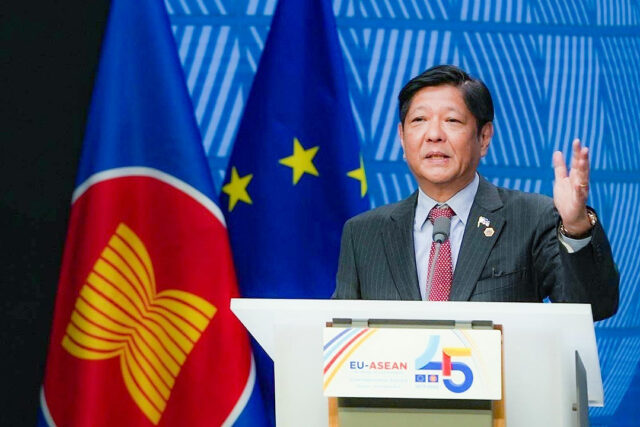
During a bilateral meeting on the sidelines of the Association of Southeast Asian Nations-European Union Commemorative Summit in Brussels, President Ferdinand R. Marcos, Jr. noted that Estonia “seemed to have managed the technologies so well” to resist cyber-attack or disruption.

“We are currently in the midst of our digitalization of government…. both the national and the local levels,” he said. “Since we are digitalizing… the issues of cybersecurity has come up, and we know the reputation of Estonia in terms of being able to resist the attacks that had been made to its digital systems.”

Estonia’s e-government set-up, known as e-Estonia, is considered one of the world’s most advanced, having transferred most citizen interactions with government to the online sphere.

Mr. Marcos said one possible drag on the Philippine digitalization effort is the potential for cyber-attack, which he hopes Estonia can assist with.

Estonia Prime Minister Kaja Kallas invited Mr. Marcos to visit Talinn to learn more about Estonia’s e-government set-up.

“Everything is connected… we have invested a lot in cybersecurity, of course,” she said. “99% of our e-governance services, or actually all the public services, are digital.”

“You don’t have like one big database, but you have very many small ones that are connected to each other, so if one of these is cyberattacked, it goes down, but all the others stay,” she added.

Information and Communications Technology Secretary Ivan John E. Uy, who was present at the meeting, said that the successful incorporation of technology will make government more efficient. — Alyssa Nicole O. Tan

PHL hospitals see foreign investment as key to upgrading management practices

PHILSTAR FILE PHOTO

By Alyssa Nicole O. Tan, Reporter

INCREASED foreign investment will allow the medical industry to incorporate more advanced technology and management practices, according to a hospital industry official.

“I think for healthcare in the Philippines, the only problem probably is financing,” Private Hospitals Association of the Philippines, Inc. President Jose Rene D. de Grano told BusinessWorld on the sidelines of the Taiwan Healthcare Expo held in Taipei.

If the Philippines is able to strengthen ties with Taiwan, it could lead to more Taiwan investment in Philippine hospitals, he added.

“While they invest, we will promote their products,” Mr. De Grano said. “At the same time, they will be improving the technology of the healthcare system in our country.”

The president of Taiwan’s Institute for Biotechnology and Medicine Industry, Chi-Huey Wong, said Philippine hospitals could be on the radar for potential Taiwan investors.

“I’m sure the business people here will have great interest to invest in the Philippines in terms of hospital management and also the healthcare system,” he told BusinessWorld at the forum.

“From that point of view, the managers of hospitals here should continue to discuss the regulatory system there (in the Philippines),” he added. “So, when you collaborate, you will know better about the system from each other, and then come up with a common acceptable business model.”

Mr. De Grano said a delegation needs to be invited to visit the Philippines to survey the medical industry.

“We would like (for them) to come over to see how things are back in the Philippines. Right now, the investors are really serious (about the business side), and the technology that they are trying to promote, so that’s what we need — to improve our own technology,” he said. 

“Maybe the Taiwan investors will (tap) the Philippines (to help promote their) technologies,” he added.

Similarly, Philippine Medical Association President Jose P. Santiago, Jr. told BusinessWorld that he thinks “funding is really always the concern of our country.”

If we are given adequate funding, the importation of innovative medical equipment will no longer be an issue, he added, “maybe we can improve the healthcare system.”

Imports raise costs and hinder advances, Mr. Santiago said. He hopes the government offers more tax exemptions for developers of medical equipment.

He said one desirable outcome of collaboration with Taiwan is to upgrade artificial intelligence and medical technology.

Mr. Santiago noted confidence in the potential of the Philippines to develop and improve the technology of its neighbors.

“Definitely ingenuity, creativity, innovativeness (are) very characteristic of Filipinos. They’re really good, very strategic, maybe they’ll even be able to improve the craft, so that’s why we want this collaboration… so we can share our expertise and knowledge (while also) improving our healthcare system,” he said.

High rates seen dulling residential market as investors favor office, industrial property

A VIEW of buildings in Makati City. — PHILIPPINE STAR/MICHAEL VARCAS

HIGH RATES are taking the shine off the residential market, with property investors expected to lean more towards office, industrial, and logistics projects, Colliers Philippines said.

Paul Chua, director for capital markets and investment services of Colliers Philippines, said that although the residential sector has seen a recovery in the high-rise condominium segment in Metro Manila, rate pressures, which affect the affordability of mortgages, are expected to continue affecting the market next year.

“We saw the uptick in horizontal developments outside of the major business districts, where prices remain competitive in all market segments… we see this continuing in 2023,” Mr. Chua said.

In its 2023 Global Investor Outlook, Asia-Pacific investors surveyed by Colliers cited interest rates, increased construction costs and higher asset operating costs as the top risks for next year.

According to Colliers, investors see these challenges to have the most negative impact on their ability to execute their investment strategies next year.

At the global level, 88% of the investors cited interest rates as the top risk, followed by inflation and supply chain disruptions at 77% and 68%, respectively.

The report also indicated that Asia-Pacific investors have expressed a preference for office, industrial and logistics, and build-to-rent projects next year.

The Philippine office market take-up rate was up 72% growth in the first nine months, said Colliers.

“This year, (the segment) posted the first positive net take-up of offices which was driven mostly by the information technology-business process outsourcing sector,” Mr. Chua said.

Colliers said that it expects the demand for horizontal residential housing and industrial property in the Philippines to remain solid in 2023.

The 2023 Colliers Global Investor Outlook report, which surveyed over 750 investors worldwide, was conducted in October and November.

It also contains input from 30 Colliers Capital Markets global and regional experts. It is the third edition of Colliers’ annual outlook for global property investors. — Justine Irish D. Tabile

DoE to explore marine-based renewable energy

REUTERS

THE Department of Energy (DoE) said it is evaluating various marine renewable energy technologies.

Marissa P. Cerezo, director of the Renewable Energy Management Bureau, said in a virtual briefing on Wednesday that the Philippine clean energy strategy will involve harnessing ocean energy.

Michael Lonchivar Sim Abundo, director of Ocean Pixel Pte. Ltd., said at the briefing that the marine renewable energy segment includes marine biomass and tidal energy, and called for them to be part of the Philippines’ renewable energy transition. 

“We just have to find a way around the financial and regulatory barriers,” John Cotton, senior program manager of the Southeast Asia Energy Transition Partnership said.

The DoE in November opens the renewable energy sector to full foreign ownership after the “impressive amounts” of interest from local and foreign investors in renewable energy development.

Secretary Raphael P.M. Lotilla has said that the Energy department is looking for potential partners to develop clean energy sources like hydrogen and ammonia fuel.

The Philippines is targeting to increase the share of renewable energy to 35% of its energy mix by 2030 and 50% by 2040. Currently, the share of renewable energy in power generation is 22%. — Ashley Erika O. Jose

GUIDE bill wins third-reading approval from House

THE House of Representatives, sitting in plenary session, passed on third reading the GUIDE bill, which would require government financial institutions to aid small businesses and others deemed “strategic” as a form of pandemic relief.

The chamber approved the bill with a vote of 282 legislators, with no votes against and no abstentions.

The proposed Government Financial Institutions Unified Initiatives to Distressed Enterprises for Economic Recovery (GUIDE) Act seeks to require the Development Bank of the Philippines (DBP), Land Bank of the Philippines (LANDBANK) to lend to micro, small, and medium enterprises (MSMEs) and those classified as strategically important companies (SICs).

The bill prescribes a pathway for LANDBANK and the DBP for aiding distressed SICs. It authorizes the establishment of a joint venture special holding company to carry out the rehabilitation.

Eligibility criteria for MSMEs are as follows: micro enterprises with assets not exceeding P3 million, small enterprises with assets not exceeding P15 million, and medium enterprises not exceeding P100 million.

The rehabilitation fund will be seeded with P10 billion from the Treasury, with P7.5 billion to be allocated to LANDBANK and P2.5 billion to the DBP.

The bill was passed by on third reading by the 18th Congress, but the Senate failed to pass a counterpart bill. — Beatriz Marie D. Cruz

China likely to just snub PHL senators’ tirade on sea incident

SEA and air assets of the Armed Forces of the Philippines’ Western Command, the lead unit watching over the West Philippine Sea, hold joint interdiction exercises in waters off Brooke’s Point, Palawan in November. — WESTERN COMMAND-AFP

By Alyssa Nicole O. Tan, Reporter

CHINA could not be expected to change its stance and course of action in disputed parts of the South China Sea after Philippine senators signed a resolution on Wednesday condemning what they called harassment and encroachment by Chinese vessels in Philippine maritime territory.

“Probably not,” said Herman Joseph S. Kraft, a professor and former chair of the political science department at the University of the Philippines, when asked on how Beijing is likely to react.

“The Chinese are probably going to be more sensitive to such statements if it was President (Ferdinand R.) Marcos (Jr.) making it,” he told BusinessWorld in a Viber message.

Senator Francis N. Tolentino, in a privilege speech on Wednesday, said they want Mr. Marcos to bring the legislative body’s formal position when he meets with Chinese President Xi Jinping during an official visit to Beijing on Jan. 3 to 6.

The Senate adopted the still unnumbered resolution expressing “disgust” over China’s maneuvers in the South China Sea.

“As it is, China is already increasingly more active in the WPS (West Philippine Sea) without having to react to the Senate’s statement,” Mr. Kraft said.

The Chinese Embassy in Manila did not immediately respond to a request for comment.

EU SUPPORT
Mr. Marcos, meanwhile, said that objections against violations on the United Nations Convention on the Law of the Sea (UNCLOS) will only be effective if nations unite behind the call.

“Every action that might be taken that objects or brings light to a possible violation of the UNCLOS  (United Nations Convention on the Law of the Sea) is much stronger when it is brought about by a group of nations such as ASEAN and if the EU, now with our strategic partnership, is able to also join their voices to that,” Mr. Marcos said in a live-streamed press conference at the Association of Southeast Asian Nations-European Union Commemorative Summit in Brussels, Belgium.

He said the EU’s commitment to the doctrine of behaviors in the South China Sea is already “a very big step” for the Philippines.

“That we now have the strategic support from not only the member-countries of EU but of EU itself, because EU and ASEAN together comprise the largest, most well-organized regional aggrupations, then that will be a very strong position to be able to negotiate even individually for the Philippines or jointly with ASEAN,” he said.

The South China Sea, a key global shipping route, is subject to overlapping territorial claims involving China, Brunei, Malaysia, the Philippines, Taiwan and Vietnam. Each year, trillions of dollars of trade flow through the sea, which is also rich in fish and gas.

Senate Minority Leader Aquilino Martin “Koko” D. Pimentel III said the resolution presented the current sentiment of the upper chamber.

“This should be sent to the Office of the President and the Department of Foreign Affairs (DFA),” he said in a statement. “We stop short of directly communicating with the foreign embassies. We should always course it through the DFA.”

The DFA did not respond to a WhatsApp message seeking update before the print deadline.

The minority leader, who chaired the Senate Foreign Affairs Committee in the last Congress, said that “the actual, concrete, practical steps to take regarding the West Philippine Sea should be made or taken by the executive branch.”

The administration, he said, should “bring the incidents in the WPS up in the meetings during the state visit for the purpose of how to avoid similar incidents in the future.”

Lucio Blanco Pitlo III, a research fellow at the Asia-Pacific Pathways to Progress Foundation, told BusinessWorld in a Viber message that the Senate condemnation will unlikely affect bilateral relations between the Philippines and China.

“Filing protests and expressing disagreement over disturbing actions taken by a rival claimant in a contested flashpoint are normal and expected,” he said.

China has rejected a 2016 arbitral ruling by a United Nations-backed tribunal that voided its claim to more than 80% of the South China Sea.

The Permanent Court of Arbitration based in the Hague upheld the Philippines’ rights to its exclusive economic zone within the disputed waterway. It rejected China’s claim to most of the sea based on a 1940s nine-dash line map.

In a statement on Thursday, Senator Joseph Victor “JV” G. Ejercito urged the government to speed up efforts to build up defense forces and military equipment in the South China Sea, noting that Beijing’s military assets are moving closer to Manila’s coastline.

“This is already a clear and present danger. It can no longer be ignored,” he said in a mix of English and Filipino. “If you saw the most recent pictures of the disputed islands, there are full blown military bases. That’s a lot. It’s like a city already.”

“If we continue to be a laggard, they might even annex Palawan,” he added.

At the House of Representatives, a coalition of progressive party-lists reiterated their push for the administration to take a more assertive stance on the Philippines’ maritime territory.

“Based on the pronouncement of the chief executive that we are friendly to other countries, [it has come to a point wherein] our territory is exposed not only to China but to other countries like the United States,” Kabataan Party-list Rep. Raoul Danniel A. Manuel said in a press conference on Thursday.

Assistant minority leader and Gabriela Part-list Rep. Arlene D. Brosas, for her part, said the government’s responses do not inspire nationalism.

“We keep calling for patriotism, yet we couldn’t prevent instances like this. If we want to show patriotism and love for the country, let us not allow the Chinese to take swarm over the Philippine Sea,” she said. — with Beatriz Marie D. Cruz


PHL partners with two EU countries on defense

PHILIPPINE President Ferdinand R. Marcos, Jr. held bilateral meetings with leaders of the Czech Republic and the Netherlands on the sidelines of the ASEAN-US Commemorative Summit in Brussels on Dec. 12-14. — OFFICE OF THE PRESS SECRETARY

PRESIDENT Ferdinand R. Marcos, Jr. has sought support from the Czech Republic and the Netherlands to enhance the technological capacity of the Philippines’ defense sector, according to statements released by the press secretary’s office on Wednesday.

“It’s something that has been very helpful to the program of modernization that we are undergoing for defense forces in the Philippines, especially now that we… are trying to strengthen the capabilities of our coast guard,” Mr. Marcos said in a meeting with Czech Republic Prime Minister Petr Fiala on the sidelines of the Association of Southeast Asian Nations-European Union (ASEAN-EU) Commemorative Summit in Brussels, Belgium.

“But what would be even more interesting is besides just the equipment, would be the transfer of technology from your country to mine so that you are able to produce (in our own country) some of the material that is now being provided by other countries and perhaps… make the Philippines a center for all that, the logistics,” he added.

Mr. Marcos noted that technology transfer is a vital aspect of the Armed Forces of the Philippines’ (AFP) modernization program, which was launched in 2013 through Republic Act No. 10349 or the Revised Armed Forces Modernization Act.

The law sets out a 15-year modernization program to beef up the AFP’s capability on counterterrorism, maritime domain security, and address internal threats.

NETHERLANDS
The Philippine leader also had a meeting with Dutch Prime Minister Mark Rutte, where they agreed to bolster maritime defense ties as well as expand collaboration in water management.

The Dutch leader noted that the Netherlands is hosting a conference on the role of artificial intelligence in the military domain in February next year, which aims to gather foreign ministers, defense ministers, and heads of states.

Mr. Marcos noted that cybersecurity is becoming increasingly more important for the Philippines’ armed forces, noting the prevalence of cyberattacks in the country’s military networks.

“The cybersecurity part of our military is growing everyday,” he said.

Mr. Rutte also invited Mr. Marcos to participate in a conferences on water management next year.

Amsterdam will be hosting a conference in March on water management and climate change adaptation, which is among the key priorities of the Marcos administration.

“We are two counties who run a risk or two with rising sea levels and climate change,” Mr. Rutte said.

Mr. Marcos, in response, said, “We are actually trying to decide whether or not to form a new agency just for water management… That seems to be right exactly within the area of concern of the Philippines.”

The Philippines is among the world’s most vulnerable to climate change. It is visited by an average of 20 typhoons every year, about five of which are destructive. — Alyssa Nicole O. Tan

House approves NCSTP bill on final reading

YOUTH activists from the College Editors Guild of the Philippines stage a die-in protest at the Mendiola Peace Arch in Manila on Dec. 12 early morning to denounce the proposed mandatory Reserve Officers’ Training Corps in schools. — PHILIPPINE STAR/ MIGUEL DE GUZMAN

THE HOUSE of Representatives on Thursday approved on 3rd and final reading a measure that seeks mandatory military training for public and private tertiary education students.   

House Bill 6687, certified by President Ferdinand R. Marcos Jr. as urgent, got 276 affirmative votes, while four opposed and one abstained.  

Under the proposed law, the National Citizens Service Training Program (NCSTP) will be required for all students enrolled in undergraduate degree programs in all public and private higher education institutions and at least two-year technical-vocational education and training programs.   

The program shall be administered for at least four semesters and 240 hours in two academic years.  

The NCST program shall provide the students with practical and applicable knowledge and skills that are necessary, essential, and ideal for survival, and for attaining resilience, and to ensure the immediate availability of these skills in times of local and national emergencies and disasters, both natural and man-made.”  

The curriculum will also instill in students the values of civic mindedness, volunteerism, and genuine service to others. It shall develop tertiary education students to be community crisis managers and leaders in times of emergencies and disasters, reads the bill.   

The NCSTP will be a requisite for graduation of all tertiary education students.  

Students who complete the NCSTP program will be incorporated in the National Service Reserve Corps and the Armed Forces of the Philippines (AFP) Reserve Force.  

The optional Reserve OfficersTraining Corps (ROTC) program will become a four-year baccalaureate degree course, wherein graduates will be capable of immediate deployment as commissioned officers of the AFP.”  

The Department of National Defense, AFP, and Commission on Higher Education (CHED) will design the ROTC baccalaureate degree program.  

In an earlier press conference, opposition lawmakers expressed their dissent on the bill. 

Kabataan Party-list Rep. Raoul Danniel A. Manuel said the bill would only normalize military presence in educational institutions. What is most disturbing is that the NCST[P] normalizes the presence of armed forces in campuses by building School-based Ready Reserve Units under the AFP, contrary to making schools zones of peace,he said.  

Assistant Minority Leader and Gabriela Party List Rep. Arlene D. Brosas said, The youth does not need mandatory [military training]. What they need is access to quality education that will enable them to attain skills that they can use to serve marginalized sectors.”  

House deputy minority leader and ACT Teachers Party List Rep. France L. Castro said that the bill would decrease funds for the Universal Access to Free Tertiary Education. It would also be costly to parents and students.  

Various student groups have also opposed the proposed law.  

The House bill is now up for transmission to the Senate, where there are several pending counterpart bills. Beatriz Marie D. Cruz 

Bangsamoro transport ministry ready to take over airport terminal operations by Jan. 1

BARMM MOTC

THE BANGSAMORO Airport Authority (BAA) will start handling the passenger terminal operations of four airports in the region by Jan. 1, the regional government said on Thursday.   

BAA head Carmencita O. Salik, in a statement from the regional information office, said they held their first meeting with airport concessionaires and other business operators on Dec. 14 to discuss the new management policies and guidelines.   

Today is our first concessionaires and stakeholders meeting because we want to inform them that starting January 1, all landside operations will be turned over to the MOTC-BARMM,she said.  

She was referring to the Bangsamoro Autonomous Region in Muslim Mindanaos Ministry of Transportation and Communications. The BAA is an attached agency of the ministry.   

The landside operations cover the passenger terminal building, administrative building, parking area, and other facilities or areas that are not restricted or not part of air navigational facilities.  

The national government, through the Civil Aviations Authority of the Philippines (CAAP), will continue to handle airside operations, as stipulated under Republic Act No. 11054 or the Bangsamoro Organic Law. 

Six airports owned and managed by CAAP were formally turned over to the Bangsamoro government in September through a memorandum of agreement.   

Under the agreement, CAAP transferred all the properties, assets, powers, and functions pertaining to the landside management of operational airports in Cotabato, Sanga-Sanga, Jolo, and Mapun, as well as the non-operational airports in Malabang and Wao.  

Ms. Salik said with BAAs takeover, all concessionaires and other business owners inside the airports will have to apply again as a new entity.  

All applications will be treated as new,she said.  

Based on the new guidelines, interested parties need to submit the following requirements: letter of intent, business plan and company profile, application form, business permit, location, certificate of good standing from previous concessionaires in charge, and clearance from the airport manager. MSJ 

Spain vows continued support for peace programs in Bangsamoro region 

OFFICE OF THE PRESS SECRETARY

SPAIN has vowed to provide continuing support to peace programs in the Bangsamoro, an autonomous region in southern Philippines that is transitioning from a history of conflicts, according to Philippine press secretarys office.   

But its true that you know, Philippines is the only Asian country infrom our side, listed as a priority country in the masterplan for Spanish cooperation,Spanish President Pedro Sánchez Pérez-Castejón said during a bilateral meeting with President Ferdinand R. Marcos, Jr. on the sidelines of the Association of Southeast Asian Nations-European Union Commemorative Summit in Brussels, Belgium.  

The Spanish cooperation in Muslim Mindanaoespecially this region, (the) Bangsamoro Autonomous Region, (is) where we try to provide institutional support and strengthen the dialogue,he said.  

The Spanish Agency for International Cooperation is among the funding agencies for the P1.5-Billion Support to Bangsamoro Transition (SUBATRA) Programme, which is intended to strengthen the regions democratic governance capacities during the transition period.  

The Bangsamoro Autonomous Region in Muslim Mindanao was set up in 2019 following a peace agreement between the national government and the Moro Islamic Liberation Front.  

Mr. Marcos, for his part, recalled his time at the Senate, where he said he was among the legislators who worked to create an autonomous political entity to end the conflict.  

I was a senator, and we were forming the new autonomous region, and of the places I went to seek advice was your experience in Catalonia, andwe learned very much,he said.   

The leaders also agreed to strengthen other aspects of the Philippines-Spain bilateral relations. Alyssa Nicole O. Tan 

ADVERTISEMENT
ADVERTISEMENT