
How PSEi member stocks performed — January 11, 2023

Here’s a quick glance at how PSEi stocks fared on Wednesday, January 11, 2023.
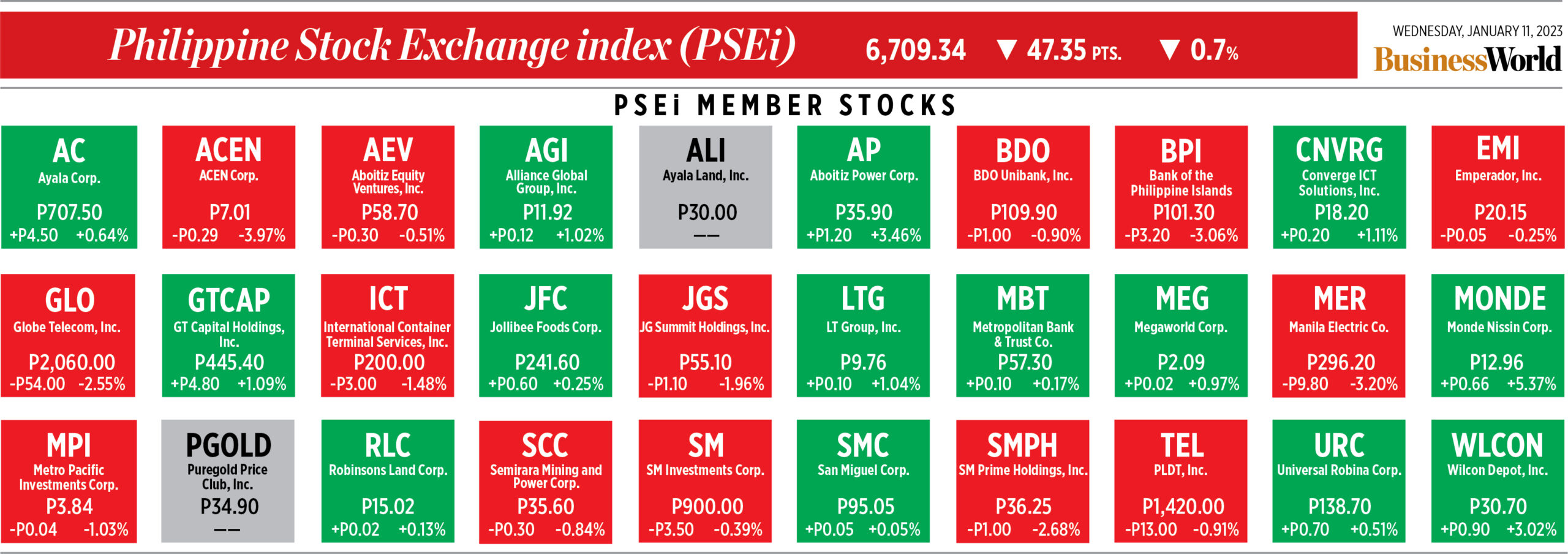

Here’s a quick glance at how PSEi stocks fared on Wednesday, January 11, 2023.

SHARES dropped on Wednesday ahead of release of December US consumer inflation data and expectations of rate hikes from both the US Federal Reserve and the Bangko Sentral ng Pilipinas (BSP) in their first meetings of the year.
The bellwether Philippine Stock Exchange index (PSEi) went down by 47.35 points or 0.7% to close at 6,709.34 on Wednesday, while the broader all shares index decreased by 19.77 points or 0.55% to end at 3,539.46.
“The local stock market gauge corrected lower for the second straight trading day, after recent signals on a possible 0.25 or 0.50 local policy rate hike, recent hawkish signals from some Fed officials, especially the possibility of Fed rates above 5%,” Rizal Commercial Banking Corp. (RCBC) Chief Economist Michael L. Ricafort said in a Viber message.
“The local market closed in the red territory, dropping by 47.35 points or 0.70% to 6,709.34, as investors await the US inflation rate,” Philstocks Financial, Inc. Research Analyst Claire T. Alviar said in a Viber message.
Ms. Alviar said that investors were also pricing a possible 25- or 50-basis-point (bp) rate hike from the BSP in their Feb. 16 meeting.
The US December inflation report will be released on Thursday, which is expected to be a key factor to be considered by the Fed in its Jan. 31 to Feb. 1 policy meeting.
The US central bank delivered 425 bps in rate hikes in 2022 that brought the federal funds rate to 4.25-4.5%. Meanwhile, the BSP raised rates by a total of 350 bps last year, which brought its policy rate to a 14-year high of 5.5%.
“Moreover, a wider balance of trade in goods in the first 11 months of 2022 compared to the same period in 2021 weighed on sentiment,” she added.
The Philippines’ trade deficit widened to $3.68 billion in November, as exports slowed down amid the decline of imports for the first time in nearly two years.
Value of merchandise imports also slipped by 19% to $10.78 billion in November, from the 7.7% revised growth the previous months and the 36.8% growth a year ago.
Most sectoral indices closed lower on Tuesday except for industrials, which went up by 36.35 points or 0.38% to close at 9,606.88, and mining and oil, which added 32.65 points or 0.28% to end at 11,576.53.
Meanwhile, financials lost 26.04 points or 1.52% to close at 1,678.53; property went down by 44.59 points or 1.49% to 2,941.65; services dropped by 10.08 points or 0.59% to 1,689.36; and holding firms decreased by 18.90 points or 0.28% to end at 6,576.26.
Value turnover declined to P7.87 billion on Wednesday with 1.55 billion shares changing hands from the P20.64 billion with 2.51 billion issues traded on Tuesday.
Decliners outnumbered advancers, 101 versus 89, while 48 names closed unchanged.
Net foreign selling surged to P1.06 billion on Wednesday from P162.96 million the previous day.
Mr. Ricafort placed the PSEi’s first minor support levels at 6,630 to 6,690 and next resistance at 6,814.14. — J.I.D. Tabile

THE PESO rose further against the dollar on Wednesday to post a fresh six-month high after US Federal Reserve Chair Jerome H. Powell avoided commenting on his monetary policy outlook in scheduled remarks on Tuesday and following strong data on foreign direct investments (FDI) in the Philippines.
The local currency closed at P54.80 versus the greenback on Wednesday, rising by seven centavos from Tuesday’s finish of P54.87, data from the Bankers Association of the Philippines showed.
This is the peso’s best close since it ended at P54.77 per dollar on June 28, 2022.
The peso opened Wednesday’s trading session at P54.80 a dollar. Its weakest showing was at P55.04, while its intraday best stood at P54.75 against the greenback.
Dollars traded went down to $1.005 billion from $1.067 billion on Tuesday.
A trader said in an e-mail that the peso strengthened after Mr. Powell stayed silent on monetary policy in his speech at a forum sponsored by the Swedish central bank.
“The peso strengthened after Fed Chair Jerome Powell did not make comments on the potential Fed policy move during this week’s central bankers symposium in Sweden. Market participants then perceived that the Fed Chairman did not echo the prior hawkish statements of his fellow Federal Reserve officials,” the trader said.
Fed Governor Michelle Bowman said on Tuesday that the bank will have to raise interest rates further to combat high inflation, along with other Fed officials remaining hawkish on future rate hikes by the Federal Open Market Committee (FOMC), Reuters reported.
The FOMC raised borrowing costs by 425 bps last year, bringing the federal funds rate to a 4.25%-4.5% range. Its first meeting for the year will be held from Jan. 31 to Feb. 1.
The peso was also supported by the FDI data released by the Bangko Sentral ng Pilipinas (BSP) on Tuesday, Rizal Commercial Banking Corp. Chief Economist Michael L. Ricafort said in a Viber message.
FDI net inflows rose by 6.3% year on year to a six-month high of $923 million in October 2022, BSP data showed. This also marked a 47.4% increase from the $626 million recorded in September 2022.
For Thursday, Mr. Ricafort sees the peso moving between P54.70 and P54.90 against the dollar, while the trader gave a wider forecast range of P54.65 to P54.90. — A.M.C. Sy with Reuters

THE American Chamber of Commerce of the Philippines (AmCham) has called on the government to remove foreign investment restrictions in the rice and corn industry if it wants to boost farm productivity.
AmCham issued the statement after President Ferdinand R. Marcos, Jr. extended tariff reductions on pork, rice, corn, and coal until the end of December.
“The lower tariff rates across these commodities will help keep these products affordable for the consuming public, which needs a reprieve under this high inflation environment,” AmCham Executive Director Ebb Hinchliffe said in a Viber message.
Mr. Hinchliffe said the extension of the low-tariff regime is “only a short-term solution,” calling for a “real effort” to improve farm productivity “in order to break the Philippines’ over-reliance on imports long term.”
“One place to start here is to remove foreign investment barriers in the rice and corn sectors by finally repealing Presidential Decree (PD) No. 194 or the Rice and Corn Law,” he said.
Issued in 1973, PD No. 194 itself eased the total restriction on foreign investment imposed by the Rice and Corn Nationalization Law of 1960.
PD No. 194 authorized the then-National Grains Authority (NGA) to admit foreign investment in case of “urgent need” if the entry of the foreign investor is not likely to create a monopoly. The NGA was also tasked with overseeing the transfer of at least 60% ownership to Filipinos over a period it deems suitable.
In 1998, the NGA’s successor agency, the National Food Authority, set the period of divestment by foreign companies at 30 years, counting from the start of actual operations.
In May, President Ferdinand R. Marcos, Jr.’s sister, Senator Maria Imelda Josefa Remedios R. Marcos, filed a bill amending PD No. 147.
Mr. Hinchliffe said the decree still “requires mandatory divestment of foreign companies participating in the rice and corn sectors, (including activities like) purchasing, storing, transporting and processing of rice and corn.”
“In this regard, we also push for a policy that will allow the tariff revenues for these imported products to be ploughed back into the domestic sectors that need to compete with these imports, akin to the Rice Competitiveness Enhancement Fund created under the Rice Tariffication Law,” Mr. Hinchliffe said.
In the third quarter of 2022, production of palay, or unmilled rice, was 3.79 million metric tons (MT), up from the 3.75 million MT a year earlier, according to the Philippine Statistics Authority.
Corn production was 2.35 million MT during the period, up 2.5% from a year earlier, it added.
In a Dec. 23 report, the US Department of Agriculture’s Foreign Agricultural Service forecast Philippine rice imports this year at 3.8 million MT, while its corn imports could hit 1 million MT “because of the extension of lower tariffs through 2023 and competitive price quotes for orders going forward, especially from ASEAN member states.” — Kyle Aristophere T. Atienza

THE fourth and last tranche of salary hikes for government employees authorized by the Salary Standardization Law took effect on Jan. 1, the Department of Budget and Management (DBM) said.
“The government recognizes the indispensable role of its dedicated personnel in serving our beloved country. We are firmly committed to help them amidst rising prices of goods and services. We hope this latest salary increase will cushion the impact of inflation,” Budget Secretary Amenah F. Pangandaman said in a statement on Wednesday.
Republic Act (RA) No. 11466 or the Salary Standardization Law raised public servants’ salaries in four phases starting Jan. 1, 2020.
Under the law, the salary increase covers all civilian personnel, whether regular, casual, or contractual, appointive or elective, full-time or part-time, existing at the time of the law’s signing or thereafter created in the executive, legislative, and judicial branches; constitutional commissions and other constitutional offices; state universities and colleges; and government-owned or -controlled corporations (GOCCs) not covered by RA No. 10149 or the GOCC Governance Act of 2011.
It also applies to all salaried personnel in local government units (LGUs), whether regular, contractual or casual, elective or appointive; full-time or part-time, existing at the time of the law’s passage or thereafter created in LGUs, and all positions for barangay personnel who are paid monthly honoraria.
“Those engaged without employer-employee relationships and funded from non-personnel services (PS) appropriations and budgets shall be excluded from (its) coverage,” it added.
Also excluded from the pay hike are military and uniformed personnel, GOCC staff covered by RA No. 10149, and individuals whose services are engaged through job orders, contracts of service, consultancy or service contracts with no employer-employee relationship.
The DBM said that around P48 million is being allocated to conduct a study on the government’s compensation structure.
“President Ferdinand R. Marcos, Jr. directed us to conduct a study to ensure that the compensation of all civilian personnel will be generally competitive with those in the private sector doing comparable work to attract, retain, and motivate corps of competent and dedicated civil servants,” Ms. Pangandaman said.
“Apart from the conduct of the study, the DBM is also undertaking a review of the rates of the existing benefits being provided to qualified government employees to assess if these may need adjustment in the future,” she added. — Luisa Maria Jacinta C. Jocson

THE Department of Agriculture (DA) said a P537 per kilogram of domestic onion order placed by Food Terminal, Inc. (FTI), a unit of the National Food Authority (NFA), followed procurement rules, amid concerns that it paid inflated prices for the commodity, in turn setting a high benchmark price for resellers.
The Office of the Ombudsman announced an investigation into alleged collusion by government officials and the private sector to rig onion prices.
Rex C. Estoperez, Agriculture deputy spokesperson, told reporters on Wednesday that the FTI, a government-owned and -controlled corporation (GOCC), is cooperating with the investigation.
“Let the FTI (disclose the details of) their transaction with the cooperative,” Mr. Estoperez said, adding that the DA has nothing to hide because the procurement exercise was above board.
FTI is 99% owned by the NFA, according to the Integrated Corporate Reporting system maintained by the Governance Council for GOCCs, the sector’s regulator. It engages in strategic purchasing to stabilize prices. The NFA is in turn an arm of the DA.
According to a Jan. 10 order issued by the Ombudsman, Senior Undersecretary Domingo F. Panganiban was ordered to submit a sworn comment within three days the onion purchase.
The Ombudsman is also asking the DA to explain the shortage of onions and a separate decision to import onions coinciding with the domestic onion harvest.
The DA has also authorized the import of 21,060 metric tons of onions, giving importers until Jan. 27 to land their shipments, as a counter to the high retail price of onions.
Kristine Y. Evangelista, DA spokesperson, said that DA is looking at the farmgate price and studying possible price manipulation somewhere along the supply chain after the onions leave the farm.
DA price monitoring as of Wednesday put the price of red and white onions in wet markets at P350 and P550 per kilogram respectively, against P420 and P600 on Tuesday.
“Price manipulation is a possibility because of the sudden price movement and it is hard to explain… we were looking at who is manipulating the price of onions from cold storage but now we are seeing that the movement of price is in the farmgate,” Ms. Evangelista told reporters.
Ms. Evangelista said that the price movements were probably the result of fresh supply from the domestic harvest, adding that price manipulation is suspected, with the DA also looking into how retailers are pricing the commodity. — Ashley Erika O. Jose

A SUPERMARKET industry association proposed that the government aid manufacturers in sourcing raw materials from the Philippines as a means of keeping prices low.
Steven T. Cua, Philippine Amalgamated Supermarkets Association president, said government aid in local sourcing will help temper manufacturer price increases.
“It would augur well for our economy if the (Department of Trade and Industry) reached out to the manufacturing sector and helped them with sourcing local raw materials. Develop the industries which would provide these raw materials and generate employment in the countryside as an added benefit,” Mr. Cua told BusinessWorld in a Viber message.
The DTI announced in December that a new suggested retail price (SRP) bulletin for basic necessities and prime commodities (BNPCs) is expected to be released this month.
According to Mr. Cua, providing manufacturers access to affordable and quality raw materials will help stabilize BNPC prices.
“The impact of having cheap and reliable quality raw materials will have a proportional effect on the price stability of basic necessities and prime commodities as well as (generate) gainful employment when local food manufacturing is prioritized,” Mr. Cua said.
One possible outcome of the sourcing policy, Mr. Cua said, will be to reduce the need for the DTI to periodically review the SRP bulletin due to movements in global prices.
“Initially, maybe review every semester and focus on assisting in the development of the various local food industries and ascertain food security,” Mr. Cua said.
“Updating that (SRP) list takes some doing especially as factors affecting prices continue to be fluid and the DTI keeps adding new items to monitor. Global economic analysts seem to be one in saying 2023 will see the ascent of commodity prices,” he added.
Trade Secretary Alfredo E. Pascual has said that some of the products that have pending price hike applications include canned goods, milk, coffee, and bread.
“We are in discussions with the manufacturers so we can appropriately assess the need for price increases. We need to check the changes in various inputs to the cost of producing the product,” Mr. Pascual said.
The DTI’s last SRP bulletin was issued in August, which authorized price increases for 67 out of 218 stock keeping units. The price increases ranged from 3.29% to 10%.
Some of the BNPC permitted to raise prices were canned sardines, coffee, noodles, bottled water, processed milk, detergent soap, candles, and condiments. — Revin Mikhael D. Ochave

THE House committee on local government has approved a bill that proposes to create the position of business permit licensing officer, its chairman said.
“By institutionalizing the position of the business permit and licensing officer (BPLO), we are also creating efficiency in local government in the delivery of frontline services, like the issuance of business permits and licenses,” Valenzuela Rep. Rexlon T. Gatchalian, the committee chairman, said in a statement on Wednesday.
The still unnumbered substitute bill approved on Tuesday also tasks the BPLO with assessing business taxes, fees, and charges. It shall also conduct tax mappings and regular inspections of all business establishments within the municipality or city.
Mr. Gatchalian, author of the original BPLO bill, added that the measure will help reduce red tape and accelerate local government transactions, resulting in a “more vibrant and thriving economic atmosphere conducive to growth.”
All business owners must secure business permits from their LGUs to be able to operate within the jurisdiction.
The Anti-Red Tape Authority has received 11,279 complaints alleging violations of Republic Act 11032 or the Ease of Doing Business and Efficient Government Service Delivery Act of 2018, it was reported in July.
The approved substitute bill also included the creation of a human resource management officer (HRMO) position at city and provincial government levels.
Margarita Ignacia B. Nograles, PBA Party-list representatives and author of the previous version of the HRMO bill, said that human resource responsibilities are currently handled by the local chief executive, resulting in “highly politicized” personnel decisions.
HRMOs will handle recruitment and selection, career development, performance management, welfare, rewards and incentives, appointment rules, and leave benefits.
The HRMO appointment will lie with the chair of the Civil Service Commission from a shortlist of at least candidates recommended by the governor or city mayor.
Mr. Gatchalian said that under the Local Government Code, the rank and salary of a BPLO and HRMO will be similar to a department head.
“We have to provide them with the proper remuneration commensurate to their management positions. This will also ensure that we can get the best people for the job,” he said. — Beatriz Marie D. Cruz

THE United States Agency for International Development (USAID) said on Wednesday that it launched a five-year project to raise the level of digitalization at Philippine small and medium enterprises (SMEs).
MaryKay L. Carlson, United States ambassador to the Philippines, said during the launch event in Makati City that the Strengthening Private Enterprise for the Digital Economy (SPEED) project, with a budget of $18 million, will help Philippine SMEs engage in e-commerce.
“This partnership with the Philippine government aims to enable SMEs to participate safely, reliably and competitively in the country’s emerging e-commerce ecosystem,” Ms. Carlson said.
“Under the project, USAID will continue to work with the Philippine government and private sector partners, including technology experts and innovators, to create an efficient and interoperable logistics and digital payments ecosystem and to assist in the establishment of domestic and cross-border trade processes to promote inclusive business development and increase SME participation in global value chains,” she added.
According to the USAID, the project will focus on improving the capacity and access of SMEs to e-commerce platforms; expand the use of e-payment systems and other financial technology programs; refine the integration of e-commerce platforms and logistical supply chains; and improve consumer awareness and protection.
Trade Secretary Alfredo E. Pascual said in his speech that small businesses will benefit from digitalization as it would streamline their operations.
Digitalization will enable small firms to “operate more efficiently, reduce costs, reach bigger markets, and earn profits,” Mr. Pascual said.
“With Strengthening Private Enterprise for the Digital Economy, USAID can be DTI’s partner in empowering small and medium enterprises through digital transformation,” he added. — Revin Mikhael D. Ochave

THE Department of Information and Communications Technology (DICT) said it met recently with the Irish and Belgian ambassadors to tap those countries’ expertise in digitalizing their economies.
Undersecretary for Public Affairs and Foreign Relations Anna Mae Y. Lamentillo said in a statement that the meeting with Irish Ambassador William John Carlos was “to discuss possible areas of digital cooperation between the Philippines and Ireland.”
Previously, Ms. Lamentillo met with Michel Parys, the Belgian ambassador to explore cooperation in cybersecurity, the implementation of digital IDs, and satellites.
The department said it is looking for partnership opportunities to tap technical expertise and best practices in digitalization.
The government “aims to provide universal connectivity and improve the delivery of government services through e-governance,” the department noted.
“We want to learn from digitally advanced nations in terms of building and improving digital infrastructure, improving the public’s access to and the government’s delivery of public services through digitalization, and strengthening measures against cyber threats,” she said. — Arjay L. Balinbin

THE Energy department said the Department of Foreign Affairs (DFA) will determine the next move for joint oil and gas exploration after the Supreme Court (SC) ruled against any undertaking with foreign partners in disputed waters.
“Perhaps the DFA could answer on how this will affect (the government’s options) moving forward as they are the lead agency that focuses on the plan… for joint exploration,” a representative of the Department of Energy (DoE) said in a Viber message on Wednesday.
The SC ruled that a 2005 government deal with China and Vietnam for joint gas and oil exploration in the South China Sea was unconstitutional.
The DoE said that it has yet to receive a copy of the decision.
Voting 12-2-1, the SC said that the 2005 tripartite agreement for joint marine seismic undertaking (JMSU) was unconstitutional because it allowed foreign entities to explore for Philippine natural resources over 142,886 square kilometers without full government supervision.
“For the environmentalists and people’s groups in our network, this decision spells stronger protection of the resources of the West Philippine Sea and their preservation for the next generation,” Jon Bonifacio, national director of Kalikasan People’s Network, a coalition of green groups, said in a statement.
Mr. Bonifacio said that the decision is also a concrete step in addressing the climate crisis, and serves to deter “any plans by President Ferdinand R. Marcos, Jr. to explore for fossil fuels in those waters.”
The JMSU was signed in 2005 between the China National Offshore Oil Corp., Vietnam’s Oil and Gas Corp., and the Philippine National Oil Co.
On Monday, Energy Secretary Raphael P.M. Lotilla said that one of the agenda items during a visit by Mr. Marcos to China on Jan. 3-5 was the resumption of talks for joint exploration in the West Philippine Sea.
He said that China and Philippines both agreed to “resume talks,” but no specific activities were agreed concerning Recto Bank, which is covered by Service Contract (SC) 72.
“We will have to be guided by the DFA with the timing and the subject matter of the resumption of talks and the venue of the talks. We will have to await their guidance,” Mr. Lotilla said on Monday.
PXP Energy Corp. was hoping to resume discussions on joint exploration in the West Philippine Sea.
Its subsidiary, Forum (GSEC 101) Ltd. is the operator of SC 72 at Recto Bank. PXP Energy also holds a 50% interest in SC 75 in northwest Palawan. These areas are also in contested waters.
The DoE in April ordered the suspension of exploration activity in the West Philippine Sea due to the maritime dispute. This led to the suspension of all exploration work in SC 72 and 75.
In October, the DoE approved the declaration of force majeure covering the two service contracts in response to a PXP Energy request made in April. — Ashley Erika O. Jose

As multinational entities (MNEs) continue to expand their businesses internationally, Base Erosion and Profit Shifting (BEPS) persists as a major concern by taxing authorities. Given the differences in tax policy among countries, MNEs implement tax strategies that effectively lower their tax bases or shift profits to countries with more favorable tax policy.
To address this concern, the Organisation for Economic Co-operation and Development (OECD), together with the G20 countries, led the BEPS 1.0 initiatives and published a 15-point Action Plan. These BEPS Action Plans were initially published in July 2013 and final reports were published in October 2015. Throughout the years, over 135 jurisdictions have implemented the 15 Action Plans.
These Action Plans tackle tax avoidance and aim to improve the consistency of various international tax rules and promote a more transparent tax environment by providing guidance on transactions such as interest, hard-to-value intangibles, mandatory disclosures and country-by-country reporting, mutual agreement procedures, etc.
While there have been developments on the other Action Plans since their launch, in this article, I’d like to focus on Action Plan 1, which covers the challenges of the digital economy (more commonly known as BEPS 2.0), specifically Pillar 1, considering the recent updates on the House Bill (HB) concerning Digital Services Taxes (DST) and Amount B of Pillar 1.
BEPS 2.0
On October 2021, the two-pillar solution of the OECD was agreed to by 137 countries and endorsed by the Finance Ministers and Leaders of the G20 countries. Since then, draft publications and public consultation documents have been made available as work progresses.
Pillar 1 focuses on the reallocation of residual profits of MNEs to the market jurisdictions where their customers are located, regardless of the presence of a permanent establishment of the MNE in such locations. It entails the determination of “Amount A” and “Amount B.”
Pillar 2 aims to implement a tax system wherein MNEs will be subject to a minimum effective tax rate of 15% on income generated in low tax jurisdictions. The scope of the Pillar 2 rules includes all multinational groups with global turnover above 750 million euros, except those which operate pension, investment funds, and international shipping services.
PILLAR 1: AMOUNT A
Going back to Pillar 1, the scope of Amount A includes MNEs with profitability above 10%, based on profit before tax with reference to financial accounting income, with adjustments (also referred to as residual profit), and global turnover above 20 billion euros. Generally excluded from the coverage of this rule are those which operate extractives and regulated financial services, provided that their non-extractives or non-regulated financial services income does not meet the revenue and profitability scope thresholds. On the other hand, for those covered by the rules of Amount A, 25% of the deemed residual profit will be allocated to market jurisdictions with sufficient nexus, using a revenue-based allocation key.
PILLAR 1: AMOUNT B
On the other hand, Amount B aims to simplify and streamline the application of the arm’s length principle to in-country baseline marketing and distribution activities, focusing on the needs of low-capacity countries. The qualifying transactions and scoping criteria of Amount B would apply to intra-group transactions where the tested party is a distributor under either buy-sell arrangements or sales agency and commissionaire arrangements, as determined primarily by the level and type of functions performed, assets owned, and risks assumed by the parties to the controlled transaction. The Inclusive Framework of the OECD is currently evaluating the set of scoping criteria for purposes of Amount B, but among the criteria are the documentation of the qualifying transactions in a written contract that would reflect the responsibilities, obligations and rights, and the assumption of risks of the distribution activities.
The recent public consultation document published by the OECD in December 2022 also provided that generally, the transactional net margin method (TNMM) shall be the pricing methodology for determining Amount B, except in cases where local market comparables are available, or if there is a most appropriate method than the TNMM. Work is still ongoing as regards the benchmarking criteria, net profit indicators, and comparability adjustments for purposes of determining Amount B. Nevertheless, the OECD acknowledges that it may be pragmatic to use local or homogenous market comparables if these provide a more reliable arm’s length price.
CHALLENGES FROM A PHILIPPINE PERSPECTIVE
Currently, the groundwork and consultations on Pillar 2 are ahead of Pillar 1. Among the challenges in the implementation of Pillar 1 is the removal of DST with respect to all companies.
In the Philippines, the House of Representatives recently approved on third and final reading HB No. 4122, which imposes value-added tax (VAT) on digital transactions. The bill aims to clarify the imposition of VAT on digital advertising services (such as those on search engines and social media platforms), subscription-based services (including music and video streaming subscriptions), and services rendered using information communication technology (ICT)-enabled infrastructure, among others.
Moreover, from a Philippine perspective, there may be gaps that need to be addressed to apply the guidance on benchmarking search criteria, net profit indicators, among others, that will be used for purposes of determining Amount B. This is considering that the Philippine tax authorities under Revenue Audit Memorandum Order No. 1-2019 (otherwise known as Philippine TP Audit Guidelines) provided for certain rejection criteria for purposes of benchmarking and other guidance in conducting their TP audits.
While the implementation of these pillars will largely depend on the large MNEs, mostly from the G20 countries, Philippine affiliates who are part of these multinational groups need to disclose relevant information on their operations (including proper documentation of related party transactions) and profitability to aid in the adoption of the two-pillar approach. In the same vein, the cooperation of the Philippine tax authorities is essential for the success of the envisioned two-pillar solution.
The views or opinions expressed in this article are solely those of the author and do not necessarily represent those of Isla Lipana & Co. The content is for general information purposes only, and should not be used as a substitute for specific advice.
Maria Isabel Silpedes is an assistant manager at the Tax Services department of Isla Lipana & Co., the Philippine member firm of the PwC network.
