Home Blog Page 539

Far Eastern University, Inc. (FEU) to conduct 2025 Annual Meeting of Stockholders via a hybrid modality on Oct. 18


Spotlight is BusinessWorld’s sponsored section that allows advertisers to amplify their brand and connect with BusinessWorld’s audience by publishing their stories on the BusinessWorld Web site. For more information, send an email to online@bworldonline.com.

Join us on Viber at https://bit.ly/3hv6bLA to get more updates and subscribe to BusinessWorld’s titles and get exclusive content through www.bworld-x.com.

US tariffs to hit Asia-Pacific growth, says S&P

THE UNITED STATES’ tariff policies may affect growth and credit conditions in Asia-Pacific economies in the coming months as the boost from the frontloading seen in the first semester recedes, S&P Global Ratings said.

“Asia-Pacific’s credit conditions are keeping steady, after strong first-half growth and supportive financing conditions,” S&P said in a Sept. 24 report. “Still, the road ahead looks bumpy.”

The credit rater said the region’s growth was mainly driven by the frontloading of exports prior to the implementation of the US’ tariffs and resilient domestic consumption.

However, trade activity is expected to slow down in the coming months as a result of higher duties.

“For Asia-Pacific manufacturers, the tariff hit will become incrementally more pronounced as the effects of trade ‘frontloading’ recede,” S&P said.

Since August, Philippine goods entering the US have been slapped with a 19% tariff, the same rate imposed on the country’s neighbors Indonesia, Cambodia, Malaysia and Thailand.

Other risks to growth include a potential slowdown in China, disruptions to financing access, falling real estate demand, bad weather and cyberattacks.

“Should shock events occur, a significant correction may occur in asset prices such as bonds, equity and real estate,” it added.

In a Sept. 22 report, S&P said the Philippine economy could grow by 5.6% this year as the country’s exports could be hit by slowing global trade due to the US’ tariff policies.

This is slower than its previous estimate of 5.9% and is at the low end of the government’s 5.5%-6.5% growth target for the year. In 2024, Philippine gross domestic product (GDP) grew by 5.7%.

The economy expanded by 5.5% in the second quarter of 2025 to bring the first-half average to 5.4%, a tad below the 2025 goal.

Despite the forecast cut, S&P still expects the Philippines to be the third-fastest growing economy in the Asia-Pacific region this year after India’s 6.5% and Vietnam’s 6.3%, it said in its latest economic outlook report.

Meanwhile, S&P also trimmed its GDP growth outlook for next year to 5.8% from 6% previously and to 6.5% from 6.6% for 2027. Its 2028 forecast was unchanged at 6.5%.

The government is targeting 6%-7% expansion for 2026 to 2028.

“As a region heavily exposed to external trade, Asia-Pacific will feel the negative impact of rising trade barriers. Still, relatively solid domestic demand, in part due to supportive macroeconomic policy, should cushion the blow,” it said.

“In Southeast Asia, we project GDP growth to ease by 0.4 percentage points from 2024 to 4.5% in 2025, on average. We expect similarly somewhat below-trend growth in 2026 as the US tariffs hit, partially offset by strong electronics demand and accommodative monetary policy.”

Meanwhile, S&P expects Philippine headline inflation to average 1.8% this year and 3% next year. This could further pick up to 3.3% in 2027 before easing to 3% in 2028, it said.

The Bangko Sentral ng Pilipinas (BSP) sees the consumer price index averaging at 1.7%, 3.3%, and 3.4% in 2025, 2026, and 2027, respectively.

Philippine headline inflation was at 1.5% in August, bringing the eight-month average to 1.7%. Both are still below the BSP’s 2%-4% target for the year.

S&P sees central banks in the region cutting benchmark interest rates further.

“We expect some more cuts, partly supported by the projected drop in US policy rates,” it said. “We see the largest room for cuts where inflation undershoots central bank targets or policymakers highlight growth risks.”

The Monetary Board last month delivered a third straight 25-basis-point (bp) cut to bring the policy rate to 5%. This brought total reductions since August 2024 to 150 bps.

BSP Governor Eli M. Remolona, Jr. has left the door open to one more cut this year that could mark the end of its easing cycle to support the economy if needed.

The Monetary Board will hold its last two meetings this year on Oct. 9 and Dec. 11.

S&P said the BSP could deliver one more 25-bp cut before yearend to bring the policy rate to 4.75%. It also expects further reductions to bring the key rate to 4% by end-2026. — K.K. Chan

SEC backs easing of bank secrecy law amid corruption concerns

FRANCISCO ED. LIM — THE SECURITIES AND EXCHANGE COMMISSION/BW FILE PHOTO

THE SECURITIES and Exchange Commission (SEC) said it supports proposals to ease the country’s bank secrecy law, saying the move would strengthen its ability to investigate financial crimes and improve transparency in the Philippine capital market.

“The lifting of the bank secrecy law will sustain our efforts toward strengthening transparency and accountability,” SEC Chairperson Francisco Ed. Lim said in a press release on Wednesday.

Mr. Lim said the strict confidentiality rules hinder investigations and prosecutions of financial crimes.

He noted that access to critical financial information, especially in cases of insider trading, market manipulation, and investment fraud, would greatly enhance the commission’s enforcement capabilities.

“Corruption is a major concern for local and foreign investors alike. It does not only create crippling uncertainties, it translates to real, unnecessary, additional costs of doing business in the country,” he added.

The bank secrecy law has been used to protect bank account owners in cases of violations of Republic Act No. 8799 (Securities Regulation Code) and Republic Act No. 11232 (Revised Corporation Code), which limit the SEC’s enforcement powers, according to the commission.

The same law also prevents the commission from verifying financial information of companies when there are “grounds” to suspect concealment of misconduct, corporate fraud, or noncompliance, it said.

The proposed amendments will grant regulators, such as the Bangko Sentral ng Pilipinas, the authority to investigate deposits when there is reasonable suspicion of fraud, irregularities, or unlawful activities involving key figures in supervised institutions, the SEC noted.

These changes will also enhance the commission’s ability to access bank records and trace funds related to securities violations, speeding up investigations by reducing the need for separate court orders, it added.

“We are optimistic that further easing of bank secrecy — especially relating to securities law violations — can significantly aid enforcement efforts,” the commission chair said.

The proposals form part of a broader government effort to align the Philippines’ financial regulatory framework with international standards set by organizations like the International Monetary Fund and the Financial Action Task Force, which have pointed out that the country’s stringent bank secrecy laws “in some instances” impede anti-money laundering and anti-corruption measures.

“As a corporate and capital market regulator, the SEC welcomes the proposed easing of our bank secrecy laws as a necessary measure to uphold trust and confidence in the Philippine capital market and overall economy,” Mr. Lim said. — Alexandria Grace C. Magno

Xiaomi’s new smart home devices now in the Philippines

Xiaomi Robot Vacuum S40 Pro — XIAOMI PHILIPPINES

XIAOMI CORP. has launched in the Philippines new smart home devices enabled by artificial intelligence (AI).

The Mijia Smart Air Purifier 6 (P9,899), the Xiaomi Outdoor Camera CW100 Dual (P2,199), and the Xiaomi Robot Vacuum S40 Pro (P14,499) are now available on the brand’s official Shopee and Lazada stores.

“This new suite of devices is more than just a collection of gadgets; it’s a foundation for a smarter, more responsive home. By combining high-performance engineering with intuitive design, Xiaomi empowers homeowners, renters, and tech enthusiasts to create an environment that is intelligent, connected, and personalized to their needs,” Xiaomi said.

Meanwhile, its latest lineup of indoor cameras, namely the Xiaomi Smart Camera C201 (P1,199), C500 (P2,399), and C701 (P2,799), is now available on its official Shopee store and will also be sold on its Lazada store soon.

“With its latest lineup of smart cameras, Xiaomi makes protection simple and smart — giving families, pet owners, and small business owners the confidence of reliable monitoring that fits their lifestyle.”

The Xiaomi Robot Vacuum S40 Pro has a 15,000-Pascal suction and dual extended mechanical arms that allow it to capture dust and debris even from hard-to-reach areas. It also has LDS laser navigation and an ultra-wide structured light system for routing and has a smart carpet recognition feature.

Meanwhile, the Mijia Smart Air Purifier 6 has an upgraded five-sensor system for better air quality monitoring and built-in UVC sterilization and filtration to get rid of airborne contaminants. It features an LCD color display.

Lastly, the Xiaomi Outdoor Camera CW100 Dual has a dual-camera system made up of two lenses and dual screens. Its advanced AI detection feature provides dual-view monitoring.

“Each device is a key component of Xiaomi’s integrated AIoT (AI of Things) platform, allowing them to work together seamlessly. The robot vacuum can be programmed to clean a room as soon as the air purifier’s sensors detect a decrease in air quality, or you can use your voice with Google Home or Alexa to check the status of your security camera,” the brand said. “This interconnectedness allows for automation and control, transforming your home into a truly responsive ecosystem that anticipates your needs, giving you a cleaner, safer, and more convenient life.”

SMART CAMERAS
Meanwhile, Xiaomi’s latest lineup of indoor smart cameras is designed for users’ different needs and budgets.

“All three models work seamlessly with the Xiaomi Home app for a quick setup, flexible storage options (microSD, cloud, or network-attached storage), and easy control from your smartphone. They are also compatible with Google Assistant and Alexa, making them part of a smarter, more connected home.”

The Xiaomi Smart Camera C201’s features include 1080P Full HD video, AI motion and pet detection with real-time alerts, two-way talk with five-meter sound pickup, infrared and full-color night vision, a privacy shield to hide the lens when not in use, an MJA1 chip with bank-level encryption for data protection, and dual pan-tilt rotation for a wider viewing angle. It is ideal for everyday home monitoring of kids, the elderly, or pets.

Meanwhile, the C500 is recommended for those residing in condominiums or larger homes, as well as small business owners as it offers wider coverage and smarter connectivity. It has a 6-megapixel (MP) resolution camera, dual-band Wi-Fi 6 for stable streaming, AI human and pet tracking with instant notifications, ultra-low-light color mode and infrared night vision, as well as a privacy lens shield.

Lastly, C701 is a premium smart camera as it has an 8MP 4K UHD resolution lens with HDR for clearer, more detailed imaging. It also comes with advanced AI monitoring features like baby cry alerts, noise detection, smoke and fire detection, human tracking, and pet monitoring.

The camera offers a 360-degree panoramic view with 111-degree tilt to ensure no blind spots. It comes with ultra-low-light color and infrared night vision, dual-band Wi-Fi 6 for smooth connectivity, intelligent cruise modes for automated surveillance, and is capable of two-way voice calls. — BVR

Entrepreneurial innovation: A playbook for creativity that drives results

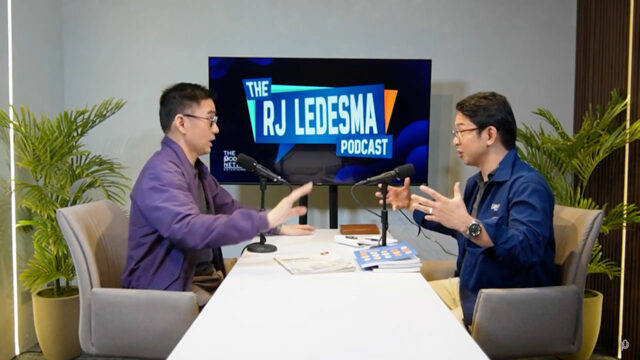
THE POD NETWORK ENTERTAINMENT

Entrepreneurs are always asked to ideate, but when were we ever taught to ideate? This paradox is at the heart of innovation, according to Aaron Palileo, Director of CIA Bootleg (Creative Intelligence Associates Bootleg), who is at the cutting edge of innovation and creativity. He also spends much of his time teaching entrepreneurs about these topics as the Program Director for Marketing and Branding Innovation Programs for the Ateneo School of Management. Here, his work intersects with a personal belief of mine — that entrepreneurial innovation plays an integral role in business.

If you’re wondering how you can innovate as an entrepreneur, disrupt the status quo, or ideate for business growth, read on. My conversation with Mr. Palileo is full of rich lessons for entrepreneurs from a unique mind in business, creativity, and the academe.

CREATIVE DESTRUCTION
Entrepreneurs aren’t just businessmen, according to Mr. Palileo. There are fundamental differences between the two. “A business owner,” he says, “is someone who literally owns a business, manages it, makes sure that profitability is there, the operational efficiency is there.” An entrepreneur is so much more.

In typical academic fashion, he quotes economist Joseph Schumpeter who said that an entrepreneur is someone who practices “creative destruction” — long before the term “disruptor” was even coined. Mr. Palileo then followed that up with some classic Peter Drucker who said that innovation is a specific tool of entrepreneurs.

This echoes my own personal experience that entrepreneurs are problem solvers who are not satisfied with the status quo. Oftentimes, they disrupt — yes, even destroy — the status quo and replace it with something of greater value. To do this, they need to know how to innovate.

“Innovation is impactful improvement,” Mr. Palileo explained.

MINDSET THAT DRIVES INNOVATION
How can entrepreneurs create this “impactful improvement?”

The answer is creativity — a discipline that is sorely lacking when it comes to training entrepreneurs, he notes.

To help entrepreneurs and creatives with the challenge of creativity, Mr. Palileo wrote the Creativity Handbook. This book is “designed as a workbook wherein, sure, I give the principles [for creativity],” he explained. As an exercise-driven book, it can help anyone generate ideas. And it’s not just for entrepreneurs. It’s for anyone “whether you are in the culinary arts, whether you’re a musician, whether you are a graphic designer,” he added.

In our conversation, which can be viewed in full on the RJ Ledesma Podcast, Mr. Palileo explained how entrepreneurial innovation starts with finding an inspiration, a problem, or an objective that you want to solve.

Only when you find this objective or problem you want to solve does ideation begin. And when it comes to ideation, what is important is a mindset of asking “What is different?”

“The great ones,” Mr. Palileo said, explaining what he learned from conversations with some of the country’s top creative minds, “they will always say, ‘What is everyone doing? Hindi ko gagawin ’yon (I won’t do that).”

Finally, entrepreneurs need to ground creativity with what meets business objectives, what delivers. “It’s not enough to be different,” he says. “It needs to deliver… You need to delight people.”

D-I-S-RUPT
In Mr. Palileo’s Innovation Course for Entrepreneurs (ICE) in the Ateneo, he trains entrepreneurs to innovate. Over the course of 18 weeks, these entrepreneurs go through a rigorous bootcamp to learn entrepreneurial innovation.

The first module is Discover. “Even before you discover out there, you have to discover your inner entrepreneur,” Mr. Palileo said. “Who are you really? What is your bent? Are you more of an analyst? Are you empathetic?”

With this knowledge, internal discovery leads to discovering opportunities. He continued, “The most important [thing] is discover who you are, then discover the opportunities in your industry and your company.”

The second module is Innovate, and the last module is Strategize. Together Discover-Innovate-Strategize spells out the beginning of DISRUPT.

Mr. Palileo told us how it all comes together, saying, “Now that you have found an objective, an opportunity, and you’ve ideated and tested some of the ideas you have, by then, meron ka nang magandang (you have a nice) innovation. So, the last part is strategizing and storytelling.

“So how will you bring this to life?” he added. “What would be the different touch points? What would be your strategy for the next year to ramp up this innovation?”

ENTREPRENEURIAL INNOVATION IN ACTION
Put into practice in his work as Director of CIA Bootleg, Mr. Palileo has worked with clients such as AC Health, Ayala Land, Carmen’s Best, Globe, Mega Sardines, Serenitea, and more.

With CIA Bootleg, he employs scientists — psychologists, sociologists, and semiotics experts who study culture — to see the company through a different lens, get to the root of a client’s enterprise DNA, and use it as a springboard for innovation.

His advice for entrepreneurs: “I think the most important thing really for entrepreneurs that are already working and have great momentum is to ask yourselves, ‘What is your corporate or your enterprise DNA? What is the core essence of your company that can connect your past, explain your present, and then predict your future?’”


RJ Ledesma (www.rjledesma.com) is a Hall of Fame Awardee for Best Male Host at the Aliw Awards, a multi-awarded serial entrepreneur, motivational speaker, and business mentor, podcaster, an Honorary Consul, and editor-in-chief of The Business Manual. Mr. Ledesma can be found on LinkedIn, Facebook and Instagram. The RJ Ledesma Podcast is available on Facebook, Spotify, Google and Apple Podcasts. Are there entrepreneurs you want Mr. Ledesma to interview? Let him know at ledesma.rj@gmail.com.

Dining In/Out (09/25/25)

The East Asian Mid-autumn Festival falls on Oct. 6, and below is a list of luxurious offerings from various establishments around the city.


From Hong Kong to The Peninsula Boutique

LIGHT UP the Mid-Autumn festivities with Peninsula mooncakes flown in especially from Hong Kong and available exclusively at The Peninsula Boutique for a very limited time. Mirroring the full moon, a traditional symbol of unity and completeness, these round pastries come in an array of flavors. In a statement, The Peninsula Food and Beverage Director Katsuma Tokitsu, said: “This year, we are thrilled to introduce two new mooncake flavors — the Mini Lotus Seed Paste with Egg Yolk and the Mini Egg Custard. We have taken the time to experiment and perfect the ingredients, ensuring that each bite offers a harmonious blend of flavors. These will be exciting new additions to this year’s celebration.” The boutique will also carry classics like Mini Lotus Seed Paste with Egg Yolk Mooncakes and Mini Egg Custard Mooncakes. Also available are boxes of assorted mooncakes. Available at The Peninsula Boutique and The Lobby, mooncake prices are P3,888 (four pieces) and P5,888 (eight pieces). For inquiries and orders call The Pen at 8887-2888 (ext. 6694 for Restaurant Reservations and 6769/6771 for The Peninsula Boutique), direct line 8887-5747, or visit peninsula.com/manila.


Super Lemon and Pokémon mooncakes

HONG KONG MX Mooncake celebrates Mid-Autumn 2025 with a lineup that blends innovation and tradition. This year, two newcomers — the Super Lemon Mooncake and the MX Pokémon Mooncake Gift Box — headline the collection. The Super Lemon Mooncake is infused with lemon essence, and features a tangy lava filling. Its sunny yellow octagonal gift box is a statement in itself. The MX Pokémon Mooncake Gift Box features a Pikachu design and Poké Ball details. Inside are four Creamy Custard Mooncakes, each stamped with a Poké Ball motif, crafted with French butter, fresh cream, and premium salted egg yolks. Beyond the mooncakes, the Pokémon set is a collectible in itself. Each box comes with a reusable eco-bag featuring Pikachu and Poké Ball patterns. Expanding the low-sugar series, this year they introduce the Low Sugar (Reduced) Mixed Nuts Mooncake, made with five high-quality nuts that deliver rich, layered flavors, crafted with maltitol for less sugar. The Low (Reduced) Sugar Lotus Seed Paste Mooncake with Egg Yolk features lotus seed paste combined with a premium salted egg yolk, with sugar alcohol replacing sugar to keep sugar content below 5%. Both varieties are free from refined white sugar, artificial colors, and preservatives. Hong Kong MX Mooncakes are available at S Maison, SM Aura, Ayala Malls Vertis North, and NuStar Cebu, as well as online via Lazada and Shopee (Hong Kong MX Products Phils) and www.doubledownimportexportinc.com. Free gifts are available for a limited time with orders worth P4,000 and up, plus delivery is free within Metro Manila for purchases of P5,000 and above.


Trio of collections at Newport World Resorts

NEWPORT World Resorts embraces the occasion with a trio of mooncake collections across its international hotels. The Hilton Manila’s offering features a bag woven with gold and royal purple, inspired by traditional Chinese textile art, paired with a structured design that echoes the elegance of an ancient wooden Chinese briefcase. This holds handmade mooncakes by chef Kevin Xu Qiao Yuan. Within are five sets: the Traditional Set with a tin can of Chinese red tea (P3,988+), the Boutique Set (P3,588+), the Snow Skin Set (P3,588+), the Shanghainese Set (P988+), and the Do-It-Yourself Set (P688+). Orders may be arranged until Oct. 6 by calling 0917-851-4044 or via e-mail: MNLPH_FB@hilton.com. Meanwhile, Hotel Okura Manila offers an elegant octagonal wooden box with a lacquer finish containing four mooncakes created by Yawaragi’s award-winning pastry team. Named Akizuki, or “Autumn Moon,” the collection presents Green Tea, Red Bean, White Lotus, and XO Conpoy. The Akizuki Mooncake Box is offered at P5,888 net and is available until Sept. 30, with advanced reservations encouraged by calling or texting 0917-842-9067 or 5318-2888 or through e-mail at fb@hotelokuramanila.com. The celebration continues with a collection at Manila Marriott Hotel. Mooncake choices include Red Lotus Paste with Salted Yolk, White Lotus Paste with Salted Yolk, Matcha with Salted Yolk, and Snow Skin with Custard, each offered at P338 net. A box of four mooncakes is P2,288 net, and a box of six is P2,888 net. Alongside the selection, Man Ho offers roasted nuts infused with rose water at P438 net. Pre-orders are accepted with mooncakes available from Sept. 15 to Oct. 10 through 0917-584-9553.


The Manila Hotel’s box of four mooncakes

THE Manila Hotel ushers in the Mid-Autumn Festival with the return of its handcrafted, premium mooncakes that are the perfect gift for family, friends, and colleagues. This year’s selection includes Single Yolk Red Bea, Single Yolk Pure White Lotus, Milk Golden Sand House, Black Sesame, and Passion Fruit. Each set is presented in an elegant commemorative box that pays tribute to the iconic façade of The Manila Hotel. The Mooncake Box of Four is priced at P3,888 net. To place orders or for further inquiries, call 8527-0011, 5301-5500, 0998-950-1912, or e-mail restaurantrsvn@themanilahotel.com.


Pastel colored mooncakes at the Grand Hyatt

THE Grand Hyatt Manila is pairing classic mooncake flavors with re-imagined snowskin creations in bright pastel hues this year. Complementing the vibrant colors of the mooncakes, this year’s gift boxes come in soft pink floral plate patterns inspired by the elegant tableware of No. 8 China House. The traditional mooncake selections are White Lotus, White Lotus with Salted Egg, Red Bean, Black Sesame, Ube, and Mixed Nuts. The contemporary set, wrapped in pastel-hued snowskin, include Raspberry, Coffee, Coconut, Sangria, Croquant, and Orange. Each mooncake is available individually or as part of a box or hamper. A single mooncake is P528; a box of four is P3,288, while a box of six is P4,288. For a more indulgent gift, the box of four mooncakes can come with a bottle of wine for P5,588, or a Bottle of Hennessy VSOP for P12,888. For festive gifting, there are two luxurious hamper options. The Mooncake Hamper with a bottle of wine is available for P9,588, while the Mooncake Hamper with a Bottle of Hennessy VSOP is offered at P15,488. Bulk orders are eligible for discounts of up to 25%. Orders of 100 boxes or more receive 25% off with free delivery within Metro Manila (one drop-off point). Orders of 50 to 99 boxes receive 20% off, 20 to 49 boxes receive 15% off, and 10 to 19 boxes receive 10% off. Delivery charges may apply based on location. The promo period runs until Oct. 6. For inquiries, call 8838-1234 or e-mail manila.grand@hyatt.com. Full details and terms are available at www.bit.ly/GHMMooncake2025.

Ex-BoJ policymaker Adachi says October hike can’t be ruled out

REUTERS

TOKYO — The Bank of Japan (BoJ) is likely to revise up its economic and inflation forecasts in its next quarterly review, which could pave the way for an interest rate hike in October, the central bank’s former board member Seiji Adachi told Reuters.

Markets see a roughly 50% chance of a rate hike at the BoJ’s next policy meeting on Oct. 29-30, when the board will also release fresh quarterly growth and inflation forecasts.

BoJ Governor Kazuo Ueda has stressed the need to scrutinise the expected impact of US tariffs on Japan’s economy and wage outlook, in deciding how soon to resume rate hikes.

Based on the risk-focused approach, the central bank is likely to hold off raising rates until around March next year when there is more clarity on whether the hit from tariffs could affect next year’s wage talks, Mr. Adachi said on Wednesday.

But a rate hike at the BoJ’s next meeting in October cannot be ruled out, as stronger-than-expected economic growth in the second quarter will likely push up the board’s growth projection and keep inflation around its 2% target, he said.

“Another 25-basis-point rate hike will do little harm to growth as borrowing costs will still be below levels deemed neutral to the economy,” Mr. Adachi said in an interview.

If the BoJ focuses more on downside risks to the outlook, it likely won’t hike in October as recent data have shown some weaknesses in exports and corporate profits, said Mr. Adachi, who served at the BoJ’s nine-member board until March.

“But if the board revises up its growth forecasts and modifies its current forecast that inflation will briefly fall below 2%, there’s little reason for the BoJ to hold fire.”

The BoJ kept interest rates steady at 0.5% last week but two board members dissented and proposed raising rates to 0.75%, a move that pushed up government bond yields on market expectations of a near-term rate hike.

In the present report released in July, the board expects the economy to expand 0.6% in the current fiscal year that began in April and 0.7% in fiscal 2026. It projects core consumer inflation to hit 2.7% in 2025 before slowing to 1.8% in 2026.

The BoJ will review the forecasts at the Oct. 29-30 meeting gauging various bits of information, including recent data that showed Japan’s economy expanded an annualized 2.2% in the second quarter, faster than initially estimated, on robust consumption.

The BoJ’s quarterly “tankan” business survey, due on Oct. 1, could also influence the bank’s decision on whether to raise interest rates next month, Mr. Adachi said.

Japan’s underlying inflation, currently estimated around 1.7%, could reach the BoJ’s 2% target if the tankan shows companies’ five-year inflation expectations accelerate to 2.5% from 2.3% in the previous survey, he said.

Governor Ueda has said the BoJ will continue to raise rates gradually if it becomes more convinced that underlying inflation will durably achieve its 2% target. At last week’s news conference, he said underlying inflation has yet to hit 2%.

“The BoJ doesn’t need to rush in raising rates as the risk of an inflation overshoot isn’t high,” Adachi said. “In a way, it has a free hand on the rate hike timing.”

A Reuters poll, taken before last week’s BoJ meeting, showed a majority of economists expect another 25-basis-point hike by yearend. But those surveyed are split on the timing with bets centering on October and January. — Reuters

DoE proposes higher financial benefits for communities hosting power facilities

SMCGLOBALPOWER.COM.PH

THE Department of Energy (DoE) is proposing an increase in the share of electricity sales that power companies must allocate to host communities.

In a draft department circular, the DoE said the move aims to enhance existing energy regulations to benefit communities hosting generating facilities, energy resources, and energy storage system facilities.

“The provision thereof shall contribute to the acceleration of total electrification in the country and lowering of electricity rates for end-users hosting the energy facilities,” the DoE said.

Energy Regulation 1-94 is the current policy designed to compensate communities for hosting energy projects.

Under the proposal, generation firms and energy resource developers must allocate P0.03 per kilowatt-hour (kWh) of electricity sales as financial benefits, higher than the P0.01 per kWh currently mandated.

The allocation is broken down as follows: P0.005 per kWh for electrification funding, and P0.025 per kWh equally divided to development and livelihood programs; reforestation and watershed management; and health and environment enhancement.

Energy Undersecretary Mylene C. Capongcol said the increase in financial benefits is intended “to provide more flexibility to support the requirements of the host communities.”

Facilities operated by microgrid system providers, small power utilities, and power generation firms with a capacity of 5 megawatts and below are exempted from the obligation.

The DoE said the financial benefits must be remitted to host local government units (LGUs) and/or indigenous cultural communities or indigenous peoples (ICC/IPs). A portion of the fund allocated for electrification should be given to the designated distribution utility.

The benefits will automatically be allocated as an electricity tariff subsidy if the host LGU or ICC/IP fails to submit the required reports or issue a council resolution. Benefits may also be reallocated if the host LGU or ICC/IPs refuse to accept or utilize the funds for up to two consecutive years.

Energy Secretary Sharon S. Garin said the agency is targeting to finalize and issue the enhanced policy “within the month.”

“We understand that the benefits are still lacking, but we are working on it,” she said.—Sheldeen Joy Talavera

The AI threat to Europe’s most valuable software company

CHRISTIAN KLEIN jogs onto the stage at SAP SE’s annual sales conference in a grey sweatsuit like he’s taking a victory lap. And in some ways, he is.

The 45-year-old chief executive officer took the helm six years ago just as the company’s sales were starting to stagnate. SAP — which makes software that runs finance, sales and other corporate functions — missed the industry’s shift to the cloud and was playing catchup. In one of his first earnings reports as CEO, Mr. Klein gave a bleak outlook and the company’s shares plummeted more than 20%. “I needed a glass of wine or two or three,” he said in a Bloomberg TV interview.

That’s when Mr. Klein decided to give his corporate clients an ultimatum: Migrate your data to our cloud products, or we will no longer support you. The gambit paid off. Cloud sales started to boom and SAP today is the most valuable software company in Europe.

Now, Mr. Klein needs a second act. The surge in sales coming from the cloud transition is going to start declining in 2027, when SAP has said it will begin rolling back support for the older software. Clients need to move over their systems by then, so the bulk of the spending will come in the next few years. After that, SAP will have to offer new services to keep up its growth.

The company is targeting artificial intelligence applications as its future, but faces competition from virtually every other tech giant in the world. Many customers are already unhappy with the expensive cloud transformation. Analysts at tech consulting firm Gartner reported concerns this year that the company is losing market share for some newer products outside of its core business and alienating clients because of its hard-nosed sales tactics.

This year, SAP’s cloud sales are set to reach nearly €22 billion ($26 billion), nearly triple 2019 levels. But interviews with more than 20 SAP executives, employees, customers and partners make clear there are serious challenges on the horizon. Internally, some executives are worried that SAP could fail to find a strategy to get customers to use its new AI products. Investors, who had been bullish on SAP’s cloud growth, sold off the stock in recent weeks on concerns the company could be disrupted by AI.

It’s not just SAP’s future that’s at stake. In Europe, the German juggernaut is one of the only software companies that’s managed to become a world-class player in its corner of the industry. Its market cap has far surpassed its old US rival Salesforce, Inc., and SAP’s position as a dominant player means European companies aren’t as dependent on other parts of the world for innovation. SAP’s strength along with a few other standouts – like ASML Holding NV, Spotify Technology SA and Arm Holdings Plc — is a point of pride on a continent that’s ceded tech leadership to the US and Asia.

At the sprawling Orange County Convention Center in Orlando, Florida this spring, Mr. Klein laid out his vision for the future. He explained to the 11,000 employees, customers and reseller partners at SAP’s annual Sapphire sales event how his company will integrate AI across its products. There are assistants to help gather and interpret information and agents to automate work across different applications — all sold in a convenient bundle. “Together,” Mr. Klein said when closing his keynote, “we have seen how the SAP business suite infused with business AI helps you in times of uncertainty, and how we help you to get there faster, simpler and at lower cost.”

But many of the customers who attended the show that week were still digesting the company’s last technological push. Some expressed frustration and exhaustion from the cloud upgrade — an expensive and complex process that most haven’t even started yet.

NBCUniversal technology executive Abhinav Gupta was the first customer on stage in Orlando to discuss his attempts to update the entertainment company’s heavily customized SAP landscape. The business has been growing and becoming more complex, and its systems now need a more refined set-up.

“It takes us a really long time to upgrade our SAP systems, and they are quite expensive to maintain. Does that sound familiar, anybody?” Mr. Gupta said to laughs on stage.

Fatih Nayebi, vice-president of data and AI for shoe company Aldo, said that while he sees AI integration as a necessity, SAP’s offers are sometimes difficult to navigate. “I need to make an effort to really understand this ecosystem myself,” Mr. Nayebi said on the sidelines of SAP’s conference in May. He wants SAP to offer more proactive support. “I really like what I’ve seen, and I think that’s the way to go. But we just started.”

The event is supposed to be a showcase for the company’s prowess. SAP’s valuation has flown past all of Germany’s other 39 largest public companies in the DAX. It’s the only German enterprise worth more than €200 billion, and it has a market valuation about 50% higher than No. 2 Siemens.

It was a hard slog to get there. The company was founded in the 1970s by five German IBM employees who started out building applications for accounting and invoicing. The new company’s key innovation was giving customers access to all their data in one place and significantly speeding up data processing.

From there SAP grew to become the world’s biggest producer of enterprise-application software, but the company struggled to adapt to change. In the early 2000s, cloud computing technology started to take off. San Francisco-based Salesforce popularized the service, leading the way in software that could be delivered and updated over the internet. It took SAP about a decade to start offering its own cloud services, ultimately buying its way into the market.

SAP spent about $30 billion on deals to catch up and had difficulty integrating the new businesses.

Billionaire Hasso Plattner, one of the five founders, hand-picked Mr. Klein to be CEO in 2019. Mr. Klein, who’s spent his entire professional life at the company after first joining as a teenaged student trainee, was tasked with restructuring SAP and its products so that the different cloud businesses could be integrated seamlessly into one SAP software suite and boost growth. Mr. Plattner was the last co-founder to leave the company when he finally stepped away from the chairman role last year at the age of 80, and the move to AI will be Mr. Klein’s first big test steering SAP without his mentor.

Internally, though, some executives in charge of selling SAP’s products are concerned that they’ll be able to maintain momentum.

The growth in cloud sales is set to fade after 2027, when SAP will start charging significantly more to support legacy “on premise” systems, the managers believe, asking not to be identified discussing their observations. SAP said it will end maintenance on the systems in 2030 and that continuing to use the old software will become “increasingly challenging and risk prone.”

Analysts expect cloud and software sales will continue to grow for the next few years, hitting 15% in 2027, according to data compiled by Bloomberg. It’s set to slow after that, though the average analyst outlook predicts growth above 10% through 2030.

To maintain its trajectory, SAP will have to convince its users to buy more services and new AI products. But most customers are still in the midst of dealing with the cloud transition. About 60% haven’t begun at all. For large firms, cloud migration of their intricate software setups can take years and cost millions of dollars.

Mercedes-Benz Group AG is one of those firms trying to figure out how to handle its portfolio of more than 10,000 applications in the move. About 1,200 of the programs are from SAP and most of those still run on software stored on local computers, not the cloud, the German carmaker’s Chief Innovation Officer Katrin Lehmann explained when she stepped on stage at Sapphire. She said she’ll prioritize the most crucial programs and is not yet sure what will happen to the rest.

One of the things that made SAP so hard to quit historically is that customers have bespoke setups, which work in tandem on their local servers to run key business processes on sensitive data. Moving to the cloud and a subscription-based model, while initially a hassle, has made it easier for clients to mix-and-match their service providers.

It’s called the “best of breed” approach, where customers cherry pick applications from different providers, and SAP had that model firmly in its crosshairs at the Sapphire event. The mantra “Best of Breed is Dead” was plastered across slides and screens around the Florida venue this spring.

SAP’s Chief Financial Officer Dominik Asam said the company is focused on increasing the number of cloud products per customer. In 2021, just 9% of cloud customers used at least four SAP products in the cloud. That’s grown to 23%. These setups, where SAP applications can work together, are key to future growth, he said.

Muhammad Alam, SAP’s head of product and engineering, said that the customers he’d met at the conference “universally believe” that picking different services from different providers “is essentially a burden as opposed to value.’’

“You can get the best capability, or you can get seamless integration,” he said. “You can’t get both.”

But users have always been wary of being dependent on one large software company and SAP’s customers, so far, aren’t reducing the number of other vendors they use, according to customers and partners who help businesses plan their SAP rollouts. While many are keeping SAP’s core enterprise products, they’re looking for diversity to decrease dependency and get access to the best software, the people said, asking not to be identified discussing their clients.

For example, Siemens uses SAP for its financial applications, but chose Salesforce for its customer relationship management functions and Workday, Inc. for human resources around ten years ago. “We take a platform approach to ensure that we use the best tool for the job,” a spokesperson said in an e-mail.

“We estimate that outside their core market, SAP is losing share in a number of other markets,” said Christian Hestermann, a Gartner senior director who follows SAP. Those include systems for analytics, customer relationship management and database management. According to Gartner reports, SAP grew by 6.8% in the CRM market in 2024, while average market growth was about 12%. Microsoft saw a rate of about 18% in the analytics space, where SAP also grew significantly slower than the market at 12% in 2024.

In a July report, Gartner wrote that some CIOs moved away from selecting SAP solutions for a number of products because of the pressure SAP exerts on companies to modernize. This prompted a shift from a “SAP-first” to a “SAP-last” strategy, it said.

An SAP spokesperson did not directly comment on the remarks, but said in an e-mailed statement that SAP had simplified adoption “by replacing complex consumption models with transparent, user-based packages — ensuring predictability and flexibility for both cloud and on-premise customers.”

In the past, SAP hasn’t needed to spend as much time cultivating customers. It generally sold its software licenses once and earned maintenance fees no matter if the customer used the programs or not. That’s another aspect of the business that’s changing with the move to cloud: subscriptions can be canceled.

Mr. Klein said he knows the company will have to improve its bedside manners with customers.

SAP needs to enhance its lines of communication, share ideas and provide recommendations, he said in an interview earlier this year. The company has introduced rigorous new training for employees to make sure they understand the products. Even a C-level executive, who asked not to be identified, failed such a test the first time around. It’s also changed bonuses for salespeople to ensure they aren’t just rewarded for an initial sale, Mr. Klein said.

He put board member Thomas Saueressig in charge of improving customer care last year and asked him to make sure clients were able to actually use the products that are being sold to them — not always a sure thing in a complex software environment. Mr. Saueressig said his teams have been helping customers to exploit their full potential and adopt SAP’s AI solutions. He’s satisfied with the progress so far. About 34,000 out of SAP’s 400,000 total customers are now using the AI products.

Internally, SAP employees have expressed concern that the company isn’t really showing customers what its AI products can do, people familiar with the matter said. The company hasn’t come up with convincing arguments to help sellers and partners market the applications, they said. SAP has not disclosed its AI sales.

Gartner’s analysts made a similar observation in their report and said they have seen “very little interest from SAP’s customers and prospects looking to make investments in SAP AI,” likely due to a “complex licensing model and unclear business benefits.”

An SAP spokesperson said in an e-mail that SAP was seeing strong and accelerating demand for its Business AI solutions. “With 240 generative AI use cases already available and 400 planned by the end of 2025, SAP is delivering scalable innovation at pace.” SAP’s AI agents were already automating dispute resolution and financial processes.

SAP is not alone with such struggles. AI employment is still in its early stages, UBS analysts including Karl Keirstead wrote in a research note in August. Some companies told UBS that deploying AI agents for complex use cases could take between two and five years, with one saying agents weren’t ready for “prime time.” They may be “70% accurate for a task, but you don’t know which are the wrong responses,” the customer said. Employees would then take “longer to find out the wrong answers than to do the task,” making it not worthwhile.

Mr. Klein may be targeting opportunities in the AI field that are simply not there yet. The UBS analysts determined that corporate customers mostly want to use AI development platforms, specifically “from cloud providers, namely Microsoft Azure AI Foundry, AWS Bedrock and Google Vertex.”

That will make it hard for SAP to sell customers its suite of services.

“Frankly, across all our checks, we’d argue that most enterprises are still crawling,” the UBS analysts said. Bloomberg

Opening Pandora’s Box

STOCK PHOTO | Image from Freepik

The Sept. 21 demonstrations against corruption carried deep symbolism. People poured into the streets of Metro Manila, their anger focused on anomalous flood control projects. The date was not lost on anyone: it was the 53rd anniversary of the proclamation of Martial Law in 1972. The demonstrations were, at once, about the present and the past.

Ironically, the spark came from President Ferdinand Marcos, Jr. himself. By exposing and then ordering investigations into a corruption scandal, he opened the proverbial Pandora’s Box. What may have begun as a bid to control the narrative quickly became less predictable. Once the lid was lifted, anger took on a life of its own.

The protests may well be the unintended consequence of the President’s initiative. In exposing corruption, he invited scrutiny not just of officials and agencies but also of his own family’s legacy. By pushing for reform, whatever his reason, the box is now open, and the forces unleashed cannot be contained.

At the same time, the President’s offensive against corruption created an atmosphere of expectancy. For a public numbed by recurring scandals, his words, actions, and the ensuing events sparked a faint flicker of hope: that this time, the powerful might not be spared.

Yet the historical baggage of the Marcos family casts a long shadow. To some, this looks less like genuine reform and more like false hope, a calibrated move to address public dissatisfaction with the government, win back approval ratings after the midterm elections, and consolidate political legitimacy before 2028.

The Pandora’s Box image is apt. Once opened, the narrative unleashes both real anger against corruption and unavoidable reminders of the Marcos family’s past. This is the risk the President may have unwittingly taken, and only time can tell when and how the situation will end.

The possible motivations are layered. The 2025 midterms were sobering with the administration’s coalition underperforming, and public discontent harder to ignore. By going after corruption in flood control projects, the President taps into one of our people’s most visceral grievances, perhaps betting that a bold gesture might help his government recover ground for 2028.

There is also the benefit of control. By exposing the shenanigans at Public Works himself and leading the charge, he frames the issue on his terms. He positions himself as the reformer of a broken system, even if that system is historically tied to his own lineage.

At the same time, his campaign against ghost projects has struck both allies and opponents, suggesting either a willingness to sacrifice friends or a calculated move that selective casualties, including within his own circle, demonstrate credibility.

The entanglement of House Speaker Martin Romualdez, his cousin and strongest ally, in allegations tied to anomalous projects complicates the picture. Was this an unintended casualty of a scattershot probe, or deliberate distancing? If unintended, it shows the danger of opening Pandora’s Box: once unleashed, corruption inquiries can scorch even kin, eroding family solidarity.

If calculated, the President is wagering that burning bridges, even familial ones, is worth the price of political survival to 2028, and maybe beyond. Either way, the move risks splitting his power base at a delicate time, without any certainty that the nation’s best interest will be served.

Likewise entangled are Senators Jinggoy Estrada and Joel Villanueva, Representative Zaldy Co, former Caloocan Representative Mary Mitzi Cajayon-Uy, former Senator Bong Revilla, and former Public Works Undersecretary Roberto R. Bernardo. Senators Estrada and Revilla had been at the center of the Janet Napoles “pork barrel” scandal a decade ago — charged, jailed, and then acquitted, only to return to the Senate with fresh mandates.

Now, once again, they are cast in a bad light in a new corruption scandal that also involves the misuse of the national budget. This implies that those who tried to reform the budget system by going after Napoles and her beneficiaries may have lit themselves up for nothing. The budget process remains as problematic as ever. And the electorate, seemingly blind to history or accountability, votes back into office even those tainted by scandal.

This validates the argument that anti-corruption initiatives cannot stand alone. They must be coupled with political, fiscal, and electoral reform. Without structural change, without breaking the hold of patronage, “pork barrel,” and celebrity politics, the fight against corruption collapses into a mere spectacle.

From whatever angle, the President’s move to expose corruption in flood control projects was bold and decisive, and credit must be given to him. If only people could judge him solely on this one act, the choice to expose and investigate corruption despite personal and political risk.

He could, for a moment, embody the statesman willing to face down a monster that has undone past presidents, becoming a catalyst for reform. He could be seen lighting the way at the risk of his own political loss. Or he could be dismissed simply as a shrewd political strategist and operator, performing boldness only to salvage trust ratings without real intent to cleanse institutions.

The lid has been pried open. Now the questions multiply, and the ghosts of the past walk freely again. Pandora’s Box rarely closes without consequence. One can only wonder how long this political episode will play out, and what else the President stands to lose or gain in the process.

One recalls the words of Islamic scholar, reformer, and theologian Muhammad Rashid Rida (1865-1935), who was born in what is now known as present-day Lebanon. An advocate for creating an “Ideal Caliphate,” he once said: “To revolt on behalf of an ignorant people is like setting yourself on fire in order to light the way for a blind man.”

Is the President, and all those who claim reform, advocating for or defending a people unwilling or unable to wean themselves from the system of patronage politics? Noble intentions alone do not guarantee meaningful change, especially if those they seek to help are incapable of receiving that help.

The President would not want to be the image of a man setting himself on fire: sacrificing political capital, credibility, and even family alliances to light a path, while risking being consumed by the flames before they illuminate anything. Perhaps the one-eyed can still be made to see the light before it dies out.

For reform to take hold, the voting public must also be willing to change and to wean themselves from election corruption. Unwillingness is not rooted in malice but in poverty, patronage, and celebrity politics. Voters choose leaders based on popularity, name recall, or handouts rather than track record or competence.

Those leading the charge against corruption may soon face a rude awakening: Philippine politics, even when up against an angry mob, may not easily yield to reform. There are limits, and perhaps heavy personal costs, when attempts at reform meet indifference or stubborn resistance. Voting behavior is a major factor to consider.

Many voters act not out of informed choice but out of constrained options, disinformation, or systemic conditioning. It is less about malice than about structural ignorance and survival politics. This shifts the blame away from individual voters to the system that fails to educate and empower them.

The system must change. At this point, follow-through is more than critical; it is crucially urgent and necessary. Without clear, resounding, immediate, and publicly acceptable reforms, the President may have unnecessarily set himself on fire in order to light the way for men who are blind by choice.

Just as the blind cannot see the light, a public trapped in patronage politics may be unable or unwilling to recognize budget and electoral reforms as beneficial. This is why the President must push on, no matter the consequences. The Independent Commission probing corruption in Public Works is only the beginning.

While corruption is investigated, political reforms must also take shape. This is the only guarantee that we will not return to the old ways. The President must march forward to stamp out systemic ignorance. The vicious recycling of ill-intentioned politicians is real, but not unbreakable.

The President should push Congress for practical reforms with visible results, not only in terms of fighting corruption but also in crafting the national budget, and in how people run for office and vote. Reform must anchor itself in tangible benefits that can be seen. Otherwise, the President may just end up only as a catalyst for deceptive expectation


Marvin Tort is a former managing editor of BusinessWorld, and a former chairman of the Philippine Press Council

matort@yahoo.com

Claudia Cardinale, Tunisian-born star of Italian cinema, 87

CLAUDIA CARDINALE in a scene from the 1968 film Once Upon a Time in the West.

ROME — Claudia Cardinale, a glamorous symbol of post-war Italian cinema who enjoyed a long and varied acting career on film and in the theater, has died at age 87, according to AFP and other French media.

Raised in Tunisia to a family of Sicilian origin, Ms. Cardinale’s introduction to the movie world came in 1957 after she won a beauty contest in Tunis and was rewarded with a trip to the Venice film festival.

Her voice had to be dubbed for her first Italian screen roles because she had grown up in a family where Sicilian dialect was spoken and had been educated at a French-speaking school.

Her early career was also complicated by a secret pregnancy which she said was the result of an abusive relationship. She gave birth to a son, Patrick, in London in 1958 and passed him off as a younger brother for several years while he was brought up by her parents.

After a series of smaller roles, she shot to international fame in 1963 when she featured in Federico Fellini’s 8-1/2 while she also starred alongside Burt Lancaster in The Leopard in the same year.

Shooting two films at the same time brought complications, with Ms. Cardinale recalling that she had to have different hair colors for the two roles.

In an interview with Britain’s Guardian newspaper in 2013, Ms. Cardinale contrasted the approaches of directors Fellini and Luchino Visconti, who directed The Leopard.

“He (Fellini) couldn’t shoot without noise. With Visconti, the opposite, like doing theater. We couldn’t say a word. Very serious,” she said.

Her growing profile opened the door to Hollywood productions and she appeared in the comedy caper The Pink Panther, directed by Blake Edwards, and Sergio Leone’s Once Upon A Time In the West in 1968.

OSTRACIZED
Ms. Cardinale’s career took a hit in the 1970s, after she separated from film producer Franco Cristaldi to start a life-long relationship with filmmaker Pasquale Squitieri, with whom she had a daughter, also called Claudia.

Angry at being dumped for another man, Cristaldi asked friends and associates in the Italian cinema industry to ostracize Ms. Cardinale, resulting for example in Visconti turning her down for his last film, The Innocent (1976).

“It was a very delicate moment. I discovered I had no money in my bank account,” Ms. Cardinale said about the period.

Franco Zeffirelli eventually came to her rescue, casting her in the 1977 television mini-series Jesus of Nazareth. She then continued working with other European directors, including Werner Herzog and Marco Bellocchio.

The husky-voiced, chain-smoking Ms. Cardinale had a reputation as a fiercely independent, free-spirited woman, who once defied Vatican protocol by showing up for a meeting with Pope Paul VI in a miniskirt.

A 2022 book celebrating her life was called Claudia Cardinale. The Indomitable.

Based for much of the time in France, and friends with presidents Francois Mitterrand and Jacques Chirac, Ms. Cardinale turned to the theater around the turn of this century, winning plaudits for her appearances on the stage.

She carried on making films in a variety of European languages until late in her life, appearing in Swiss TV series Bulle in 2020.

Awarded a lifetime achievement at the Berlin Film Festival back in 2002, she said acting had been a great career.

“I’ve lived more than 150 lives, prostitute, saint, romantic, every kind of woman, and that is marvellous to have this opportunity to change yourself,” she said.

“I’ve worked with the most important directors. They gave me everything.” — Reuters

Asialink’s loan disbursements to women entrepreneurs hit P525 million

ASIALINK Finance Corp. has released P525.148 million in loans to over 1,000 entrepreneurs under its lending program for women-led businesses, its top official said on Wednesday.

Asialink President and Chief Executive Officer Samuel Z. Cariño said the company has approved 876 loans under its Women’s Access to Inclusive Support (WAIS) Loan program that was launched in June.

Nearly half of the total were car loans amounting to P250.3 million, followed by truck loans worth P70.1 million, Mr. Cariño said at an event on Wednesday, where Asialink introduced actress Jolina Magdangal as its first WAIS loan ambassador.

“We also see steady demand for brand new vehicle loans, both cars and trucks, proving that WAIS is flexible enough to support different needs whether for mobility, logistics, or business expansion,” he added.

The WAIS Loan program allows women-led micro, small and medium enterprises (MSMEs) to borrow up to P20 million with interest rates as low as 0.99%.

Asialink Chief Operating Officer Eleanor E. Yap said women entrepreneurs may avail of auto loans worth up to P2 million, payable within two years, and apply for real estate loans amounting to P20 million under a five-year repayment term.

Asialink said the program has benefited 1,025 women entrepreneurs nationwide and provided them with capital to expand their businesses, among others.

The average loan size per borrower is at P500,000, it added.

Mr. Cariño said women-owned MSMEs from various industries such as retail and agribusiness accounted for 57% of Asialink’s nearly P1-billion total loan portfolio as of end-August.

“Our growth shows the strong demand for financing solutions designed for women-led MSMEs, a sector that drives inclusive economic development,” he said.

“The success of WAIS and the trust of our MSME clients nationwide inspire us to keep creating financial solutions that help Filipinos grow their businesses and uplift their communities,” he added. “Moving forward, we aim to reach more women entrepreneurs, equipping them with the right financial tools as they shape a better future.”

The WAIS Loan program is partly funded by the financing facilities that Asialink secured from the International Finance Corp. (IFC) and the Asian Development Bank (ADB) that aim to boost support for small businesses in the Philippines, particularly those owned or led by women.

In January, it received a $130-million credit facility from the IFC, the private sector lending arm of the World Bank Group. In December last year, it signed a $115-million financing package with the ADB to expand its working capital.

Asialink disbursed over P15.5 billion in loans in 2024, with 77% of the total supporting MSMEs. The company targets to reach P24 billion in loan releases this year, Mr. Cariño earlier said.

He also said that he is optimistic that their net income will hit P2 billion this year, up from P1.1 billion in 2024.

Asialink secured a P4-billion strategic investment from Malaysian equity firm Creador in February last year. — Katherine K. Chan