
How PSEi member stocks performed — September 1, 2025
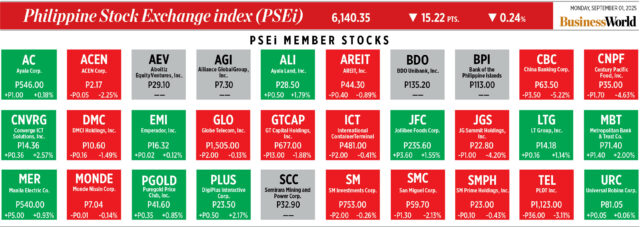
Here’s a quick glance at how PSEi stocks fared on Monday, September 1, 2025.
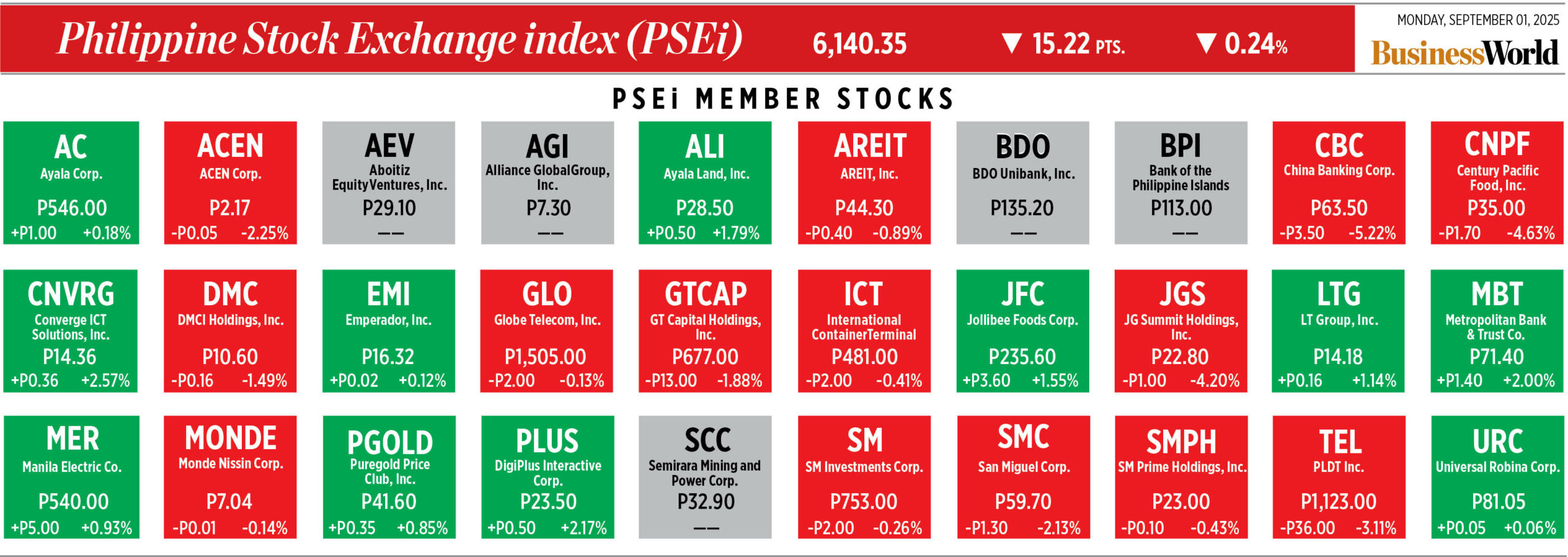

Here’s a quick glance at how PSEi stocks fared on Monday, September 1, 2025.
PHILIPPINE STOCKS continued to decline on Monday amid selling pressure and weak trading activity due to a lack of leads.
The Philippine Stock Exchange index (PSEi) decreased by 0.24% or 15.22 points to end at 6,140.35, while the broader all shares index slipped by 0.09% or 3.33 points to close at 3,683.55.
This was the PSEi’s worst finish in over four months or since it ended at 6,138 on April 21.
“The PSEi extended its decline this Monday… Profit taking continued amid the lack of a positive catalyst,” Philstocks Financial Inc. Research Manager Japhet Louis O. Tantiangco said in a Viber message.
“The local market was also dragged by foreign fund outflows, with net selling amounting to P148.55 million. The market is already on a six-day net selling streak, with net outflows averaging P784.18 million per day.”
Net foreign selling declined to P148.55 million on Monday from P983.24 million on Friday.
The peso’s recent weakness against the dollar also weighed on the stock market, Mr. Tantiangco said.
“Despite a series of declines in recent days, sellers continue to exert control over the market,” Regina Capital Development Corp. Head of Sales Luis A. Limlingan said in a Viber message.
“Moreover, the downturn likely reflects sentiment driven by forecasts suggesting an inflation growth this month as it is affected by the bad weather that stormed the country last month,” he said.
A BusinessWorld poll of 16 analysts conducted last week yielded a median estimate of 1.3% for August headline inflation, picking up from 0.9% in July but slower than the 3.3% clip in the same month in 2024.
If realized, August would mark the sixth month in a row that inflation was below the Bangko Sentral ng Pilipinas’ 2-4% target range.
The Philippine Statistics Authority is scheduled to release the August inflation data on Friday, Sept. 5.
Mr. Limlingan said the market is also awaiting the release of the latest US jobs report for clues on the US Federal Reserve’s next move.
Almost all sectoral indices closed lower on Monday. Holding firms fell by 0.65% or 33.04 points to 5,048.96; services decreased by 0.47% or 10.37 points to 2,184.49; financials declined by 0.29% or 6.18 points to 2,079.32; and industrials retreated by 0.1% or 9.39 points to 9,053.05.
Meanwhile, mining and oil surged by 4.33% or 432.38 points to 10,414.56, and property climbed by 0.08% or 2.14 points to 2,445.74.
“Converge ICT Solutions, Inc. was the day’s index leader, climbing 2.57% to P14.36. China Banking Corp. was the worst index performer, dropping 5.22% to P63.50,” Mr. Tantiangco said.
Value turnover declined to P4.21 billion on Monday with 1.15 billion shares traded from the P6.85 billion with 1.63 billion shares exchanged on Friday.
Advancers outnumbered decliners, 110 to 96, while 55 names were unchanged. — A.G.C. Magno
THE Department of Finance (DoF) said on Monday that a proposed general tax amnesty (GTA) will likely cover unpaid internal revenue taxes as far back as 2007.
“The proposed general amnesty bill will cover all internal revenue taxes from 2024 and previous years. It could be up to 2007,” Finance Undersecretary Charlito Martin R. Mendoza said at a Senate Finance Committee briefing with the Development Budget Coordination Committee.
Mr. Mendoza said the DoF is still working out the details of the bill but it could “possibly” include unpaid Customs duties.
Finance Secretary Ralph G. Recto has said that amnesty legislation is set to be refiled to Congress this year, after having been vetoed in 2019.
In 2019, President Rodrigo R. Duterte rejected the GTA provisions of Republic Act No. 11213 but retained the estate tax amnesty.
The tax amnesty program will involve an amnesty charge equivalent to a portion of the outstanding unpaid tax in exchange for immunity from civil, criminal, and administrative penalties.
The DoF expects additional revenue from the proposed bill, though no projections are available as yet.
Mr. Mendoza said the DoF is still working on how to address Mr. Duterte’s veto.
At the same briefing, the government aims to trim the share of the deficit relative to gross domestic product to 3.1% by 2030.
“With higher government revenue collections and improved expenditure management, our fiscal deficit will drop from the pandemic high of 8.6%, to 5.5% in 2025 and down to about 4% by 2028. It will further drop to 3% in 2030,” Finance Undersecretary Karlo Fermin S. Adriano said.
Mr. Adriano said government efforts to curb wasteful expenditure are crucial to this forecast.
The DoF reiterated its no new taxes pledge until 2028, with the exemption of the Single Use Plastics Act.
The excise tax on single-use plastic bags was one of the 28 priority bills identified by the Legislative-Executive Development Advisory Council.
While it was approved by the House on third reading in 2022, the measure remains with the Senate Ways and Means Committee. — Aubrey Rose A. Inosante

THE Energy Regulatory Commission (ERC) said it drafted rules for the National Grid Corp. of the Philippines (NGCP) to follow in procuring reserve power.
In a draft resolution, the ERC proposed implementing guidelines for the procurement, execution, and evaluation of ancillary services (AS) procurement agreements by the NGCP.
Ancillary services refer to power reserves tapped by the grid to ensure the reliable operation of the transmission system should its regular sources of power fall short.
The ERC said that the Department of Energy’s policy on the competitive selection process (CSP) for AS requires that the regulator review whether the parties comply with the requirements.
The proposed rules require the system operator to undertake “a transparent, competitive and non-discriminatory procurement process for AS.”
To encourage broader participation in AS procurement, the system operator is directed to ensure compliance with the DoE on the mandatory AS capability testing of all generating facilities.
“To ensure SO’s compliance with its obligation to procure cost-effective and least-cost AS, the lowest calculated bid shall be subject to an AS.
Price Cap set by the system operator, which shall not be disclosed by the TPBAC (Third Party Bids and Awards Committee) to the bidders until the opening of bids,” the ERC said.
The ERC said that all AS procurement agreements must obtain its approval prior to implementation, with a maximum term of five years.
Francis Saturnino Juan, ERC chairman and chief executive officer, said in a recent commission meeting that the review of AS procurement agreements should be streamlined akin to the process for power supply agreements.
“I took the initiative to propose these kinds of guidelines so that we have a clear set to follow, which can also serve as a guide for the industry, the SO, and the AS providers who will participate in any CSP that the SO will carry out,” Mr. Juan said.
He said that the review of AS procurement agreements should be streamlined to accelerate the application and for the system to have access to the capacity immediately.
“What we are proposing is to look at the price that came out and, if it has already gone through the CSP, (we need) to accept it as the lowest cost that the system operator can obtain, and for the ERC to just review the other terms of the AS procurement agreement,” Mr. Juan said. — Sheldeen Joy Talavera

THE Department of Economy, Planning, and Development (DEPDev) said it will overhaul the food poverty threshold in 2026, which is currently set at P64 per person per day.
“We will be revising the poverty threshold,” Economy Undersecretary Rosemarie G. Edillon told a Senate Finance Committee briefing on Monday, adding that new data will be incorporated from the 2024 census.
Sen. Loren Regina B. Legarda called the P64 threshold an “out-of-touch economic benchmark.”
According to the 2023 Family Income and Expenditure Survey (FIES), the monthly food poverty threshold for a family of five was P9,581, or about P64 per person a day.
Economy Secretary Arsenio M. Balisacan has admitted that P64 was outdated and committed to revise it. The Philippine Statistics Authority (PSA) has also called it “insufficient” and not reflective of actual food spending.
Ms. Edillon said the revised threshold will consider factors such as age, sex, and size, which affect nutritional requirements.
“The 2025 FIES is currently being conducted. The PSA has finished the first round covering the first semester of 2025. The second round covering July until December will be conducted in January to February of 2026. Results will be available sometime in July next year,” she said.
Updated methodology will be submitted to the PSA Board for approval and will be applied to the 2025 FIES data. Until then, the 2023 threshold remains in use. — Aubrey Rose A. Inosante

THE Association of Negros Producers (ANP) said it is seeking to develop niches in organics and crafts to supplement the island’s strengths as a food producer.
“Food has always been one of the favorites of people who visit Negros,” ANP President Christina Gaston told BusinessWorld on the sidelines of the preview of the 39th Negros Trade Fair. “But everything that we make comes from the soil … whether it is the food or fashion.
“The products that we use (in crafts) actually are considered waste materials,” she added.
She said the group was organized to help micro, small and medium enterprises (MSMEs) grow their businesses after the sugar industry collapsed in the 1980s, offering farm workers creative endeavors for their livelihood.
“Sustainability is very important to us. There are those who are working in the organic sector, producing liniments, soaps, and candles,” she said.
“Of course, we have organic agriculture. We have coffee and chocolate growers developing those industries as well,” she added.
She said the first wave of ANP members started in export, as directed by the Department of Trade and Industry (DTI) at the time, developing major markets in Europe and the US.
“Over the last 10 years, the domestic market has developed a lot both in appreciation and size, and logistics have enabled us to really expand our market range,” she added.
Last week, the ANP launched its 39th Negros Trade Fair, known as HIMBON, at the SMX Convention Center in SM Aura.
Expected to be the biggest Negros Trade Fair, it will occupy 2,500 square meters and showcase 139 vendors and partners between Sept. 23 and 28.
“After 39 years, we have seen the sustainable growth of our exhibitors. We’ve witnessed how they’ve scaled up to the B2B (business-to-business) level, even supplying for international markets,” Ms. Gaston said.
“This is why we continuously strive to bring the trade fair to future markets and pass on the advocacy,” she added.
SM Supermalls President Steven Tan said that ANP’s approach is aligned with SM’s vision of providing a platform for MSMEs to showcase their products.
“Negros has so many rich and beautiful products, whether it is fabrics, home decor, or even food,” he said.
He noted the need to ensure “the continuity of this culture and heritage. We have to preserve it.”
The trade fair will not only showcase Negros food, fashion, and home and design, but also vendors and businesses from the Negros Island Region.
“This is just the start of the partnership. And we really hope that we could be a long-term partner. We want to make sure that the purveyors inside the fair could be successful,” said Mr. Tan.
“That would encourage them to do more and influence other MSMEs to really also showcase their products. Our (common) objective is to help the MSMEs,” he added. — Justine Irish D. Tabile

HANN PHILIPPINES, Inc. (HPI) registered its mixed-use development in Clark as a special economic zone, the Philippine Economic Zone Authority (PEZA) said, converting it from its initial status as a leisure project.
In a statement on Monday, PEZA said it signed a supplemental agreement with the company for the registration of the Hann Reserve.
“To be located in Pampanga, Hann Reserve is set to emerge as a world-class, master-planned destination where industries, agriculture, technology, and tourism converge,” PEZA said in a social media post.
“Once operational, the project is expected to create new investments, generate quality jobs, and unlock opportunities for local communities — anchoring Pampanga as a premier growth hub in Luzon,” it added.
The company earmarked P10.459 billion to develop an additional 324.6 hectares, which will supplement its 131-hectare property in New Clark City.
It is expected to begin construction and land development within the year.
According to PEZA, HPI requested the reclassification of Hann Reserve from a tourism economic zone to a mixed-use special economic zone, to allow for manufacturing, agro-industrial, tourism, and information technology activities.
“This reclassification will enable HPI to attract a wider range of investors to its 455.60-hectare leased property,” it added.
PEZA Director General Tereso O. Panga said the agreement is a significant step in economic zone development.
“This reclassification of Hann Reserve ushers in a new era of ecozone development, one that fuses industry, innovation, agriculture, and tourism into a single, sustainable engine of growth,” he said.
“Beyond harnessing the country’s global investment competitiveness, this initiative strengthens PEZA’s mission of ecozoning the Philippines towards inclusive, balanced, and sustainable growth, with the countryside at the heart of progress,” he added.
PEZA is expecting 20 to 30 economic zone proclamations this year. — Justine Irish D. Tabile

THE Anti-Money Laundering Council (AMLC) said “covered persons” subject to its oversight must only deal with legitimate online gambling platforms and casinos.
“Covered persons (CPs) are hereby reminded that transactions involving online casinos and online gambling platforms must be conducted exclusively with entities duly registered with the Philippine Amusement and Gaming Corp. (PAGCOR),” the AMLC said in a statement.
“CPs are expected to maintain heightened vigilance by monitoring customer transactions involving online gambling activities, updating customer profiles as necessary, and conducting enhanced due diligence when warranted, in accordance with their Money Laundering and Terrorism Financing Prevention Program,” the council added.
According to the AMLC, CPs refer to financial institutions and designated non-financial businesses and professions, including banks, quasi-banks, trust entities, pawnshops, nonstock savings and loan associations, electronic money issuers, insurance companies, securities dealers, brokers, salesmen, investment houses and other similar persons.
AMLC warned CPs of the risks of transacting with unregistered online casinos and gaming apps, instructing them to file suspicious transaction reports as warranted.
Under the Anti-Money Laundering Act, CPs are required to report to the AMLC all suspicious transactions within five working days from its occurrence.
CPs that fail to comply could face administrative sanctions under the AMLC’s rules of procedure, it added.
President Ferdinand R. Marcos, Jr. ordered stricter regulation of online gambling platforms, citing the industry’s social costs and risks to the financial system.
Last month, the Bangko Sentral ng Pilipinas ordered e-wallet providers, banks and other financial institutions to delink their services from gambling apps and websites.
The central bank is also working on additional measures such as bans on credit card use for betting, biometric verification, transaction limits and self-exclusion tools.
PAGCOR projected online gambling to account for about 60% of its revenue this year, equivalent to P62-65 billion. — Katherine K. Chan

Sen. Francisco Pancratius N. Pangilinan said prosecutions for economic sabotage are going slowly, blunting the law’s deterrent effect.
Mr. Pangilinan, who chairs the Senate Committee on Agriculture, Food, and Agrarian Reform, said in a statement submitted to a Senate hearing that the Anti-Agricultural Economic Sabotage Council has been slow to act on cases of smuggling involving food products.
“You have all the information to find cases of economic sabotage. Why is nothing happening? The President himself said so six, nine months ago,” Mr. Pangilinan said.
He said in light of the dearth of prosecutions, he is seeking greater powers for the DA to initiate smuggling prosecutions on its own.
The Anti-Agricultural Economic Sabotage Act (Republic Act 12022) defines economic sabotage as a separate crime if the value of smuggled farm goods exceeds P10 million.
Mr. Pangilinan called economic sabotage prosecutions “low-hanging fruit” and described the attention being paid to the National Single Window — a streamlined trade permit processing portal — as misdirected in light of three pending cases involving shipments to Subic, Baco, Oriental Mindoro and Talisay, Cebu, which is the site of one of the province’s container terminals.
“When will these be charged. Because we can discuss everything… — fix this, fix that, but it’s been ten (months),” he said.
He added that the Philippine Coast Guard has adequate powers to initiate smuggling prosecutions but has not exercised them.
“We have three cases, can we just get an update? For the Coast Guard, my understanding is that the Coast Guard is part of the council. You have the power, you can file a case.”
Separately, the DA said in a statement that the DA’s Inspectorate and Enforcement office conducted 182 anti-smuggling operations between January 2024 and July 2025, leading to the confiscation of P3.78 billion worth of agricultural and fishery products.
In 2024, it tallied P2.8 billion worth of seizures of smuggled products. This year so far, 111 operations were conducted yielding P953 million worth of seizures. — Andre Christopher H. Alampay

PRESIDENT Ferdinand R. Marcos, Jr., said on Monday that the government will expand financing for small tourism enterprises as the government reorients its strategy to focus on cultural and community-based experiences.
At the Turismo Asenso Loan Awarding Ceremony in Pasay City, Mr. Marcos announced loan packages for nine tourism-related micro, small, and medium enterprises (MSMEs) in Metro Manila and Calabarzon.
The program is backed by the Department of Tourism, the Department of Trade and Industry (DTI), and the Small Business Corp.), which were urged by the President to “make sure that the Turismo Asenso Loan Program and other forms of assistance reach every part of the country.”
“Tourism is one of the pillars of our economy. It sustains livelihoods and fuels growth for thousands of small businesses across the country,” he added in remarks livestreamed by Radio, Television Malacañang.
According to the Philippine Statistics Authority, in 2024, tourism’s direct gross value added grew 11.2% to P2.35 trillion, its strongest performance since 2019, pushing tourism’s share of gross domestic product to 8.9%, level with its pre-pandemic share.
The loan program is part of a broader push to widen MSME financing channels, alongside DTI-led Negosyo Centers, trade fairs, and the Go Lokal! platform promoting homegrown products.
Mr. Marcos said the financing packages are an investment in “experiential tourism” focusing on immersive cultural experiences rather than resort-based leisure. — Chloe Mari A. Hufana

THE Department of Trade and Industry (DTI) said it is considering mobilizing its financing arm, the Small Business Corp. (SB Corp.), to provide P2-3 billion to small exporters affected by US tariffs.
“Actually, (financing small exporters) is a good idea. We can talk about that, as we do not have that loan program in place yet,” Trade Secretary Ma. Cristina A. Roque told reporters on the sidelines of the Turismo Asenso Loan Awarding Ceremony on Monday.
“It will be easy because I (chair) SBCorp.,” she added, estimating the size of the package at at least P2-3 billion.
“I will check, but it should be a bit big, like at least P2 billion or P3 billion,” she added.
The US imposed a 19% reciprocal tariff on shipments of Philippine goods, likely degrading the competitiveness of the export sector.
She said SB Corp. received an additional P1.5-billion allocation from the Department of Budget and Management (DBM), bringing its loanable funds to P11.5 billion.
She also said that the department will seek more funding for SB Corp. next year on top of the P1.5 billion provided by the National Expenditure Program (NEP) 2026.
The NEP is a document prepared by the Executive branch outlining its spending plans, which are subject to adjustment when the budget bill is legislated.
On Monday, the DTI and the Department of Tourism (DoT) launched the Turismo Asenso Loan Program aimed at helping tourism MSMEs in expanding their operations.
During the event, President Ferdinand R. Marcos, Jr. presided over the awarding of loans to nine tourism beneficiaries, including wellness spas, resorts, and travel and tour agencies from Rizal, Cavite, Laguna, and Metro Manila.
In a statement on Monday, the DoT said that the approved amounts ranged from P150,000 to P1 million.
“They are Reluxx Body and Wellness Spa, Pressure Point Wellness and Spa, S.E.AL Travel and Tours, Robles Resort, Imassage De Cavite Wellness Spa, Sense Body Massage Spa, Lavmemar Travel and Tours, Landsafe Travel and Tours Agency, and Silverscape Travel and Tours,” it added.
The Turismo Asenso Loan stemmed from a memorandum of agreement signed between the DTI and DoT on April 7.
“By empowering our MSMEs, we are fostering economic stability, generating sustainable employment opportunities, and strengthening the fabric of our communities,” Tourism Secretary Ma. Esperanza Christina G. Frasco said.
“When tourism and trade flourish, so does the livelihood of our fellow Filipinos, creating a ripple effect of prosperity and growth that will be felt across the nation,” she added.
The loan facility will be available for businesses with at least 60% Filipino ownership, assets not exceeding P100 million, with at least a year’s track record, with no past due accounts owed to SBCorp. — Justine Irish D. Tabile

THE GOVERNMENT needs to tap artificial intelligence (AI) to better detect corruption and waste in public procurement, the Philippine Institute for Development Studies (PIDS) said.
“Tools like AI-powered whistleblower reporting systems and blockchain-enabled reporting systems… can ensure reliability of information, protection of the citizen-whistleblowers, and (help ensure successful) forensics,” PIDS Senior Research Fellow Adoracion M. Navarro said during the 2025 Development Policy Research Month (DPRM) National Kickoff Press Conference on Monday.
Ms. Navarro said on the sidelines of the event that the government can leverage AI in government procurement via the Philippine Government Electronic Procurement System (PhilGEPS) to detect “bid rigging or weakening of competition.”
Ms. Navarro cited the case of Brazil, which uses AI-driven anti-corruption technology in auditing government transactions.
However, government data is currently not centralized, making it difficult to feed data to the AI, PIDS Senior Research Fellow Kris Francisco-Abrigo said.
“Remember that AI is a computer software that analyzes patterns, and at the moment, our data in government is not centralized. Digitalization is not widely adapted,” Ms. Abrigo told the forum. “I think that is something that we can work on if we want to use AI to combat corruption.“
Krystal Lyn T. Uy, former undersecretary for Legal Affairs at Department of Economy, Planning, and Development, said the government cannot take advantage of AI without data.
“Even AI systems are prone to biases, depending on the type of data that you feed into it,” she said. “If the only data that you have is Metro Manila data, then the results of the AI application would be biased towards Metro Manila.”
Emmanuel C. Lallana, professorial fellow at the University of the Philippines Center for Integrative and Development Studies, said the government must adopt a data governance framework to harness AI tools effectively.
“There has to be a shift in the mindset that the government doesn’t own the data. They’re just taking care of the data, and that we have to adopt an attitude of proactively releasing it,” he told the forum. — Beatriz Marie D. Cruz
