Home Blog Page 5384

PHL working to exit FATF ‘gray list’

BW FILE PHOTO

THE BANGKO SENTRAL ng Pilipinas (BSP) hopes the country can exit the Financial Action Task Force’s (FATF) “gray list” of jurisdictions under increased monitoring for “dirty money” risks within the next 12 months after failing to meet its original January 2023 goal.

“We have clearly missed the first deadline. The first deadline was this January. We are now given until January 2024,” BSP Governor Felipe M. Medalla told reporters on Tuesday.

The BSP chief said the country should show progress in enforcing laws to address money laundering and terrorist financing.

“The problem is enforcement, not legislation. Of course, the usual problem is identifying the real beneficiaries, but that’s no longer a major issue. The major issue is there are not a lot of persecutions and convictions,” Mr. Medalla said in a mix of English and Tagalog.

“What happens between now and then is much critical,” he added.

Global financial crime watchdog FATF put the country in its list of jurisdictions under increased monitoring for dirty money risks in June 2021.

In October 2022, it said the Philippines remains on the list and cited the need to further strengthen its action plan to address “strategic deficiencies” related to casino junkets, nonprofit organizations, and beneficial ownership.

To be removed from the list, the country committed to comply with 18 action plan items. Progress reports are submitted to the FATF in three reporting cycles in a year: January, May and September.

Mr. Medalla said most of the legislation part of the FATF’s action plan items for the Philippines have been addressed, as only amendments to the country’s deposit secrecy law have yet to be passed.

“We met with the Department of Justice (DoJ) and they told me, if we’re only more diligent in having a system that truly brings out all the real prosecution and conviction, the number (of cases) will be much higher. So that’s what we need to show. The solution requires a whole of government approach, not just the AMLC (Anti-Money Laundering Council) and not just the DoJ, but the law enforcement also,” Mr. Medalla said.

“I’m quite confident, given the early meetings with Justice Secretary Jesus Crispin C. Remulla. The focus will be there to try our best to increase the chances so that by early next year, those problems have been met,” he added.   

Based on the FATF’s latest assessment, the Philippines needs to show it is implementing effective risk-based supervision of designated nonfinancial businesses and professions. These include jewelry dealers, real estate brokers and developers and service providers for financial businesses.

The dirty money watchdog also said the country has to improve monitoring controls to mitigate financial crimes associated with casino junkets.

It added that it will continue to track the country’s progress in ensuring beneficial ownership information is streamlined and up to date for better access of law enforcement agencies. — K.B. Ta-asan

Tarnished Golden Globes aim to regain role as Hollywood’s ‘party of the year’

HFPA/ GOLDENGLOBES.COM

LOS ANGELES — A year after Hollywood boycotted the Golden Globes, Brad Pitt, Steven Spielberg and other big names are set to return as organizers try to restore the luster to what had been one of the biggest stops on the industry’s awards circuit.

Most of this year’s nominees are expected to attend the red-carpet ceremony in Beverly Hills on Tuesday (Wednesday in the Philippines – Ed.), said Helen Hoehne, president of the Hollywood Foreign Press Association (HFPA), the group that hands out the Globes.

“We’ve gotten a really great response from the nominees,” said Ms. Hoehne, a German journalist elected in late 2021 to lead the group through diversity and ethics scandals. “We have very few not coming, so we are thrilled.”

She vowed the night would be “the party of the year.”

Now in their 80th year, the Globes had been known as a festive, alcohol-fueled ceremony that kicked off Hollywood’s awards season and helped propel nominees and winners in their quest for Academy Awards.

The future of the Globes was thrown into doubt after a 2021 Los Angeles Times investigation revealed the organization had no Black journalists in its ranks. Some members were accused of making sexist and racist remarks and soliciting favors from celebrities and movie studios.

Longtime broadcaster NBC dropped the 2022 telecast, but the Comcast Corp. network agreed to air the ceremony again this year after the HFPA instituted changes and new ethics rules. Among roughly 200 current voters, nearly 52% are racially and ethnically diverse, including 10% who are Black.

“The organization really went through a total reform process in the last 18 months,” Ms. Hoehne said. “We increased diversity, transparency, accountability.””

The lineup for Tuesday shows Hollywood appears ready to give the HFPA a shot at redemption.

Comedian Jerrod Carmichael, who is Black, will host the three-hour ceremony, while Eddie Murphy will receive a lifetime achievement honor. Director Quentin Tarantino and actor Jamie Lee Curtis are listed among presenters.

SOME STARS MAY PASS
Nominees expected to attend include Mr. Pitt and his Babylon co-star Margot Robbie, Mr. Spielberg and cast from his coming-of-age film The Fabelmans, The Woman King star Viola Davis, Avatar director James Cameron and singer Rihanna, a nominee for a song from Black Panther: Wakanda Forever.

Some celebrities will stay away.

Brendan Fraser, nominated for his leading role in The Whale, has said he will not attend after accusing a former HFPA president of groping him.

Tom Cruise is not expected to appear even though his blockbuster movie Top Gun: Maverick is nominated for best drama film. Cruise returned his three Globe statues in protest of the organization’s practices in 2021.

Chris Beachum, managing editor at awards website Gold Derby, said producers likely will stage a lively show, but there is a risk that some of the winners might skip the ceremony.

“It’s a matter of how many people are getting their name called and not going on stage because they’re not there. That’s more of an issue,” he said.

Mr. Cameron’s Avatar: The Way of Water and Baz Luhrmann’s Elvis biopic are among the contenders for best drama film. Dark comedy The Banshees of Inisherin leads all movies with eight nominations, and Abbott Elementary tops the field of TV contenders.

Even with the recent controversy, Mr. Beachum believes most actors, studios, and publicists would be happy to have a Globe honor to tout as they head toward the Oscars in March.

“You want to be winning awards in this period of December, January, and February,” Mr. Beachum said. “You hardly ever see somebody go through an entire cycle, losing most everywhere and then winning the Oscar. It just doesn’t happen.” — Reuters

Omicron COVID booster cuts hospitalization in over 65s — Israeli study

JERUSALEM — The Omicron-adapted coronavirus disease 2019 (COVID-19) vaccine booster developed by Pfizer, Inc. and BioNTech SE sharply reduced hospitalizations among older patients, Israeli researchers said on Monday, in some of the first evidence of the jab’s real-world effectiveness.  

The study by researchers from healthcare provider Clalit, Ben-Gurion University of the Negev, and Sapir College has not yet been peer reviewed.  

It found an 81% reduction in hospitalizations among people aged 65 and older who had received the booster against those who had previously received at least two COVID vaccinations, but not the Omicron-adapted shot.  

The study was carried out from the end of September until mid-December and looked at 622,701 people aged 65 and over who were eligible for the bivalent booster. Among them, 85,314, or 14%, had received it.  

“Hospitalization due to COVID-19 occurred in 6 bivalent recipients and 297 participants who did not” receive it, the study said. “Death due to COVID-19 occurred in 1 bivalent recipient and 73 participants who did not.”  

Though the 86% drop in mortality was statistically borderline because of the relatively low death rates in the country, it was nonetheless significant, the researchers said.  

“Participants who received the bivalent vaccine had lower hospitalization and mortality rates due to COVID-19 than non-recipients up to 70 days after vaccination.”  

While the bivalent vaccine targets the original strain and its BA.4/BA.5 Omicron subvariant, scientists have been closely watching another Omicron subvariant, XBB.1.5, which has been rapidly spreading in the United States. — Reuters 

IKEA Philippines issues recall of chair product due to injury risks 

FURNITURE retailer IKEA Philippines has issued a recall of one of its products due to reported fall and injury incidents.

The Swedish retailer said in an advisory posted on the Department of Trade and Industry (DTI) website that it is recalling its Odger swivel chair in the anthracite color with date stamps before and including “2221” due to fall and injury hazards.

On its website, IKEA explained that the first two numbers refer to the year and the last two are for the week of that year, thus 2221 means year 2022, week 21.

The advisory, dated Dec. 21 last year, was sent by IKEA to the DTI’s Consumer Protection and Advocacy Bureau.

“Globally, IKEA received 19 incident reports concerning breakage of the chair’s star base, where five cases involved injuries. One of the reported injuries includes medical treatment,” the advisory said.

The retailer said that the Odger swivel chair was designed for home use, with the anthracite color having been sold to customers since October 2019.

“Since sale start, IKEA sold approximately 63,000 pieces all over the world,” the advisory said. “Improvement has been made beginning date stamp 2222.”  

According to the advisory, consumers will be able to find the name and date stamp of the product underneath the seat, molded in the material of the chair.

It said IKEA is urging all customers who own an Odger swivel chair in the anthracite color with date stamps before and including 2221 “to immediately stop using it and return it to the IKEA store for a full refund.”

“Safety is a top priority for IKEA,” it added, thus it is recalling the affected swivel chair “to protect the Filipino consumers from potential risks.”

The Swedish furniture retailer opened a branch in the Philippines in November 2021 in Pasay City. — Revin Mikhael D. Ochave 

Philippines must boost financial system’s resilience amid volatile conditions

THE PHILIPPINES needs to improve the financial system’s resilience and preparedness amid volatile and uncertain market conditions due to tighter monetary policy here and abroad, the Financial Stability Coordination Council (FSCC) said in its annual report.

Bangko Sentral ng Pilipinas (BSP) Governor Felipe M. Medalla, who also chairs the FSCC, said even though the country has recovered from various disruptions caused by the coronavirus pandemic, it needs to be prepared for the challenges ahead.

“The supply and distribution of key commodities such as oil and food are still not where they were pre-pandemic. These bottlenecks would keep consumer prices high,” Mr. Medalla said in his remarks during the release of the FSCC’s Financial Stability Report (FSR) for 2022 on Tuesday.

“The policy response though of raising interest rates will eventually affect the demand side of economic activity. How these changing demand and supply patterns manifest in 2023 at the global stage remains to be seen,” he added.

The FSCC said in the report that elevated inflation and rising interest rates remain the primary concern in an interconnected global economy where risks and vulnerabilities can spill over from one country to the other.

“All these matter to emerging markets (EMs)/small open economies (SOEs) which (1) take global prices as a given and (2) rely heavily on imports to fuel domestic activity. This presents a policy challenge because the EMs/SOEs have to address their onshore issues while keeping an eye on offshore issues that they would not directly influence,” the report read.

“The crux of our systemic risk assessment is that the market is going through a storm. By their very nature, there is considerable uncertainty with storms and the extent of damage they can cause. Some will face more benign conditions, while others will feel the full brunt. However, none of this is known in advance. The question then is how prepared a community is for more rains, and more rainy days,” it said.

The FSCC said growth is at risk due to higher rates, which could translate to weaker currencies against the safe-haven dollar.

“What is important to keep top of mind is that the global rise in interest rates is largely referenced against the actions of the US Federal Reserve System. Other jurisdictions are also raising their policy rate, but it is the rise in the fed funds rate that is the focus of market players,” the report read.

“The effect is for pairwise currencies, particularly with the dollar, to revalue towards the dollar. This depreciation of the local currency, coupled with rising interest rates, fuels uncertainties,” the FSCC added.

The Fed delivered 425 basis points (bps) in rate increases in 2022 to curb rising inflation, bringing the fed funds rate to 4.25-4.5%.

The US central bank’s hawkish stance caused the peso to weaken significantly against the dollar in 2022. The local unit recorded a new record low of P59 in October last year, but has since rebounded, finishing at P54.87 per dollar on Tuesday.

Back home, the BSP raised benchmark interest rates by 350 bps last year, bringing its policy rate to 5.5%.

“The interest rate actions consider local inflationary pressures while keeping an eye for cross-border cross-currency implications of the actions taken by advanced economies. The challenge for SOEs, though, is that we are price-takers in the global market and our actions have onshore i.e., cost of doing business and growth consequences as well,” the FSR read.   

“Thus, calls have grown louder for non-monetary interventions to push and sustain growth. This will invariably require some further borrowings. The dilemma, however, is that fiscal space has been reduced when we responded to the needs from COVID-19 (coronavirus disease 2019). More importantly, ensuing borrowings will be subjected to the same tighter market conditions faced by the private sector,” it added.

Mr. Medalla said current policy issues are “systemic because of the interlinked cause-and-effect consequences they create.”

“This is why systemic risk analysis is particularly challenging. We need to scope the key connections among stakeholders, understand their interlinked behaviors, and only then assess how the economy is affected,” he said.

He said the FSCC’s goal of promoting financial stability is anchored on its commitment to safeguard the improvement of the welfare of Filipinos.

“Just as global risks play out, your financial authorities will always have the interest of Filipinos in mind both today and into the future,” Mr. Medalla added.

The FSCC is an interagency body composed of representatives of the BSP, the Department of Finance, the Insurance Commission, the Philippine Deposit Insurance Corp., and the Securities and Exchange Commission.

In July 2021, Executive Order 144 institutionalized the FSCC to focus on assessing and implementing policies to prevent systemic risk factors or company- and industry-level events that have the potential to trigger severe instability within entire industries, or even the economy. — K.B. Ta-asan

Ex-Sex Pistol John Lydon makes Eurovision Song Contest bid

John Lydon aka Johnny Rotten of the Sex Pistols — ALEX MARSHALL/ EN.WIKIPEDIA.ORG/

DUBLIN— Former Sex Pistols front-man John Lydon will compete to represent Ireland at the 2023 Eurovision Song Contest with his long-running post-Pistols band, Public Image Ltd (PiL), the “Anarchy in the UK” singer said on Monday.

Mr. Lydon, better known as Johnny Rotten when he led the punk rock movement of the late 1970s, has entered a new PiL song “Hawaii” which he described as a love letter to his wife of nearly 50 years, Nora, who is living with Alzheimer’s.

PiL were among six artists shortlisted to represent Ireland, where Mr. Lydon’s parents were born, at the contest in May. Mr. Lydon’s native Britain will host the annual event on behalf of 2022 winners Ukraine due to the ongoing conflict there.

“It is dedicated to everyone going through tough times on the journey of life, with the person they care for the most,” the 66-year-old Lydon said on his official website of “Hawaii,” which was released on Monday.

“It’s also a message of hope that ultimately love conquers all.”

PiL will compete against the other Irish hopefuls on Feb. 3, national broadcaster RTE said. The 2023 Eurovision Song Contest will take place in Liverpool on May 13. — Reuters

Enabling vaccine and medicine innovation

FREEPIK

During the coronavirus disease 2019 (COVID-19) pandemic, intellectual property (IP) offices supported the fastest development and scale-up of safe and effective vaccines in history, with 13.9 billion COVID-19 vaccines produced to date. The IP framework has provided the basis for more than 380 voluntary partnerships for COVID-19 vaccines to be set up in record time, 88% of which involve technology transfer. 

With more than 8,400 drugs in development across all therapeutic fields, the biopharmaceutical industry drives exploratory research, taking care of translating early research into patient-ready treatments, according to the International Federation of Pharmaceutical Manufacturers and Associations (IFPMA).   

In the last 20 years, the industry has developed over 650 new medicines for the world’s emerging health needs, focusing on treatment for the various cancers, cardiovascular diseases, and diabetes, among others.  

Innovation ecosystems are sustainable when governments, research institutions, and the private sector collectively address the elements necessary to drive investments in new technology and science, underpinned by a stable and transparent rule of law and an incentive system to attract the right people, expertise, and investment.  

Open dialogue and collaboration with all stakeholders, including the private sector, is critical to the process to create policies that support the emergence of sustainable innovation ecosystems.  

TAKING RISKS
Innovation in technology-dependent sectors requires a significant risk appetite. However, without innovation, there would not be any advancement in science and the arts. Recognizing this dichotomy early on, countries have rewarded and incentivized researchers through the IP system to undertake the risks needed to provide the solutions.  

Thus, effective and predictable IP systems have proven to provide an important incentive for investing in innovation and enable innovative ideas to be made available and scaled.  

A stable IP system provides the certainty necessary to build confidence for investments in the creation of technologies. Intellectual property incentives also support technological partnerships by providing the legal framework necessary for collaborative innovation and the exchange of technology and knowledge.  

Effective IP regimes bring clarity and certainty to the market, encouraging the introduction of technology to new places and enabling innovative ideas to be scaled. It lends confidence in the country to its people that their rights are protected.  

As shown by recent studies, a strong IP system and protection allows faster launch and access to new medicines for patients across the world, both in developing and developed countries. In fact, having a strong IP system allows for incentives for the introduction of many medicines which would not be otherwise available.  

With the success rate of clinical trials being less than 12%, inventing, developing, and launching new medicines is a long, resource-intensive and risky process. However, despite setbacks, risks and uncertainty, the industry continues to invest in pharmaceutical research and development (R&D).  

The temporary and limited period of protection given by patents is part of the factors incentivizing the industry to keep investing in the uncertain and long process that is pharmaceutical R&D. In return for this limited protection, the IP system requires the patent applicant to publicly disclose the invention to allow others to learn and build upon prior advances, creating a perfectly balanced policy system.  

Effective intellectual property systems — including protection of patents, trademarks, and proprietary data — are critical for stimulating R&D. They provide some assurance that, if a new medicine is successfully approved, the innovator has a chance to generate revenues sufficient enough to justify the investments in R&D and ensure sustainable innovation into the future.  

Medical technologies that benefit patients and manufacturers alike are possible only with huge R&D investments and the protection of intellectual property that make those investments feasible.  

Innovation in the biopharmaceutical industry is about creating and improving medicines and vaccines for patients who need them, and allowing the greatest choice of treatments for doctors with health outcomes that matter. It happens when we challenge the status quo and the “business as usual” realities.  

Most of the innovations brought in by our industry are born from rigor, discipline, risks taking, time, money, and collaboration. A successful innovation process is one that minimizes the time and cost needed to translate a scientific “idea” to an approved new, safe, and effective medicine or vaccine that ultimately will benefit patients.  


Teodoro B. Padilla is the executive director of the Pharmaceutical and Healthcare Association of the Philippines (PHAP), which represents the biopharmaceutical medicines and vaccines industry in the country. Its members are at the forefront of research and development efforts for COVID-19 and other diseases that affect Filipinos. 

Toyota holds safety recall on various Lexus models 

PHILSTAR FILE PHOTO

TOYOTA MOTOR Philippines Corp. has issued a safety recall or a special service campaign on various Lexus models due to a defect that could increase the risk of a vehicle fire.

The car manufacturer said in an advisory uploaded on the Department of Trade and Industry (DTI) website that 808 sold units of multiple Lexus models will be subjected to a special service campaign to replace a design issue with the fuel tank vent tube assembly.

Toyota owns the Lexus brand. The advisory was addressed to the DTI’s Consumer Protection and Advocacy Bureau.

These sold vehicles consist of GS F (four units with production period Nov. 4, 2015 to Jan. 22, 2016), GS350 (48 units with production period Jan. 24, 2012 to March 2, 2018), GS450h (six units with production period March 21, 2012 to June 6, 2017). IS350 (638 units with production period April 22, 2013 to Aug. 1, 2018), RC F (55 units with production period Sept. 24, 2014 to Oct. 5, 2016), and RC350 (57 units with production period Sept. 12, 2014 to June 20, 2018).

“We will replace the fuel tank vent tube assembly,” the DTI said, adding that the remedy will be performed free of charge to vehicle owners.

According to Toyota, the design issue in the affected vehicles is in the flange, which attaches the fuel tank vent tube assembly (fuel evaporative emission control unit) and the fuel tank.

The fuel tank vent tube assembly avoids the fuel vapor that is created in the fuel tank from being released directly into the atmosphere.

“Due to the design of the flange, there is a possibility that a stress related crack could develop on the exterior surface of the flange. The crack could expand over time and depending on the size of the crack, could eventually allow fuel to leak from the crack. Depending on the amount of fuel that escapes from the crack, and if it is in the presence of an ignition source, this could increase the risk of a vehicle fire,” the advisory said. — Revin Mikhael D. Ochave

China state financial media warn of two-way volatility for yuan this year

SHANGHAI — Investors should avoid Chinese currency risk and adapt to higher foreign exchange volatility, three state financial newspapers in Shanghai and Beijing said in front-page commentaries on Tuesday after more than a week of strong gains by the yuan.

The currency may have strengthened, but this year it would be volatile in both directions, they warned.

Since the newspapers delivered essentially the same message on the same day and on their front pages, they had almost certainly been directed to do so by the government.

The yuan has strengthened 2.2% against the dollar this year, hitting an almost five-month high on Tuesday and reversing much of 2022’s annual loss, the biggest in 28 years. Optimism over economic recovery following the country’s ending of pandemic controls in late November and early December has driven the currency.

“Even if the depreciation pressure has diminished, two-way volatility in the yuan exchange rate will still be the norm in 2023,” the Securities Times said.

“The shrinking current account surplus and yield gap between China and the United States will keep adding depreciation pressure on the yuan,” it warned.

That newspaper, from Beijing, and the two others urged investors to adopt risk neutrality in foreign exchange.

The US Federal Reserve’s raising of interest rates and the resulting strength of the dollar was a key factor weighing on the yuan in 2022, since higher US yields attracted money to dollar-denominated assets.

Markets widely expect the US central bank to continue hiking interest rates at its next few meetings until it is sure that inflation has peaked.

The China Securities Journal of Beijing said improvements in China’s economic expectations remained the most fundamental force in deciding the yuan’s value.

“After a reasonable correction, the yuan will likely continue to be subject to two-way volatility, gradually converging towards a reasonable range in the long run,” the newspaper said.

The Shanghai Securities News said the value of yuan would be determined mainly by domestic factors this year. The pace of improvements in economic fundamentals would become the focus.

Recent economic indicators, including December factory activity, have suggested that surging COVID-19 infections following the removal of social restrictions disrupted production in December and weighed on demand.

Many investment banks, including Nomura and JPMorgan, have downgraded their estimates for Chinese gross domestic product for the fourth quarter and 2022. — Reuters

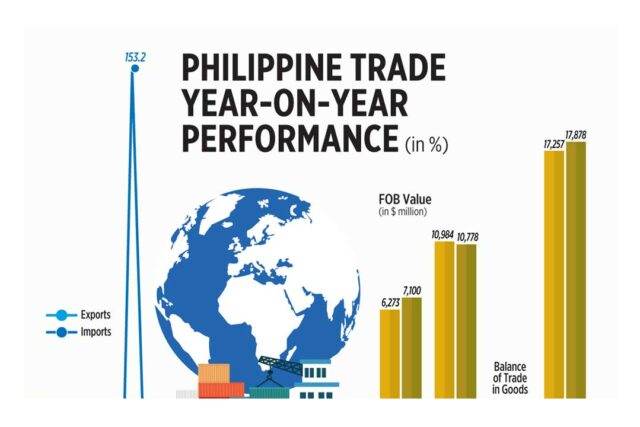
Philippine trade year-on-year performance

THE PHILIPPINES’ trade deficit widened to a two-month high of $3.68 billion in November, as export growth slowed while imports declined for the first time in nearly two years, the Philippine Statistics Authority (PSA) reported on Tuesday. Read the full story.

Philippine trade year-on-year performance

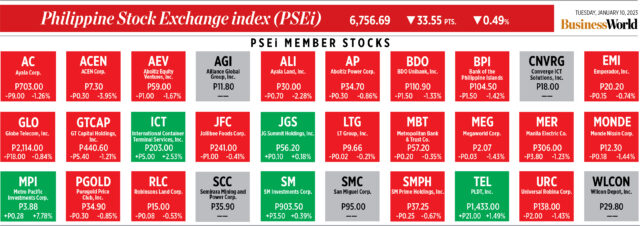
How PSEi member stocks performed — January 10, 2023

Here’s a quick glance at how PSEi stocks fared on Tuesday, January 10, 2023.


Peso climbs to over six-month high vs dollar

THE PESO strengthened to an over six-month high against the dollar on Tuesday as weak services activity data and expectations of easing inflation out of the United States fueled hopes of smaller rate hikes from the US Federal Reserve.

The local currency closed at P54.87 versus the greenback on Tuesday, climbing by 24 centavos from Monday’s finish of P55.11, data from the Bankers Association of the Philippines showed.

This is the peso’s best finish since it closed at P54.77 a dollar on June 28, 2022.

The peso opened Tuesday’s trading session stronger at P54.95 per dollar, which was already its weakest showing for the day. Its intraday best was at P54.80 against the greenback.

Dollars traded went down to $1.067 billion from $1.219 billion on Monday.

“The peso strengthened amid growing views of a softer 25-bp (basis point) policy rate hike from the US Federal Reserve after the US manufacturing PMI (purchasing managers’ index) was reported below the 50-level, signifying contraction in the manufacturing sector,” a trader said in a Viber message.

The Institute for Supply Management reported on Friday that US non-manufacturing PMI dropped to 49.6 last month from 56.5 in November, the first time since May 2020 that it fell below the 50 threshold.

“The peso and Asian/global currencies also gained versus the US currency ahead latest US consumer price index (CPI) data on Jan. 12, expected by the markets to ease further to 6.5% in December 2022 from the 11-month low of 7.1% posted in November 2022… after slower-than-expected US wage inflation data lately,” Rizal Commercial Banking Corp. Chief Economist Michael L. Ricafort said in a Viber message.

“Any further easing in the US CPI data would lead to reduced need for further Fed rate hikes for the coming months, at the very least, especially if it eventually goes to the Fed’s target of 2%,” Mr. Ricafort added.

The US central bank last year raised borrowing costs by 425 bps, bringing the fed funds rate to a 4.25%-4.5% range.

The trader said expectations of softer US CPI data may cause the peso to appreciate further against the dollar this week.

The trader sees the peso moving between P54.70 and P54.95 versus the greenback on Wednesday, while Mr. Ricafort gave a slightly weaker P54.75 to P55 range. — AMCS