Home Blog Page 5381

P124-B cash aid still being pushed for inclusion in 2023 budget

PHILIPPINE STAR/EDD GUMBAN

A GROUP of progressive party-lists that form part of the minority in the House of Representatives continue to push for the inclusion of a P124-billion fund for cash aid in the 2023 budget, a move supported by public finance experts.   

We agree that ayuda (cash aid) should be part of the 2023 budget,Kenneth Isaiah I. Abante, the coordinator of Citizens Budget Tracker, said during a forum on Monday organized by the Makabayan bloc.   

Gabriela Party-list Rep. Arlene D. Brosas, a member of the bloc, said the funds would be used to provide a one-time cash aid of P2,000 to 62 million poor and vulnerable individuals.

Ms. Brosas added that a maximum of P10,000 could be given to 12.4 million poor families. 

Mr. Abante said cash aid remains crucial as it supports teachers and other low-income workers affected by the coronavirus pandemic. 

Its an important reminder that the pandemic isnt finished, as we speak theres around a 15% positivity rate,he said.   

Zy-za Nadine M. Suzara, a public finance expert and executive director of I-Lead, said the government can afford the cash aid by realigning other funds.  

We need cash aid because the pandemic is still ongoing,Ms. Suzara said during the same forum.   

She said the proposed 2023 expenditure program could put more emphasis on people-centered programs. Matthew Carl L. Montecillo

Mau debuts with F2 Logistics facing revamped Chery Tiggo

POWER-hitting Fil-Am Kalei Mau (1) debuts today against Cherry Tiggo. — SHAKEY’S SUPER LEAGUE

Games Today
(PhilSports Arena)
2:30 p.m. — F2 Logistics vs Chery Tiggo
5:30 p.m. — Petro Gazz vs Choco Mucho

KALEI Mau gets her much-awaited Premier Volleyball League debut as her F2 Logistics clashes with a revamped Chery Tiggo in today’s resumption of the PVL Reinforced Conference at the PhilSports Arena.

The power-hitting, 27-year-old 6-2 Fil-Am spiker is teaming up with Grizzled American veteran Lindsay Stalzer in the Cargo Movers’ return after skipping the Invitational a couple of months ago.

Benson Bocboc has been given the coaching rein anew in lieu of Ramil de Jesus, who skipped the event due to personal reasons, and he hopes to improve on F2’s sixth-place finish in the Open Conference early this year.

“The team is showing great cohesiveness,” said Mr. Bocboc referring to his charges that included Kianna Dy, Abi Marano, Mary Joy Baron, Dawn Macandili, Kim Fajardo, Ara Galang, Dzi Gervacio, Ernestine Tiamzon and newly acquired Ivy Lacsina among others.

The Crossovers will parade a roster headed by Jelena Cvijovic, a 6-1 outside hitter from Montenegro who last suited up for SCM U Craiova in the 2021-2022 Romanian League.

Leading the Chery Tiggo locals are Dindin Santiago, Mylene Paat, Jasmine Nabor, May Luna, Ria Duremdes and EJ Laure.

Jaja Santiago, who suited up last year when the Crossovers topped the Open Conference in Bacarra, Ilocos Norte, was listed in the line up but there is no certainty when she will play.

Game time is at 2:30 p.m.

Meanwhile, Petro Gazz, the 2019 Reinforced titlist when the league wasn’t professional yet, battles a young and dangerous Choco Mucho in the only other game at 5:30 p.m.

Lindsay Mae Vander Weide will reinforce the Angels headed by MJ Philips, Myla Pablo, Grethcel Soltones, Chie Saet, Aiza Pontillas, Mary Remy Joy Palma and Bang Pineda.

The Oliver Almadro-mentored Flying Titans, for their part, will have Odina Aliyeva as their import to go along with Deanna Wong, Bea de Leon, Isa Molde, Kat Tolentino, Pongay Gaston, Des Cheng and Denden Revilla. — Joey Villar

Diaz leads Philippine team in IWF World Championship in Colombia

REUTERS

TOKYO Olympics gold medalist Hidilyn Diaz will spearhead the country’s campaign in the International Weightlifting Federation (IWF) World Championships slated Dec. 5 to 16 in Bogota, Colombia.

“Our women lifters for the World Championships in Colombia will include our golden girl Hidilyn Diaz,” said Samahang Weightlifting ng Pilipinas president Monico Puentevella.

It will be the first competition for Ms. Diaz, now married to her strength and conditioning coach Julius Naranjo last April, after her golden effort in last May’s Hanoi Southeast Asian Games.

The country is also fielding in their best of the best that also includes Asian champion and SEA Games gold winner Vanessa Sarno, Tokyo Olympian Elreen Ando, Kristel Macrohon and Rosegie Ramos.

Also in the roster are Lovely Inan, Nestor Colonia, John Ceniza and John Pacaldo.

Mr. Puentevella said they only sent two representatives — Rose Jean Ramos and Fernando Agad — in the ongoing Asian Championships in Manama, Bahrain to focus on the Bogota tilt. “We skipped the Asian, so we can join the World this December. The Olympics is our main goal,” he said.

Ms. Ramos, younger sister of Rosegie, snared a bronze in Manama despite being the youngest participant at 16 years old.

“She might qualify to the 2028 Los Angeles Olympics,” said Mr. Puentevella of Rose Jean (Ramos). — J. Villar

LPU turns things around with hard work and dedication

LPU coach Gilbert Malabanan gives instruction to the team. — NCAA/SYNERGY-GMA

Game Today
(Filoil EcoOil Centre)
3 p.m. — AU vs LPU

PLACING ninth and second to last the NCAA season before, Lyceum of the Philippines University (LPU) has turned things around using two big weapons — hard work and dedication.

“It depends on how far our hard work and dedication would take us,” LPU coach Gilbert Malabanan yesterday told The STAR when asked if they could sustain their strong start in Season 98.

The Pirates will try to close out their first round campaign with a bang as they square off with the unpredictable Arellano U Chiefs in the league’s lone offering at 3 p.m. today at the Filoil EcoOil Centre.

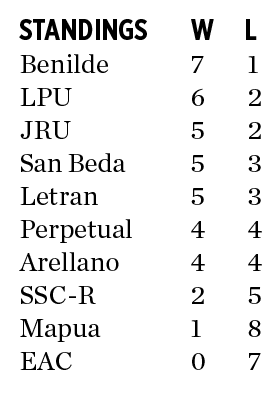
LPU is currently at No. 2 with a 6-2 mark, which was capped by an 82-79 overtime thriller over San Sebastian Sunday, and behind pace setter College of St. Benilde (7-1).

The Pirates are on pace in matching a pair of runner up finishes in 2017 and 2018 and potentially putting them in a position to claim their first championship since joining the league 11 years ago.

Mr. Malabanan though isn’t thinking that too far ahead.

“We’re not thinking of the finals yet because our goal is make it to the Final Four first,” he said.

AU, for its part, has been playing hot and cold.

After showing some fight early with big wins after big wins including one over the three-peat-seeking Letran Knights, the Cholo Martin-mentored Arellano University (AU) Chiefs suddenly played flat and suffered their worst defeat of the season — an embarrassing 96-61 rubout at the hands of the San Beda Lions Friday.

The rout sent AU out of the magic four and into joint No. 6 with UPHSD on identical 4-4 cards.

And they hope to get back on track with a win over the Pirates. — J. Villar

Musgrove silences Mets, Padres advance to NLDS

SAN Diego Padres starting pitcher Joe Musgrove — REUTERS/WENDELL CRUZ-USA TODAY SPORTS

NEW YORK — Joe Musgrove tossed seven innings of scoreless, one-hit ball and retired six of the final seven batters he faced after being checked for illegal substances Sunday night as the visiting San Diego Padres beat the New York Mets 6-0 in the decisive third game of their National League wild-card series.

The Padres, the fifth seed in the NL, advance to face the top-seeded Los Angeles Dodgers in a National League Division Series (NLDS) scheduled to begin Tuesday. The Dodgers finished 22 games ahead of San Diego in the NL West this season.

The Mets, who won 101 regular season games and spent 175 days in first place in the NL East this year, head into an uncertain offseason in which Jacob deGrom is expected to opt out of his contract and closer Edwin Diaz and leadoff hitter Brandon Nimmo are headed for free agency.

Mr. Musgrove retired the first 12 batters he faced before Pete Alonso singled leading off the fifth. Just before the bottom of the sixth started, Mets manager Buck Showalter walked on to the field and asked umpires to check Mr. Musgrove, whose ears appeared to be glistening with a glossy substance per photos on social media.

After his ears, hat and glove were checked for illegal substances, Mr. Musgrove threw a perfect sixth inning and appeared to shout at the Mets’ dugout on his way off the field.

Mr. Musgrove (1-0) struck out five and walked one. Robert Suarez struck out two in a perfect eighth before Josh Hader tossed a 1-2-3 ninth to close out the 15th one-hitter in postseason history and the first since the Washington Nationals blanked the St. Louis Cardinals on Oct. 11, 2019.

Austin Nola had a two-run single in the second off Chris Bassitt (0-1). Trent Grisham continued his big series with an RBI single in the fourth and Manny Machado had an RBI single in the fifth before Juan Soto added a two-run base hit in the eighth.

Mr. Grisham homered in each of the first two games and hit .500 (4-for-8) while reaching base in eight of 12 plate appearances. He reached base just 10 times in 60 plate appearances after Aug. 31.

Mr. Bassitt allowed three runs on three hits and three walks while striking out two over four innings. — Reuters

Defense leads the way as Dallas tops LA Rams, 22-10

DALLAS COWBOYS defensive Osa Odighizuwa (97) pressures Los Angeles Rams quarterback Matthew Stafford (9) to throw an incomplete pass in the second half at SoFi Stadium. — REUTERS/JAYNE KAMIN-ONCEA-USA TODAY SPORTS

DEMARCUS Lawrence returned a fumble for a touchdown as the Dallas Cowboys’ defense led the way in a 22-10 road victory against the host Los Angeles Rams on Sunday.

The Cowboys (4-1) won their fourth consecutive game with their defense doing the heavy lifting again.

Running backs Tony Pollard, who gained 86 yards on eight carries, and Ezekiel Elliott, who added 78 yards on 22 attempts, did their parts. That ground attack supported quarterback Cooper Rush, who was 10 of 16 for 102 yards in the air.

Dallas won despite managing only 239 yards of total offense and 10 first downs.

The Rams (2-3) — the reigning Super Bowl champs — have posted just one touchdown between their last two games, dropping both of them. They had 323 yards of offense against Dallas, with only 38 on the ground compared to Dallas’ 163 rushing yards.

Los Angeles quarterback Matthew Stafford was 28 of 42 for 308 yards with a touchdown and an interception. He also lost two fumbles, with those coming on the Rams’ first and final possessions of the game.

Brett Maher made field goals of 33, 40 and 36 yards for the Cowboys. His final attempt came with 5:32 left at the end of a drive that chewed nearly six minutes off the clock.

Dallas scored the game’s first nine points off Rams’ miscues. Lawrence had the fumble return after Stafford was sacked. The next Los Angeles possession ended in a blocked punt, with the Cowboys converting that into the first Maher field goal.

The Rams went ahead 10-9 in the second quarter by taking advantage of a rare defensive breakdown by Dallas. Receiver Cooper Kupp turned Stafford’s pass into an 75-yard touchdown play.

Less than two minutes later, the Cowboys were back ahead on Pollard’s 57-yard run.

Trailing 19-10, the Rams could have trimmed the deficit to a single possession, but kicker Matt Gay missed from 51 yards out.

Cowboys starting tight end Dalton Schultz exited the game with an apparent knee injury. — Reuters

Waiving Djokovic ban would be ‘slap in the face’ for Australia: ex-minister

NOVAK DJOKOVIC — REUTERS

MELBOURNE — Waiving Novak Djokovic’s visa ban to let him play the Australian Open would be a “slap in the face” for Australian people who vaccinated for COVID-19, opposition lawmaker and former Home Affairs Minister Karen Andrews said on Monday.

Serbian Mr. Djokovic was deported from Australia in the leadup to the Grand Slam in January for declining to be vaccinated.

The former world number one is barred from the country until 2025 but can have his three-year visa ban waived by the government.

Australia in July scrapped a rule that required international travelers to declare their COVID vaccination status, and Mr. Djokovic has said he was hoping for “positive news” on his bid to play next year’s Australian Open.

Ms. Andrews said, however, that the rule change should have no bearing on Mr. Djokovic’s case.

“There would have been other people in similar circumstances that have also had their visas canceled,” the lawmaker told ABC Radio on Monday. “So if immigration now chooses to make a special allowance for Novak Djokovic the obvious question is what are they going to do about anyone else who may be in similar circumstances?”

Ms. Andrews said lifting Mr. Djokovic’s ban would be a “slap in the face for those people in Australia who did the right thing (and) got vaccinated.”

Mr. Djokovic, who has won the Australian Open a record nine times, was unable to travel to New York for the recent US Open because he was not vaccinated but said he had no regrets about missing two of the year’s four Grand Slams. — Reuters

EDCOM 2: Lifelong Learning Poverty Crisis

AARON BURDEN-UNSPLASH

(Second of two parts)

The Education Commission 2 (EDCOM 2) must connect our primary school learning crisis to more fundamental questions of the Philippines as a Lifelong Learning (LLL) nation. Formal and informal learning in communities and corporations must be integrally pursued.

Long-term education-work-life issues of EDCOM 2 cover the more difficult subject of systematic risks (basic skills covered by the 4 Cs of 21st Century education — critical thinking, communication, collaboration, and creativity) in grade school.

On the other hand, the short-term LLL agenda are specific risks related to individual sector reforms, industry-vetted micro-credential courses, and granularly targeted government programs, including improved literacy and numeracy, and vocational-technical education for adult learners.

Both short- and long-term agendas must be chased at the same time.

It is best for our economy to survive with the present sectoral winners through targeted strategies, thereby helping finance the improvement of the future workforce in grade school now.

So, what can EDCOM 2 pursue to avoid death by a thousand cuts — when learners find that, despite hard work, their skills are deteriorating rapidly relative to the changing times? Where should we focus the additional LLL training of the current workforce?

AREAS FOR SHORT-TERM LLL FOCUS
Four reasons for continued employee training were found out to be critical among 11 variables in the 2007 International Labor Organization (ILO) study on the Philippines: 1.) GDP growth relative to other countries, 2.) flexibility (adaptability of people in the economy is high when faced with new challenges), 3.) educational system (meeting the needs of a competitive economy), and, 4.) knowledge transfer (highly developed between companies and universities).

These are as relevant today as in 2007. Only the first two are discussed in greater detail here.

DRIVING GDP GROWTH
Whole-of-nation LLL in the Philippines was required, but never addressed, based on its low GDP growth relative to dynamic Southeast and Northeast Asian neighbors in 2007.

Today, with the false comfort of higher short-term GDP growth rates after a disastrous pandemic fall, LLL must be pushed by leaders in key sub-sectors where the industry growth slippage is most problematical, e.g., evidenced by increased difficulty in hiring qualified talents. Specific training must be directed where we have the most potential comparative advantage to promote for domestic and global markets.

Our marine resource wealth is one new area to scale up, from marine flora/fauna and seabed minerals protection, maritime services provision, to asin/rock salt production. For the first time in its planning history, we have a marine archipelagic nation document which must be explored by Filipino science, technology, and innovation talents in collaborative programs with producer and consumer stakeholders. (NAST, Pagtanaw 2050: STI Foresight Document, 2021).

Two factors augur well: in the last generation (25 years), the relatively speedy rise of our innovative startups, and the continued flow of excellent ideas from many programs between the Department of Science and Technology (DoST) and private firms.

Other LLL for GDP growth drivers are current major foreign exchange earners with large number of employed workers and concerned families:

1.) Cybersecurity for maritime, and technical/conversational English for nursing services (both delivered overseas where we are the top supplier of global talents and thus potential sources of related business ideas),

2.) 4Cs of 21st C education for business process outsourcing and tourism sectors services (rendered domestically where fewer family problems may ensue),

3.) Liberal Arts plus STEM-influenced learning for fields requiring professional examinations and substituting micro-credentials — doing away with college diplomas, as Singapore selectively started in some industries for employment purposes in late 2021 [Congressman Go noted three weeks ago: the most recent passing rates of licensure exam-takers are about 56% of first-time takers, and 38% of graduates across disciplines], and,

4.) Arts and culture, other cybersecurity services, marine-based products (carrageenan, seafood, mariculture), and natural products for climate change mitigation.

FLEXIBILITY IN THE FACE OF NEW CHALLENGES
Five of the top 10 global concerns of leaders surveyed for the 2021-22 Global Risk Report of the World Economic Forum are on climate change. The Philippines is in a region where extreme temperature changes will bring in more severe precipitation and harsher typhoons, as Karding ominously warned us along with other contemporaneous disasters around the world most recently.

Can we adjust our learning systems here, in modality and content?

Our flexibility as a nation has been exhibited recently in the dramatic increase of local startups, largely inspired by our overseas talents. They brought the Silicon Valley joie de vivre back to the country and sparked a brain circulation vs. the brain drain spawned by the education-skills mismatch and attractive migration offers.

Many entrepreneurial Filipino domestic and expatriate professionals can be drawn into local businesses directly — to impact on livelihood and environment concerns through further training, marketing, and financial support in new ventures to speed up and scale efforts. For example:

1.) Coordinated planting of bamboo for region-specific species to counter disastrous soil erosion and greenhouse gas emissions from agriculture, transport, and industry, additionally to fulfill import offers for bamboo charcoal for gasification in renewable energy plants (part of the Philippines’ Billion Bamboos Campaign through 2030 as our contribution to some UN SDG targets),

2.) Speeding up of translational research from universities to industries, e.g., bioethanol production from nipa palm as renewable energy (for bancas (outrigger boats) and vehicles use, and electricity in remote areas), and other DoST programs from the “Filipinnovation” strategy which is now the trade and industry department’s responsibility, and,

3.) Mangrove reforestation in Marine Protected Areas, for increased fishery catch, ecotourism, and eco-system-based adaptation for climate change problems (championed by the French impact investor Blue Finance in the Verde Island Passage between Batangas and the Visayas, the most marine biodiverse region of planet Earth).

CONCLUSION
These practical adult LLL concerns are what micro-credentials should focus on. Obviously, they include adapting the 4Cs of basic education skills to community and corporate adult learning — what the country needs today as schools attempt to re-invent old ideas into new curricula for new mindsets.

Indeed, they are at the heart of whatever LLL we have, sinking so fast in rising seas that our archipelago risks having fewer islands of talent excellence.

This article reflects the personal opinion of the author and does not reflect the official stand of the Management Association of the Philippines or MAP.


Federico “Poch” M. Macaranas is co-chair of the Sub-Committee on Lifelong Learning of the MAP Management and Human Development Committee. He is author of the ILO Monograph on Lifelong Learning in the Philippines (2007).

map@map.org.ph

fmmacaranas@gmail.com

The Filipino smile, oft-misunderstood

TIM MOSSHOLDER-UNSPLASH

During the Senate Finance Sub-committee hearing on Sept. 30 on the Philippine-US Mutual Defense Treaty (MDT), Visiting Forces Agreement (VFA), and the 2016 arbitral ruling on the West Philippine Sea, Senator Robinhood Padilla was piqued by the way Eduardo Jose de Vega, Undersecretary of the Department of Foreign Affairs (DFA), responded to his question. “The question I was supposed to ask that rude undersecretary… is how he will implement the arbitral ruling in the middle of the West Philippine Sea. And if ever he would answer, I am a senator of the Philippines, so he must respect me. It’s not funny,” Padilla said in an irked manner.

Senator Alan Peter Cayetano quickly cut in to calm down the ruffled Padilla. Addressing the peeved senator, he said De Vega meant no offense, it is just his mannerism to smile when responding to questions. Cayetano admitted that De Vega did look like he was smirking at him and Padilla. Whereupon, De Vega immediately apologized, saying, “Oh, my apologies. I was not smirking. Apologies, Senator Padilla.”

I saw the video clips. De Vega didn’t look or sound rude at all in language or in tone. Yes, he was smiling when he answered Padilla’s question, but it looked to me he was smiling because he was pleased to be able to clarify matters with the senator. In fact, DFA Secretary Enrique Manalo, who first responded to Padilla, also smiled at certain points of his response but Padilla didn’t take offense, maybe because Manalo smiled only slightly.

The smiling mannerism is characteristic of many Filipinos. The smile when speaking is part of Filipino culture. It is as cultural as when a Thai puts his hands together in front of him when talking to someone. The Filipino smile does not always signify happiness or pleasure over what is being said. Many times, it is meant to show empathy or an understanding of the other person’s feelings or concerns.

Many Filipinos smile when discussing sensitive issues to give the impression that he is not confrontational or intractable. That is most probably the impression De Vega was imparting to Padilla when he was all smiles while responding to the senator’s query.

There are many Filipinos who have a permanent smile on their face. That is what first-time visitors to the Philippines observe — that Filipinos are always smiling. Many Filipinos smile when there is no reason to or when it is even inappropriate. Maybe that is how Senator Padilla saw De Vega’s smile. There was nothing funny about the matter at issue. To the senator, it must have looked like De Vega was mocking him.

That brings to mind another senator, the over-sensitive and ever-condescending Miriam Defensor Santiago. The late senator was wont to tell resource persons in Senate hearings to wipe their smile off their face. One time, she went overboard. During the impeachment trial of President Joseph “Erap” Estrada in January 2001, she had three observers sitting in the gallery removed from the chamber and permanently banned from watching the trial “for looking at her in a provocative way.” The “provocative way” was their smiling while looking at her.

Sometimes the smile is used to cover up an embarrassment. Miriam Quiambao smiled at the audience when she picked herself up after stumbling during the 1999 Miss Universe evening gown competition, as if saying, “I am okay, there’s nothing to it.” The audience applauded her for it.

Any other Miss Philippines who had any kind of mishap on coronation night would have done the same. When Venus Raj stumbled in a major, major way in the question-and-answer portion in the 2010 Miss Universe Pageant, she too just smiled off her gaffe. In fact, she was smiling all the way to Naga, unmindful of the heavy flak that her only big mistake in life drew.

The viewers of the telecast of the Erap impeachment trial did not find anything weird about Leyte 2nd District Representative Sergio Apostol, one of the prosecutors in the Erap impeachment trial, grinning after presiding justice Hilario Davide admonished senators and people in the gallery for laughing at Apostol’s pronunciation of the word “witness” as “wetness” and of Prieto (one of the witnesses) as “Prito.” He smiled as if to say, “It’s okay, I don’t mind at all people laughing at me.”

President Cory Aquino broke into a smile every time she opened her mouth to speak, her face turning serious again just as soon as she finished speaking. She smiled when announcing her programs and policies, never mind if some of them were bitter pills to swallow. She smiled when giving instructions to her Cabinet members, never mind if they involved pressing matters of state.

At the height of the coup attempts, she listened grimly to the reporters’ questions but smiled when she gave her answers. She smiled even when extending her condolences to the families of departed friends and political allies. She smiled when extending her condolences to the grieving and embittered families of victims of heinous crimes.

Her daughter Ballsy took after her. Like Cory, Ballsy breaks into a smile every time she speaks. When Imee and Bongbong Marcos went to Cory’s wake, it was Ballsy who received them. She was smiling as she talked animatedly with them, as if they had come to greet her on her birthday.

We understand when people smile for no reason at all or even when it is inappropriate. Foreigners who have not been here and seen the ubiquitous smile do not. President Noynoy Aquino was smiling while inspecting the scene where seven tourists from Hong Kong were shot indiscriminately by a disgruntled former Manila cop in August 2010. Hong Kong officials made known their resentment at the video footage showing a grinning PNoy.

PNoy explained that his facial expression was not one of satisfaction but was in fact one of frustration. It was just the way his face contorted when emotional. I believed him, for smiling whatever the circumstances are is a trait of the members of the Aquino family.

The mannerism of smiling when speaking is not characteristic of Cory’s family alone. One other prominent family which does the same is that of former vice-president Leni Robredo. In interviews with TV anchors, VP Leni smiled as she spoke, even if the subject of the interview was the war on drugs, making her appear she takes things lightly, including the matter of mass murder of actual and suspected drug users. That is why when the groundswell of support for her candidacy for president grew in social media, I commented, “She should look and sound presidential.”

Going back to Senator Robinhood Padilla, a video showed him smiling while telling a bunch of reporters that he has a hard time understanding plenary debates because his fellow senators argue in English. We don’t find that funny. In fact, we are sorry for it.


Oscar P. Lagman, Jr. is a retired corporate executive, business consultant, and management professor. He has been a politicized citizen since his college days in the late 1950s.

The ERC, NGCP, inflation and public debt

Four important events that occurred last week: the Energy Regulatory Commission (ERC) dismissed the rate hike petition of the power companies of San Miguel Corp. (SMC); the continuing threat of blackouts was highlighted; the jump in the inflation rate; and, the government’s cash operations and debt payment information were released.

ERC’S DISMISSAL OF SMC POWER COMPANIES PETITION
Last Monday, the ERC published its decision denying the petition of SMC for a rate hike for its two power plants. See these reports in BusinessWorld: “Meralco vows to prevent termination of SMC deals” Oct. 5), “SMC studies legal options after rate hike denial” (Oct. 6), and, “SMC plans to sell power to WESM after rate-hike denial” (Oct. 7).

For me the main issue that the ERC has to grapple with is not the projected higher electricity rate hike if the SMC petition was not granted. The main issue is rule of law and sanctity of contract. If the ERC granted the SMC petition, then it would be a signal for many other generation companies to also go to the ERC and demand a rate hike. Since the rule of law mandates that the law applies equally to unequal people and companies, that no one should grant exception and favoritism, then the ERC would be obliged to also grant those new petitions. A cascade of new generation rate hikes for the consumers would be much larger than the price hike threats of SMC.

The ERC made the correct decision. Thank you, ERC, for doing your job and protecting the consumers.

NGCP AND CONTINUING BLACKOUT THREATS
Last week, Sen. Sherwin Gatchalian urged the National Grid Corp. of the Philippines (NGCP) to increase the level of standby power available to it, that it “should not neglect its duty of contracting ancillary services so that we can ensure continuous energy supply and avoid the harm caused by constant brownouts to our citizens.” See this report in BusinessWorld: “NGCP urged to raise level of power available via standby contracts” (Oct. 4).

Senator Gatchalian is correct in his position that the NGCP should have a firm contract of reserve power exclusive to it, and that the frequent threats of blackouts are ugly. See also five reports and opinions in this column last week, “Economic freedom, power reserves, and declining births” (Oct. 3).

I saw the “Transition Report: Energy Sector Accomplishments for 2016-2022” section in the report “Areas of Major Concern for the Next Administration.” On the NGCP — the only remaining private monopoly nationwide via Congressional franchise — the report pointed out the following, among others:

One, the NGCP never heeded, never complied with certain Department of Energy (DoE) directives like DC2017- 12-0016, DC2019-120018, on a.) conduct of performance assessment and audit of power transmission operations, business and assets, b.) conversion of ancillary contracts from non-firm to firm, c.) conduct of competitive selection process (CSP) for the procurement of ancillary services, and, d.) requirements in the preparation and review of the Transmission Development Plan.

Two, NGCP argues that only the ERC has regulatory jurisdiction over them. But RA 7638 of 1992 creating the DoE mandates it as “the central coordinating machinery of the government for the implementation of energy policies and programs.” So, the DoE insists that its “policy-making mandate does not conflict with ERC’s mandate… ERC’s exercise of its authority necessarily must only operate within the bounds of policies and framework set by the DoE.”

Three, the NGCP as systems operator has a national security aspect. The original National Transmission Corp. (TransCo) Supervisory Control and Data Acquisition (SCADA) of equipment in transmission substations has been replaced by a Chinese SCADA system and it can “remotely control (turn on and shut down) all power plants and substations that are connected to the grid.” That is why the DoE and TransCo, as the owner of the physical assets, insist on having a performance audit of the NGCP’s new SCADA. The State Grid Corp. of China (SGCC) is NGCP’s technical partner and four of 10 NGCP Board members are from China, and six from the Philippines.

In 2021, the Philippines had a total power generation of 106 terawatt-hours (TWH). That year, Vietnam had 245 TWH, Malaysia had 177 TWH and Thailand had 176 TWH. These three neighbors of ours have smaller populations than us but have power generation much larger than ours.

Among the reasons I believe, are: a.) the NGCP delayed the construction of new transmission lines that results in frequent congestion of existing power plants, and can the discourage building of more new plants; b.) the NGCP not getting firm and exclusive contracts of ancillary services and is relying more on getting any excess reserves in the spot market which can be thin already.

The Transition Report proposes “unbundling the transmission sector by separating the system operator (SO) in charge of grid security, and transmission network provider (TNP) in charge of development, operation and maintenance of the transmission network and assets.”

I support that. Monopolies are almost always ugly. Under the government national monopolies like PhilHealth and SSS, people in the formal sector have no choice to opt out. Under the private national monopoly NGCP, power generators and distributors also have no choice to opt out from its inefficiencies.

BIG JUMP IN INFLATION RATES
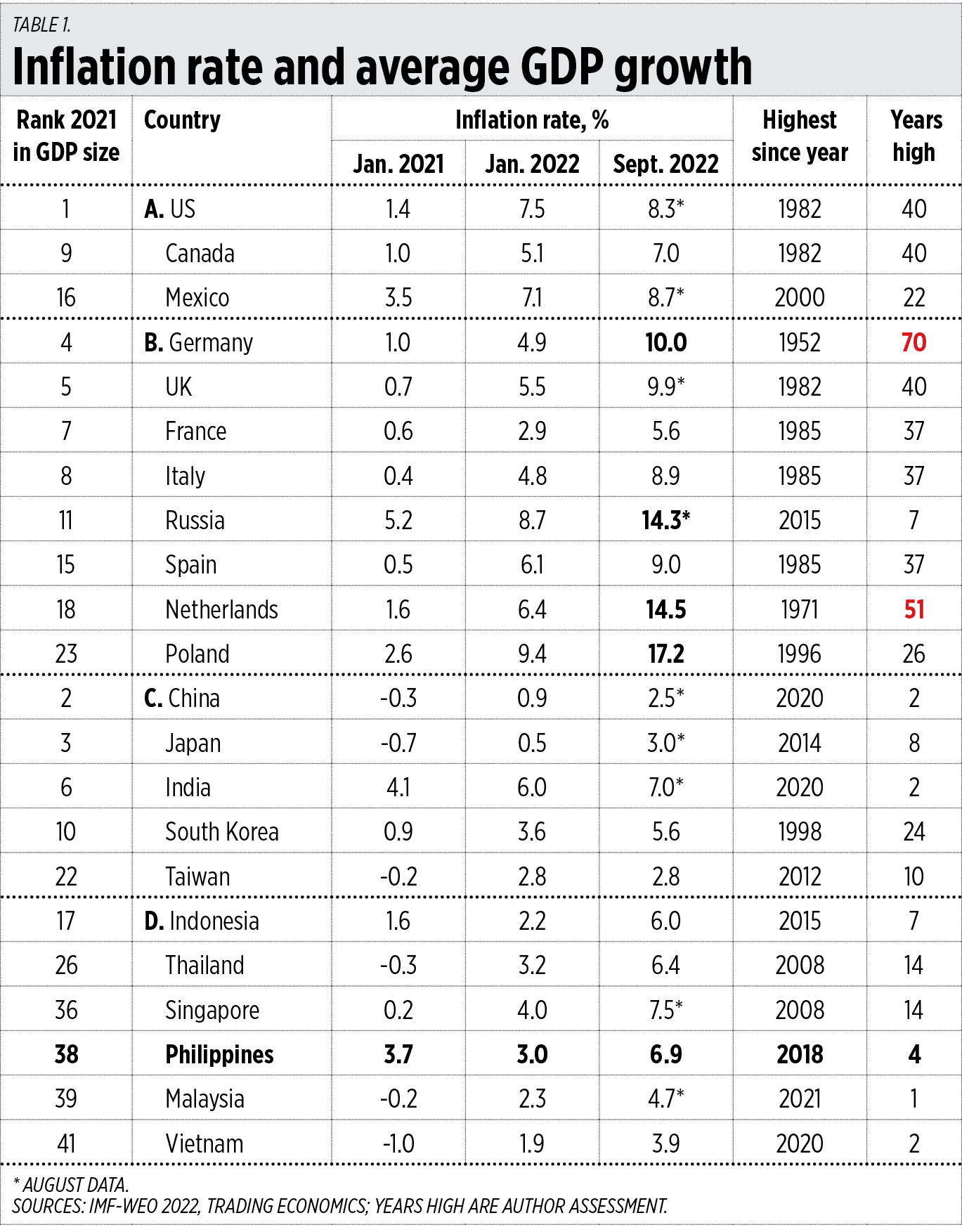
Last week, the Philippine Statistics Authority reported the September inflation rate at 6.9%, up from August’s 6.3%. This is indeed high but is still only a four-years high compared to Germany’s 70-years high, the Netherlands’ 51-years high, the US, Canada, and the UK’s 40-years high, and France, Italy, and Spain’s 37-years high (Table 1).

The 6.9% inflation rate was used by some bashers of the Marcos Jr. administration and its economic team’s performance. This is misplaced criticism. One, our four-years high in inflation is among the more benign levels in Asia and the world’s large economies as shown in the table. Two, no price control was imposed, especially on oil products.

DOF-DBM CASH OPERATIONS AND DEBT PAYMENT
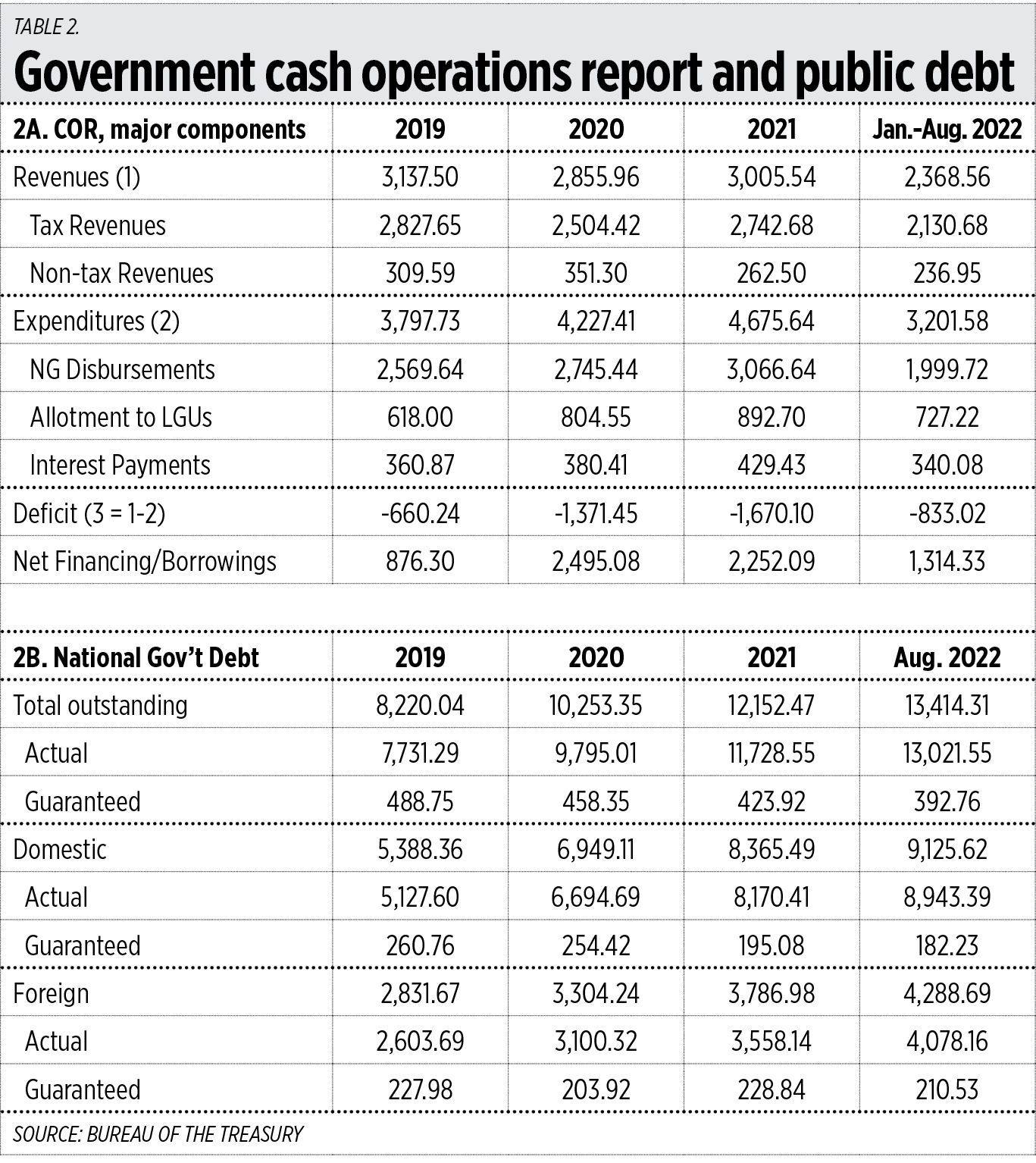
Last week, the Bureau of the Treasury released the National Government’s cash operations report (COR) and outstanding public debt. In the past two years, the budget deficits were P1.4 trillion and P1.7 trillion, while net financing or borrowings were P2.5 trillion and P2.2 trillion. From January-August 2022, financing has tamed to P1.3 trillion — hopefully it will not reach P2 trillion this year.

With high borrowings come high interest payments, P429 billion in 2021 and it might reach P500 billion this year.

The public debt stock has increased from P8.22 trillion in December 2019 to P13.41 in August 2022 (Table 2). It might reach P14.0 trillion by the end of this year.

The big challenge for the administration and the economic team is how to control the spending that leads to high borrowings and high interest payments. This can be done at least three ways.

One, reduce the size of many national agencies and let the local governments, which now have more funding under the Mandanas ruling, do more work. The Department of Budget and Management’s Bureaucracy Rightsizing program should materialize.

Two, reduce if not abolish old subsidies whenever new subsidies are created. The creation of a new welfare program is implicit admission that the old welfare programs are not working.

Three, reform and reduce certain entitlements like the huge military and uniformed personnel (MUP) pension. The pension of all retired civilian personnel in 2022 is P7.14 billion but the pension of MUP is P153.13 billion or 21.4 times larger than the former.


Bienvenido S. Oplas, Jr. is the president of Minimal Government Thinkers.

minimalgovernment@gmail.com

Five ideas that will reshape Capitalism’s next century

BOB GHOST-UNSPLASH

(Part 1)

THE Harvard Business Review (HBR) is celebrating its 100th birthday with a fat book of its most influential and innovative articles and an electronic fanfare of videos, charts, and online articles.

HBR was founded 14 years after its mothership, the Harvard Business School, to provide the fledgling discipline of business with a bit of academic heft. The new discipline faced a lot of sneering from the Brahmin establishment who ran Harvard in those days for lacking academic rigor as well as social cachet. Wallace Brett Donham, HBS’s dean from 1919 to 1942, hoped that the review would address one of these complaints by pioneering a “theory of business” based on rigorous research and capable of teaching fledgling businessmen sound judgment. Without such a theory, he wrote in the inaugural issue, business would be “unsystematic, haphazard, and for many men a pathetic gamble.”

Donham’s brainchild succeeded beyond anybody’s wildest dreams. HBR articles launched billion-dollar management ideas, such as re-engineering or asset-lite management, that changed entire industries. The few Brahmins who remain in Harvard look out from their little cubby holes at the business school across the river and gnash their teeth with envy. A magazine that was once described by one of its editors as being written by people who can’t write for people who can’t read is now a bible of corporate America.

Which is why the current volume is such a disappointment. The brief introduction makes a few interesting points — notably that the magazine’s focus has shifted from the tangible aspects of management, such as how to allocate financial resources or organize production, to more intangible subjects such as how to get the most out of your workers or enthrall your customers. But it fails to tackle any of the hard questions. Why is a discipline that is supposed to make business less of a haphazard gamble subject to so many fads and indeed frauds? And how does HBR explain its role in promoting ideas such as re-engineering or companies such as Enron? The HBR doesn’t necessarily owe us humility, but it does owe us introspection.

The collection includes some great articles which it’s nice to have in one place (two of my favorites are the articles that bookend the collection, Peter Drucker on managing oneself and Gary Hamel and C.K. Prahalad on strategic intent). But it also contains some inexplicable gaps. How can you produce a collection of the most interesting and innovative articles in the HBR without including Michael Jensen’s “the eclipse of the public corporation,” an intellectual tour de force which defined an era? In general, the collection is ludicrously heavy on current preoccupations (such as authenticity) and light on yesterday’s passions (globalization as well as private equity). The book eschews chronological organization without embracing any thematic alternative that I could work out.

The extras are even more variable in quality. HBR asked some leading thinkers to speculate about what’s next for some big topics. Some of what they had to say was interesting (Ram Charam on the future of organizations); some were merely platitudinous (Marcus Buckingham on what a “good job” would look like). Where the package hit its nadir is about the future of management. HBR asked “a panel of global experts” what management will look like in the next 100 years. The answer that came back from each of the experts was almost identical: Management will become cuddlier and less command-and-control. Sut I Wong of the Norwegian Business School says that management will be all about “empathy.” Frederic Frery of ESCP Business School says that management will/should “forget about the art of war and focus instead on the art of seduction.” Rachel Spivey, the head of Google’s Stay & Thrive team, says that the future will be “all about fostering a direct, transparent and empathetic approach to management.”

What twaddle! I suspect the empathy-first approach that dominates today’s business schools will not survive the next five years intact, let alone the next 50 or 100, or else will simply become so ossified that nobody outside a tiny clique will listen to it. Today’s focus on inclusion and empathy was dictated by the peculiar combination of a prolonged bull market on the one hand and the shock of the societal rifts exploited and widened by the Trump presidency.  The focus will shift significantly in the future as recent preoccupations, notably diversity, become bureaucratized, and companies desperately adjust to the fracturing of the global economy, the rise of Asia, and the long-term decline in productivity.

It would be churlish for me to be so brutal about the HBR panel’s predictions without offering some alternative predictions of my own (and with them my head, at least metaphorically, for anybody who wants to chop it off). I think that business life over the coming decades will be dominated by five great trends that will reshape management just as dramatically as did world wars, whether hot or cold, or the invention of the computer.

THE RETURN OF A WARTIME ECONOMY
Vladimir Putin’s invasion of Ukraine has inaugurated a new era in business affairs, not just because it has forced business to respond to Russia’s immediate aggression but also because it has forced it to wake up to China’s geostrategic ambitions. President Xi Jinping will be further emboldened if, as is widely expected, he is effectively made president for life in the National Congress of the Chinese Communist Party. Competition between China and the West for resources, ranging from food, fish, and water to rare earths, will only intensify as the world shifts to battery power and the war in Ukraine continues to threaten grain supplies.

So far most of the great initiatives have come from governments, particularly from the US government. President Joe Biden has passed a CHIPS Act to reduce dependence on Chinese semiconductors. Treasury Secretary Janet Yellen has sung the praises of “friend-shoring.” Businesses are still playing catch-up — belatedly creating new supply chains in India or Vietnam to supplement their existing ones in China for example.

They will surely become more proactive as they adjust to a new world in which military spending is an increasingly powerful driver of the global economy and potential conflict an ever-present danger. A growing number of start-ups will shift their focus from consumer goods to military supplies. High-tech companies will follow the example of Palantir Technologies, Inc. and challenge the power of companies such as Lockheed Martin Corp. and General Dynamics Corp. that were born before the digital age. Indeed, in the longer term a military-digital complex will likely replace the old military-industrial complex. Companies of all description, whether or not they are formally part of the digital-industrial complex, will beef up their political risk departments to pay more attention to military and strategic risks. Frederic Frery mocks the bad old days when “business strategy was often taught by military officers who looked to generals such as Sun Tzu and Carl von Clausewitz for management insights.” In fact, companies will turn to military men and women, schooled in hard realities at West Point and on the front line, for leadership and advice.

(To be continued.)

BLOOMBERG OPINION

Taiwan says war with China ‘absolutely’ not an option

TAIWAN President Tsai Ing-wen — REUTERS

TAIPEI — War between Taiwan and China is “absolutely not an option”, Taiwan President Tsai Ing-wen said on Monday, as she reiterated her willingness to talk to Beijing and also pledged to boost the island’s defenses including with precision missiles.

Democratic Taiwan, which China claims as its territory, has come under increasing military and political pressure from Beijing, especially after Chinese war games in early August following a Taipei visit by US House Speaker Nancy Pelosi.

Any conflict over Taiwan could drag in the United States, Japan and perhaps much of the world, as well as shatter the global economy, especially given Taiwan’s dominant position as a maker of semiconductors used in everything from smartphones and tablets to fighter jets.

Ms. Tsai, in her national day speech outside the presidential office under a grey sky, said it was “regrettable” that China had escalated its intimidation and threatened peace and stability in the Taiwan Strait and region.

China should not think there is room for compromise in the commitment of Taiwan’s people to democracy and freedom, she said.

“I want to make clear to the Beijing authorities that armed confrontation is absolutely not an option for our two sides. Only by respecting the commitment of the Taiwanese people to our sovereignty, democracy, and freedom can there be a foundation for resuming constructive interaction across the Taiwan Strait.”

There was no immediate reaction from Beijing.

China calls Ms. Tsai — re-elected by a landslide in 2020 on a promise to stand up to Beijing — a separatist and refuses to speak to her.

Ms. Tsai’s speech comes less than a week before China’s ruling Communist Party’s congress opens in Beijing, where President Xi Jinping is widely expected to win a precedent-breaking third five-year term.

An official familiar with Ms. Tsai’s thinking, speaking on condition of anonymity, told reporters the president was looking to “clearly convey” her position to the world and Beijing.

“Standing firm on the status quo of peace and stability in the Taiwan Strait is the main axis of Tsai’s comments on cross-strait relations this year,” the official said, adding this was the world’s expectation and responsibility of both Taipei and Beijing.

‘NO ROOM FOR COMPROMISE’
Ms. Tsai said, to applause, that her government looked forward to the gradual post-pandemic resumption of healthy and orderly people-to-people exchanges across the strait, which would ease tensions.

But the broad consensus in Taiwan is that its sovereignty and free and democratic way of life must be defended, she added.

“On this point, we have no room for compromise,” she said.

Ms. Tsai has made strengthening Taiwan’s defenses a cornerstone of her administration to enable it to mount a more credible deterrence to China, which is ramping up an ambitious modernization program of its own military.

Taiwan will show the world it is taking responsibility for its own defense, Ms. Tsai said.

Taiwan is increasing mass production of precision missiles and high-performance naval vessels, and working to acquire small, highly mobile weapons that will ensure Taiwan is fully prepared to respond to “external military threats,” she added.

The military tensions have raised concerns, especially in the United States, about the concentration of chip making in Taiwan.

“I want to specifically emphasize one point to my fellow citizens and the international community, which is that the concentration of the semiconductor sector in Taiwan is not a risk,” she said.

“We will continue to maintain Taiwan’s advantages and capacity in leading-edge semiconductor manufacturing processes, and will help optimize the worldwide restructuring of the semiconductor supply chain, giving our semiconductor firms an even more prominent global role,” she added. — Reuters