Home Blog Page 5378

BTr limits tap facility bids to one per dealer

ELIGIBLE DEALERS of government securities can now submit just one bid for the Bureau of the Treasury’s (BTr) tap facility offers, a memorandum showed.

The BTr said in a memorandum dated Jan. 11 addressed to government securities eligible dealers (GSED) that only one bid or placement for its tap facility offerings will be allowed per GSED-market maker.

The placement amount should also not exceed the amount on offer, the Treasury said.

The BTr previously did not have a limit on how many bids a GSED-market maker could make and the value of their tenders.

The memorandum amended Treasury Circular No. 1- 2018 dated Nov. 28, 2018, which set the guidelines for the tap facility as ordered by the Department of Finance.

The original guidelines said GSED-market makers could make a minimum placement of P10 million and any excess in multiples of P1 million.

Only GSED-market makers are allowed to access the tap facility, with placements made via the National Registry for Scripless Securities auction module.

The window for placements is open from 2 p.m. to 4 p.m., with the Treasury announcing results on or before 5 p.m. of the same day.

The BTr uses its tap facility to accommodate strong demand for its Treasury bill and bond offerings. Terms of tap facility offers are similar to the auctioned securities. — A.M.C. Sy

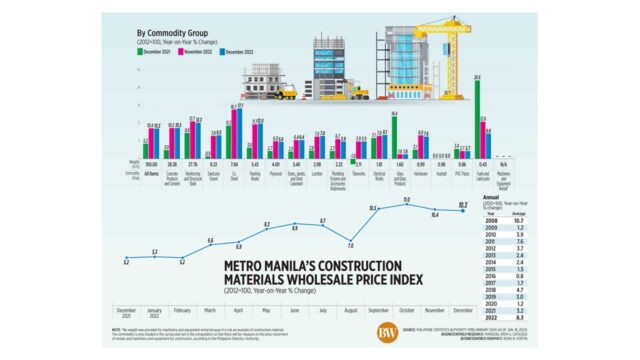
Metro Manila’s construction materials wholesale price index

THE GROWTH in wholesale and retail prices of building materials accelerated to the highest level in 14 years in 2022, as construction activity picked up, according to preliminary data from the Philippine Statistics Authority (PSA). Read the full story.

Metro Manila's construction materials wholesale price index

Apple rolls out Macbooks with M2 chips in rare January launch

APPLE Inc. on Tuesday unveiled MacBooks powered by its new and faster M2 Pro and M2 Max chips in a surprise launch weeks ahead of its usual schedule.

The rollout of the devices using Apple’s latest versions of the M2 chip, which it debuted last year, is an outgrowth of the tech giant’s decision in 2020 to use semiconductors designed in-house after 15 years of relying on Intel’s technology.

The new Mac mini starts at $599 and will be available from Jan. 24. The 14-inch and 16-inch MacBook Pro with the latest chips start at $1,999, compared with the $1,299 price tag for a 13-inch model fitted with the M2 chip.

The new Macbook Pro models were expected for months, but supply-chain issues meant the launch was delayed from last year to early 2023, Bloomberg News reported in October.

“This is all connected to the delayed chipset transition… With it being delayed, Apple has been faced with the questions to wait for the traditional, expected launch or actually do something a bit unexpected,” said Canalys analyst Runar Bjørhovde.

“This is a great way of throwing things around and surprising the consumers and competitors,” Mr. Bjørhovde said, adding that the announcement could generate some hype at a time when the broader personal computer market is in a slump. 

Shares of Apple rose about 1%, outperforming a broadly weaker market. The stock lost about 27% in 2022, its biggest fall since the 2008 financial crisis.

Apple said the new M2 Pro has nearly 20% more transistors than the M1 Pro and double the amount in M2, helping programs like Adobe Photoshop run heavy workloads “faster than ever.”

The company, which gets its chips manufactured by Taiwan’s TSMC, replaced chipmaker Nvidia as one of the top ten semiconductor vendors by revenue last year, according to a Gartner report on Tuesday.

“We estimate that the value of these (Apple) chips is equivalent to $17.6 billion in 2022. The growth coming from increased cost of ever more complex chips,” said Andrew Norwood, VP Analyst at Gartner.

Apple usually holds its first event of the year in March, when it rolls out its iMacs and accessories. This year’s spring event could include the launch of a long-awaited augmented reality headset, Bloomberg News reported earlier this year. — Reuters

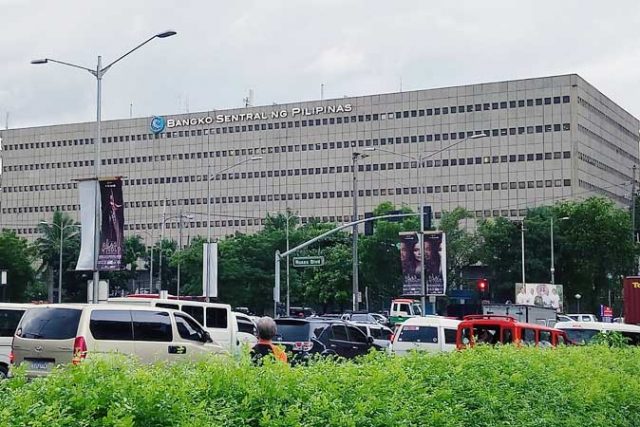
BSP’s relief measures boost lending growth

BW FILE PHOTO

THE targeted relief measures of the Bangko Sentral ng Pilipinas (BSP) for lenders has helped sustain credit growth amid the recovery of the economy from the coronavirus pandemic, an official said.

BSP Supervisory Policy and Research Department Director Maria Cynthia M. Sison said the relief measures were meant to encourage banks to continue to lend or restructure loans, especially to credit-worthy micro, small, and medium enterprises (MSMEs).

“The recovery in the economy alongside BSP’s targeted relief measures has reinforced growth in bank lending in general and to MSMEs,” Ms. Sison said during the central bank’s 4th Regional Macroeconomic Conference Series on Wednesday.

She said the banking system has allocated P254 billion of loans to MSMEs as alternative compliance with reserve requirements as of Dec. 29, 2022, the end of the last reserve week that month.

Thrift banks also lent out P16.4 billion in the same period, while rural and cooperative banks granted P6.4 billion in loans as alternative compliance.

Ms. Sison said total loans to MSMEs grew by 2.9% to P468.2 billion as of end-November 2022 from the P454.6 billion seen a year earlier.

Broken down, MSME loans stood at P62.6 billion and P58.1 billion as of end-November for thrift banks and rural and cooperative banks, respectively.

Southern Luzon banks also provided P28.7 billion in loans to small businesses. This is around 23.8% of the combined MSME loans of thrift banks and rural and cooperative banks.

Meanwhile, banks continued to provide relief to borrowers as restructured loans amounted to P327.8 billion as of end-November. This represents about 2.7% of the banking system’s total loans, Ms. Sison said.

Restructured loans for thrift banks reached P14 billion at end-November, rural and cooperative banks recorded P6.1 billion, while Southern Luzon banks booked P1.5-billion restructured loans.

“Some of the BSP’s relief measures remain in place to encourage banks to continue to lend or restructure loans, especially to credit-worthy MSME borrowers. This includes the temporary reduction in the credit-risk rates of loans granted to MSMEs,” Ms. Sison said.

“This relief measure is in place until end-June 2023. Banks are also still allowed to use their MSME loans as alternative compliance with the reserve requirements. This means that for banks, instead of depositing funds in the BSP, they can use these funds to lend out to their MSME clients,” she said.

First implemented in April 2020 at the height of the pandemic, the BSP allowed MSME loans to be counted as part of banks’ reserve requirements in a bid to boost lending to the sector.

The central bank also capped loans to MSME and large enterprises that banks could use as alternate reserve compliance at P300 billion and P425 billion, respectively.

“The BSP has also retained other measures which will help support access of enterprises to financial services,” Ms. Sison said.

“For instance, the single borrowers limit of a bank was temporarily increased to 30% from 25% and this is in place until end-June 2023. This gives banks more flexibility in lending for big-ticket projects,” she added.

Ms. Sison said banks have played an important role in promoting inclusive growth and in serving the needs of MSMEs and agri-agra sectors.

“Beyond the temporary relief measures, we will continue to pursue policy reforms on risk governance and risk management to ensure the safety and stability of the financial system,” she said.

“These prudential reforms will be complimented by initiatives in the areas of sustainable finance and digital transformation. These areas have the capacity to revolutionize ways by which consumers, enterprises, and financial markets operate and thrive on their new economy,” Ms. Sison added. — Keisha B. Ta-asan


Metro Manila’s construction materials retail price index

THE GROWTH in wholesale and retail prices of building materials accelerated to the highest level in 14 years in 2022, as construction activity picked up, according to preliminary data from the Philippine Statistics Authority (PSA). Read the full story.

Metro Manila's construction materials retail price index

Dining In/Out (01/19/23)


Kenny Rogers Roasters offers Truffle Collection

KENNY Rogers Roasters’ classic offerings are now infused with a most luxurious flavor with its Limited Edition Truffle Collection. Available in all Kenny Rogers Roasters stores nationwide, guests can enjoy the distinctive taste and flavor of truffle in its signature Roasted Chicken which is marinated in truffle extracts and buttermilk, topped with a drizzle of truffle oil and served with buttermilk sauce. It’s then wrapped in gold foil to heighten the flavors and seal in the truffle aroma. The Roasted Chicken can be ordered for one with the Truffle Roast Solo B plate (P300), which is a quarter truffle roast chicken, a choice of two side dishes, rice, and muffin; or shared with family and friends with the Truffle Roast Group Meal (P1,065) which includes a whole roast, four side dishes, four cups of rice, four muffins, and 1.5-liter soda. The Truffle Collection also offers the Truffle Mac & Cheese, a truffle pasta topped with creamy truffle sauce and freshly chopped parsley. It’s available in solo servings (P180) and platter (P539). For meat-lovers, there’s the Truffle Steak – grilled striploin steak paired with truffle sauce. Each Truffle Steak plate (P590) comes with the truffle steak, and a choice of two side dishes. Kenny Rogers Roasters’ all-new Truffle Collection is avialable for dine-in, takeout, or delivery through www.kennyrogersdelivery.com.ph, hotline: 8-555-9000, or via Grab Food and Food Panda.


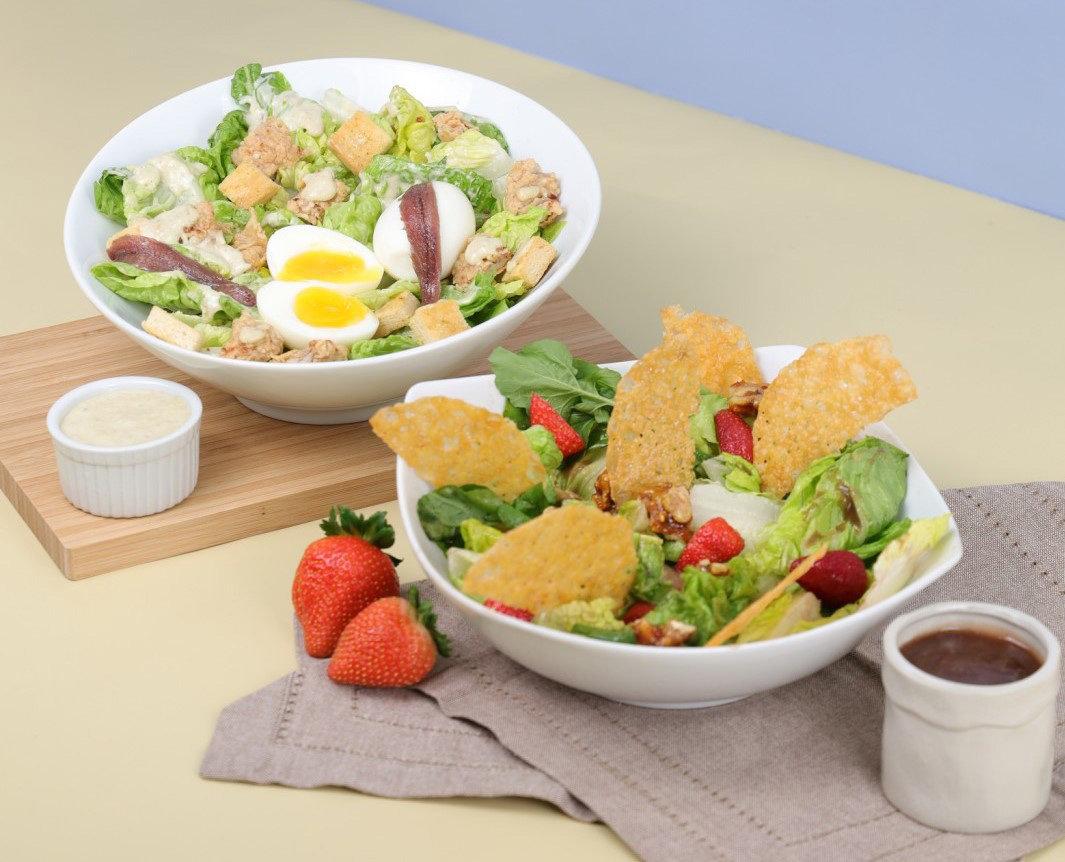
Conti’s salads for 2023

THE LONG Christmas season is over and now it’s time for making resolutions and drawing up goals, the best ones are those filled with health-giving goodness. The new salads of Conti’s Bakeshop and Restaurant fit the bill — light but filling, tasty but healthy. The Signature Salad has fresh strawberry slices, candied walnuts, and crispy mixed greens tossed in Conti’s’ signature raspberry vinaigrette, and topped with lacey parmesan crisps for added taste and texture. For a bit more indulgence without the guilt, the new Homemade Caesar Salad serves up fresh greens with Southern-style chicken fillet, croutons, and Conti’s zesty homemade Caesar dressing. The bowl is topped with soft-boiled egg and anchovy to taste. The salad bowls are available for dine-in in all Conti’s branches throughout the Philippines, and are also available via Grab and Foodpanda.


Food bundles at the Chowking Lazada Store

THIS YEAR, Chowking is launching its Lazada Flagship Store to give customers a more convenient way to celebrate special occasions through Lazada-exclusive deals and bundles. Chowking is kicking off the Chinese New Year with a One Day Sale on Jan. 22, with up to 20% off on select bestsellers: two Siomai Chao Fan Family Platter Bundle, for P517 from P647, saving P129; Dimsum Chao Fan and Halo-Halo Combo Bundle for P156 from P195, saving P39; and, the two Fried Chicken Lauriat Combo Bundle for P348 from P435, saving P87. Twenty other bundles and promos are up for grabs all year round. Visit the Chowking Lazada Flagship Store to avail vouchers for different food bundles. Customers will receive vouchers in the form of digital codes via SMS, which they can present in all Chowking stores nationwide to redeem their orders for dine-in, take-out, and drive-through. The vouchers are also valid up to two months after purchase.


Krispy Kreme’s newest Milk Choco Creations

KRISPY Kreme is welcoming a new year with its Milk Choco Creations, in partnership with KitKat. Throughout the years, KitKat Choco doughnuts have been a staple in the American doughnut shop. There are now three new flavors made with the classic chocolate brand — Milk Choco Crisp, Choco Swirl Cake, and White Chocolate Kreme Filled. There is now also a Milk Choco Chiller made with KitKat. The Milk Choco Crisp is a ring doughnut hand-dipped in KitKat chocolate spread; the Choco Swirl Cake is a cake doughnut dipped in white chocolate, drizzled with a milk choco swirl, and topped with a KitKat chocolate bar; while the White Chocolate Kreme Filled is a shell doughnut filled with kreme and a KitKat chocolate bar, dipped in white chocolate topped with dark chocolate and caramel. The Milk Choco Chiller is an iced-blended drink made with kreme base, KitKat spread, and hazelnut syrup, topped with whipped cream and KitKat chocolate bits. The Milk Choco Creations start at P59 per piece and P550 for a dozen, while the Milk Choco Chiller starts at P150 for 12 oz. They are available at any Krispy Kreme stores nationwide. For delivery, call 888-79000 or order online through now.krispykreme.com.ph, GrabFood, Foodpanda, Pick.a.Roo, Mangan, OrderMo, and Groover.

Move over Ben Franklin: Laser lightning rod electrifies scientists

TRUSTPAIR.COM

WASHINGTON — When Benjamin Franklin fashioned the first lightning rod in the 1750s following his famous experiment flying a kite with a key attached during a thunderstorm, the American inventor had no way of knowing this would remain the state of the art for centuries.

Scientists now are moving to improve on that 18th century innovation with 21st century technology — a system employing a high-powered laser that may revolutionize lightning protection. Researchers said on Monday they succeeded in using a laser aimed at the sky from atop Mount Santis in northeastern Switzerland to divert lightning strikes.

With further development, this Laser Lightning Rod could safeguard critical infrastructure including power stations, airports, wind farms and launchpads. Lightning inflicts billions of dollars in damage on buildings, communication systems, power lines and electrical equipment annually while also killing thousands of people.

The equipment was hauled to the mountaintop at an altitude of about 8,200 feet (2,500 meters), some parts using a gondola and others by helicopter, and was focused on the sky above a 400-foot-tall (124-meter-tall) transmission tower belonging to telecommunications provider Swisscom, one of Europe’s structures most affected by lightning.

In experiments during two months in 2021, intense laser pulses — 1,000 times per second — were emitted to redirect lightning strikes. All four strikes while the system was active were successfully intercepted. In the first instance, the researchers used two high-speed cameras to record the redirection of the lightning’s path by more than 160 feet (50 meters). Three others were documented with different data.

“We demonstrate for the first time that a laser can be used to guide natural lightning,” said physicist Aurelien Houard of Ecole Polytechnique’s Laboratory of Applied Optics in France, coordinator of the Laser Lightning Rod project and lead author of the research published in the journal Nature Photonics.

Lightning is a high-voltage electrical discharge between a cloud and the ground, within a cloud or between clouds.

“An intense laser can generate on its path long columns of plasmas in the atmosphere with electrons, ions and hot air molecules,” Mr. Houard said, referring to positively charged particles called ions and negatively charged particles called electrons.

“We have shown here that these plasma columns can act as a guide for lightning,” Mr. Houard added. “It is important because it is the first step toward a laser-based lightning protection that could virtually reach a height of hundreds of meters (yards) or a kilometer (0.6 mile) with sufficient laser energy.”

The laser device is the size of a large car and weighs more than 3 tons. It uses lasers from German industrial machine manufacturing company Trumpf Group. With University of Geneva scientists also playing a key role, the experiments were conducted in collaboration with aerospace company ArianeGroup, a European joint venture between Airbus SE and Safran SA.

This concept, first proposed in the 1970s, has worked in laboratory conditions, but until now not in the field.

Lightning rods, dating back to Mr. Franklin’s time, are metal rods atop buildings, connected to the ground with a wire, that conduct electric charges lightning strikes harmlessly into the ground. Their limitations include protecting only a small area.

Houard anticipated that 10 to 15 years more work would be needed before the Laser Lightning Rod can enter common use. One concern is avoiding interference with airplanes in flight. In fact, air traffic in the area was halted when the researchers used the laser.

“Indeed, there is a potential issue using the system with air traffic in the area because the laser could harm the eyes of the pilot if he crosses the laser beam and looks down,” Mr. Houard said. — Reuters

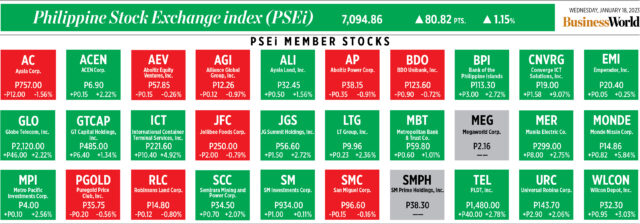
How PSEi member stocks performed — January 18, 2023

Here’s a quick glance at how PSEi stocks fared on Wednesday, January 18, 2023.


Philippine stocks climb on upbeat economic view

REUTERS

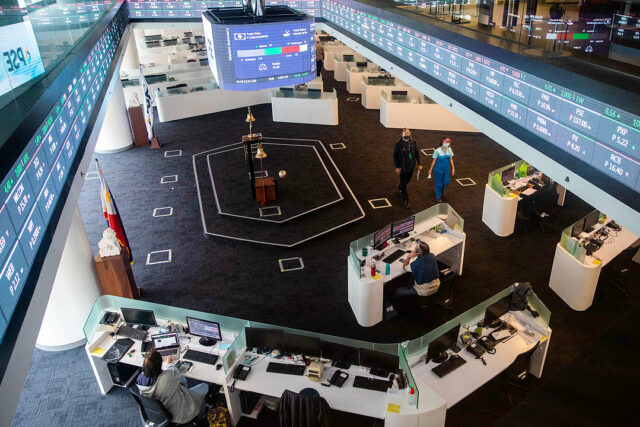
PHILIPPINE STOCKS posted gains on Wednesday on positive market sentiment after the Finance chief said economic growth is expected to remain robust this year.

The bellwether Philippine Stock Exchange index (PSEi) went up by 80.82 points or 1.15% to close at 7,094.86 on Wednesday, while the broader all shares index added 34.59 points or 0.94% to end at 3,692.51.

“This Wednesday, the bullish sentiment in the market returned as the PSEi rose to 7,094.86, up by 80.82 points. This was brought by optimism towards the prospects of our economy this year,” Philstocks Financial, Inc. Research Analyst Claire T. Alviar said in a Viber message.

Finance Secretary Benjamin E. Diokno said in a statement that quoted his speech at an event in Davos, Switzerland on Tuesday that the Philippines will likely grow by around 6.5% this year, even with a potential global economic slowdown.

Economic managers are targeting 6-7% gross domestic product (GDP) growth this year.

The ASEAN+3 Macroeconomic Research Office sees Philippine GDP growing by 6.2%, while the World Bank expects a 5.4% expansion.

Mr. Diokno also said the economy in 2022 likely expanded “much faster” than the government’s 6.5-7.5% goal. Philippine GDP expanded by 7.6% in the third quarter of 2022, bringing the nine-month average to 7.7%.

The Philippine Statistics Authority is set to release fourth-quarter and full-year 2022 GDP data on Jan. 26.

“The market continued to stay strong despite the performance of the Dow Jones last night. A strong break of 7,150 can bring the index to 7,500,” Mercantile Securities Corp. Head Trader Jeff Radley C. See said in a Viber message on Wednesday.

The Dow Jones Industrial Average fell 391.76 points or 1.14% to 33,910.85; the S&P 500 lost 8.12 points or 0.2% to 3,990.97; and the Nasdaq Composite added 15.96 points or 0.14% to 11,095.11.

Back home, all of the sectoral indices closed higher on Wednesday. Services went up by 58.16 points or 3.36% to close at 1,787.23; industrials climbed by 146.76 points or 1.48% to 10,019.33; mining and oil added 88.99 points or 0.78% to end at 11,482.89; financials increased by 10.95 points or 0.59% to 1,839.02; property gained 16.58 points or 0.53% to close at 3,114.83; and holdings firms rose by 22.24 points or 0.32% to 6,821.67.

Value turnover declined to P7.99 billion on Wednesday with 991.91 million shares changing hands from the P10.14 billion with 1.25 billion issues traded on Tuesday.

Advancers outnumbered decliners, 124 versus 82, while 47 names closed unchanged.

Net foreign buying declined to P532.16 million on Wednesday from P1.75 billion the previous trading day.

Philstocks Financial’s Ms. Alviar placed the PSEi’s support at 6,800 and resistance at the 7,000-7,100 range. — J.I.D. Tabile

Peso rises on BoJ decision, stock market’s gains

ANGIE REYES-PEXELS

THE PESO strengthened against the dollar on Wednesday following the Bank of Japan’s (BoJ) decision to keep rates ultra-low and amid expectations that the Philippines will be among one of the fastest-growing economies in the region this year.

The local unit closed at P54.62 per dollar on Wednesday, appreciating by 20 centavos from Tuesday’s finish of P54.82, according to data from the Bankers Association of the Philippines.

The peso opened Wednesday’s session at P54.80 versus the dollar. Its weakest showing was at P55.01, while its intraday best was at P54.57 against the greenback.

Dollars exchanged rose to $1.429 billion on Wednesday from $1.373 billion on Tuesday.

The peso climbed after the BoJ kept its monetary policy settings unchanged, Rizal Commercial Banking Corp. Chief Economist Michael L. Ricafort said.

“As a result, the benchmark 10-year US Treasury yield eased anew, now at 3.48%, among one-month lows and near 4-month lows, already lower by a total of -0.86 from the 15-year high of 4.34% posted on Oct. 21, 2023, thereby could help lower borrowing costs for some listed companies and also somewhat reduce the attractiveness of the US currency,” Mr. Ricafort said.

The BoJ on Wednesday maintained ultra-low interest rates, including a bond yield cap it was struggling to defend, defying market expectations it would phase out its massive stimulus program in the wake of rising inflationary pressure, Reuters reported.

At a two-day policy meeting, the BoJ kept intact its yield curve control targets, set at -0.1% for short-term interest rates and around 0% for the 10-year yield, by a unanimous vote.

The central bank also made no change to its guidance that allows the 10-year bond yield to move 50 basis points either side of its 0% target.

The peso also strengthened as the local stock market posted gains, Mr. Ricafort added.

The benchmark Philippine Stock Exchange index gained by 80.82 points or 1.15% to close at 7,094.86 on Wednesday, while the broader all-shares index closed higher by 34.59 points or 0.94% to finish at 3,692.51.

“The recent gains in the local financial markets, including the peso, also supported by optimism over the country’s economic growth estimates… as the Philippines is expected to be one of the fasting-growing economies in the region for 2023,” Mr. Ricafort said.

The ASEAN+3 Macroeconomic Research Office (AMRO) trimmed its growth outlook for the Philippines this year amid deteriorating global economic conditions.

In its Regional Economic Outlook Update released on Tuesday, the Philippine economy is expected to expand by 6.2% this year, slightly lower than the 6.3% projection given in October.

The AMRO’s 6.2% forecast is within the government’s 6-7% growth target this year, and the second-fastest growth in the region behind Vietnam’s 6.8%.

“The peso appreciated ahead of a potentially weaker US producer inflation report for December 2022 tonight. The local currency might strengthen amid likely higher US initial jobless claims report,” a trader said in an e-mail on Wednesday.

US producer price index , retail sales, and manufacturing output data were set to be released overnight.

For Thursday, the trader sees the peso moving between P54.45 and P54.70 versus the greenback, while Mr. Ricafort gave a forecast range of P54.55 to P54.75. — Keisha B. Ta-asan with Reuters

DA issues initial estimate of 450,000 MT in sugar imports

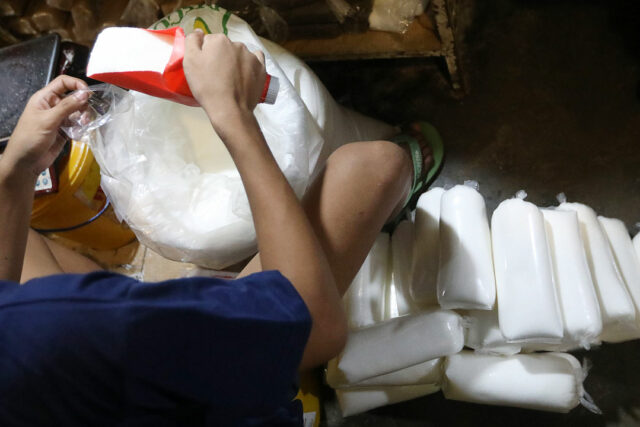
A vendor places sugar in plastic bags for sale. — PHILIPPINE STAR/EDD GUMBAN

THE Department of Agriculture (DA) is considering sugar imports of as much as 450,000 metric tons (MT) following an order from the President to maintain a two-month buffer stock of the commodity.

Rex C. Estoperez, DA deputy spokesman, said on Wednesday in response to a question about sugar import plans: “Our information is that 450,000 metric tons needs to be imported (because the) President ordered a buffer stock good for two months. We’ll update you on what the procurement plan is.”

It was unclear whether Mr. Estoperez meant the buffer stock will be built up solely from imports. If so, the sugar reserve will diverge from the practice of the National Food Authority (NFA), which is tasked with maintaining a rice buffer stock of at least 15 days.

The NFA maintains its rice reserve solely from palay (unmilled rice) purchased from domestic farmers.

President Ferdinand R. Marcos, Jr., said that the government must maintain a two-month buffer stock of sugar to keep price volatility in check.

The Sugar Regulatory Administration (SRA) has also said that it will recommend to Mr. Marcos the sale of 80,000 bags of sugar confiscated from smugglers at DA-operated Kadiwa stores.

Mr. Estoperez said such a sale will require inter-agency approval.

“It has to be cleared first by the Department of Finance, because the Bureau of Customs is under the (DoF). We need to check the seizure order and (the sale needs) to be cleared again by the SRA,” Mr. Estoperez said.

He said that the proposed Kadiwa sugar price is P70 per kilo.

According to the DA’s price monitoring as of Wednesday, refined sugar sells at retail for P87-P110 per kilo.

Pablo Luis S. Azcona, a member of the SRA board, said that selling the confiscated sugar at Kadiwa stores will not affect the farmgate price of sugar.

“80,000 bags, more or less, is the same amount of sugar that one small mill can produce in one week. I think it is not significant enough to affect the farmgate price,” he said.

Separately, planters’ federations said on Wednesday that they signed a memorandum of agreement to form a coalition.

In a statement on Wednesday, Enrique D. Rojas of the National Federation of Sugarcane Planters, Aurelio Gerardo J. Valderrama, Jr. of the Confederation of Sugar Producers Association and Danilo A. Abelita of the Panay Federation of Sugarcane Farmers established the coalition, to be known as the “Sugar Council.”

The council, whose members will account for the majority of sugar production nationwide, will be the venue for discussing policy recommendations to the government that will help “ensure the continued viability of the sugar industry.” — Ashley Erika O. Jose

US CHIPS law not expected to rule out foreign production

THE head of the US Semiconductor Industry Association (SIA) is exploring the Philippines as a hub, noting that a recent US law encouraging tech companies to re-shore their operations will not rule out overseas production.

SIA President John Neuffer met with Board of Investments (BoI) Managing Head Ceferino S. Rodolfo on Jan. 16 to discuss the investment landscape after the US passed the CHIPS Act last year.

The CHIPS Act offers $500 million in incentives for producing microchips in the US.

“While the CHIPS Act aims to increase the capacity of the US semiconductor industry, we recognize that we cannot do it all in the US. And that’s where countries like the Philippines have an opportunity,” Mr. Neuffer said.

“Rather than reshoring all manufacturing activities, it is more of rebalancing the supply chain. The pandemic has forced global businesses to rethink their supply chain strategies and consider diversification of suppliers to mitigate disruptions in their business operations,” he added.

SIA accounts for 99% of the US semiconductor industry in terms of revenue and also counts among its members two-thirds of non-US chip companies. SIA members operating in the Philippines include Analog Devices, Onsemi, and Texas Instruments.

According to the BoI, the majority of industrial parts and components are still sourced from Southeast and East Asia.

Mr. Rodolfo said that the Philippines is ready to accommodate semiconductor investors from the US.

“We, in the Philippine government… promote partnerships and enhancing local capacities and competencies in semiconductor manufacturing to deepen the country’s role in the global semiconductor supply chain and be able to further support US companies in their endeavors under the CHIPS Act,” Mr. Rodolfo said.

At the end of November, the Philippines exported $45.63 billion worth of electronics products, or 62.36% of the total, according to the BoI. — Revin Mikhael D. Ochave

ADVERTISEMENT
ADVERTISEMENT