THE COURT of Tax Appeals (CTA) upheld its denial of Lepanto Consolidated Mining Co.’s petition to annul its alleged recess input value-added tax (VAT) worth P18.3 million for 2010.
In a12-page decision dated Oct. 6 and made public on Oct. 10, the CTA full court said the mining firm failed to raise new arguments in its appeal.
“Accordingly, the court in division correctly dismissed the petition before it for lack of jurisdiction,” according to the ruling penned by Associate Justice Ivy F. Reyes-Fajardo.
The tribunal noted that the CTA Third Division’s previous decision had already reached finality when the current appeal was presented before the court.
It added that the commissioner of internal revenue’s (CIR) inaction on the claim during the 120-day period mandated under law made the tax assessment unappealable.
Under the country’s tax code, when the CIR denies or fails to act on a claim for refund, the taxpayer is given 30 days from the receipt of an adverse decision or ruling to file a petition for review with the CTA.
The commissioner is given 120 days to act on a disputed tax assessment; otherwise, the decision would be final.
Lepanto argued that the deadline for appealing the case should have started after the Bureau of Internal Revenue issued its denial letter.
The tax court disagreed saying the denial letter was also filed beyond the 120-day period.
The firm filed its administrative claim more than 2,000 days after the 30-day period, it added.
“It bears stressing that the right to appeal to the CTA from a decision or ‘deemed a denial’ decision of the CIR is merely a statutory privilege, not a constitutional right,” said the court.
“The exercise of such statutory privilege requires strict compliance with the conditions attached by the statute for its exercise.” — John Victor D. Ordoñez
ACTOR Ian McKellen (R) and comedian John Bishop (L) at the announcement of pantomime Mother Goose, Oct. 3. — PA VIA REUTERS
LONDON — Veteran actor Ian McKellen hopes to bring some laughs to audiences around Britain with a new extended pantomime production of Mother Goose.
The 83-year-old will play the titular character, who together with husband Vic, portrayed by comedian John Bishop, runs an animal sanctuary inside an abandoned department store that once belonged to retailer Debenhams.
Actress and presenter Mel Giedroyc plays a goose with a special gift, whose arrival changes their lives.
Like other pantomimes — classic Christmas productions in Britain — Mother Goose promises plenty of laughs for audiences of all ages. It will also tour the country and run until Easter.
“When I was a kid growing up, there were pantomimes that opened… the day after Christmas and ended on Easter Saturday… and that’s what we’re going to be doing,” Mr. McKellen told Reuters in a joint interview with Mr. Bishop on Monday.
“It’s a risk, we’ll see whether that still works but again when I was a kid, there were touring pantomimes which there aren’t really much these days, if any. So, we’re going to back to what has made pantomime successful in the past. It’s finding the audience when they need us most and I think the winter months are probably it.”
While pantomimes are not new to Mr. McKellen, the Lord of the Rings and X-Men films actor is best known for performing William Shakespeare plays on stage.
“Whether it’s soldiers marching in the streets at a funeral, whether it’s a crowd at a football match all singing together, or whether it’s a family going to a pantomime and sitting next to another family… We care about the same things and that’s what pantomime underlines,” he said, referring to live entertainment connecting Britons.
“And to be allowed (together with Bishop) to be sort of master and mistress of ceremonies of this mayhem and fun, it’s better than playing King Lear… It’s not better, it’s different.”
Mother Goose kicks off in Brighton on Dec. 3 before moving to London, where it will show until end-January. It will then go on tour around Britain as well as perform in Dublin.
“Everybody knows that there’s a cost of living crisis, there’s a lot of negative news about,” Mr. Bishop said. “People need some escapism, they need some joy. But also they need it as a family.” — Reuters
THE GOVERNMENT partially awarded the fresh seven-year Treasury bonds (T-bonds) it auctioned off on Tuesday even as the offer was oversubscribed as investors asked for higher returns on expectations of more rate hikes here and abroad.
The Bureau of the Treasury (BTr) raised just P24.125 billion from its offer of new seven-year papers on Tuesday, less than the programmed P35 billion, even as total bids reached P54.105 billion.
The debt papers were awarded a coupon rate of 7%, 22.2 basis points (bps) higher than the 6.7781% quoted for the seven-year tenor at the secondary market before the auction, based on the PHP Bloomberg Valuation (BVAL) Reference Rates data provided by the BTr.
Rates bid by participants ranged from 6.625% to 7.1% for an average of 6.943%.
A bond trader said in a Viber message that the Treasury likely capped bids for the seven-year bond at 7% in anticipation of next week’s auction.
“Next week, they will issue a 10-year paper. So, if they fully awarded today’s auction, the coupon would have been 7.25%,” the bond trader said.
UnionBank of the Philippines, Inc. Chief Economist Ruben Carlo O. Asuncion said in a separate Viber message that the Treasury made a partial award as investors asked for rates that were higher than it was willing to pay.
“This usually happens when interest rates are on the uptrend and the market would like to take advantage of the government’s financing needs,” Mr. Asuncion said.
Rates of government securities have been rising as persistent global inflation concerns have fanned expectations of further tightening from central banks, in particular from the US Federal Reserve and the Bangko Sentral ng Pilipinas (BSP).
The Fed has raised key rates by 300 bps since March, and policy makers have said further hikes may be needed to rein in stubbornly high inflation.
Meanwhile, BSP Governor Felipe M. Medalla last week said the central bank may need to hike rates further to anchor inflation expectations as the Fed is expected to remain aggressive, which will put pressure on the peso and affect prices.
The BSP has raised borrowing costs by 225 bps so far since May.
The BTr wants to raise P200 billion from the domestic market this month, or P60 billion through Treasury bills and P140 billion from T-bonds.
The government borrows from local and external sources to help plug a budget deficit capped at 7.6% of gross domestic product this year. — Ana Olivia A. Tirona
THE PHILIPPINES should establish its own virology and vaccine institute considering that the country has three viruses that are in the same family as pathogens identified by the World Health Organization as having “pandemic potential” — with a possible fourth on the horizon, according to a wildlife biologist.
The three viruses, all found in bats, are the Reston ebolavirus, the antibodies of which were found between 2008 and 2009 in bats captured in the forests of Diliman, Quezon City, and Atimonan, Quezon; bat coronavirus, the antibodies of which were found in 66.5% of bats across five areas in Region IV-A, according to a 2012 study; and the henipavirus, which caused an outbreak with a mortality rate of between 45% and 70% in Sultan Kudarat in 2014 (horse-to-human and human-to-human transmission occurred; the most likely source of horse infection was fruit bats).
The fourth — a poxvirus (the family of viruses that causes monkeypox) — was found in a survey of Biak-na-Bato National Park in Bulacan in March 2020, a few days before the country was locked down due to coronavirus disease 2019 (COVID-19).
“It would be the first record in Asia,” said Phillip A. Alviola, a wildlife biologist and an associate professor at UP Los Baños’ Institute of Biological Sciences, who was part of the team that found genetic evidence of the presence of the poxvirus.
“We haven’t yet found any viruses from bats that have made the transmission jump to humans but we did find … SARS CoV-2-related coronaviruses in bats. The similarity goes up to more than 90% to SARS CoV-2,” he said at an Oct. 10 forum organized by the National Academy of Science and Technology.
The findings of the survey conducted by Mr. Alviola’s team will be published this year.
HEALTH SECURITY Establishing a virology and vaccine institute will also help address issues such as climate change, disease emergence, disasters, habitat degradation, urbanization, poverty, and competition within the ecosystem, said Noel Lee J. Miranda, an independent regional consultant who specializes in emerging pandemic threats.
“Biodiversity fragility drives zoonotic disease [diseases from animals] emergence. That’s why I’m saying let’s not just focus on diagnostics, vaccines, and therapeutics,” he said.
“We need to collectively address pandemic risks and emerging pandemic threats at their source,” he added, citing as an example the unregulated wildlife markets where wild animals are traded and sold.
While the number of bat and bird species in Southeast Asia makes it vulnerable to zoonotic diseases, it may also hold the key to the solution. “Our rich biodiversity is still not well understood, and therefore remains untapped for its full benefits for health and wellness,” said Theresa Mundita S. Lim, executive director of the ASEAN Centre for Biodiversity.
The virology and vaccine institute will coordinate research efforts and act as a lead agency, said Dr. Jaime C. Montoya, executive director of the Department of Science and Technology Philippine Council for Health Research and Development.
“We hope this can be further supported and institutionalized through appropriate legislation,” he said.
The Bases Conversion and Development Authority has allocated a five-hectare land in New Clark City for the construction of the proposed virology and vaccine institute.
FINANCIAL INSTITUTIONS should adopt robust and layered security controls for their e-mail servers to prevent cyberattacks, the Bangko Sentral ng Pilipinas (BSP) said.
Memorandum No. M-2022-043 signed by BSP Deputy Governor Chuchi G. Fonacier said BSP-supervised financial institutions (BSFIs) should enhance their e-mail security controls as it has become a primary mode of communication in business operations.
“Given the central role of e-mail in digital communications, cyberthreats ranging from spam, phishing, ransomware and other malware attacks targeting e-mail platforms and communications continue to confront BSFIs,” the central bank said.
“To further enhance e-mail security, BSFIs should adopt, as warranted, the security controls and best practices in safeguarding both incoming and outgoing e-mails,” it added.
The BSP, in the memo, advised BSFIs to set up a Simple Mail Transfer Protocol (SMTP) authentication method for their mail servers. They should also use industry-accepted encryption standards and versions.
Financial institutions are also expected to enforce thresholds and rate-limit SMTP connections to prevent attacks on mail servers.
To ensure that the Internet Protocol (IP) addresses of incoming e-mails are under a valid domain name, financial institutions should activate a Reverse Domain Name System. This would also cut down spam e-mails if BSFIs use reputation-based blacklists and local IP address filtering.
The central bank also advised institutions to allow anti-spam and anti-virus features to detect and block suspicious e-mails with malicious links and attachments.
Institutions are also encouraged to use layered security controls such as firewalls and intrusion prevention systems.
“(BSFIs should) activate Sender Policy Framework (SPF), Domain-based Message Authentication Reporting and Conformance (DMARC), and DKIM (DomainKeys Identified Mail) to prevent sender address spoofing,” the BSP said.
SPF refers to an e-mail authentication protocol used to stop phishing attacks. Likewise, DMARC provides domain-level protection of the e-mail channel.
These authentication protocols detect and prevent e-mail spoofing techniques used in phishing and other e-mail-based attacks.
Lastly, DKIM allows an organization to transmit a message in a way that mailbox providers can verify. This is to protect employees and customers from targeted cyberattacks.
“To thwart advanced threats and implement a defense-in-depth approach, BSFIs should integrate e-mail security solutions with enterprise fraud management systems, privilege access management, data leak protection, and mobile device management, among others,” the BSP said.
Aside from technical controls, financial institutions should also ensure ample user education and awareness on how to report and handle malicious e-mails.
BSFIs should also identify risks of malware infection, inspect e-mail header information, carefully scrutinize the content of the e-mail, and conduct regular phishing simulations or exercises, the BSP said.
Financial institutions likewise are expected to report any major e-mail-related cyber incidents or crimes to the central bank. They may also ask help from appropriate law enforcement agencies, especially for cases involving public safety and security. — Keisha B. Ta-asan
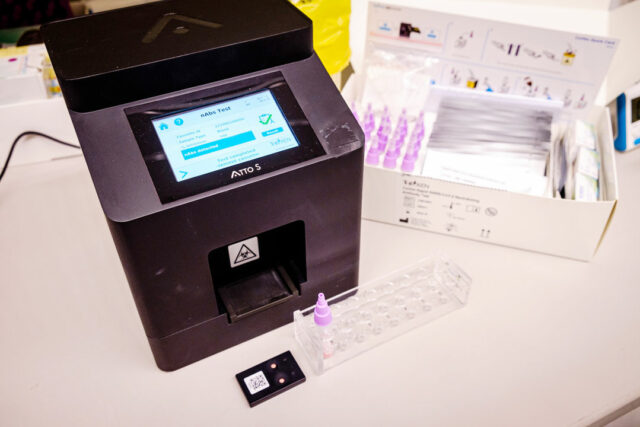
SCIENTISTS from the Singapore-MIT Alliance for Research and Technology (SMART) and Nanyang Technological University Singapore (NTU Singapore) developed a test kit that can determine one’s immunity against coronavirus disease 2019 (COVID-19) in 10 minutes.
The rapid test kit measures levels of neutralizing antibodies against COVID-19 and its variants from just a drop of blood.
“Our study proves that our new test kit can be a powerful tool, allowing healthcare organizations to screen people and determine their vaccination needs,” said Peter Preiser, co-lead principal investigator at SMART Antimicrobial Resistance (AMR) group and associate vice-president for biomedical sciences at NTU Singapore, in a statement.
“This will help allay some people’s fears that they will be ‘over-vaccinated with a booster,’ since the results will inform them accurately if they are well-protected against COVID-19 or not,” he said.
The kit can also be easily adapted for new variants of concern in the future since it is “low-cost, fast, and has up to 93% accuracy,” according to the team. The test findings are described in the related paper published in the Microbiology Spectrum journal.
The low costs and quick results are possible because the kit uses a paper-based assay coated with chemicals that bind to antibodies.
The team predicts it will pave the way for personalized vaccination, where people are only given vaccinations and booster shots when necessary, based on antibody levels.
“Depending on the country or jurisdiction, different evaluations for the test need to be conducted,” said Dr. Megan McBee, scientific director of the SMART AMR research group, in an e-mail to BusinessWorld.
The SMART spin-off company Thrixen is looking into necessary evaluations, manufacturing, and distribution options.
In Singapore, the test evaluation process can take several months to a year. And once data and production details are submitted to regulators, it could take another year to bring the test to market without emergency use authorization.
The rapid COVID-19 immunity test kit is ideal for governments and healthcare organizations struggling to manage limited vaccine resources, said Dr. McBee.
She added that the test can be developed and adapted for use to tackle other diseases beyond COVID-19.
“Think instant diagnostics, where a doctor is able to test a patient’s response to a viral disease which would allow them to recommend the right course of treatment there and then. This would be hugely beneficial to everyday healthcare, and we are just at the cusp of exploring the possibilities and applications,” she said.
METRO Pacific Investments Corp. (MPIC) bagged a coveted award at the 10th Finance for the Future Awards after going through a three-stage judging process and besting seven international listed companies.
The infrastructure investment company clinched the Finance for the Future Award for Embedding an Integrated Approach (Listed Companies) during an event held on Oct. 4.
“People, planet, and long-term impact are at the core of our work,” said MPIC Chairman, President, and Chief Executive Officer Manuel V. Pangilinan in a statement. “We view this as an obligation to future generations of Filipinos. We will never stop pursuing sustainable growth.”
The Finance for the Future Awards recognized organizations and individuals that support the integration of sustainability into financial decision-making. It is a partnership among Accounting for Sustainability, Deloitte, and the Institute of Chartered Accountants in England and Wales.
Finalists numbering 33 from 13 countries were recognized at the awards ceremony, which was held in London with hybrid attendance by businesses around the world. MPIC participated and received the award online.
“At MPIC, we do sustainability as part of our overall stakeholder value creation, along with our purpose of improving the lives of the Filipinos and communities we serve,” said MPIC Chief Finance, Risk, and Sustainability Officer June Cheryl A. Cabal-Revilla. “This recognition will inspire and push us all, not just to continue what we are doing, but to do much, much more.”
Created in 2012, the Finance for the Future Awards recognize leadership within the finance function to drive sustainable economies.
The category “Embedding an Integrated Approach (Listed Companies)” acknowledges publicly listed firms where sustainability is embedded in the overall strategy and decision-making processes, as well as finance teams that play a critical role in delivering this.
Winners of the category are said to not only embed sustainability into their overall strategy and decision-making process and consider it as the core of the organization’s activities but also generate tangible environmental or social benefits.
MPIC has holdings in Manila Electric Co., Maynilad Water Services, Inc., MetroPac Water Investments Corp., Metro Pacific Tollways Corp., Metro Pacific Hospital Holdings Inc., Light Rail Manila Corp., and mWell PH.
MPIC is one of three key Philippine units of First Pacific, the others being Philex Mining Corp. and PLDT, Inc.
Hastings Holdings, Inc., a unit of PLDT Beneficial Trust Fund subsidiary MediaQuest Holdings, Inc., has a majority stake in BusinessWorld through the Philippine Star Group, which it controls.
STOCKHOLM/PARIS — French author Annie Ernaux won the 2022 Nobel Prize in Literature last Thursday for “the courage and clinical acuity” in her largely autobiographical books examining personal memory and social inequality.
In explaining its choice, the Swedish Academy said Ms. Ernaux, 82, “consistently and from different angles examines a life marked by strong disparities regarding gender, language and class.”
Ms. Ernaux, the first French woman to win the literature prize, said winning the award was “immense.”
She has previously said that writing is a political act, opening our eyes to social inequality. “And for this purpose she uses language as ‘a knife,’ as she calls it, to tear apart the veils of imagination,” the academy said.
Her debut novel was Les Armoires Vides in 1974 but she gained international recognition following the publication of Les Années in 2008, translated into English as The Years in 2017.
“It is her most ambitious project, which has given her an international reputation and a raft of followers and literary disciples,” the academy said of that book.
By substituting in her narrative “the spontaneous memory of the self with the third person of collective memory,” the academy said of The Years, Ms. Ernaux merges together the personal and collective memory.
Born to a modest family of grocers from Normandy in northern France, Ms. Ernaux writes in a frank, direct style about class and how she struggled to adopt the codes and habits of the French bourgeoisie while staying true to her working-class background.
“It’s a long path that she makes in her life,” Swedish Academy member Anders Olsson told Reuters. “She’s a courageous woman.”
‘RUTHLESSLY HONEST’ A film adaptation of Ms. Ernaux’s 2000 novel Happening, about her experiences of having an abortion when it was still illegal in France in the 1960s, won the Golden Lion at the Venice Film Festival in 2021.
“I did not imagine at the time that 22 years later, the right to abortion would be challenged,” Ms. Ernaux told reporters in Paris. “Until my last breath, I will fight for women’s right to choose whether they want to be a mother or not.”
Ms. Ernaux also touched on the political power won by the far right in countries around Europe in recent years, saying “the extreme right in history has never been favorable to women.”
The academy said her “clinically restrained narrative” about a 23-year-old narrator’s abortion remained a masterpiece among her works.
“It is a ruthlessly honest text, where in parentheses she adds reflections in a vitally lucid voice, addressing herself and the reader in one and the same flow,” the academy said.
Jason Whittaker, head of English and Journalism at University of Lincoln in Britain, said the prize should bring more attention to the genre of women’s autobiography, “which is very often overlooked in what is still a male-dominated sphere.”
Similarly to when Polish writer Olga Tokarczuk won the 2018 prize, the recognition given to Ms. Ernaux’s work would attract readers in English, he said.
“She’s been a very important contributor in terms of memoir and autobiographical work,” Mr. Whittaker told Reuters. “In terms of her contribution to global literature, it’s really important in placing innovation and interesting techniques in women’s memoir at the center of literary writing.”
WOMEN’S RIGHTS Seven Stories Press, Ms. Ernaux’s US publisher of 31 years, said it published the English translation of her most recent book, Getting Lost, just two days before she won the Nobel prize, and was now rushing several of her backlist titles to press.
Seven Stories Press Publisher Dan Simon said in a statement that Ms. Ernaux “has stood up for herself as a woman, as someone who came from the French working class, unbowed, for decade after decade.”
In picking Ms. Ernaux, he said, the Swedish Academy had made a brave choice of “someone who writes unabashedly about her sexual life, about women’s rights and her experience and sensibility as a woman.”
Former French Culture Minister Roselyne Bachelot wrote on Twitter that Ms. Ernaux is “a writer who has put the autobiographical mode in its cold analytical way at the heart of her career. One may not agree with her political options but one must salute a powerful and moving work.”
A NOBEL ‘BADGE’ The prizes for achievements in science, literature and peace were established in the will of Swedish chemist and engineer Alfred Nobel, whose invention of dynamite made him rich and famous, and have been awarded since 1901.
The prize is worth 10 million Swedish crowns ($915,000).
The prize, widely seen as the world’s most prestigious literary award, was won last year by Tanzanian novelist Abdulrazak Gurnah.
Some prizes have gone to writers from outside mainstream literary genres, including French philosopher Henri Bergson in 1927, British Prime Minister Winston Churchill in 1953, and American singer-songwriter Bob Dylan in 2016.
Readers in France said they’d been waiting for Ms. Ernaux to win. “It seems rather a foregone conclusion,” said Marie Roisson, 48. “What I liked among Annie Ernaux’s works — is the work she did on becoming — to manage to enter another place in a society from where she did not come, and despite the difficulty, to succeed.”
Ms. Ernaux suggested winning was a mixed blessing.
“I always said that I did not want to get the Nobel prize,” she told reporters at her French publisher Gallimard’s office.
“Because once you get it, afterwards you always have that badge attached to your name, and I fear that it could mean one no longer evolves once one’s statue is made.” — Reuters
DIGITAL LENDER Maya Bank, Inc. has gained one million customers and recorded P10 billion in deposits just five months after its launch, it said in a statement on Tuesday.
“Propelling Maya’s growth is its game-changing customer experience, powered by innovative services, personalized features, and a highly reliable and secure platform,” bank said.
Maya Bank said its rapid growth shows “booming preference” of Filipinos for its “all-in-one” finance platform.
“Financial services need not be complex. This astounding response to our efforts reflects the big opportunity for digital banking in the Philippines,” Maya Group Chief Executive Officer and Founder and Maya Bank Co-Founder Orlando B. Vea said in the statement.
“Filipinos are ready for more progressive digital experiences; that’s why we’ve established ourselves as the country’s leading digital bank app in record time. We’re continuing to strengthen our financial services ecosystem as we bring more innovative services to consumers and enterprises,” Maya Group President and Maya Bank Co-Founder Shailesh Baidwan said.
Maya Bank was launched on April 29, about six months after it was granted a digital banking license by the Bangko Sentral ng Pilipinas (BSP). The PayMaya Philippines platform was rebranded to Maya to include online banking services alongside e-wallet, cryptocurrency trading and micro-investments.
Maya Bank President Angelo Madrid had said at the launch that they hope one million of PayMaya’s more than 47 million users as of March would become Maya Bank clients.
“We’re very grateful for the warm response from the market. We’re ushering in a new era of banking, and we’re excited to roll out more innovative and customer-centric digital banking features in Maya that can enrich everyday lives,” Mr. Madrid said on Tuesday.
Maya Bank said its “innovative executions of digital banking features” have helped in its growth.
These features include the recently introduced daily interest crediting for Maya Savings, which now allows Maya Bank customers to view their earnings through their transaction history daily instead of monthly.
It also introduced a mission-led rewards system to incentivize users to use the app for its transactions. Starting Oct. 15, Maya Bank clients can extend their 6% per annum savings interest rate for an additional 30 days every time they use the app to pay personal bills and transactions through their Maya QR, card, or phone number.
Users can also manage their money through Maya’s “Personal Goals” feature, which allows them to create a maximum of five “wallets” with a target amount and a trackable timeline, with the 6% per annum interest rate also available until Dec. 31.
Upgraded Maya Bank wallet users can also conveniently start a savings account without maintaining a minimum balance. Users can also interbank PESONet transfers without fees until Dec. 31, 2022.
Maya Bank is one of the six entities that were granted digital banking licenses by the BSP.
PayMaya and Maya Bank are owned by Voyager Innovations, Inc. PLDT, Inc. is Voyager’s main shareholder. Hastings Holdings, Inc., a unit of PLDT Beneficial Trust Fund subsidiary MediaQuest Holdings, Inc., has a majority stake in BusinessWorld through the Philippine Star Group, which it controls. — A.O.A. Tirona
National Institute of Allergy and Infectious Diseases (NIAID)/FLICKR/CC BY 2.0
ATTEMPTS by Oxford University researchers and AstraZeneca Plc to create a nasal-spray version of their jointly developed coronavirus disease 2019 (COVID-19) shot suffered a setback on Tuesday as initial testing on humans did not yield the desired protection.
An antibody response in the respiratory mucous membranes was seen in only a minority of participants in the trial, which was in the first of usually three phases of clinical testing, the University of Oxford said in a statement on Tuesday.
Also, the immune response measured in the blood was weaker than that from a shot-in-the-arm vaccination.
Researchers across the world have placed high hopes on nasal spray vaccines against the coronavirus because the method is believed to potentially prevent infection and not just disease as it may prompt an immune response directly in the airways, where the virus enters the body.
In addition, the method would be less painful and easier to handle than injections.
Regulators in India and China have already cleared products that are administered through the airways.
India’s health minister last month approved Bharat Biotech’s COVID-19 nasal spray vaccine while China’s CanSino Biologics, Inc. last month won emergency approval by the country’s drug regulator for an inhaled version of its COVID-19 vaccine.
CanSino has said studies indicated that its vaccine, delivered via a nebulizer device, can induce strong immunity to effectively contain infection, while Bharat’s trial results have not yet been published.
The British trial enrolled 30 previously unvaccinated participants as well as 12 volunteers, who had previously received a standard two-dose vaccine course by injection.
“The nasal spray did not perform as well in this study as we had hoped,” said Sandy Douglas, chief investigator of the trial at Oxford University’s Jenner Institute.
“We believe that delivery of vaccines to the nose and lungs remains a promising approach, but this study suggests there are likely to be challenges in making nasal sprays a reliable option,” she added.
No serious adverse events or safety concerns were reported during the trial, which was funded by AstraZeneca, according to the statement. — Reuters
THE PHILIPPINES’ retirement income system is the second worst among 44 economies in Mercer-CFA Institute’s Global Pension Index released on Tuesday, due to inadequate pension for retirees. Read the full story.
AXELUM Resources Corp. said that it cut its direct greenhouse gas emissions by up to 19% from manufacturing operations due to efficient diesel consumption.
“Greenhouse gases trap heat in the atmosphere resulting in a shift in temperature of the Earth’s climate,” the coconut product exporter and retailer said in a disclosure on Tuesday. “Axelum has made significant inroads towards climate change resiliency.”
The company added that it recycled up to 20% of wastewater, including ground watering and sanitation of production areas.
“Axelum recently upgraded its state-of-the-art wastewater treatment plant to ensure compliance with international effluent standards,” it said.
The listed firm said it used more than 44,000 metric tons of coconut shells as feedstock to fuel industrial boilers that generate culinary-grade steam.
“Moreover, Axelum repurposed approximately 71% of used Tetra packaging materials into 2,183 pieces of regular size chipboards, which served as alternative plywood and table dividers, to observe proper physical distancing within plant premises,” it added.
The firm said it is exploring additional renewable energy sources for its Medina plant to “support peak operating hours and limit dependence on traditional power.”
“Our climate action response forms a major part of our evolving sustainability agenda. Aligned with the goals of the Paris Agreement, we enacted a proactive approach to contribute to mitigating the effects of global warming,” Axelum Chairman and Chief Executive Romeo I. Chan said.
“For us, this is just the beginning of a long-term commitment to advancing sustainable development by integrating its principles deep within the context of our business,” he added.
The company is a fully integrated manufacturer, exporter and retailer of premium coconut products.
In the second quarter, Axelum’s attributable net income rose by 38.3% to P238.91 million from P172.81 million in 2021.
At the stock exchange on Tuesday, its shares ended higher by 1.16% or three centavos to end at P2.61. — Luisa Maria Jacinta C. Jocson