Home Blog Page 5276

8 Filipino trafficking victims rescued from Myanmar 

DFA.GOV.PH

EIGHT FILIPINOS have returned to the Philippines after being rescued from a trafficking scheme in Myanmar, the Department of Foreign Affairs (DFA) said on Monday.  

Among the eight, four males were recruited online from Dubai to supposedly work as customer support representatives in Thailand. Instead, they were brought to Myanmar and forced to scam individuals into investing in cryptocurrency.  

The other four, all females, were detained for allegedly entering Myanmar illegally from Thailand.  

The DFA wishes to advise all that the Myanmar-Thai Friendship Bridge, the border crossing closed for nearly three years, only reopened last January 2023 for the citizens of the two countries,it said in a statement.  

Therefore, crossing by any other means, e.g. across the river, is illegal,” it added. “Moreover, the legal entry points for foreigners, including Filipinos, are through Yangon, Mandalay, and Nay Pyi Taw airports.”  

The DFA warned Filipinos both in the Philippines and abroad to be cautious of jobs offered in social media sites.  

It is vital to pass through the legal deployment processes in the Philippines and arrive in their countries of destination not as tourists but with actual working visas,it said. Alyssa Nicole O. Tan

DA eyes permanent KADIWA stores in Metro Manila markets 

OFFICE OF THE PRESS SECRETARY PHOTO

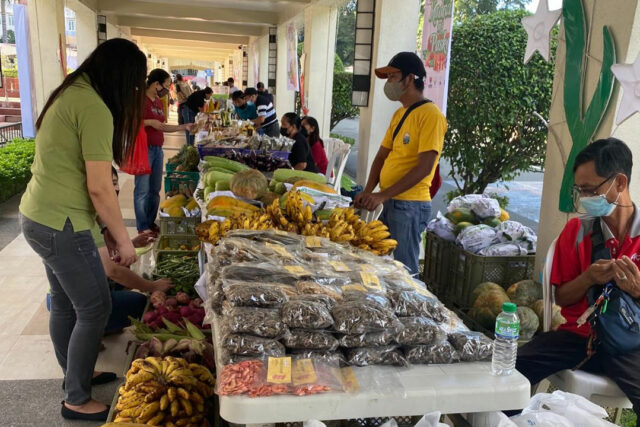
THE DEPARTMENT of Agriculture (DA) plans to set up permanent KADIWA stores in Metro Manilas public markets, providing a stable venue where farmers can directly sell to consumers.  

In a statement on Monday, the DA said the plan is expected to ensure food availabilityin local markets while addressing the high prices of agricultural commodities. 

“One of the things we’re looking at is having accredited KADIWA retailers inside the market itself for the countrymen to have access to cheaper agricultural commodities — especially now that we have identified cooperatives that are ready to supply the market,” DA Assistant Secretary Kristine Y. Evangelista said in Filipino in a media interview on Feb. 10.   

KADIWA stores were rolled in various localities at the height of the coronavirus pandemic to facilitate access between growers and buyers amid mobility restrictions.  

The DA also said that it has asked farmer cooperatives, members of the private sector, and other agricultural stakeholders to take part in direct and effective food supply distribution system throughout the country.”  

To date, there are 308 KADIWA stores, pop-up stores, and KADIWA-on-Wheels, according to the DA Agribusiness and Marketing Assistance Service.  

Interested outlets and stores may apply as KADIWA-accredited retailers by submitting a letter of intent addressed to the AMAS Director or the DA Regional Field Office Agribusiness and Marketing Assistance Division (AMAD) Chief, along with the location and/or sketch plan of the store,the DA said.  

In line with the marketing linkage initiative of the DA, farmer cooperatives will also be directed to KADIWA outlets. Sheldeen Joy Talavera

‘Consumer-to-consumer’ online transactions need protection — groups

JCOMP-FREEPIK

Consumer groups said the proposed law that seeks to protect online customers and merchants should also cover consumer-to-consumer transactions.

“There is a gap relating to the customer-to-customer transaction, which is explicitly exempted from the bill,” said Ronald Gustilo, national campaigner of Digital Pinoys, a network of digital advocates focused on developments in telecommunications. 

“Most unscrupulous sellers are not registered with the Department of Trade and Industry (DTI) nor the Securities and Exchange Commission,” he said via Messenger chat. 

Sponsored by Senator Mark A. Villar, the recently filed Senate Bill No. 1846, or the Internet Transactions Act of 2022, seeks to ensure the protection of consumer rights and data privacy in online transactions.

The proposed measure will cover business-to-business and business-to-consumer internet transactions, including internet retail of consumer goods and non-financial services, online travel, online media, and online delivery.

“Consumer-to-consumer transactions shall be exempt from the operation of this act, without prejudice to the application of other laws,” a section of the bill reads.

While the bill both protects e-commerce players and promotes the rapidly growing industry, the exemption can be exploited by scammers, Mr. Gustilo said.

“As such, the bill should define when consumer-to-consumer sellers become online merchants, which may be determined based on sales or product volume,” he noted.

Rodolfo B. Javellana, Jr., president of the advocacy group United Filipino Consumers and Commuters, agreed that the bill’s coverage should be expanded. 

“There’s still time to expand the bill’s scope,” he said in a phone interview. “This is a welcome development if they think consumers need protection, because a lot have become victims.”

He said it is important for the lawmakers to hold public consultations on the matter.

The bill also calls for the establishment of an e-commerce bureau under the DTI.

This is to “ensure the attainment of the objectives of this act and promote the growth of e-commerce,” the bill reads. The e-commerce division created by the Department of Budget and Management under the Competitiveness Bureau of the DTI in Jan. 2020 will be abolished.

The aim of the Internet Transactions Act is to combat online fraud, Mr. Villar said. 

“Once signed into law, merchants and consumers will be able to safely conduct business across different online platforms,” he said in a statement. — Patricia B. Mirasol

Chiefs rally in 4th quarter to take down Eagles, win Super Bowl 57

KANSAS CITY Chiefs’ Travis Kelce and Patrick Mahomes celebrate with the Vince Lombardi Trophy after winning Super Bowl LVII. — REUTERS

HARRISON Butker kicked a 27-yard field goal with eight seconds left and Patrick Mahomes passed for two of his three touchdowns in the fourth quarter as the Kansas City Chiefs rallied to a 38-35 victory over the Philadelphia Eagles in Super Bowl LVII on Sunday night in Glendale, Arizona.

Kadarius Toney caught a touchdown pass and set up another score with a long punt return as Kansas City became just the second team in Super Bowl history to rally from a deficit of 10 or more points.

Travis Kelce and Skyy Moore caught touchdown passes, Isiah Pacheco ran for a score and Nick Bolton returned a fumble for a touchdown for the Chiefs.

The Super Bowl title is the third for Kansas City. The Chiefs also won Super Bowl IV (1969 season) and Super Bowl LIV (2019).

Philadelphia’s Jalen Hurts tied a Super Bowl record with three rushing scores and also passed for one touchdown. Mr. Hurts was 27-of-38 passing for 304 yards and rushed for 70 while teaming up with Mr. Mahomes as the first pair of Black starting quarterbacks in Super Bowl history.

Former Denver Broncos star Terrell Davis rushed for three touchdowns against the Green Bay Packers in Super Bowl XXXII.

Kansas City moved 66 yards on 12 plays for the winning field goal, receiving help from a third-down defensive holding penalty on Philadelphia’s James Bradberry. Another key play was a 26-yard scramble by Mr. Mahomes, who earlier aggravated his right ankle injury on Kansas City’s final offensive snap of the first half.

A.J. Brown caught six passes for 96 yards and one touchdown and DeVonta Smith had seven receptions for 100 yards for the Eagles.

Teams that trailed by 10 or more points at halftime in the Super Bowl are now 2-26. The New England Patriots were the first team to accomplish it as they recovered from a 25-point hole to beat the Atlanta Falcons in Super Bowl LI.

Kansas City took its first lead of the contest at 28-27 when Mr. Mahomes completed a 5-yard scoring pass to a wide-open Mr. Toney with 12:04 left in the game. That also marked the first time Philadelphia had trailed the entire postseason.

The Chiefs then forced a three-and-out and cashed in big when Mr. Toney set a Super Bowl record with a 65-yard punt return. He fielded the ball at his 30-yard line and started left before reversing to the right with a wall of teammates blocking. He was stopped at the Eagles’ 5.

Three plays later, Mr. Mahomes had another wide-open target in Mr. Moore, who caught the 4-yard scoring pass to give Kansas City an eight-point lead with 9:22 remaining.

Philadelphia quickly responded as Mr. Hurts connected with Smith on a 45-yard pass to the Chiefs’ 2. Mr. Hurts scored on a quarterback sneak on the next play and then ran in the two-point conversion to tie it at 35 with 5:15 remaining.

Mr. Mahomes reinjured his right ankle when tackled with 1:33 left in the first half but he didn’t seem bothered by it when the Chiefs opened the second half with a 10-play, 75-yard drive. Mr. Pacheco capped the drive with a 1-yard run with 9:30 left in the third quarter to pull Kansas City within 24-21.

Philadelphia responded with a 17-play, 60-yard drive that took 7:45. Jake Elliott finished it by booting a 33-yard field goal to give the Eagles a six-point lead with 1:45 left in the period.

Mr. Hurts rushed for two touchdowns and threw for one in the first half to give Philadelphia a 24-14 advantage. — Reuters

Janry Ubas clinches bronze medal in men’s heptathlon in Asian Indoors Athletics

JANRY UBAS — PHILSTAR FILE PHOTO

JANRY Ubas delivered a record-breaking performance in snaring the men’s heptathlon bronze medal in the Asian Indoor Athletics Championships in Astana, Kazakhstan Sunday night.

The 29-year-old Ubas amassed 5306 points in finishing behind Japanese Yuma Maruyama and Keisuke Okuda, who took the gold and silver with 5801 and 5497 points, respectively.

That bronze was the second medal copped by the country in the 19-year history of the Asian Indoors after Eric Cray also sniped a bronze in the 60 meters in the 2016 Doha, Qatar edition.

The Misamis Oriental native’s 7.66m effort in long jump also set a new mark, eclipsing the 7.64 registered by Donnovant Arriola eight years ago in Albuquerque, United States.

It came a day after countryman Leonard Grospe’s record-shattering effort in high jump of 2.15m.

The 2022 Hanoi Southeast Asian Games decathlon bronze winner also set a new national indoor mark previously owned and set by Jeson Ramil Cid (4,565) in the 2014 Asian Championships in Hangzhou, China.

And most importantly, it averted a medal shutout for the national team backed by the Philippine Sports Commission and CEL Logistics, Inc.

“This is a good note for Philippine athletics as Janry outscored the best the region has to offer,” said Philippine Athletics Track and Field Association president Terry Capistrano.

“He put up a brave stand and showcased the Filipino’s fighting heart in the final event, the 1000 meter run despite an injury enabling him to secure points necessary to capture a podium finish,” he added. — Joey Villar

Creamline Cool Smashers face sister Choco Mucho in Valentine’s Day showdown

CREAMLINE Cool Smashers will have a chance to regain the solo lead again as it shoots for win No. 3 against Choco Mucho Flying Titans. — PVL

Games Today
(Smart Araneta Coliseum)
4 p.m. — Cignal vs Akari
6:30 p.m. — Creamline vs Choco Mucho

CREAMLINE looked impressive in its straight-set victories over last year’s Reinforced Conference finalists Petro Gazz and Cignal that reinforced what every team in the Premier Volleyball League (PVL) already know — the Cool Smashers are the team to beat.

And the Jonathan Ng-owned franchise is not about to slow down as it is expected to show no mercy against little sister Choco Mucho in a Valentine’s Day PVL All-Filipino Conference showdown that is expected to draw a mammoth crowd at the Smart Araneta Coliseum today.

Out for a vengeance after it was denied a historic Grand Slam last season, the Open and Invitational Conferences titlist came out like a super typhoon as it left a trail of devastation in flattening Petro Gazz, 25-18, 25-20, 25-22, and Cignal, 25-16, 25-21, 25-15, to jump to the top early.

While Chery Tiggo and F2 Logistics managed to catch up by also zooming to a pristine 2-0 start, Creamline will have a chance to regain the solo lead again as it shoots for win No. 3 against Choco Mucho at 6:30 p.m. in a duel that could come close, if not eclipse, the 19,000-plus fans that watched them clash in their last encounter in November last year at the MOA Arena.

Expect the Flying Titans to likewise come out with fire in their eyes and bounce back from a 25-18, 25-20, 25-21 beating the former suffered at the hands of the Angels Thursday at the Filoil EcoOil Centre.

But everyone knows, including Choco Mucho itself, that Creamline will come into their match as the heavy favorite, thanks to the latter’s loaded roster headed by resurgent Michele Gumabao and the power-spiking duo of Tots Carlos and Jema Galanza.

The troika have actually stepped up and filled the massive void left by their hurting captain Alyssa Valdez especially Ms. Gumabao, who has been playing like an MVP and averaged a team-high 13.5 points a game, which is currently seventh best in the league’s scoring race.

Meanwhile, Cignal and Akari desperately gun for their first win after dropping their first two assignments as they tackle each other at 4 p.m. — Joey Villar

Rolando Nolte beats Dau Khuong Duy to grab solo lead of AQ ASEAN Chess Championship

GR STOCKS-UNSPLASH

NOT even age could stop Rolando Nolte in his pursuit of a Grandmaster (GM) title.

Showing he still has it at age 50 years old, Mr. Nolte subdued Vietnamese Dau Khuong Duy in 35 moves of their super-sharp Sicilian encounter to seize the solo lead after three rounds of the AQ Prime ASEAN Chess Championship at the Great Eastern Hotel Sunday.

Mr. Nolte, who finished third and the highest Filipino performer in the Manny Pacquiao International Open in General Santos in December last year, went on a sacrificial attack that resulted to pinning his teenage rival’s king to submission.

The former Olympiad player was hoping to top this 11-round event organized by the Kamatyas Chess Club that would earn him his second the three required norm to become a GM.

With eight rounds to go, Mr. Nolte is on course to making it a reality as he jumped to the top with 2.5 points, or half a point ahead of a five-man group that included Filipino Grandmasters Darwin Laylo and John Paul Gomez and International Master (IM) Paulo Bersamina.

Also in the pack of two-pointers were Malaysian IM Yeoh Li Tian and top seed Indonesian GM Susanto Megaranto.

Mr. Laylo, who is riding the crest of his recent National Championship conquest in Malolos, turned back Indonesian IM Yoseph Theolifus Taher while Mr. Gomez slew the fancied Megaranto.

Mr. Bersamina, for his part, escaped with a marathon 56-move draw with Indonesian IM Mohamad Ervan.

IM Daniel Quizon finally nailed his first win after two painful defeats and smashed Laotian FIDE Master Prin Laohawirapap. — Joey Villar

Wu becomes first Chinese man to win ATP title with Dallas triumph

WU Yibing became the first man from China to win an ATP title on Sunday as he held off home hero John Isner 6-7(4) 7-6(3) 7-6(12) in a thrilling final to claim the Dallas Open.

China’s men have barely made an impression in tennis’ elite circuit but 23-year-old Mr. Wu’s breakthrough could inspire generations to come in the East Asian nation.

Before this week, no Chinese man had ever reached a tour-level final in the professional era or defeated a top 10 opponent.

Mr. Wu, from the eastern city of Hangzhou, has done both, having upset American world number eight Taylor Fritz in the semi-finals in Dallas.

Against Mr. Isner, a hardened tour professional with 16 titles and one of the game’s most feared serves, Mr. Wu had to earn the right to create history.

Mr. Isner hammered 44 aces and held match point as Mr. Wu served to stay in the second set at 6-5.

After 22 consecutive points went with serve in the final tiebreak, Mr. Wu forced Mr. Isner to push the ball long, claiming the match a minute short of three hours.

On Monday Mr. Wu became the second Chinese man to crack the world top 100 and is now projected to rise to 58.

Ranked outside the top 1,000 last April, Mr. Wu qualified for the US Open and won two main draw matches, becoming the first Chinese man to reach the third round of a Grand Slam since 1938. — Reuters

StoreHub adds tool designed to drive repeat sales for local partners

StoreHub

Technology startup StoreHub, which helps retailers and restaurants automate, introduced on Monday its new tool StoreHub Engage that is designed to help business owners generate more repeat sales and build customer loyalty.

StoreHub, one of the point-of-sale system providers accredited by the Philippines’ Bureau of Internal Revenue, hopes to help its existing partners in getting their customers to spend with them again, the tech startup said in an e-mailed statement.

“The new feature allows businesses already using StoreHub’s ecosystem to automate up to four personalized short-message-service or SMS campaigns to existing customers within their database,” StoreHub noted. “This includes sending cashback reminders and birthday voucher codes.”

StoreHub is working to improve its operations in the Philippines and other Southeast Asian countries after raising $13.5 million in new capital.

“With the Philippine economy expected to pick up in 2023, local businesses have been encouraged to increase digital adoption in order to leverage on opportunities to grow their business,” the company said.

The Trade department previously urged growing businesses and entrepreneurs to adopt digital solutions to “operate more efficiently, reduce costs, reach bigger markets, and earn more profits.”

“Traditional brick and mortar businesses typically lack access to specialized knowledge to effectively reach their customers. We built Engage to help automate that,” said Wai Hong Fong, chieftain and co-founder of StoreHub.

“Imagine it’s your customer’s birthday – Engage will send them a personalized ‘Happy birthday’ SMS with a unique voucher code. Instead of spending time doing this manually, or paying for expensive tools or specialists to achieve this, business owners can now just turn it on and let it run.”

StoreHub, which was launched in 2013, now serves more than 15,000 retail and restaurant outlets across its key markets in the region.

The company said that there are now more than 300 businesses across all markets that use its StoreHub Engage tool.

Restaurants and retailers, for example, see a median return on investment of “up to 18 times through a surge in repeat customers as well as new customers brought in by improved Google ratings,” StoreHub noted. — Brontë H. Lacsamana 

Limiting tax avoidance in the Philippines

IJEAB-FREEPIK

The digitalization of the economy has resulted in significant innovations, especially in terms of convenience for the general population. Now, you can buy your groceries, your clothes, and your food digitally and have those same orders brought to you within the same day or, at most, a week. However, digitalization comes with a dark side as well. The digitalization of the economy has allowed multinational corporations to take advantage of tax systems around the world by transferring their income to tax havens (or places where their income would not be subject to tax).

As of 2023, the Fortune 500 has pegged the revenues of Amazon at $469.8 billion, Alphabet (or, more commonly known as Google) at $257.6 billion, Apple at $365.8 billion, Microsoft at $204.1 billion, Meta (or Facebook) at $118.1 billion, and Netflix at $31.6 billion. Yet these tech giants have been among those criticized as avoiding taxes by shifting their income to tax havens, such as Ireland or Bermuda.

According to Fair Tax Mark, a non-profit organization, these tech companies paid significantly below threshold. From 2010 to 2017, at a time when the baseline rate for tax around the world was 35%, they paid only 15.9% of their declared profits on taxes. And while they generate millions of dollars from the Philippines, they have paid zero in taxes to the Bureau of Internal Revenue (BIR).

Technically speaking, of course, this is all legal. Unlike tax evasion, tax avoidance is a legal way of decreasing the amount of taxes that a taxpayer has to pay. Nevertheless, excessive tax avoidance can cause problems for the government, especially for developing countries like the Philippines, which would need those tax revenues the most.

One of the basic principles behind taxation is that it is the lifeblood of the nation. Without taxes, governments would not be able to function. While tax avoidance should be allowed to a certain extent, it must not result in the detriment of the government.

In 2021, the Organization for Economic Co-operation and Development (OECD) recognized the problem of tax avoidance around the world. Called “base erosion and profit shifting” (BEPS), the OECD noted that multinational enterprises were exploiting tax systems by shifting their profits to countries where their income would not be subject to tax. By the OECD estimate, countries lost $100 billion to $240 billion in tax revenues due to BEPS practices.

To combat this, the OECD, together with the G20, came up with a Two-Pillar Solution to address the tax challenges arising from the digitalization of the economy.

The first pillar addressed the issue of determining the nexus of taxation (which essentially means which government can collect the tax concerned) and the determination of the tax base. Naturally, this also requires the elimination of double taxation so that companies would not be taxed twice by different tax authorities. The first pillar also creates the concept of Amount A (which refers to a portion of the residual profit of large and highly profitable enterprises) and Amount B (which refers to the application of the arm’s length principle to in-country baseline marketing and distribution activities) and setting down the guidelines for their respective collection.

The second pillar, on the other hand, focuses on the establishment of the Global Anti-Base Erosion (GloBE) rules. Under these rules, a global minimum corporate tax rate will be set at 15% and this tax would be applicable to multinational enterprises earning €750 million annually. This minimum tax is intended to ensure that multinational corporations would be liable to pay a minimum amount of tax on their income arising from each of the jurisdictions in which they operate.

So, what does this have to do with the Philippines? The Philippines is one of the countries which is not a member of the OECD/G20 Inclusive Framework on BEPS. Meaning, it has not had much involvement in the fight against tax avoidance. Fortunately, the OECD has noted that the Philippines does not have any harmful tax regimes.

Still, it is important that the Philippines participate in this global initiative in order to curb tax avoidance. As noted before, tax avoidance hurts developing countries the most and fighting this tax avoidance issue would only serve to strengthen the country more.

The Two-Pillar Solution creates rules which allow the “redistribution of taxing rights to market jurisdictions.” Simply put, this means that the countries which would have the right to tax are the ones where the sales happen and where the users are located. In essence, this means that developing countries would gain additional revenue. The OECD estimates that, at a rate of 15% global minimum tax, countries can generate around $150 billion. Moreover, developing countries would also gain further revenues under the Subject to Tax Rule (STTR) which would allow countries to deny the application of tax treaty reliefs in certain cases.

Already, there are concrete policies that can be taken from the OECD proposal, especially on Pillar Two. As of January 2023, the Pillar One model rules are still undergoing finalization, but the Pillar Two model rules (i.e., model rules on Global Anti-Base Erosion) have already been released in 2021. One of the main policies enshrined in those model rules is the imposition of the minimum global corporate tax of 15%, as well as the rules for determining which taxpayers would that tax be applicable to. The model rules also already contain the basis for the global minimum tax, and other pertinent rules.

Instead of implementing tax measures without any significant impact and which would only harm the consumers (such as the recently proposed VAT on digital services), these OECD policies are worth the consideration of the Philippine Congress. As noted above, these measures could result in up to $150 billion in annual revenues. Revenue collections from these tech giants could then be used by the government to address inflation and support the economic recovery of the country.

This article reflects the personal opinion of the author and does not reflect the official stand of the Management Association of the Philippines or MAP.


Raymond “Mon” A. Abrea is an MPA/Mason Fellow at the Harvard Kennedy School. He is a member of the MAP Tax Committee and the MAP Ease of Doing Business Committee, co-chair of the Paying Taxes on Ease of Doing Business Task Force, and the chief tax advisor of the Asian Consulting Group.

map@map.org.ph

mon@acg.ph

Removal of World War II memorials may be imminent

“My bilateral visit to Japan is essential and is part of a larger foreign policy agenda to forge closer political ties, stronger defense and security cooperation as well as lasting economic partnership,” President Ferdinand Marcos, Jr. said in his departure speech last Wednesday.

Closer political ties, security cooperation, and economic partnership to be forged and to endure require a show of trust, respect, understanding, and willingness to compromise by both countries. If there had been conflict between the two countries in the past, fallouts from the conflict should be forgiven and forgotten.

It will be recalled that sometime in December 2021, people learned, to their extreme puzzlement, that the portraits of World War II heroes Jose Abad Santos, Vicente Lim, and Josefa Llanes Escoda in the P1,000 bank note would be replaced by the Philippine Eagle. There is something the three have in common. The three played key roles in the Philippine resistance to the Japanese occupation in 1942 to 1945. All three were executed by the Japanese military.

Jose Abad Santos was an Associate Justice of the Supreme Court when World War II broke out. President Manuel Quezon named him Chief Justice on Dec. 24, 1941 and subsequently designated him Acting President. In April 1942, he and his son were captured by the Japanese. When he refused to cooperate with the Japanese occupation government, he was executed.

Gen. Vicente Lim, the first Filipino to graduate from the US Military Academy in West Point, was in command of the 41st Infantry Division of the Philippine Army in Bataan. After four months of fierce fighting, all Filipino and American forces in Bataan were ordered to surrender on April 9, 1942.

After his release as a prisoner of war, he joined the resistance against the Japanese invaders by funding various guerrilla activities and providing information on Japanese troop movement and military installation. But in June 1944, Lim was captured, brought to Fort Santiago where he was tortured, then to the Chinese Cemetery where he was beheaded.

Josefa Llanes Escoda was a civic leader and social worker. Following the fall of Bataan, she and her husband Antonio mobilized the staff of the National Federation of Women’s Clubs, of which she was the secretary, to make the connections between prisoners of war and their families. They also supplied medicine, food, and messages to both prisoners in Japanese garrisons and internees in internment camps. They were arrested for their activities and subsequently executed.

Some civil society groups suspected the removal of the portraits of the World War II heroes was part of the conditions for Japan’s support of the country’s infrastructure program worth trillions of US dollars.

There is good reason for such suspicion. In April 2018, the statue of the Comfort Woman (a sex slave of the Japanese soldiers in World War II) in Baywalk, Roxas Boulevard, Manila was removed. The statue was a representation of the estimated 1,000 young Filipino women who were either abducted, coerced, or deceived to serve as sexual slaves for hundreds of Japanese soldiers during the Japanese occupation.

The city government of Manila provided the place for the statue. The National Historical Commission of the Philippines (NHCP) installed the marker on the pedestal. My translation of the inscription, which is in Pilipino, is: “This monument is a memorial of the Filipino women who were victims of abuse during the Japanese occupation (1942-1945). A long time passed before they testified and gave a statement about their experience.”

The statue was formally unveiled on Dec. 8, 2017. But days after the installation, officials of the Department of Foreign Affairs (DFA) formally sought through a letter marked “extremely urgent,” an explanation from the City Hall of Manila and the NHCP regarding the statue. The DFA cited the sensitivity of the “comfort women issue” to Japan.

Officials from the Japanese embassy also went to see Manila officials to express their objection to the statue. DFA Secretary Alan Peter Cayetano said the statue would adversely affect Philippines-Japan relations.

On April 27, 2018, personnel of the Department of Public Works and Highways removed the statue, supposedly “to give way to a drainage improvement project along the Baywalk.” Anyway, the sympathizers of comfort women unveiled a new statue that no government agency can touch. It is located in a private property — the courtyard of the Redemptorist Church in Baclaran, Parañaque. The marker says: “The statue stands as a reminder that wars of aggression must always be opposed, and that sexual slavery and violence should never happen again to any woman, anywhere at any time.”

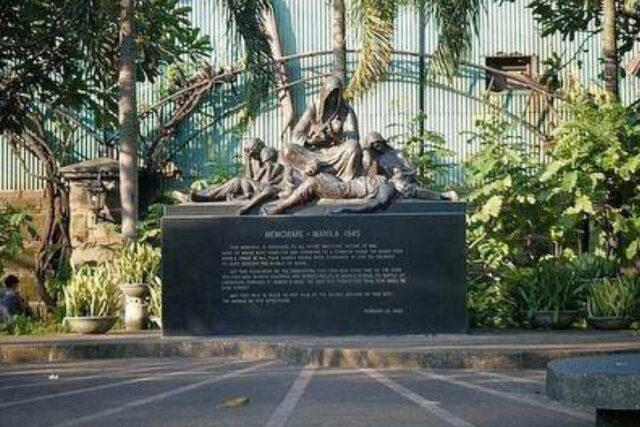
If a statue representing Filipino women forced into sexual slavery by the Japanese Imperial Army was troubling to Japanese, the memorial in Intramuros for the more than 100,000 civilians who perished during the Battle of Manila in February 1945 would be much more upsetting to them because of the sculpture and the inscription. The marker on the monument Memorare-Manila 1945 on Anda Street near General Luna Street, Intramuros, says:

“This monument is erected in memory of the more than 100,000 defenseless civilians who were killed during the Battle for the Liberation of Manila between February 3 and March 3, 1945. They were mainly victims of heinous acts perpetrated by the Japanese Imperial Forces and the casualties of the heavy artillery barrage by the American Forces. The Battle for Manila at the end of World War II was one of the most brutal episodes in the history of Asia and the Pacific. The non-combatant victims of that tragic battle will remain forever in the hearts and minds of the Filipino people.”

Intramuros is a popular tourist destination. The huge size of the monument attracts the curiosity of tourists. Removal or relocation to a private place of the monument at the instance of Japanese officials will certainly draw the ire of the surviving children and close relatives — there are thousands of them — of those killed during the Battle of Manila. I think the most that can be done to please Japanese officials would be the removal of the phrase “They were mainly victims of heinous acts perpetrated by the Japanese Imperial Forces” from the marker.

Much less conspicuous than the monument in Intramuros but just as disturbing to Japanese sensitivity is a marker in a building in the campus of the University of Santo Tomas in Sampaloc, Manila. The inscription says:

“Through these portals passed up to ten thousand Americans and other nationals of the free world who were interned within these walls by the Japanese military, suffering great physical and national humiliation from January 4, 1942, until liberated February 3, 1945, by the American Forces under General Douglas MacArthur.”

The building was used to house civilians numbering more than 3,000, mostly American businessmen and executives of subsidiaries of American companies and their families, Catholic priests and nuns, and Protestant missionaries. Thirty to 50 people were crowded into small classrooms in university buildings.

Little food was provided them by the Japanese Army. Sanitation was poor. Bathrooms and toilets were too few for the thousands of internees. Many died of starvation or of unavailability of medical care. Internees rescued by the American troops in February 1945 were emaciated and near death.

The marker is beyond the prerogatives of Philippine government officials, national or local, as the marker is in a building in a private property and was installed by the American Association of the Philippines.

There are other World War II memorials outside Manila that are as disconcerting to Japanese. They are the Capas National Shrine in the former concentration camp for Allied prisoners in Capas, Tarlac, and a marker in a building in the UP College of Agriculture in Los Baños, Laguna. The building served as an internment camp similar to the one in the University of Santo Tomas campus. But because they are in remote places unlikely to be visited by Japanese tourists, they are probably of no concern to officials of the Japanese Embassy.

But there is something Mr. Bongbong Marcos can do well within his prerogatives as president and as son of Ferdinand Marcos that would please both Filipinos and Japanese — to cease calling the proposed Sovereign Wealth Fund the Maharlika Investment Fund. “Maharlika” is the name of the supposed guerrilla unit of Ferdinand Marcos during the Japanese occupation. There are no records that affirm the existence of such a unit. It was merely a fiction of Bongbong Marcos’ father.

To please the Japanese immensely, he can also order the revision of the book For Every Tear a Victory. The chapter on his father’s war exploits should be expunged from the book. Ferdinand Marcos’ war stories are pure tall tales!


Oscar P. Lagman, Jr. is a retired corporate executive, business consultant, and management professor. He has been a politicized citizen since his college days in the late 1950s.


Ten trends in inflation, PPP, employment, cancer treatment and energy

Last week, several important pieces of news and events came out. I am summarizing them here.

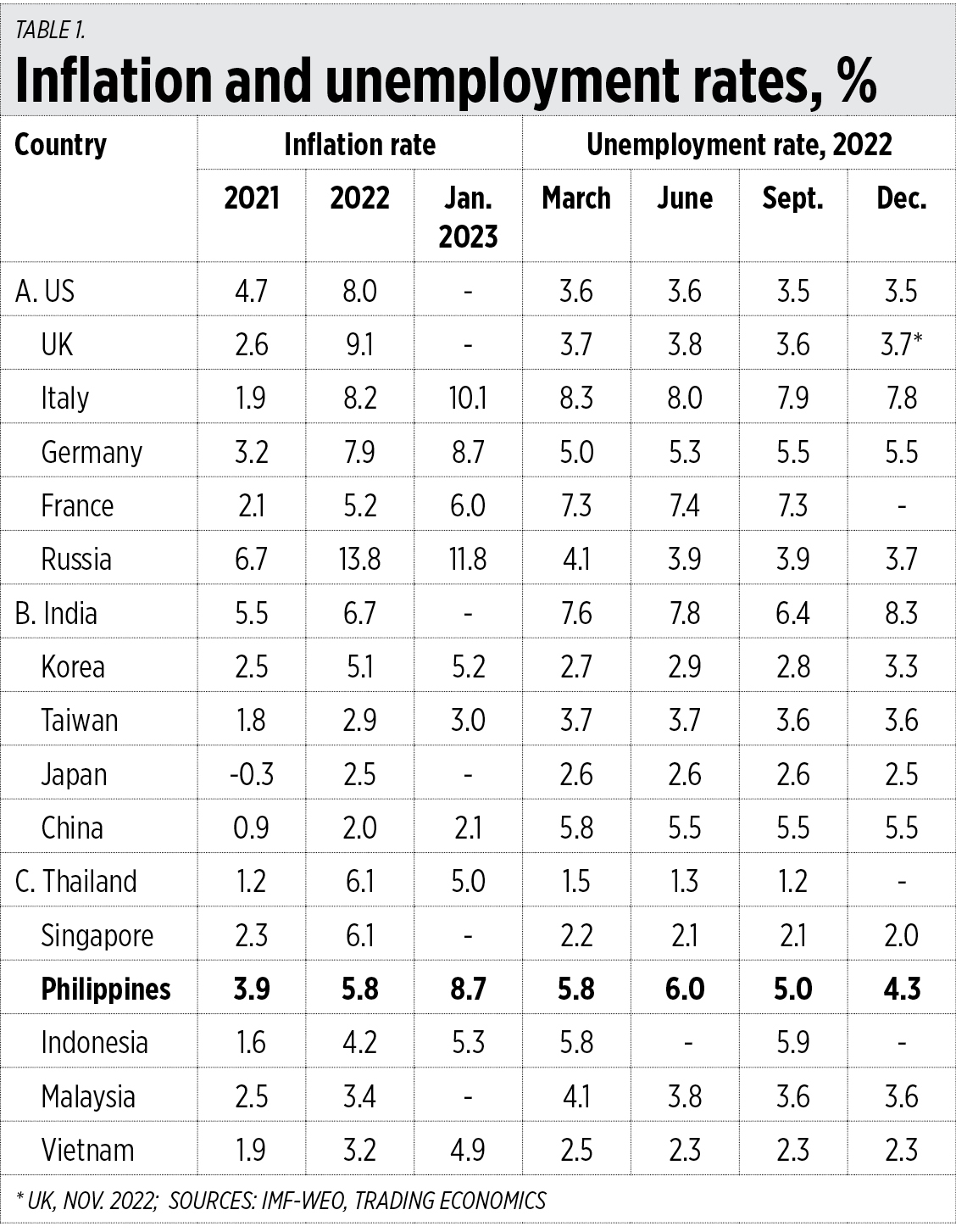
1. The Philippines inflation rate was 8.7%. The Philippine Statistics Authority (PSA) released the January inflation data last week, and the number is indeed bad. But last year, Thailand and Singapore also experienced inflation at 14-year highs, South Korea hit a 24-years high, Japan has a 41-year high.

The main contributors of the 8.7% inflation rate (the highest since November 2008) are from housing, water, electricity, gas, other fuels, transport, and food. These are basic necessities so even if the Bangko Sentral ng Pilipinas (BSP) interest rates further rise from the current 5.5% (only 2% last April) to 10%, people will still spend for them. The appropriate policies are to encourage more supply of those goods — cement, steel, electricity, water, etc. — both through domestic production and trade liberalization.

2. Low unemployment rate despite high labor force participation rate (LFPR). The PSA also released last week employment data for December 2022. LFPR is an indicator of people’s optimism or pessimism about the jobs market. They enter the labor force if they think they can find a good job, they don’t join if they think good paying jobs are not available anyway. The two highest LFPR in 2022 were recorded in November at 67.5% and December at 66.4%.

The two lowest unemployment rates in 2022 were also in November at 4.2% and December at 4.3%. That is a three-year low and it is the best situation that one can hope for in the jobs market. People are optimistic they can find good jobs or they can employ themselves via entrepreneurship. And when they do enter the labor force, very few are unemployed.

Last year among the ASEAN-6, the Philippines had the third highest inflation rate next to Thailand and Singapore. And when it came to the unemployment rate, the Philippines had the second highest as of September 2022 next to Indonesia. But the good thing is that Philippines unemployment shows a consistent decline (see Table 1).

3. Lecture on public-private partnership (PPP). On Feb. 8, the inaugural Ruperto P. Alonzo lecture series was held at the UP School of Economics. The speaker was Cynthia Hernandez, Executive Director of the PPP Center. She discussed the big PPP projects since the time of former President Cory Aquino under RA 6957 or build-operate-transfer (BOT) law of 1990, then RA 7718 or Amended BOT law of 1994 under former President Fidel Ramos, and so on. The main reason why I support more PPP in big infrastructure projects is that it relies on user-pay principle, not all taxpayers-pay principle. So the North Luzon Expressway (NLEX) will be paid only by those who use it and not by people who hardly or never use it, like taxpayers and businesses in Bicol, the Visayas, and Mindanao.

4. The Philippine Business Opportunities Forum (PBOF) in Japan. Last Friday, President Ferdinand Marcos, Jr. and the economic team plus infrastructure team held the PBOF in front of many Japanese and foreign investors. Among the important outcome of the Japan trip was the signing of 35 Letters of Intent (LOIs) between the Philippines and Japan that cover business opportunities in energy, manufacturing, transportation, healthcare, and other sectors.

5. Cancer center and treatment is highlighted. Also during the lecture by Ms. Hernandez last week, she mentioned the University of the Philippines-Philippine General Hospital (UP PGH) Cancer Center, a $95 million (or about P5.5 billion) 300-bed capacity hospital for cancer patients. A week before, it was also reported in BusinessWorld, “Cancer center is Marcos gov’t’s first PPP project” (Feb. 2).

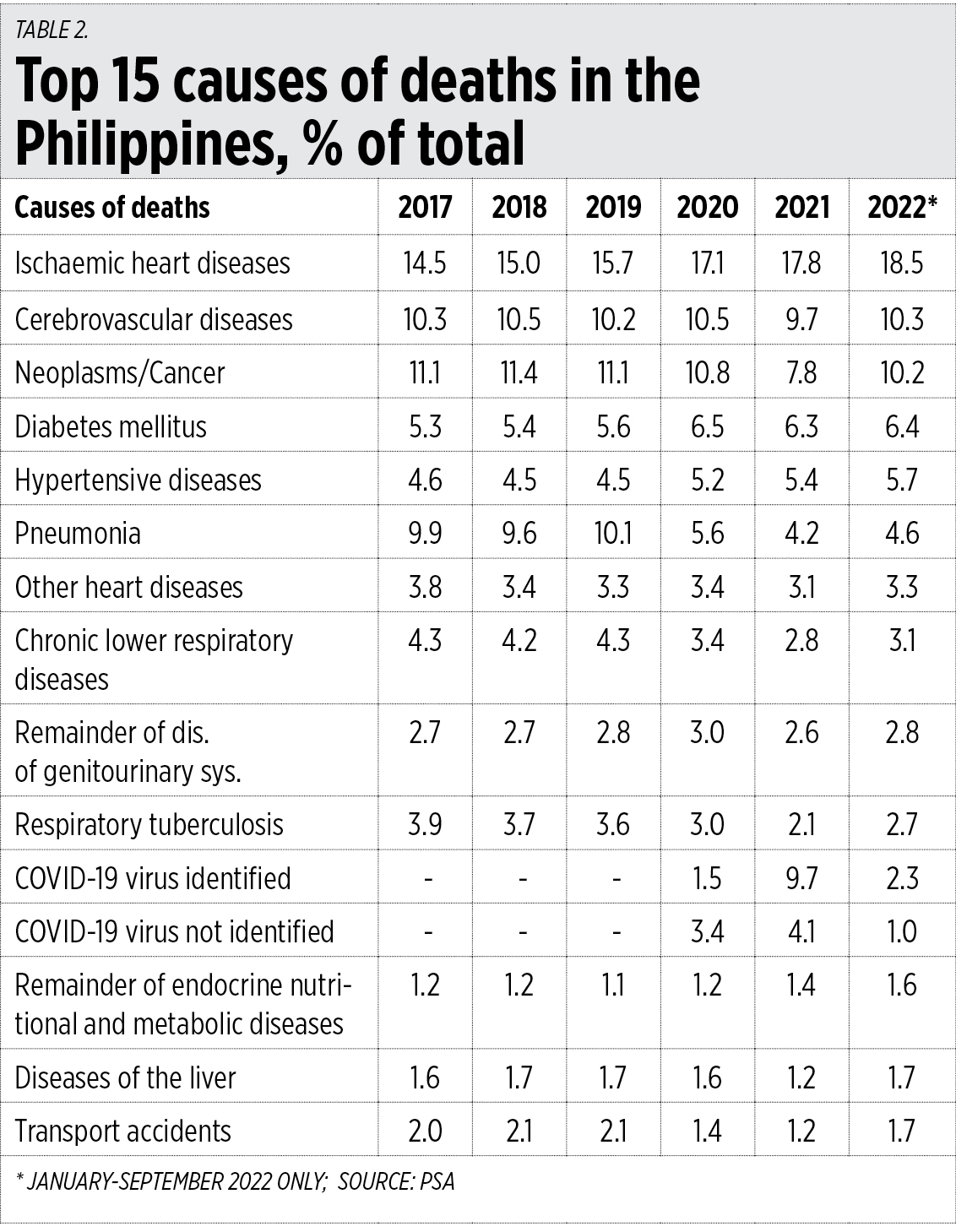
6. Cancer is third main cause of death in the Philippines. Last month, the PSA released the “2022 Causes of deaths in the Philippines,” data covering January-September 2022. I expand here with data from way back to 2017. For some reasons, cancer deaths and pneumonia deaths have declined significantly in 2021 and 2022 while COVID deaths came in (see Table 2).

It is possible that regular pneumonia deaths were labeled as COVID deaths because reporting of COVID cases and deaths were incentivized via higher PhilHealth coverage and subsidies if the patient was sick or died of COVID than non-COVID causes.

7. Cancer treatment is underfunded while COVID vaccination funding remains bloated. Another report in BusinessWorld last week was “More public funds seen needed for cancer care in PHL” (Feb. 9). It quotes Dr. Marvin Jonne Mendoza, head of the medical oncology section of the National Kidney and Transplant Institute, saying that the 2023 General Appropriations Act includes P1.56 billion for two cancer funds but for breast cancer, a patient needs P300,000 to P450,000 to complete the required 18 treatment cycles, and there are at least 27,000 new breast cancer cases/year in the Philippines. Even taking the low-end of P300,000/patient, this means some P8.1 billion is needed to deal with breast cancer alone.

Compare that with COVID vaccine procurement plus logistics of about P88.6 billion in 2021, P45 billion in 2022, and P24.5 billion in 2023.

8. New medicines are replacing chemotherapy. My older brother, Manong Nestor Oplas, died about 17 years ago of prostate cancer. His wife and my sister-in-law, Ate Alita Oplas died of cervical cancer several months ahead of Manong. As both went through painful and expensive treatments including chemo, my well-off sister covered their costly treatment, but both died young, only in their early 50s. My father died of liver cancer but he was almost 90 years old when he rested. Three of my wedding godparents also died of cancer.

If these new anti-cancer medicines — through intravenous or subcutaneous delivery — were available say two decades ago, my brother and sister-in-law, godparents and many other friends, may have lived longer.

9. The budget this year for “Prevention and Control of Non-Communicable Diseases” like cancer is P2.91 billion. The Department of Health has a total budget of P209.13 billion from the General Appropriations Act of 2023.

10. Last Friday, the Independent Electricity Market Operator of the Philippines (IEMOP) held a media briefing and they reported two pieces of good news. One was the launch of the Wholesale Electricity Spot Market (WESM) Mindanao on Jan. 26. Two is the start of operation of the Mindanao-Visayas Interconnection Program (MVIP) this coming March. This is a long-delayed project by the National Grid Corp. of the Philippines (NGCP) — the original target was end-2020, which became 2021, then became 2022. With President Marcos Jr. at the WESM Mindanao launch and announcing the March 2023 operation of MVIP, the NGCP will have no more excuses to keep delaying completion of the project.

The MVIP is important because Mindanao often has power surpluses — it has many new coal power plants — while Visayas and Luzon have occasional power deficits. In Mindanao, coal is 53% of installed capacity but contributes 62.5% of actual power generation.

The trends show bad numbers in inflation but good numbers in employment, energy, PPP, and foreign investments. In health, the continuing distortion in public spending in favor of COVID vaccination spending should stop and resources be diverted to controlling cancer and other non-communicable diseases.


Bienvenido S. Oplas, Jr. is the president of Bienvenido S. Oplas, Jr. Research Consultancy Services, and Minimal Government Thinkers.

minimalgovernment@gmail.com