Home Blog Page 526

De Guzman, Pons, Rondina return to PVL clubs after national team service

JIA DE GUZMAN — PVL

THREE PREMIER Volleyball League (PVL) stars will make a much-awaited return to their respective mother clubs after their tour of duty with the national team.

Jia de Guzman and Bernadeth Pons should be back with the Creamline Cool Smashers and Sisi Rondina with the Choco Mucho Flying Titans when the PVL All-Filipino Conference unfolds Jan. 30.

Ms. De Guzman was originally scheduled to return to Creamline in the Reinforced Conference but eventually decided to skip it to focus on Alas Pilipinas where she was the top setter and captain in the Thailand Southeast Asian (SEA) Games.

They eventually finished fourth.

Ms. Pons and Ms. Rondina also took a leave of absence to play in the SEA Games beach volley event where they were pivotal pieces in the country’s breakthrough gold medal campaign there.

“They’re returning to their PVL mother teams,” said Philippine National Volleyball Federation Chief Tonyboy Liao referring to Ms. Pons and Ms. Rondina.

Ms. De Guzman already stated in October that suiting up for Creamline in the PVL All-Conference is part of her timeline next year.

Ms. De Guzman and Ms. Pons should be what the doctor ordered for a hurting franchise that missed its first podium finish since joining the league in 2017.

Over that span, the Cool Smashers had 10 titles, four runner-up finishes and five third-place efforts.

Ms. Rondina, for her part, should help resuscitate Choco Mucho’s flagging fortune after ending up 10th in the PVL on Tour and ninth in the Reinforced. — Joey Villar

Heat’s Rozier seeks dismissal of federal sports gambling charges

TERRY ROZIER — REUTERS/EDUARDO MUNOZ

SUSPENDED Miami Heat guard Terry Rozier is waiting to hear whether a federal court judge will dismiss the charges against him in a well-publicized sports gambling case.

The Athletic reported that an attorney representing Rozier filed a motion to dismiss the case earlier this month in the Eastern Division of New York. The filing became public on Tuesday.

Jim Trusty, who is representing Rozier, contended in documents that the player cannot be charged under federal law because the charges actually should fall under state law.

In addition, Trusty claimed in his filing that the charging documents don’t clearly state Rozier’s involvement in the case.

“The government has billed this case as involving ‘insider betting’ and ‘rigging’ professional basketball games,” Trusty wrote. “But the indictment alleges something less headline-worthy: that some bettors broke certain sportsbooks’ terms of use.”

Rozier, 31, was arrested Oct. 23 and charged with wire fraud conspiracy and money laundering. Also arrested was Portland Trail Blazers head coach Chauncey Billups.

Both entered not guilty pleas, and Rozier is free on $3-million bond. — Reuters

Koepka exits LIV Golf before contract ends

LIV GOLF announced on Tuesday that five-time major champion Brooks Koepka has parted ways with the worldwide tour prior to the 2026 season.

The 35-year-old Koepka, who had one year left on his LIV contract, has yet to declare whether he intends to return to the PGA Tour. He left in June 2022 when LIV signed him to a reported $100-million contract to jump-start its bid to compete with the PGA Tour.

“We have amicably and mutually agreed that Brooks Koepka will no longer compete in the LIV Golf League, following the 2025 season,” LIV Golf Chief Executive Officer Scott O’Neil said in a statement. “Brooks is prioritizing the needs of his family and staying closer to home.”

Koepka’s tenure with LIV was laden with highs and lows. When he won the 2023 PGA Championship after spending most of his days playing in LIV’s comparatively non-competitive environment that featured 54-hole, no-cut tournaments, it gave LIV a big boost of credibility.

On the flip side, Koepka occasionally expressed his frustration with his situation – sounding like the 2017 and 2018 US Open champion and 2018, 2019, 2023 PGA titlist was marking time.

“I’ve got a contract obligation out here to fulfill, and then we’ll see what happens,” Koepka said at one LIV event.

His official third-person statement did not offer any hints as to his future.

“Brooks Koepka will be stepping away from LIV Golf. He is deeply grateful to Yasir Al-Rumayyan, Scott O’Neil, and the LIV Golf leadership team, his teammates, and the fans. Family has always guided Brooks’ decisions, and he feels this is the right moment to spend more time at home. Brooks will continue to be a huge supporter of LIV Golf and wishes the league and its players continued success. Brooks remains passionate about the game of golf and will keep fans updated on what’s ahead.”

While Koepka can tee it up for all four majors next year thanks to his 2023 PGA Championship victory, the PGA Tour requires LIV exiles to sit out one year from their last LIV tournament. His last appearance was Aug. 24 at the one-day LIV Golf Michigan event.

The PGA Tour could offer an exemption, but also opted not to offer any hints in its statement.

“Brooks Koepka is a highly accomplished professional, and we wish him and his family continued success. The PGA Tour continues to offer the best professional golfers the most competitive, challenging and lucrative environment in which to pursue greatness.” — Reuters

Hall of Fame golfer Jumbo Ozaki dies at 78

WORLD GOLF Hall of Famer Masashi “Jumbo” Ozaki of Japan died on Tuesday after a battle with colon cancer. He was 78.

Ozaki won 114 tournaments around the world, including a record 94 on the Japan Golf Tour between 1973 and 2002.

“He is an indispensable, one-of-a-kind figure in discussing men’s golf, both now and in the future,” the Japan Golf Tour posted on X, translated into English.

He never won a major but finished in the top 10 at the Masters (T8 in 1973), The Open Championship (T10 in 1979) and the US Open (T6 in 1989). His 49 appearances in Grand Slam tournaments included 19 trips to the Masters, between 1972 and 2000.

Ozaki climbed as high as No. 5 in the world rankings in 1996 and was inducted into the World Golf Hall of Fame in 2011. — Field Level Media/Reuters

Pressure builds on Winter Games as climate, funding concerns build

VAL GARDENA, Italy — Pressure is mounting on Italian authorities to accelerate preparations for the Milano Cortina Olympics amid funding gaps and unusually warm temperatures, even as the head of world skiing openly advocates a fundamental overhaul of how future Winter Games are hosted.

With the Games due to start in February, International Ski and Snowboard Federation president Johan Eliasch said Italy’s challenges were symptomatic of deeper structural issues facing winter sport, as rising costs, climate pressure and under-used infrastructure fuel calls for a rotating model of permanent Olympic hosts.

Growing concern over climate pressure, escalating costs and the waste of Olympic infrastructure after the Games is strengthening support within international sport for a rotation system, under which a small pool of established venues would host the Winter Olympics on a recurring basis.

Proponents argue that such a model would allow long-term planning, reduce spending and ensure consistent conditions for athletes and spectators, rather than forcing hosts to build or upgrade facilities that are rarely used once the Games end.

Eliasch said several Olympic venues were facing technical difficulties not because of shortcomings by local organizers, but because of funding issues at government level.

Games organizers have said the venues will be ready on time.

“We see here that there are some venues that have technical difficulties. It’s not the organizing committees. It’s just simply a lack of funding from the Italian government,” he told Reuters.

“It’s really important that every effort is now made to make sure that everything is ready on time.”

Eliasch warned that readiness alone was not enough.

“We know that we will get everything somehow ready on time,” he said. “But the question is, of course, what? And that’s what needs to meet a certain quality threshold and also experience threshold for the spectators, the fans, the athletes, first and foremost, to make this a success.”

He warned that funding constraints could push preparations beyond critical tipping points.

“We shouldn’t be penny wise and pound foolish,” Eliasch said. “And there are certain tipping points here in the process beyond which there is no return.

“So from a quality perspective, for what we’re trying to do here, it’s really important that funding doesn’t become an impediment to delivering the best of the best for those two and a half weeks in February,” he added.

Snowmaking has emerged as a key concern as organizers prepare venues across northern Italy, and Eliasch noted that parts of the downhill course in Bormio had no snow on them.

“We know right now that the snowmaking equipment is working, but we have an additional problem, and that is that the temperatures are very warm,” Eliasch said. “Which means we can only produce snow during the night, not during the daytime because it’s too warm.

“So the theoretical capacity simply can’t be met,” he added.

Alessandro Morelli, Italian Undersecretary of the Presidency of the Council of Ministers, said he was happy with the situation.

“In Livigno, 53 additional snow cannons are in operation, ensuring the production of the snow needed for the smooth running of the competitions, ahead of the Olympics,” he told Italian news agency ANSA.

“The situation satisfies us, and we are confident that we can achieve an even better result than we had imagined.”

Eliasch contrasted the situation with regular international competitions.

“If this was a World Cup race or a World Championship race, it would be easy,” Eliasch said. “We’d know exactly what plan B, plan C, plan D is. We wouldn’t start making snow this late. We would have plans to bring in snow from other areas, track it in. We would have all sorts of contingency planning.”

Olympic events are far more complex, making financial certainty essential.

“Without clarity on and transparency for the organizing committee that we’re trying to support in every possible way — and they are doing their best, they’re working incredibly hard — but without resources, no one is going to step forward and deliver without knowing that they will get paid,” Eliasch, an International Olympic Committee (IOC) member, said.

“It is a very logical step to take,” Eliasch said of a rotation model. “And I have advocated for it with my IOC hat on. Without long-term planning, people are not going to invest. And the Games are getting more and more expensive.”

“Huge investments, billions of dollars, are being invested in infrastructure,” Eliasch added. “Which becomes wasted after the Olympic Games have been held.”

“For Olympic Winter Games, to pull all that together, they need at least five or six years’ notice,” Eliasch said. “I think we’re looking at maybe six to eight venues to start with,” Eliasch said.

Climate pressure is accelerating the debate.

“Climate change could become an existential threat,” Eliasch said. “The only logical way to bring costs down to reasonable levels is to have a rotation scheme.”

The stakes extend far beyond winter sports.

“We are competing with Formula One, NFL, NBA, football — we have to be at the forefront,” he said.

“The five rings are magical. And that’s something we must protect at all costs.” — Reuters

Flagg’s breakout game

The National Basketball Association’s calendar was abuzz the other day with holiday matchups featuring marquee names, but it was a 19-year-old who ultimately made the biggest statement. Cooper Flagg, barely a week past his birthday and still settling into the league he entered as the first overall pick in the draft in June, delivered a breakout performance that redefined the Mavericks’ narrative for the season and, perhaps, for the foreseeable future.

Flagg finished with 33, nine, nine, one, and one, spearheading a breathtaking 131-130 win over the Nuggets at the American Airlines Center. In putting on a show filled with highlight reels, he flirted with a triple-double through efficient shooting, timely threes, crisp playmaking, and poise in tightly contested moments. And although the visitors had every chance to steal the contest at the buzzer, fate smiled on him and his teammates; a wide-open attempt rimmed out, and they prevailed. 

Still grappling with a losing record and the weight of a seismic shift following the departure of erstwhile foundational piece Luka Doncic last season, the Mavericks most definitely needed the performance. More than a mere, if rare, notch in the win column, it was a signal that their rising star was no longer a project with promise. In taking the measure of the Nuggets’ twin engines of Nikola Jokic and Jamal Murray, Flagg showcased an unusual blend of youth and savvy. Losing head coach David Adelman noted what many around the league saw: His maturity belied his age, especially as he stymied a furious comeback from double digits.

Flagg’s transcendent outing enters the record books alongside the Mavericks’ great single-game lines, joining Luka Doncic and Jason Kidd as the only rookies to post a 33-9-9 line. It’s a feat more often associated with longtime All-Stars than a teenager in just his first full season. And, yes, the context around these numbers deepens their resonance. The Mavs have been searching for consistency and identity, and, if nothing else, his emergence offers a connective thread between the here and now and the there and then. It suggests that even in a rebuilding patch, moments of real promise are tangible.

Beyond the gaudy numbers, what stands out is the manner in which they were amassed by a competitive mind in the crunch. Flagg’s capacity to elevate those around him, even under duress, is what separates him from other prospects. For the Mavericks, the victory — narrow, dramatic, and narratively rich — may well be the first of many where he becomes a catalyst for collective growth.

The 2025-26 campaign has oscillated between hope and frustration, but success against the Nuggets the other nigh served to remind all and sundry that the essence of pro hoops is often distilled in singular performances that herald broader trajectories. And, for all intents, his Christmas Eve gift was a definitive declaration of intent.


Anthony L. Cuaycong has been writing Courtside since BusinessWorld introduced a Sports section in 1994. He is a consultant on strategic planning, operations and human resources management, corporate communications, and business development.

Manila urged to expand ASEAN chairship agenda beyond security

PRESIDENT Ferdinand R. Marcos, Jr. leading the official launch of the Philippines’ Chairship of the Association of Southeast Asian Nations (ASEAN) 2026 at Foro de Intramuros, Manila, Nov. 14. — PHILIPPINE STAR/NOEL B. PABALATE

By Adrian H. Halili, Reporter

THE PHILIPPINES should focus its agenda beyond traditional security issues, analysts said, as the country assumes chairship of the Association of Southeast Asian Nations (ASEAN) next year.

Climate change and the digital economy should be central to the Philippines’ agenda as these could shape how Southeast Asia navigates its collective future, Josue Raphael J. Cortez, an ASEAN Studies lecturer at the De La Salle-College of St. Benilde, said in a Facebook Messenger chat.

Mr. Cortez added that the country’s upcoming chairship should address most of the “complex challenges” that the region is confronting.

Hansley A. Juliano, a political science lecturer at Ateneo de Manila University, however, said the regional bloc is not expected to change its focus next year.

“General agenda does not seem to shift much. The things we are discussing in ASEAN seem to be consistent every year — only because the issues concerning us in the region also remain unresolved,” he said in a Messenger chat.

The Philippines is set to host the ASEAN summit in 2026, following the official hand over by Malaysia last month. The country assumed the post a year earlier than scheduled, in place of Myanmar which won’t take over due to political unrest.

Manila is expected to put peace and stability matter high on its agenda next year, amid increasing tension with China on the South China Sea and growing conflict between Thailand and Cambodia.

According to Mr. Cortez, the country should take a stronger stance against conflict across Southeast Asia.

“Conflicts have always been a part and parcel of our shared experiences, and given that some of today’s tensions may potentially diminish the spirit of collective action and the regional order and stability we have always subscribed to when the bloc was established,” Mr. Cortez said.

He added that Manila is expected to “generate bold ideas that can aid in mitigating and devising pragmatic yet constructive pathways for coexistence between the involved parties.”

Southeast Asia has emerged as a flashpoint, with border clashes in Cambodia and Thailand, Myanmar’s junta-led elections amid a humanitarian crisis, and intensifying disputes in the South China Sea involving China and the Philippines among other claimant states.

Mr. Juliano added it is in the country’s best interest to promote peace in mainland Southeast Asia.

“Of course, the salient concern here is that these very countries are vulnerable to Chinese influence due to the governance situation of the Mekong. We should have a proper response to that, too,” he said.

He added that the government has become keen in platforming its agenda in the South China Sea by consolidating allies in the region. He, however, noted the Philippines should take caution in pushing for the completion of the South China Sea code of conduct (CoC).

“We should be cautious about the CoC because passage is contingent on neutralizing open China allies and even if it should pass, it is not an automatic guarantee of ceasing hostilities,” Mr. Juliano said.

Benilde’s Mr. Cortez said that the Philippines can lead in helming regional discussions on how the South China Sea dispute can be handled collectively.

“With some of its neighbors, including Vietnam and Brunei, also as state-claimants, the Philippines’ perception can undoubtedly be the impetus for us to further realize the importance of ensuring that these waters would not be subjected to full hegemonic control,” he added.

He said that Manila can exert pressure on member states to finalize a legally binding CoC for the disputed waterway.

“It is necessary that ASEAN takes a collective stance on the matter, and Manila as a regional negotiator may trailblaze all the trajectories we could pursue together,” he added.

The ASEAN and China agreed to craft a code of conduct in 2002, however, progress toward a binding framework has been repeatedly delayed by legal, political and strategic differences.

China has increasingly expanded its presence in the disputed waterway despite a 2016 arbitral ruling by a United Nations-backed tribunal that voided its sweeping claims, it has ignored the decision.

Analysts urge caution on blockchain bill as costly tech risks draining public funds

FREEPIK

By Adrian H. Halili, Reporter

ANALYSTS caution that the proposed measure that will require the government to upload all budget data onto a digital portal, risks draining public funds if expensive technology contracts fail to yield actual transparency reform.

“If it will require spending on tech and consultancies that hype mere services but ultimately do not deliver or become a drain on public finances,” Hansley A. Juliano, a political science lecturer at the Ateneo de Manila University, said in a Facebook Messenger chat.

The Senate last week approved on third and final reading Senate Bill No. 1506, the Citizen Access and Disclosure of Expenditures for National Accountability (CADENA) bill, which seeks to create a tamper-proof, publicly accessible digital ledger for tracking all national government expenditures in real time.

It will be developed through the adoption of distributed ledger technology, including but not limited to blockchain. A similar measure in the House of Representatives is pending at the committee level.

The proposal gained significant momentum following massive public outcry for greater transparency in government transactions after billions of pesos in public funds were siphoned off by Public Works officials, lawmakers, and contractors.

President Ferdinand R. Marcos, Jr. also certified the bill as a priority measure to help restore public trust and ensure that taxpayer money is traceable from allocation to actual disbursement.

“The digitization of materials and putting them in secure platforms is always a good idea,” Mr. Juliano said, however noting that the government needs to be more wary of adopting new tech.

He added that it is necessary to establish infrastructure that would ensure the proper storage of information and its access to the public.

“The security of data will mean no single office can wipe out documents the way we do where we burn offices with documents during corruption scandals, but also data must be backed up constantly,” he said.

Mr. Juliano added that the process should also involve civil society, including long-time advocates for data transparency, in scrutinizing government spending.

While the CADENA bill is “not a cure all” measure, Ederson DT. Tapia, a political science professor at the University of Makati, said in a Messenger chat that as a structural reform, “it moves accountability from episodic disclosure toward continuous public oversight.”

This is necessary in strengthening public scrutiny of the budget system, which, as he observed, weakens after enactment. It also emphasizes that accountability in budgeting is shared across institutions.

“The bill could recalibrate accountability by making agencies answerable not only upward to Congress and DBM (Department of Budget and Management), but outward to the public,” he said.

“Agencies would face stronger incentives to justify delays, reallocations, and deviations from approved purposes because those actions would be more visible and easier to question. For Congress, the measure subtly shifts responsibility as well. Greater transparency during execution reduces the ability to deflect blame onto implementing agencies alone.”

Adolfo Jose A. Montesa, an adviser for the People’s Budget Coalition, said the Senate bill would allow the public to track allocations in the budget and how they are being utilized.

“This would ostensibly allow for a democratized tracking of every peso from every line item in the budget and allow all budget documents to be visible to the public,” he said in a Messenger chat.

He added that approving the proposed measure would not only enable better transparency and accountability, but also wider public participation.

Concrete action against corruption crucial to Marcos’ legacy, analysts say

PRESIDENT Ferdinand R. Marcos, Jr. led the 2025 Galing Pook Awards, which recognized 10 outstanding barangay initiatives, at the Ceremonial Hall in Malacañan Palace. — PPA POOL/MARIANNE BERMUDEZ

By Chloe Mari A. Hufana, Reporter

PHILIPPINE President Ferdinand R. Marcos, Jr. should translate his reform rhetoric into concrete action as his final two years in office near, analysts said with corruption, institutional reform and delivery failures emerging as defining tests of his presidency.

The window for shaping a lasting legacy is narrowing, with public skepticism persisting despite repeated pledges to clean up government.

Arjan P. Aguirre, who teaches political science at Ateneo de Manila University, said Mr. Marcos must confront what he described as a credibility deficit that has undercut his anti-corruption messaging.

While the President has made strong pronouncements, Mr. Aguirre said that restoring trust would require demonstrable steps, such as backing a Freedom of Information law, protecting the independence of investigative bodies, and pushing for long-stalled legislation against political dynasties.

“President Marcos should take the project of building his legacy more seriously,” he said via Facebook Messenger, adding the President must confront his “credibility problem.”

“Restoring public trust requires more than rhetoric; it demands concrete action.”

Earlier this month, Mr. Marcos urged Congress to prioritize the passage of an anti-political dynasty measure despite belonging to one of the country’s most powerful political clans himself.

The call was framed as part of a broader push to strengthen democratic institutions and level the political playing field, with the Presidential Palace saying that entrenched family rule has weakened accountability amid a widening graft scandal.

As the administration looks toward 2026, Ederson DT. Tapia, a University of Makati political science professor, said the President’s challenge is shifting from agenda-setting to institutional discipline.

With policy priorities already laid out, he said the focus should now be on execution — pushing difficult reforms through Congress, enforcing coherence across agencies and delivering results that outlast political cycles.

“This includes long-delayed legislation such as the anti-political dynasty bill, stronger campaign finance regulation, and more credible budget transparency and fiscal accountability measures,” he said via Facebook Messenger.

He added that these reforms go to the core of how political power is exercised and restrained.

Jean S. Encinas-Franco, a political science professor at the University of the Philippines, also said that anti-corruption enforcement should be a central component of the President’s agenda, including the arrest and prosecution of corrupt officials.

She warned that flood control — amid recurring infrastructure failures and allegations of misuse of funds — could become the defining issue of the administration.

“If he does well in addressing this, he will have a legacy to leave behind,” Ms. Encinas-Franco said via Viber. “Otherwise, his administration will be remembered for corruption.”

She added that reforms to make the budget process less vulnerable to corruption and excessive political discretion should be a priority in 2026, particularly as lawmakers debate next year’s spending plan amid heightened scrutiny over public funds.

The proposed 2026 General Appropriations Act is under intensified scrutiny following allegations that billions of pesos in unprogrammed funds were inserted into this year’s national budget.

Despite heightened scrutiny in the budget-making process due to the graft scandal, the bicameral conference committee still approved P243 billion in standby funds, undoing earlier attempts to curb the mechanism after the Senate version reduced the allocation to P174.55 billion — roughly P68.66 billion less than the P243.22 billion passed by the House.

Such funds are contentious because, while intended to provide flexibility for emergencies or unforeseen needs, their excessive or opaque use can weaken fiscal discipline and undermine accountability.

Mr. Tapia said a “successful” 2026 would not be marked by new slogans or headline initiatives, but by measurable progress.

He cited food security, disciplined infrastructure rollout and fully functioning digital government services as key indicators of whether the administration has moved from promises to performance.

“For President Marcos, success would mean being remembered less for rhetoric and more for stewardship,” he added. “For helping anchor reforms within institutions and restoring confidence in government as a system that works, even without constant spectacle.”

The Philippines is probing a massive graft scandal following Mr. Marcos’ exposé last July in his fourth State of the Nation Address.

He alleged that high-ranking government officials and contractors were colluding to receive kickbacks from public works projects, specifically flood control plans in a climate-vulnerable country.

Since the scandal erupted, the country has suffered economically, following a lackluster third-quarter economic growth and a historical low in Philippine peso values.

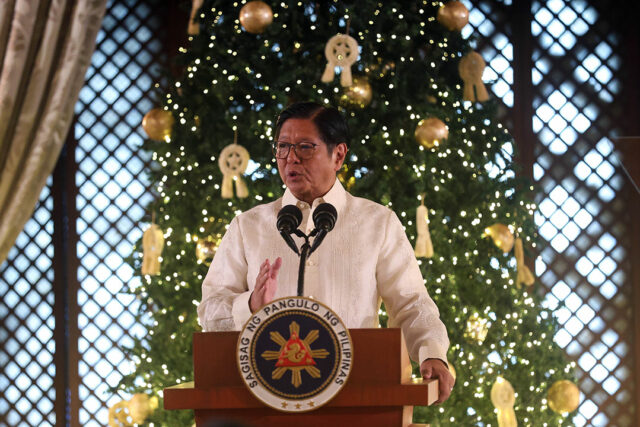
Help those in need, Marcos says

DEVOTEES flocked at the Minor Basilica and National Shrine of Jesus Nazareno in Quiapo, Manila on Thursday to attend the Holy Mass in celebration of Christmas Day. — PHILIPPINE STAR/RYAN BALDEMOR

PRESIDENT Ferdinand R. Marcos, Jr. urged Filipinos on Thursday to turn the spirit of Christmas into acts of compassion and generosity, calling on the public to be “a source of light and goodness” for others amid continued economic and social challenges.

In a Christmas message, Mr. Marcos said the season should go beyond festive gatherings and serve as a reminder to extend help to those most in need, including the poor, the sick, disaster-hit communities and other marginalized groups.

“As we enjoy our gatherings, let us also remember those who are in most need of our compassion and generosity — the poor, sick, calamity-stricken, and marginalized,” he said.

“Like Jesus, who brought salvation to the world, let us share our abundance with the people around us,” he added, calling for special focus on the children.

The President described Christmas as a uniquely Filipino tradition marked by joy, reflection and gratitude, saying it offers time to appreciate life’s blessings and strengthen ties with family and loved ones.

He encouraged citizens to carry the values of kindness and goodwill beyond the holidays.

“It is my fervent hope that the deepest desires of our hearts be fulfilled and that love and goodwill continue to guide our families and communities.” — Chloe Mari A. Hufana

CPP begins holiday ceasefire

THE Communist Party of the Philippines (CPP) said its unilateral holiday ceasefire began on Wednesday, a declaration that put Maoist rebels on the defensive amid clashes with government forces in the countryside.

While units of the CPP’s New People’s Army (NPA) will refrain from launching offensive operations, the Philippine Army said it will continue pursuing the Maoist rebels, describing them as a weak and depleted force.

“They are not a force to reckon with, they are just bandits,” Army spokesman Col. Louie Dema-ala told reporters in a Viber message.

The NPA, which is waging one of the world’s longest‑running insurgencies, has significantly weakened since its peak in the 1980s. Armed communist fighters have dwindled to about 780 from about 25,000 at the height of the rebellion, according to government data released earlier this month.

In a statement last week, The CPP said it would cease hostilities from Dec. 25 to 26 and again from Dec. 31 to Jan. 1 to mark the Christmas and New Year holidays, as well as the group’s anniversary celebrations.

The Defense department had dismissed the announcement as a “sad propaganda stunt,” saying the armed forces would continue its security operations throughout the holidays.

The CPP said on Wednesday the NPA must remain prepared to defend itself should the military launch attacks.

“This clearly demonstrates Marcos’ bloodlust and his intent to disrupt the Filipino people’s traditional holiday celebrations,” CPP Chief Information Officer Marco L. Valbuena said. “He has nothing to offer the people during this season but bullets and bombs.”

Palace Press Officer Clarissa A. Castro did not immediately reply to a Viber message seeking comment. — Kenneth Christiane L. Basilio

UN, BARMM assist Moro entrepreneurs

COTABATO CITY — An agency of the United Nations (UN) and the Bangsamoro government provided on Tuesday, eight groups of neophyte Moro entrepreneurs producing preserved native delicacies a P50,000 grant each as additional capital input to boost their productivity.

Bangsamoro Labor and Employment Minister Muslimin G. Sema said on Thursday that many of the entrepreneurs in the eight groups, based in barangays in Datu Odin Sinsuat and Talitay in Maguindanao del Norte and in Guindulungan, Shariff Saydona Mustapha and South Upi, all in Maguindanao del Sur, belong to families identified with the Moro Islamic Liberation Front and the Moro National Liberation Front (MNLF) that have separate peace pacts with the government.

This was facilitated through the Bangsamoro Rural Employment through Entrepreneurial Development (BREED) Program of the Ministry of Labor and Employment-Bangsamoro Autonomous Region in Muslim Mindanao (MoLE-BARMM).

It was led by Mr. Sema, Director-General Surab A. Abutazil, Jr., and Abdulrakman S. Nor of MoLE-BARMM’s Bureau of Labor Relations and Standards, at their regional office in Cotabato City.

Mr. Sema told reporters on Thursday that they are thankful to the Food and Agriculture Organization of the UN, whose representative to MoLE-BARMM is Helen M. Flores, for its active involvement in the BREED Program.

Another entity under the UN, the International Labour Organization, is also MoLE-BARMM’s partner in addressing child labor and use of children as combatants by their clans that are locked in bloody “rido,” or feud in most southern vernaculars, triggered by affronts to family pride and honor, land disputes and political rivalries.

“To these two entities of the United Nations, we in the Bagsamoro Labor and Employment ministry are so grateful,” said Mr. Sema, who is chairman of the central committee of the MNLF. — John Felix M. Unson

ADVERTISEMENT
ADVERTISEMENT