Home Blog Page 5216

The problem with being authentic

One key change to our shopping experience has been the rise of mobile shopping apps. These apps offer unparalleled convenience and, at times, unbelievable savings. I recall one experience this year during the “7.7” flash sale where I was notified by my smartphone of drastically lowered prices for any and all kinds of products. Lo and behold, the golf club which I had been saving up for was available. Surprisingly, it only cost about a fifth of the selling price from a brick and mortar authorized retailer. To my disappointment, however, the golf club broke after only my second round of using it.

This incident made me realize that we should be cautious of the products we buy online and remain steadfast against counterfeit items. At the very least, we should check the comments and reviews section of the merchant’s page to get feedback on the merchant and the quality of the products it is selling.

In a similar vein, our tax authorities have enforced strict measures to ensure that documents submitted by taxpayers are authentic, especially when the documents are executed overseas.

To cite an example, Revenue Memorandum Order (RMO) No. 46-2020 was issued by the Bureau of Internal Revenue (BIR) to promulgate guidelines and procedures for the availment of the 15% rate on dividends paid by a domestic corporation to a non-resident foreign corporation (NRFC), otherwise known as the Tax Sparing Rule. In the RMO, the BIR requires certain documents to be authenticated or apostilled in order to prove an NRFC’s entitlement to the lower rate.

TAX SPARING RULE PROCEDURES UNDER RMO NO. 46-2020
Under Section 28(B)(5)(b) of the Tax Code or the Tax Sparing Rule, the final withholding tax (FWT) on Philippine-sourced dividends received by an NRFC can be reduced from 25% to 15%. To avail of the tax sparing rate, the NRFC-applicant must prove that the foreign tax jurisdiction of the NRFC either: a) allows a credit against the tax due from the NRFC the taxes deemed to have been paid in the Philippines of at least to 10%; or b) exempts the dividends from tax.

For this purpose, the RMO requires the NRFC-applicant to submit the following documents:

• A copy of the law of the country of domicile allowing a tax credit for taxes actually paid in the Philippines and for taxes deemed paid in the Philippines equivalent to at least 10% of the dividends; and

• A copy of any document issued by, or filed with, the foreign tax authority showing the amount of deemed paid tax credit actually granted by the foreign tax authority or a document confirming that the NRFC is exempt from income tax on dividends received from the Philippine corporation.

AUTHENTICATION REQUIREMENT
Based on the RMO, in order to be acceptable in the Philippines, all documents executed in a foreign country must either be authenticated by the Philippine Embassy stationed there, or apostilled if the foreign country is a signatory to the Convention Abolishing the Requirement of Legalization for Foreign Public Documents (HCCH 1961 otherwise known as the Apostille Convention).

The reason for the authentication requirement, as cited by the BIR, is that existence of a foreign law is a question of fact and Philippine courts do not take judicial notice of foreign laws. Thus, citing Section 24 and 25 of Rule 132 of the Revised Rules on Evidence, the BIR requires that a foreign law be established by a certification and authenticated copy thereof. In case the country of Domicile of the NRFC is a member of the Apostille Convention, a foreign law can also be established by submitting an apostilled copy thereof in lieu of the required certification and authentication.

In practice, if the copy of the foreign law and other required documents executed abroad are not apostilled or authenticated and certified, the BIR will not accept the taxpayer’s Tax Sparing application.

While the intention is to guard against spurious and outdated versions of the foreign tax law, the strict authentication requirement has become a burden for NRFCs intending to avail of lower tax rates on their Philippine sourced income. Not only does the authentication process entail additional costs for the NRFC-applicant, it normally takes a long time to apostille or authenticate a document, taking as long as a month in certain jurisdictions.

Foregoing considered, I think that the BIR could revisit these strict requirements. The BIR is an administrative agency tasked to enforce the National Internal Revenue Code of the Philippines. Thus, it need not adhere strictly to the requirements of the Rules of Court with regard to administrative matters. In administrative proceedings, case law provides that the technical rules of procedure and evidence are not to be strictly applied. The quantum of evidence in administrative proceedings is substantial evidence, which refers to more than a mere scintilla, but such quantum of relevant evidence which a reasonable mind might accept as adequate to justify a conclusion.

Thus, in lieu of the strict authentication or apostille requirements to prove the foreign tax law, the BIR may consider accepting documents from other verifiable sources. In fact, in one BIR Ruling confirming the application of the Tax Sparing rule issued prior to RMO No. 46-2020, a full text copy of the foreign jurisdiction’s tax law from a reliable source (i.e., website of a reputable audit firm located in the NRFC’s country) was accepted by the BIR. If the copy of the foreign tax law is from a reputable source (such as a copy of the tax law from the government’s official website), I think that the BIR could dispense with the requirement of authenticating or apostilling the copy of the foreign law since the BIR can readily verify the authenticity of its contents.

To conclude, I fully agree that the BIR should remain vigilant when evaluating documents, just as online buyers should be careful with potential counterfeit purchases made over an online platform. Nevertheless, RMO No. 46-2020 was issued to simplify the manner of confirming entitlement to reduced tax rates in view of the implementation of the Ease of Doing Business and Efficient Government Service Delivery Act of 2018. Perhaps, the BIR should exercise some flexibility with its requirements to better achieve the government’s overarching intention.

The views or opinions expressed in this article are solely those of the author and do not necessarily represent those of Isla Lipana & Co. The content is for general information purposes only, and should not be used as a substitute for specific advice.


Jose Luis M. Yupangco is a senior associate at the Tax Services department of Isla Lipana & Co., the Philippine member firm of the PwC network.

+63 (2)8845-2728
jose.luis.yupangco@pwc.com

Marcos vows support as he asks scientists to ‘stay in the country’

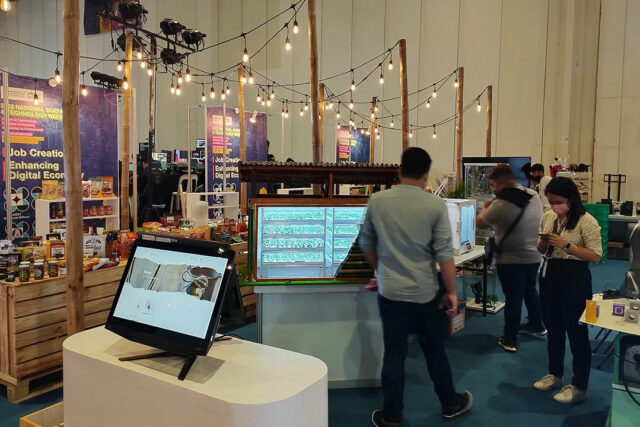
INNOVATIVE products and services developed by Filipino scientists, researchers, and engineers are on display at the World Trade Center in Pasay City for the 2022 National Science and Technology Week celebration. — DOST

By Kyle Aristophere T. Atienza, Reporter

PRESIDENT Ferdinand R. Marcos, Jr. on Wednesday asked Filipino scientists and researchers to stay in the country, vowing to support their careers and the sector.

At the same time, the President urged them to partner with the government as it seeks to build a sustainable future.

“I encourage our Filipino scientists, researchers, inventors, and innovators to continue sharing your expertise especially to young people,” Mr. Marcos said in a speech at the celebration of the National Science and Technology Week.

“I urge you to stay in the country as you pursue your career. We will continue to support you and continue to look to you to be active partners of the government,” he added.

Mr. Marcos said the country needs more local experts as it recovers from the pandemic and faces a “new economy.”

“It is a new world, these are new problems we are facing, and therefore we need to find new solutions and innovation is the key, innovation and agility.”

Mr. Marcos underscored the important role of the scientific community in generating new knowledge and devising better strategies to safeguard and advance the well-being of Filipinos.

“I also urge the DoST and all other concerned agencies to allocate resources to institutions that carry out research and development and integrate these in government programs,” he said.

“What Dr. Solidum and I discovered is that there are many research institutions that are doing really remarkable food research, however the problem that we are finding is that research is not directed,” he said, referring to Science and Technology Secretary Renato U. Solidum, Jr.

“Everyone has their own program, has their own projects. It’s not their fault. They’re studying what they are interested in,” Mr. Marcos added.

He said it is the government’s job to “give direction” so that research outputs can be immediately used by farmers, micro, small and medium-sized enterprises, other businesses, and citizens.

“I’ve spoken to some of the researchers and some of those administering research institutes around the country, not only agriculture but all kinds of other R&D (research and development), and they’re willing to take direction from us, from the private sector as to what are the necessary technologies for the Philippines,” he said.

The President said the government will “wholeheartedly” support their R&D initiatives.

STEM SCHOLARSHIPS
Mr. Marcos also challenged the Department of Science and Technology (DoST) and their partner institutions to continue “to provide more scholarships to Filipino students to develop a bigger pool of scientists, researchers, and  innovators in the country.”

He said he will institute a scholarship program specifically for Science, Technology, Engineering, and Math (STEM) students and “this will not be limited to those who have shown their capabilities, their ability, and how they deserve these scholarships here in the Philippines but to any institution that they are accepted to abroad.”

He also called for improvements in the country’s STEM program, noting that  the Philippines lags behind its Southeast Asian peers in these fields.

“The material I can see is available. It is just a question of us incorporating it into our curricula, it is just up to us to give it an emphasis because in every aspect the STEM subjects have become terribly, terribly important,” he added.

AGHAM, a group of local scientists, earlier said government support for STEM remains low and called for a long-term plan to boost the scientific community.

“The present government should acknowledge that we are suffering from brain drain due to the absence of a national program for the development of the country’s science and technology that could provide opportunities locally for our experts,” AGHAM said last month.

“This is critical as climate change is one of the important things that need to be addressed using science-based action.”

AGHAM said the budgetary allocation for research and development does not meet the recommended UNESCO threshold of 1% of gross domestic product.

Under the proposed 2023 national budget, the DoST will receive P24.06 billion, slightly lower than its allocation of P24.27 billion this year.

Mr. Solidum told the House of Representatives in September that the DoST originally proposed a P44.17-billion budget.

Half or P12.14 billion of the proposed budget for the DoST will be allocated to scientific and technical services, while 25.32% or P6.09 billion will be earmarked for the office of the secretary and regional offices.

Police in drug war case convicted of torture, planting evidence 

PHILIPPINE STAR/EDD GUMBAN
THE JUSTICE department filed charges in 2018 against two cops involved in the murder of two teens during an anti-drug operation. — PHILIPPINE STAR/ EDD GUMBAN

By John Victor D. Ordoñez, Reporter

A REGIONAL trial court has convicted a police officer of torture and planting of evidence in the killings of two teenagers during the previous administration’s anti-illegal drug campaign.

In a decision made public on Wednesday, the Caloocan City Regional Trial Court Branch 122 sentenced the law enforcer to reclusion perpetua or up to 40 years in prison for torturing the teens and planting a .38 caliber firearm ammunition, packets of marijuana leaves and crystal meth at the crime scene.

“After a careful scrutiny of the records and evaluation of the pieces of evidence presented by the prosecution, the Court is convinced that the prosecution was able to overcome its burden,” according to the ruling written by Presiding Judge Rodrigo F. Pascua, Jr.

The police officer was also ordered to pay the families of 19-year-old Carl Angelo M. Arnaiz and 14-year-old Reynaldo D. De Guzman for moral and exemplary damages totaling P2 million each.

In 2018, the Justice department filed charges before the court against two policemen involved in the murder of the two teens.

The court noted the other cop died of hepatitis in 2019 while in detention.

The Public Attorney’s Office forensic laboratory service director had testified before the court that Mr. Arnaiz sustained swelling, contusions and abrasions in his face due to blunt force, while Mr. De Guzman had stab wounds and abrasions on various body parts.

“The court holds that the foregoing narrations lead to a reasonable hypothesis that the evidence of physical torture sustained by the victims, were perpetrated by no other persons than the accused in this case,” the trial court said.

It added that the two police officers had the motive to plant the ammunition on Mr. Arnaiz to support their story of a shootout after Mr. Arnaiz supposedly robbed a taxi driver.

Another witness testified that the 19-year-old was handcuffed before being shot by the policemen.

Separate murder charges for the teenagers’ deaths are still pending before another trial court in Navotas City.

At least 25 police officers have been charged with murder in connection with ex-President Rodrigo R. Duterte’s deadly drug war, Justice Secretary Jesus Crispin C. Remulla told the United Nations Human Rights Council this month.

An inter-agency task force on extralegal killings had investigated at least 17,000 cops, he added.

There were 221-drug-related killings from January to August this year, Human Rights Watch said in September, citing a joint study by the University of the Philippines and Belgium’s Ghent University.

National police chief Rodolfo S. Azurin, Jr. told a press briefing last week that law enforcers had killed 46 suspects during illegal drug operations five months into President Ferdinand R. Marcos’ term.

Marcos meets with Vietnam’s legislative chair

OFFICE OF THE PRESS SECRETARY

PHILIPPINE President Ferdinand R. Marcos, Jr. met on Wednesday with Vietnam National Assembly Chairman Vuong Dinh Hue in Malacañang, where they reaffirmed the two countries’ commitment to enhance ties.

“[Mr. Marcos] got an added boost of commitment from Vietnam in a wide range of areas that include food security, climate change, defense and food supply,” the Office of the Press Secretary (OPS) said in a news release, but did not provide more details.   

The OPS said Mr. Vuong told Mr. Marcos that Vietnam will help the Philippines in elevating its role and position in the global stage.

“I am looking forward to building upon excellent relationships between our two countries… and also in helping elevate the role and position of the Philippines on the global stage,” Vietnam’s top legislator told Mr. Marcos.

The Vietnamese official said he was “much impressed” about the commitments made by the Philippines during the Association of Southeast Asian Nations (ASEAN) Inter-Parliamentary Assembly for expressing the “concerted efforts and coordination to address climate change and to work together on transitioning towards clean energy.”

Mr. Marcos was represented by House Speaker Martin G. Romualdez during the event.

Mr. Vuong, meanwhile, expressed hope to “enhance the partnership” between the two countries’ legislatures.

“We are hopeful that we can do more to enhance the relationships between our political parties and government-to-government and parliament-to-parliament relationships, and most importantly, the people-to-people exchanges,” he added.

Mr. Marcos said he was “a little surprised that 16, 18 years have transpired since the exchange of visits between our two legislatures — that is much too long for such close neighbors.”

The Philippine leader said he’s “very optimistic that the Asia-Pacific region will return to its old position as the driving force behind the global economy.” — Kyle Aristophere T. Atienza

Cybercrime posts to be set up in PHL airports 

REUTERS

THE BUREAU of Immigration (BI) and the Cybercrime Investigation and Coordinating Center (CICC) will establish posts that will cater to cases of cybercrime and online fraud in the countrys major airports.  

In a statement on Wednesday, Immigration Commissioner Norman G. Tansingco said the cybercrime hubs will assist both locals and foreigners who have been victims of online fraud.   

The two agencies inked the agreement on Nov. 15 at the BI office in Manila.  

The CICC under the Department of Information and Communications Technology (DICT) serves as the lead agency in addressing cybercrimes.  

The agency earlier said the pandemic aggravated the issue of online child exploitation, specifically with minors from low-income families.  

In August, the Department of Justice (DoJ), Department of Interior and Local Government, Department of Social Welfare and Development, and the DICT formed a task force to combat the online exploitation of children.  

The DoJ and Bankers Association of the Philippines (BAP) also launched an anti-cybercrime partnership in February to train workers on cyber-security amid increasing cases of online fraud.  

The Philippines placed third worldwide in ransomware payments last year, with local organizations spending an average of P1.6 million, according to cybersecurity firm Sophos.  

BAP has said unauthorized withdrawals and transfers reached more than P1 billion last year due to an uptick of cybercrime incidents amid a coronavirus pandemic.  

“This invaluable partnership between government agencies is a major step towards eliminating cybercrime in the country,Mr. Tansingco said. John Victor D. Ordoñez 

Tourist arrivals in Asia-Pacific still below pre-pandemic levels — UNWTO

PHILIPPINE STAR/KRIZ JOHN ROSALES

TOURIST arrivals in the Asia-Pacific region during the first nine months of the year were still below pre-pandemic levels despite the opening of many destinations, according to the United Nations World Tourism Organization (UNWTO).   

The UNWTOs latest World Tourism Barometer issued on Wednesday showed that international visitors in the region increased for the January to September period but was still 83% below the numbers three years ago.  

In Asia and the Pacific (+230%) arrivals more than tripled in the first nine months of 2022, reflecting the opening of many destinations, though remained 83% below 2019 levels,the UNWTO said.    

The UN agency said international tourism is expected to reach 65% of pre-pandemic levels by yearend following the surge in the first three quarters.  

“An estimated 700 million tourists traveled internationally between January and September, more than double (+133%) the number recorded in the same period of 2021. This equates to 63% of 2019 levels and puts the sector on course to reach 65% of its pre-pandemic levels this year,the UNWTO said.    

Results were boosted by strong pent-up demand, improved confidence levels and the lifting of restrictions in an increasing number of destinations,it added.    

The Philippine Tourism department recently announced that its 1.7 million tourist arrivals projection for 2022 has been surpassed with 2.025 million visitors recorded as of Nov. 14. Revin Mikhael D. Ochave

JICA donates P80-M vaccine storage equipment to PHL

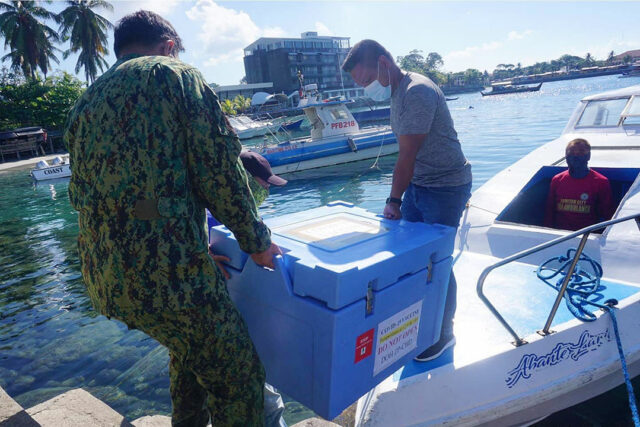
VACCINES against COVID-19 are delivered by boat to the island province of Basilan in southern Philippines in this March 15, 2021 photo. — BANGSAMORO GOV’T

THE JAPAN International Cooperation Agency (JICA) on Wednesday announced that it officially turned over P80 million worth of cold chain and logistics equipment to help deploy COVID-19 vaccines across the Philippines.  

This includes two units of service vehicles, two units of refrigerated vans, and 600 units of biothermal packaging, which are reusable iceless containers for the storage of vaccines.  

JICA said in a press release that this initiative will help the Philippines achieve its vaccination targets to underserved priority groups, particularly in hard-to-reach communities, and restart new normal lives and economic activities.  

The agency is also planning to provide P275 million worth of other cold chain equipment under a grant aid project.   

JICA previously donated around P80 million worth of medical equipment and supplies to various hospitals and medical centers in the country.  

It also provided training on telemedicine to Filipino doctors and frontliners to increase hospitalscapacity of giving intensive care services.   

It is also looking into initiatives to strengthen the countrys capacity for infectious disease control. Luisa Maria Jacinta C. Jocson

NKTI emergency room hits full capacity

EN.WIKIPEDIA.ORG

THE STATE-OWNED National Kidney and Transplant Institute (NKTI) on Wednesday urged patients to go to other hospitals as its emergency rooms and services have reached full capacity.  

In a Facebook post, the NKTI said its emergency room was overwhelmed and had reached three times its capacity, with majority of patients needing dialysis and those with leptospirosis and COVID-19.  

(T)here are no more vacant rooms in the wards,the NKTI said in an advisory signed by Executive Director Rose Marie O. Rosete-Liquete.  

In addition to this is the lack of nurses in NKTI, which is among the biggest problems facing the DoH (Department of Health) nationwide,it added.   

The NKTI, a government-owned and controlled corporation attached to the DoH, is a specialty center for renal health. It is located in Quezon City. Kyle Aristophere T. Atienza 

Davao coastal road opening moved anew to Q2 next year

DPWH

AN initial 7.6-kilometer segment of the Davao Coastal Road project is targeted for opening to motorists by the second quarter (Q2) next year, according to a Department of Public Works and Highways-Davao region official, after several postponements in the past three years.    

We intend to finish in the second quarter of next year and once completed we can open the first segment of the coastal road at Bago Aplaya to Times Beach,Dean I. Ortiz, spokesperson of the departments regional office, told the city council on Tuesday.   

Parts of the road project, with an estimated cost of over P30 billion, was opened to the public earlier this year for recreational and sports activities.  

Construction of the 18-kilometer coastal road started in 2017, and has faced delays due to the coronavirus pandemic and right-of-way acquisition.   

It stretches from the Toril district in the southwestern part of Davao City to the downtown area.   

Mr. Ortiz also reported to the council that construction of the Bucana Bridge component of the road project is already scheduled to start by next year.    

The P3.11-billion bridge will be funded through a China government grant, with the agreement signed by the Chinese Embassy in Manila and DPWH in December 2020.  

The coastal road is intended to provide an alternative route to the Pan-Philippine Highway in the southern part of the city, which has been experiencing heavy traffic congestion. It will also serve as a costal shore protection and breakwater. Maya M. Padillo

Twitter isn’t helping your career

NATANAELGINTING-FREEPIK

TWITTER’s rapid descent into corporate chaos has prompted a wave of nostalgic posts and witty laments from users who fear these are the app’s final days. Without a doubt, Twitter has had a unique role shaping the cultural zeitgeist, and for better or worse it has had a disproportionate influence on how some people — journalists in particular — do their jobs. It can be very funny or rather horrifying, but it often has felt essential. What if it goes away?

In an era when all workers are supposed to sustain a personal brand that in theory will insulate us from job losses and other workplace misfortunes, something important could be lost if the site disappears or becomes a junkyard of spambots and trolls. And yet I also wonder what we might gain from its demise.

One of the great things about Twitter is how flexible and customizable it is. In my line of work, I’ve used Twitter to find new voices; to track academic research; to keep in touch with professional contacts and make new ones; to promote pieces I’ve written or edited; to share job descriptions for roles I think are interesting. I’ve had great professional opportunities slide into my DMs. When I’m about to interview someone, I like to first scan their tweets. One especially gratifying aspect of Twitter has been following people different from me as a way to expand my perspective. And when a truly big news event hits, the endless scroll is addictive.

And yet for all that apparent professional utility, when I was on maternity leave I barely signed into Twitter for a full six months. Somewhat to my surprise, I didn’t miss it. I didn’t miss the reply-guys or the flame wars or the snark. And it’s not like I was too busy to be on social media; in fact, my phone was barely out of my hand. The best tweets found their way onto my new platform of choice, Instagram, as screenshots. I read newspapers and magazines rather than hopscotching from one random link to another.

It turned out that although it felt like Twitter added a lot to my professional life, it had also taken things away. Despite my careful attempts to curate an interesting feed, I wound up with an echo chamber that gave me the mere illusion of knowing what people were thinking. I realized it had been years since it had meaningfully expanded my professional network, perhaps because the site had grown shoutier, whether as a result of changes to the algorithm or changes in people’s attitudes.

Then there is the opportunity cost. It’s painstaking work to build a following — it takes hours of tweeting, replying, and tweeting again. You have to be provocative or no one will want to engage with you, but you can’t be so provocative that no one will hire you. Perhaps all those hours and effort would be better devoted to the core work of one’s paid job, whatever it is — or to building up a different, more durable way of connecting with people.

Because after all, what is the value of a tweet? In theory having a Twitter presence can make you a thought leader who presumably becomes more employable. Yet only the very largest accounts gain the kind of following that translates into something clearly monetizable such as a book or a podcast. And even then, if Twitter goes under, you can’t take your 100,000 followers with you. (Twitter’s struggles have strengthened calls to create a measure of portability for users’ information and allow users to communicate across platforms.)

If the promise of Twitter for professionals has always been nebulous, its risks are only too obvious. At any given moment, we’re all just one bad tweet away from being fired or publicly embarrassed. I’ve lost count of the number of professionals whose attempts at sarcasm or humor were met by stone-faced human resources representatives and a quick walk to the door. I remember a few years ago a former boss asking why I’d “liked” a certain tweet. I ended up apologizing for my over-eager thumb.

Frequently, people I respect have tweeted things that make me think less of their judgment. Trolling is rife, not only between accounts of dubious verifiability, but between professional people who, if they had met in a real-world setting, undoubtedly would have been able to disagree more courteously. (Just take a look, if you have the stomach, at some of the flame wars that have erupted between experts who disagree over COVID school closures or the value of homemade cloth masks.)

After my six-month Twitter break, I realized that the app had become a professional obligation rather than an entertaining hobby — that if I didn’t feel I had to be there, tweeting, I would open it no more than I do Facebook or LinkedIn (that is, rarely).

Social media companies are still a relatively new phenomenon. Maybe it’s just not in their nature to stay dominant for very long. Friendster and Google Wave are gone; MySpace limps along; Instagram (owned by Facebook parent Meta) is now threatened by TikTok. Elon Musk seems to be running Twitter into the ground, but the company wasn’t in fantastic shape when he took over.

As I began enjoying Twitter less, I started spending more time reading books. One book I read this year with the time I used to spend scrolling is No One Is Talking About This, a novel whose protagonist spends a massive amount of time using a Twitter-like app she calls “the portal.” The author, Patricia Lockwood, is sometimes called the poet laureate of Twitter. One passage has stuck in my mind:

“The people who lived in the portal were often compared to those legendary experiment rats who kept hitting a button over and over to get a pellet. But at least the rats were getting a pellet, or the hope of a pellet, or the memory of a pellet. When we hit the button, all we were getting was to be more of a rat.”

Things on the internet come and go. I still miss Google Reader. If Twitter goes away, there are aspects of it I will miss. But I won’t miss feeling like a rat.

BLOOMBERG OPINION

Bilateral digital partnerships

RAWPIXEL.COM-FREEPIK

Southeast Asia’s internet economy is expected to be worth $330 billion by 2025, Reuters reported recently, slightly down from a previous forecast of $363 billion after considering prevailing economic uncertainties as well as pressure on tech companies to make a profit. Reuters cited a yearly report by Alphabet’s Google, Singapore state investor Temasek Holdings, and global business consultants Bain & Company.

“Amidst global macroeconomic headwinds, reduced disposable income, sky-rocketing prices, and lower product availability, there is tapering of demand from Southeast Asia consumers,” the trio said in a joint release reported by Reuters. The report covers Indonesia, Thailand, Vietnam, Singapore, Malaysia, and the Philippines.

But, Reuters said, the report remains “upbeat on this year and sees the internet economy growing 20% to $200 billion, three years earlier than anticipated in an inaugural report in 2016.” It also noted that all six countries covered by the report “are expected to post double-digit growth between now and 2025, with Vietnam having the fastest growing digital economy this year at 28%.”

The Google-Temasek-Bain report also noted that “the digital financial services sector is expected to overtake e-commerce to become the region’s top investment sector, with payments taking up the majority share of the deals. In the first half of 2022, the sector saw a record funding of around $4 billion.” Vietnam, Indonesia, and the Philippines were also “likely to attract more investors in the longer-term.”

In their 2021 report, Google-Temasek-Bain noted that e-commerce, travel, media, transport, and food were driving the region’s digital growth. Their report also noted that online spending rose 49% year on year in 2021 to $174 billion, as Southeast Asia was said to have added 60 million new internet users since the start of the pandemic in early 2020. New users came mostly from Thailand and the Philippines.

“Continued shifts in consumer and merchant behavior, matched with strong investor confidence, have ushered Southeast Asia to its ‘digital decade’ — and the region is on its way towards $1-trillion GMV [Gross Merchandise Volume] by 2030,” Google-Temasek-Bain said in the 2021 report.

Singapore is one country that has never failed to seize opportunities. And in light of how the world economy is transitioning and how the digital economy is growing, I am not surprised that Singapore has also moved ahead of others in signing bilateral digital partnership agreements. It is on its fourth now, with Korea, having signed similar deals previously with Chile, New Zealand, Australia, and the United Kingdom. Maybe the Philippines should follow Singapore’s lead.

Just this week, Singapore signed a Digital Partnership Agreement with the Republic of Korea, paving the way for greater cooperation between the two countries in creating a seamless digital economy environment that benefits businesses and consumers through enhanced trading and payment platforms, among others.

The Straits Times reported the agreement will facilitate “smoother digital activities between both sides in areas such as e-payments and paperless trading,” with both countries working “to align their digital rules and standards to promote interoperability between systems.” The Times quoted Singapore’s Trade and Industry Ministry as saying the agreement “will enable more seamless cross-border data flows and build a trusted and secure digital environment for businesses and consumers.”

The agreement, said the Ministry, will “deepen bilateral cooperation in emerging areas, including personal data protection, e-payments, artificial intelligence and source code protection,” and will be the “basis for strengthening our close relationship and shaping, together, the rules of digital trade in the Asia-Pacific region.”

Both countries are said to be looking into accepting electronic versions of trade administration documents, and using data exchange systems for such paperwork; encouraging small- and medium-sized enterprises’ participation in platforms that connect them with overseas suppliers, buyers, and potential business partners; greater cooperation in artificial intelligence; and, the electronic exchange of data between Customs administrations.

Singapore’s Tan See Long, Minister for Manpower and Second Minister for Trade and Industry, was quoted by the Times as saying that “the growth of our digital economy and trade will be boosted by the closer cross-border integration of our digital ecosystems.” And, given the way the global economy is now, digital integration is necessary for growth.

I recall that during a meeting in Singapore in 2004 with then Senior Minister Goh Chok Tong, he explained to us, his visitors, his plan to tour the Middle East. At the time, Minister Goh had just stepped down as Prime Minister and was preparing for trips to the Arab world to seek opportunities for Singapore businesses as well as to attract more Arab investments.

The initiative was two-pronged: to improve diplomatic relations, and thus perhaps mitigate the threat of Islamic terrorism in Singapore; and to invite Arab investors to Singapore. At the time, as an aftermath of 9-11 in 2001, Arab investors were seeking investment opportunities outside the Western world. And Singapore was among those presenting themselves as a suitable investment location.

And this is precisely what I mean by knowing when to strike. Islamic investments were not exactly welcome in the West soon after 9-11, and Singapore saw an opportunity. The same with the internet economy and going digital, with Singapore’s Temasek partnering with Google and Bain in monitoring developments since 2016. Access to such valuable information allowed it to move ahead of others on the digital front.

I am also curious to find out as well how Singapore intends to move with respect to digital taxation and tax administration. Government policies and regulations adjust to the changing times, to sustain revenue collection. It will be interesting to know how Singapore’s bilateral digital partnerships will actually impact business and the economy, and how this might lead to changes in their tax regime, particularly for global trade.

As experts from the International Monetary Fund (IMF) have noted in a previous report, “new global reforms will change where tech giants pay taxes in Asia, and make the international tax system more robust.”

“More than half of all services trade in Asia is digitally delivered, making it hard to collect value-added taxes when these services cross borders. Cross-border e-commerce sales of goods have also been exempted from value-added taxes when shipped internationally in small parcels. Resolving these challenges pays off,” noted Era Dabla-Norris, division chief in the IMF’s Asia-Pacific Department and mission chief for Vietnam; Ruud De Mooij, advisor in the IMF’s Fiscal Affairs Department; Andrew Hodge, economist in the IMF’s Western Hemisphere Department; and, Dinar Prihardini, an economist in the IMF’s Fiscal Affairs Department.

In a blog, the IMF experts noted that “requiring nonresident suppliers of digital services and e-commerce marketplaces to register with local tax authorities and remit value-added taxes on their sales could raise revenue between 0.04 and 0.11% of GDP in some countries in Asia.”

They added: “As Asian consumers and businesses increase their online activity in the coming years, tech giants will expand further into Asian countries, making taxation in a digitalizing economy even more important. Countries in Asia, in particular, can invest in ways to harness digitalization for tax administration, helping to reduce tax evasion, boost revenue mobilization, and make tax collection more efficient.”

Singapore’s bilateral digital partnership agreements are just the first of many to come. I am certain other countries, including the Philippines, will follow suit. And, as these agreements become the foundation for seamless digital trade among nations, major adjustments in policies and rules for trade facilitation, customs, and tax administration must occur.


Marvin Tort is a former managing editor of BusinessWorld, and a former chairman of the Philippine Press Council

matort@yahoo.com

Controversies hounding the World Cup in Qatar

VIARPRODESIGN-FREEPIK

The 2022 FIFA World Cup in Doha, Qatar, kicked off last Sunday. It started 12 years after the FIFA — Federation Internationale de Football Association — awarded the hosting rights to a tiny but rich Middle East country that has, in the words of football experts, “no soccer pedigree.” It however has the financial muscle to host a massive undertaking featuring the world’s top 32 soccer powers playing 64 matches over the next 30 days. More than a million visitors are expected to flock to Qatar, which has a population of about three million.

The controversy behind Qatar 2022 started the moment the hosting rights were awarded to the Gulf nation by football’s governing body. Other issues shared the spotlight, including the treatment of migrant workers in the country. These and Qatar’s policy on the transgender were all brought to light. No doubt these issues collided with the core of the country’s conservative culture, religious beliefs and practices. For years and up to a few weeks before the first match between Ecuador and Qatar was played, human rights groups and media continued to devote time and space to the issues with various nuances and what the FIFA was or was not doing about these topics.

In the meantime, some sponsors felt they had to speak out since it would affect the image of the brands that support the World Cup. Sponsors and broadcast rights holders and fans help ensure the viability of an event such as the FIFA World Cup.

In an article dated June 9, 2014, writer Seb Joseph reported that sponsors had “broken their silence over the Qatar World cup row.” Joseph claimed that sponsors have heaped pressure on FIFA to tackle corruption charges swirling around the 2022 Qatar World Cup bid. Exerting pressure on FIFA is due to the importance brands give to Corporate Social Responsibility (CSR) and management and avoidance of repetitional risks.

Despite the sponsors’ efforts to get FIFA to deal with the controversies emanating from the hosting by Qatar of the 2022 FIFA World Cup, at the end of the day, these same corporate sponsors generally avoid controversy. As pointed out by Arthur Sullivan in Business Qatar, when Tiger Woods, then the world’s biggest sports star, was engulfed in a sex scandal in 2009, Gillette, Gatorade, AT&T, Tag Heuer, and Accenture were among the brands which dropped the golfer. Most recently, Kanye “Ye” West — the rapper, record producer, and songwriter — lost a multimillion, multiyear endorsement contract with rubber shoe giant adidas for his anti-Semitic comments. Adidas, through owner Adolf Dassler, lost no time in canceling the deal with West. Dassler is from Bavaria, Germany which, during the brutal dictatorship of Dassler’s namesake, Adolf Hitler, attempted mass genocide of Jews.

The year following the Tiger Woods controversy, Qatar was awarded, in 2010, what Sullivan calls the world’s most lucrative sponsorship bonanzas, the FIFA World Cup. Sullivan adds that in the 12 years that (had) passed since that decision and the beginning of the tournament itself, Qatar 2022 has been the definition of controversy. Thousands of migrant workers have reportedly died in Qatar since 2010. Male homosexuality is outlawed while LGBT people on the whole face severe discrimination and various legal obstacles. Sullivan adds that all these matters don’t even get into the controversial manner in which Qatar was awarded the World Cup. It has been reported that since the infamous 2010 award, more than half of the 22 members of the FIFA Executive Committee which voted for Qatar had earlier been implicated in or investigated for alleged corruption or other bad practices.

Yet, when the tournament kicked off on Nov. 20, big brands like adidas, Coca-Cola, and even Budweiser Beer — the sale of which have been banned inside any of the eight stadiums in a big U-turn by Qatar from earlier agreements — and other globally prominent brands still decided to associate themselves with the Qatar soccer festival. It seems that Sony and Emirates are the only brands that decided to cut their ties with the 2022 FIFA World Cup. The only other brand that opted out is Gazprom, the Russian gas company which was in the 2018 FIFA World Cup in Russia but which has been heavily sanctioned because of the war in Ukraine.

Alongside adidas, Coca-Cola, Anheuser-Busch (Budweiser), other companies which decided to continue their relationship with Qatar 2020 are Hyundai-Kia and Qatar Airways. Other brands which are continuing their sponsorship probably have a pragmatic view of publicity, whether good or bad — VISA and the Wanda Group of China which prides itself with the following advocacies: “targeted poverty alleviation, charitable donation, environmental sustainability, caring staff, entrepreneurship.” The list of brands that continued their sponsorship includes McDonald’s and other global brands which were in Russia 2018. Both Emirates and Sony opted not to renew their commercial deals once they expired at the end of 2014.

Sullivan also points out that new sponsors have been added to the list of official sponsors. Among them are software company Globant and Indian tech education company Byju’s, among others. The main reason for the renewal of commitments by global brands despite the controversial Qatar 2022 is, as Kieran Maguire, sports finance expert at the University of Liverpool says, many companies are locked into long-term deals with FIFA and prefer to focus on that relationship rather than dwell on issues with the host nation.

“They signed a deal with FIFA, not with the Qatari government,” says Maguire.

The situation brings to mind the Russian annexation of Crimea in 2014 which did not become a high-profile issue tied to Russia 2018.

Brand exposure is just too tempting for sponsors to ignore. FIFA President Gianni Infantino from Italy says that about five billion people are expected to watch the month-long extravaganza, exceeding the four billion who watched FIFA Russia 2018. Five billion pairs of eyes to which one’s product is exposed, is nothing to sneeze at.

It is not surprising therefore that despite some of the alleged serious ethical and moral issues involved, very few companies have terminated their relationship with Qatar 2022, for the main reason that these companies are dealing with FIFA and not the host country. In fact, FIFA points out that very few of its 200 members “have issues of what’s taking place in Qatar.”

Other companies have, however, taken a slightly different position: ING, the giant Dutch multinational banking and financial services corporation, will downscale or water down its promotions of the Netherlands team.

Qatar 2022 brings to mind the LIV golf dispute which brings to front and center human rights and other issues against the main financial backer of LIV, the sovereign wealth fund of the Kingdom of Saudi Arabia.

Hereabouts, we have practically the same ethical issues with respect to support for sports and so-called sportsmen or athletes. Athletes or groups engulfed in integrity, moral and accountability issues are protected by business interests which have invested in these so-called winners and are willing to change and revise the narrative to bail out these same characters. Walls are built by politicians and PR groups, even to the point of changing the narrative or content in community-built, free, open, online encyclopedias.


Philip Ella Juico’s areas of interest include the protection and promotion of democracy, free markets, sustainable development, social responsibility and sports as a tool for social development. He obtained his doctorate in business at De La Salle University. Dr. Juico served as secretary of Agrarian Reform during the Corazon C. Aquino administration.