Home Blog Page 5213

Zara UK customers offered in-house swap, mend and donate service

UNSPLASH

MADRID — Zara said on Friday that it will launch an in-house service for British customers to sell, repair, or donate second-hand clothes, moving the Spanish brand into a growing part of the market.

The platform, to be launched on Nov. 3, will be available through Zara stores, its website, and a mobile app.

It is the first time Inditex, the fashion group that owns Zara, has offered a service to resell its products. The company said the initiative would contribute to the reduction of waste and the consumption of raw materials, without clarifying if it would expand the service to other markets.

The Zara Pre-Owned platform brings in-house the success of second-hand Zara clothing sales on other online platforms and among shoppers on social networks such as Instagram.

The resale space will be organized by product categories, with detailed information for each item including current images provided by the seller and original product information provided by Zara, the company said.

Zara is following other fast fashion brands such as its main competitor H&M in offering products for resale at a time when the global second-hand apparel market is growing.

The global second-hand clothing market is estimated at $71.2 billion in 2022, according to a Future Market Insights report published in September.

Future Market Insights expects the market to grow by 14.8% a year in the next decade as people embrace the environmental benefits of using second-hand clothes.

Zara already offers customers the option to donate its clothing to charities in several markets.

Zara customers in Britain will also have the option repair their garments from any season, either in-store or applying online.

Inditex has 100 stores in Britain, including 60 Zara shops. — Reuters

Rates of Treasury bills, bonds to go up

BW FILE PHOTO

RATES of government securities on offer this week may rise on expectations of further tightening by the central bank to support the weakening currency.

The Bureau of the Treasury (BTr) will auction off P15 billion in Treasury bills (T-bills) on Monday, made up of P5 billion each in 91-, 182-, and 364-day debt papers.

On Tuesday, the BTr will offer P35 billion in reissued 25-year Treasury bonds (T-bonds) with a remaining life of 12 years and 11 months.

A trader expects rates of T-bills and T-bonds on offer this week to continue rising after the Finance chief said the central bank may consider big hikes in their last two meetings for the year to help support the peso.

Finance Secretary Benjamin E. Diokno is a member of the Monetary Board, the Bangko Sentral ng Pilipinas’ (BSP) policy-setting body.

The trader said T-bill rates may climb by 25 basis points (bps) if awarded, while the average rate of the reissued 25-year bond could range between 7.75% and 8.125%.

Rizal Commercial Banking Corp. Chief Economist Michael L. Ricafort likewise said in a text message that Mr. Diokno’s signals could cause T-bill and T-bond yields to go up at this week’s auctions, tracking secondary market rates.

“With inflation and interest rates yet to peak, interest rates are still seen to rise, especially after the BSP hinted that more hikes are likely,” eManagement for Business and Marketing Services Managing Director Jonathan L. Ravelas added in a text message.

For his part, UnionBank of the Philippines, Inc. Chief Economist Ruben Carlo O. Asuncion said the reissued 25-year bonds to be auctioned off this week may fetch yields from 7.625% to 7.875% as investors anticipate further rate hikes here and abroad, which could cause the global economy to slow.

Mr. Diokno told Bloomberg last week that the government will act “aggressively” to prevent the peso from further weakening, which could include looking at a total of 100 bps worth of hikes at the BSP’s Nov. 17 and Dec. 15 meetings following 225 bps in cumulative increases since May.

If realized, this would bring the BSP’s policy rate to 5.25% — the highest since the central bank adopted the interest rate corridor framework in 2016.

Mr. Diokno also said the government plans to use its foreign exchange reserves to prevent the peso-dollar exchange rate from breaching P60 and bring it back to P55 by yearend, which is “where [they] want it to be.”

The country’s gross international reserves as of end-September stood at $93 billion, 4.5% lower than the $97.4 billion as of end-August.

On Friday, the local currency ended at P58.75 against the dollar. For the year so far, the peso has weakened by 15.2% or P7.75 from its P51 close on Dec. 31, 2021.

At the secondary market on Friday, the 91- 182- and 364-day T-bills were quoted at 3.5554%, 4.3793%, and 3.9236%, respectively, based on the PHP Bloomberg Valuation Service Reference Rates published on the Philippine Dealing System’s website.

Meanwhile, the 10-year bond, the tenor closest to the remaining life of the bonds to be auctioned off this week, fetched a yield of 7.3823%. 

Last week, the BTr rejected all bids for its offer of T-bills, even as total tenders reached P16.303 billion, higher than the P15 billion on the auction block.

Broken down, the Treasury refused all offers for the 91-day T-bill even as total tenders reached P7.6 billion, above the P5-billion plan. Had the Treasury made a full award, the three-month debt papers would have fetched an average rate of 4.82%, 250.2 bps higher than the 2.318% seen on Sept. 5, the last successful award of the tenor.

The BTr also turned down all 182-day securities even as demand reached P5.503 billion, higher than the programmed P5 billion. If the offer was fully awarded, the average rate of the six-month T-bill would have gone up by 126.8 bps to 5.226% from the 3.958% quoted for the last successful award on Sept. 26.

Lastly, the government did not award any 364-day debt papers as total bids came in at only P3.2 billion, below the P5-billion offer. Had the Treasury accepted these bids, the average yield on the one-year instrument would have jumped by 208 bps to 5.862% from the 3.782% fetched for the tenor when it was last awarded on Aug. 22.

Meanwhile, the reissued 25-year bonds to be offered on Tuesday were first issued on Sept. 30, 2010 at a coupon rate of 8%.

The BTr plans to raise P200 billion from the domestic market this month, or P60 billion through T-bills and P140 billion from T-bonds.

The government borrows from local and external sources to help plug a budget deficit capped at 7.6% of gross domestic product this year. — L.M.J.C. Jocson

Smart, PLDT to bundle MPIC’s mWell in offerings

PANGILINAN-led PLDT Inc. and Smart Communications, Inc. will be backing up the health technology platform of Metro Pacific Investments Corp. (MPIC) through their offerings.

“Now, Smart will be bundling mWell [too] because one of the priorities of our administration now, given the inputs from the Filipino population, is that their first concern is really health. PLDT and Smart are really mindful of that,” MPIC Chief Finance Officer and Chief Sustainability Officer June Cheryl A. Cabal-Revilla said on the sidelines of the mWell application’s launch.

The mWell health technology platform was developed by MPIC subsidiary Metro Pacific Health Tech Corp. Among its offerings are telemedicine, health and wellness programs, and e-commerce.

“We’re in discussions with Smart and they’re supposed to come up with something on the postpaid before the end of the year and then prepaid shortly after that,” Ms. Cabal-Revilla said.

She also mentioned that PLDT will introduce telephone consultations that will allow subscribers to consult with a doctor through PLDT landlines.

“The PLDT offer is not just going to be a special plan for the doctors. They will also put the health feature and function in their subscription or in their offering,” she said, adding that the thrust of PLDT Home is “what is important to the family.”

mWell’s doctors, through the application’s partnership with PLDT, will be provided a special internet package of P1,499 a month at 1,000 megabits per second speed.

On Friday, MPIC held the first press event of its integrated health application after its first digital launch in July 2021.

Ms. Cabal-Revilla said that the application will be available globally even to migrant workers or overseas Filipino workers.

According to MPIC Chairman Manuel V. Pangilinan, mWell is part of the group’s overall strategy for completing the health ecosystem for Filipinos. He said there is still more room to improve the app.

“There’s a lot more work that needs to be done in terms of improving the app and propagating it to a greater number of Filipinos. Right now, we have more than 800,000 subscribers on the app and I think by year-end we’ll have at least a million subscribers,” Mr. Pangilinan told reporters on the sidelines of the event.

MPIC is one of three Philippine subsidiaries of First Pacific, the others being PLDT and Philex Mining Corp. Hastings Holdings, Inc., a unit of PLDT Beneficial Trust Fund subsidiary MediaQuest Holdings, Inc., maintains an interest in BusinessWorld through the Philippine Star Group. — Justine Irish DP. Tabile

Seaoil and Pamantasan ng Lungsod ng Pasig partner for ‘Angat Pangarap

Seaoil Chief Financial Officer and President for Retail Business Mark Yu and Pasig City Mayor Vico Sotto at the contract signing of ‘Angat Pangarap’ — PHOTO FROM SEAOIL

FILIPINO INDEPENDENT fuel company Seaoil has inked a partnership with the Pamantasan ng Lungsod ng Pasig (PLP) to spearhead its Angat Pangarap program. Through the initiative, Seaoil will provide PLP with P1 million that will be awarded as incentive to its students who will place first in the National Licensure Examinations in the following courses: Bachelor of Science in Accountancy, Bachelor of Science in Nursing, Bachelor of Science in Electronics Engineering, Bachelor of Elementary Education, and Bachelor of Secondary Education. The program is set to run for two years, and the unused portion will be earmarked for training and research programs for the faculty to strengthen the quality of education in the university.

Said Seaoil President for Retail Business and CFO Mark Yu, “Our students are the future of this society, hence we need to ensure they are driven to maximize the resources available to them and be accountable for their own learning. I hope this initiative will inspire many PLP students to not just top the licensure examinations, but to also give their best in everything that they do, whether in class or in their other endeavors.”

Remarked Pasig City Mayor Vico Sotto, “We were thinking of ways to encourage and inspire our students to do better in their studies. By collaborating with all stakeholders involved, led by Seaoil, we are now putting this to fruition. I hope the Angat Pangarap project will be an inspiration to our students — our future engineers, nurses, teachers, and accountants.”

Meanwhile, PLP Officer-in-Charge Dr. Reggie Maningas expressed, “The PLP community is grateful to Mr. Mark Yu and Seaoil Philippines for the Angat Pangarap project. We welcome this initiative with great excitement as it will engage parents and teachers alike in the academic lives of the students. This gives us renewed hope and commitment to improve the quality of tertiary education to our students.”

Limited-edition, suede-upholstered Subaru XV from Motor Image Pilipinas

Subaru XV 2.0i-S Leather-Suede Deluxe — PHOTO FROM MOTOR IMAGE PILIPINAS

DARK-BLUE-COLORED Subaru XVs will come with an exclusive seat cover for a limited time starting this October, and while supplies last. The XV 2.0i-S Leather-Suede Deluxe features designer seats which combine two premium interior materials — traditional leather and suede. Accentuating the textures and comfortable cushions of this variant is a colorway of gloss black, matte black and sleek silver, coordinated with the XV cabin’s signature orange stitching.

Through the Leather-Suede Deluxe, the XV 2.0i-S’s occupants can experience a fresh blend of luxury and sportiness while seated, “making the Subaru SUV even more enjoyable for everybody on board.” The XV comes equipped with Subaru’s core technologies — EyeSight Advanced Driver Assist System, boxer engine, Symmetrical All-Wheel Drive and the Subaru Global Platform. The XV is also available with special deals this October, with down payment as low as P269,000 or monthly payments as low as P20,710. For more information, visit www.subaru.asia/ph/en/vehicles/xv. Alternatively, customers may view the e-brochure of the Subaru XV at www.subaru.asia/ph/en/contact-us/brochure.php.

India rice export curbs to end a decade of price stability

REUTERS

MUMBAI/NEW DELHI — India’s recent curbs on rice exports could trigger a rally in global prices after more than a decade of stability, traders said, as New Delhi’s protectionist move coincides with falling output in other major producers and rising global demand.

Uneven monsoon rains hit rice planting in India, prompting the export restrictions in September, and floods have cut output in Pakistan even as consumption has grown in top importers such as Bangladesh and the Philippines. That’s why forecasters are saying global demand will outstrip production in 2022/23.

This is bad for Asian and African countries that use rice as a staple, some of which import as much as 60% of their supply.

Since India — the world’s biggest rice exporter — banned exports of broken rice and slapped a 20% export tax on some non-basmati varieties, global rice prices have jumped more than 10%. Last month, the Food and Agriculture Organization’s global rice price index rose 2.2% to hit an 18-month high.

“The international market has gone up and it will go up further,” said Nitin Gupta, vice-president for Olam India’s rice business.

Governments worldwide had already been struggling to tame food inflation because of COVID-19 disruptions to production and supply chains, and then Russia’s invasion of Ukraine removed millions of tons of foodstuffs from global markets, pushing inflation to a record earlier this year.

Still, before India implemented its export curbs a few months ago, industry and government officials in Asia were saying rice prices would hold steady due to ample stocks.

Rice, unlike wheat, was insulated from the Russia-Ukraine war as neither country is a big producer, and supplies of the grain had remained relatively steady during the COVID-related disruptions for other foodstuffs.

Now, however, top exporters Thailand and Vietnam sit on insufficient inventories to make up for India’s curb on exports and widespread output losses. Global rice inventories could fall to their lowest in at least five years in 2023, three global traders said, citing internal assessments.

“Since India cornered 40% of the global trade, it’s not easy for others to replace falling Indian shipments when demand is rising from leading importers,” Mr. Gupta said.

The US Agriculture Department (USDA) has cut its global rice production estimate for 2022/23 to 508 million tons, the lowest in four years. Just a month ago, the agency was expecting output for the year at 512 million tons.

Some top global trading houses, though, expect a sharper fall to around 500 million tons because of the extreme weather conditions that threaten crop yields in countries such as China, India, Bangladesh and Pakistan.

In India, dry weather conditions delayed the sowing of rice, with many farmers not planting the crop at all, and then torrential rains damaged ripening paddy fields, raising concerns about food inflation.

India’s summer-sown rice output is likely to fall to 105 million tons in 2022/23, down 6%, the farm ministry said in September, and private traders estimate it could fall as low as 100 million tons.

Rice output in China, biggest consumer of the grain, could drop 2.9% from a year ago to 206 million tons due to higher temperatures and drought in some rice-growing regions, according Shanghai JC Intelligence Co. Ltd., a consultancy.

This is a big change from last year, when India’s record 21.2 million tons of rice exports — 30% cheaper than rival suppliers — helped cap global prices while other food commodities soared due to supply disruptions.

After the September curb, India’s rice exports are set to fall by around a quarter this year.

Almost all top producers are beset with lower rice output, and global demand will likely outstrip supply, said B.V. Krishna Rao, president of India’s Rice Exporters Association.

India’s export restrictions have helped rival suppliers Vietnam, Thailand and Myanmar increase their sales, but they have limited surplus stocks for exports, Mr. Rao said.

Vietnam’s unmilled rice output is forecast to hold flat to last year’s 43 million tons, according to government data.

Neighboring Thailand is aiming to export 7.5 million tons this year, up about 7% from its previous target of 7 million tons, said Anucha Burapachaisri, a government spokesman.

Together the two can add no more than an extra 2 million tons of rice to fill the void left by India, traders said.

Meanwhile, Pakistan cannot capitalize on India’s export curbs after severe flooding ravaged its crop. Its rice output could fall 18% to 7.4 million tons, according to the USDA.

Other Asian producers such as China, Bangladesh and the Philippines were, like India, hit by unfavorable weather conditions, including drought, flooding, typhoons and cyclones.

“The exceptional confluence of events in Asia will badly hit consumers in many parts of the world and many poor consumers will have to either buy far more expensive, superior grades or go without rice,” said Himanshu Agarwal, executive director at Satyam Balajee, India’s biggest rice exporter.

“The choice will be difficult.” — Reuters

Ralph Lauren accused of plagiarizing indigenous Mexican designs

INSTAGRAM.COM/BEATRIZGUTIERREZMULLER

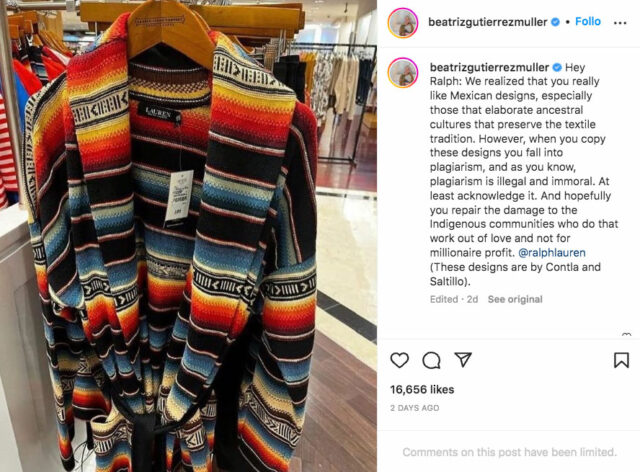
MEXICO CITY — The wife of Mexico’s president on Thursday accused luxury American clothes brand Ralph Lauren of plagiarizing indigenous designs, which she described as an appropriation of the work of the country’s pre-Hispanic cultures.

“Hey Ralph (Lauren): we already realized that you really like Mexican designs,” writer and researcher Beatriz Gutierrez said in an Instagram post. “However, by copying these designs you are committing plagiarism, which is illegal and immoral.”

The post shows a photo of a cardigan with colorful indigenous motifs hanging in a store. The label reads Ralph Lauren.

Ralph Lauren told Reuters it was “surprised” to learn the product was still being sold, after issuing a directive to remove it from its channels after discovering it some months previously.

“We are deeply sorry this happened and, as always, we are open to dialogue about how we can do better,” it said in a statement.

The US fashion retailer has pledged that all new products using indigenous designs following its summer 2023 season will be created under a model of “credit and collaboration.”

Reuters found the garment currently selling online for hundreds of dollars.

“Hopefully you repair the damage to the original communities that do this work with love and not for profit,” Gutierrez added, attributing the designs to the indigenous communities of Contla and Saltillo.

President Andrés Manuel Lopez Obrador has launched an intense campaign to reclaim relics of Mexico’s pre-Columbian heritage since taking office in 2018, including lodging complaints against auction houses in the United States and Europe, and recovering dozens of Mexican antiques.

In July, the Mexican government also asked Chinese fashion retailer Shein to explain its use of indigenous Mayan elements in one of its pieces, causing it to remove the garment from its website.

The government has made similar complaints against France’s Louis Vuitton, Venezuelan designer Carolina Herrera, Spain’s Zara, and US retailer Anthopologie. — Reuters

Yields on gov’t debt rise on tightening bets

YIELDS on government securities (GS) rose last week as investors remained defensive due to expectations of more rate hikes from the Bangko Sentral ng Pilipinas (BSP) and the US Federal Reserve next month.

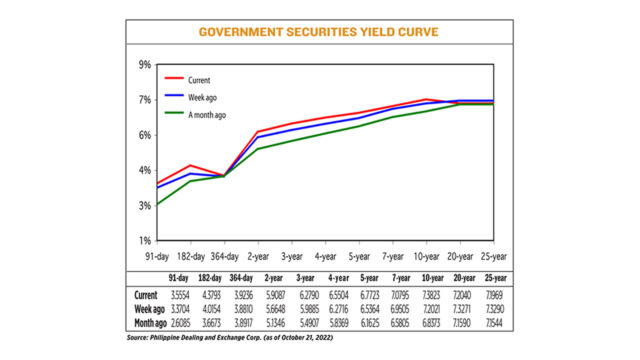
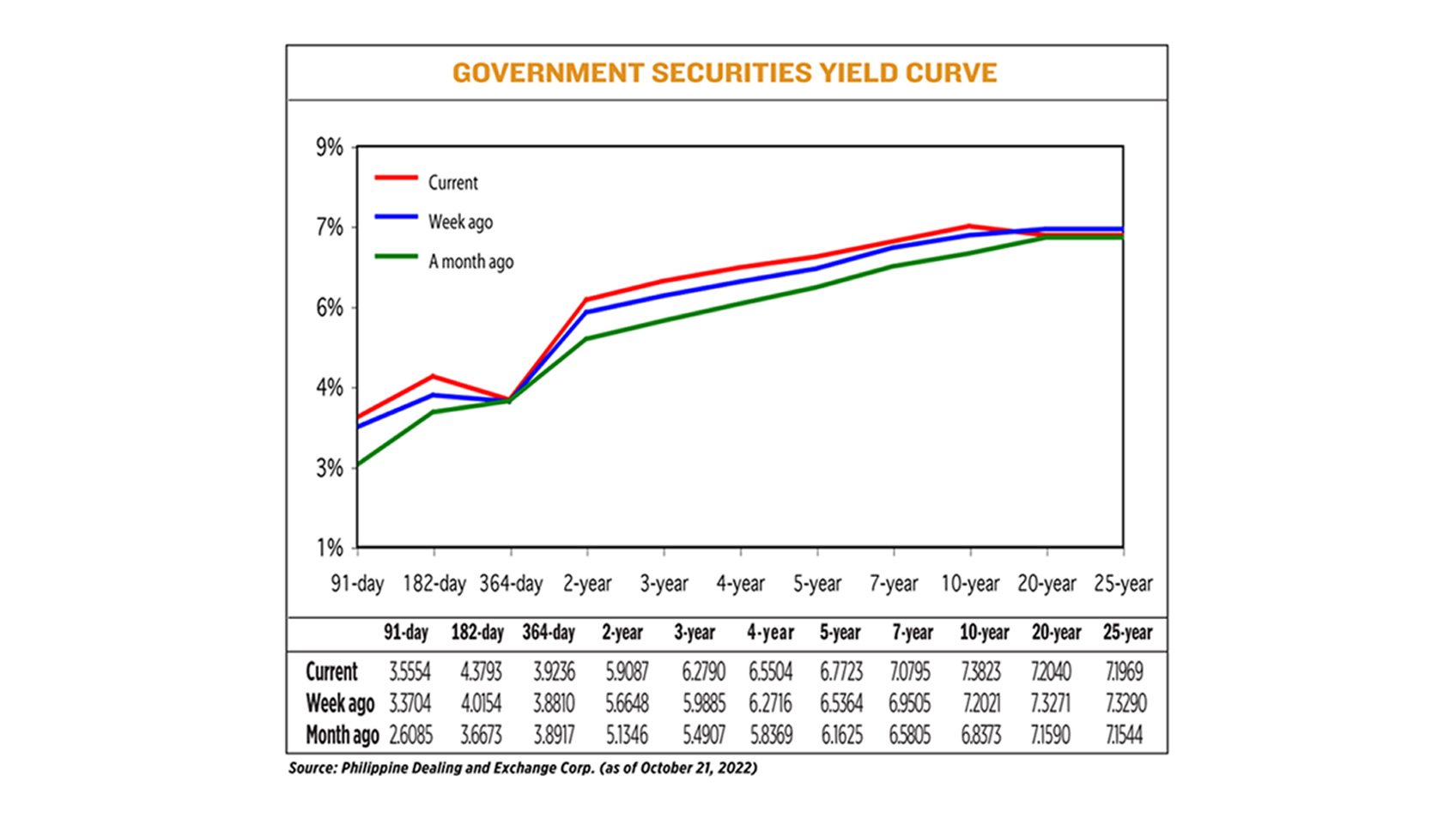
Debt yields, which move opposite to prices, climbed by an average of 15.41 basis points (bps) week on week, based on the PHP Bloomberg Valuation (BVAL) Service Reference Rates as of Oct. 21 published on the Philippine Dealing System’s website.

Rates at the short end of the curve climbed. The yield on the 91-day Treasury bill (T-bill) gained 18.5 bps (to 3.5554%), the 182-day paper jumped by 36.39 bps (4.3793%), and the 364-day T-bill rose by 4.26 bps (3.9236%).

The belly of the curve also surged. The two-, three- four-, five-, and seven-year Treasury bonds (T-bond) saw their yields increase by 24.39 bps (5.9087%), 29.05 bps (6.279%), 27.88 bps (6.5504%), 23.59 bps (6.7723%), and 12.90 bps (7.0795%), respectively.

Meanwhile, the long end of the curve ended mixed. The 10-year paper rose by 18.02 bps to yield 7.3823%, while the 20- and 25-year papers dropped by 12.31 bps (7.204%) and 13.21 bps (7.1969%), respectively.

Total GS volume traded reached P4.58 billion on Friday, jumping from the P3.769 billion recorded on Oct. 14.

Analysts said rates of government securities continued to climb as the market expects further tightening from the Fed and the BSP next month amid rising inflation.

“GS yields increased over the week as various Federal Reserve officials reiterate the US central bank’s plan in raising policy rates further to address elevated inflation,” a trader said in an e-mail.

“Yields likewise rose after BSP Governor Felipe M. Medalla hinted at a potentially stronger 75-bp rate hike at their November policy meeting,” the trader added. “Market participants have leaned toward the long end of the yield curve as the current levels continue to remain relatively more attractive for bond holders, even as short-term rates are likewise elevated.”

A second bond trader said market players remained defensive following the Bureau of the Treasury’s (BTr) auction of fresh 10-year bonds last week.

“Market players continued to be defensive post-auction given that the coupon rate was relatively higher than the secondary market rates. Key theme for the week was risk aversion and hesitancy to build up major bond positions due to the rising interest rates backdrop,” the second bond trader said in a Viber message.

Mr. Medalla said earlier this month that the central bank will consider another big rate hike at their Nov. 17 policy meeting to support the peso and prevent its depreciation from further stoking inflation.

He said they are looking at a 50-bp or 75-bp increase next month to help cool inflation and ease currency pressures stemming from a strong dollar amid the Fed’s hawkish stance.

The BSP has raised benchmark rates by 225 bps since May.

Meanwhile, the Fed is likely to deliver another large rate hike at its own meeting next month as inflation remains high, with more increases also expected to be on the table until next year.

The US central bank has raised rates by 300 bps since March and will next meet on Nov. 1-2.

On the other hand, the government fully awarded the fresh 10-year T-bonds it offered last week on strong demand for higher-yielding instruments amid expectations of more rate hikes here and abroad.

The BTr raised P35 billion as planned via the fresh 10-year T-bonds, with total tenders reaching P58.411 billion.

The debt papers were awarded at a coupon rate of 7.5%, 29.81 bps higher than the 7.2019% quoted for the 10-year tenor at the secondary market before the auction, based on the PHP BVAL Service Reference Rates data provided by the Treasury. Accepted rates ranged from 7% to 7.5% for an average of 7.344%.

For this week, analysts expect yields on government debt to continue rising ahead of the Fed’s policy meeting on Nov. 1-2.

“Local yields might move higher this week as expectations of an elevated reading for the US personal consumption expenditure inflation, which is the Federal Reserve’s inflation gauge,” the first trader said.

The second trader said markets widely expect the Fed to hike rates by 75 bps for a fourth straight time at their next meeting and to continue being aggressive to end the year.

“Moreover, potential catalysts of local yields also include the 13-year FXTN 25-07 auction on Tuesday, the BTr’s borrowing plan for November, and the BSP’s inflation forecast for the current month,” the second trader added.

On Tuesday, the Treasury will auction off P35 billion in reissued 25-year bonds with a remaining life of 12 years and 11 months. — B.T.M. Gadon

Record-high cash dividend moves Semirara Mining and Power stocks

MARKET players rallied behind Semirara Mining and Power Corp. (SMPC) after the announcement of its highest-ever special cash dividends, analysts said.

A total of P1.1-billion worth of 24.61 million shares in SMPC were traded from Oct. 17 to 21, data from the Philippine Stock Exchange (PSE) showed, making it the sixth most actively traded stock last week.

Its shares were up by 1.48% week on week to P41.10 apiece on Friday compared with its closing on Oct. 14 of P40.50 each. Since the beginning of the year, the stock went up 81.9%.

Equity analysts pointed out that SMPC’s stock was driven by the approved issuance of special cash dividends, which meant P3.50 per outstanding common share. This was double the P1.75 special cash dividends declared last year.

“With the additional special cash dividend, the total dividend payout of SCC to its shareholders for 2022 will be P5.00 per share, the highest in its corporate history,” SMPC said in a press release last week. SCC is the company’s stock symbol.

“The news of SMPC shareholders receiving record-high dividends pushed the stock higher this week. However, the gains were short-lived as investors began booking profits due to market uncertainties caused by the US Federal Reserve’s recent hawkish comments,” Timson Securities, Inc. Head of Online Trading Marc Kebinson L. Lood said in a Viber message.

“This is good for the company and that as long as they continue to pay out high dividends on a regular basis, investors will hold the stock for a long period, and demand for the stock will rise among those seeking a steady stream of passive income,” Mr. Lood added.

Recent minutes of the Sept. 20 to 21 meeting of the US Fed showed a hawkish stance might be taken by policymakers. The continuous rise of commodity prices could be tempered by increasing interest rates.

Since March, the Fed has raised rates by 300 basis points (bps), with the latest move being a third straight 75-bp hike in the September meeting.

Mercantile Securities Corp. Head Trader Jeff Radley C. See said in a separate interview that investors ran to the stock anticipating “huge dividends” but does not see the price moving any higher.

“The stock might just move sideways. There won’t be any catalyst for the stock moving forward,” Mr. See said in an e-mail.

Meanwhile, Mr. Lood foresees “bright” prospects for the power and mining firm in the medium term.

“Given that the winter months are approaching, we believe SCC will make good numbers because coal is in high demand during this season. In the long term, I believe people will gradually transition to renewables as many nations begin to reinforce and promote sustainability,” Mr. Lood said.

Traders are also “optimistic” for SMPC’s third-quarter earnings report, Mr. Lood added.

In the second quarter, SMPC posted a net income of P10.8 billion, almost three times the P4 billion from the year before.

“In 2022, we anticipate a net income of P48.1 billion,” Mr. Lood said. He expects the stock’s support level at P38.4 and resistance at P43.7 for this week.

For Mr. See, support will be between P40.3 and P38.5 while resistance levels are between P42 and P44.3. — Ana Olivia A. Tirona

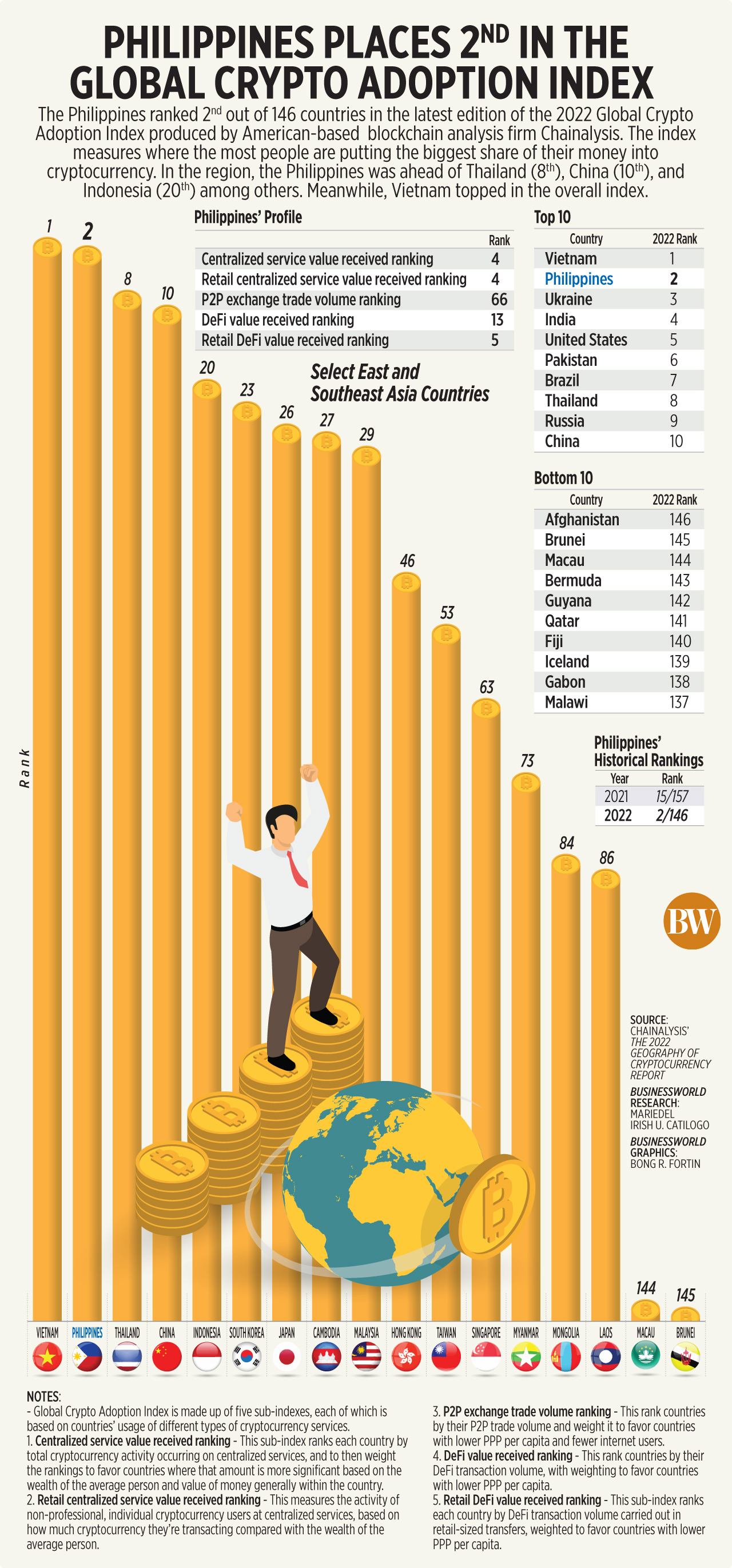
Philippines places 2nd in the Global Crypto Adoption Index

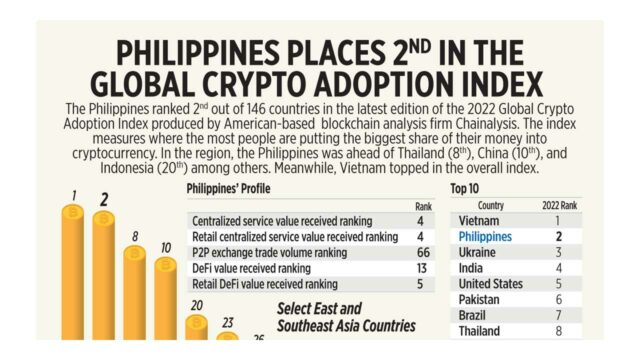
The Philippines ranked 2nd out of 146 countries in the latest edition of the 2022 Global Crypto Adoption Index produced by American-based  blockchain analysis firm Chainalysis. The index measures where the most people are putting the biggest share of their money into cryptocurrency. In the region, the Philippines was ahead of Thailand (8th), China (10th), and Indonesia (20th) among others. Meanwhile, Vietnam topped in the overall index.

Philippines places 2<sup>nd</sup> in the global crypto adoption index

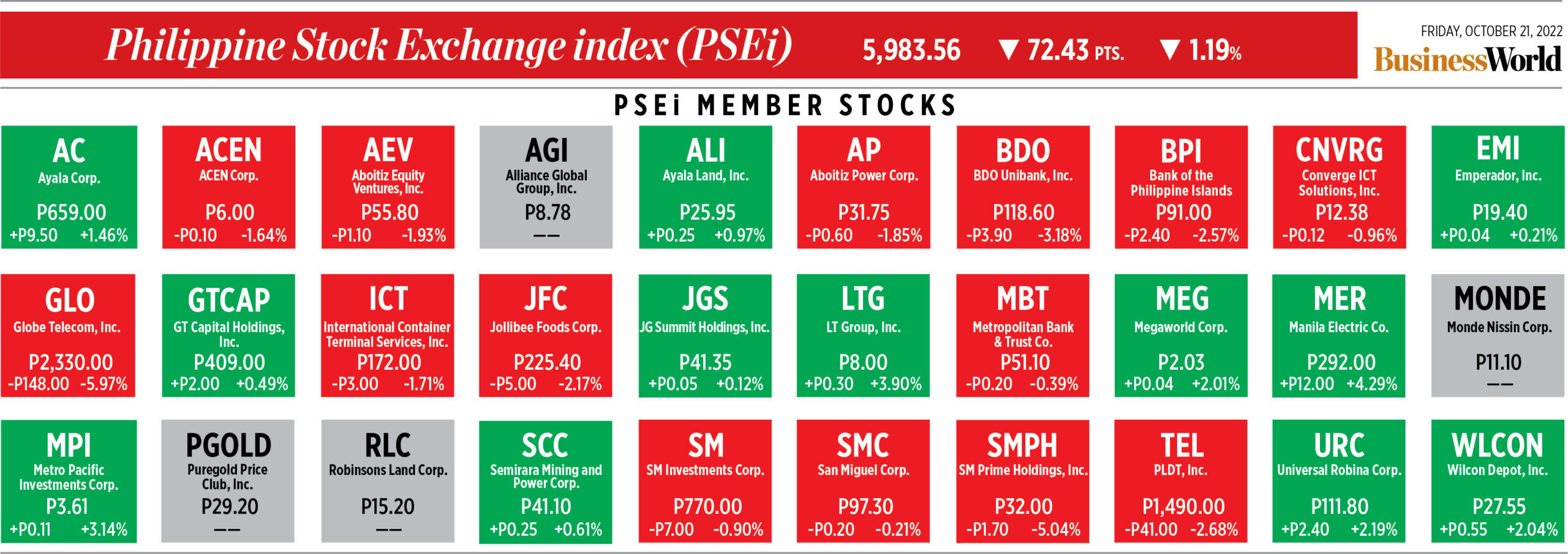
How PSEi member stocks performed — October 21, 2022

Here’s a quick glance at how PSEi stocks fared on Friday, October 21, 2022.


Stocks may drop as investors look for catalysts

REUTERS

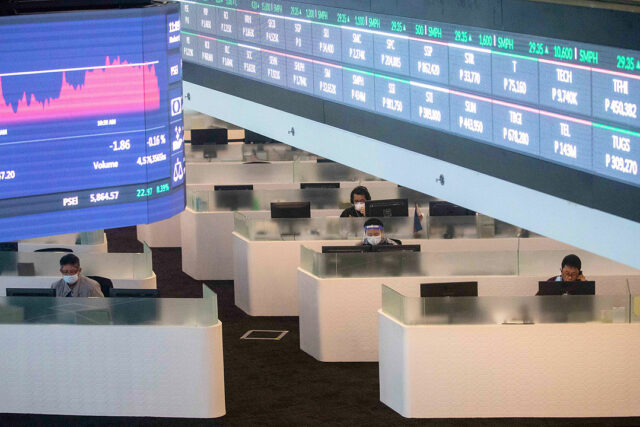
PHILIPPINE STOCKS may trade lower this week as investors stay cautious amid of the release of the third-quarter financial reports of more companies and as the market awaits catalysts.

On Friday, the benchmark Philippine Stock Exchange index (PSEi) declined by 72.43 points or 1.19% to close at 5,983.56, while the broader all shares index went down by 28.57 points or 0.88% to 3,195.04.

Still, week on week, the PSEi went up by 78.81 points or 1.33% from its close of 5,904.75 on Oct. 14. 

Timson Securities, Inc. Head of Online Trading Marc Kebinson L. Lood said in a Viber message that the market ended lower on Friday as it continued to track losses on Wall Street.

“The PSEi continues to fall as a reflection of Wall Street’s [Thursday] performance. The US market fell on Thursday as strong labor statistics and hawkish Federal Reserve remarks supported expectations for more combative rate hikes,” Mr. Lood said.

On Thursday, the Dow Jones Industrial Average dropped 90.22 points or 0.3% to 30,333.59; the S&P 500 fell 29.38 points or 0.8% to 3,665.78; and the Nasdaq Composite went down by 65.66 points or 0.61% to 10,614.84.

However, Wall Street rebounded on Friday after a report said the Fed may consider a smaller interest rate hike in December.

“Philippine shares logged their second straight day of bathing in the red as investors came out of a tumultuous day with bond yields rising and wide-ranging corporate earnings,” Regina Capital Development Corp. Head of Sales Luis A. Limlingan said in a Viber message on Friday.

AP Securities, Inc. Equity Research Analyst Carlos Angelo O. Temporal said in a Viber message on Friday that profit taking also continued to affect local stocks.

“Following the end of the short-term rally, we are seeing a downward bias for the index this week with a potential to retest support level of 5,700,” Mr. Temporal said.

Meanwhile, Philstocks Financial, Inc. Senior Research Analyst Japhet Louis O. Tantiangco said in a Viber message that there may be bargain hunting this week as stock prices remain attractive.

“This week, the local market may take cues from the movement of local and US yields, as well as from the peso. A rise in the yields amid the hawkish policy outlooks of the Federal Reserve and the Bangko Sentral ng Pilipinas is seen to pose downside risks,” Mr. Tantiangco said.

“Investors are also expected to look forward to third quarter corporate reports which is seen as the hope for a catalyst,” he added.

Regina Capital’s Mr. Limlingan said the market will also focus on US data on manufacturing, economic growth and jobs, among others, to gauge the Fed’s next action.

“Here at home, there may be some window dressing to end the month and before the long four-day holiday. Some third quarter earnings may affect some individual stocks movements if they are released,” Mr. Limlingan said.

2TradeAsia.com put the PSEi’s support at 5,800 and resistance at 6,000-6,100, while Philstocks Financial’s Mr. Tantiangco put immediate support at 5,700. — A.E.O. Jose