Home Blog Page 5208

Marcos touts state-assisted stores ‘solution’ to food crisis

PHILSTAR/KRIZ JOHN ROSALES

THE MARCOS administration considers its effort of setting up more farm-to-consumer stores in the country as a means towards food security and addressing rising costs.  

This is our response to the food crisis and the increasing prices of goods,President Ferdinand R. Marcos, Jr. said in Filipino at the launch of the so-called Kadiwa program in the central Philippine province of Cebu.  

We will continue this to ease the burden of our countrymen.”  

He said the government will establish more stalls, especially in areas where residents struggle with the rising costs of food.   

We will continue to do this, increase and improve, he said.   

The Kadiwa program facilitates a farm-to-market supply chain, with pop-up shops selling agricultural products as well as other locally manufactured goods at relatively low prices since the state shoulders costs for transportation and other expenses.  

Earlier this month, the Department of Agriculture announced a plan to install Kadiwa retail stores in select Metro Manila dry and wet markets within the first quarter.  

Mr. Marcos said there are already more than 500 state-assisted stalls across the country.  

Inflation hit a fresh 14-year high of 8.7% in January, accelerating from 8.1% in December as food prices soared amid supply issues.   

Onion a basic ingredient in Philippine dishes was among the agricultural products whose price became unaffordable for many Filipinos.   

The price of onion, which hit as much as P700 per kilo in December, has prompted the government to revise retail price suggestions for the food staple and launch a campaign against alleged smugglers. 

National Economic and Development Authority Secretary Arsenio M. Balisacan said earlier this month that Philippine inflation may start to plateau starting March as food supply is expected to improve due to the start of harvest season and absence of typhoons so far this year.  

HOUSING
Also on Monday, Mr. Marcos called for a multisectoral approach to accomplish his administrations goal of building six million housing units until 2028 to address the countrys backlog. 

He made the call as he led the inauguration of a 25-hectare housing project for residents of a coastal community in Cebu City.  

This will not be successful if our national government and local government dont collaborate, work together, and join forces,he said in a speech, adding that lawmakers as well as the private sector have important roles in the governments housing program.  

He said he is coordinating with Congress to ensure that the monthly amortization of the housing projects would be affordable, noting that the program is intended to help minimum wage earners, informal settlers, and other vulnerable sectors.  

He also asked authorities to ensure that housing units are built to withstand extreme weather events and other natural calamities.  

Last month, the president asked legislators to allot funding that would help people pay interest on government housing units.  

Public housing is the only solution to informal settlements, Mr. Marcos told reporters on the sidelines of his trip to Cebu.  

There is really no other way to solve that problem.”  

The President said his administration is evaluating a possible flexible and deferred payment system for housing beneficiaries. Kyle Aristophere T. Atienza 

Transport chief calls for dialogue before planned strike next week

PHILIPPINE STAR/RUSSEL PALMA

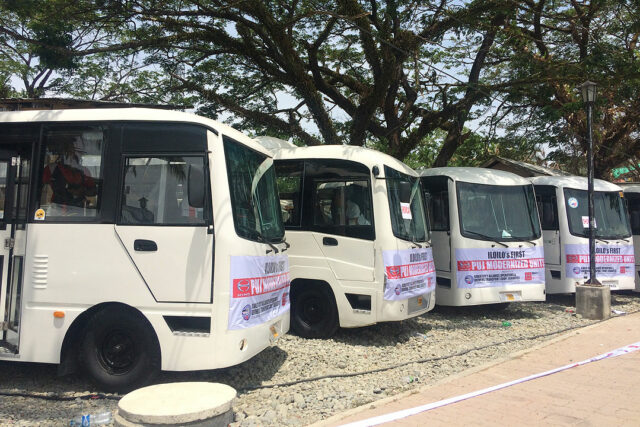
TRANSPORTATION Secretary Jaime J. Bautista on Monday appealed for a dialogue with transport groups before their planned strike starting March 6 to protest the governments public utility vehicle (PUV) modernization program.  

I think we should think hard first before stopping operations. We should have a dialogue first,Mr. Bautista said in Filipino in a video interview with Presidential Communications Office Secretary Cheloy Velicaria-Garafil.  

Lets understand what the issues are, because we might not be understanding each other,the chief of the Department of Transportation (DoTr) said in mixed English and Filipino.  

Mr. Bautista proposed a dialogue with representatives from transport operators, the DoTr, and the Land Transportation Franchising and Regulatory Board (LTFRB).  

He noted that representatives from the DoTr were not able to attend previous discussions between transport operators and the LTFRB to clarify issues about the program.  

So, I have already instructed the undersecretary for road sector to coordinate with the LTFRB and with the operators,Mr. Bautista added.  

Last week, the LTFRB issued Memorandum Circular 2023-013 which allowed the provisional authority of PUVs to be extended until Dec. 31, as long as the individual operators are able to join an existing consolidated entity such as a cooperative on or before June 30.  

Public transport drivers and operators have been resisting the modernization program, citing the cost of new vehicles. Operators who fail to consolidate by June 30 will lose their provisional authority.   

Meanwhile, Mr. Bautista clarified that there would be no phase out of old PUV units in areas where groups could not immediately acquire new units for their designated routes.  

He said that the government will provide ample time for the transition with consideration on external factors such as the availability of vehicle supply. Justine Irish D. Tabile 

Salceda tells gov’t to subsidize cooperatives for jeepneys, vans 

BW FILE PHOTO

A SOLON on Monday called on the government to subsidize public transport cooperatives, particularly for jeepneys and vans, to help drivers and operators cope with the transition to modern vehicles.   

Albay Rep. Jose Ma. Clemente S. Salceda opposed the scheduled phaseout of public utility jeepneys (PUJs) and vans by June 30 without government providing concrete assistance to help PUJs cooperativize or to provide ample seed funding for their cooperatives. 

He said the policy is cruel and inhumane.

The Land Transportation Franchising and Regulatory Board (LTFRB) announced last week that it has already moved the phaseout schedule to end-December, provided that PUJ and van operators or owners join an existing group or cooperative.  

Operators who fail to consolidate by June 30 will lose their provisional authority and their vehicles will no longer be allowed to ply designated routes.    

LTFRB said the consolidation, a part of the Public Utility Vehicle Modernization program, aims to bring together single operators and drivers as one legal entity to help facilitate the transition to modern transport units.  

The transition will require financing for modern vehicles as well as training and other alternative livelihood options for affected drivers and operators.    

The Department of Transportations (DoTr) proposed P788-million allocation under the 2023 budget for the modernization program was scrapped from the approved expenditure program.  

Mr. Salceda said the DoTr and the LTFRB should delegate the transition to modernized transport to local government units (LGUs).  

We should work with local governmentsso that LGU-led cooperatives or corporations can run the routes instead, with the displaced PUV (public utility vehicle) drivers are regular employees,Mr. Salceda said.   

Transport groups announced on Monday that they will be conducting a one-week strike beginning March 6 to protest the jeepney modernization program. Beatriz Marie D. Cruz

Manila rep wants MMDA abolished

PHILIPPINE STAR/ RUSSEL PALMA

A MANILA City representative wants to abolish the Metro Manila Development Authority (MMDA), citing that its functions could just be carried out by national agencies and local governments.

During the House’s plenary session on Monday, Manila Rep. Joel R. Chua lambasted the MMDA and called it “disruptive.”

“This is proven by the often demolitions, sidewalk clearing, and towing operations of the MMDA that aren’t coordinated with the barangay, city hall, municipality, and police,” Mr. Chua said.

He also cited reports from state auditors indicating that the MMDA failed to complete 20 out of 39 flood control projects in 2021.

He also said the MMDA sometimes contradicts the rules of other agencies and local governments.

“Respect is mandatory. MMDA has been disrespecting agencies and local governments and their individual laws,” he said.

He also pointed out that the MMDA does not have legislative or police powers, contrary to its actions.

Quezon City Rep. Franz S. Pumaren supported Mr. Chua’s call, saying, “There are incidents wherein cars are parked for a short time, but they’re suddenly towed (by the MMDA). What is this? Do they have a quota in catching vehicles?”

Mr. Chua suggested to retain the Metro Manila Council, the governing board and policy making body of the MMDA composed of 17 mayors and district representatives in the capital region. Mr. Chua is a member of the council.

He said that the council should be placed under the Department of Interior and Local Government, with its office to be composed of 50 employees.

“Instead of a big office like the MMDA that the Congress funds more than P5 billion yearly and P4 billion from other fund sources, the council and its secretariat will only need P100 million (to operate),” Mr. Chua said.

He noted the MMDA’s increasing manpower with 9,767 personnel in 2021 from 6,812 in 2011.

He also said that dissolving the MMDA is in line with President Ferdinand R. Marcos Jr.’s call to rightsize the bureaucracy.

The MMDA has not replied to messages and emails seeking comment. — Beatriz Marie D. Cruz

PCC sees onion ‘cartel’ probe done in 2-3 months

PHILSTAR FILE PHOTO

AN ongoing investigation into a possible onion cartel could be completed within two or three months, according to the new chairman of the Philippine Competition Commission (PCC).

“If it leads to nowhere, then there’s no use prolonging it. But if the evidence is there, and I believe they (will be) able to find evidence, then it should be done within the next two or three months,” Michael G. Aguinaldo said in a news conference in Quezon City on Monday.

“The investigation is ongoing. There are no firm results yet because they’re still gathering a lot of information. The hearings in the Congress have provided also a great deal of information and so, our enforcement office is actually looking into it,” he added.

The competition regulator said on Feb. 16 that it is looking into whether the alleged onion cartel is behind the surge in prices, which it said hit a high of P600 per kilogram in December.

According to Mr. Aguinaldo, the challenge for the PCC is to prove the existence of anti-competitive agreements causing onion prices to rise.

He added that there was a lack of physical evidence in the cold storage facilities examined by the PCC.

“The challenge when you talk about cartels or anti-competitive agreements like this (is that) it’s quite difficult to prove because (of the need) to prove an agreement actually exists among major players and usually you won’t find anything like that in writing,” Mr. Aguinaldo said.

The PCC also provided updates on the refund process of transport network company Grab Philippines.

Lianne Ivy P. Medina, PCC officer-in-charge director for mergers and acquisitions office, said that the PCC is now studying the possibility of imposing another fine on Grab for being unable to provide the full amount to riders.

“The commission is now considering whether or not the circumstances or the reasons for which those refunds were not actually fully paid to the consumers would merit another fine to be imposed on Grab,” Ms. Medina said.

“The PCC found that Grab has not yet fully refunded all of the amount that they were supposed to have given to the riders,” she added.

However, Ms. Medina said that it does not necessarily mean that Grab Philippines is non-compliant on the refund.

“I would not say that it’s non-compliance (on the refund), but there was a defect in the way they complied such that a portion of the amount that they should have refunded was not fully refunded to the consumers,” she added.

According to Mr. Aguinaldo, Grab Philippines has refunded 70% of the amount but has yet to give back the remaining 30%, amounting P5 to P6 million.

The PCC ordered Grab to issue refunds to riders amounting to P5.05 million in November 2019, P14.15 million in December 2019, and P6.25 million in October 2020, totaling P25.45 million, due to breaches of the transportation firm’s price monitoring commitment.

The PCC imposed a P63.7-million penalty on Grab in 2018 for violating its price and service quality commitments.

In March, the PCC said only 24.1% of the total refunds have been claimed as of June 2021.

“There are portions that they cannot comply with and they’ve given reasons for it. So now, before the commission, that issue is now being brought up,” Mr. Aguinaldo said.

Grab Philippines has said that it cannot issue refunds where passengers did not complete the know-your-customer requirements, or undergo the identity verification process.

The transport firm added that it is “fully committed to complying with its undertakings and commitments with the PCC, and doing right by its stakeholders — especially its millions of users.”

Separately, Mr. Aguinaldo said that the PCC’s priority industries for 2023 include e-commerce and digital platforms, health and pharmaceuticals, energy and electricity, insurance, water, construction, telecommunications, food and agriculture.

In an e-mail, the PCC said that it has 16 active cases in the investigation stage, of which five have been made public. The five cases involve the industries of power, cement, shipping, telecommunication interconnection, and internet service provider (ISP) services in connection with property development.

A decision has been reached on the ISP case but it has yet to be released, it said.

It added that four are in the litigation stage or for decision by the Commission sitting en banc.

These cases involve the insurance, trade association, tourism, and medical services industries. — Revin Mikhael D. Ochave

Cebu BRT signals more ‘innovative’ transport solutions, Marcos says

PHILSTAR FILE PHOTO

PRESIDENT Ferdinand R. Marcos, Jr. said on Monday that the bus rapid transit (BRT) which he broke ground on in Cebu will herald more “innovative” transport solutions intended to boost economic activity.

He made the remarks at the groundbreaking of the first package of Cebu’s P16.307-billion BRT.

“Rest assured that the National Government remains committed to improving economic activities in the many parts of our country through the introduction of innovative solutions to public transport and the improvement of mobility infrastructure, among others,” Mr. Marcos said in a speech.

“My administration resolutely supports you in exploring ways to improve our public transport systems and in forging partnerships that will help the Philippines keep up with the innovative interventions of other progressive countries.”

Mr. Marcos urged the Department of Transportation (DoTr) to finish the Cebu Bus Rapid Transit project, which is being funded by the World Bank and French Development Agency, on time.

“I also want to take this opportunity (to call on) the DoTr and other stakeholders to finish this project within the target completion timeline,” he said. “I think if we in fact start operations in December, that will be the best possible Christmas gift that we can give to Cebu.”

The ceremony kicked off the civil works for the four stations under Package I of the project, which involves the construction of a 2.38-kilometer segregated bus lane with four bus stations, the Palace said.

It also involves the construction of a 1.15-kilometer pedestrian walkway, which will link the system to the port of Cebu.

Package I, which costs almost P1 billion, was awarded to the Chinese contractor Hunan Road and Bridge Construction Group Co. Ltd. in November.

Mr. Marcos urged the DoTr “to ensure the just compensation of the property owners who will be affected by the CBRT project.”

The bus rapid transit project will “support economic development through travel time savings, environmental improvements, and reduction of accidents among residents and visitors,” he said.

The project is modeled after the BRT systems in Bogota, Colombia, Curitiba, Brazil, Seoul, South Korea, and Guangzhou, China.

The 13.18-kilometer project “will not only reduce travel time between Cebu’s north and south districts but also boost economic productivity in various communities through the efficient mobility of passengers, goods, and services,” Transport Secretary Jaime J. Bautista said in a speech.

“The project likewise promises to provide better job security and working conditions for the PUV drivers and reduce vehicle and pedestrian accidents,” he added.

The project consists of three packages, and can accommodate 83 12-meter buses by its opening year.

It is expected to be fully operational by the second quarter of 2025, Mr. Bautista said. It can accommodate as many as 160,000 passengers a day, he added.

The BRT “took 20 years before the project became a reality,” the Palace said. — Kyle Aristophere T. Atienza

Senate raises questions over Maharlika foreign board membership

PHILSTAR FILE PHOTO

OBJECTIONS were registered in the Senate on Monday to foreign board representation in the proposed Maharlika Investment Fund (MIF), though a Treasury official said foreign representation on the board is unlikely.

Senator Maria Lourdes Nancy S. Binay told the banking committee, which is assessing a bill that will establish up the fund, that legislation should be clear about foreign ownership in the Maharlika Investment Corp. (MIC).

“Why don’t we just specify that no foreign entity can be part of the board regardless of investment and make the composition of board members less vague?” she said at the hearing.

She said that if the bill establishing the fund is approved, the MIF’s implementing rules and regulations should explicitly set limits on foreign ownership.

National Treasurer Rosalia V. de Leon said at the hearing that if the bill passes, the Maharlika Investment Corp. will be set up as a government-owned and -controlled corporation (GOCC), which will have a cap on how much foreign entities can invest in the fund.

“Because of the limits that would be imposed on foreign investors, they would not be represented on the board,” she said.

She added that the company managing the MIF would also be subject to regular audits by the Commission on Audit.

Ms. Binay also floated the National Development Co. (NDC) as an alternative to the MIF.

NDC General Manager Antonio D. Mauricio told the hearing that the NDC could complement the proposed sovereign wealth fund by bringing in smaller-scale investments.

He clarified that the NDC is a GOCC completely owned by the government but handles subsidiaries that have foreign investors within the 40% limit.

“The Maharlika Investment Fund can hit the ground running with our help,” Mr. Mauricio said.

Earlier this month, President Ferdinand R. Marcos, Jr. said that three Japanese private firms made commitments to invest in the proposed MIF.

At the same hearing, Senator Ana Theresia N. Hontiveros-Baraquel asked representatives from the Bangko Sentral ng Pilipinas (BSP) if they were willing to delay the timing of the bank’s capital buildup to P200 billion to fund Maharlika.

“BSP can afford to provide dividends to the MIF temporarily for two years based on the recent five years of income incurred by the bank,” Iluminada T. Sicat, BSP senior assistant governor, said at the same hearing.

At a Feb. 15 hearing, BSP Deputy Governor Francisco G. Dakila, Jr. said that the central bank could take 14 years to reach its target capitalization if it is designated the main source of the MIF’s capital.

Meanwhile, Philippine Stock Exchange Chief Executive Officer Ramon S. Monzon said the fund’s profits should be re-invested in long-term projects.

“This will defeat the objectives of growing the fund to a size sufficient to build intergenerational wealth,” he said.

Mr. Monzon proposed that at least 25% of the profits of the MIC be directly used for the government’s poverty and social welfare programs, excluding infrastructure projects.

In a position paper presented before the Senate committee, the PSE said the MIF could address the Philippines’ major infrastructure gaps and enhance the government’s delivery of basic services.

“We believe that now is an opportune time to establish the fund if we want to see and reap the exponential benefits of major infrastructure improvements and the country’s economic transformation,” it said. — John Victor D. Ordoñez

EU carbon emissions-based tariffs seen encouraging greener practices

REUTERS

AN upcoming European Union (EU) tariff scheme that rewards low-carbon practices could encourage exporters to shift to greener technology, Sustainable Fitch said.

“We believe APAC (Asia-Pacific) exporters will be incentivized to develop clean production technologies that meet the more stringent EU emission standard. Regulators could also be more inclined to set up domestic carbon-pricing mechanisms to encourage a reduction in carbon intensity and minimize downside risk amid a growing trend of carbon tariffs, elsewhere around the world,” according to Sustainable Fitch, a specialist environmental, social and governance (ESG) unit of the Fitch Solutions group.

The EU is aiming to launch the Carbon Border Adjustment Mechanism (CBAM) by October, which will require importers to purchase carbon certificates mirroring European carbon prices. It is expected to be fully operational by 2026.

“Ultimately, the scheme aims to incentivize the adoption of cleaner technologies in industrial production to reduce carbon leakage, particularly by major exporters of raw materials and manufactured goods,” Sustainable Fitch said.

“We expect the scheme to encourage Asia-Pacific (APAC) exporters to develop and implement clean technologies that reduce carbon intensity in anticipation of CBAM compliance as well as a possible expansion of sectors covered by the mechanism,” it added.

Sustainable Fitch said it expects that decarbonization will not be as straightforward in Southeast Asia, particularly as “governments balance social and economic considerations with environmental ones.”

However, it noted that CBAM may hasten the progress in aligning national carbon frameworks and strategies with net-zero carbon emission goals.

The EU is southeast Asia’s third-largest trading partner after China and the US, accounting for around 11% of total trade, according to the European Commission.

On the other hand, Sustainable Fitch said that the CBAM will increase the supply-chain costs of covered commodities, which will be passed on downstream.

“This scenario has spurred discussions over trade protectionism and discrimination against EU’s trading partners, as the carbon tariffs may encourage APAC industrial producers to divert trade flow towards markets that do not impose such schemes to remain cost competitive. The effectiveness of carbon tariffs to curb carbon leakage should improve as the scale of carbon markets and covered sectors expands,” it said.

“Still, despite the large trading volume, the region’s response to the CBAM has been muted, because close to 90% of southeast Asian exports of manufactured goods to the bloc fall outside the stipulated product categories,” it added, citing Eurostat.

The initial phase of CBAM will only apply to six sectors, none of which are key to EU-southeast Asian trade, the report noted.

“As such, Sustainable Fitch sees a limited impact to major southeast Asian economies for now. However, the situation is likely to evolve over time. For instance, if the CBAM is expanded to include a larger range of sectors and imported products, regional southeast Asian economies may be compelled to implement appropriate domestic environmental regulations and technologies to avoid losing an important overseas market. Such a transition would not be without challenges,” it added.

British Chamber of Commerce of the Philippines Executive Director Chris Nelson said that, while the UK is now on the outside looking in on EU policy, schemes like CBAM could set the trend in trade policy.

“I think the move on carbon emissions is an inevitable consequence not only in Europe or the United Kingdom (UK) but in Asia. The Philippines is looking at ESG principles and I think the positive side is the move of companies and businesses to look at greener sources of energy. Inevitable, but it has positive developments,” he said by phone on Monday.

“This is a likely development which will need to be adjusted to. Carbon emissions apply to many sectors and businesses. I think this will give a further push to renewable energy, which has been mentioned by the (Philippine) administration,” Mr. Nelson said, also noting that the UK is also considering its own carbon pricing system.

Meanwhile, Confederation of Wearable Exporters of the Philippines Executive Director Maritess Jocson-Agoncillo said that the CBAM represents “another major tariff barrier.”

“(It) will definitely impact the Philippine apparel and textile sector. The supply chain, specifically from textile production, will be adversely affected as carbon emissions are mostly a by-product of textile production. This will add up to the cost of the base raw material,” she said in a Viber message.

“The supply chain at source will definitely carry additional costs and this will be passed on within the supply chain, apparel manufacturers and ultimately the consumer,” she added.

In 2022, exports to the EU accounted for 7.3% of total apparel exports. A decade ago, it was at around 15%, Ms. Jocson-Agoncillo added.

The Philippines was the EU’s 39th largest trading partner in 2021. — Luisa Maria Jacinta C. Jocson

LNG seen as medium-term solution at best for power supply problem

LIQUEFIED natural gas (LNG) import terminals are only a short to medium-term solution for fueling the power industry, undertaken because the Philippines had “no choice” due to the depletion of the Malampaya gas field, a senior Senator said.

In a statement on Monday, Senator Sherwin T. Gatchalian, vice-chairman of the Senate’s energy committee, added: “LNG is good for the country’s national energy security now and I commend the energy department’s support for the construction of LNG terminals in a bid to ensure continuous power supply this year,” Mr. Gatchalian said.

Service Contract 38, which covers the Malampaya gas field, is set to expire in 2024. Its concession holders are currently seeking a 15-year extension of the Malampaya concession.

“The establishment of LNG facilities addresses the expected shortfall in the country’s power supply at least in the near and medium terms. Certainly, this is one of the intervention projects that we desperately need to address the loss of thousands of megawatts of power,” he said.

The Malampaya gas field is the country’s only indigenous commercial source of natural gas. It is expected to be largely depleted of easily-recoverable gas using current techniques by 2027.

The Department of Energy (DoE) estimates that the Malampaya gas field accounts for about 20% of Luzon’s total electricity requirements.

To date, seven LNG terminal projects have been approved by the DoE, two of which are expected to come online in the first half of 2023.

The LNG terminals of First Gen Corp. and Linseed Field Power Corp., a unit of Atlantic Gulf & Pacific Co., are expected to come online this year.

A report from Fitch Solutions Country Risk and Industry Research warned that the country will need to turn to the volatile spot market as none of the LNG proponents has secured long-term LNG supply agreements.

Mr. Gatchalian has filed Senate Bill No. 152 or the Midstream Natural Gas Industry Development Act.

The measure allows the private sector to participate in the entire value chain. — Ashley Erika O. Jose

BCDA targets P5-B dividend to Treasury in 2023

THE Bases Conversion and Development Authority (BCDA) said it expects to remit around P5 billion in dividends to the National Government in 2023.

“(We are eyeing) almost P5 billion. It depends on our net income. It is a sure estimate,” BCDA President Aileen R. Zosa told reporters during a media briefing in Taguig City on Monday.

The BCDA’s 2023 target is lower than the P7.53 billion remitted in 2022. Last year’s dividend was 64% higher from the 2021 payment.

Ms. Zosa said the low remittance projection for 2023 is the result of the failure to clear over 20 hectares on its 33.1-hectare development in Bonifacio South Pointe project, undertaken as a joint venture with SM Prime Holdings.

“So far, we have cleared 11 hectares of the Philippine Army property for SM to develop. We need 20 plus hectares (more) before we can turn over to them the 33.1-hectare project area,” Ms. Zosa said.

The BCDA is developing the Bonifacio South Pointe site to generate funds for the modernization program of the Armed Forces of the Philippines (AFP).

Of the BCDA’s total remittances for 2022, P6.38 billion was generated from the sale, lease, or joint venture of former military camps in Metro Manila. The funds will then be allocated and distributed by the Department of Budget and Management to the AFP.

Gross disposition proceeds between 1993 and 2022 rose 6% to P134.66 billion, compared to the total logged at the end of 2021.

“This strong financial performance is driven by our commitment to our mandate of improving the quality of life of those not just in our properties, but also those in the surrounding communities,” Ms. Zosa said.

Ms. Zosa said that the BCDA has P11 billion worth of projects in the pipeline for New Clark City in Tarlac such as a P10-billion solid waste management and waste-to-energy project and a P1-billion solar farm.

The P1-billion solar farm project will rise 2.5 kilometers from the New Clark City substation and will be accessible through major thoroughfares.

Ms. Zosa said New Clark City has tallied P95.51 billion worth of committed investments and P14.59 billion worth of investments injected by locators as of the end of 2022.

“Of the P15 billion, some are investments in the utilities. Some are investments of locators. Some are investments of government locators,” Ms. Zosa said. — Revin Mikhael D. Ochave  

BIR transfer pricing audits — the next wave?

The Bureau of Internal Revenue (BIR) and the Department of Finance (DoF) have expressed a shared goal to increase taxes collected as a percentage of GDP from 14.6% in 2022 to 17.1% by 2028. They confidently expect to meet this goal as it will be driven primarily by economic growth and by offering taxpayers convenience through tax digitalization programs. While it is accurate to claim that the BIR will derive more revenue with a stronger economy and by providing more convenient avenues for taxpayers to pay their dues, taxpayers know well what this means — an upsurge of BIR assessments across all industries.

On Jan. 9, the BIR announced that the Commissioner met with the Japan International Cooperation Agency (JICA) to discuss JICA’s proposal for setting up a dedicated transfer pricing team in the BIR. The Commissioner also noted “leakage in transfer pricing” causing the Bureau to lose significant amounts of revenue from international transactions. This begs the question: are transfer pricing (TP) audits the next wave of incoming assessments?

The answer is yes, and it’s just a question of when. It wouldn’t hurt to plan for what may lie over the horizon. To guide taxpayers, let’s look at Revenue Audit Memorandum Order (RAMO) No. 1-19, the current regulations set by the BIR when it comes to TP audits.

TP AUDIT SELECTION PROCESS
As a general rule, all taxpayers are candidates for a tax audit. However, for a TP audit, the BIR lays down the selection process (i.e., gather and review BIR Form 1709, perform risk assessment, identify high-risk TP issues and select the entity or transaction subject to audit).

The Revenue Officer (RO) will kickstart the process with a review and analysis of the information contained in BIR Form 1709 (Information Return on Transactions with Related Party) submitted by taxpayers. This form aims to improve and strengthen the BIR’s TP risk assessment and audit.

Next, the RO will perform TP risk assessment and make an informed decision, at an early stage, whether to conduct a thorough review or audit of a particular entity or transaction. The BIR will focus its audit and commit its resources only to the most important or high-risk TP issues. The RO will give due consideration to the level of profit and tax paid in the Philippines. Then comes the selection of high-risk entity or transaction that will undergo the audit.

TP AUDIT PHASES
A TP audit is conducted to test the compliance in fulfillment of tax obligations of a taxpayer with related party transactions. The audit procedure on TP consists of preparation, implementation, and reporting.

In the preparation phase of the audit, the RO collects and studies a taxpayer’s data in respect of special relations with their related parties. This is done by reviewing the annual income tax return (AITR), audited financial statements (AFS), tax treaty relief applications, and prior year’s tax audit, among others. The RO will schedule a meeting with the taxpayer to gain an understanding of the general background of the business, product/service flow, value chain, worldwide structure, rationale for conducting the transaction, functions, assets and risks, and TP policy. The meeting is also conducted and designed to gather information about the worldwide effective tax rate, sources of income, transactions with related parties domiciled/located in countries or economic zones with low or zero tax rates, a determination whether the taxpayer’s net operating profit is lower than that of other companies in the same industry, and whether the taxpayer suffered losses over several years.

Implementation of the TP audit comprises the following: (1) Determination of the characteristics of the taxpayer’s business; (2) Selection of the TP method; and (3) Application of the arm’s length principle (ALP).

The reporting phase of the TP audit provides a summary of the factual background and functional analysis of the taxpayer and the transaction/s at issue, a summary of the taxpayer’s proposed economic analysis for the transaction at issue, a critique of taxpayer’s methodology and analysis of the transaction at issue, the RO’s determination of arm’s length price based upon economic analysis, and summary and conclusion.

DOCUMENTARY REQUIREMENTS
The RO will require the taxpayer to prepare and submit the following annexes which are attached to RAMO No. 1-19:

• Annex 3 – Related Party Transaction

• Annex 4 – Segmented Financial Statements

• Annex 5 – Supply Chain Management Analysis

• Annex 6 – Functions, Assets and Risks Analysis (FAR)

• Annex 7 – Characteristics of business

• Annex 8 – Comparability analysis

The taxpayer is required to submit these within five days from the date of receipt of the request. It is worth noting that most of the information contained in the annexes listed above are also present in transfer pricing documentation (TPD). The TPD, on the other hand, must be submitted to the RO within 30 days from the date of receipt of the request.

TP AUDIT IMPLEMENTATION
The RO is expected to perform the audit in a three-step implementation phase, as discussed below.

1. Determination of the characteristics of the taxpayer’s business

In this step, the RO will identify the characteristics of the related party transaction in question by studying several sources of information as earlier discussed in the preparation phase.

A functional analysis will also be performed by the RO by taking into account the economically significant activities and responsibilities undertaken, assets used or contributed, and risks assumed by the parties to the transaction. The more functions, assets, and risks associated with the taxpayer concerning the tested transaction, the higher level of profit it is expected to generate. As a result of the functional analysis, the RO should be able to come to a conclusion as to the taxpayer’s characterization, which may take the form of toll manufacturing, contract manufacturing, fully fledged manufacturing, fully fledged distributor, limited risk distributor, commissionaire, commission agent, service provider, or others.

2. Selection of transfer pricing method

Next, the RO will identify available comparables, whether internal or external. Internal comparables are obtained when the tested party engages in transactions with unrelated parties. Meanwhile, external comparables may include, but are not limited to, the market price of commodity products, BSP rates, the SEC database, and commercial databases.

Thereafter, the most appropriate transfer pricing method is chosen from traditional transaction-based methods and transaction profit-based methods. These methods are used to compute the “arm’s-length price.” Traditional transaction-based methods include the comparable uncontrolled price method, resale price method, and cost-plus method. On the other hand, transaction profit-based methods include transactional net margin method and profit split method.

3. Application of arm’s-length principle

The crux of a TP audit lies in the performance of comparability analysis, wherein the controlled and uncontrolled transactions are weighed against each other. This step aims to answer the main question of whether the tested transactions are conducted at arm’s length.

The RO arrives at a conclusion whether the tested transaction was conducted at arm’s length based on the audit. If the relevant conditions of the controlled (e.g., price or margin) are within the arm’s length range of price or profit, no adjustment should be made.

However, if the relevant conditions of the controlled transaction fall outside the arm’s length range asserted by the RO, the taxpayer should have the opportunity to present arguments that the conditions of the controlled transaction satisfy the ALP, and that the result falls within the arm’s length range (i.e., that the arm’s length range is different from the one asserted by the RO). If the taxpayer is unable to establish this fact, the RO must determine the point within the arm’s length range to which it will adjust the conditions of the controlled transaction.

A TP adjustment will be proposed by the RO as part of his findings in an assessment when:

a. The consideration for the sale of services/goods is less than the arm’s-length price; or

b. The consideration for the purchase of services/goods is higher than the arm’s-length price; or

c.  No consideration has been charged to the related party for the supply of goods/services.

TAKEAWAY
TP audits have yet to be fully integrated in most tax assessments as TP rules and regulations are relatively fresh and ROs are unfamiliar with their concepts. However, with JICA proposing to institutionalize an intensive transfer pricing team in the BIR, we can reasonably assume that regular TP audits are looming for multinational companies.

The TPD will serve as the main line of defense for taxpayers in the event of a TP audit as it has essentially pre-performed the procedures that are expected to be conducted by the BIR. This allows the taxpayer to re-evaluate its transfer pricing policies before an audit is conducted. If TP audits are the next wave of assessments from the BIR, the TPD serves as a surfboard and allows the taxpayer to ride the waves, be they calm or rough.

Let’s Talk TP is a weekly newspaper column of P&A Grant Thornton that aims to keep the public informed of various developments in taxation. This article is not intended to be a substitute for competent professional advice.


Kyle Benedict C. Paris is a senior in charge from the Tax Advisory & Compliance division of P&A Grant Thornton, the Philippine member firm of Grant Thornton International Ltd.

pagrantthornton@ph.gt.com

Creamline banks on Galanza as it battles Army Black Mamba

PVL

Team’s top players deal with injuries

Games Today
(Philsports Arena)
4 p.m. — Creamline vs Army
6:30 p.m. — Akari vs PLDT

THE CREAMLINE Cool Smashers may summon Jema Galanza to come up with another monster performance similar to the one she unleashed the last time out because of a nagging injury that befell teammate Tots Carlos.

Already saddled by the absence of team captain Alyssa Valdez due to knee problems, Creamline is now having Ms. Carlos — a two-time league MVP — battling hamstring issues as it clashes with Army Black Mamba in today’s (Feb. 28) PVL All-Filipino Conference at the PhilSports Arena.

Good thing there is Ms. Galanza who is always ready to answer the call.

Ms. Galanza, a 2019 league MVP whose magnificence was evident in the franchise’s 17-25, 25-11, 25-19, 25-21 win over Chery Tiggo Saturday in a game where she dropped a triple-double effort—25 points, 13 digs and 12 receptions.

It was Ms. Galanza who breathed life to the Cool Smashers when they dozed off that cost them the opening set.

Creamline coach Sherwin Meneses is hoping and praying Ms. Carlos will continue to heal.

Creamline, owner of five championships and currently tied at the helm with F2 Logistics with a 4-1 record apiece, is expected to shoot for a win in its 4 p.m. showdown with Army Black Mamba, winless in four outings, that should push it a step closer to claiming a spot in the single-round robin semifinals.

Meanwhile, PLDT High Speed Hitters (3-1) tries to keep in step with the best of the league as it guns for another victory when it squares off with Akari (1-3) at 6:30 p.m. — Joey Villar