Home Blog Page 5150

NG debt hits record P13.52 trillion amid weak peso

Long lines of commuters are seen along Ortigas Extension in Taytay, Rizal. The National Government’s (NG) outstanding debt reached a new high of P13.52 trillion as of end-September. — PHILIPPINE STAR/ WALTER BOLLOZOS

THE NATIONAL GOVERNMENT’S (NG) outstanding debt hit a record P13.52 trillion as of end-September, mainly due to the weakness of the peso and higher domestic borrowings, the Bureau of the Treasury (BTr) said on Thursday.

In a statement, the BTr said outstanding debt jumped 3.8% or P495.54 billion as of end-September from the then-record-high P13.02 trillion as of end-August, “primarily due to peso depreciation against the US dollar and the net issuance of government securities to support the budget.”

Year on year, the debt stock rose 13.4% from P11.92 trillion.

National government outstanding debtThe BTr said debt increased by 15.2% from the P11.73-trillion level as of end-December 2021.

Of the total outstanding debt, 68.8% came from domestic borrowings while the rest was sourced from foreign creditors.

The domestic debt stock rose by 10.9% to P9.3 trillion as of end-September. Month on month, it increased 4% from P8.94 trillion as of end-August.

“For September, the increase in domestic debt resulted from the net issuance of government securities amounting to P352.09 billion and the P5.18-billion impact of local currency depreciation against the US dollar,” the BTr said.

The peso closed at P58.646 against the US dollar on Sept. 30, weakening by 13% from the P51 finish on Dec. 31, 2021, and by 4.9% from its P56.171 close as of end of August.

“Since the beginning of the year, the domestic debt portfolio has increased by P1.13 trillion or 13.8% due to continued preference for domestic financing to mitigate the effects of currency fluctuations,” BTr said.

Meanwhile, external debt jumped 19.5% to P4.22 trillion as of end-September, from P3.52 trillion a year ago. It increased 3.4% from P4.08 trillion in the previous month.

Broken down, external debt consisted of P1.89 trillion in loans and P2.32 trillion in global bonds.

“The increment in the level of external debt was due to the P179.69-billion impact of local currency depreciation against the USD (US dollar). This was partially offset by the P30.62-billion effect of third-currency depreciation against the USD and net repayment amounting to P10.80 billion,” the BTr said.

Year to date, external debt jumped 18.5% from P3.56 trillion “due to local- and third-currency fluctuations that increase the peso value of foreign denominated obligations.”

NG’s overall guaranteed obligations inched up 1.1% month on month to P397.22 billion, but fell 8.2% from a year ago.

“For September, the increment in guaranteed debt was primarily due to the impact of local currency depreciation amounting to P9.27 billion, offsetting the net repayment amounting to P1.43 billion and P3.48 net depreciation effect on third- currency denominated guarantees,” BTr said.

Rizal Commercial Banking Corp. Chief Economist Michael L. Ricafort said in a text message that the increase in outstanding debt was due to the peso’s continued weakness against the US dollar.

“The outstanding National Government debt may have continued to increase on a month-on-month basis after slower monthly increments in previous months due to some frontloading or lumped borrowings amid the need to hedge amid rising interest rates,” Mr. Ricafort said.

“Higher interest rates would also increase the government’s interest rate payments and could lead to more borrowings. Higher inflation could also increase the government’s expenditures, widen the budget deficit, and, in turn, would lead to more debt.”

In September, the Bangko Sentral ng Pilipinas (BSP) increased its overnight borrowing rate by 50 basis points (bps) to 4.25%, and its corresponding lending rate to 4.75%. The BSP has raised rates by 225 bps since May.

Inflation quickened to 6.9% in September, driven by rising food, fuel and transport costs.

Leonardo A. Lanzona, an economics professor at the Ateneo de Manila University, said that government borrowings are beneficial as long as they are utilized to drive economic growth.

“The increase in debt makes the country more dependent on growth in order to repay it.  This means that the increase in borrowings is fine as long as this increase is used for more productive projects,” he said in an e-mail.

“The government should be more transparent now and inform Filipinos where this is going to be used. Otherwise, we will end up paying for the debt without gaining any benefits from it,” he added.

The country’s debt-to-gross domestic product (GDP) level reached 62.1% at the end of the second quarter. This is higher than the 60% debt-to-GDP ratio considered manageable by multilateral lenders for developing economies, and significantly higher than the 39.6% seen at the end of 2019 and 54.6% as of end-2020.

The government is aiming to bring down the debt-to-GDP ratio to 61.8% by year end and 52.5% by 2028. — Luisa Maria Jacinta C. Jocson


Teaching Filipinos to ride with pride

The Entrepreneur Of The Year Philippines 2022 has concluded its search for the country’s most undaunted and unstoppable entrepreneurs. Entrepreneur Of The Year Philippines is a program of the SGV Foundation, Inc., with the participation of co-presenters the Asian Institute of Management, the Department of Trade and Industry, the Philippine Business for Social Progress, and the Philippine Stock Exchange. BusinessWorld will feature each finalist in the next few weeks.


George Royeca
Chief Executive Officer
DBDOYC, Inc. (Angkas)

IN A COUNTRY plagued by traffic congestion, insufficient transportation infrastructure and limited last-mile transport options, the arrival of Angkas’ pioneering and industry-defining motorcycle taxi service seemed like a godsend for many long-suffering Filipino commuters.

Prior to Angkas, there was a growing proliferation of “habal-habal” motorcycle drivers, an alternative but unregulated and “colorum” form of public transportation. Considered generally unsafe, these habal-habal operate on the sly and are not recognized by the government as legitimate public transportation. Despite the risks, many commuters still prefer using them over regular public utility vehicles since these are more affordable and offer a faster way of traveling.

Seeing the daily plight of commuters and drivers, George Royeca, the chief executive officer, co-founder and chief transport advocate of DBDOYC, Inc. (Angkas), saw an opportunity to help transform the country’s transportation system.

Mr. Royeca and his wife, Angeline Tham, founded Angkas, the Philippines’ first app-based motorcycle ride-hailing platform, in December 2016. The business was a response to the worsening traffic conditions in Metro Manila and its impact on the overall quality of life of Filipinos. They came up with the idea to professionalize and legitimize motorcycle taxi operations by providing commuters with a safe and affordable option. They also envisioned creating a new generation of micro-entrepreneurs, which is how they view all their drivers.

As with any pioneering industry, establishing Angkas was not without challenges. Before Angkas came on the scene, 50% of fatal road accidents involved motorcycles. At the beginning of its operations, the company were subjected to intense scrutiny. The government ordered Angkas to cease operations twice due to regulatory concerns and safety issues.

Through it all, Mr. Royeca and his wife boldly held on to their vision and worked tirelessly to get provisional authorization from the government to operate, prove that Angkas is safe and that motorcycle taxi services can be professionalized. In the end, they were proven correct.

“After millions of rides, our accident rate is 0.003%. That’s a 99.997% safety rating. We proved to the regulators, to the government that if we are serious about educating Filipinos, if we give them the right tools, the right training, the right seminars, Filipinos will follow,” Mr. Royeca said.

To date, Angkas has close to 30,000 riders. The company has also trained nearly 200,000 people since it gives free safety training and assessment to motorcycle riders. The company also certifies TESDA instructors, and creates the curriculum for the government — highlighting Mr. Royeca’s dedication to fight not just for their business, but for the livelihood of thousands of Angkas motorcycle riders.

The coronavirus disease 2019 (COVID-19) pandemic necessitated a third closure for Angkas. However, instead of being discouraged, the company leveraged on the challenges to identify areas for innovation such as developing courier and buying assistance services. Angkas also partnered with the Red Cross for PCR testing, helping bring down the cost of PCR testing and swab RT-PCR by more than 50% while providing more value-added services.

What started out as a business eventually became more of an advocacy. Mr. Royeca has been working with Congress to draft a law that will ultimately regulate motorcycles-for-hire taxis — the main thrust of their advocacy. Another important part of the company’s purpose is to provide a livelihood that will elevate the motorcycle driving community as a whole.

“When they start earning, even if they used to be the street loiterers you avoid when going home, they become productive citizens. And they really produce. The dignity goes back to them. Our product is our stakeholders. These guys that you see out there, that’s our product, not the app. The product is when you see them and they’re courteous, safe, and not reckless. They know that this is a business that they can thrive in, that they can use this as a tool to take care of their families. That is what we’re trying to build,” Mr. Royeca said.

On average, the riders of Angkas earn significantly higher than the country’s current minimum wage rate. The company provided partner bikers with the means to lift themselves from poverty and to give their families a better chance in life.

For his efforts, Mr. Royeca was recognized as one of The Outstanding Young Men (TOYM) Class of 2020. Angkas has also received various recognition, such as the Airspeed Service Excellence Company of the Year in the Asia CEO Awards 2022 Circle of Excellence, the winner of one gold and two bronze Stevie Awards in the 2019 International Business Awards, and the Digital Disruptor for Philippines in the 2019 Philippines IDC Digital Transformation Awards.

So far, Mr. Royeca, through Angkas, has created 30,000 livelihood opportunities. Over the next 10 years, he wants to create millions more jobs for over 18 million motorcycle owners in the country.

“I believe that our system eradicates poverty in a sustainable manner. It’s not a dole out. It’s not a hand-down. We’re not subsidizing anything. It’s an ecosystem. I’m not even talking about a platform. It’s a system wherein this product, as it becomes successful, also grows in services to the larger community. And that growth leads to a symbiotic relationship. We want people to feel that anybody that has felt the Angkas system has graduated from an impoverished state. And I want that system for all 18 million Filipinos that purchased motorcycles to get out of poverty,” Mr. Royeca said.

The media sponsors of the Entrepreneur of the Year Philippines 2022 are BusinessWorld and the ABS-CBN News Channel. Gold Sponsors are SteelAsia Manufacturing Corp., Uratex, and Navegar. Silver Sponsors are Intellicare, OneWorld Alliance Logistics Corp., and Regan Industrial Sales, Inc.

The winners of the Entrepreneur Of The Year Philippines 2022 will be announced on Nov. 21 in an awards banquet at the Grand Hyatt Manila. The winner will represent the country in the World Entrepreneur Of The Year 2023 in Monte Carlo, Monaco in June 2023. The Entrepreneur Of The Year program is produced globally by Ernst & Young (EY).

Philippines has most FX reserve cover in emerging Asia, ANZ says

PHILIPPINE STAR/ MIGUEL DE GUZMAN

THE PHILIPPINES holds the biggest foreign exchange (FX) cover among Asia’s biggest emerging economies, suggesting authorities have sufficient firepower to defend the peso from breaching P60 per dollar, according to Australia & New Zealand Banking Group Ltd. (ANZ).

The Philippines’ reserve adequacy ratio stood at 190% as of end-September, the highest among nine Asian nations, according to an ANZ study that covers economies including China, India and South Korea. The ratio took into account a weighted average of exports, broad money, short-term debt and other liabilities.

“The Philippines still has very strong reserve buffers even after the decline in its stockpile this year due to intervention,” Khoon Goh, head of Asia research at ANZ in Singapore, said in an interview on Thursday. “There is a good chance that peso weakness can be contained by FX intervention, a seasonal increase in remittances, and further aggressive rate hikes by the central bank.” ANZ released the study last week.

Traders are assessing the ability of central banks to defend their currencies as the US Federal Reserve vowed to push rates higher. In the Philippines, another $30 billion in FX reserves can be used to defend the peso before any concern over the stockpile’s adequacy emerges, ANZ said.

Bangko Sentral ng Pilipinas is stepping up efforts to support the peso, which fell to a record-low P59 per dollar in late September and has held near that level since then.

BSP will increase its benchmark interest rate by 75 basis points at its Nov. 17 meeting to match the Fed hike, Governor Felipe M. Medalla said on Thursday. — Bloomberg

How your favorite series is dubbed in Filipino

Ulitin lang natin ’yung [line na], ‘Ilang araw nang busy ito,’ ha? (Let’s repeat the line, ‘It’s been busy for days’),” dubbing director Cheska Aguiluz instructed voice actress Steffi Bontogon who lends her voice to the character of Max from the Netflix Original series Stranger Things.

“More of pinapaisip mo sila Dustin na ‘hindi kasi siya ganoon eh’ (It’s more of making Dustin and his friends think that ‘She [Joyce] is not like that’,” she said, directing the actress from a neighboring soundproof room.

The actors then perform the lines in different takes until the best delivery is achieved.

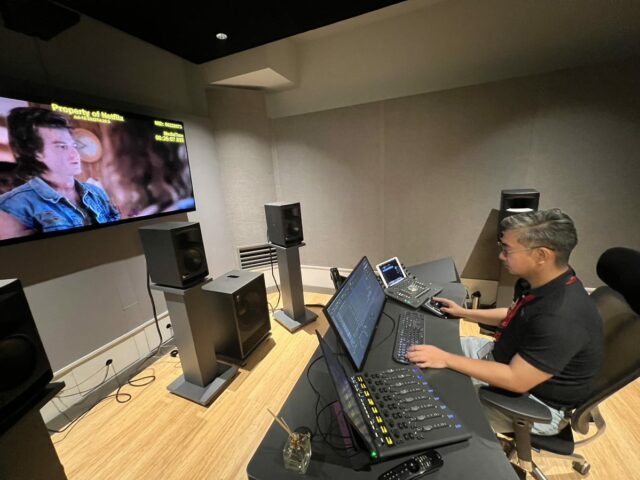
The four seasons of Stranger Things have been dubbed by HIT Productions, Inc., one of Netflix’s dubbing partners.

During a media tour of HIT’s studio on Oct. 26, we saw how Season 4 of Stranger Things was dubbed in Filipino.

Rudolfo “Rudolf” Baldonado, head of localization, briefly described the workflow of dubbing a live action material. Mr. Baldonado is the writer and director of the Filipino dubbed version of the Netflix Original Series Trese.

“We get the material, study that with the director, and then translate,” Mr. Baldonado said.

“We come up with the concept for the Filipino dub,” he added, citing that the story should be understood first and a concept for its localization follows.

When it comes to localizing foreign material, the nature of the content also dictates the translation — whether it is appropriate to translate the dialogue in full Filipino or a mix of Filipino and English.

The writers then work on the script and the directors do the casting simultaneously. The chosen voice actors and writers then meet on the day of the recording.

A full episode is not finished in a day — it may take a few days to record depending on the availability of the talent to record his or her parts.

During the recording session, actors hear the original language through their headphones and deliver the Filipino lines in sync with the delivery of the original characters. They observe the original footage on a screen while reading the translated script, and note the director’s instructions during pauses.

“Being a voice actor, halos lahat ng character, kung kaya ng boses ko, puwede kong gawin (Being a voice actor, I can do almost any character. As long as my voice is capable, I can do it.) I can be any character,” said Nelieza Magauay, who lends her voice to Stranger Thing’s Robin in the Filipino dub.

“As a voice actor, one of the things I find really fun is the idea of creating a character and giving life to a character through your voice. Just like everyone, we grew up watching cartoons…You get to appreciate the intricacies of how to bring one character to life,” said JM Torres who voiced the series’ villain Vecna.

Ms. Aguiluz recalled that a previous session where the sound engineer thought of using a term “tulok” — or “kulot” (curly) spelled backwards — when they were recording a scene with the voice actors playing Lucas, Dustin, and Steve. The term was not in the script but ended up being recorded since it fit the scene.

“One of the happiest things about being in a session are organic moments na may naisip ’yung engineer ko, or talent ko na we incorporate [to the script] as long as appropriate sa scene,” Ms. Aguiluz said.

For animation dubbing, characters tend to have bigger reactions, while for live action, voice actors have to deliver following the character’s facial expression.

“What I love about my directors and the most challenging thing is they sometimes give you characters that you don’t think fit your voice but then they push you at a certain point na suma-swak siya and that’s what’s really cool about this job,” Mr. Torres said.

In between, the sound engineers fine tune the recording prior to sound mixing which focuses on how the audio should sound depending on where the sound of an object or voice is seen on screen.

“And then after that we check everything… and then we submit,” Mr. Baldonado said.

Three to four episodes are done in one month, which their team sends to Netflix’s international office.

Once they see it on the platform, they celebrate, Mr. Baldonado said.

“Voice acting is acting. It’s about truth. So, the ability to give your heart to act and do the technical stuff — looking at the time code, timing, expression, script — ’yung pagsabayin mo ’yun (to do them altogether), it’s a very special skill that not everybody can do or obtain,” Ericka Peralejo, who voices Suzie, said.

JM Canlas, who voices Lucas, said that it is important to enjoy the work.

“[Direk Rudolf] never forgets to remind us that we have to always enjoy kasi mas maganda ’yung nailalabas na (we come out with better) output if we’re enjoying [ourselves],” Mr. Canlas said.

NETFLIX’S FILIPINO USER INTERFACE
On Oct. 21, Netflix activated a user interface (UI) available in Filipino.

This new feature allows subscribers to navigate the UI, read titles and synopses, plus watch shows and movies with Filipino subtitles, and in Filipino dubbing.

Titles such as Emily in Paris, You, and The Queen’s Gambit can now be viewed in the Filipino UI setting.

“At Netflix, we believe our members should be able to choose their viewing experience, whether it be the genre, format, or language of the content. We are very happy that our Filipino members will now have the option to enjoy their favorite Netflix content from all over the world with Filipino subtitles and dubbing, should they prefer to watch as such,” Netflix Content Director for Southeast Asia Malobika Banerji said in a statement.

The Filipino UI feature offers flexibility for Netflix users as they will be able to switch their profile to Filipino from the language option in the “Manage Profiles” section on their desktop, TV, or mobile browsers. The complete Netflix experience in Filipino is available across all devices — from member sign-up, to search function, and payment options.

Netflix subscribers can set up to five profiles in each account, with each profile having the option to choose its own language setting. The Filipino UI feature is also available to members outside the Philippines. — Michelle Anne P. Soliman

Songbird

FRED CORTES as Prinsipe Juan in Ibong Adarna (1941)

Movie Review
Ibong Adarna
https://www.youtube.com/watch?v=tceC79cLxoY

WHAT Filipino hasn’t heard of the Ibong Adarna, the magical bird whose sweet singing puts the unwary listener to sleep and whose droppings turn said listener into stone? Narcisa “Doña Sisang” de Leon (grandmother of filmmaker Mike de Leon) certainly did, and knew just how much Filipinos loved the story — so much so that she was willing to risk money on a lavish (for Filipinos anyway) film adaptation. She was right too — the production was a hit, the first Filipino film to gross over a million pesos.

The film credits Vicente Salumbides as director — but Nick Tiongson’s 2008 book on Manuel Conde claims the latter directed and gave the credit to Salumbides, keeping a “technical supervision” title for himself. Not sure how true this is, but a quick peek at their respective filmographies shows Conde had more films under his belt at this point, had worked on several productions with sound, one of which (Mahiwagang Biolin The Magic Violin) is presumably fantasy and presumably involves special effects.

Not sure, who knows — that’s a common mantra heard while writing on Philippine cinema, the documentation poor to nonexistent.

The film follows the adventures of Prinsipe Juan (Fred Cortes) and his brothers Diego and Pedro as they seek the legendary Ibong Adarna to cure their ailing father. The three meet a beggar along the way; two dismiss the old man but Juan shares his food, and here Salumbides (who’s on record as having done the adaptation) adds a clever touch: where the beggar annoys the two brothers, Juan is solicitous to the point that the elder is forced to shake him off. The little revision helps set Juan apart, make his unalloyed goodness more believable (as Stephen Hillenberg might put it, living with a pure heart is possible, they’re just impossible to live with).

The beggar rewards Juan with cunning advice (turns out a bit of lime squeezed over self-inflicted wounds keeps one awake long enough to catch the bird). Juan not just fulfills the mission but saves his brothers; they repay him by knocking him out with a club and taking the bird (and the credit) for themselves. When the ruse is exposed, Juan pleads on behalf of his brothers (as mentioned: pure of heart and irritating as hell); Pedro pays him back yet again by releasing the bird and framing Juan for carelessness; Juan goes off yet again to recover the bird — and so it goes.

The Adarna bird accounts for perhaps a fourth of the film’s running time; the remainder has Juan descending into the underground kingdom of Armenia and battling a giant to win over Princess Leonora; has him traveling by giant eagle to the distant kingdom of Reino de los Cristales to woo Princess Maria (Mila del Sol) — the man does get around. The transition from Leonora to Maria feels particularly disturbing — are princes so fickle? Actually, this isn’t a case of too many revisions to the script but of the script being faithful to the source material. The trope of a royal prince seeking and staying with his One True Love seems to be a recent Disney development; in the Grimm fairy tales, lovers switched loyalties all the time, usually as a result of some enchantment — though one might consider said “enchantment” to be more of an excuse than an explanation.

Thus Juan — otherwise of excellent character, to the point of being exasperating — seems wanting in the fidelity department. He falls for Leonora but soon as they’re separated, falls for Maria instead; when he leaves Maria at an inn and bumps into Leonora he forgets Maria and falls for Leonora again, forcing Maria to barge her way into the royal palace and remind him of previous (or subsequent previous) commitments. Bewildering fare for those used to Disney puritanism but to these eyes feels more contemporary than anything, down to the self-absorbed male buffeted by the conflicting desires of two strong-willed women.

Plus — Pedro, who betrays his brother and is once, twice, three times forgiven, finally — finally — shows some impulse at reform. Character development and redemption in a fairy tale! How progressive can you get? Given his past record, you wonder how long reformation will last, though Pedro is the rare villain with valid motivation — he was passed over in favor of young Juan in the line of succession, and may be content to settle down with a kingdom of his own.

The film itself looks odd, it has a Middle Eastern ambiance (sets by Gumercindo Buencamino and Teody Carmona, music by Francisco Buencamino — his second ever score) with a strong Western European feel (a magic carriage that could have rolled straight out of Disney’s Cinderella; a royal guest room sporting a pine tree motif; an inn fitted with Arabic windows and suspiciously Swiss-looking stairway, fireplace, chandelier).

The array of special effects, everything from hand-tinted color sequences (when the Adarna sings, the bird turns into a rainbow of bright hues) to forced perspective shots (Juan fights a near-naked giant on his way to winning Leonora’s hand) to intricate models and background paintings joined to live action by means of an optical printer. Alas, the hand-painted colors are gone; ABS-CBN, which has otherwise done us a service by cleaning up the film print, can only manage digital coloration, and you miss the flickering brush strokes of a real paint job. The forced perspective effects still work fine, and the optical printer has this added benefit — when the princes first leave to seek the Adarna, the towers and turrets of the kingdom of Berbania loom in the distance, and the slightly misty look (An accident of the optical printer?) gives the realm a dreamlike, miraculous feel.

Arguably the film’s best sequences are the early ones: when the Adarna starts singing (sweet warble by Angeles Gayoso), the monochrome image gives way to an unearthly radiance that affirms one’s belief in the miracle of cinema, where anything — even the magic of rainbows — is possible onscreen. And it’s not just effects for effect’s sake; the parable of the Adarna bird warns us against being lulled by pretty lights and lilting melodies, a warning that we Filipinos fail to heed time and time again. Stay focused, the film tells us. And if you’ve fallen asleep, for God’s sake, wake up.

PLDT earns P10.6B; capex may top P85-B guidance

BW FILE PHOTO

PLDT, Inc.’s third-quarter net income attributable to the equity holders increased 79% to P10.64 billion from P5.93 billion in the same period last year as “consumers thrived on their digital lifestyles in the new normal,” the company’s chief executive officer said.

Service revenues for the period reached P49.40 billion, up 5% from P46.87 billion in the same period in 2021, PLDT officials reported during a briefing on Thursday. Non-service revenues rose around 56% to P2.13 billion from P1.37 billion previously.

In the third quarter, the company said that its earnings before interest, taxes, depreciation, and amortization (EBITDA) grew 2% to P25 billion compared with the same period last year.

For the January-to-September period, the company saw its net income attributable to the equity holders increase 45% to P27.38 billion from P18.85 in the same period last year.

Total revenues for the period went up 6% to P152.92 billion from P143.86 billion in the previous year.

Consolidated EBITDA for the period increased by 6% or P4.3 billion to P75.4 billion. EBITDA margin was at 51%.

PLDT Chief Financial Officer Anabelle L. Chua said the company’s consolidated EBITDA is trending to cross P100 billion for the full year despite the “stressful economic conditions.”

The company’s telco core income, which excludes the impact of asset sales and Voyager Innovations, rose 10% or P2.3 billion to P25.4 billion.

“Enterprise seems to be our bright spot as we continue to empower businesses in their digital transformation and help promote the Philippines to be the next major ASEAN digital hub. Our 11th and, by far, largest data center is also on track to be completed in late 2023,” said Alfredo S. Panlilio, PLDT and Smart Communications, Inc. president and chief executive officer.

“Meanwhile, PLDT Home continues to grow despite increasing challenges to people’s wallets due to continuing high inflation and the prolonged impact of typhoon Odette,” he noted.

“We are aware of the headwinds that we face, and certainly, this will not be the last time we will encounter challenges,” he said. “What is key here is that while we continue to drive revenues by responding to our customers’ needs, we are trying to put discipline in place by focusing on strong efforts to control our operational expenses and improve operating efficiencies.”

Mr. Panlilio likewise said the company is currently reviewing its consolidated capital expenditure (capex) for 2022, “which could exceed the initial capex guidance of P85 billion.”

“Once the review is completed PLDT will issue a separate disclosure on the matter.”

PLDT is watching its capex levels, especially the impact of the weakening peso on its dollar-denominated debts and imported capex, and even capex committed in previous years and current ones, Mr. Panlilio said.

“With the disciplined effort led by our transformation office, we are trying to manage some softness in our topline, as well as tightly control our costs.”

PLDT Chairman Manuel V. Pangilinan said: “At this time that the consumer wallet is diminished — when consumer income is under threat and government finances are challenged — investments will emerge as a primary recovery tool. Hence, investments are needed, both by the government and the private sector to drive the economy forward.”

“The supreme task of nation-building is one that the group is very serious about. We help as many people as we can, especially those below the line of poverty, in partnership with government,” he said.

PLDT shares closed 2.13% lower at P1,608 apiece on Thursday.

Hastings Holdings, Inc., a unit of PLDT Beneficial Trust Fund subsidiary MediaQuest Holdings, Inc., has a majority stake in BusinessWorld through the Philippine Star Group, which it controls. — Arjay L. Balinbin

Philippine film archiving institutions seek to stand the test of time

PFA’S FACEBOOK PAGE

FILM archives in the Philippines are hoping to improve their skills and resources to keep the audiovisual heritage of the country alive despite the pandemic and economic crisis. This according to archivists during a forum on Oct. 27 organized by the Society of Filipino Archivists for Film (SOFIA) at the Cinematheque Centre Manila.

“The challenge for us is providing video and film a safe space with the proper temperature, control, and humidity. If we skimp on this, we will have nothing left in the next 10 to 20 years,” said Jeffrey S. Sonora, head of the Fernando Poe, Jr. (FPJ) Archives, at the event. He was referring to the refrigeration for storage of film reels.

The FPJ Archives in particular is working on acquiring technology such as insulated panels for industrial refrigeration and thermal imaging cameras for checking of leaks. It has also switched to solar energy to offset cooling costs.

“It takes 32 hours to scan a 2,000-foot film reel. With a movie usually made up of six reels, it takes a total of 192 hours to scan each movie,” added Mr. Sonora, as a way to give context to the tedious processes of film preservation and restoration.

Julie Ann S. Nealega, head of Probe Archives, agreed that it’s important for an archive to have its own equipment. Using an in-house digitization machine, the Probe Team, which ran documentary programs from 1988 to 2004, is working on digitally converting its 14,000 Umatic, mini DV, betacam, and magnetic tapes by 2025.

“It’s not just archival footage. Probe produced stories that are documentary-based and evidence-based, the preservation of which will help with fact-checking in the modern age,” she explained.

Currently, Probe is streaming shows on its social media platforms that contextualize its old documentaries.

ARCHIVE ENHANCEMENT
As part of the Mowelfund library and audiovisual archive’s enhancement program, the Mowelfund Film Institute (MFI) is also doing its part to preserve essential pieces of film history. Since the pandemic, it has conducted a reinventory of its materials and a redesign of its database software to encourage remote research.

The institute also has a short film digitization project in partnership with the Philippine Film Archive (PFA), focused on Mowelfund-produced films in 16-mm, 35-mm, and super 8 formats.

“The thing is, you could do research with our materials but even we, keepers of the archive, are not familiar with what we have,” said Ricky Orellana, MFI director and archivist, at the same event.

Filmmaker and film historian Nick de Ocampo has stated that we are sitting on a gold mine.

Meanwhile, the PFA under the Film Development Council of the Philippines (FDCP) is trying to catch up despite only being formalized in 2011 and remaining dormant until 2018. Private institutions filled in the archiving gaps left by government all the while.

“We did a good job of collecting all these materials, but it takes a lot of funds to be able to equip archives with the proper tools to take care of a collection,” said Don Gervin T. Arawan, PFA’s division manager.

He added that the main enemy of all archivists is time because film reels gradually deteriorate each day. To speed up the migration of analog archives to digital, partnerships among institutions must be encouraged, such as with the archiving talks facilitated by SOFIA.

“Film archives in other countries have passed their digitization process and are now bringing their content back to film. We are struggling to even reach that point,” he said. Each film costs about P1.5 to 2 million to process.

Like the other archives, the PFA is working on making its collections accessible through a localized media library and catalogue for researchers. Another ongoing project, a film heritage building, is pending as per a lease agreement for a property in Intramuros. — Brontë H. Lacsamana

Branded goods drive Century Pacific’s profit rise

CENTURY Pacific Food, Inc.’s third-quarter attributable net income climbed by 0.4% to P1.27 billion after the food products manufacturer booked higher sales led by its branded segment.

“The performance was primarily driven by the company’s branded business, which comprised the majority of its sales,” the company said in a press release on Thursday.

In the three months that ended September, the company’s topline totaled P15.87 billion, up by 12.8% from P14.08 billion last year.

Its cost of goods sold climbed by 13% to P12.18 billion from the P10.77 billion it recorded a year ago. Operating expenses in the quarter were also higher at P2.25 billion, a 19.9% climb from P1.88 billion in the previous year.

Century Pacific Chief Financial Officer Richard Kristoffer S. Manapat said plans are underway as “2023 is on the horizon.”

“We continue to see higher costs working their way into the system,” he said. “While conditions remain uncertain at this point, we have full confidence in our brands, our team, and business model to remain resilient.”

YEAR-TO-DATE PERFORMANCE
In the nine months to September, the company’s attributable net income climbed to P4.22 billion, a 6.1% jump from the P3.98 billion it posted last year.

Year to date, Century Pacific’s net revenue amounted to P46.95 billion, which is 14.3% higher than P41.08 billion a year ago.

The company said that its branded segment, which is composed of its marine, meat, milk, and other emerging businesses, drove the increase with a 17% year-on-year growth during the nine-month period.

It also added that its original equipment manufacturer, or OEM tuna and coconut exports business, registered a 5% growth year on year.

“[It was] driven by improving freight rates, easing supply chain pressures, and favorable movements in commodity prices,” the company said.

Its cost of goods sold was also higher at P35.45 billion, up by 14.1% from P31.05 billion in the previous year.

The company’s operating expenses climbed by 22.3% to P6.6 billion from P5.4 billion expenses it posted last year which the company attributed to recently launched innovations, investments and higher logistics costs.

Century Pacific owns brands and household consumer names such as Century Tuna, 555, Argentina, and Birch Tree.

On the stock exchange on Thursday, shares in Century Pacific climbed by 10 centavos or 0.41% to P24.20 apiece. — Justine Irish D. Tabile

New Dangerous Liaisons TV series ‘a prelude, origin story,’ makers say

LONDON — The latest screen adaptation of the 1782 novel Les Liaisons dangereuses by Pierre Choderlos de Laclos, imagines a backstory to its key characters as they get caught in a game of sex, power, and revenge.

The new TV series sees the passionate love affair of protagonists Marquise de Merteuil and Vicomte de Valmont turn sour in pre-revolutionary Paris. Young, poor, and traumatized by their past, the kindred spirits are driven apart as they seek a better life for themselves, eventually turning into morally corrupt rivals who use seduction and manipulation to destroy lives around them.

Earlier screen adaptations of the book include Stephen Frears’ 1988 film Dangerous Liaisons with Glenn Close, John Malkovich and Michelle Pfeiffer and 1999’s Cruel Intentions starring Sarah Michelle Gellar, Ryan Phillippe, and Reese Witherspoon.

“It is a prelude to what we see later with the book and the Malkovich version,” Australian actor Nicholas Denton, who plays Valmont, told Reuters.

“It’s their kind of origin story. We see them and we see why they become the way they are.”

The series’ creator, writer, showrunner, and executive producer Harriet Warner said she was inspired by one particular letter in the epistolary novel, in which the marquise describes creating herself to survive and to navigate the world she is in.

The details made Ms. Warner wonder who the marquise, who goes by Camille and is played by Australian Alice Englert in the series, was before. To tell that story, Warner assembled a largely female-led team around her.

“It’s interesting because my slight reservations about coming to it was as a feminist, how to love this destructive narcissist who’s Valmont,” she said.

“As key as discovering the way into Camille was the way into Valmont, that meant that you can understand his behavior. There’s a complexity, I think, that the show allows the characters that you don’t get in the novel. In the novel you have two very spoilt people, destroying women as a game.”

The eight-episode first season of Dangerous Liaisons premieres on LIONSGATE+ on Sunday. — Reuters

Alternergy, partner to develop 6.8-MW hydropower project

ALTERNERGY Holdings Corp. has partnered with Exeter Portofino Holdings, Inc. for the development of the 6.8-megawatts (MW) Lamut-Asipulo hydropower project.

“We are happy to bring in Exeter as we create transformative partnerships in promoting clean energy and impacting the lives of the people,” Eduardo Martinez Miranda, president and chief executive officer for Alternergy Mini Hydro Holdings Corp., said in a media release on Thursday.

“While the development of hydropower projects could be long-gestation, the benefits of clean and renewable power are long-term and significant,” he added.

The Lamut-Asipulo project in Ifugao is expected to start operation by 2024, with its construction to start by the first quarter of 2023.

“Exeter and Alternergy share the same commitment to sustainability and improvement of the local communities and cultural heritage,” Sara Soliven de Guzman, chairperson of Exeter, said in the media release.

With the entry of Exeter as Alternergy’s co-partner, the renewable energy company said the Lamut-Asipulo hydropower project is now in an advanced stage of development and is expected to issue a notice to proceed to early construction in the coming months.

Alternergy said that the project will harness the flow of water from the Cawayan river and convert it to clean and renewable power. The hydropower project is expected to generate about 33,270 megawatt-hours of renewable energy per year.

The company said that it also signed a memorandum of agreement with indigenous peoples as the project is located within the ancestral domains of the Kalanguya, Ayangan and Tuwali indigenous cultural communities.

It said the National Commission on Indigenous Peoples en banc has issued the “certification precondition,” which states that free, prior and informed consent had been obtained from the indigenous community.

Alternergy aims to develop up to 1,370 MW of additional wind, offshore wind, solar, and run-of-river hydro projects in the next five years. — Ashley Erika O. Jose

What to see this Week (11/04/22)

The One Hundred 

IN a quarantine hotel where overseas travelers stay in isolation to curb the spread of a contagious virus, a young woman comes across a 100-legged monster. Directed by Pakphum Wongjinda and Chalit Krileadmongkon, it stars Mike Angelo, Chanya McClory, and David Asavanond. Wannasin’s reviewer Poom Namvol writes: “The film is like a centipede with 100 legs, but each leg wants to walk in different directions. Unprepared, he took the long torso, crawling somewhere clearly. Finally, this 100-legged centipede took its bodies and tangled them all up.”

MTRCB Rating: R-13

SMC power arm to reforest sites of its battery storage

SMCGLOBALPOWER.COM.PH

SMC Global Power Corp. is planning to expand the scope of its forestation project around its new battery energy storage system (BESS) facilities.

In a media release on Thursday, SMC Global Power, the power arm of San Miguel Corp. (SMC), said it planted more than five million trees and mangroves to date under its nationwide forestation and carbon capture program.

The project aims to plant about seven million trees on 4,000 hectares of land in seven provinces.

The company said that it has to date planted trees in eight provinces, namely: Albay, Bataan, Bulacan, Davao Occidental, Negros Occidental, Pangasinan, Quezon, and Zambales.

It is planning to expand its coverage to include the areas of SMC Global Power’s battery storage facilities in Albay, Bohol, Cagayan, Cebu, Davao del Norte, Davao de Oro, Isabela, Laguna, Leyte, Misamis Oriental, Pampanga, Pangasinan, and Tarlac.

SMC Global Power is developing a total of 31 BESS facilities with a total capacity of 1,000 megawatts (MW).

SMC President Ramon S. Ang said reforestation is one of the major sustainability priorities of the entire group.

“While we have had many similar efforts initiated by our various subsidiaries in the past, [SMC Global Power] has taken it to another level, planting a record 5 million trees in just under three years, with consistently high survival rates,” he said.

SMC Global Power said the battery facilities will minimize power wastage and redirect unused capacity to remote areas.

“[Battery facilities] are regarded as the best and most sustainable technical solution to the country’s power quality and reliability issues. They are seen to balance and improve access to power nationwide,” SMC Global Power said.

At the stock exchange on Thursday, shares in SMC closed 15 centavos or 0.15% lower to finish at P98.50 apiece. — Ashley Erika O. Jose