Home Blog Page 5150

From wine to fishing tackle, retailers pray Advent calendars draw in shoppers
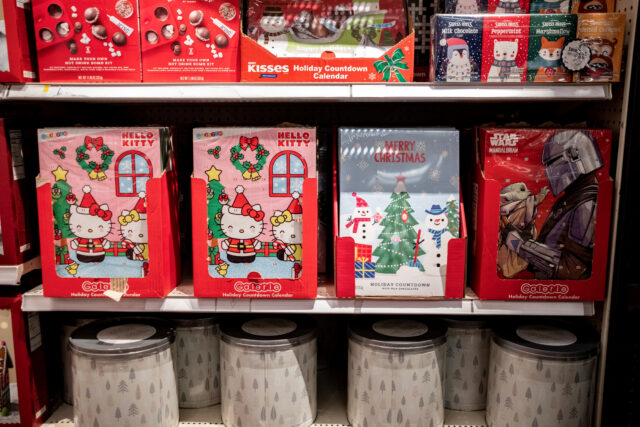
ADVENT calendars are seen at Target during Black Friday sales in Chicago, Illinois, US, Nov. 25. — REUTERS/JIM VONDRUSKA

NEW YORK — Counting the days until Christmas is a major marketing move for retailers this year. Retailers from Target to LVMH’s Christian Dior are betting that the spirit of this season can be summed up with a centuries-old religious object: the Advent calendar.

The calendars traditionally mark every day in December of Advent, a time of reflection for Christian believers and of preparation for the Nativity and expected return of Jesus Christ. Retailers’ secular versions generally sport 12, 24, or 25 small, numbered compartments, each with a unique item to be revealed daily leading up to Christmas.

Jen Cole, 45, from Biddeford, Maine, was on the hunt for a calendar for her teenage daughter at the American Dream Mall in East Rutherford, New Jersey. She purchased the Fish “Meowy Christmas” Hanging Advent Calendar for her cat from Target for $10, and a Burt’s Bees Calendar for her son from Sam’s Club for $19.48.

“He loves Chapstick, so we thought we’d try it out,” she said.

Last year, she picked up the Marvel 12 Days of Advent Calendar from JC Penney with superhero-themed socks.

Dior is selling a $3,500 Advent calendar inside a wooden and cotton canvas box fashioned like its Paris boutique on Avenue Montaigne. Open a door and slide out the drawer daily. You’ll find one of 12 fragrances, four candles, four soaps, three candle accessories, and a scented ornament.

For toddlers, Walmart sells the Baby Shark Advent Calendar, priced at $44.99. Behind 24 little doors are parts for 18 small toys, including a tiny candy-cane slide. “Count down to Fishmas,” the box beckons.

And for anglers, there’s a $34.99 fishing tackle Advent calendar with life-like and color-changing soft baits at The Fishing Shop.

Inflation is high. The economy is wobbly. Stores have too much inventory. And shoppers are mostly too cautious to splurge. Retailers see the calendars as a way to introduce products that people otherwise might not have bought or tried, nabbing an early-season sale from people who want to treat their friends, family and even pets to small luxuries.

POPULAR FORMAT
Cadbury was the first to mass produce chocolate Advent calendars in 1971. But the format has grown in popularity since minimal offerings in 2013, according to Heather Ibberson, retail analyst at EDITED, a data analytics firm.

UK-based high-end department store Liberty launched its own Advent calendar in 2014, which Ibberson said has become “the most successful and fastest-selling product in its nearly 150-year history.”

Selfridges & Co. has 128 Advent calendars priced from £4.99 to £623 this season, more than double last year’s offerings. The UK-based retailer said in early October “Advent calendar” was the highest searched term on its website and its beauty calendar sold out its first release. It claims it was the first to offer a beauty Advent calendar.

Such calendars are an effective tool to convince early holiday shoppers “to check something else out,” said Mark Cohen, director of retail studies at Columbia Business School.

“Opening the drawers of this Advent calendar is reminiscent of the experience you get on our beauty floors, in which we take you through the brands and products,” said Marissa Galante Frank, Bloomingdale’s accessories and beauty fashion director.

Advent calendars can’t stay on shelves on the seventh floor of the luxury department store Bergdorf Goodman in New York. Inside a red box with gold embroidery are 24 small sliding compartments filled with home fragrance sprays, candles, car parfums and ornaments by Italian fragrance brand Dr. Vranjes Firenze, priced at $629.

Rival Saks Fifth Avenue has 18 calendars for sale this year up from 12 in 2021, priced $65 to $3,500.

Discount supermarket ALDI said it has 25 holiday calendars. The ALDI Holiday Magic Wine Advent Calendar includes 24 unique labels and 16 wine varieties from eight countries of origin for $59.99. Each wine label has a QR code that shoppers can scan to learn more about the wine.

“The consumer is overwhelmed with an often unmanageable range of choices,” said Howard Meitiner, former President and CEO of Sephora USA. “There has been a move toward seasonal new product.” — Reuters


Ford has sold 15,000 Territory units here

PHOTO FROM FORD PHILIPPINES

A TOTAL of 15,236 units of the Territory have been sold in the Philippines since the small SUV’s launch in 2020 until September this year, according to Ford Philippines.

“Over the last three years, sales for the Territory SUV have been consistently growing with 1,925 units sold by the end of 2020, 6,881 units sold in 2021, and 6,430 units sold for the first nine months of 2022, or a 29% increase from the same period a year ago,” said the company in a release.

The Territory has cornered 52% of the small SUV market through three quarters of 2022. Said Ford Philippines Managing Director Mike Breen, “We are very happy to achieve another milestone for the Ford Territory in the Philippines — over 15,000 happy and proud owners all over the country. It is truly a representation of the trust that we receive from our customers and the great support from our dealers to enhance the ownership experience… As we see more Ford Territory SUVs being driven on the road, we can’t wait to see more Filipino customers experience the amazing features and capabilities that the Ford Territory offers.”

The Ford Territory reached its 5,000 sales milestone in June 2021, 8,000 in November of the same year, then 10,000 at the end of the first quarter of 2022.

The growing community of Ford Territory owners have lauded its capabilities and features, which include the panoramic moonroof, 360-Degree Around View Monitor, Blind Spot Information System, 10-inch infotainment system, and Apple CarPlay with wireless connectivity feature and Android Auto capability.

Ford Philippines bundles a free three-year scheduled service plan with the purchase of a Territory. Customers can also avail of a special financing program where they can get the Territory at an all-in down payment of P149,000.

CTA partially grants Lazada’s tax refund claim

CTA.JUDICIARY.GOV.PH

THE Court of Tax Appeals (CTA) has reduced the local business tax (LBT) liabilities of Lazada E-Services Philippines, Inc. to P8.17 million from P21.84 million for the years 2015 and 2017.

In a decision dated Nov. 23 and made public on Nov. 25, the CTA Special Third Division said the city treasurer of Makati City had the power to impose LBT on Lazada for those years.

The court ruled that the e-commerce platform was liable to pay the local government unit (LGU) P3.42 million for the taxable year 2015 and P4.75 million for 2017.

“Accordingly, petitioner Lazada E-Services Philippines, Inc. is ordered to pay the respondents City of Makati and City Treasurer of Makati City the reduced amount of P8,167,694.76,” CTA Associate Justice Erlinda P. Uy said in the ruling.

The tribunal also set aside the P13.67 million LBT for 2016 due to a lack of evidence.

Lazada transferred its main office to Taguig City in 2016 but retained its Makati office until it stopped doing business in Makati on Sept. 30, 2017.

The court said the firm failed to prove that the operations in the Makati office were not taxable or limited to non-revenue generating activities upon the retirement of its businessmen in Makati City.

“It is evident from the foregoing gross sales/receipts for 2017 that despite the transfer of the petitioner’s principal office to Taguig City, sales activities were still being conducted, generated, and recorded in the petitioner’s Makati office,” it noted.

Under the local government code, upon the termination of a business in the city, a taxpayer must submit a sworn statement of its gross sales or receipts for the current year to the LGU.

Taxpayers may also file a written protest with the local treasurer when contesting an assessment within 60 days.

The court noted that Lazada did contest the LBT assessment for 2015.

“The authority of local government units to impose LBT for taxable years 2016 and 2017 is not dependent on the procedural requirement of filing an application for the retirement of business but is conditioned on the business transactions conducted within their territorial jurisdiction,” it said.

“Accordingly, in view of petitioner’s (Lazada) failure to contest the LBT assessment for TY 2015, the same has become final, executory and unappealable.” — John Victor D. Ordoñez

Ukraine grain export plan to ship food aid to vulnerable countries

REUTERS

KYIV — Ukrainian President Volodymyr Zelensky hosted a summit in Kyiv with allied nations Saturday to launch a plan to export $150 million worth of grain to countries most vulnerable to famine and drought.

The “Grain from Ukraine” initiative demonstrated global food security was “not just empty words” for Kyiv, he said.

The Kremlin says food exported from Ukraine’s Black Sea ports under a United Nations-brokered plan has not been reaching the most vulnerable countries.

Mr. Zelensky said Kyiv had raised $150 million from more than 20 countries and the European Union to export grain to countries including Ethiopia, Sudan, South Sudan, Somalia and Yemen.

“We plan to send at least 60 vessels from Ukrainian ports to countries that most face the threat of famine and drought,” Mr. Zelensky told the gathering.

The summit was attended in-person by the prime ministers of Belgium, Poland and Lithuania and the president of Hungary. Germany and France’s presidents and the head of the European Commission delivered speeches by video.

A joint statement issued after the summit said that since Russia’s Feb. 24 invasion of Ukraine, the world had received 10 million tons fewer agricultural products than in the same period in 2021.

“This means that the food security of millions of people around the world is seriously threatened,” it said, blaming a Russian blockade of Ukrainian ports earlier in the conflict.

“We are convinced that we will jointly overcome the grave humanitarian and economic consequences of the global food crisis caused by Russia’s aggressive war against Ukraine,” it said.

The gathering coincided with Ukraine’s annual memorial day for Holodomor, the man-made Stalin-era famine that killed millions of Ukrainians in the winter of 1932-33.

In a video address, French President Emmanuel Macron announced a contribution of 6 million euros ($6.24 million) for the transport and distribution by the World Food Programme of Ukrainian grain to Yemen and Sudan.

“The most vulnerable countries must not pay the price of a war they did not want,” he said. — Reuters

Jennifer Lopez announces This is Me album follow-up 20 years later

EN.WIKIPEDIA.ORG

LONDON — Twenty years after she put out her album This Is Me… Then, singer and actor Jennifer Lopez announced on Friday a follow-up, This Is Me… Now, to be released next year.

The 53-year-old, who has deleted posts from her Instagram in the last few days, shared a video clip on the social media platform in which she recreated the 2002 record’s cover of herself dressed in a pink top and hat before turning into her current older self, all while saying “This is me then … this is me now.”

The 2002 album, which featured hit songs “Jenny from the Block” and “All I Have,” was inspired by Ms. Lopez’s relationship at the time with actor Ben Affleck. The couple, dubbed “Bennifer,” got engaged but called off their wedding in 2003 and split up a few months later.

They rekindled their romance last year and married in the summer.

In her Instagram post, Ms. Lopez listed the new album’s 13 song titles, including one called “Dear Ben pt. Ll.” — Reuters

MG Cebu South is 42nd dealership of brand in the Philippines

The MG Cebu South measures 210 sq.m. and features a three-vehicle showroom and a service bay. — PHOTO FROM MG PHILIPPINES

MG CEBU SOUTH joins the growing MG Philippines nationwide dealership network — providing easy access to MG products, promos, and after-sales services in the municipality of Minglanilla, Cebu. MG Cebu South is located along Cebu South Road, within the Plaza Margarita commercial complex — an area frequented by residents and guests from neighboring townships.

MG Cebu South measures 210 sq.m. and is strategically located along the periphery of Plaza Margarita, making it fully visible to all commuters and passersby who travel along one of Cebu’s major thoroughfares. The dealership is also within close proximity of other municipalities including the cities of Naga, Toledo, and Talisay.

MG Cebu South features a three-vehicle showroom with tall windows that let the light in, plus a customer lounge, and an after-sales service bay. “The Covenant Car Company, Inc. (TCCCI) and MG continue to expand the brand’s nationwide dealership network with the opening of MG Cebu South… With the new MG Cebu South dealership, MG Philippines strengthens its presence in the province of Cebu by offering attainable, modern, and stylish British heritage MGs to clients looking to make a responsible new car purchase,” said MG Philippines President and CEO Atty. Alberto B. Arcilla in a release.

The dealership is operated by the Gateway Group, an organization with extensive experience in the car dealership businesses. “Our short-term goal for MG Cebu South is to increase awareness and visibility for the MG brand in this area, while enabling customers to trust the quality and durability of our MG vehicles and making them aware of the high value-for-money proposition that MG offers. In the long term, we envision MG Cebu South to positively contribute to the continuous growth and sustainability of the MG brand here and in the rest of Cebu, while establishing a solid community of MG owners who will be more than willing to spread the good word about MG,” said Gateway Group Executive Vice-President Michael Goho.

The new MG Cebu South dealership offers test drives, along with the latest promos available from MG Philippines. It also presents clients with freebies on new car purchases. MG Cebu South also offers MG Philippines’ host of after-sales deals, including a five-year/100,000-km (whichever comes first) vehicle warranty; MG Hero Services, which provides 24/7 roadside support through the MG Philippines hotline (+632) 5328-4664; and the My MG mobile app which allows clients to easily schedule vehicle servicing appointments from their smart devices. Customers can also use the My MG App to reserve genuine spare parts and book a visit from MG Philippines’ Mobile Garage service caravan that provides MG owners with vehicle home service for major technical issues.

MG Cebu South is open from Mondays to Saturdays (8 a.m. to 5 p.m.) for inquiries, reservations and service; and on Sundays, from 8 a.m. to 4 p.m., for inquiries and reservations. For more information, contact 0917-770-1179 or visit its official Facebook page (MG Gateway-Cebu South).

To learn more about MG Philippines, visit mgmotor.com.ph and follow official Facebook (OfficialMGPhilippines) and Instagram (mg_philippines) accounts.

Ortigas Land to enter capital market within 5 years

ORTIGAS LAND Corp. is preparing its estates and planning to launch two more as it aims to enter the capital market in the next five years.

“If we plan to do an initial public offering (IPO), I would like to see six estates from four and hopefully show the market that we also can expand by another two,” Ortigas Land President and Chief Executive Officer Jose Emmanuel H. Jalandoni told reporters last week.

“What we need to do now is of course fix some of our estates. Some of them are already a bit dated like Greenhills, so we are doing a bit of redevelopment,” he added.

Mr. Jalandoni said, “[We want to] prove to the market that we can execute. We are doing well with Capitol Commons; we need to prove to the market that we can redevelop Greenhills in a proper way.”

According to Mr. Jalandoni, the company is not yet sure whether it will pursue a company listing or a real estate investment trust (REIT).

“It could be either, we can do both. It depends on what our advisors will tell us, but we’re preparing for both so we will just decide whether it’s this or that,” he said.

“We have enough commercial space for a decent REIT market capitalization. I think we will have around 200,000 square meters (sq.m.) of office space and 250,000 sq.m. of commercial malls. I think it’s big enough for us to do a REIT,” he added.

According to analysts, the main issue in the listing is the timing. Analysts say that Ortigas Land should wait for the market to be more favorable.

“It is a timing issue when market conditions are favorable, in terms of selling the shares at the highest price possible from the perspective of the sellers or issuers,” Rizal Commercial Banking Corp. Chief Economist Michael L. Ricafort said in a Viber message.

Separately, Luis A. Limlingan, head of sales of Regina Capital Development Corp., said, “It depends on what interest rates are doing at the time so it can also be a timing issue too.”

According to Mr. Limlingan, the kind of listing Ortigas Land will pursue, will depend on the company’s future strategy.

“If they plan to invest in projects earning rental income or management fees, then REITs would be more ideal. Also, if they are focusing on a specific sector — retail, office, etc. — then REITs might be a better alternative,” he said.

“If in the medium term they are looking to grow their landbank then maybe another fund-raising route might be better suited,” he added.

Meanwhile, Mr. Ricafort said that choosing to put up a REIT will give greater flexibility to the company and its investors.

“REIT would give greater flexibility for issuers and investors on the type of real estate used as underlying asset that would effectively allow investors to become lessors through dividend yields set without the hassles related to managing the leased property,” Mr. Ricafort said. — Justine Irish D. Tabile


Note: This story has been updated to change the figure previously given by the company for commercial mall space.

Rates of Treasury bills, bonds to rise as Fed seen to hike further

BW FILE PHOTO

RATES of government securities on offer this week could climb after minutes of the US Federal Reserve’s latest meeting hinted on less aggressive tightening.

The Bureau of the Treasury (BTr) will auction off P15 billion in Treasury bills (T-bills) on Monday, made up of P5 billion each in 91-, 182-, and 364-day debt papers.

On Tuesday, the BTr will also offer P35 billion in reissued 20-year Treasury bonds (T-bonds) with a remaining life of four years and nine months.

A trader said the T-bills and T-bonds on offer this week could fetch higher yields.

“Our indication for the 91-day T-bills next week will most likely move higher by 5 basis points (bps) while the 182- and 364-papers will move by 10-15 bps,” a trader said in a phone call.

For the 20-year bond, the trader said they expect yields to range between 6.5% and 6.75%.

Rizal Commercial Banking Corp. Chief Economist Michael L. Ricafort said in a text message that T-bill and T-bond yields could move higher amid less hawkish signals from the Fed.

Analysts from UnionBank Economics Research likewise said in a report that investors are pricing in a 50-bp rate hike at the Fed’s Dec. 13-14 policy meeting.

Minutes of the Fed’s policy meeting this month where they delivered a fourth straight 75-bp hike showed a “substantial majority” of policy makers agreed it would soon be appropriate to slow the pace of rate hikes.

The Fed has raised rates by 375 bps since March in its fight to cool inflation. Its next meeting is on Dec. 13-14.

Back home, the Bangko Sentral ng Pilipinas (BSP) has hiked borrowing costs by 300 bps since May to keep in step with the Fed and rein in rising prices.

Mr. Ricafort also noted that global crude oil prices further eased to near two-month lows, which could help ease inflation.

Brent crude futures settled down $1.71 or 2% to trade at $83.63 a barrel while US West Texas Intermediate crude futures were down $1.66 or 2.1% at $76.28 a barrel.

At the secondary market on Friday, the 91- 182- and 364-day T-bills were quoted at 4.1770%, 4.9237%, and 5.0810%, respectively, based on the PHP BVAL Reference Rates published on the Philippine Dealing System’s website.

Meanwhile, the 20-year paper fetched a yield of 7.6584%, while the five-year debt, the tenor closest to the remaining life of the T-bond on offer this week, was quoted at 6.6618%.

Last week, the government partially awarded the T-bills it auctioned off even as bids reached P29.452 billion, higher than the P15-billion offer.

Broken down, the Treasury borrowed P5 billion as planned via the 91-day securities, with tenders for the tenor reaching P17.371 billion. The average rate of the tenor went down by 8.9 bps to 4.375% from 4.464%, with accepted rates ranging from 4.14% to 4.513%.

Meanwhile, the government raised just P3.25 billion from the 182-day T-bills, even as bids hit P7.11 billion, above the P5-billion program. The six-month paper fetched an average rate of 4.921%, up by 8.3 bps from the 4.838% quoted for the previous week’s partial award, with the Treasury accepting offers with yields from 4.88% to 4.95%.

Lastly, the BTr awarded only P2.3 billion in 364-day debt papers, with demand reaching just P4.971 billion, lower than the P5 billion on the auction block. The average rate of the one-year paper rose by 4.2 bps to 5.142% from 5.1%. Accepted rates ranged from 5.125% to 5.15%.

Meanwhile, the reissued 20-year bonds to be offered on Tuesday were last auctioned off on Nov. 8, where the Treasury raised P30.64 billion, less than the programmed P35 billion, even as total bids reached P41.6 billion.

The bonds were awarded at rates ranging from 6.8% to 7.5%, bringing the average to 7.131% or 146.8 bps lower than the 8.599% quoted for the papers when there was first offered on Sept. 4, 2007 and also 149.4 bps below the issue’s 8.625% coupon.

The Treasury plans to raise P135 billion from the domestic market in December, or P30 billion in T-bills and P105 billion in T-bonds.

The government borrows from local and external sources to help plug a budget deficit capped at 7.6% of gross domestic product this year. — L.M.J.C. Jocson

End of cheap money for US farmers plows trouble into food production

REUTERS

CHICAGO —  Montana farmer Sarah Degn had big plans to invest the healthy profits she gleaned for her soybeans and wheat this year into upgrading her planter or buying a new storage bin.

But those plans have gone by the wayside. Everything Ms. Degn needs to farm is more expensive, and for the first time in her five-year career, so is the interest rate on the short-term debt she and nearly every other US farmer relies upon to grow their crops and raise their livestock.

“We might have made more money this year, but we spent just as much as we made,” said Ms. Degn, a fourth-generation farmer in Sidney, Montana.

The interest rate on her operating note doubled this year and will be higher in 2023. “We can’t get ahead.”

Most US farmers depend on short-term, variable-rate loans they take out after fall harvest and before spring planting to pay for everything from seeds and fertilizer to livestock and machinery. Farmers repay these loans after harvest with cash from their crops before repeating the process.

Often, farmers seek to secure loans by yearend or early January to take advantage of suppliers’ early-pay discounts and to ensure they won’t be caught short as global supplies of fertilizers and chemicals remain tight.

Now, producers are wrestling with how to pay for that debt as interest rates rise headed into the next planting season, according to interviews with two dozen farmers and bankers, as well as data from the US Department of Agriculture (USDA) and the Kansas City Federal Reserve.

This rising cost of credit is straining some producers’ liquidity and prompting them to look at reducing fertilizer or chemical use, or plant fewer seeds next spring. That, in turn, could reduce crop yields, and place upward pressure on the cost of producing that food.

All this comes as crop prices and global demand are strong. US grain and oilseed producers reaped a boon this year when crop prices hit decade- or all-time highs, as the conflict in Ukraine disrupted grain exports from the Black Sea region.

But that financial windfall came as widespread drought hobbled crops in the US Plains and caused cattle slaughter rates in Texas to soar. Fertilizer and fuel costs have risen, as have farmland prices and cash rents.

Farming “is a highly leveraged business, so about everything is financed,” said Casey Seymour, who manages a farm equipment dealership in Scottsbluff, Nebraska and runs the Moving Iron podcast. “There’s a lot of money out there being paid in interest.”

The US farm sector’s total interest expense — the cost of debt carried — is forecast to hit $26.45 billion this year, nearly 32% higher than last year and the highest since 1990, when adjusted for inflation, according to USDA data.

That sum is double or more the amount incurred by other US industries, including the retail and pharmaceutical products sectors, where interest expense historically has been similar or higher, according to US Census Bureau data.

Farmers are taking on bigger loans due to higher costs, despite the financial burden it puts on their operations. The average size of bank loans for operating a farm has surged to a near five-decade high in outright dollar terms, according to Kansas City Fed data.

The average interest rates of such loans are the highest since 2019, the data show. Most farm operating loans tend to be variable, rather than fixed. Variable-rate financing carries lower rates than fixed-rate financing, but exposes borrowers to the risk of higher costs if rates go up.

That’s exactly what happened when the US Federal Reserve started raising short-term rates to quell surging inflation. The short-term federal funds rate is now in a range of 3.75% to 4%, from a range of 0% to 0.25% in early March, just before Fed policy makers began raising rates.

Inflation is still high, however, and demand is strong, and Fed policy makers have signaled they will continue raising rates until they see broader evidence of their effect.

In agriculture, the pinch is already here: The average interest rate of all farm operating loans is 4.93%, according to the latest Kansas City Fed data. Many farmers are paying more.

Ohio corn and soybean farmer Chris Gibbs signed up for a $70,000 operating loan on May 1 with a 3.3% variable interest rate with his local lender at the Farm Credit System, a government-sponsored enterprise.

Rising fertilizer and chemical prices forced him to borrow more to cover those expenses, even as Farm Credit continued to increase costs each time the Fed hiked rates.

Now, his interest rate is 7.35%, and he expects it could reach 8% by year’s end – a 142% increase in eight months.

Mr. Gibbs raced to pay off the bulk of his loan by liquidating his crop, rather than store it and sell for potentially higher prices next summer.

Machinery purchases are on hold, and he’s trying to pay for inputs with cash. “I have the highest gross value for my crop in my history of farming,” said Mr. Gibbs, 64. “If I didn’t, I would have difficult decisions to make and looking at what I can sell.”

The financial hit is being felt on equipment dealers’ lots, where farmers are forgoing buying equipment on credit, according to interviews with four dealers. Dealers said they are seeing banks tightening underwriting standards, which can be a hurdle for newer and smaller farm operators seeking capital to purchase equipment.

“It’s easier to get financing when interest rates are cheap because are willing to take more risk,” said a CNH Industrial dealer representative, who declined to be named.

Authorized dealers from equipment manufacturers Deere & Co., AGCO, and CNH Industrial told Reuters that financing rates that the machinery manufacturers themselves offer also have more than doubled in six months. 

Farm equipment machinery loans currently have interest rates up to 7.65% at Deere, 7.8% at CNH Industrial, 8.14% at AGCO and 8.25% at Ag Direct, according to industry sources.

The industry average nationwide is 5.86%, according to Kansas City Fed data.

In separate statements, Deere and AGCO said interest rates they offer depend on loan terms, borrower creditworthiness and equipment type. CNH Industrial said interest rates for larger equipment are lower than rates for smaller machinery. — Reuters

Star of 1980s classics Fame and Flashdance, Irene Cara, 63

IRENE CARA in a scene from the 1980 film Fame.

IRENE CARA, the Oscar- and Grammy-winning actress and singer-songwriter best known for her work in the 1980s cult movies Flashdance and Fame, has died, her publicist said on Saturday.

Ms. Cara, 63, passed away at her Florida home, her publicist Judith Moose said in a statement posted on Twitter, and the cause of death is currently unknown.

“She was a beautiful gifted soul whose legacy will live forever through her music and films,” the statement read.

Ms. Cara’s career in show business began at an early age and spanned theater, television, music, and film. The artist got her big break in 1980 when she was cast to play Coco Hernandez in the iconic movie-musical Fame, which chronicled the vicissitudes of a group of New York City high schoolers.

The musical drama’s title song, sung by Ms. Cara, would go on to win an Academy Award for Best Original Song and earned the artist two Grammy Awards nominations, among other recognitions.

Ms. Cara’s rise to Hollywood stardom continued in the following years. In 1983 she co-wrote and sang the title song for the blockbuster movie Flashdance, which landed Cara the coveted Academy Award for Best Original Song and became one of the defining songs of the decade.

Moose, the publicist, said a memorial for Ms. Cara’s fans “will be planned at a future date,” and funeral services for the artist are pending.

Tributes to Ms. Cara poured in on social media on Saturday.

“Irene Cara, you inspired me more than you could ever know. Your songwriting and vocals created pure energy that will never cease,” musician Lenny Kravitz said on Twitter. — Reuters

MPTC unboxes ‘Download, Drive, and Win’ promo

Two MG ZS units will be given away. — PHOTO FROM MPTC

THE METRO PACIFIC Tollways Corp. (MPTC) — operator of the CCLEX, CAVITEX, CAVITEX C5 Link, CALAX, NLEX, NLEX Connector, and SCTEX — and MPT Mobility unveil a 2022 holiday raffle promo, dubbed “Download, Drive, and Win” via the MPT DriveHub application.

Brand-new MG ZS crossovers will be given away to two lucky MPT DriveHub app users, and 10 more will be gifted with P100,000 in cash each.

Current app users of Easytrip or the CCLEX RFID are automatically in the running when they download the app via the App Store or Google Play Store. The app can be used across all MPTC expressways.

Once successfully registered, the users can earn rewards points which will be converted into raffle entries. Rewards points earned will be capped at 24 points per month until Jan. 31, 2023 and each reward point earned will be converted to an equivalent of one raffle entry.

Downloading the MPT DriveHub app, registering an account, and linking an Easytrip or CCLEX RFID account earns a point. Referring a friend who will download the MPT DriveHub app and register an account gets five points, while downloading the app and registering an account through a referral link gets a point. Each P200 loaded on an Easytrip RFID using the MPT DriveHub app earns a point. The Easytrip RFID load can only be used to pass the MPTC Tollways and nothing else; it is non-transferable or refundable. Points are not cumulative and are counted per reload of the Easytrip RFID.

“We’re very excited for the lucky winners,” said MPTC President and CEO Rodrigo E. Franco. “The point of ‘Download, Drive, and Win’ is to show our appreciation for our customers, and with people’s renewed enthusiasm to travel, we want to reward them in a manner befitting the holiday season.”

For more information, follow MPT DriveHub on Facebook.

Earnings data, digitalization news lift Security Bank stock

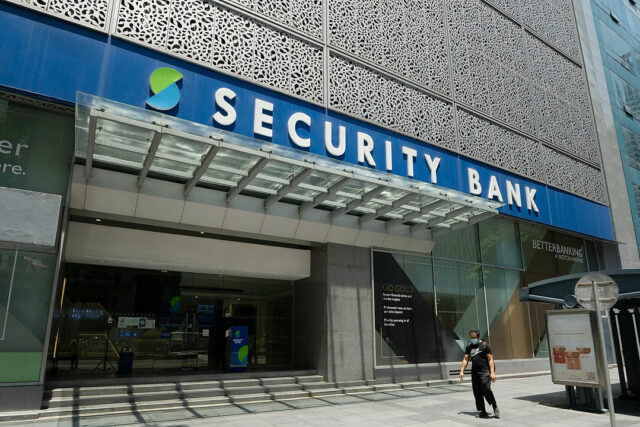
SECURITY BANK/BW FILE PHOTO

SHARES in Security Bank Corp. moved upward as market players assessed its latest earnings report as well as its partnership with Consolsys, the Malaysia-based automation company that will handle the listed bank’s move to go digital.

Data from the Philippine Stock Exchange (PSE) show Security Bank ranking 17th in value turnover with P556.09 million worth of 5.86 million shares changing hands from Nov. 21 to 25.

The bank’s shares closed at P96 apiece on Friday, up by 4.4% from its Nov. 18 close. For the year, the stock has decreased by 19.3%.

Joylin F. Telagen, research head at IB Gimenez Research Securities, said the stock’s movement was a continuation of its upward trajectory after the bank reported better-than-expected third-quarter and nine-month earnings.

“Coupled by Fed minutes that they might start to slow down the future increases, with possible 50 basis points increase in federal funds rate next month, Dec 13-14,” Ms. Telagen said in an e-mail.

Mercantile Securities Corp. Head Trader Jeff Radley C. See said in a separate e-mail that overall market sentiment pushed the listed bank’s share price higher.

“Last PSE Index rebalancing, SECB was taken out thus dropping to as long as P80,” Mr. See added, referring to Security Bank’s ticker symbol. “SECB is undervalued among the other actively traded banks.”

In July, the PSE announced changes in the composition of the local stock barometer, the PSE index or PSEi. Consunji-led Semirara Mining and Power Corp. replaced the bank in the main index starting on Aug. 8.

Meanwhile, Reuters reported that a “substantial majority” of policy makers at the US Federal Reserve agreed that it would “likely soon be appropriate” to slow the pace of interest rate hikes as debate broadened over the implications of the US central bank’s rapid tightening of monetary policy.

The meeting showed officials were satisfied that they could move rates in smaller, more deliberate steps as the economy adjusted to more expensive credit and concerns about “overshooting” seemed to increase.

Back home, reports last week said Security Bank tapped Consolsys to shift its branch banking management system to a state-of-the-art digital, cloud-based, omnichannel platform.

Under the partnership, the listed bank’s current tellering, lobby management, and signature verification system (SVS) are to be replaced with Mosaic Voyager.

Mosaic Voyager is a cloud-based omnichannel delivery system that reduces inefficiencies, increases overall productivity, and provides an avenue for increased touchpoints.

According to Security Bank, once the system has been fully implemented, the comprehensive and transformative system would enhance its capability to provide a truly differentiated experience for transacting customers, boost operational efficiency, and propel the bank forward in its digital banking transformation.

Ms. Telagen said that fundamentally, the news was taken positively by long-term investors because of its impact on future revenue streams.

However, she cautioned that the risk of stagflation still lingers.

For Mr. See, market players took the news positively.

“Very positive news as there are updates on their company and an institution wants to have more stake in their company,” he said.

Security Bank reported around a 34% increase in its attributable net income to P2.31 billion in the third quarter from P1.72 billion in the same period in 2021. Gross revenues grew by 11.5% to P10.18 billion from P9.13 billion in the same period last year.

The quarterly growth brought its nine-month attributable net income to P8.56 billion, up by 77% from P4.83 billion a year ago. Revenues climbed by 7.1% to P29.41 billion from P27.47 billion previously.

Ms. Telagen sees the bank’s earnings for the fourth quarter to reach P2 billion and expects attributable net income for the entire year to hit P10 billion.

She added the earnings expectations would depend on whether market players would consider investing or trading in the listed bank.

On a technical note, she said the bank had broken a long-term uptrend and is now on a downtrend. She added that “it’s much better to wait a bit and buy when it’s back to its long-term uptrend or breakout from the current downtrend. Trade or invest cautiously.”

Ms. Telagen pegged Security Bank’s support level at P77 while its resistance level at P124.

For Mr. See, the stock is currently trading at overbought levels.

“Investors will be seeing some profit taking possibly next week. Support levels are P93 and P88, while resistance levels are P100 and P104.” — Abigail Marie P. Yraola