Home Blog Page 506

Zara turns to AI to generate fashion imagery using real-life models

LONDON — Zara has become the latest fast-fashion retailer to use artificial intelligence (AI) to help create new images of real models in different outfits, speeding up the production process as part of an industry shift that could have a major impact on fashion photography.

Zara’s AI experimentation follows Swedish rival H&M, which earlier this year said it had created AI clones of models to use in marketing. European online fashion retailer Zalando is also using AI to create imagery faster.

“We are using artificial intelligence only to complement our existing processes,” a spokesperson for Zara owner Inditex said in a statement. “We work collaboratively with our valued models — agreeing any aspect on a mutual basis — and compensate in line with industry best practice.”

Zara’s move was first reported by London business-focused newspaper CityAM, which cited an unnamed model saying Zara asked for approval to edit images of them with AI to show different items, and that they were paid the same amount as if they had traveled for another photo shoot.

H&M and Zalando, like Inditex, have said AI would complement their creative teams’ processes and help them be more efficient rather than replacing them, downplaying the risk to photographers and production teams who work on fashion shoots.

Inditex chair Marta Ortega, daughter of the founder Amancio Ortega, has spoken in interviews about her passion for fashion photography.

Since 2021 her MOP (Marta Ortega Perez) Foundation gallery in A Coruna, the town in northern Spain where Zara was founded, has hosted exhibitions showcasing the work of major photographers.

It is currently showing Annie Leibovitz’s fashion photography, and previous exhibitions have spotlighted photography greats Steven Meisel — with whom Zara has worked extensively — and Helmut Newton.

Ms. Ortega has tried to move Zara upmarket, cutting store numbers to focus on fewer, bigger flagships with a more spacious, sophisticated feel.

Isabelle Doran, chief executive officer of the Association of Photographers in London, said the use of AI would reduce the number of times photographers, models, and production teams are commissioned, impacting a whole ecosystem of established professionals as well as early-career fashion photographers trying to get a foothold in the industry. — Reuters

ALI shares dip despite developments

AYALALAND.COM.PH

STOCKS of Ayala Land, Inc. (ALI) inched down weekly despite promising announcements as external factors dragged markets, analysts said.

Data from the Philippine Stock Exchange (PSE) website showed ALI ranking sixth last week among most actively traded stocks by value, as 72.16 million shares worth P1.60 billion exchanged hands up to Friday.

The stock closed the week with a value of P21.30, lower by 1.8% from the previous Friday’s P21.70. The property sector and the PSE index (PSEi) were likewise on the red week on week as the former declined by 1.3% and the latter by 1.9%.

Ayala Land saw an even sharper drop of 18.5% year to date from its P26.20 close on the last trading day of 2024, outpacing the downward movements of the property sector (6.5%) and PSEi (9.3%) during the span.

The price dip came despite a couple of welcome moves made by the company over that week.

On Tuesday, ALI announced the P13.5-billion sale of its 50% stake in Alabang Town Center to the Madrigal family.

The company said that proceeds from the sale will be used to support leasing growth plans in the future.

Aniceto K. Pangan, equity trader at Diversified Securities, Inc., said that the company “unlocked a premium value from its mature asset” through the sale to help boost its leasing portfolio and “provide better returns to its capital.”

Additionally, Ayala Land also announced the launch of its second CityFlats living development in Cebu the previous Friday.

CityFlats properties aim to cater to residential- and working-space needs of young professionals and students — cutting down affordability and travel issues for the targeted stakeholders.

“Taken together, the Alabang Town Center stake sale and the CityFlats Cebu launch are both relatively good news […] even so, ALI shares still fell, which suggests the market move was likely driven by external factors,” Luis A. Limlingan, head of sales at Regina Capital Development Corp., added in a Viber message.

On Thursday, the PSEi’s downward movement already began as it inched down 0.78% to end at 6,031.48.

Analysts said the sell-off was due to the market lacking catalysts for the week and instead setting its eyes on upcoming US inflation data which may set the tone for the Fed’s outlook.

Banks’ exposure to the property sector also slipped in the July-September period.

Data from the Bangko Sentral ng Pilipinas showed that the banking sector’s real estate investments over the span slipped by 5.75% to P354.75 billion from P376.41 billion last year.

Analysts said the exposure eased due to higher nonperforming real estate loans in the quarter due to muted developments amid weaker demand.

Moreover, Mr. Pangan noted that valuation for ALI was low with its price in the week, citing its decline to levels lower than those seen during the pandemic.

According to PSE data, ALI shares dropped by 38% from its closing price of P34.35 at year-end 2020.

Moving forward, Mr. Limlingan said that Ayala Land investors may monitor updates on project launches, capital spending plans, and changes in real estate demand.

For this week, Mr. Pangan placed immediate support at P20 and immediate resistance at P22.70.

On the other hand, Mr. Limlingan pegged support and resistance at around P21-20 and P23-24.50, respectively. — Matthew Miguel L. Castillo

USDA not likely to issue more farm aid

REUTERS

WASHINGTON — The US Department of Agriculture (USDA) is not considering issuing more farm aid beyond its recently announced $12-billion package meant to help farmers weather poor economic conditions, said Richard Fordyce, the undersecretary for farm production and conservation.

Farmers are facing low crop prices, high costs of agricultural inputs like fertilizer and the impacts of President Donald J. Trump’s trade war, which has shrunk exports of some crops. While farmers welcomed news of the $12-billion package earlier this month, they warned that it would not make them whole or rescue the sagging farm economy.

Farm losses this year could reach $44 billion, according to an estimate from North Dakota State University.

Mr. Fordyce said the USDA was aware the aid would fall short, but is not considering further assistance in part due to funding limitations.

“At this point, we feel like we’ve kind of done what we can do. I don’t know what next year will bring, but at this point, we’re where we’re going to be,” Mr. Fordyce said.

Trump administration officials have said the aid should serve as a stopgap until new farm supports from Mr. Trump’s tax and spending bill take effect, like higher reference prices for crops.

The aid program allocates $11 billion to row crops like corn, soybeans and wheat, and $1 billion to fruits, vegetables and other “specialty crops.”

Mr. Fordyce said the agency has still not finalized how that $1 billion will be issued but that it is soliciting data and input from farmers.

Agriculture Secretary Brooke Rollins has said that aid payments will be disbursed by Feb. 28. — Reuters

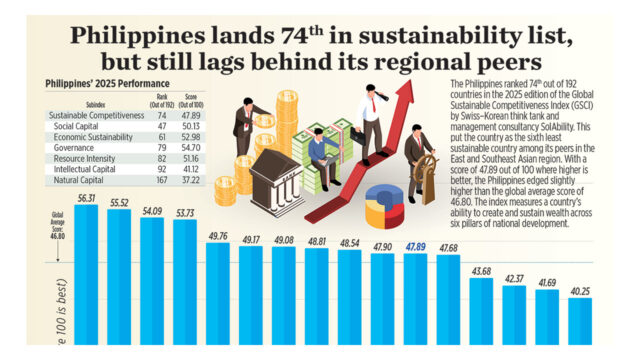
Philippines lands 74th in sustainability list, but still lags behind its regional peers

The Philippines ranked 74th out of 192 countries in the 2025 edition of the Global Sustainable Competitiveness Index (GSCI) by Swiss–Korean think tank and management consultancy SolAbility. This put the country as the sixth least sustainable country among its peers in the East and Southeast Asian region. With a score of 47.89 out of 100 where higher is better, the Philippines edged slightly higher than the global average score of 46.80. The index measures a country’s ability to create and sustain wealth across six pillars of national development.

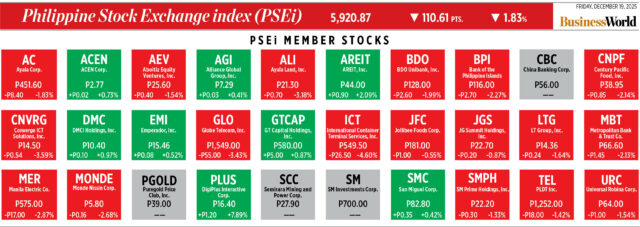
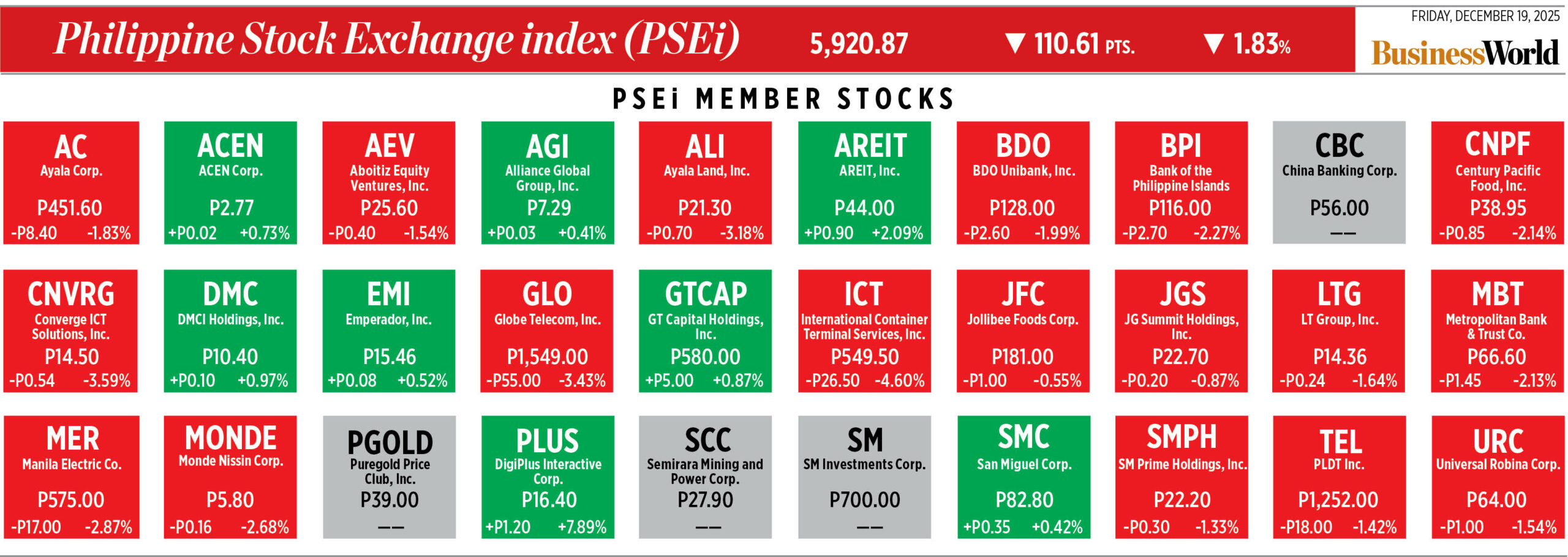
How PSEi member stocks performed — December 19, 2025

Here’s a quick glance at how PSEi stocks fared on Friday, December 19, 2025.


Shares may move sideways before holiday break

PHILIPPINE STAR/KRIZ JOHN ROSALES

PHILIPPINE SHARES may trade sideways this week as investors stay cautious ahead of the holiday break and amid a lack of catalysts.

On Friday, the bellwether Philippine Stock Exchange index (PSEi) dropped below 6,000 again, falling by 1.83% or 110.61 points to end at 5,920.87, while the broader all shares index declined 1.42% or 49.24 points to close at 3,397.72.

Week on week, the PSEi decreased by 115.85 points from its 6,036.72 close on Dec. 12.

“The local bourse’s early-week momentum dissipated Friday as pre-holiday de-risking pulled the PSEi below the 6,000 psychological floor,” 2TradeAsia.com said in a market note.

“The local market declined last week with investors immediately taking gains from the prior week’s rally, as trust towards the local economy’s growth prospects remains weak. Ultimately, anemic confidence remains as the local market’s main problem,” Philstocks Financial, Inc. Research Manager Japhet Louis O. Tantiangco said in a Viber message.

Mr. Tantiangco said the market could continue to move sideways during this shortened trading week. Philippine financial markets are closed on Dec. 24-25 for the Christmas holidays.

“Investors are expected to maintain their cautious stance. Investors may sell positions to shield themselves from any possible negative developments over the holidays. Investors are also expected to watch out for fresh leads,” he said.

“On a positive note, the local currency’s appreciation, if it continues, is expected to provide support to the local bourse. Given all of these, next week, the market could move sideways.”

He added that with the PSEi returning to the 6,000 level last week, the market may continue to move within this range.

“The market’s MACD (moving average convergence/divergence) line is about to cross the signal line. If this continues, it will signal bearish momentum for the bourse. If the market is unable to get back above 6,000, its next support is seen at 5,800.”

“Locally, the approaching holiday break points to thin trading volumes, with most funds shifting focus toward 2026 positioning,” 2TradeAsia.com said.

It said the market remains cautious amid governance risks due to the lingering concerns over the scandal surrounding the use of public funds for allegedly anomalous infrastructure projects.

“Next year’s theme centers on identifying rebound angles in undervalued cyclicals and defensives, supported by resilient consumption and potential infrastructure acceleration,” it said.

“With holiday liquidity potentially capping downside and valuations offering attractive entry points, disciplined accumulation in quality names positions portfolios well for 2026 upside.”

It placed the PSEi’s immediate support at 5,800 and resistance at 6,000, with secondary resistance at 6,100. — Alexandria Grace C. Magno

PEZA expects more ecozone proclamations early next year

FILINVESTINNOVATIONPARKS.COM

THE Philippine Economic Zone Authority (PEZA) said it is expecting additional economic zones (ecozones) to be proclaimed by January, and is targeting 30 new ecozones next year.

PEZA had in October given an estimate of 14 proclamations by year’s end, but now sees the approvals to start coming next month.

“We wrote a follow-up letter to the Executive Secretary (ES). Developers have been meeting with the ES. They were told that by January, there’s going to be another release of newly proclaimed eco-zones,” PEZA Director-General Tereso O. Panga said on the sidelines of the agency’s 30th anniversary event last week.

Mr. Panga said PEZA is also targeting 30 new ecozones in 2026.

Since 2022, 35 new and expanded ecozones have been proclaimed, according to PEZA.

“Most of them (are) strategically located in the countryside to promote regional development. And we have more in the pipeline, including new public economic zones in the Bicol region and in Palawan,” Mr. Panga said at the event.

The Office of the President issues proclamations that designate specific sites as special economic zones, upon the recommendation of PEZA.

Mr. Panga said PEZA is trying to locate ecozones in new areas. “They can only attract investment when there are new locations for development. We’re trying to locate in new growth areas,” he said. — Vonn Andrei E. Villamiel

Sugar import ban extended until December 2026

BOC - PUBLIC INFORMATION AND ASSISTANCE DIVISION (BOC-PIAD)

THE Department of Agriculture (DA) said the ban on importing sugar will be extended until December 2026 to protect domestic producers, who are expected to post strong output.

“Based on the current outlook for sugar production and demand, a longer import moratorium than initially suggested is necessary,” Agriculture Secretary Francisco P. Tiu Laurel, Jr. was quoted as saying in a statement.

Sugar imports were halted in October to encourage traders to purchase domestic sugar and prop up prices.

Mr. Laurel said domestically produced sugar should be prioritized to stabilize the market.

The DA said it will also step up monitoring of refinery operations to maintain accurate data on standard and premium-grade refined sugar inventories. Mr. Laurel said this is critical to prevent supply distortions and speculative pricing.

The DA and the Sugar Regulatory Administration (SRA) are also finalizing a regulatory framework governing molasses imports to shield domestic producers.

Under the proposed rules, the DA said molasses users will first be required to purchase and withdraw domestically produced molasses before applying to import, subject to a pre-determined ratio and the SRA’s approval. — Vonn Andrei E. Villamiel

Industrial policy deemed key to elevating PHL to UMIC status

PPA POOL

By Aubrey Rose A. Inosante, Reporter

THE Philippines needs to make public spending more transparent and assign more weight to industrialization to achieve upper middle-income country (UMIC) status, analysts said.

The road to UMIC status, a long-stated government objective, is now expected to face further delays, possibly to 2027, due to cooling economic growth, they added.

“Better transparency on public spending and strong industrial policy are the key to reaching UMIC status,” Oikonomia Advisory and Research, Inc. economist Reinielle Matt M. Erece told BusinessWorld via Viber.

A corruption scandal in infrastructure projects surfaced after heavy rains in July, which exposed flood control works that were substandard or even non-existent. It resulted in an overhaul of the Department of Public Works and Highways, whose disbursements were subjected to greater scrutiny, slowing down public spending and damaging investment confidence.

Mr. Erece also noted that the government may find it challenging to achieve UMIC status unless the gross domestic product (GDP) growth expands by at least 7%.

“Even if we reach that pace in 2026, we may only reach UMIC status by 2027,” he added, noting that this projection represented the optimistic scenario.

This will take longer than the government’s target of achieving UMIC status by 2026. The Philippines has been classified as lower middle-income since 1987.

“It’s going to be quite a challenge to do that. (Economy Secretary Arsenio M.) Balisacan already said he’d want 6 to 7% growth to have a strong chance of achieving that goal,” Ser Percival K. Peña-Reyes, director of the Ateneo Center for Economic Research and Development, said via Viber.

Finance Secretary Frederick D. Go last week said he remains optimistic the Philippines can achieve UMIC status by 2026, assuming a rebound in economic growth.

“Our strategy is to grow the economy and make sure that no one is left behind,” Mr. Go told reporters on Dec. 18.

The Philippines’ gross national income per capita stood at $4,470 in 2024, up from $4,230 a year earlier, according to the World Bank’s country income classification issued in July.

The Philippines was $26 short of the threshold of $4,496 to be reclassified as an UMIC. The upper end of the UMIC band is $13,935.

Securing up to 7% GDP growth is likely out of reach, with Mr. Balisacan conceding that the Philippines may not even hit 5.5 to 6.5% goal this year.

“If public spending continues to be tight, and more politicians continue to want to cut spending rather than improving transparency measures, GDP growth will continue to falter,” Mr. Erece said.

Analysts also lagged the peso’s recent weakness as a potential risk to UMIC status, but some said it could support exports, with remittance inflows also cushioning the currency’s depreciation.

Mr. Peña-Reyes said he sees the weak peso as a concern but noted that the central bank is intervening to stabilize the currency.

The central bank said it is intervening in the foreign exchange market to dampen volatility in the peso, thought it has no target rate against the dollar.

“We don’t always intervene. We’re kind of shy about intervening. But if we do decide to intervene, we’re more likely to do it when the market is going crazy,” Bangko Sentral ng Pilipinas governor Eli M. Remolona, Jr. said.

The peso breached the P59-to-the-dollar mark several times since November and hit a record low of P59.22 on Dec. 9.

Mr. Go has said that the peso could be one of the obstacles to the UMIC transition, as the World Bank income categories are set in dollars.

“Even if we grow in pesos, if the foreign exchange rate works against us, that’s the problem,” Mr. Go said.

Mr. Erece said the depreciation of the peso is an economic risk, but does not consider it a “major risk” in achieving UMIC.

“A depreciated peso may even be helpful in boosting export demand due to competitive prices, and OFW (Overseas Filipino Workers) remittances may also offset the falling peso,” he said.

The weak peso can make the exports more competitive, Mr. Erece said.

“Thus, a strong industrial policy is also needed to boost the economy and create more jobs. If the government is concerned about higher import costs due to the falling peso, a strong industrial policy is much more needed to create competitive domestic industries, which may even absorb some of the demand away from imports,” he said.

Foundation for Economic Freedom President Calixto V. Chikiamco said pursuing UMIC status is irrelevant, as it does not account for how income is distributed.

“The fact that a fluctuating figure like the exchange rate affects the milestone emphasizes its artificiality,” he told BusinessWorld via Viber.

Mr. Chikiamco said the UMIC transition is “nothing to celebrate and nothing to keep watching over,” as it affects the country’s eligibility for access to cheap loans or multilateral assistance.

Achieving UMIC status would mean the Philippines would have reduced access to official development assistance from development partners.


Budget utilization rate hits 94.5% in November

BW FILE PHOTO

THE cash utilization rate of government agencies hit 94.5% at the end of November, the Department of Budget and Management (DBM) said.

In a report released Dec. 19, the DBM said the National Government, local governments, and government-owned and -controlled corporations used P4.32 trillion worth of notices of cash allocation (NCAs) issued during the period.

Unused NCAs amounted to P249.78 billion, as of the end of November.

The cash utilization rate compares with the year-earlier pace of 94%.

NCAs are quarterly disbursement authorities issued by the DBM to agencies, allowing them to withdraw funds from the Bureau of the Treasury for their spending needs.

During the 11 months, line departments used P3.15 trillion, or 92.9% of their allotments, while P241.90 billion remained unused.

The Department of Migrant Workers posted the highest utilization rate of 99.4% at the end of November.

This was followed by the Department of Social Welfare and Development (97.5%), the Office of the Vice-President (95.8%), the Commission on Human Rights (95.6%), and the Department of Education (95%).

The Department of Energy and the Commission on Elections posted the lowest usage rates of 62.5% and 67.7%, respectively.

Budgetary support to state-run firms was 98.6% utilized, while allocations to local government units amounted to 99.4%. — Aubrey Rose A. Inosante

NGCP approved to build P13-B CamSur substation

BW FILE PHOTO

THE Energy Regulatory Commission (ERC) granted approval to the National Grid Corp. of the Philippines (NGCP), which is seeking to build the Milaor 500-kilovolt Substation Project in Camarines Sur to accommodate the additional power to be generated by offshore wind farms.

In a decision promulgated on Dec. 18, the ERC called the P13-billion project a necessary component of the NGCP’s expansion plans.

The regulator said cost recovery will be determined after expenses are validated in the next rate reset process.

Camarines Sur is expected to host several energy projects, including offshore wind farms. Developers with offshore wind power projects in the province have targeted commissioning of their projects as early as 2027.

The NGCP said the substation will provide a connection point for the proposed bulk offshore wind power plants in Camarines Sur to the grid.

The Philippines hopes to generate initial power from offshore wind by 2028.

The NGCP also said the substation will complement the planned increase in the transfer capacity of the Luzon-Visayas link by upgrading the high-voltage direct current system’s transfer facility from 440 megawatts (MW) to 880 MW.

The ERC directed the grid operator to complete the installation and commissioning of one of the two 1,000-megavolt-ampere power transformers at the substation by 2027, with full completion scheduled by Aug. 31, 2030.

“Non-compliance therewith will result in administrative penalty provided under relevant laws, and pertinent rules and regulations of the Commission,” the ERC said.

The Commission also ordered NGCP to pay a P97.2-million permit fee.

Under a congressionally granted 50-year franchise, the NGCP has the right to operate and maintain the transmission system and related facilities, and to exercise the right of eminent domain as needed to construct, expand, maintain, and operate the transmission system.

NGCP’s capital expenditure projects must be approval by the ERC under Republic Act No. 9136 or the Electric Power Industry Reform Act. — Sheldeen Joy Talavera

Go sees continued role in attracting investment following move to DoF

Office of the Special Assistant to the President for Investment and Economic Affairs Secretary Frederick D. Go — PHILIPPINE STAR/KRIZ JOHN ROSALES

FINANCE SECRETARY Frederick D. Go will continue to assist President Ferdinand R. Marcos, Jr. in screening global investors next year, after he relinquished his position as the government’s chief investment adviser.

Mr. Go said he will “continue to help coordinate and support the investment promotion activities of the government” as the new Secretary of Finance.

His previous posting was as head of the head of the Office of the Special Assistant to the President for Investment and Economic Affairs (OSAPIEA), starting 2023, until his appointment to the Department of Finance (DoF) on Nov. 13.

Despite the abolition of the OSAPIEA, Mr. Marcos appointed former Deputy Treasurer and World Bank Executive Director Erwin D. Sta. Ana as undersecretary for economic affairs.

“For example, there are overseas plans next year of the President. So again, we will meet some of the most serious investors or interested investors in the Philippines,” Mr. Go told reporters on Dec. 18.

He will also vet prospective investors and recommend those that Mr. Marcos should meet.

“I’ll continue to help with investments. That’s what we really need. It’s all about job creation, increasing the number of jobs,” he said.

Foreign direct investment net inflows fell 25.8% to $320 million in September, the lowest monthly level in over five years, the Bangko Sentral ng Pilipinas reported. This brought the nine-month tally to $5.537 billion.

Mr. Go said 10 staffers from his former OSAPIEA team will remain with the Office of the President to assist on investment matters.

Mr. Go said he would like reforms like the Public-Private Partnership Law and the Corporate Recovery and Tax Incentives for Enterprises to Maximize Opportunities for Reinvigorating the Economy Act tax incentives to play a key role in attracting investment.

He added that the Accelerated and Reformed Right-of-Way Act, the Land Lease for Foreign Investors Act, and the Philippine Mining Fiscal Regime Act should be broadened.

Mr. Go said the Department of Trade and Industry (DTI) remains the key agency in trade negotiations, with the DoF’s input to be required on issues that involve taxation.

“I’ll still be very much involved because in trade negotiations, majority of the discussion are tariff considerations. So as Secretary of Finance, again, no choice but I’ll be actively involved,” he said.

Mr. Go as head of OSAPIEA had been a key member of the delegation that negotiated tariff arrangements with the US after Washington imposed its reciprocal tariff regime in April. 

The DTI has that most Philippine agricultural products, valued at more than $1 billion, were declared exempt from the 19% reciprocal tariff by virtue of a US executive order which took effect on Nov. 13. — Aubrey Rose A. Inosante