Home Blog Page 5014

Malaysia says Beijing concerned about its energy projects in South China Sea

REUTERS

KUALA LUMPUR – Malaysian Prime Minister Anwar Ibrahim on Tuesday said Beijing has expressed concerns about energy activities by Malaysian state firm Petronas in the South China Sea, even though Kuala Lumpur believes the projects are in its territory.

Anwar’s remarks come after he opened the door for negotiations with China earlier this week, in a sign of mounting pressure on Malaysia’s energy operations in waters that Beijing claims as its own.

China claims sovereignty over almost the entire South China Sea, through which about $3 trillion worth of ship-borne trade passes annually. Malaysia, Brunei, the Philippines, Taiwan and Vietnam have some overlapping claims.

Petronas operates oil and gas fields within Malaysia’s 200-mile exclusive economic zone (EEZ) and has in recent years had several encounters with Chinese vessels.

China was worried that “Petronas has carried out a major activity at an area that is also claimed by China,” Anwar said, responding to a parliamentary question about his discussions on the South China Sea during his visit to China last week.

“I stressed… that Malaysia sees the area as Malaysian territory therefore Petronas will continue its exploration activities there,” Anwar said, without specifying an offshore project or a location.

But Malaysia is open for negotiations “if China feels this is their right”, Anwar said, adding the Association of Southeast Asian Nations bloc feels that overlapping claims should be resolved by negotiations.

Petronas declined to comment and the Chinese embassy in Kuala Lumpur was not immediately available for comment.

China claims its territory via a “nine-dash line” on its maps, which cuts into the EEZs of Vietnam, the Philippines, Malaysia, Brunei and Indonesia.

The Permanent Court of Arbitration, however, ruled in 2016 that the nine-dash line, which stretches as far as 1,500 km off its coastline, has no legal basis.

US think tank, the Asia Maritime Transparency Initiative (AMTI), last week said a Chinese coast guard vessel was for the past month operating near Petronas’ Kasawari gas development off Malaysia’s Sarawak state, and came as close as 1.5 miles of the project. A Malaysian navy ship was in the area, AMTI said.

The Kasawari field holds an estimated 3 trillion cubic feet of gas reserves and is expected to start production this year.

China foreign ministry on Monday said they were not aware of the specific incident but said the conduct of the China coast guard is beyond reproach.

Anwar, in his parliamentary comments, said China believes its ships were in international waters.

Malaysia’s foreign ministry will issue a protest note if there were “collisions” between Malaysian and Chinese vessels there, Anwar said. — Reuters

Italy’s ChatGPT ban attracts EU privacy regulators

Tourists walk on a bridge as a gondolier rows his gondola near St. Mark’s Square in Venice, Italy, April 2, 2019. — REUTERS

STOCKHOLM/MILAN/BERLIN – Italy’s move to temporarily ban ChatGPT has inspired other European countries to study if harsher measures are needed to rein in the wildly popular chatbots and whether to coordinate such actions.

While European parliamentarians disagree over the content and reach of the EU AI Act, some regulators are finding that xisting tools, such as the General Data Protection Regulation (GDPR) that gives users control over their personal information, can apply to the rapidly emerging category of generative AI companies.

Generative AI, such as OpenAI’s ChatGPT, relies on algorithms to generate remarkably human responses to text queries based on analyzing large volumes of data, some of which may be owned by internet users.

The Italian agency, also known as Garante, accused Microsoft Corp-backed OpenAI of failing to check the age of ChatGPT users and the “absence of any legal basis that justifies the massive collection and storage of personal data” to “train” the chatbot.

“The points they raise are fundamental and show that GDPR does offer tools for the regulators to be involved and engaged into shaping the future of AI,” said Dessislava Savova, partner at law firm Clifford Chance.

Privacy regulators in France and Ireland have reached out to counterparts in Italy to find out more about the basis of the ban. Germany could follow in Italy’s footsteps by blocking ChatGPT over data security concerns, the German commissioner for data protection told the Handelsblatt newspaper.

“We are following up with the Italian regulator,” said a spokesperson for Ireland’s Data Protection Commissioner. “We will coordinate with all EU data protection authorities in relation to this matter.”

The privacy regulator in Sweden, however, said it had no plan to ban ChatGPT nor was it in contact with the Italian watchdog. Spain’s regulator said it had not received any complaint about ChatGPT but did not rule out a future investigation.

Italy’s Garante, like other privacy regulators, is independent of the government and was also among the first to formally warn Chinese-owned TikTok about breaching of existing European Union privacy rules.

While the privacy commissioners favor more regulation, the governments are more lenient.

Italy’s deputy prime minister has criticized its own regulator’s decision by calling it “excessive” and a German government spokesman said a ban of ChatGPT would not be necessary.

The Italian authority’s move last week was aimed at starting a dialogue with the company to address the issues raised over ChatGPT’s compliance to EU data protection rules and not to ban the tool, a source familiar with the matter said.

OpenAI has not responded to regulators over the weekend the source said. Meanwhile, OpenAI has taken ChatGPT offline in Italy on Friday. It did not respond to questions about other European regulators looking into potential violation in their countries.

It has no offices in the European Union. OpenAI, whose artificial intelligence platform took the world by storm after its launch in November, said on Friday it actively works to reduce personal data in training its AI systems.

The Italian investigation into OpenAI was launched after a nine-hour cyber security breach last month led to people being shown excerpts of other users’ ChatGPT conversations and their financial information.

Italy is the first Western country to take action against a chatbot powered by artificial intelligence.

While the Italian regulator has only singled out ChatGPT so far because of its popularity, other AI platforms such as Google Inc’s Bard might be questioned too, several experts said.

“Unlike ChatGPT, Google is more likely to have taken that into account already because of its history in Europe and because of the size of the organization,” Savova said. — Reuters

Saudi crown prince acts to realign Mideast dynamics amid concern over US support

REUTERS
A Saudi flag flutters atop Saudi Arabia’s consulate in Istanbul, Turkey, Oct. 20, 2018. — REUTERS/HUSEYIN ALDEMIR

RIYADH – Saudi Arabia’s unpredictable crown prince is pushing hard to realign Middle East dynamics, engaging with old foes and orchestrating OPEC oil cuts like the ones on Sunday which took the global market by surprise.

Crown Prince Mohammed Bin Salman, known as MbS, has signaled he is prepared to go it alone without the help of the United States to pursue Saudi interests, whether it means re-establishing ties with US adversaries like Iran, or removing supplies from the oil market and angering consumers.

The strategy is designed to create conditions enabling Saudi Arabia to focus on MbS’s vast economic transformation plan, Vision 2030, in which he has poured hundreds of billions of dollars, hoping it will open the conservative kingdom to business and tourism amid rising regional competition.

The strategic shift began in 2019 after the devastating attacks on Saudi Aramco’s oil facilities – after which Riyadh questioned US security commitments to the region – and gained momentum after Israeli attacks on Iranian targets, analysts say.

The kingdom hopes to avoid getting caught up in the crossfire, they say.

“Saudi Arabia is moving from disengagement towards engagement to allow it to focus on pushing ahead on Vision 2030,” said Saudi analyst Abdulaziz Sager.

The kingdom has gone into diplomatic overdrive, restoring relations with Iran and agreeing to a rapprochement with Syria in its quest to rebuild regional alliances, instead of leaning entirely on the United States, its long-time big power ally.

Saudi Arabia is planning to invite Syrian President Bashar al-Assad to an Arab League summit that Riyadh is hosting in May, three sources familiar with the plans have said, a move that would formally end Syria’s regional isolation.

‘UNWISE MOVE’

The kingdom also announced a decision to join the China-led Shanghai Cooperation Organization, a sign that it is cultivating a long-term relationship with Beijing at the expense of the United States.

A Saudi official said the United States and China are both very important partners for Riyadh.

“We certainly hope not to be part of any competition or dispute between the two superpowers. We are not a superpower, but what we are is an important player in the region and global economy,” the official, who declined to be named, said.

White House national security spokesperson John Kirby said on Monday Riyadh remains a strategic partner for Washington even if the two did not agree on all issues. Washington and Riyadh are working on addressing common security challenges, he said.

Riyadh’s increasing assertiveness extends to oil policies.

On Sunday, the Saudi-led Organization of the Petroleum Exporting Countries and their allies including Russia (OPEC+) announced further production cuts of about 1.16 million barrels per day (bpd), drawing US disapproval.

The Gulf Research Center, a Saudi-based think-tank, said the OPEC cuts show major oil producers can free themselves from US Western pressure and pursue an independent policy that puts their national interests first.

“We’re in a Saudi First oil market now. Producers don’t just earn more, they enjoy far more geopolitical leverage when markets are tight,” said Jim Krane, a research fellow at Rice University’s Baker Institute.

MENDING FENCES WITH IRAN

In a significant deal brokered by China, Riyadh reached an agreement with Tehran to revive diplomatic relations, after years of bitter rivalry that have fuelled conflict across the Middle East.

Elisabeth Kendall, a Middle East expert at Cambridge’s Girton College, said the abrupt U-turn might have been spurred by the escalating confrontation between Israel and Iran.

“Saudi likely hopes that by thawing relations with Iran, it will avoid getting caught up in another regional conflict, thereby removing the risk of another direct Iranian attack on its infrastructure, such as the crippling 2019 attacks on Aramco,” Kendall said. Iran denied responsibility.

On Sunday, Israeli forces carried out air strikes on Iranian outposts in Syria, the Syrian defense ministry said. Western intelligence sources said a series of air bases in central Syria where Iranian personnel are based were hit.

The attack, the latest in a series on Iranian military facilities in Tehran’s close ally Syria, raised the spectre of a broader regional confrontation that would put US Gulf allies in the line of fire should military operations escalate.

Previous air strikes on Saudi oil sites, and on a United Arab Emirates fuel depot by Iranian-backed Yemeni Houthi forces, have laid bare the uncertainty surrounding the US security stake in its Arab allies, prompting Riyadh to push for de-escalation with Tehran and diversify its security partners.

There has never been any serious dialogue, either within the US government or with the Saudis, on the conditions under which Washington would come to the defense of Saudi Arabia should it be attacked, said Bilal Saab, Director of the Defense and Security Program at the Middle East Institute in Washington.

“The Saudis don’t want to be in a shooting war between Iran and the United States. They don’t trust that Washington will protect them,” Saab said.

Riyadh’s growing ties with Beijing have raised security jitters in Washington, which says Chinese attempts to exert influence around the world will not change US policy toward the Middle East.

Shadi Hamid of the Brookings Institution in Washington said Saudi Arabia’s view that the US is increasingly disengaged from the region is not entirely wrong.

“The crown prince has decided to hedge his bets, both as a concession to reality but also as a way of provoking the US to pay more attention to its security concerns,” Hamid said.

“The US has been annoyed but has not retaliated in any way, which in turn has emboldened Saudi Arabia to continue deepening its relationship with America’s chief adversaries.” — Reuters

Impact of Holy Week on the Philippine economy

“Here you have almost one whole week of people leaving their work, which cannot be recovered anymore,” Ateneo economics professor Leonardo A. Lanzona tells BusinessWorld. “Firms will have to continue paying their workers, so that’s going to be a significant loss.”

How travel agencies adjust pricing and marketing for Holy Week

Though it’s a good thing that the Holy Week and summer seasons drive a lot of inbound and domestic traffic, this onslaught of activity can become a challenge for small travel companies, according to Marjorie Jayne O. Zamudio, Bridgeway Travel & Tours’ inbound sales manager.

In this video, Ms. Zamudio tells BusinessWorld that competitive pricing and strong, visually appealing social media marketing are vital elements for tour operators to stand out from the rest.

Filipinos will travel this Holy Week, but spending will be tame

“Things are more expensive, but they [Filipinos] will just have to spend according to what they’re capable of paying,” George T. Barcelon, president of the Philippine Chamber of Commerce and Industry, tells BusinessWorld.

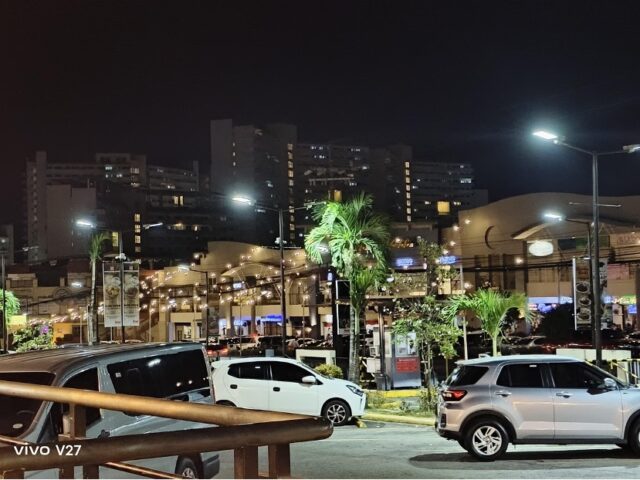
About last night: Take stunning nighttime photos with the new vivo V27 Series 5G, The Aura Portrait Master

When the sun goes down, the majestic city lights start to shine. Coffee turns into spirited drinks and slow music into electronic beats. You go dancing with your friends and have the time of your life. But the next morning, you barely remember anything from the night before and your blurry photos are not any help.

Let no amazing moment go undocumented! The vivo V27 Series, The Aura Portrait Master, features first-of-its-kind Aura Portrait Algorithm to produce photos with professional, studio-level quality. The latest addition to vivo’s V smartphone line and its newest release in the Philippines, the vivo V27 Series upgrades the industry-standard camera flash, sensors and portrait capabilities so you are assured of high-quality photos whether you’re shooting at night or in low-light locations.

Light up your aura with the Aura Light

Ever wonder why night photos do not come out vivid and clear even when you’re already using your flash? That is because ordinary camera flashes are designed to just light up a certain range around you. They are not specifically created for taking portraits.

vivo V27 Series’ Aura Light was designed to properly illuminate the subject’s face and create even lighting to keep the skin refined when taking photos in low-light environments. When it is toggled on, the camera automatically detects the ambient light and adjusts the Aura Light’s intensity based on the environment in order to produce night photos with clearer facial details without over- or underexposing the subject’s face.

Go and take as many photos with your friends or pose in your best aura underneath the spinning disco ball. No need to search for the spot with the best lighting. Just turn the Aura  Light on and your portraits will surely come out as sensational as you!

Make night shots vibrant with the Sony IMX766V sensor

They say the bigger the sensors, the higher the image quality. vivo made upgrades to its flagship standard sensors by making them ultra-large and ultra-clear.

The vivo V27 Series’ camera is powered by the new Sony IMX766V sensor that is now 59 percent bigger in effective sensor size and 104 percent bigger in single-pixel size. By enlarging the sensors, the camera has 145 percent more light intake, which effectively boosts image quality and vibrance and makes images appear brighter and vivid even when they are taken in low-light conditions.

The new sensors also include the industry-leading Optical Image Stabilization (OIS) technology, which can handle all kinds of light situations and gets rid of jitters. Say goodbye to blurry night images because with the new ultra-clear sensors, photos you take during your night out with the squad will come out with clear details and more authentic colors. Don’t hesitate to take photos even if you’re right in the middle of the dance floor as the vivo V27 Series’ also comes with the EIS+OIS Dual Ultra Stabilization that can take a photo or video of you and your friends busting those awesome moves in great detail.

Set the vibe with the vivo V27’s Advanced Portrait Mode

The vivo V27 Series’ portrait mode is now supported by vivo’s Exclusive Portrait Algorithms. This new portrait mode helps understand, beautify and enhance portraits.

To make sure that your subject has a natural and healthy appearance, the vivo V27 Series’ portrait mode decodes information about your subject and coordinates with up to 103 facial points. The portrait mode’s AI algorithm retouches your subject’s face but without making unrealistic over-enhancements.

The portrait mode also creates a balance between your subject and the background using the new Low-Light Portrait feature. When the Low-Light Portrait feature is turned on, the Aura Light automatically turns on as well. The Aura Light will light up the subject’s face while the Low-Light Portrait enhances the background by adding tones, thereby creating a warm and vivid vibe. The resulting image then is not only high quality with stunning details but also depicts the same exciting and vibrant moment during which it was taken.

The Aura Light, the Sony IMX766V and the advanced Portrait Mode all create the newest and first-of-its-kind Aura Portrait Algorithm. Don’t let your night out outfit go to waste. Capture every exciting moment of your night out and let your best aura shine with the vivo V27 Series, The Aura Portrait Master.

The vivo V27e retails for PHP16,999 while the vivo V27 5G lists at PHP24,999. Both variants are now available for purchase in all vivo official stores nationwide. They are also available for purchase on vivo’s official website and Shopee, Lazada and TikTok pages.


Spotlight is BusinessWorld’s sponsored section that allows advertisers to amplify their brand and connect with BusinessWorld’s audience by enabling them to publish their stories directly on the BusinessWorld Web site. For more information, send an email to online@bworldonline.com.

Join us on Viber at https://bit.ly/3hv6bLA to get more updates and subscribe to BusinessWorld’s titles and get exclusive content through www.bworld-x.com.

InLife’s top group insurance specialists in the spotlight

InLife’s 2022 Club of Honors awardees from Cebu District Sales Office IX champion the noble mission of life insurance professionals to help policyholders prepare for life’s uncertainties, achieve their financial goals, and secure the best future for their families. (From left) Leonila “Nila” Ponce-Ceniza was recognized as Group Agency Head of the Year; and second place, Agency Head of the Year. Renato T. Ceniza of RNC Life Insurance Consultants was recognized as Group Unit of the Year. Peter Teejay M. Salgado Salgado was recognized as Group Underwriter of the Year.

Insular Life (InLife) takes pride in its financial advisors who help Filipinos attain “A Lifetime for Good.” In its recently held Club of Honors Annual Awards Night 2023, the company recognized its financial advisors and agency leaders nationwide for their excellent sales performance in 2022. InLife honored 270 awardees for championing the noble mission of life insurance professionals to help policyholders prepare for life’s uncertainties, achieve their financial goals, and secure the best future for their families.

Leonila “Nila” Ponce-Ceniza, Renato T. Ceniza, and Peter Teejay M. Salgado were among those who made it to InLife’s 2022 Club of Honors. Nila was recognized as the Group Agency Head of the Year; and second place, Agency Head of the Year. Renato of RNC Life Insurance Consultants and Teejay were honored as the Group Unit of the Year, and Group Underwriter of the Year, respectively.

The three financial advisors who are part of Cebu District Sales Office (DSO) IX have successfully championed group insurance. The awardees discussed the benefits of group insurance for both employers and employees. They also shared how InLife helped them reach out to more Filipinos, and how they found a fulfilling career in the insurance industry.

Win-Win proposition for companies and employees

InLife’s Top Group Agency Head awardee pointed out that group insurance and individual insurance are equally important. Nila noted that through a group insurance plan, companies show care for their employees. She explained that group insurance plans are very affordable but flexible; customized and tailored fit to the needs of an organization, whether this is for protection against natural or accidental death and disability of employees and their dependents, medical care, retirement fund management, or credit protection.

Nila’s team includes group insurance specialists who are already well-versed in handling individual life insurance plans, and are more patient when it comes to group insurance.

“Patience means going the extra mile. In group insurance, we make our propositions remarkable. Since the market is unique, we flex unique skills as well,” she said, adding that group insurance specialists craft simple yet comprehensive presentations for the company’s board or human resources team.

Nila also underscored the importance of being confident and knowledgeable about taxation laws and principles, collaborating with the prospective corporate clients, and creating synergy with InLife’s Corporate Solutions Division.

Teejay, for his part, explained that group insurance is the most affordable way to get employees covered, and the best vehicle to provide retirement benefits in compliance with the Retirement Pay Law. He added that through InLife’s Comprehensive Group Plan, the retirement plan of a company may be tax qualified by the Bureau of Internal Revenue so that retiring employees may receive tax-free benefits. And with Group Hospitalization, the quarterly replenishment of the maximum benefit limit for the same illness provides employees with more comprehensive medical cover.

A supportive company that fosters innovation and excellence

Renato shared that InLife’s support has been crucial in their success in promoting group insurance in Cebu.

“InLife’s knack for innovation makes transactions efficient and effective. InLife also maintains an open line of communication to its stakeholders, which includes us agency leaders. The culture of excellence and unity in the organization has a huge impact on our performance. When you are singing one song and making sure that everyone becomes happy, and you celebrate small and big wins together — these keep us going when the going gets tough,” he said.

Climbing the ladder of success

Nila is among InLife’s most successful financial advisors. A BS Airline Management graduate, she first worked in sales as the team lead of an international publisher for encyclopedias. When she became a financial advisor in 1997, she won the Rookie of the Year Award.

“In 1998, I decided to form my own team which was recognized as Rookie Unit of the Year. Our team, Cebu DSO IX, composed of 141 agents and 11 managers, consistently ranks among InLife’s top teams nationwide. I have groomed Million Dollar Round Table awardees in our team,” she proudly shared.

Renato, on the other hand, gained his first sales experience as a supervisor in a car distributor in the US. When he returned to the Philippines in 1990, he set up his own business in trading and buying and selling used cars.

“When I bought my personal policy with InLife, the manager introduced me to the business. At first, I said no since I was not sure if I can make it. But the manager was persistent and told me that I will just apply my sales experience to life insurance as a financial advisor. So, I said yes. A year after, I was promoted to unit manager. I have received awards and qualified for international incentive trips. I do not regret my decision of saying yes,” he said.

Teejay, meanwhile, shared that his financial advisor career was the answer to his prayer for a sales job that will allow him to spend more time with his son.

“Joining the insurance industry also opened my eyes and enlightened me as to why we Filipinos are poor. So, I made financial awareness an advocacy. My goal is to help cut this vicious cycle of financial illiteracy. I cannot say that I’m close to my goal because this is a very high mountain to climb. It will take more years to break this bad financial cycle so I will just keep on going,” he said.

Teejay also acknowledged that while a career in insurance is not something that Filipinos aspire for, it’s the best profession for “work-smart” people.

“There are people who tend to belittle or avoid this career just because they are unfamiliar with this industry. A few years ago, I did a survey among millennials on what their ideal job is. The popular answer was ‘an easy but highly rewarding job.’ Where can we find that job? This job as financial advisor may not be easy, but it is definitely a highly rewarding one,” he said.

InLife hopes to amplify its mission to provide “A Lifetime for Good” to Filipinos through its financial advisors and agency leaders. Visit https://www.insularlife.com.ph/become-a-financial-advisor for more details.


Spotlight is BusinessWorld’s sponsored section that allows advertisers to amplify their brand and connect with BusinessWorld’s audience by enabling them to publish their stories directly on the BusinessWorld Web site. For more information, send an email to online@bworldonline.com.

Join us on Viber at https://bit.ly/3hv6bLA to get more updates and subscribe to BusinessWorld’s titles and get exclusive content through www.bworld-x.com.

March manufacturing growth slows

Workers are seen inside the Mega manufacturing plant in Sto. Tomas, Batangas, March 1, 2023. — PHILIPPINE STAR/KRIZ JOHN ROSALES

MANUFACTURING ACTIVITY in the Philippines expanded at its slowest pace in seven months in March despite strong demand, S&P Global said.

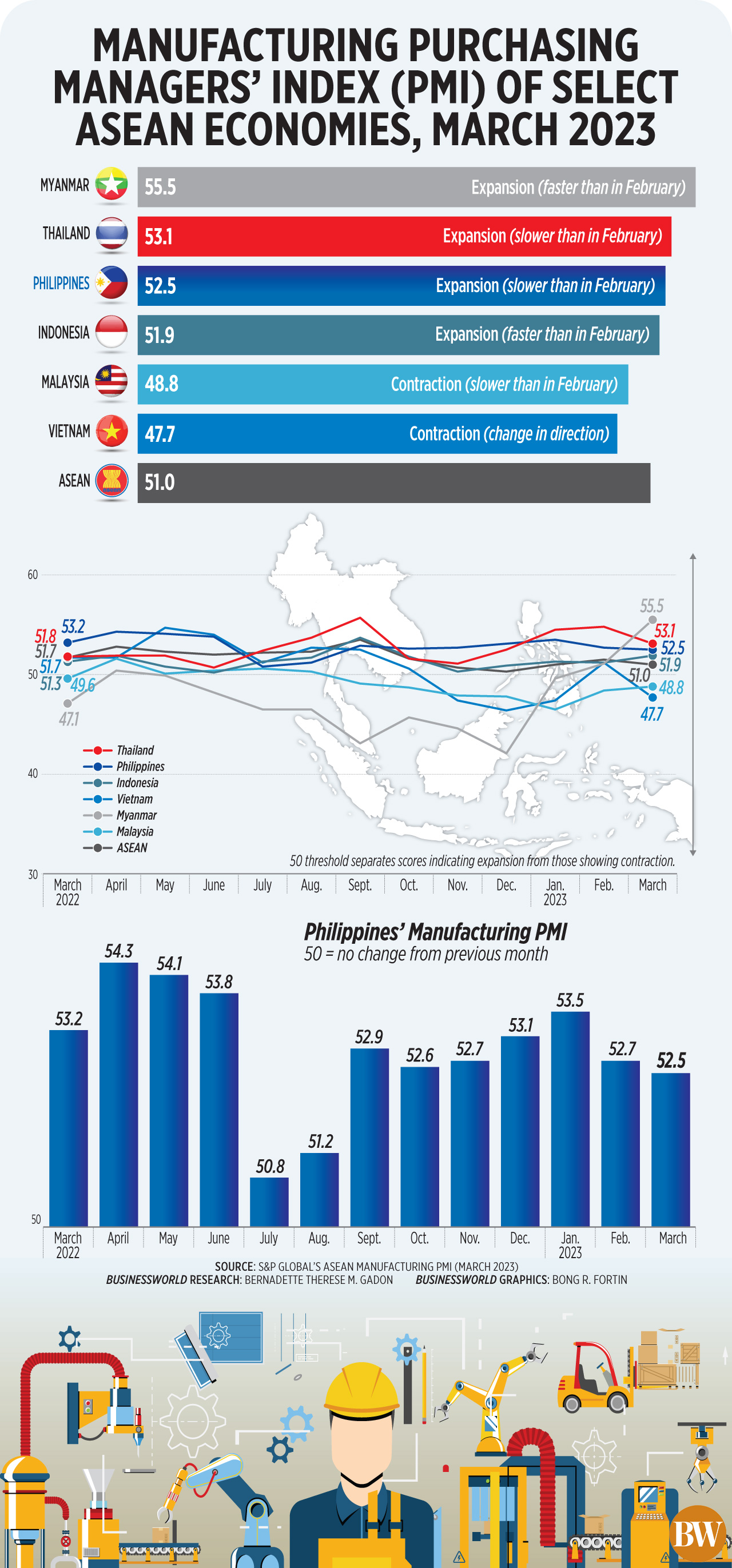
The S&P Global Philippines Manufacturing Purchasing Managers’ Index (PMI) reading slipped to 52.5 in March from 52.7 in February. This was the lowest PMI reading since the 51.2 posted in August last year.

In its report, S&P Global said despite the softer pace of expansion, the headline figure still showed a “historically strong improvement in operating conditions.”

Manufacturing Purchasing Managers’ Index (PMI) of select ASEAN economies, March 2023March also marked the 14th straight month that the PMI reading was above the 50 mark, which indicates an improvement in conditions for the manufacturing sector. A reading below 50 means a deterioration.

“The first quarter of 2023 concluded on a solid note, with a further expansion reported across the Filipino manufacturing sector, according to the latest PMI data. Both output and new orders rose at historically strong rates,” Maryam Baluch, economist at S&P Global Market Intelligence, said in a statement.

However, the slower expansion in March was partly due to the weaker rise in production and purchasing.

3RD IN ASEAN
The Philippines’ PMI reading was the third fastest among six Association of Southeast Asian Nations (ASEAN) member countries, behind Myanmar (55.5) and Thailand (53.1). The Philippines was ahead of Indonesia (51.9) and also above the ASEAN average of 51.

Malaysia (48.8) and Vietnam (47.7) saw a contraction in manufacturing activity.

The headline PMI measures manufacturing conditions through the weighted average of five indices: new orders (30%), output (25%), employment (20%), suppliers’ delivery times (15%) and stocks of purchases (10%).

For the Philippines, S&P Global said production rose for the seventh month in a row in March, largely due to the “strong upturn” in new orders.

“Firms noted that a stronger demand environment, new projects and a broader clientele helped boost sales. That said, foreign demand increased at a slower pace, with March data indicating only a fractional uptick in new business from abroad and suggesting that domestic demand propelled total new sales growth in the manufacturing sector,” S&P Global said.

Purchasing activity rose at a slower pace in March as high input costs weighed on manufacturing firms.

“Despite a softer rise in input buying, companies were keen to maintain their holdings of raw materials and semi-finished items amid hopes of continued growth in sales, and to protect against long lead times,” S&P Global said.

Ms. Baluch said the latest data showed pressures on inflation and supply chains eased in March, adding that operating expenses rose at the slowest pace in 27 months.

“Greater demand for inputs, higher prices for energy and material scarcity continued to drive up operating expenses. That said, the rate of input price inflation was the slowest since December 2020, and softer than the historical average,” S&P Global said.

While the incidence of delays was also among the slowest, S&P Global said port congestion and material shortages resulted in longer lead times for manufacturers. Backlogs also rose due to delivery delays, it added.

March data also showed firms implemented job cuts for a second month in a row.

“The rate of job shedding remained only marginal overall, as strong growth in new orders meant some firms were able to make additional hires,” S&P Global said.

Ms. Baluch said business confidence remained positive, as “strong demand conditions buoyed optimism in the outlook for future output.”

“Filipino manufacturers remained strongly optimistic, with more than a half of the respondents predicting growth in output in the year ahead. That said, the degree of confidence was below the historical trend,” S&P said. 

Rizal Commercial Banking Corp. Chief Economist Michael L. Ricafort attributed the easing manufacturing activity in March to the higher prices of goods and rising borrowing costs.

“The sustained expansion mode (above 50) in the local manufacturing PMI is still a good signal, as one of the major sources of economic growth,” Mr. Ricafort said.

The Bangko Sentral ng Pilipinas has raised key lending rates by a total of 425 basis points (bps) since May 2022, bringing the policy rate to 6.25% — the highest since 2007.

Moving forward, higher inflation and interest rates may weigh on manufacturing growth for the next months. A recession in the US could also hurt exports, investments, among others, Mr. Ricafort said. — Keisha B. Ta-asan

Budget gap widens in February as revenue collections decline

PHILIPPINE STAR/EDD GUMBAN

By Keisha B. Ta-asan, Reporter

THE NATIONAL GOVERNMENT’S (NG) budget deficit slightly widened in February as revenue collection slipped and spending was flat, the Bureau of the Treasury (BTr) reported on Monday.

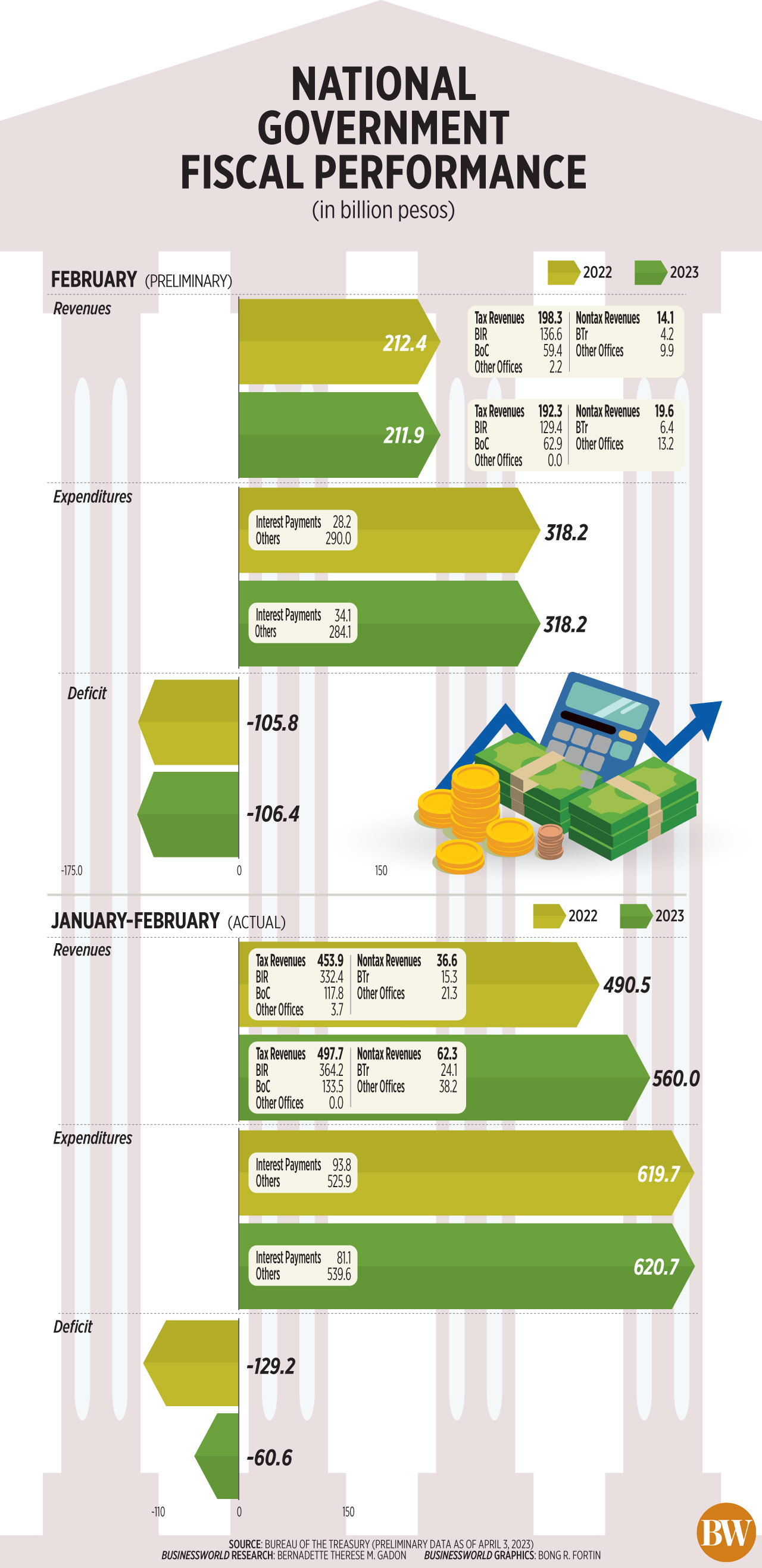
Data from the BTr showed the Philippines’ budget gap reached P106.4 billion in February, up by 0.5% from P105.8 billion recorded in the same month in 2022.

Month on month, the NG’s fiscal balance swung back to a deficit in February from the P45.75-billion surplus in January.

National Government fiscal performance“The fiscal performance was mainly attributed to a marginal 0.25% decrease in revenue collection, coupled with the flat expenditure outturn during the period,” the BTr said.

State revenue collections dipped by 0.25% year on year to P211.9 billion in February as tax revenues declined.

In February, tax revenues fell by 3.01% to P192.3 billion, amid a 5.29% drop in collections by the Bureau of Internal Revenue (BIR) to P129.4 billion. The Bureau of Customs (BoC) reported a 5.83% rise in revenues to P62.9 billion for the month.

Nontax revenues, on the other hand, climbed by 38.37% to P19.6 billion in February, thanks to a 51.16% increase in income from the Bureau of the Treasury to P6.4 billion.

“The upturn was driven by the higher remittance of NG share from Philippine Amusement and Gaming Corp. (PAGCOR) earnings, as well as income from Bond Sinking Fund (BSF) investment and interest on NG deposits,” the Treasury said.

Nontax collections from other offices such as privatization proceeds and fees and charges, grew by 32.93% to P13.2 billion.

Nicholas Antonio T. Mapa, a senior economist at ING Bank N.V. Manila, said February revenue collections have declined as base effects waned.

“BIR collections were benefiting from the positive base effects due to the economic reopening but that appears to be ebbing,” Mr. Mapa said in an e-mail.

Union Bank of the Philippines, Inc. Chief Economist Ruben Carlo O. Asuncion said Customs collections also grew at a softer pace in February.

“It may be a signal that the reopening narrative and its momentum may be starting to fade with easing domestic demand particularly on imports,” Mr. Asuncion said.

Meanwhile, expenditures were flat, inching up by 0.01% to P318.2 billion in February. Interest payments climbed by 20.83% to P34.1 billion.

“The growth of disbursements was dampened by the decline of the National Tax Allotment (NTA) shares of local government units (LGUs) resulting from the lower national tax collections in 2020,” the BTr said, adding that this was due to the impact of the pandemic.

Mr. Asuncion said the sharply lower LGU revenue allocations on the expenditure side “may have mitigated the fiscal impact of the drop in tax collections.”

According to Mr. Mapa, lower spending suggests that the government may not be a significant source of economic growth this year.

Primary spending — which refers to total expenditures minus interest payments — contracted by 2.01% to P284.1 billion from P290 billion a year ago.

TWO-MONTH GAP
For the first two months of the year, the fiscal deficit sharply narrowed to P60.6 billion, 53.07% lower than the P129.2-billion gap a year ago.

Total revenues jumped by 14.2% to P560 billion in the January-to-February period, 88.9% of which were from taxes.

Tax collection rose by 9.66% to P497.7 billion. Broken down, the BIR collections rose 9.6% to P364.2 billion, while Customs collections went up by 13.3% to P133.5 billion.

Nontax revenues surged by 70.3% to P62.3 billion, driven by an 80% surge in revenues from other offices to P38.2 billion. BTr income also jumped by 57.3% to P24.1 billion.

On the other hand, expenditures in the January-to-February period inched up by 0.16% to P620.7 billion as interest payments fell by 13.5% to P81.1 billion.

Primary expenditures rose by 2.6% to P539.6 billion.

Aside from the high base effect, Mr. Asuncion said disinflation and slower spending conditions may dampen total collections this year.

“Less upbeat revenues will restrain primary expenditure growth to 4% in our estimate. Next year, tax revenues may improve by 5-6% as economic growth heads back to potential with inflation back to the (2-4%) target range,” he said. 

Primary expenditure gain is also expected next year, but the government may decide to keep spending in line with revenue growth, he added.

Mr. Mapa said lower revenue collection may continue in the coming months due to the uncertain growth outlook.

This year, the government has set a budget deficit ceiling of P1.47 trillion, equivalent to 6.1% of gross domestic product. The program consists of P3.71 trillion in revenues and P5.18 trillion in disbursements.

PHL told to use UN climate ruling to demand more from polluters

Plastic bottles float on the heavily polluted San Juan River, June 21, 2021. — REUTERS/ELOISA LOPEZ

By Kyle Aristophere T. Atienza, Reporter

PHILIPPINE CLIMATE and good governance advocates urged the Marcos government to use the landmark United Nations (UN) ruling asking the world’s top court to clarify states’ obligations regarding climate change in demanding more action from top polluters.

On March 29, the United Nations General Assembly adopted a resolution led by the Pacific Island nation of Vanuatu seeking an International Court of Justice (ICJ) advisory opinion on the obligations of states to combat climate change.

The resolution asks the ICJ to outline the “legal consequences” for states which “have caused significant harm to the climate system and other parts of the environment” in consideration of climate change’s impacts on small island states and peoples.

“This is really a historic move by the UN and a very important one for climate-impacted countries like ours,” Lea Guerrero, country director of Greenpeace Philippines, said in a phone interview.

“We believe that the Philippine government can substantially contribute to the proceedings,” she said.

It might take about 18 months for an ICJ opinion to be issued, which will include inputs from different countries, Ms. Guerrero said, citing Vanuatu’s estimate. 

She urged the administration of President Ferdinand R. Marcos, Jr. to use the decision in calling for more climate commitments from rich countries.

“This move should also be cited by the Philippine government as a basis to continue calling on rich countries to meet their targets in terms of reducing greenhouse gas emissions,” Ms. Guerrero said. 

The decision, she said, should also prompt the government to craft a coherent climate policy that would take into consideration the Commission on Human Rights’ (CHR) report indicting more than 40 companies for driving the climate crisis and causing harm to Filipinos. 

The National Government has yet to formally acknowledge the CHR report. 

“Through this landmark resolution, countries and corporations with high carbon emissions and those funding or supporting environmentally destructive projects in climate-vulnerable developing countries will be held accountable,” Jerwin Baure, public information officer of Manila-based AGHAM, said in a Facebook Messenger chat.

“Countries like the Philippines have been suffering from worsening climate-related disasters, and this resolution could serve as a basis in demanding reparations.”

Joshua Villalobos, a 17-year-old climate activist from the central Philippine province of Negros Occidental, is among those who rejoice over the landmark ruling, which he said is “long overdue.”

“For the longest time, we have seen the inaction of polluter countries and vulnerable countries like the Philippines and our people have been at the receiving end of destructive and deadly climate impacts,” he said via Messenger chat.

‘POWERFUL WEAPON’
The UN’s adoption of the Vanuatu-led resolution came on the same day that the European Court of Human Rights opened cases against France and Switzerland over alleged failures to protect the environment.

Gerry C. Arances, executive director of Center for Energy, Ecology, and Development, said the expected opinion from ICJ will be a “powerful weapon” for the Philippines and other vulnerable countries in demanding more climate actions from big countries.

“[It will compel them] to act in the best interests of peoples and protect them from worsening climate impact,” he said via Messenger chat.

Mr. Arances said the UN resolution should be taken as a “challenge” by the Philippine government to align all its development and economic plans to the “most ambitious” climate targets, advance a long overdue transition plan, and amplify the call for a global energy transition and the phaseout of fossil fuels.

Philip Arnold “Randy” P. Tuaño, dean of the Ateneo School of Government, said the UN decision should prompt the Marcos government to thoroughly document the impact of climate change on Philippine communities.

It should also compile reports showing climate change’s impact on the education and health sectors as well as economic activities including food production.

“The top polluters are…becoming more aware of these adverse impact and compensation was one of the key discussions in the previous Conference of Parties on the environment,” Mr. Tuaño noted. “There is some talk in European countries of increasing tariffs on goods and services that have a high carbon content but we hope that the European Union helps developing countries adjust to this situation before this is undertaken.”

Last year, Greenpeace said as much as 80% of Manila could be submerged by 2030, potentially impacting 87% of its economic output.

Antonio Gabriel “Tony” M.  La Viña, a lawyer and environmental expert, said that although an advisory opinion is non-binding, it has a legal and moral weight. “It will send a strong signal to carbon-emitting countries and companies,” he said via Messenger chat.

Mr. Marcos, who vowed to work towards a shift to green energy, has yet to declare a climate emergency, which would authorize the government to mobilize funds to step up climate mitigation efforts.

The House of Representative made a declaration in 2019, but Greenpeace said last year that a “follow-through” from the National Government has yet to be seen.

The US has yet to declare a climate emergency, nor has China. They accounted for 41.89% and 34.75% of world GDP in nominal and purchasing power parity terms, respectively, in 2021.

Terry L. Ridon, a public investment analyst and convenor of infrastructure think tank InfraWatch, said that although the ruling would target big countries, it should not “preclude the Philippines from undertaking voluntary commitments to contribute to the global climate mission.”

Mr. Ridon, meanwhile, said expediting the adoption of electric vehicles (EVs) is one of the “most realistic” commitments the Philippines can make, as the prices of EVs continue to drop.

“The current pricing of EVs is starting to compete with the pricing of mass market internal combustion engine vehicles,” he said.

Mr. Marcos earlier said there’s a need to “look properly at what the real timetable is for the introduction of electric vehicles” since the country does not have enough renewable energy capacity yet to complement green transport.   

Sonny S. Melencio, chairman of Partido Lakas ng Masa, which has been actively campaigning for climate justice, said the Marcos government should follow the lead of Vanuatu and urge the ICJ and local courts “to pursue charges and cases against the polluters, and to develop a people-centered, socially equitable and inclusive just transition program for the Philippines.”

Mr. Melencio said the ruling would push people’s movements to continue “mobilizing the people and putting pressure on governments to stop building coal and fossil fuel projects and pursuing other destructive projects.”


Upson IPO lifts shares by 21% 

(FROM left): UPSON Founder and Director William Lim, UPSON former COO Catherine M. Lee, UPSON Founder and Director Ricardo A. Lee, UPSON President and CEO Arlene Louisa T. Sy, UPSON Chairman Lawrence O. Lee, PSE President and CEO Ramon S. Monzon, PSE COO Atty. Roel A. Refran, PSE Issuer Regulation Division Head Atty. Marigel M. Baniqued-Garcia, PSE Capital Market Division Head Mark Frederick V. Visda, and Securities Clearing Corp. of the Philippines COO Renee D. Rubio.

UPSON International Corp. saw its share price jump by 20.8% on its market debut on Monday, closing at P2.90 per share from its initial public offering (IPO) price of P2.40 each.

“Price action moved swiftly higher in the last hour of trading, with trading volumes picking up after lackluster trading earlier in the day,” China Bank Securities Corp. Research Director Rastine Mackie D. Mercado said in a Viber message.

On its maiden listing on the main board of the Philippine Stock Exchange, the company — under the ticker symbol UPSON — hit a high of P3.30 per share.

The information technology retailer offered about 625 million common shares with an over-allotment option of 62.5 million common shares.

Mr. Mercado said the company’s value turnover for the day amounted to P47.8 million, which was below the average of P300 million reported by non-real estate investment trust IPOs in the last 12 months.

He said that while Monday’s price action may reflect investors’ optimism on Upson’s growth prospects, “the relatively low value turnover points to possible selling pressure in the coming days as investors could look to secure gains.”

Mr. Mercado said the possible outcome is “against a backdrop of continuing broad market weakness.”

Meanwhile, Regina Capital Development Corp. Head of Sales Luis A. Limlingan said in a Viber message that investors would be banking on the company’s store expansion plans.

Upson said in its final prospectus that it will use proceeds from the IPO to open 250 stores from 2023 to 2027, or an additional retail space of 25,000 square meters.

For the year, the company plans to open 50 stores within the National Capital Region and key cities of the country. It has about 200 stores nationwide as of September 2022.

“We are the digital partner of choice in the Philippines with over 200 stores in the broadest range of information technology products,” Upson President and Chief Executive Officer (CEO) Arlene Louisa T. Sy during the company’s listing ceremony.

“We are a partner to the Filipino consumer, and we are a partner to the world’s biggest brands looking to expand in this market,” Ms. Sy added. — Adrian H. Halili