Home Blog Page 4992

Remittance growth slows in February

PHILIPPINE STAR/MIGUEL DE GUZMAN

By Luisa Maria Jacinta C. Jocson, Reporter

MONEY SENT by overseas Filipino workers (OFWs) grew at the slowest pace in seven months in February, data from the Bangko Sentral ng Pilipinas (BSP) showed.

Cash remittances coursed through banks went up by 2.4% to $2.57 billion in February from $2.51 billion in the same month a year ago, the BSP said in a statement.

This was slower than the 3.5% in January, and the weakest annual growth since 2.3% recorded in July 2022.

February also saw the lowest level of cash remittances in nine months or since the $2.43 billion posted in May 2022.

Month on month, cash remittances declined by 6.9% from the $2.76 billion seen in January.

Overseas Filipinos’ cash remittances (February 2023)“The expansion in cash remittances in February 2023 was due to the growth in receipts from land- and sea-based workers,” the central bank said in a statement.

In February, remittances sent by land-based OFWs jumped by 2.6% to $2.06 billion from $2.01 billion in the same month a year earlier.

Remittances from sea-based workers inched up by 1.6% to $509.4 million in February from the $501.4 million a year ago.

Personal remittances, which contain inflows in kind, also went up by 2.4% to $2.86 billion in February from $2.79 billion a year ago. Month on month, it was down by 6.8% from $3.07 billion in January.

China Banking Corp. Chief Economist Domini S. Velasquez said cash remittance growth may have slowed as OFWs sent more money home during the Christmas season.

“A more depreciated peso in February could have worked positively for remittances,” Ms. Velasquez said in a Viber message.

The peso depreciated in February, closing the month at P55.33 on Feb. 28, down by P0.69 or 1.25% from its finish of P54.64 on Jan. 31.

Rizal Commercial Banking Corp. Chief Economist Michael L. Ricafort said OFWs continue to send more money to their families to help them cope with rising prices.

“Higher prices locally may have necessitated some continued increase in OFW remittances sent to the country, as well as continued reopening of the economy towards greater normalcy with some pent-up demand that also entailed the sending of more OFW remittances to the country,” he said in a Viber message.

Headline inflation slowed to 8.6% in February, from the 14-year high 8.7% in January, but still above the BSP’s 2-4% target band.

Core inflation, which discounts volatile prices of food and fuel, accelerated to 7.8% in February, from 7.4% in January. This was the quickest rise in core inflation in over 22 years or since December 2000.

For the first two months of the year, cash remittances coursed through banks jumped by 3% to $5.33 billion from the $5.18 billion in the same period in 2022.

Personal remittances rose by 3% to $5.93 billion in the January-to-February period, from $5.76 billion in the same period in 2022.

“The growth in cash remittances from the United States, Saudi Arabia, Singapore, and Qatar contributed mainly to the increase in remittances in January-February 2023,” the BSP said.

Nearly half or 41.6% of total remittances came from OFWs in the United States, followed by Singapore (7.3%), Saudi Arabia (5.5%), Japan (5.3%), United Kingdom (4.7%) and the United Arab Emirates (3.7%).

Ms. Velasquez said she also expects moderation in remittances as global economic growth wanes.

“Remittances from the United States, the biggest source, will likely slow down as prospects of a hard landing increase. Layoffs and the possibility of a recession will curtail the sending of remittances. In the Middle East, a decline in oil prices will likely inhibit economic growth of the region,” Ms. Velasquez added.

Union Bank of the Philippines, Inc. Chief Economist Ruben Carlo O. Asuncion said remittance growth may have already peaked.

“It’s still positive growth, but it has confirmed that the peak of remittances performance from the previous months has already passed. Nevertheless, the 2.4% growth in February is still respectable,” he said in a Viber message.

“This slower monthly growth may mean that OFWs are anticipating the impact of external headwinds. They may also be saving up and waiting for the right time to send money back home especially when recipient families need the inflow support,” he added.

The BSP expects remittances to grow by 3% this year.

Mr. Asuncion said he still expects remittances to grow by 2-4% this year “despite of the incoming global challenges.”

The International Monetary Fund gave a 2.8% global growth forecast for 2023, which it said, “is not enough to bring opportunities to businesses and people around the world.” It also projects “weak” global growth of around 3% through 2028.

In 2022, cash remittances hit a record high $32.54 billion, up by 3.6% from $31.42 billion in 2021.


BIR confident it will hit income tax target

PHOTO BY LUISA MARIA JACINTA C. JOCSON
Taxpayers wait to file their income tax returns at the Bureau of Internal Revenue (BIR) Revenue Region 7A office in Fishermall, Quezon City on Monday. — PHOTO BY LUISA MARIA JACINTA C. JOCSON

THE BUREAU of Internal Revenue (BIR) is confident it will reach its P1.1-trillion collection target from the filing of annual income tax returns (AITRs).

“We’re optimistic that we will reach that target. As to how much exactly has come in, we have to verify and check,” BIR Commissioner Romeo D. Lumagui, Jr. told reporters at the BIR Revenue Region 7A office in Fishermall, Quezon City on Monday.

Mr. Lumagui and other officials visited four BIR offices on Monday, the deadline for the filing of 2022 annual income tax returns.

“We saw a very good turnout for this year’s filing. We saw that our online facilities worked properly. This year’s filing was not like previous years, where taxpayers would file and pay their ITR on the deadline. Our campaign this season was effective,” Mr. Lumagui said.

He noted lines were noticeably shorter at the BIR offices, as there were fewer taxpayers filing their ITRs on the last day compared with previous years.

Mr. Lumagui said allowing taxpayers to file “anywhere” helped them meet the deadline.

Revenue Memorandum Circular (RMC) No. 32-2023 allowed taxpayers to file their 2022 AITR and pay the corresponding taxes due anywhere on or before April 17, 2023, without penalties imposed for wrong venue filing.

“Last week, we said that we were waiting for less than 10% of taxpayers to file and pay their annual income tax returns. When we checked a while ago, it was already less than 4%. There were a lot of transactions over the weekend because we lengthened office hours and accepted more filings,” he added.

There are an estimated 3.8 million individual taxpayers, not including businesses, in the country.

The BIR did not extend the deadline for the filing of income tax returns. Taxpayers who failed to file and pay their tax returns on Monday will now face penalties, such as 12% interest and 25% surcharge.

Mr. Lumagui said the BIR is working to improve its procedures for filing and payment of income taxes.

“We are hoping there won’t be any long lines in the coming years. We’ve seen today that there were shorter lines, and we were able to make transactions easier. In the years to come, we will work hard to further improve our processes,” he added. 

This year, the agency expects to collect P2.6 trillion in revenues, up by 11% from the P2.34 trillion it collected last year. — Luisa Maria Jacinta C. Jocson

Robust shipbuilding industry key to making PHL a maritime power

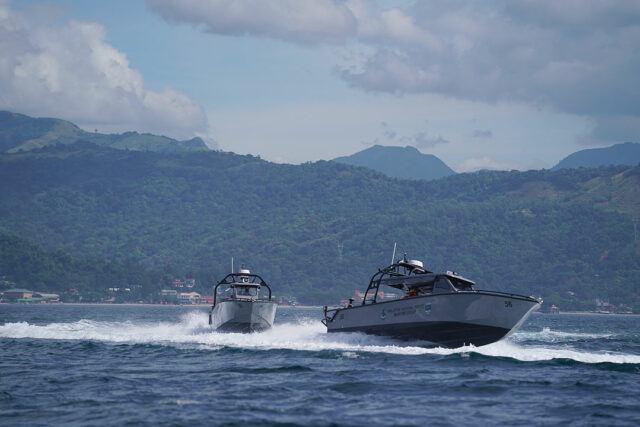
Propmech Corp is a company that has built over a thousand vessels for the Philippines’ defense forces, such as this high-speed tactical water craft. — COMPANY HANDOUT

By Kyle Aristophere T. Atienza, Reporter

THE PHILIPPINES should build a self-reliant coastal defense system and support local shipmakers if it wants to become a maritime hub, experts and a local shipbuilder said. 

“Maritime security is a necessary condition for developing the Philippines as a maritime hub,” said George N. Manzano, a trade expert from the University of Asia and the Pacific.

“If there are dangers from piracy and armed threats, there will be commercial risks in investing in maritime transactions, making the Philippines less attractive,” he said in an e-mail.

During the campaign, then-presidential candidate Ferdinand R. Marcos, Jr. had promised to develop the maritime sector and make the Philippines a “logistics hub.”

In 2021, there were 118 registered shipyards in the Philippines scattered across the country, 17 of which belong to the medium-large scale category, according to the Maritime Page website.

One of them is Propmech Corp., a company that has built over a thousand vessels for the Philippines’ defense forces with the help of its 900 employees in different sites across the country.

Glenn Tong, director at Propmech, said the government should prioritize local shipbuilders over foreign companies in securing maritime assets for the defense sector if it wants to make the Philippines a “great shipbuilding” and maritime hub.

“After all, how are we going to develop if our own government does not support [us]?” he told BusinessWorld on the sidelines of a media tour of its shipyard in Subic Bay Freeport last week.

“The government plays a big role in this. Hopefully, it will give more opportunities to local companies or some preference to keep local companies’ services for the long term,” Mr. Tong said. “The ability locally is not able to grow unless you maintain a force here who can do the work effectively.”

Mr. Tong cited the lack of local materials used for building ships as one of the main challenges facing the local shipbuilding industry.

“A lot of raw materials required to build vessels such as steel, resins, among others, still need to be brought in,” he said.

Another challenge is ensuring there are skilled and capable workers available for the industry, he said.

Mr. Tong said it’s also “costly” to maintain operations locally, citing the high electricity rates.

“The Philippines is uniquely suited to be a maritime nation. But of course, there are some challenges,” he said.

Mr. Manzano said having a local shipbuilding industry can help enhance the maritime security on the supply side by providing assets such as sea craft and surveillance systems, among others, to law enforcement agencies.

“However, this is not a sufficient condition because the assets can be procured from foreign suppliers. It really depends on the prices, which are a reflection of the competitiveness of the shipbuilding sector,” he said.

Lack of funds has prevented the Philippine defense establishment — one of the weakest in the world — from achieving its goal of becoming self-reliant in terms of assets.

One of the “signature” products of Propmech is the Philippine Navy’s first-ever missile-capable boats.

With speeds of up to 83.3 kilometers (km) per hour and an operational range of 650 km on a full tank, the 17-meter multipurpose attack craft (MPAC) is widely used for patrols, logistical purposes, and search and rescue operations. 

Propmech has improved each MPAC model based on recommendations from the Philippine Navy.

“As a maritime nation with high stakes in the maritime industry (since the Philippines is a big player in maritime human resource), it is important that commercial maritime vessels understand maritime security,” Chester B. Cabalza, a security expert, said in a Facebook Messenger chat.

Maritime security “should be imbedded” in their operational manuals “since there are transnational maritime issues that could paralyze the industry.”

During the media tour, Propmech showed its ongoing work on a batch of watercraft for the Philippine Marines — a total of 16 vessels with a contract price of P338 million.

“Part of the rationale of elevating our shipbuilding industry is to boost our national defense,” Michael Henry Ll. Yusingco, a policy analyst who has closely observed geopolitical issues confronting the Philippines, said via Messenger chat.

“Building ships for our Navy and Coast Guard will compel us to develop our own cohort of experts and technicians,” he added. “Ultimately, it will wean us away from relying too much on our foreign allies for our defense.”

Mr. Yusingco said the local shipbuilding industry has made some progress but there is still much potential.

Last month, the largest aluminum ferry built in a Philippine shipyard was delivered to Molslinjen, Denmark’s largest passenger ferry company. The shipyard is owned by Australian shipbuilder Austal Limited.

“If indeed this government is serious in elevating our shipbuilding industry, then they have to bring together the key stakeholders,” Mr. Yusingco said. “The education sector must be on board to provide a steady source of human resources with the needed skills and aptitudes in shipbuilding.” 

Coastal areas must also be involved in any plans to develop the shipbuilding sector, he added.

‘STRONG ECOSYSTEM’
Propmech, which has vowed to help the Philippines become the “maritime capital” of the world, hopes the government will help develop a robust “ecosystem” for local shipbuilders. 

“A lot of subservices for shipbuilding are not yet available here, which is one reason why we have to do everything. We have to do the engine installation; we have to do everything — unlike in other countries where there are specific support groups that can do some needed operations.” 

Mr. Tong hopes that the Philippine government’s push for economic liberalization will not disadvantage local shipbuilders but will give them opportunities to partner with foreign entities.

“What we’re hoping is that in the long term, we can create a strong shipbuilding ecosystem in the Philippines, which will allow yards to do certain things while getting expertise from other partners.”

Propmech, a family business that has over 70 years of experience, began its operations as a distributor of marine engines in 1991 before expanding its services to vessel refurbishing, boat building and maintenance more than ten years later.

It has since entered into contracts worth about P20 billion with government agencies including the Navy, Philippine Coast Guard, Philippine police, and the Bureau of Fisheries and Aquatic Resources.

“The Philippines is not lacking in talents and expertise on shipbuilding in the global maritime industry since the Philippines is an archipelagic and a maritime nation,” Mr. Cabalza said.

“If we don’t see ourselves as a maritime nation like our forebears did, then we may not accept the sacrifices that must be made to become a shipbuilding superpower,” Mr. Yusingco said. “We may not be willing to do the hard work. This challenge even weighs heavier on our political leaders because they are the beneficiaries of the untenable status quo.”

PCCI sees more Czech investments in PHL

Czech Republic Prime Minister Petr Fiala arrives at Villamor Air Base in Pasay City, Sunday. — PNA-MALACANANG

THE PHILIPPINE Chamber of Commerce and Industry (PCCI) expects more investments from Czech Republic-based companies in various sectors such as defense and transportation.

PCCI President George T. Barcelon said it is important the Philippines pursue new opportunities for trade and investment with the Czech Republic.

“To expand two-way trade, we can explore various sectors such as agriculture, manufacturing, transportation, construction, mining, and renewable energy. We want them to come and invest (in the Philippines),” he said during the Czech Industry Forum in Makati City on Monday.   

Czech Prime Minister Petr Fiala attended the forum, as part of his three-day official visit to the Philippines. He was accompanied by a delegation of Czech businessmen.

Bilateral trade between the Philippines and the Czech Republic reached about $700 million in 2021, with Philippine exports worth about $500 million and imports from the Czech Republic totaling about $200 million.   

“The majority of these exports consist of world-standard Philippine machines, including integrated circuits, electrical equipment, transformers, among other products under the European Union’s (EU) Generalized System of Preferences Plus (GSP+),” Mr. Barcelon said.   

The Philippines is seeking to renew its participation in the EU’s GSP+, which allows the Philippines to enjoy zero tariffs on 6,274 products or 66% of all EU tariff lines. The Philippines has been threatened with the loss of GSP+ status, with the European Parliament in February approving a resolution asking the previous government to address human rights violations.

Mr. Barcelon said Czech investors could also invest in mass transportation in areas outside Metro Manila such as Davao, Cagayan de Oro, and Cebu.   

“Why concentrate on the National Capital Region? I have been telling them to concentrate on the regional. The regional areas already have the budget. They can decide faster,” he said.   

The PCCI chief noted the country’s top imports from the Czech Republic are from the arms and defense sector. He said the production of Colt firearms, which is a subsidiary of Czech company Colt CZ Group SE, could be done in the Philippines.   

“Colt could invest in a factory in the country. We have the skill. We can produce firearms. Armscor (Arms Corp. of the Philippines) is exporting. We have already people in these sectors. They can take a look at that,” Mr. Barcelon said.   

Companies from the Czech Republic could also invest in agriculture, he added.

“For the agriculture sector, it can be the mechanization. Definitely, if we can get the technical know-how will add knowledge to us. That would help,” Mr. Barcelon said.   

Vladimir Dlouhy, Czech Chamber of Commerce president, said that the Czech Republic is an important producer in the global defense industry.

“There are a couple of interesting niches, spaces on the market where we can offer our products. I believe that our products are competitive. Defense is an important part but it is not only defense. It is also in construction, logistics, finance, export insurance, and digital economy like cryptocurrency,” he added.

Meanwhile, the PCCI and the Czech Chamber of Commerce signed a memorandum of understanding (MoU) to strengthen bilateral trade and investment cooperation between the two countries.    

“The MoU includes provisions for exchange of market information, promotion of investments, and the establishment of joint business councils. At the PCCI, we are ready to link the Czech and Philippine business communities to create mutually rewarding opportunities,” Mr. Barcelon said. — R.M.D.Ochave

Key PLDT officials, including CFO, retire early

PHOTO FROM JGSUMMIT.COM.PH

By Justine Irish D. Tabile, Reporter

FIVE officials of Pangilinan-led PLDT Inc. have voluntarily separated from service starting April 14 in a move analysts said might be related to the listed telecommunication company’s budget overrun.

In separate disclosures on Monday, the country’s dominant telco announced the early retirement of Anabelle L. Chua, its senior vice-president, chief financial officer (CFO) and chief risk management officer, along with Mario G. Tamayo, senior vice-president and network head.

“PLDT did mention during the time of their internal investigation into the P48-billion overrun that it will reorganize management. I think this is the fruition of that,” Globalinks Securities and Stocks, Inc. Head of Sales Trading Toby Allan C. Arce said in a Viber message.

“Although the investigation concluded that there was no fraud, P48 billion is a huge amount and rather unexpected for a company of such caliber that should have systems in place for accountability mismanagement prevention,” he added.

PLDT also disclosed the voluntary resignation of one of its vice-presidents, Wilson S. Bobier, and its senior vice-president and chief procurement officer, Mary Rose L. Dela Paz.

“Amid the capital expenditure overrun fiasco, it could be that the resignations occurred as key executives under PLDT faced scrutiny over the issue,” Regina Capital Development Corp. Head of Sales Luis A. Limlingan said in a Viber message.

“Late last year we heard PLDT placed its CFO on leave after the disclosure of its budget overrun. It is possible that PLDT recently was much as willing to let go of its CFO,” he added.

Meanwhile, Alexander S. Kibanoff, one of the vice-presidents of the company, was announced to have availed of its manpower reduction program.

Mercantile Securities Corp. Head Trader Jeff Radley C. See said in a Viber message that “trust and confidence” are what PLDT is showing to its investors.

“They mean business when they start removing the department who is overseeing the budget of the company,” he said.

In December last year, the telco said that it would be undertaking a management reorganization process to address weaknesses that allowed the budget overrun to occur.

The statement came after PLDT’s internal probe showed a P48-billion budget overrun in the past four years.

On March 23, the company said that the review conducted by an external counsel for the period 2019-2022 showed “no evidence of fraud, intentional concealment, or bad faith conduct on the part of any employee of the company and no basis to restate the company’s historical financial statements.”

Post-2022, its outstanding commitment to its major vendors for the acquisition of property and equipment was reduced to P33 billion which the company said resulted from PLDT’s entry into settlement and mutual release agreements in March this year.

On Monday, shares in PLDT grew by P24 or 1.9% to P1,284 apiece.

Hastings Holdings, Inc., a unit of PLDT Beneficial Trust Fund subsidiary MediaQuest Holdings, Inc., has a majority stake in BusinessWorld through the Philippine Star Group, which it controls.

Maynilad service interruptions set to halt this week 

BW FILE PHOTO

By Ashley Erika O. Jose, Reporter

MAYNILAD Water Services, Inc. is targeting to suspend its water service interruptions within this week after the government approved a higher water allocation for the concessionaire from Angat Dam.

Ramoncito S. Fernandez, president and chief executive officer of Maynilad, said during a virtual press briefing on Monday that except for some areas in Cavite, the west zone water provider will halt the recurring water interruptions.

“This higher allocation will definitely improve the volume of water reaching the portal, allowing Maynilad to increase its production and improve the levels of Ipo and La Mesa [reservoir],” Mr. Fernandez said.

Last week, the National Water Resources Board (NWRB) announced the approval of a 52 cubic meters per second (CMS) allocation to the Metropolitan Waterworks and Sewerage System (MWSS) for the April 16-30 period. Maynilad is a concessionaire of the MWSS.

The move follows the NWRB’s decision to temporarily raise the allocation for MWSS to 50 CMS between April 1 and 15. The MWSS normally draws 48 CMS from Angat.

Over the weekend, Maynilad announced that some areas in Cavite would experience water service interruptions due to the intensified cleaning of filters at the Putatan water treatment plants.

Mr. Fernandez said that the initial assumption for the combined production of the Putatan 1 and 2 plants was about 240 million liters per day (MLD), which could potentially affect about 170,000 customers. But as turbidity levels in Laguna Lake settled below 100 NTU or nephelometric turbidity units, the affected customers have been down to 79,000.

“This enabled Putatan 1 and 2 to produce a combined volume of 260 to 280 [MLD]. At 280 MLD, affected customers are now down 79,000 — that is the good news. We are working hard to maintain the 270-280 MLD production,” he said.

Mr. Fernandez said Maynilad has a water system in the north and south of its service area. The north is dependent on the Bagbag reservoir, which along with the Ipo reservoir, benefitted from the 52 CMS allocation. The south is dependent on the Putatan treatment plants, he said, adding that the pipeline connecting the north and south “has limited capacity.”

“We’re trying to improve the cleaning capacity [and] capability of [Putatan] 1 and 2 [treatment plants],” he said.

Patrick Lester N. Ty, the chief regulator at the MWSS-Regulatory Office (RO), said the agency is studying the possibility of imposing financial penalties on Maynilad if the water interruptions continue.

“The MWSS RO is monitoring the situation. If there will still be water service interruptions in the Angat Dam influence areas despite Maynilad receiving their proper raw water allocation, we will not hesitate to impose financial penalties,” Mr. Ty said.

MWSS Administrator Leonor C. Cleofas said that the agreement with the NWRB on the increased allocation is the suspension of the ongoing water interruptions experienced by Maynilad customers.

“The condition of NWRB is clear, that we will suspend, that Maynilad has to suspend the water interruptions because of our additional CMS that will be devoted to Maynilad,” she said.

Meanwhile, Jose Victor Emmanuel A. De Dios, president and chief executive officer of Manila Water Co. Inc., said the east zone concessionaire is also ramping up leak repairs to increase water supply.

Manila Water serves Manila’s east zone network, which comprises Marikina, Pasig, Makati, Taguig, Pateros, Mandaluyong, San Juan, portions of Quezon City and Manila, and several towns of nearby Rizal province.

Maynilad serves the cities of Manila, except portions of San Andres and Sta. Ana. It also operates in Quezon City, Makati, Caloocan, Pasay, Parañaque, Las Piñas, Muntinlupa, Valenzuela, Navotas, and Malabon. It also supplies the cities of Cavite, Bacoor, and Imus, and the towns of Kawit, Noveleta, and Rosario, all in Cavite province.

Metro Pacific Investments Corp., which has a majority stake in Maynilad, is one of three Philippine units of Hong Kong-based First Pacific Co. Ltd., the others being Philex Mining Corp. and PLDT Inc.

Hastings Holdings, Inc., a unit of PLDT Beneficial Trust Fund subsidiary MediaQuest Holdings, Inc., has an interest in BusinessWorld through the Philippine Star Group, which it controls.

Online attacks on PHL businesses up 29% in 2022 – Kaspersky

REUTERS

AS businesses reopened, web attacks targeting entities in the Philippines grew to 492,567 in 2022 from 382,940 in the previous year, said global cybersecurity firm Kaspersky.

“The Philippines logged a 29% increase in online attacks in 2022 compared to 2021,” it said in a report, defining web-based threats as “attempts to download malicious objects from an infected website.”

“Last year was a period of reopening for most businesses in Southeast Asia and, unfortunately, so as for cybercriminals,” said Yeo Siang Tiong, general manager for Southeast Asia of Kaspersky.

For the whole of Southeast Asia, Kaspersky said it blocked a total of 13.34-million web attacks from infecting businesses in 2022, which shows a 45.3% increase from the 9.18-million web attacks it recorded in 2021.

Singapore logged the highest year-on-year jump of more than threefold to 889,093 web attacks in 2022 from 207,175 in 2021.

Malaysia recorded a 197% increase, followed by Thailand at 63%, and Indonesia at 46%.

In contrast, incidents in Vietnam declined by 12% to 2.49 million in 2022 from 2.82 million in 2021.

Kaspersky identified human and technical errors as the two main weaknesses of businesses that lead to successful online attacks.

“Full protection from web threats means you will need to find ways to cover these weak points. As these web threats were targeted against enterprises, this means these are just the starting points of more complex cyberattacks,” it said.

To address this, businesses should have consistent incident investigation and response processes, the security company said.

“As 2023 will be the first year of fully reopened borders and markets, we encourage companies here to allocate budget and resources to strengthen their defenses against the increasing attacks against their networks,” said Mr. Yeo.

He said that the talent gap in the information technology security industry can be addressed through outsourcing experts and comprehensive solutions. — Justine Irish D. Tabile

Axelum posts 37% higher income

LISTED maker of coconut products Axelum Resources Corp. on Monday reported a 37% increase in net income for 2022 to P983.52 million brought about by higher sales.

“Sustained global market demand, improved shipping conditions and the strength of the dollar catapulted us to historic levels for 2022,” said Axelum President and Chief Operating Officer Henry J. Raperoga in a statement.

“Looking ahead, we are determined to build on this momentum,” he said, despite the extended effects of “geopolitical armed conflicts overseas and untamed inflation.”

In its financial report, Axelum recorded an 11% growth in sales to P7.04 billion from P6.36 billion, driven by higher volumes and increased selling prices of its core product segments.

The report also stated that sales of sweetened coconuts increased by 30% to P251 million, coconut milk powder by 15% to P135 million, coconut water by 12% to P195 million, and desiccated coconut sales by 5% to P109 million.

“Collectively, these core products accounted for 87% of consolidated topline,” the company said.

Earnings before interests, taxes, depreciation, and amortization increased 31% to P1.50 billion brought about by revenue growth, margin expansion, cost rationalization, and foreign exchange gain.

Gross profit reached P2.11 billion, higher by 21% than the P1.73 billion recorded a year earlier.

Last year, coconut prices increased to reach between P10,000 and P13,000 per metric ton (MT) from between P9,500 and P10,500 per MT in 2021.

According to the company, it plans to launch “new prime-branded offerings to meet increasing requirements for plant-based food substitutes” due to the demand for vegan and nondairy choices.

“This forms part of Axelum’s strategy to unlock its massive retail potential in the long term by leveraging on its proven manufacturing and export model,” the company said.

In February, Metro Pacific Agro Ventures, Inc., a subsidiary of Metro Pacific Investments Corp., bought a nearly 35% stake in Axelum valued at P5.32 billion to boost its presence in agribusiness.

On Monday, Axelum shares fell by five centavos or 1.92% to close at P2.55 apiece. — Sheldeen Joy Talavera

RLC bets on upscale market in Cebu with Mantawi Residences

CEBU CITY —  RLC Residences on Friday launched Mantawi Residences, its first premium residential condominium project here, as it bets on the growing appetite for upscale developments in Cebu province.

Mantawi Residences is a premium condominium development strategically located along Ouano Avenue, Mandaue City.

Sitting on a 20,328-square-meter (sq.m.) property, the project will have four towers with 40 floors each. The first tower will have 474 units, including four penthouse units.

Stephanie Anne C. Go, RLC Residences business development and design head, said units at Mantawi Residences offer spacious living spaces and built-in smart home devices.

The first tower of Mantawi Residences will have 310 one-bedroom units (46 sq.m.), 148 two-bedroom units (92 sq.m. and 115 sq.m.), and 12 three-bedroom units (138 sq.m.). There are four penthouse units (207 sq.m.) which will have three bedrooms, a dining area, kitchen, living room, study den, utility room, powder room and balconies.

Mantawi Residences also boasts of a 1.3-hectare amenity area, which will feature beach-inspired swimming pools, a cascading water wall, a pet park and an outdoor play area.

“The amenity area is one of the biggest, if not the biggest, across RLC projects. The beach-inspired swimming pool is something that we’re doing for the first time,” Ms. Go said in a press briefing here on Friday.

The property will also have a retail area on the ground floor of the first tower.

Prices of units at Mantawi Residences start at P15 million for a one-bedroom unit to P60 million for a penthouse suite.

John Richard B. Sotelo, senior vice-president and business unit general manager of RLC Residences, said the price points for Mantawi Residences is a “little higher” than the company’s other projects since it is a premium development.

“We are guided by what the market is telling us… and the market in Cebu is telling us that it’s ready. It’s not just the folks in Cebu who are ready and willing to pay, but also Filipinos who work abroad who are willing to make this investment as long as they can get their money’s worth,” he said during the same press briefing.

The prices have not appeared to have dented demand, as one of Mantawi Residences’ penthouse units was already sold to a Cebu businessman after it was unveiled in late March.

“Based on what we’re offering in terms of design, location, amenities and features, I think we kind of hit that ‘sweet spot’ of offering good value for what you’re paying for but still making it affordable for Cebu,” Mr. Sotelo said.

Mantawi Residences is located in a bustling area where the cities of Cebu and Mandaue meet. It is just 3.5 kilometers (km) to Cebu Business Park, 2.5 km to Robinsons Galleria Cebu and 5 km from the Cebu-Cordova Link Expressway.

“We know the project is investment-worthy since the location speaks for itself. It’s at the heart of the city. The government has a lot of gentrification programs for Mandaue City as well. The economic activities are all in the area,” Ms. Go said.

The Mandaue government reportedly plans to turn the Cebu International Port into a docking area for international cruise ships, as well as develop a Metro Cebu Expressway and Cebu Bus Transit. There are also plans to build a waterfront development with commercial spaces, and to rehabilitate the Mahiga River.

Mr. Sotelo said the company expects to break ground on Mantawi Residences around late third quarter or early fourth quarter.

“We anticipate turnover of the first tower by the fourth quarter of 2029. We expect residences to start moving in by December 2029,” he added.

Depending on demand, Mr. Sotelo said the second tower for Mantawi Residences may be launched within a year or a year and a half.

As part of its commitment to sustainability, Ms. Go said the company is planning to secure BERDE and EDGE certifications for Mantawi Residences.

Mantawi Residences is RLC Residences’ third project launch this year, after Le Pont Residences in Bridgetowne estate and the fourth tower of Sierra Valley Gardens in Cainta, Rizal.

In Cebu, RLC Residences’ projects include AmiSa Private Residences and Galleria Residences Cebu. — Cathy Rose A. Garcia

DITO net loss widens to P11B on higher expenses

DITO CME Holdings Corp. incurred a net loss of P11.24 billion last year, further expanding from the P9.67-billion loss it suffered a year earlier, amid higher expenses.

The bigger net loss came despite the company booking a more than threefold increase in revenues from contracts with customers to P7.28 billion in 2022 from P2.19 billion in 2021. Service revenues accounted for most of last year’s top line, with non-service revenues contributing P5.35 million.

DITO’s costs and expenses offset the revenue growth as these increased by 59.6% to P20.55 billion from P12.88 billion previously. General, selling and administrative expenses grew by 40.3% to P10.75 billion from P7.66 billion.

Expenses on depreciation and amortization were 88% higher at P9.49 billion than the previous year’s P5.05 billion. Cost of sales and services reached P314.49 million, up by 83% from P171.87 million.

DITO also incurred other charges consisting of P7.24 billion in foreign exchange losses and P5.25 billion in interest expenses. It booked other income from interest at P128.81 million and other income from investments amounting to P7.21 million.

The company’s net other charges were P12.36 billion in 2022, which is 70.3% higher than the P7.26 billion other charges incurred in 2021.

DITO has a direct interest in DITO CME Ventures, Inc, Udenna Communications, Media and Entertainment Holdings Corp., Wagas Consultants Ltd., Una Technologies Corp., and Luna Technologies, Inc.

It also has an indirect interest in Host Union International Ltd., Dito Holdings Corp., and Dito Telecommunity Corp.

On Monday, shares in DITO went down by 11 centavos or 3.91% to P2.70 each. — Justine Irish D. Tabile

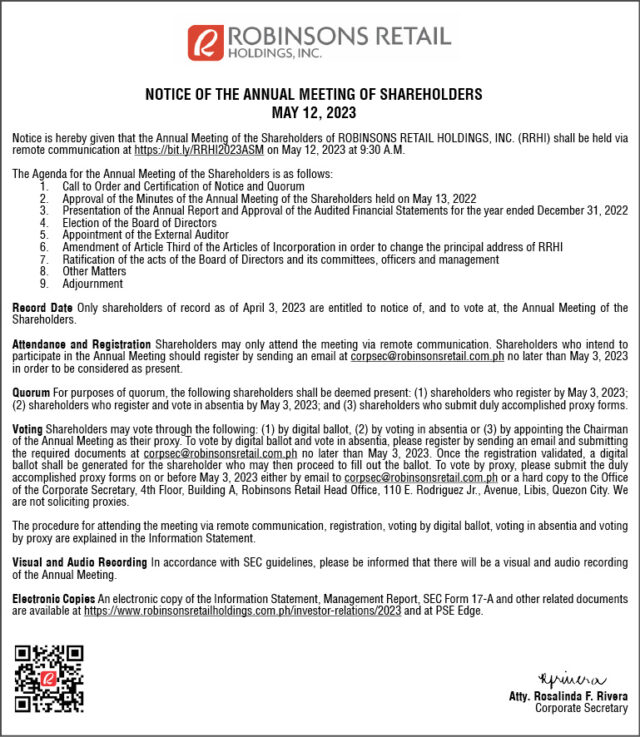
Robinsons Retail Holdings, Inc. to hold annual meeting of shareholders via remote communication on May 12


Spotlight is BusinessWorld’s sponsored section that allows advertisers to amplify their brand and connect with BusinessWorld’s audience by enabling them to publish their stories directly on the BusinessWorld Web site. For more information, send an email to online@bworldonline.com.

Join us on Viber at https://bit.ly/3hv6bLA to get more updates and subscribe to BusinessWorld’s titles and get exclusive content through www.bworld-x.com.

Hann Dev’t to build 3 golf courses in New Clark City

HANN Development Corp. is building the Hann Reserve in New Clark City, Tarlac. — COMPANY HANDOUT

By Brontë H. Lacsamana, Reporter

HANN Development Corp. is investing an initial P9 billion in a 450-hectare luxury integrated mountain resort project, which includes three world-class golf courses, in New Clark City (NCC), Tarlac.

The master-planned lifestyle leisure development called Hann Reserve will be 20 kilometers away from Clark Freeport Zone, Pampanga, where the company built Hann Casino Resort.

“Accessibility is important, and NCC in Tarlac is very accessible via NLEX (North Luzon Expressway) and SCTEX (Subic-Clark-Tarlac Expressway),” Daesik Han, chairman and chief executive officer of Hann Philippines, Inc. (HPI), said during the launch of Hann Reserve’s valley golf course on April 14.

HPI is the parent company of Hann Development.

The 18-hole valley course, part of phase two of the project, is designed by South Korean professional golfer KJ Choi.

At the launch event, Mr. Choi told reporters that his course will be user-friendly and will highlight the locale’s natural strengths and features.

“I’m making it challenging and accurate [for the use of] many golfers — junior golfers, women golfers, professional golfers,” he said.

The golf course is targeted to be completed by 2027.

Development is underway for the first phase of the project, which includes a clubhouse, public park, Banyan Tree hotel, and the first 18-hole mountain golf course by Nicklaus Design. The first phase is expected to be completed by 2026.

The third golf course will be a river course designed by former world number 1 golfer Sir Nick Faldo, and is slated for completion in 2028.

“We are excited and proud to create a truly world-class golfing experience befitting NCC as an equally world-class leisure and entertainment destination,” said Mr. Han.

Apart from the designer golf courses, Mr. Han said the master plan also includes the first Professional Golfers Association of America (PGA)-affiliated player development facility in the Philippines.

Once the entire Hann Reserve project is completed by 2030, it will boast of luxury hotel brands, a mixed-use commercial center and casino, and exclusive residences with an international school.

The total approximate cost of the development is $3 billion. Around 3,500 local jobs will be created. It also aims to be sustainable in its reuse of water and inclusion of indigenous materials and plants.

According to Mr. Han, Hann Reserve’s golf courses will be double the usual cost of golf courses in the Philippines due to the use of high technology — from special grass that consumes less water than Bermuda grass to satellite-powered irrigation that uses up only the right amount of water.

“The most important thing is to strike the balance between development and taking care of nature,” he said. “I believe our contribution to the society and economy is going to be very big yet we are not destroying nature. We are spending money to protect it.”

ADVERTISEMENT
ADVERTISEMENT